Showing posts with label art. Show all posts

Tuesday, October 5, 2021

In America: Remember

Last Saturday on the National Mall in Washington, D.C., between 15th and 17th Streets NW, I witnessed a sea of white flags representing the largest participatory art project in a quarter of a century.

In America: Remember, artist Suzanne Brennan Firstenberg makes tangible the human toll that COVID-19 has taken on our country. The billboard off to one corner has a stark figure posted on it: 700,327. It represents the number of persons in the U.S. who have died of COVID-19. There’s a planted white flag for each of them. 

As I walked around the massive installation located near the Washington Monument – a memorial garden if you will – that went up on September 17 and concluded on Sunday,  I couldn’t help but notice many of them had personalized printed messages. Each represented a real person who died from COVID-19. It’s a reminder of the human cost of this still-ongoing pandemic – all the while as the death toll increases daily and as thousands of Americans continue to refuse to get the free and safe vaccination that could prevent them from becoming part of the death toll – from becoming a statistic.

In my research for writing this post, I learned that it took 150 landscapers three days to install America: Remember, which began with 670,032 flags and represented the largest public participatory art installation on the National Mall since the NAMES Project AIDS Memorial Quilt was shown there in full in 1996.

The white flags are spaced 10 inches apart and spread over 20 acres of grass in 60-foot grids. There are nearly four miles of grassy paths to walk along. 

As someone wrote about the installation: “It helps make tangible the sheer scale of loss that is otherwise unfathomable.”

On Saturday, I saw many people walking quietly about the installation, some taking photographs, a few stopping to read some of the many messages. While there were benches to sit and reflect on throughout, I noticed that a few chose to sit on the ground, perhaps to better connect with a lost friend or family member. 
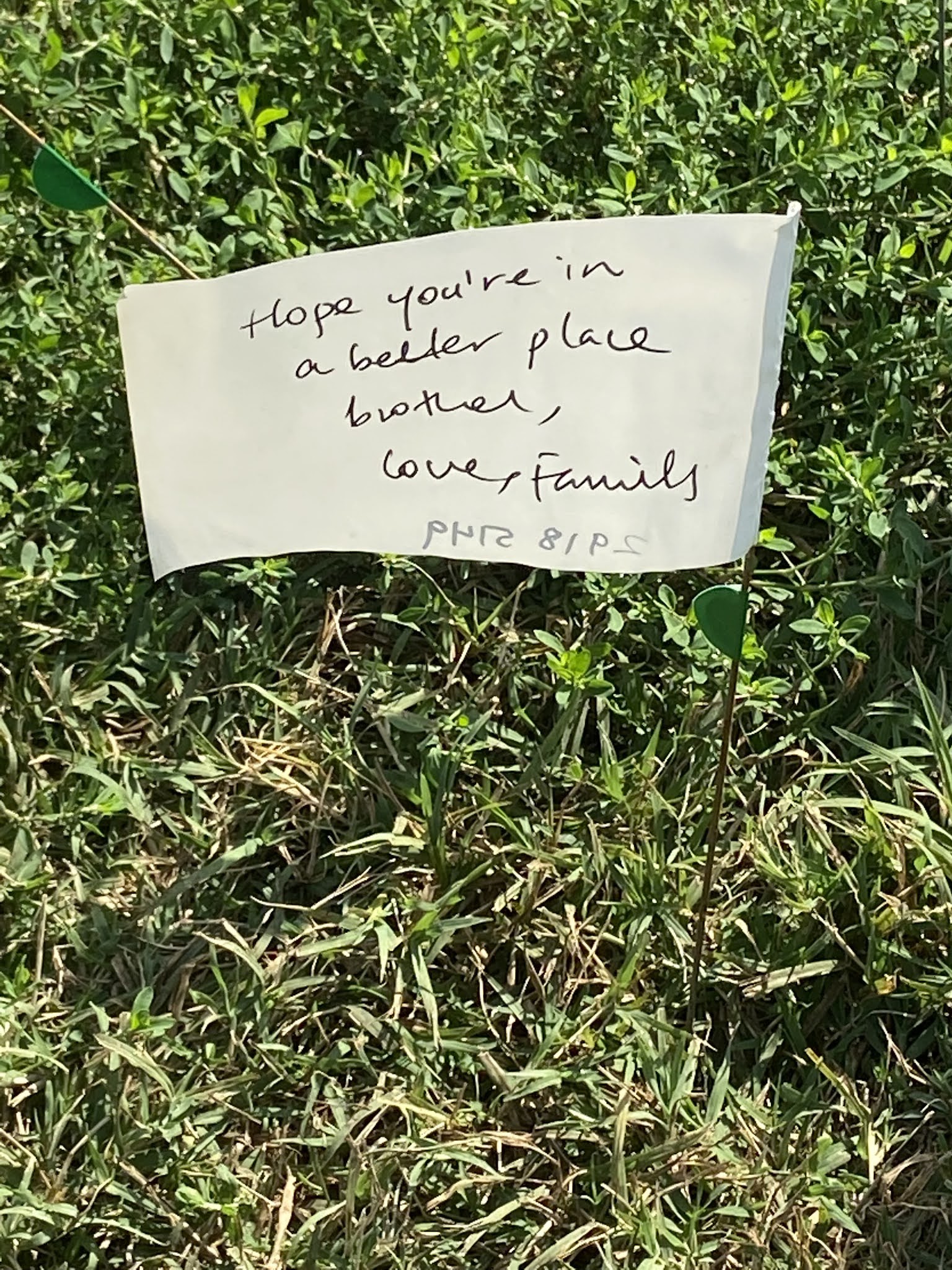
One of the messages I happened upon summed things simply: 

“Hope you’re in a better place brother. Love, Family”

In an interview for artnet.com, Firstenberg, 62, a social practice artist from Washington, D.C., explained what drove her to create In America: Remember.

“The National Mall is the greatest stage, and to have the opportunity to call attention to such a tragedy was something I felt I had to do. Words aren’t working any longer,” she said. 

“Words are falling on unlistening ears. It really is incumbent on visual artists to help translate and reflect back to society what is happening in the hope that things will improve, because art can effect positive change.”


Note: Because many across the country will be unable to visit this exhibition in person, the artist teamed with Esri, Inc. to present In America: Remember in the digital sphere concurrently at InAmericaFlags.org. At this website, people across the country will be able to view flags and join in honoring loved ones lost to COVID-19.

Photos: Michael Dickens © 2021.


Tuesday, October 8, 2019

On art and photography: By the light of the silvery moon

A friend of mine recently noted that it must be nice to live in Washington, D.C., and have access to so many varied museums. Indeed, it is – and the great thing about it is most of them offer free admission, too. Take the National Gallery of Art, for instance, which has grown into our favorite museum to visit in the two years we’ve resided inside the Beltway.

In addition to regularly attending the NGA’s monthly “Evenings on the Edge,” in which the east gallery stays open late the first Thursday of selected months, from time to time the NGA also sponsors insightful lectures in conjunction with its ongoing exhibitions.

Last week, my wife and I attended one of these lectures, “Photographing the Moon,” which featured curators from the Smithsonian National Air and Space Museum discussing the history of photographing the moon and how photography played both a significant role in preparing for the Apollo 11 moon landing on July 20, 1969 and in shaping the cultural consciousness of the event.

We learned how “the mission, launched within the framework of Cold War rivalry with the Soviet Union, was not merely one of scientific discovery and technical prowess. It was necessary, as President John F. Kennedy explained in a famous 1962 speech, ‘to win the battle ... between freedom and tyranny’ and held nothing less than ‘the key to our future on Earth.’”

Buzz Aldrin’s Footprint, July 20, 1969
David DeVorkin, senior curator of astronomy and space sciences, spoke on “Mapping the Moon with Telescopes,” in which he illustrated the interplay of the eye and hand with the development of the photographic process of the moon over the past 150 years and how it impacted the Apollo space program.

Then, Matthew Shindell, curator of planetary science, in “Geology from Orbit: Robots, Cameras and Photogeology,” described the development and impact that photogeology, which provided for early photography of the earth and moon from airplanes, had in establishing a pathway for mapping and selecting landing sites for manned missions to the moon.

Finally, Jennifer Levasseur, curator of space history, showed how images captured by the Apollo Era astronauts formed a framework for our ability to understand human spaceflight today.

The hour-long lecture tied in nicely with the “By the Light of the Silvery Moon” exhibition at the National Gallery of Art, which we viewed afterward. (The exhibition opened on July 14 and continues through January 5, 2020 in Gallery 22 of the NGA’s West Building.)

“By the Light of the Silvery Moon” contains some 50 works including a selection of photographs taken by the unmanned Ranger, Surveyor and Lunar Orbiter missions that were preliminary to the Apollo 11 manned space flight. The landmark event is represented by glass stereographs that were taken on the moon by astronauts Neil Armstrong and Edwin “Buzz” Aldrin. They show close-up views of three-inch-square areas of the lunar surface. There are also many iconic NASA and press photographs of the astronauts, which brought back memories of my childhood, that received wide recognition and dissemination following the success of the Apollo 11 mission.

The exhibition also includes lunar photographs collected from the 19th and early 20th centuries, including Warren de la Rue’s late 1850s glass stereograph of the full moon and Charles Le Morvan’s photogravures from Carte photographique et systematique de la lune that was published in 1914, in which he tried to “systematically map the entire visible lunar surface.”

Collectively, the photographs displayed in “By the Light of the Silvery Moon,” ranging from the 19th century to the “space-age” 1960s, “merged art and science and transformed the way that we envision and comprehend the cosmos.”


Credits: Cover photo: By Michael Dickens. Other photos: Courtesy of “By the Light of the Silvery Moon” exhibition. Video: Courtesy of YouTube and National Gallery of Art.

Tuesday, January 8, 2019

A Tuesday Night Memo: Thoughts on turning nine

My blog, “A Tuesday Night Memo,” turns nine later this month.

People who know me well know that I've been interested in writing, reporting and storytelling for a long time. So, it's only natural that I turned to blog writing because it gave me an opportunity to hone my writing skills and provided a forum for writing about things that truly interested me that I wanted to share with others.

Here’s a little history about my blog:

I started writing “A Tuesday Night Memo” on January 26, 2010, as a means for sharing musings about my life filled with music, sport, and urban travel, and to foster community with my friends, family and Facebook acquaintances. More recently, I added a Twitter profile, which has allowed me to reach a wider audience across the country and the world.

People who read my blog know that I'm passionate about music, sport, and urban travel. Additionally, I have used “A Tuesday Night Memo” as a vehicle for writing about art, food, fashion, religion and gardening – and, in the age of Trump, about politics. Before we moved to the east coast, sharing news and photos about our former Oakland, Calif., flower gardens at home always seem to generate great interest and enthusiasm. Maybe, it was the pretty shapes and colors of our flowers that others found appealing, especially since we could maintain a garden all year long.

Up to now, I have "blogged" 439 entries for “A Tuesday Night Memo,” which collectively have received more than 161,700 page views. Among many subjects I have written about, some of my favorites have been: my appreciation of tennis champion Roger Federer; how the city of Seattle fosters community through international cinema; a history of the world as seen through 100 objects; classical music conductor Gustavo Dudamel; Golden State Warriors head coach Steve Kerr; my music love affairs with Pink Martini and Elvis Costello; validating our travel through our photographs; and Jerry Seinfeld's Internet comedy Comedians in Cars Getting Coffee.

Among my recent posts, I have written about the Golden Globe-winning film “Roma”; the humanitarian work of Washington, D.C. chef José Andrés; and recent books written by American historians Doris Kearns Goodwin and Jon Meacham. Also, I have shared my interest in digital photography since beginning my blog, which has enabled me to illustrate many if not all of my posts with colorful visuals to match the words I've written.

The feedback I have received not only is very much appreciated, but I also find it very useful. Much of it has been positive, but sometimes it's also been critical. Whether good or bad, I've found the feedback readers provide to be a valuable learning tool. Occasionally, I like to sneak a look at my blog's statistics, which are the key indicators that show how many total "hits" my blog has received, which stories have been read the most, and what countries comprise the blog's readership. The numbers are modest but nevertheless interesting.

Here are a few fun facts about “A Tuesday Night Memo” I thought you might enjoy:

• 
Since my blog's debut, it has been read in dozens of countries, including the U.S., Canada, Mexico, France, Morocco, Tunisia, Turkey and Hong Kong – even Brazil, India, Vietnam, and Australia. The top five countries reading my blog include the U.S, Russia, United Kingdom, Germany and France. I hope Russia's interest in my blog has nothing to do with their wanting to hack me because of my occasional blog posts about President Donald Trump.

Looking ahead, two years since he was inaugurated, the Trump presidency continues to garner my interest and attention from time to time. How could it not? However, there's so much more to write about. Among things that I look forward to learning about include my continuing interest in exploring museums – and what we can learn from them. Also, I would like to explore the effect digital music and media have in connecting our world.

In the meantime, I thoroughly enjoy sharing my writing week in and week out, and I look forward to contributing more of my words and thoughts in what is shaping up to be another exciting year awaiting all of us.

Stay tuned! 

Saturday, November 24, 2018

Thoughts on art and travel: Revisiting an artistic interior

An artistic interior /
Interior of the Church of Saint Bavo
by Dutch artist Pieter Saenredam
As I ready to visit Europe next month for the first time in six years, I am reminded of the last time I crossed the Atlantic Ocean. It was during a spring holiday in 2012, and my travel included visits to Amsterdam and Brussels, with a quick day trip by train to Paris. As I recall, I spent part of a Sunday afternoon visiting the Rijksmuseum in Amsterdam. For me, spending time in art museums is always time well spent. And, if you're lucky like I was on that day, you just might learn something new, too.

In an exhibit featuring a retrospective of Dutch artists, I came across a 17th-century painting depicting the interior of the Saint Bavo Church in Haarlem, the Netherlands, by Pieter Jansz. Saenredam.

Saenredam (1597-1665), who was the son of a printmaker and draughtsman, painted this oil on panel of the light-filled interior of Saint Bavo Church in 1636. Saenredam painted no fewer than six "portraits" of Saint Bavo, considered by many as one of the finest Gothic buildings still in existence today. Each time, he focused on one of the organs. Here, he depicted the Resurrection of Christ on the open shutter of the organ. He mixed gold powder with his paint to represent the gold in the painting. In describing the ornamentation of this painting, the Rijksmuseum website wrote: 

"At the time Saenredam painted the Saint Bavo Church, leading music-lovers were campaigning for more organ music to be played in church services. Calvinist ministers object to organ music. Little music was played in church and psalms were sung unaccompanied. The ministers would rather have had no organs at all in church because they felt the beautifully decorated organs were evidence of ostentation and excess. Haarlem's music-lovers handed a petition to the town council, in which they asked to be allowed to use the organ, 'the ornament of the church', everyday. It is possible that Saenredam gave the organs a prominent position in his painting in support of this campaign."

(As an aside, the interior of the church, which was originally Roman Catholic, was stripped of all of its embellishments, including statues and paintings, by the Protestants following the iconoclasm of the Protestant Reformation.)

What I learned in researching the artist and the painting is this: Saenredam was the first Dutch painter to specialize in church interiors. His precise on-the-spot observations and detailed perspectives helped us to have a better understanding and appreciation for these architectural marvels. And, through the addition of including tiny figures, he helped to emphasize the height and immensity of the church. Finally, in some of his interior paintings, the artist used a central perspective: All the lines in the painting disappear in a single point.

The Getty Center in Los Angeles, California, which owns one of Saenredam's interior paintings of Saint Bavo, commented on his work in its website:

"The overall impression is one of strong verticality, soaring space, and penetrating light, a spiritual reference to the heavens above. The inclusion of small figures accentuate the viewer's experience of exalted interior space. Saenredam described architectural elements in great detail: vaulted ceilings, moldings, decorative capitals, clustered pillars, and clerestory windows."

Saenredam made his first drawing of the interior of the church of Saint Bavo in 1626. From then on, he devoted himself almost exclusively to painting church interiors, always using precise perspective. Of his fifty surviving paintings, almost half show the interiors of two churches, Saint Bavo and the Mariakerk in Utrecht.

What can we learn from Saenredam's sacred interior spaces? For one, they were designed for contemplation. Unlike others whose paintings evoked a certain type of pomp, pageantry, and theatre that was usually seen in Roman Catholic churches, Saenredam's surprisingly modern paintings evoked "the whitewashed austerity of the Dutch Reformed church," says the Getty Center.

In describing Saenredam's style and viewpoint, the Getty Center said: "There are no processions, no clusters of worshippers at shrines. He adopted a very low viewpoint and a palette restricted to the palest of tones, and allowed few people into his bare interiors. He concentrated on depicting light, color, and space. Many Dutch artists continued his tradition, but few equaled his inventive vision." 

Indeed, Saenredam's painting of the interior of the Church of Saint Bavo owes its poetry to his desire to paint a faithful rendering, one that is careful and accurate.

Note: An original version of this blog post was published on July 10, 2012.

Tuesday, November 20, 2018

On art and fashion: Contemporary Muslim Fashions

Thanks to social media, I have become Facebook friends with several Tunisian women, all whom are Muslim. Some of them cover their heads in colorful headscarves, known as hijabs; most do not. Each have become individuals of style within and beyond their communities in this North African country bordered by Algeria, Libya and the Mediterranean Sea, as I’ve learned firsthand through many thoughtful online conversations. While the nature of the Muslim dress code worldwide is a complex and diverse one, like it or not, Muslim fashion has become part of the mass-media’s attention drawn to contemporary Muslim life.
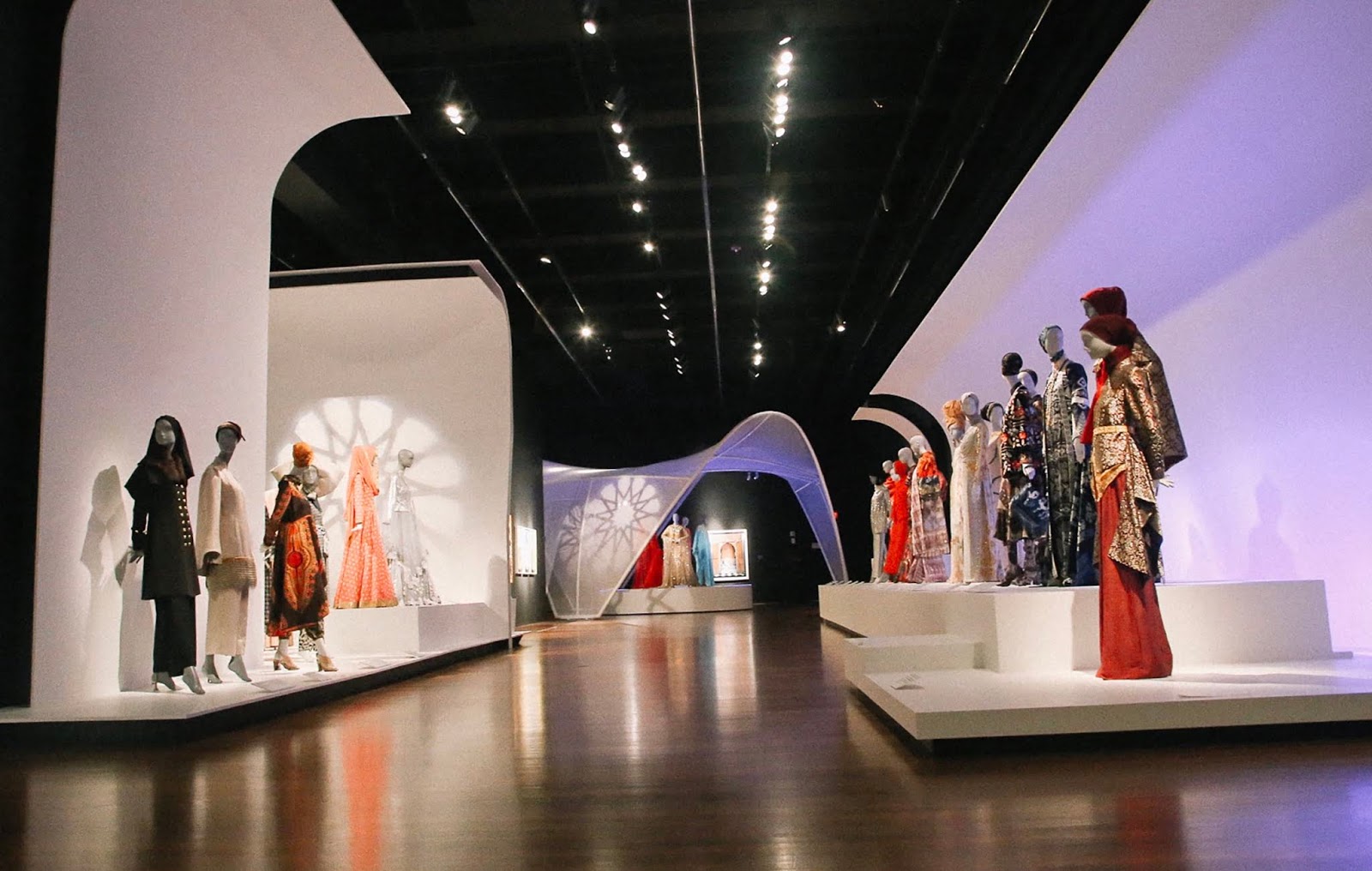
Currently, the deYoung Fine Arts Museum in San Francisco is examining Contemporary Muslim Fashions by “spotlighting places, garments, and styles from around the world,” in a show that began in late September and continues through January 6, 2019.

Contemporary Muslim Fashions is the first major museum exhibition to explore “the complex, diverse nature of Muslim dress codes worldwide” by bringing together different religious interpretations and cultures of Islam. The creativity and diversity – and politics – of modest dressing is celebrated.


I’ve learned that this exhibition considers “how Muslims define themselves – and are defined – by their dress and how these sartorial choices can reflect the multifaceted nature of their identities.”

Contemporary Muslim Fashions crosses through many different religious interpretations and cultures, featuring spectacular creations from a dynamic fashion scene by designers from both the Middle East and Southeast Asia – think Malaysia and Indonesia. From street wear to couture, the exhibition includes “high-end fashions, such as those by Malaysia-based Blancheur; street wear, such as modest designs from London-based Sarah Elenany; sportswear, such as the burkini; and commissioned garments from both emerging and established designers.”


The exhibition also includes the use of social media as a primary material – an agent of change. Muslim voices and personal narratives are framed by using runway footage of fashion shows and news clips as well as documentary and fashion photography.

As visitors to Contemporary Muslim Fashions will learn, while Islam is a multicultural faith, the dress of its followers is “shaped not only by religious principles but also by local customs and traditions and global fashion trends.” Thus, a woman from Tunisia is more likely to be contemporary in her fashion attire than a woman living in Saudi Arabia.


In her review of Contemporary Muslim Fashions for The Hollywood Reporter, critic Celine Semaan wrote, “Because of the current political climate from which it is rising, the show carries a message of hope and acceptance. The act itself of organizing this exhibition is nothing if not a peaceful demonstration of the American values written in the First Amendment: freedom of speech, freedom of expression, freedom of religion.”

Laird Borrelli-Persson of Vogue, in reviewing Contemporary Muslim Fashions, quotes curator Jill D’Alessandro, who believes, “Fashion can be an agent for positive change, for understanding, and breaking down barriers; they (fashion designers) want to exhibit in the United States and in Europe because they want their cultures to be understood.”

One thing’s for sure: There’s a diversity in Muslim fashion that is strikingly beautiful, both for its modern aesthetic and for its street-style appeal.

Photos: Cover – Mary Katrantzou skirt and shirt (silk and polyester), and Malone Souliers shoes.  Bottom – Flight jacket with U.S. Constitution written in Arabic on the back and First Amendment written in English inside, by Slow Factory (Courtesy of deYoung Museum and Google Images). Video: Courtesy of YouTube.com.

Friday, August 18, 2017

Connecting the Bard through words and paintings


We all know Shakespeare was a man of words. Over 400 years after the Bard magically wrote his word masterpieces, look all around us: his words continue to be spoken aloud, they are spoken through sign language, they appear in printed form, and they even appear on some very cool t-shirts.

Now,  in a celebration of 400 years of Shakespeare, the Folger Shakespeare Library in Washington, D.C. is taking a different approach by presenting Painting Shakespeare, a free exhibition that combines the power of Shakespeare as seen through his words and paintings, as well as Shakespeare-related art and memorabilia. It opened on May 13 and continues through February 11, 2018. This remarkable collection has been placed in a building space that's adjacent to both the Library of Congress and the Supreme Court on Capitol Hill, and includes space for researchers, as well as an intimate theater and a lovely exhibition hall.

The Bard
One afternoon recently, I visited this lively and thoughtful exhibition, where I was warmly greeted by the Folger Shakespeare Library staff as soon as I arrived. While I've always known about the impact of Shakespeare's words – think Macbeth, Othello, King Lear, Romeo and Juliet – inside this exhibition, I was invited to explore just how Shakespeare's words could be represented in pictures. I asked myself: Just how do you represent Shakespeare if you've never seen him with your own eyes?

Through nine different sections, from "Looking Back in Time" to "Imagining Shakespeare" to "Lost and Found," there were twenty-one selections from the Folger Shakespeare Library collection of paintings showcased in the exhibition hall that try to portray the Bard for our own eyes.

"It might seem unusual for a library to have a paintings collection, but Henry and Emily Folger knew that it takes more than books and manuscripts alone to understand Shakespeare and his era," I learned, reading an introductory panel that was displayed at the beginning of Painting Shakespeare. "They also collected scrapbooks, posters, programs, figurines, prints, drawings, and photographs."

I spent about an hour walking through Painting Shakespeare, carefully stopping at each area to observe and discover something interesting or unique about each painting – and to study their stories and glories. Let's see, among the memorable paintings I discovered were: Dexter Portrait of Shakespeare, a 19th century oil on canvas by an unknown British painter; The Awakening of King Lear, circa 1792 from King Lear (act 4, scene 7), an oil on canvas by the 18th century British painter Robert Smirke; and Macbeth Meeting the Witches, 1760 from Macbeth (act 1, scene 3), an oil on panel by the 18th century Italian painter Francesco Zuccarelli. One should also take time to look at Henry Fuseli's gothic masterpiece Macbeth Consulting the Vision of the Armed Head that was painted for the Irish Shakespeare Gallery in Dublin in 1793, and is presented in its original frame.

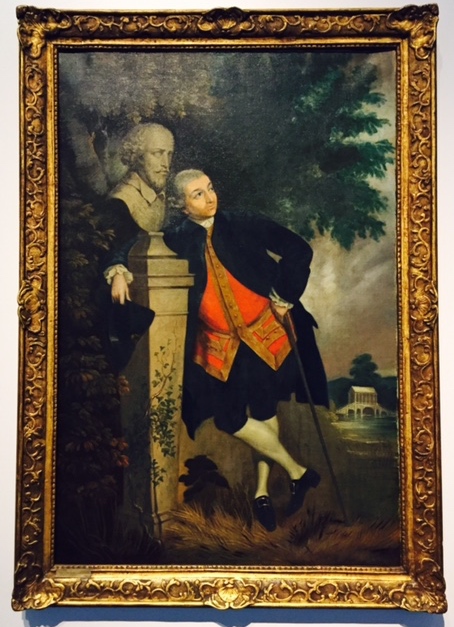
One of my own personal favorites was David Garrick Leaning on a Bust of Shakespeare. In this oil on canvas painting finished after 1769 by an unknown British painter styled after Thomas Gainsborough, I learned this from reading the description card: "David Garrick's devotion to Shakespeare and revolutionarily informal acting style comes across wordlessly here. Viewers familiar with Westminster Abbey will recognize that Garrick's relaxed poise echoes the life-sized marble statue of William Shakespeare in Poets' Corner."

Throughout Painting Shakespeare, visitors are encouraged to share their own personal experiences and connections with Shakespeare and his works. Just because the people in the paintings are standing still doesn't mean we have to, right?

Imagine, using a smartphone or other device to record and share short videos, answering one of these questions:

• When did you first read or see Shakespeare?
• Which words and lines from Shakespeare do you love the most and why?
• Which Shakespeare character speaks to you and why?

The power of Shakespeare allows us to connect with his works and, now, thanks to the Folger Shakespeare Library, through the art of painting, too.

Thursday, January 26, 2017

A Tuesday Night Memo: Thoughts on turning seven

Michael Dickens / A selfie. 
I've been interested in writing, reporting and storytelling for a long time. So, it's only natural that I turned to blog writing because it gave me an opportunity to hone my writing skills and a forum for writing about things of interest and importance.

As A Tuesday Night Memo turns seven today, here's a little history about it:

I started writing A Tuesday Night Memo on January 26, 2010, as a means for sharing musings about my life filled with music, sport, and urban travel, and to foster community with my friends, family and Facebook acquaintances. People who know me well know that I'm passionate about music, sport, and urban travel. Additionally, I have used my blog as a vehicle for writing about art, food, fashion, religion and gardening – and, more recently, about politics. Sharing news and photos about our flower gardens at home always seem to generate great interest and enthusiasm. Maybe, it's the pretty shapes and colors of our flowers that others find appealing.

Up to now, I have "blogged" 358 entries for A Tuesday Night Memo, which collectively have received  nearly 108,000 page views. Among the many subjects I have written about include: my appreciation of tennis champion Roger Federer, how the city of Seattle fosters community through international cinema, a history of the world as seen through 100 objects, classical music conductor Gustavo Dudamel, Golden State Warriors head coach Steve Kerr, my love affair with Pink Martini, validating our travel through our photographs, and Jerry Seinfeld's Internet comedy Comedians in Cars Getting Coffee. My most recent post focused on the importance of the Women's March held last weekend in Washington, D.C, and across America and the world. I have shared my interest in digital photography within my blog, which has enabled me to illustrate many if not all of my posts with nice visuals to match the words I've written.

The feedback many have shared is not only very much appreciated, but I also find it very useful. Much of it has been positive, but sometimes it's also been critical. Whether good or bad, I've found the feedback you provide to be a valuable learning tool. From time to time, I like to sneak a peek at my blog's statistics, which are the key indicators that show how many total "hits" my blog has received, which stories have been read the most, and what countries comprise the blog's readership. The numbers are modest but nevertheless interesting.

Here are a few fun facts about A Tuesday Night Memo I thought you might enjoy:

Since the debut of my blog, it has been read in dozens of different countries, including the U.S., Canada, Mexico, France, Morocco, Tunisia, Turkey and Hong Kong – even Brazil, India, Vietnam, and Australia. The top five countries reading my blog include the U.S, Russia, Germany, France, and the United Kingdom. I hope Russia's interest in my blog has nothing to do with wanting to hack me because of my occasional forays into writing about Donald Trump.

* The most widely-read blog entry in terms of "hits" remains one I wrote back in December 2010 about "CNN International: Connecting the world," in which I explored the intelligent – albeit sometimes irreverent – manner that CNN International delivers the news and how it differs from it's American cousin that's based in Atlanta. Other top "hits" include musings about the artist Pablo Picasso and the British comedian Ricky Gervais. (I'm still trying to figure that one out!)

Looking ahead, I suspect the Trump presidency will continue to garner my interest and attention from time to time. How can it not? However, among things that I look forward to exploring, include: the effect digital music and media have in connecting our world, and my ongoing interest in exploring museums – and what we can learn from them.

In the meantime, I've thoroughly enjoyed sharing my writing with you throughout the past seven years, and I look forward to sharing more of my words and thoughts in what is shaping up to be another exciting year awaiting all of us.

Stay tuned!

Tuesday, January 17, 2017

On art and politics: "We the People ... "

We the People of the United States ...

In just four days, Donald J. Trump will be sworn in as the 45th President of the United States. With a lot of division surfacing throughout the country, many Americans are looking to art as a means of connecting us as human beings.

We the People ...
 are greater than fear.
"We the People are greater than fear," reads the message of a new poster created by Shepard Fairey, the graphic arts, muralist, illustrator and activist behind the iconic 2008 Hope posters he created for Barack Obama. Another new poster reads "We the People protect each other" and the third one says "We the People defend dignity."

There is a lot of division right now. Trump is not a healer," says Fairey. "Art, on the other hand, is healing and inclusive, whether topically it celebrates humanity, or whether it's just compelling visuals to make a human connection."

Interviewed recently by the PBS NewsHour, Fairey said "it was the right time to make a campaign that's about diversity and inclusion, about people seeing the common bonds we have, and our connections as human beings. The idea was to take back a lot of this patriotic language in a way that we see is positive and progressive, and not let it be hijacked by people who want to say that the American flag or American concepts only represent one narrow way of thinking."

Shepard has created three portraits for the "We the People" campaign. One depicts a Muslim woman wrapped in a hijab resembling an American flag. Another shows a young African-American girl and the third features a Latina female.

We the People ...
protect each other.
Two other artists, the Colombian American muralist Jessica Sabogal and the Chicano graphic artist Ernesto Yerena, each contributed to the project in collaboration with the Amplifier Foundation, a nonprofit that works to amplify grassroots movements and which commissioned the project. Together, the artists hope the faces of "We the People" – standing in for traditionally marginalized groups or those specifically targeted during Trump's presidential campaign – will flood Washington, D.C., on Friday during Inauguration Day.

According to Fairey, "All the subjects (in 'We the People') were photographed by people who relate to them somehow. The Muslim woman was shot by a Muslim photographer, the Latina woman shot by a Latino photographer, and the African-American kid shot by a French African-American woman photographer. We realized that this has got to be a diverse coalition of artists for us to do this, and that while it's good for us to be allies, this campaign really has to be authentically diverse."

Fairey went on to say in the PBS NewsHour interview, "We came to a conclusion as a group that in the language (for these posters) we want to say, 'We reject fear-mongering and exclusion.' But we also wanted to do it in a way that doesn't leave the door open for the Fox News type to say, 'This is reverse racism' ..."

We the People ...
defend dignity.
Adds Fairey: "It's hard to encapsulate the complexity of what we're facing, going into this Trump presidency, in three images. But we chose three groups that are vulnerable. In the history of the U.S., there are a lot of people who fled persecution from Europe on the basis of religious identities. The idea of championing the ideals of our forefathers and then limiting the movement of Muslims – it so confounding that this is not riling more people up. And so it's really time to do some (work) that I think is a counterargument to that, and that's not based on division but based on inclusion. We've seen where division has got us."

A Kickstarter campaign has begun that according to Fairey is "getting great traction." He said a goal of his group is funding an ongoing and expanding range of creative projects, with the next wave of people from all different communities. "We want to allow people to express all their social/political views around a number of issues – LGBT rights, women's rights – because a number of those things are going to be under attack under Trump."

Photos: We the People images by Shepard Fairey; U.S. Constitution courtesy of Google Images.

Tuesday, September 13, 2016

On being selective: To have fewer, but better things


Organize + Tidying Up = Spark Joy
Whether it was a desire to have fewer things in our lives or merely say thank you and bid adieu to things that fail to "spark joy" – or that we no longer value – my wife and I both agreed that we needed less.

In recent years, our buying habits have changed. Rather than rush out to buy books, we've made better use of our local public library as a resource to check out books we've read about in The New York Times or garnered an interest in from seeing an author appear on Comedy Central's The Daily Show. And, our music purchases have shifted away from physical CDs to mp3s via iTunes, which we can play on our iPhones (and I still have a classic iPod I use at the gym). Plus, thanks to streaming movies and binge-watching TV series using Netflix, buying DVDs has become irrelevant. There's definitely an ease of portability that we are using to our advantage.


Now, our living room space is neither minimalist or lacking in abundance – just decluttered.

We used the occasion of a remodeling project to "declutter" our living room, following in the success of the decluttering superstar Marie Kondo, who has written a couple of best-sellers on the subject, including The Life-Changing Magic of Tidying Up: The Japanese Art of Decluttering and Organizing and Spark Joy: An Illustrated Master Class on the Art of Organizing and Tidying Up.

On a recent Sunday afternoon, we assessed four bookcases-worth of books as well as several hundred CDs and DVDs. Following Kondo's guideline, we "dumped" the contents of both collections – first our books and later our CDs and DVDs – in the middle of the living room floor and decided what could stay and what needed to go among our material excess of living.

Following Kondo's guidelines, it forced us to ask ourselves whether each object was achieving a purpose. Did it spark joy in our lives? I'm happy to report that things went much smoother than I anticipated. There were no tug-of-wars or endless debates about what to keep or what to let go. By the end of our back-to-back sessions, we had earmarked 55 books to donate to the Friends of the Oakland Public Library store and close to 100 CDs and DVDs to sell for credit at our favorite record store in Berkeley.

It's taken time, but we have become more selective about what we buy and own – following a trend of having fewer, but perhaps better, things. We no longer feel the need to rush out the first day an author publishes a new book or a music artist releases a new album to purchase it. Now, our trips to our favorite bookseller or record store are fewer but more meaningful.

If I've learned anything from this exercise, it's this: Having fewer things of a higher quality – things which we can adore and enjoy – is a decluttering philosophy unto itself.


Tuesday, May 24, 2016

SFMOMA – Welcoming an old friend back to the City


Welcome back / The new-look SFMOMA has grown from five to 10 stories.

Last Thursday evening, my wife and I welcomed an old friend back to San Francisco. The San Francisco Museum of Modern ART (SFMOMA) reopened earlier this month after being closed for the past three years while undergoing a massive – and challenging – expansion project by Oslo and New York design firm Snøhetta. The new-look SFMOMA has grown from five to 10 stories. Dropping in on the newly transformed museum after work for a short visit before heading out for dinner and shopping, we delighted in seeing some favorite artworks and architectural features – including some of the gems from the Doris and Donald Fisher Collection, considered to be one of the world's greatest.

The largest living wall in the U.S. greets visitors to SFMOMA.
From first glimpse, there's much to like about the new look and space of SFMOMA, including new galleries, expanded exhibition space, better lighting, greater access, art-filled public spaces, six terraces and sculptural staircases, which offer unique views out to the city.

As visitors step outside onto the main terrace, they are greeted by a giant living wall designed by Habitat Horticulture. It is part art, part landscape and it's the nation's largest public green wall of native plants.

Constellation  (1949) / From Alexander Calder: Motion Lab
We delighted in seeing the Alexander Calder: Motion Lab, which highlights Calder's restless innovation in bringing actual movement into art. We viewed About Time: Photography in a Moment of Change, a thematic exhibition which investigates how photography has profoundly reflected, inflected and transformed our perception of time through its 180-year history. We also saw Model Behavior, Snøhetta's initial sketches and models for the expanded SFMOMA building, located in a challenging and prominent urban site on Third Street, just south of Market Street.

A swarm of chaotic energy /
Studying Antony Gormley's "Quantum Cloud VIII"
Finally, upon ascending to Floor 5, we admired British Sculptors, in which more than forty years of diverse sculpture by artists who were born or reside in Great Britain was displayed.

My favorite was Antony Gormley's "Quantum Cloud VIII," a 1999 steel sculpture that was acquired by the Fisher Family in 2000. According to the sculptor, "Quantum Cloud VIII conceives of the body as a swarm of chaotic energy. A human figure seems to alternately materialize from and disintegrate into the cloud of metal bars."

Created between 1999 and 2009, Gormley's Quantum Cloud series reflects on "how the subatomic particles and energy that make up our bodies are integrated with those that compose the universe around us."

Alexander Calder /
Big Crinkly (1969)
There is much to see and enjoy in the 170,000 square feet of exhibition space, and as members, we look forward to going back often to see some of the things we missed during our initial visit. Some of the current exhibits include:

Paul Klee in Color, which includes paintings and watercolors by the Swiss-born modernist Paul Klee (1879-1940) that explore "his intuitive and theoretical approaches to color."

German Art after 1960, which is an overview of leading German artists such as Gerhard Richter, Georg Baslitz, Anselm Kiefer, and Bernd and Hilla Becher.

Typeface to Interface, which features graphic design from the Collection, "a trajectory of iconic type and the evolution of digital tools marking the rapid transformation of graphic design over the past sixty years."

San Francisco / A city that loves art and open spaces.
In its 81-year history, SFMOMA has established itself as a premier showcase for modern art – think Calder, Close, Kahlo, Kelly, Pollack and Warhol. One things certain: There's definitely a new a positive dedication to openness as the museum begins a new dialogue with San Francisco, a city that loves its art.

To read more about what art critics are saying about the new SFMOMA design:
http://www.dezeen.com/2016/05/18/critics-reaction-san-francisco-museum-modern-art-sfmoma-extension-snohetta-mario-botta/

Photos: All photos by Michael Dickens © 2016.

Tuesday, March 8, 2016

Who lives, who dies, who gets to tell your story?

Lin-Manuel Miranda /
Writer, composer, star, genius of "Hamilton".
It's been said that works of art have long informed how people understand the past, and Lin-Manuel Miranda's Hamilton is no exception.

As the writer, composer, and star of the Broadway smash-hit Hamilton, Miranda is changing the way that people consider one of the Founding Fathers and the era he lived in. It puts him in lofty territory, alongside how Shakespeare transformed Richard III, and how the author Leon Uris romanticized the founding of Israel in his novel Exodus.

The recipient of a MacArthur "Genius" grant, the 36-year-old Miranda relies on the core elements of hip-hop and R & B-inspired music as well as jazz, pop and Tin Pan Alley – plus a racially-diverse cast – to make history as relatable as possible. Hamilton has become a certifiable Broadway box office hit – tickets are sold out into early 2017 – and the musical is centered around a story arc that related Hamilton's life story, from his orphaned upbringing in the West Indies to his death in a duel at the hands of Aaron Burr.

"This is a story about America then, told by America now," said Miranda, a native New Yorker, in an interview with The Atlantic, "and we want to eliminate any distance between a contemporary audience and this story."

The real Alexander Hamilton (L) and Lin-Manuel Miranda,
who portrays the First U.S. Treasury Secretary in "Hamilton".
"Hamilton, then, has the potential to strongly influence the way Americans think about the early republic. For one thing ... it understands Thomas Jefferson to be a deeply flawed individual. It presents an American history in which women and people of color share the spotlight with the founding fathers. The primarily black and Hispanic cast reminds audiences that American history is not just the history of white people, and frequent allusions to slavery serve as constant reminders that just as the revolutionaries were fighting for their freedom, slaves were held in bondage," wrote Edward Delman in a September 29, 2015 essay for The Atlantic. 

"Perhaps the most significant lesson the show might teach audiences, and one particular relevance today, is the outsized role immigrants have played in the nation's history. Alexander Hamilton was an immigrant – a fact that Miranda repeatedly emphasizes throughout the show – and the musical also prominently features the Marquis de Lafayette, a French nobleman who played a crucial role during the revolutionary war."

Lin-Manuel Miranda / The artist at work.
The process which Miranda translated the history of the unlikely rise and untimely fall of the first U.S. Treasury Secretary, Alexander Hamilton, onto the stage is a fascinating one. The origin of
Hamilton dates back to May 12, 2009, when Miranda performed "The Hamilton Mixtape" before an audience that included President Barack Obama and First Lady Michelle Obama at the White House Evening of Poetry, Music and the Spoken World, accompanied by pianist Alex Lacamoire.


Lin-Manuel Miranda (center) translated the history of the
unlikely rise and untimely fall of the first U.S. Treasury
Secretary, Alexander Hamilton, in "Hamilton". 
In a February 2015 feature about Hamilton, Rebecca Meade of The New Yorker wrote: "It does not seem accidental that Hamilton was created during the tenure of the first African-American President. The musical presents the birth of the nation in an unfamiliar but necessary light: not solely as a work of élite white men but as the foundational story of all Americans. Thomas Jefferson, James Madison, and George Washington are all played by African-Americans. Miranda also gives prominent roles to women, including Hamilton's wife, Eliza Schuyler (Phillipa Soo), and sister-in-law, Angelica Schuyler (Renée Elise Goldsberry). When they are joined by a third sister, their zigzagging harmonies sound rather like those of Destiny's Child. Miranda portrays the Founding Fathers not as exalted statesmen but as orphaned sons, reckless revolutionaries, and sometimes petty rivals, living at a moment of extreme volatility, opportunity, and risk. The achievements and the dangers of America's current moment – under the Presidency of a fatherless son of an immigrant, born in the country's island margins – are never far from view."

The original cast recording, produced by The Roots' Questlove and Black Thought – which has been a constant companion of mine in my car stereo the past couple of weeks – recently garnered a Grammy Award, and Hamilton most assuredly and deservedly will clean up at this summer's Tony Awards.


"I don't know how many really good ideas you get in a lifetime," Miranda recalled in a December 2015 interview with The Hollywood Reporter, "But the idea of telling Hamilton as a hip-hop story was definitely one because you get to do everything: love and death and a war and duels and revenge and affairs and sex scandals."

One thing's certain: thanks to Miranda's genius, Hamilton is having a positive influence in altering our perception of American history, and the role in which artists are helping shape the historical narrative.

Tuesday, December 29, 2015

Jerry Seinfeld and the art of conversation

President Obama and Jerry Seinfeld sharing the art of conversation --
and a good laugh, too.

Comedians In Cars Getting Coffee is a show that focuses on the art of conversation. It's a gathering of comedian Jerry Seinfeld and his friends, going for a cup of coffee, driving in cool old cars, sharing stories all the way.

"It's a show about trust," said former Daily Show host Jon Stewart.

Now, in an ultimate show of trust, President Obama is going to ride in a car and share coffee with Seinfeld. The president will appear in the opening show of the seventh season of the popular web series, which debuts on Dec. 30. He becomes the first non-comedian to appear with Seinfeld.

In their episode filmed earlier this month in Washington, D.C., Mr. Obama and Seinfeld take turns driving a blue 1963 Corvette Sting Ray split-window coupe around the White House driveway that encircles the South Lawn, then sit down to chat over coffee in a staff dining room.

According to the White House, the president's appearance in Comedians In Cars Getting Coffee was "an opportunity to pull back the curtain for Americans on life in the White House.

"The president and Jerry had a unique, candid conversation that focused largely on the lighter side of the presidency," said a White House statement last week.

"Growing up in the '60s my kid dream was always to be an astronaut -- doing a comedy show with President Obama in and around the White House felt like going into space," said Seinfeld in a statement released by Crackle, Sony's online video site and the show's distributor.

At 61, Seinfeld has been a comedian his whole adult life. He's one of the best when it comes to the art of observational humor, whether talking about personal relationships or the nuances of uncomfortable social obligations. It's what we loved about the New York native in Seinfeld, which spanned 180 episodes over nine seasons from 1989-98 on NBC. The series remains a fixture in reruns across the country.

Now, in transitioning from TV to the internet, Seinfeld takes an offbeat approach that shows the other side of the comedy world, something he feels talk shows and interviews can't or don't let you see. The web-based comedy series he created, directs and stars in debuted in 2012 and is shot using DSLR and interior-mounted Go-Pro cameras.

A who's who of contemporary A-list comedians, including Chris Rock, Ricky Gervais, Sarah Silverman and Amy Schumer as well as iconic comedians Mel Brooks and Don Rickles, have been coffee companions of Seinfeld's. So have past and present late night TV hosts such as Stewart, Jay Leno, David Letterman, Jimmy Fallon, Trevor Noah, and Stephen Colbert. Seinfeld co-stars Julia Louis-Dreyfus, Jason Alexander and Michael Richards have also made appearances.

Each episode of Comedians In Cars Getting Coffee follows the premise of Seinfeld introducing a vintage car such as a 1952 Volkswagen Beetle or a 1967 Austin-Healey 3000, then picking up his guest comedian in that vintage car and, finally, taking them out to have coffee or dine in a restaurant. Seinfeld has filmed episodes on both coasts, in New York and Los Angeles, and he's also ventured to Portland, Oregon as well as to New Jersey and Massassuchetts. Comedians In Cars Getting Coffee can be seen by anyone, anywhere with access to the internet, and on any web-enabled device. And, don't worry, the language in each 12-to-20 minute episode is family friendly.

The unscripted conversations between Seinfeld and his companions in Comedians In Cars Getting Coffee are at times both meaningful and meandering, silly and deep. Yet, with the series having been streamed over 100 million times, they're very comfortable to watch on a smart phone.

Hardly a show about nothing.


Note: The seventh season of Comedians In Cars Getting Coffee premieres online on Dec. 30 at 11:30 p.m. Eastern Standard Time. Along with President Obama, other featured guests this season include Will Ferrell, Steve Martin and Garry Shandling.

Go behind the wheel of the President Obama episode of Comedians In Cars Getting Coffee: https://www.washingtonpost.com/lifestyle/style/behind-the-wheel-of-the-obama-episode-of-seinfelds-comedians-in-cars/2015/12/21/2d6376b0-a29b-11e5-9c4e-be37f66848bb_story.html

To watch previous episodes: http://comediansincarsgettingcoffee.com

Photo: Courtesy of comediansgettingcarsgettingcoffee.com. Video: Courtesy of YouTube. 

Wednesday, July 22, 2015

Renegade Craft Fair: A celebration of all things handmade


Renegade Craft Fair / This annual event has become one of my favorite
San Francisco things to do.

The Renegade Craft Fair at San Francisco's Fort Mason is a celebration of all things handmade in a variety of media. Last weekend's annual Renegade event provided hundreds of artists and craft makers a chance to escape their studios and step into a relaxed, festive and lively atmosphere.

Since its debut in 2003, the Renegade Craft Fair has showcased the best and brightest in Etsy indie craft and design, and it's become a major player in a booming DIY (Do It Yourself) craft movement in the U.S. and elsewhere.

Each year, the Renegade Craft Fair visits seven U.S. cities (Austin, Brooklyn, Chicago, Los Angeles, Portland, San Francisco and Seattle) plus London. The San Francisco summer happening comes in mid-to-late July. I've been a Renegade Craft Fair goer for the past five summers, and it's become one of my favorite San Francisco things to do.

BambuEarth / Natural, sustainable, ethical, vegan, local
handmade soap.
From new and traditional to modern and innovative, there's always a diversity of art and style at the Renegade Craft Fair and this year was no different from the past. For me, I find it truly interesting to see what's new and hip in the areas of art, clothing, jewelry, photography, quilts, toys and other knick-knacks -- and to be able to meet and mingle with the artists behind these creations.

On Sunday, my wife and I were among thousands gathered inside both the Herbst Pavilion and the Festival Pavilion at Fort Mason to see over 450 modern makers of art.

There were arts and crafts enthusiasts, a poetry store, media scouts and taste makers -- even savvy shoppers stocking up early on unique, artist-created gifts for the end of the year holidays.

Of the 2015 Renegade San Francisco craft makers, one in particular garnered my interest and attention: Jordan Graves, a young, twenty-something artist from Savannah, Ga., whose Repeat Offfender -- yes with 3 f's in Offfender -- whose multi-disciplinary approach to art "generates patterns with digital artifacts for surface design, jewelry, and motion graphics."

According to her website, the multidisciplinary work of Repeat Offfender grew out of Graves' work towards a B.F.A. degree in Motion Media Design at the Savannah College of Art and Design.

Sprouted Spirals / 3D printed jewelry by Jordan Graves.
Graves greeted my wife and I with a cute and polite smile as we perused her creative and colorful stud earrings -- she calls them "Sprouted Spirals."

They came in a variety of cool colors, including: white, black, red, blue, pink, purple, orange and yellow.

We were excited and so was Graves.

I asked what inspired her art and without any hesitation, Graves answered my question with interest and enthusiasm by saying it was her interest in textile design combined with a passion for digital roots -- you know, mathematics. Thus, Graves' combination of interests morphed into her unique creation of 3D printed jewelry.

Perusing Graves' website for Repeat Offfender is not only enjoyable, it's also about taking a deeper look into how she bridges her motion graphics background into her work and to see what is influencing her new collections. It's all about happy bright colors.

Photographs: BambuEarth by Michael Dickens ©2015; Repeat Offfender booth and Sprouted Spirals courtesy of RepeatOfffender.com. 

Tuesday, July 14, 2015

Yountville: Come for the food and wine, stay for the art

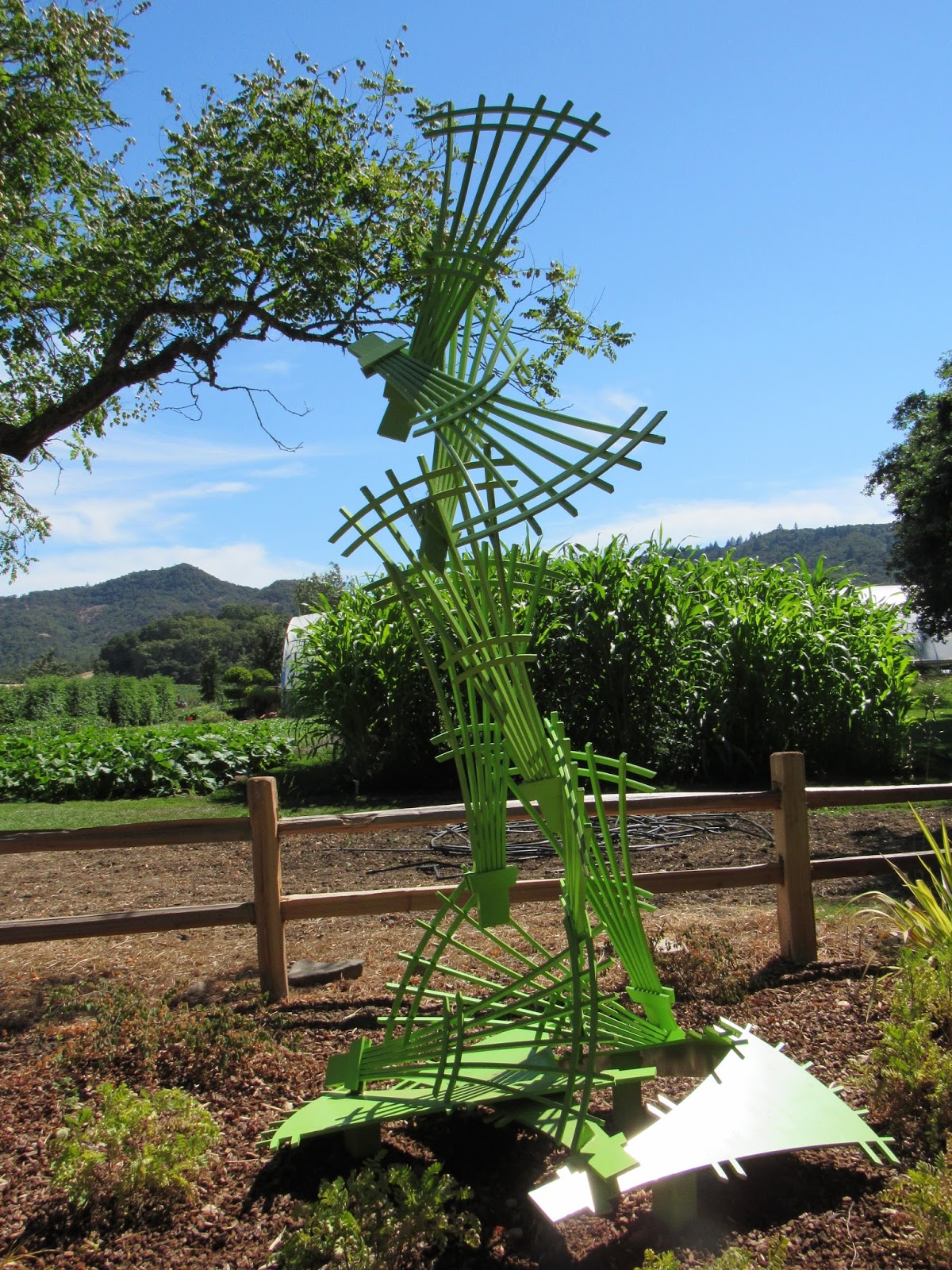
A New Spin / Napa Valley artist Freeland Tanner's 2014 sculpture is
comprised of Cedar and Redwood grape stakes and repurposed poplar wood.

The town of Yountville is quickly becoming synonymous with art as it is with food and wine. Look around and you'll see how the influences from vintner culture, wine industry, culinary and arts converge in this lovely destination situated along Highway 29 in the heart of California's Napa Valley, about 60 miles outside San Francisco.

Bouchon / One of Yountville's
 world-class dining experiences.
While French Laundry and Bouchon brought Michelin stars and accolades -- and helped transform Yountville into a world-class destination for food -- there's been a push to show a creative, artsy side in a very public and profound way thanks to the installation of outdoor sculptures. The output of artwork doting Yountville has been very inspiring and has helped turn this wine country town into an outdoor art gallery.

Balance by Sherry Tobin.
Locals or tourists who walk along Yountville's Washington Street, the town's main thoroughfare, will notice about three dozen pieces of outdoor sculpture. The town went on an art binge beginning about three years ago by installing sculptures by local artists and some internationally-known ones, too.

While some of the sculptures are subtle in their quality, most are quite colorful and grab one's attention. Each is a welcome sight and during a recent visit, I noticed, many were magnets for both serious photographers as well as tourists stopping to take selfies.

Trellis Way to the Sky
by Freeland Tanner.
Each sculpture is well signed with information such as title, artist and composition. And, best of all, each is for sale with a percentage of the sales benefitting the Yountville Arts Fund which helps provide continued support for arts related activities and events in Yountville.

As someone who has returned often to Yountville to enjoy its culinary aspects, at Bouchon as well as Ad Hoc and Redd Wood, I've seen the town evolve nicely over the past 20 years. Now, the outdoor sculptures have become an essential and enjoyable component of the Yountville experience just like the puff pastries and macarons at Bouchon Bakery.

Indeed, come for the food and wine, stay for the art.

All photographs by Michael Dickens © 2015.