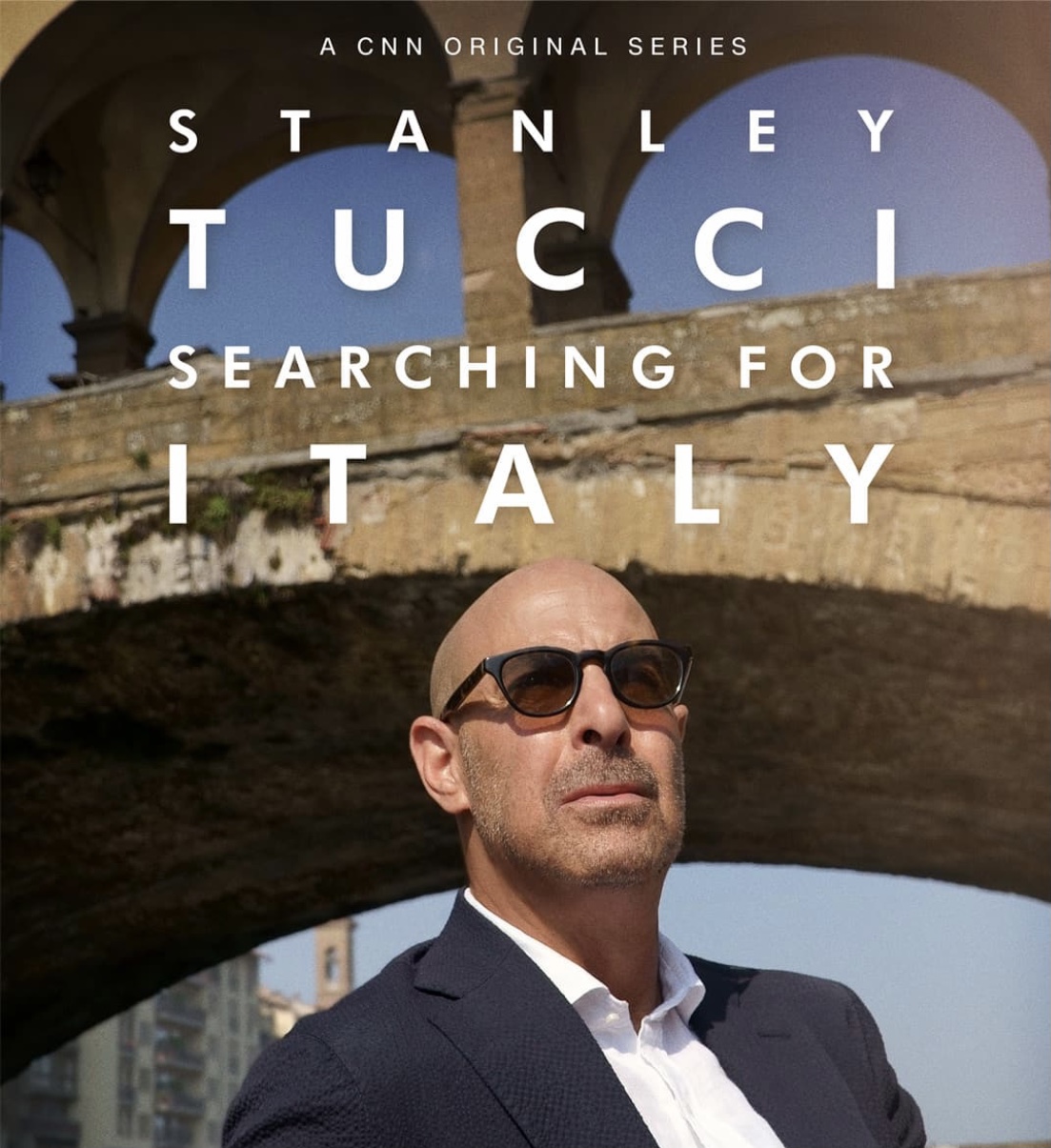
I’ll admit I’m a little bit late to discovering Stanley Tucci: Searching For Italy, a six-part CNN Original Series focusing on travel and food, which had its premiere last February. Recently, it’s come to HBO Max and I immediately got hooked.
Stanley Tucci: Searching For Italy follows the Academy Award-nominated actor, who travels around Italy to explore the regional culture, cuisine and history of this boot-shaped southern European country with its lengthy Mediterranean Sea coastline that has left its powerful mark on Western culture and food. The series received two Primetime Emmy Award nominations, including one for Outstanding Hosted Nonfiction Series, and has been renewed for a second season.
In the first season, filmed both in 2019 and during the Covid-19 pandemic that hit Italy in 2020, Tucci explores Naples and the Amalfi Coast, Rome, Bologna, Milan, Tuscany, and Sicily. Each has a particular theme and all of them are well-written and produced as well as nicely paced. Tucci is stylish and entertaining, both as a storyteller and as a conversationalist – and we learn he’s quite comfortable performing in the kitchen, too. His parents are both of Italian descent, and had roots in Calabria. He spent part of his youth living in Florence, so it’s not surprising that the episode about Tuscany feels like a big family homecoming.
After watching all six episodes of Stanley Tucci: Searching For Italy over the past week, it’s easy to make comparisons to Anthony Bourdain’s Parts Unknown, which set the standard for fusing food and travel. However, as Tucci admitted in an interview with The Hollywood Reporter, “The show that we are doing is distinctly different than his: I am not nearly as adventurous as Tony was, not nearly. Or as brave. But what he did is open the doors to all of us who were interested in food, and travel, to explore in our own ways. … He was an extraordinary writer, a nice person, and a great explorer of the human condition through food.”
While not all of the culinary discoveries Tucci introduces us to are new – and many of them come back to traditional Italian cuisine that focuses on pasta and cheese – the way in which he presents them, filled with his warmth and charisma lighting up the screen, makes this series an enjoyable experience. In Naples, it’s the search for the freshest mozzarella and the best San Marzano tomatoes. In Bologna, in the Emilia-Romagna region of the country, it’s about exploring prosciutto de Parma. In Rome, it’s all about enjoying the creamy carbonara. In Sicily, it’s learning about the hospitality.
Each episode is peppered with equal parts cuisine and culture and how Italy’s colorful history ties them all together – and it’s all captured in living color. It’s what I found very charming and entertaining. Of course, what’s not to love about Italian cuisine as well as hearing the Italian language spoken so eloquently and passionately?
Stanley Tucci: Searching For Italy is a smart and endearing series that is revealing about the universal human condition – and how good food and conversation can unite us – and it made me yearn for more after watching each of the six episodes with great interest. May it whet your appetite, too.
Photos: Stanley Tucci: Searching For Italy CNN and HBO Max websites.
Once upon a time, the beloved and respected American actor Alan Alda suggested that you have to leave the city of your comfort and go into the wilderness of your intuition. “What you’ll discover,” he said “will be wonderful. What you’ll discover is yourself.”
As we begin the New Year, 2020, no matter where we may be or reside in the world, it’s worth a moment of our time to consider the meaning of Alda’s words.
Last Sunday, my wife and I returned from a brief but eventful five-day holiday visit to New York City, our fourth trip there during 2019. Each time we go – and it’s only a 3 1/2-hour trip via the Amtrak Northeast Regional – we try to see a different part of what is arguably one of the greatest cities in the world. Our post-Christmas, pre-New Year’s visit rewarded us with a wonderful opportunity to discover new things – and, this time, from a Lower East Side perspective. It was worth it.
Our visit began with theater – we saw the much anticipated “David Byrne’s American Utopia” at the intimate Hudson Theatre (once home to NBC’s “Tonight Show” back in the early 1950s Steve Allen era), featuring a tour de force performance by the Talking Heads superstar that was part TED talk, part rock concert, and very much a bare-footed dance spectacle. There were crowd-favorite hits newly arranged by Byrne like “Once in a Lifetime” and “Burning Down the House,” that complemented songs covering the 67-year-old’s post-Heads solo career. All together, they wove a narrative in which Byrne tried to help his audience find a sense of happiness in these troubled times we all live in.
Our visit included shopping, from loading up on mouth-watering Lindt chocolates to finding new fashion at Uniqlo’s expansive Fifth Avenue headquarters near the Museum of Modern Art just above Rockefeller Plaza, where there was plenty of activity centering around its colorful, larger-than-life Christmas tree and popular skating rink.
We enjoyed a satisfying, educational day visiting two of the city’s finest museums – the newly re-opened MOMA, where we braved the crowds hovering around Van Gogh’s “The Starry Night” and Monet’s “Water Lillies,” and a hidden gem in the Tenement Museum, located at the corner of Orchard and Delaney streets in the Lower East Side, about a five-minute walk from the Hotel Indigo, where we lodged during our stay.
All along our journey in New York City, which the cast of Hamilton describes it as “the greatest city in the world,” there was plenty of wonderful food awaiting us, from the delicious dim sum at Nom Wah Tea Parlor in Chinatown on Christmas Evening (very much worth the 75-minute wait just to get a table); to a pre fixe epicurean delight at Butter in Midtown; to late night posh doughnuts at the Donut Pub in Chelsea; and, finally, deli delights at Russ & Daughters Appetizers (bagels with cream cheese) and Katz’s (cheese blintzes).
New York City is a place in which I could never see myself getting bored. There’s always plenty of interesting things to explore and admire – and to be curious about – any time of the day or night.
As I learned once again, it’s easy to get caught up in the city’s history. I was reminded of this when I learned about late 19th/early 20th-century shop life at 97 Orchard Street while visiting the Tenement Museum. I was reminded of this through the art I saw at MOMA; as well as in the Puerto Rican-infused jazz music I heard at Jazz at Lincoln Center. Also, in the theater I enjoyed on Broadway with “David Byrne’s American Utopia,” and from the tremendous choice of food – where, if you think about it, there’s every imaginable ethnic cuisine to be discovered and eaten.
There’s plenty to explore in New York City. I know I’ll be back, again, soon.
In the meantime, I look forward to 2020 and the New Year that awaits. Hopefully, it will be a year full of new discoveries and new travel adventures. It is truly my hope that yours will be filled with new discoveries and new travel adventures, too.
Looking for something fun and enjoyable to watch on TV one recent evening, my wife and I came upon The Chef Show, which reunites multi-talented producer/actor/director Jon Favreau with Los Angeles chef Roy Choi. It’s the latest foodie offering from Netflix, which in recent months has very nicely taken over food TV with Chef’s Table, which explores the discipline and culinary talent of world-renowned chefs such as Mashama Bailey and Dario Cecchini; Salt, Fat, Acid, Heat, based upon Samin Nosrat’s book of the same name in which she travels the world to explore how these principles fuel good food; David Chang’s Ugly Delicious, in which the James Beard Award-winning chef uses food to break down cultural barriers;and the Great British Baking Show.
The Chef Show is all about bonding over the joy of cooking – in a kitchen – with friends. Each episode takes place around a place to eat or cook without being like a travelogue. Favreau described it for Grub Street as a “dinner party in the back of the house” kind of atmosphere. The series took its name from the 2014 film, Chef, which starred Favreau as Carl Casper, a chef who opens a Cuban food truck with his son in Miami. Choi, of Kogi Korean BBQ food truck fame, was the film’s food consultant and created all of the dishes that were featured – including the deliciously mouth-watering Cubano and grilled cheese sandwiches.
After watching the first three episodes of The Chef Show – there are eight in all and it’s quite easy to binge watch – it becomes evident from the beginning that Favreau and Choi have developed a deep and wonderful rapport in the kitchen – built upon mutual respect for one another – and they share a similar taste in food. Each episode always welcomes banter between hosts – taking with each other without looking directly at the camera – and celebrity guests such as actress Gwyneth Paltrow, Avengers actor Tom Holland and Sin City director Robert Rodriguez.
What viewers get to enjoy in this documentary-style series is the showcasing of Choi’s technique and enthusiasm for the craft of cooking and Favreau’s interest in absorbing this knowledge and wisdom while keeping things light and funny. Choi is the master chef and Favreau is both his student and best buddy.
One of the funniest bits that delivers a big laugh – and, thankfully, it didn’t wind up on the cutting-room floor – shows Favreau attempting to make New Orleans-style beignets made famous at Cafe DuMonde. After making the dough by just adding water, then cutting it into individual squares, deep frying them, and showering them with powdered sugar, Choi bites into one of them. He throws the rest into the garbage. Favreau deadpans, “It’s not quite like there.” Looking for the right response, Choi pauses for a moment, then with a serious look on his face that turns into a big grin, he looks at Favreau and says, “I can tell they were a year old.” Both burst out laughing. Choi adds: “I didn’t want to say it on camera, but f••k it, this whole thing isn’t about lying.”
In a recent story about The Chef Show, Eater’s Greg Morabito wrote: “This new series allows the chef to showcase his obsession with technique and enthusiasm for the craft of cooking in ways that we’ve never seen on TV before. In every kitchen sequence, he drops culinary knowledge like an older brother handing you a mixtape of his favorite jams. Favreau, meanwhile, manages to keep the spirit light, even as he tackles new culinary challenges at the encouragement of his friend. Part of the fun is watching (Favreau) gradually increase his skill level and build more confidence in the kitchen.”
As Favreau told Grubstreet.com in a recent interview, “I’ve watched all these episodes a dozen times in the process of making and defining the show. Every little thing, a lot of care went into it. The animation, the way we talk, there’s recipes in it, the way the food is filmed. It’s just incredibly personal and something we both like a lot. It’s just really nice to share.
“It’s like you cooked a meal you want to eat, and now you’ve invited people. It’s mind-boggling to me that there’ll be someone sitting on the opposite end of the world watching the most personal, specific story. I’m really interested to see who connects to it because if they do, there’s nothing else like it that they’ll find about people in L.A. cooking and talking about Korean food. It’s such a specific thing about what Roy and I geek out about.
“Hopefully, there’s some humanity and personalness. And then people who like to cook and want to just go and show people who cook for real, and not try to present it any other way. And what it’s like to be there by the side of someone who is really great at what they do and learning from them. I wanted to show what that was like.”
My blog, “A Tuesday Night Memo,” turns nine later this month.
People who know me well know that I've been interested in writing, reporting and storytelling for a long time. So, it's only natural that I turned to blog writing because it gave me an opportunity to hone my writing skills and provided a forum for writing about things that truly interested me that I wanted to share with others.
Here’s a little history about my blog:
I started writing “A Tuesday Night Memo” on January 26, 2010, as a means for sharing musings about my life filled with music, sport, and urban travel, and to foster community with my friends, family and Facebook acquaintances. More recently, I added a Twitter profile, which has allowed me to reach a wider audience across the country and the world.
People who read my blog know that I'm passionate about music, sport, and urban travel. Additionally, I have used “A Tuesday Night Memo” as a vehicle for writing about art, food, fashion, religion and gardening – and, in the age of Trump, about politics. Before we moved to the east coast, sharing news and photos about our former Oakland, Calif., flower gardens at home always seem to generate great interest and enthusiasm. Maybe, it was the pretty shapes and colors of our flowers that others found appealing, especially since we could maintain a garden all year long.
Up to now, I have "blogged" 439 entries for “A Tuesday Night Memo,”which collectively have received more than 161,700 page views. Among many subjects I have written about, some of my favorites have been: my appreciation of tennis champion Roger Federer; how the city of Seattle fosters community through international cinema; a history of the world as seen through 100 objects; classical music conductor Gustavo Dudamel; Golden State Warriors head coach Steve Kerr; my music love affairs with Pink Martini and Elvis Costello; validating our travel through our photographs; and Jerry Seinfeld's Internet comedy Comedians in Cars Getting Coffee.
Among my recent posts, I have written about the Golden Globe-winning film “Roma”; the humanitarian work of Washington, D.C. chef José Andrés; and recent books written by American historians Doris Kearns Goodwin and Jon Meacham. Also, I have shared my interest in digital photography since beginning my blog, which has enabled me to illustrate many if not all of my posts with colorful visuals to match the words I've written.
The feedback I have received not only is very much appreciated, but I also find it very useful. Much of it has been positive, but sometimes it's also been critical. Whether good or bad, I've found the feedback readers provide to be a valuable learning tool. Occasionally, I like to sneak a look at my blog's statistics, which are the key indicators that show how many total "hits" my blog has received, which stories have been read the most, and what countries comprise the blog's readership. The numbers are modest but nevertheless interesting.
Here are a few fun facts about “A Tuesday Night Memo”I thought you might enjoy: • Since my blog's debut, it has been read in dozens of countries, including the U.S., Canada, Mexico, France, Morocco, Tunisia, Turkey and Hong Kong – even Brazil, India, Vietnam, and Australia. The top five countries reading my blog include the U.S, Russia, United Kingdom, Germany and France. I hope Russia's interest in my blog has nothing to do with their wanting to hack me because of my occasional blog posts about President Donald Trump.
Looking ahead, two years since he was inaugurated, the Trump presidency continues to garner my interest and attention from time to time. How could it not? However, there's so much more to write about. Among things that I look forward to learning about include my continuing interest in exploring museums – and what we can learn from them. Also, I would like to explore the effect digital music and media have in connecting our world.
In the meantime, I thoroughly enjoy sharing my writing week in and week out, and I look forward to contributing more of my words and thoughts in what is shaping up to be another exciting year awaiting all of us.
Following an evening of enjoyable shopping at the Holiday Market one recent Friday, we happened upon the very lively and fascinating China Chilcano (418 7th Street NW), one of José Andrés’ signature Washington, D.C., restaurants that defines the culinary spectrum of Peru.
“Food is about making an interaction with ingredients,” says Andrés, the celebrity chef and restauranteur – and Nobel Peace Prize nominee – who is a national hero in a city full of political enemies. “If you talk to them, they will always tell you a story.”
What a brilliant story chef Andrés shares night after night. He’s engaging his diners to indulge in a wide range of culinary delights that juxtaposes traditional Peruvian cuisine with Chinese Chifa and Japanese Nikkei – and I’m happy to say that it works. It’s an exciting journey. If you’re lucky, like my wife and I were on the night we dined at China Chilcano, you might even have a chance to say “hi” to chef Andrés and thank him yourself for a wonderful meal.
Why Peru, China and Japan together? According to the menu, the story goes like this: “In the late 19th century, Chinese and Japanese settlers traveled to Peru and made it their home, bringing with them time-honored cooking traditions that sparked the beginning of the rich, multicultural offering that is Peruvian cuisine.”
Our menu selections, which included Chifles Chiferos con Salsa (crispy plantain and taro root chips served with a sweet potato-rocoto sauce and Chinese five spice), Chupe de Camarón (Pacific wild shrimp soup with fresh cheese, chocolate, rice, potato and poached egg), and Chicharrón (a fried pork belly with sweet potato, salsa criollo, and hot sauce sandwich), were bold and flavorful – and all simply superb. We saved room for dessert and ordered the Ponderaciones de Kiwicha (a crispy fried spiral cookie, Fortunato No. 4 chocolate cream, banana, and Algarrobina ice cream). I learned that the Fortunato No. 4 chocolate is made from Pure Nacional Cacao. The name honors the Peruvian farmer, Fortunato, and the mother tree of the rare Pure Nacional Cacao trees that grow in his Marañón Canyon farm.
Recently, chef Andrés and World Central Kitchen, his non-profit organization, have established themselves as a reliable source for feeding the hungry. In the past year, they’ve been to a number of different natural disaster areas such as Houston, Florida, and California as well as to Guatemala and Puerto Rico to provide food and emergency relief. More recently, they’ve fed the hungry and contributed humanitarian relief along the Mexican border town of Tijuana in response to the Trump administration’s hard-line stance on immigration.
In a recent interview with the Washington Post, chef Andrés said showing up in Tijuana was the right thing to do. “In the end, it’s very simple. Our motto comes from John Steinbeck’s ‘The Grapes of Wrath,’” he said. Then, quoting from the author’s Depression-era novel, “Wherever there’s a fight so hungry people may eat, I will be there.”
A Spanish native who became a naturalized U.S. citizen five years ago, chef Andrés continued: “If you are a person of faith, you will argue this is the right thing to do. If you are a person of love and compassion, this is the right thing to do. If you are a person that believes that pain in the world should go away, this is the right thing to do.”
Earlier this year, chef Andrés, who has become the face of American natural disaster relief, co-wrote a book, ‘We Fed an Island,’ with veteran British journalist Richard Wolffe, following the Hurricane Maria disaster that struck Puerto Rico. It served as a manifesto that asks governments and nonprofit groups to rethink the way in which they feed people after a natural disaster has struck.
If chef Andrés can feed just one person, he is happy. The bottom line according to him is simple: “We don’t need to be politicizing the suffering of others. What we need to be doing is having more compassion.”
Indeed, putting humanity forward is the right thing to do – especially during the holiday season.
Credits: Photo – Google images. Video – PBS NewsHour/YouTube.
Earlier this year, chef Marcus Samuelsson of Food Network Chopped fame took an inspiring journey across the United States in which he explored – and celebrated – the wide-ranging diversity of immigrant traditions and cuisine woven into American food and culture.
On “No Passport Required,” a six-episode PBS/Eater series which first aired across the U.S. during the summer months, Samuelsson visited Detroit, New Orleans, Chicago, New York City, Miami and Washington, D.C. An immigrant himself, who was born in Ethiopia and raised in Sweden, Samuelsson discovered dynamic and creative ways in which a particular community thrives – making its mark, so to speak. He spoke to poets and musicians, business owners and community leaders, as well as artists and home cooks – each who have contributed to enhancing our nation’s culture and its cuisine.
In Detroit, Samuelsson gathered with Middle Eastern immigrants who call the Motor City home and in New Orleans, he learned how the culinary traditions of the Vietnamese have been fully integrated into the fabric of the Big Easy, which has its long-established French and Creole influences. Samuelsson gathered with Ethiopians in Washington, D.C., and with the Indo-Guyanese in Queens, New York. He discovered how Chicago’s Mexican neighborhoods have impacted that area’s food and culture, and in Miami, he was welcomed by the city’s proud Haitian community.
The bottom line in Samuelsson’s adventures – and what I learned from watching – is this: there are many wondrous global food traditions that are waiting to be discovered throughout the United States. Sometimes, we just need a little bit of encouragement. After all, as the title of Samuelsson’s show reinforces, there’s No Passport Required.
• • •
There’s a great back story about chef Samuelsson I blogged about six years ago that's worth sharing, again. Back in July 2012, he wrote a memoir, Yes, Chef – an incomparable story – about what it means to be an American. Through his cooking, he told a story that in the words of former President Bill Clinton, “reached past racial and national divides to the foundations of family, hope and downright good food.” Gabrielle Hamilton, the bestselling author of Blood, Bones & Butter said that Samuelsson exudes “a quiet bravery, and a lyrical and discreetly glittering style – in the kitchen and on the page.”
Thus, an opportunity to meet chef Samuelsson in person, hear him wax poetically on his life’s passion and get a signed copy of his memoir was too good an opportunity to pass up.
“It begins with a simple ritual: Every Saturday afternoon, a boy who loves to cook walks to his grandmother’s house and helps her prepare a roast chicken for dinner. The grandmother is Swedish, a retired domestic. The boy is Ethiopian and adopted, and he will grow up to become the world-renowned chef Marcus Samuelsson.” His memoir, Yes, Chef, became his love letter to food and family in all its manifestations.
As Samuelsson shared his fascinating life’s story at Book Passage’s intimate San Francisco Ferry Building store, he said, “Sometimes, the worst situation can become the best situation.”
In a chapter of Yes, Chef devoted to his grandmother, Helga, Samuelsson wrote: “Mormor (the Swedish word for mother’s mother) treated her house like it was her own little food factory. She made everything herself: jams, pickles, and breads. She bought large cuts of meat or whole chickens and game animals from the butcher and then broke them down into chops and roasts at home. It’s so funny to me how, today, we celebrate braising as some refined, elegant approach, when it’s the same slow cooking method Mormor used. Her menus followed a simple logic:
“You have bread today because it’s fresh. You have toast tomorrow because the bread has gone stale. You make croutons the next day, and whatever bread is left after that gets ground into crumbs that you’ll use to batter fish.
“I don’t think I saw a rib-eye steak until my late teens when I started working in restaurants. At home, we ate mostly ground meat that was rolled into balls and stretched even further by ample additions of breadcrumbs. We ate our own Swedish version of a hamburger: pan beef, a patty topped with caramel iced onions. Sometimes we ate beef Lindstrom: a hamburger patty mixed with onions, capers, and pickled beets before being seared in butter. That’s comfort food where I come from, and it’s damn good.”
• • •
At times, it’s been a struggle for Samuelsson to find his place, both in the kitchen and in the world. At least now, he has the appearance of a man who’s found peace in all the right places – and he’s always with a smile on his face.
“I am an immigrant, not a refugee,” Samuelsson reminds us. “There is a big difference. I am as a patriotic as any American. I am determined and grateful.”
As a chef, Samuelsson states that inside the kitchen or out, “it’s a matter of luck and the belief in others.
“Cooking has changed, but the core values remain the same. It’s about expressing a journey and culture. What better way than through food,” he says. And, besides, as Samuelsson playfully shared with his San Francisco audience on that summer night six years ago, “My fried chicken is better than yours!”
On “Fix Me a Plate,” world-renowned chef Alex Guarnaschelli’s weekly web series, the quintessential New Yorker shows us in delightful four-and-five-minute bites that she knows just where to go for a truly New York food experience.
Guarnaschelli, a Food Network star recognized for her work as a "Chopped" judge and an "Iron Chef," has selected old-school cafes and restaurants throughout New York’s five boroughs to highlight on “Fix Me a Plate.” These are places where one can still get fresh and authentic, quality-made dishes. Most of these are no-frills establishments – hangouts, if you will – that are filled with longtime traditions and plenty of charm.
In each episode, Guarnaschelli explores a different iconic New York eatery “that has built its success on a confidence and connection to doing things the way they’ve always been done.”
In the first six episodes of “Fix Me a Plate,” Guarnaschelli visits Lucali – think best pizza in Brooklyn – then, follows it with soulful chicken and waffles at Amy Ruth’s in Harlem. Need we say more? She also stops by Tanoreen in Bay Ridge, Brooklyn, for traditional Middle Eastern cuisine, and Nom Wah Tea Parlor, a Chinatown delight that serves a variety of treats from egg rolls to almond cookies. Finally, there’s Indian samosas at Dhaka in Queens, and Russ and Daughters on the Lower East Side for bagels piled high with cream cheese and lox.
Recently, “Fix Me a Plate” returned with a new season of shows that so far has served up Polish pierogi at Krolewskie Jadlo in Williamsburg, Brooklyn; tacos at Rockaway Beach Surf Club on Long Island, and doughnuts at the Donut Pub in Chelsea. Also, there’s been Thai at Brooklyn’s Pok Pok, the knock-out combo of Sicilian-style square pizza and Italian spumoni ice cream at Spumoni Garden in Bensonhurst, Brooklyn; and chopped liver at Sammy’ Roumanian in lower Manhattan. This week, “Fix Me a Plate” introduced viewers to the Original Crab Shanty in City Island by the Bronx for a family-style portion size of pasta with crabs and lobster.
Asked via Twitter if she has a favorite episode of “Fix Me a Plate,” Guarnaschelli tweeted, “Spumoni Garden obviously. Also love Sammy’s Roumanian and a couple of others that haven’t aired yet.”
New episodes of “Fix Me a Plate” debut weekly on the show’s Facebook page on Monday evenings.
In the Shadow of Statues, which was published March 20, is on the New York Times Bestseller List.
"These statues are not just stone and metal. They were erected purposefully to send a strong message to all who walked in their shadows about who was still in charge."
– Mitch Landrieu, from In the Shadow of Statues
New Orleans is one of the great multicultural cities in the world. It is also a racially divided city that has dealt with its fair share of poverty and urban violence. In spite of all of its troubles, the Big Easy remains a beloved cultural treasure to everyone who visits thanks to its rich tradition of funky jazz music and the beauty and grace of its amazing food.
Enter Mitch Landrieu, the mayor of New Orleans since 2010, who has been an important catalyst in helping his city rebuild from the devastation of Hurricane Katrina. As the son of a former state legislator and mayor of New Orleans – who was a huge force in the integration of that city in the 1960s and 1970s – and the brother of a former U.S. senator from Louisiana, Landrieu grew up with a progressive education in the racially divided Crescent City among America's lingering Confederate monuments.
At a time when the issue of racism has become resurgent "with seemingly tacit approval from the highest levels of government and when too many Americans have a misplaced nostalgia for a time and place that never existed," Landrieu has written In the Shadow of Statues – a book that's a must read.
In the Shadow of Statues is equal parts memoir, history, and a "prescription for finally confronting America's most painful legacy." As a white southerner confronting his city's past history, Landrieu contributes a very strong voice to our national conversation about race in America today by taking on many difficult issues related to it, including slavery and inequality.
In praising In the Shadow of Statues, Walter Isaacson, author of Leonardo da Vinci and Steve Jobs, writes: "With a balance of humility and conviction, he recounts his path to a more profound understanding of racial justice and explains how this journey led him to remove the Confederate monuments in New Orleans. It's an important book for everyone in America to read, because it shows how intellectual honesty can lead to moral clarity."
Mitch Landrieu at Politics & Prose Bookstore in Washington, D.C. last week.
Last week, my wife and I attended a standing room-only book event at Politics & Prose Bookstore in northwest Washington, D.C., featuring a conversation between Landrieu and Jeffrey Goldberg, editor in chief of The Atlantic, before a thoughtful and engaging audience, that was followed by a 30-minute Q & A periodand a book signing.
"There's a difference between remembering and revering history," said Landrieu, who addressed the people of New Orleans in May 2017 about his decision to take down and remove four Confederate monuments, including the statue of the famous southern Confederate general Robert E. Lee. The affected statues represent a mere four-year period of U.S. history, from 1861-65, but a searing one, too. While Landrieu said that the decision to remove the monuments was a difficult one, it was a right one, too. It was about eradicating history.
"We were on the wrong side of history," Landrieu told the Politics & Prose audience very matter-of-factly. "These statues were erected to send a strong message to all who walked in their shadows about who was still in charge. For decades, these statues have cast a long shadow on society, particularly African-Americans."
Lee Circle before the Confederate monument of Robert E. Lee was removed in 2017.
Landrieu says In the Shadow of Statues is an invitation to stand and sit in other people's shoes. He recalled for his Politics & Prose audience a conversation he once shared with his dear friend, the famous jazz musician and educator – and New Orleans native son – Wynton Marsalis, who helped him see the truth about the city's exclusionary attitudes. "'Hey, man,'" Landrieu recalled the trumpeter saying to him. "'You should take the statue of Robert E. Lee down. Do you know how it got there and who put it up?'"
In the book, Landrieu expands on his conversation with Marsalis.
"I don't like the fact that Lee Circle is named Lee Circle."
"Why is that?"
"Let me help you see it through my eyes. Who is he? What does he represent? And in that most prominent space in the city of New Orleans, does that space reflect who we are, who we want to be, or who we are?"
Suddenly, Landrieu was listening.
Later in their conversation, according to the mayor, Marsalis added, "'Did you know Louis Armstrong left the city and never came back because of that statue? He did not even want to be buried in his hometown. You ever think about what Robert E. Lee means to someone black?'"
Landrieu emphasized that there's a difference between remembrance of history and reverence of it. "I think there are a lot of people who are struggling with the notion that the South fought for a cause that was reviled," he said. When you make sense of it, monuments are usually reserved for winners not losers. The Confederate monuments celebrated the losing side of the Civil War.
New Orleans Mayor Mitch Landrieu
As Landrieu remarked back during his May 2017 speech, "For America and New Orleans, it has been a long, winding road, marked by great tragedy and great triumph. But we cannot be afraid of our truth."
And, as Landrieu writes, "Here is the essential truth: We are better together than we are apart.
"Indivisibility is our essence."
Near the end of his conversation at Politics & Prose, Landrieu said, "If we are going to move forward as a country, we must confront the issue of race head on. Our diversity is what makes this country great.
"We need to understand our history. We need to tell the whole story."
Photo credits: Book cover courtesy of Amazon.com. Politics & Prose audience courtesy of @PoliticsProse Twitter. Robert E. Lee statue courtesy of New Orleans Advocate. Mitch Landrieu courtesy of Cheryl Gerber.
Last Thursday, The New York Times hosted a most interesting and informative "TimesTalks D.C." roundtable on the future of restaurants, the plight of undocumented workers in the food industry and gender equity in the workplace at George Washington University. The "Future of Restaurants" panelists included James Beard Foundation Award-winners José Andrés (Spanish-American chef and Washington, D.C. restaurateur, often credited for bringing the small plates dining concept "tapas" to America), Danny Meyer (CEO of the Union Square Hospitality Group and founder of the popular Shake Shack casual dining cafes), and Aaron Silverman (owner/chef at Rose's Luxury in Washington, D.C.). The multi-Michelin starred panel was moderated by Kim Severson, national food correspondent for The New York Times.
During the frank and lively 80-minute discussion, which was aired live on Facebook.com/nytimes, Severson started by asking each panelist if they have been practicing their "active male listening" in light of recent stories pertaining to sexual harassment in the workplace, including the restaurant industry.
"We are only as good as the people we have around us ... and we need to be calling out when we see something that is not right," said Andrés, the father of three daughters, about the #MeToo movement happening now in every industry, not just the field of food. "It's about humanity. ... I don't want to have any regrets that I didn't do the right thing."
Meyer, whose New York City-based Union Square Hospitality Group includes Union Square Cafe, Gramercy Tavern and Shake Shack concepts, spoke about the future opening of his first Union Square Cafe outside of New York at the Capitol Crossing complex in Mount Vernon triangle. "The thing that I'm most excited about is starting with the great restaurant community (in D.C.)," he said, which also includes creating safe spaces and promoting diversity. "I think we have an amazing moment to talk about who we want to be going forward right now."
Silverman, whose Little Pearl coffee shop and wine bar evolved out of a daytime cafe (Pineapple and Pearls) he used to operate, responded to a question about the elevation of "ethnic" foods: "I think there is a lot of food that isn't 'American' or French or Spanish that is already being elevated. It's totally happening and I hope to see more of it.
"It feels good to be able to say yes to people. We're just trying to make people happy."
Andrés, whose humanitarian relief effort has resulted in more than 3.2 million meals for hurricane-ravaged Puerto Rico, recently wrote a Washington Post op-ed about immigration reform. He said: "America is about pragmatism. We should be creating smart visas to give opportunities for those people to come in, work, get paid, and go back to their communities."
Later, Andrés summed up the evening's wide-ranging discussion perfectly – and it took just one just one sentence to do it. He said: "At the end of the day, food is what's going to save America."
Domilise's / Nothing fancy or elaborate. Just one of the best meals in the Big Easy.
New Orleans takes its food seriously – gumbo, red beans and rice, and beignets come to mind – and it's been said that you can't come to the Big Easy and not eat a po-boy sandwich. So, why not try the best – even if it's made to order in a hard-to-find location up river from the French Quarter, where parking is difficult at best and getting a table (there are only five) or a seat at the bar (there's about 10 of them) is a matter of good timing. Yet, despite all of these obstacles, the locals swear by this hole in the wall kind of place.
Domilise's Po-Boy and Bar consists of a single-room bar and dining area with five tables and about 10 bar seats.
Such it was on a recent Friday afternoon while visiting New Orleans that my wife and I dropped in at Domilise's Po-Boy and Bar, tucked away at 5240 Annunciation Street (corner Bellecastle), and treated ourselves to a po-boy sandwich for lunch. We had an hour to kill before we had to be on the highway headed west toward Lafayette in the Acadiana region of Louisiana to attend our nephew's wedding celebration.
We first visited Domilise's back in 2001 – pre Hurricane Katrina – and it was an enjoyable experience. So it was on our next visit to New Orleans earlier this month, we knew we wanted to revisit Domilise's.
Domilise's Po-Boy and Bar is an Uptown New Orleans restaurant known for its po-boy sandwiches. For the uninitiated, a po-boy is a traditional Louisiana sandwich served on baguette-like New Orleans French bread that's known for its fluffy center and crispy crust. The restaurant was founded in the 1930s by the Domilise family, who I learned lived in the house above the single-room bar/dining area. It was run by Sam and Dorothy "Miss Dot" Domilise for more than 75 years until her death in 2013. Although it was closed during Hurricane Katrina, since reopening Domilise's has been more popular than ever – acclaimed by many, including CNN's Anderson Cooper as well as Anthony Bourdain, who once filmed a spot on location for his Travel Channel program No Reservations.
My Domilise's meal / A delicious ham and Swiss po-boy, Zapp's New Orleans kettle-style chips, Barq's root beer.
During our recent visit, my po-boy of choice a ham and Swiss cheese dressed with spicy Cajun mustard, shredded lettuce and pickles while my wife opted for a turkey dressed all the way. Both were made with love by the sweet ladies who manned the kitchen. The reasonably priced menu is full of excellent choices, including shrimp, oyster, catfish, roast beef and sausage, and come in two sizes: small and large. The small was plenty large for my appetite. Along with my fabulous po-boy, I complemented my "meal" with a bag of Zapp's New Orleans kettle-style potato chips and a bottle of Barq's root beer.
We sat at the bar sipping on our sodas and munching our chips – and soaking up the vibrant atmosphere – while our po-boys were being prepared with TLC, waiting for a table to open up. By the time our order was called, a table materialized by the back entrance. Nothing fancy, but plenty of space to spread out and enjoy our delicious – albeit sometimes messy – po-boys. Looking around as we ate, I couldn't help but notice we were likely the only tourists mixed among a crowded room full of white- and blue-collar locals who swear by this place for a great meal.
Domilise's Po-Boy & Bar / Uptown at the corner of Annunciation and Bellecastle.
As Tom Piazza points out in his insightful 2006 book Why New Orleans Matters, "the real neighborhood places, tucked away usually in some unlikely corner of a residential street, animate the day-to-day grass roots culinary life of the city. There is nothing fancy or elaborate about these places to say the least, but also nothing humdrum or mass-produced, or even lackluster ... It is a point of honor to make food that tastes good – I don't think a New Orleanian would even understand the concept of turning out blah food so you could just eat and run.
"You can go into the most unassuming place – say, Domilise's, a sandwich shop with a hand-lettered sign in a very modest corner house a block from the river in a residential uptown neighborhood – and get a meal that you will remember for the rest of your days. Or at least for the rest of the day."
Indeed, you see food is a part of the rhythm and life of New Orleans, and it doesn't get much better than this. There's a reason that Domilise's is one of the best at what they do.
To read or not to read / So many books ... so little time.
Happy New Year everyone! We're less than a week into 2016, and just as everyone is writing out their New Year's resolutions, I've jotted down a few of my own. One resolution that's near the top of my list each year is to read more. "So many books ... so little time," reads the slogan printed on one of my tattered, well-worn navy-colored t-shirtsthat I bought a few years ago at The Elliott Bay Book Company, one of my favorite independent bookstores in the country, located on Capitol Hill in Seattle, Washington.
Elliott Bay Book Company, Seattle / One of my favorite independent bookstores in the country.
When I say "read more" I mean books. Oh, sure. I stay abreast of current events by reading The New York Times, both in print and online, on a daily basis, and I enjoy giving a good read to periodicals like Monocle, the London-based monthly that covers world affairs, culture, food, and design. And, of course, there's always perusing my Facebook news feed, to stay current on what's trending, too.
But, what about books, you ask?
Roger Angell / This Old Man: All in Pieces. This book is on my reading list for 2016.
Yes, books, remember them? It's the foundation behind what made Amazon.com one of the most successful online retailers. Before Twitter, before Facebook, before Netflix, before texting sapped all of our intellectual energy, there were books. I have several bookshelves at home lined with hundreds of titles that I've bought or received as gifts over the years. I'm proud of my collection of books by The New Yorker writers Roger Angell and Calvin Trillin, among many. However, a few years ago, in a space-saving and budget-cutting effort, I trimmed back on the number of new titles I bought and, instead, decided to start making better use of the local public library.
Looking back on 2015, I can say without boasting that I made good use of my Oakland Public Library card. I checked out seven books at our local branch library. One thing I've learned about libraries is this: If you're willing to wait for a popular best-seller or a new title to become available, checking out library books is a good way to save money (and, I might add, bookshelf space) while also showing support for public libraries.
Watching Comedy Central's The Daily Show, I've found, is a pretty good barometer about good books to read, and before he left the show last summer, former host Jon Stewart always brought out the best in authors. You could judge by his interest in a book if it was worth reading. Fortunately, new Daily Show host Trevor Noah is carrying on the tradition begun by Stewart.
Among the books which I read during 2015 were:
Mark Bittman on food / A Bone To Pick
Where Good Ideas Come From by Steven Johnson Midnight in Siberia by David Green A Call to Action: Women, Religion, Violence, and Power by Jimmy Carter The Children of Willesden Green: Beyond the Kindertransport: A Memoir of Music, Love, and Survival by Mona Golabek Cooked: A Natural History of Transformation by Michael Pollan Heretic: Why Islam Needs a Reformation Now by Ayaan Hirsi Ali You Can't Make This Up by Al Michaels
Mona Golabek / The Children of Willesden Lane: Beyond the Kindertransport: A Memoir of Music, Love, and Survival
A Bone to Pick: The Good News and Bad News About Food by Mark Bittman Leap: Leaving a Job with No Plan B to Find the Career and Life You Really Want by Tess Vigeland
Among the ties that bind these titles are my interest in non-fiction, memoirs, sports, food, travel and public radio personalities, as well as interest in world religions. And, of course, good writing and good stories always garner my attention.
Looking ahead, I wonder if it's possible that I can increase my output to 12 books, thus reading an average of a book a month? Let's see, I've already started a wonderful memoir by the gifted New Orleans actor Wendell Pierce, The Wind in the Reeds: A Storm, a Play, and the City That Would Not Be Broken, and I received Dispatches from Pluto: Lost and Found in the Mississippi Delta by award-winning adventure writer Richard Grant as a Christmas gift from my brother. Plus, I can't wait to begin reading Unfaithful Music & Disappearing Ink, the acclaimed 674-page memoir by Elvis Costello that spans his almost four-decade music career. So, yes, reading a book a month seems like a reasonable goal.
I'm optimistic.
Now, if I can just somehow find a way to unplug my TV set and turn off my iPhone.
"Philosophically considered, the universe is composed of Nature and the Soul."
Ralph Waldo Emerson (1802-1883), American poet and essayist, and champion of individualism
* * *
Ralph Waldo Emerson wrote about a variety of subjects, and he wrote very well. The 19th century American poet and essayist spent considerable time and effort focusing on and developing certain tenets about individuality and freedom, and about the relationship between the soul and surrounding world.
While Emerson's view about nature was more philosophical than naturalistic, I find much comfort in using his words to illustrate my photographs of our garden.
Below are a few of Emerson's word pictures that I've found joy in discovering and sharing. The themes of friendship, giving thanks and integrity are universal and go beyond borders.
Cheers, love and peace my dear readers.
* * *
"The glory of friendship is not in the outstretched hand, nor the kindly smile, nor the joy of companionship; it is in the spiritual inspiration that comes to one when he discovers that someone else believes in him and is willing to trust him."
* * *
For each new morning with its light,
For rest and shelter of the night,
For health and food, for love and friends,
For everything Thy goodness sends.
* * *
"Nothing is at last sacred but the integrity of your own mind."
Photograph of Pristine rose by Michael Dickens, copyright 2012. All rights reserved.
Eat Real Festival / Good food complimented by good conversation.
The British novelist Virginia Woolf wrote in her 1929 novel, A Room of One's Own: "One cannot think well, love well, sleep well if one has not dined well." She mused that the human frame being what it is ~ consisting of a heart, body and brain ~ a good dinner is of great importance to us all. And, it is best complimented by good conversation, too.
Indeed, last week was a very good one to be a foodie in the San Francisco Bay Area. First, I had the pleasure of attending a fascinating City Arts & Lectures event featuring New York Times food writer Mark Bittman at the Herbst Theatre in San Francisco. Then, during the weekend, I visited the annual Eat Real Festival at Jack London Square in Oakland and delighted in many delectable edibles that were seasonal, local and sustainable. Both events left my body and mind feeling happy and well nourished.
Mark Bittman
As the lead food writer for The New York Times Magazine, Mark Bittman shares his love of food through personal storytelling, teaching fundamental cooking techniques and essential lessons. He also covers food policy, cooking and eating as an Opinion columnist for The New York Times. He is the author of Food Matters, which explored the crucial connections among food, health and the environment. Many of my friends might remember him for writing "The Minimalist," a weekly column that ran for 13 years in The New York Times, which was part recipes and a lot of commonsense advice about food technique and taste.
Among the many interesting comments that Bittman made during his hour-long, cultural studies conversation with Jessica Battilana, a senior editor at Tasting Table, was this: "We have to take responsibility for what we eat. But we also need to demand accountability for what is produced for us to eat."
Mark Bittman / Sharing a conversation about food at San Francisco's City Arts & Lectures.
Bittman supports the sustainability food movement as well as the principle of giving consumers the right to know what is in our food. Also, he advocates that we should care about the welfare of the animals which farms raise for our consumption of beef, pork and poultry. And, he stressed, we as consumers should make a conscientious effort to buy and eat quality food that is locally grown and sourced.
However, admits Bittman, "We need to grow, plan and distribute this food in a better manner." He believes we should be more aware of the carbon footprint being left by the food we buy and consume in our daily lives, whether we choose to be carnivores or vegetarians ~ even vegans.
Mark Bittman signs a copy of his current book How to Cook Everything: The Basics
While Bittman has built a nation-wide community of like-minded enthusiasts through his writing for The New York Times, his books (Bittman's latest is How to Cook Everything: The Basics, which I bought and had signed) and his television appearances on The Cooking Channel, PBS and NBC's Today, his own personal taste in food leans toward keeping things simple and basic. Whether dining at home or going out, Bittman forgoes labor-intensive dishes like lasagna ~ he hasn't cooked it in 20 years ~ in favor of simplicity, like a delicious bowl of miso soup or Asian noodles. He eschews fine dining and is more at ease eating out at any number of New York City's hidden nook, Japanese-cuisine restaurants he's discovered over the years.
A discovery of another kind is the Eat Real Festival, an annual event that draws thousands of like-minded foodies from around the Bay Area to the Oakland waterfront at Jack London Square. Eat Real has been described by some as "part street food festival, part country fair and part block party." According to its website, what this social adventure has been created for ~ its raison d'être ~ is to inspire festival goers to enjoy "tasty, healthy, good food." Around the grounds, there was live music, cooking lectures and demonstrations, and green spaces to spread out a blanket and turn this culinary experience into a picnic, too.
Eat real, eat well / Standing in line for seasonal, local, sustainable cuisine from Tru Gourmet Dim Sum at the Eat Real Festival.
The S+S Gastro Grub menu promoted its local partnerships.
In just a couple of hours on Saturday, I enjoyed a delicious sampling Brown Cow ("Cream on the top") Greek honey yogurt; a freshly steamed BBQ pork bun and hot chicken pot sticker from Tru Gourmet Dim Sum; a freshly grilled and very tender Macau-style Niman Ranch pork bun from S+S Gastro Grub; a Vietnamese Bánh Mi, one of the best street foods in the world, which is a sandwich served on a baguette with pickled organic carrots and organic daikon, tomatoes, cucumbers, jalapenos, cilantro, mayo and soy sauce from Little Green Cyclo; and a slice of wood-fired artisan pepperoni pizza served with enthusiasm from an 800-degree Italian Valoriani oven that's been described as "reminiscent of a large blacksmith's forge" at the soon-to-open Forge pizzeria. Finally, for dessert, I treated myself to a Mexican chocolate popsicle (other eclectic flavors included pluot Thai basil and sweet corn) from Lick Pops that hit the spot on this clear, sunny afternoon.
The Eat Real Festival / A family-friendly atmosphere with good food, great weather and wonderful conversation, too.
Everything I sampled at this year's Eat Real Festival was simply amazing, not to mention affordable, too. All portions were $5 or less. I arrived with a good appetite and departed feeling both satisfied and smiling.
There's no love more sincerer than the love of food, wrote the Irish poet George Bernard Shaw. And, as Mark Bittman and the Eat Real Festival confirmed for me last week, there's something very special about building communities through food. Bon appetit! All photographs by Michael Dickens. Copyright 2012, all rights reserved.