Showing posts with label diversity. Show all posts

Saturday, December 1, 2018

No Passport Required: Still connecting with food and having a conversation about it with Marcus Samuelsson


Earlier this year, chef Marcus Samuelsson of Food Network Chopped fame took an inspiring journey across the United States in which he explored – and celebrated – the wide-ranging diversity of immigrant traditions and cuisine woven into American food and culture.

On “No Passport Required,” a six-episode PBS/Eater series which first aired across the U.S. during the summer months, Samuelsson visited Detroit, New Orleans, Chicago, New York City, Miami and Washington, D.C. An immigrant himself, who was born in Ethiopia and raised in Sweden, Samuelsson discovered dynamic and creative ways in which a particular community thrives – making its mark, so to speak. He spoke to poets and musicians, business owners and community leaders, as well as artists and home cooks – each who have contributed to enhancing our nation’s culture and its cuisine.


In Detroit, Samuelsson gathered with Middle Eastern immigrants who call the Motor City home and in New Orleans, he learned how the culinary traditions of the Vietnamese have been fully integrated into the fabric of the Big Easy, which has its long-established French and Creole influences. Samuelsson gathered with Ethiopians in Washington, D.C., and with the Indo-Guyanese in Queens, New York. He discovered how Chicago’s Mexican neighborhoods have impacted that area’s food and culture, and in Miami, he was welcomed by the city’s proud Haitian community.


The bottom line in Samuelsson’s adventures – and what I learned from watching – is this: there are many wondrous global food traditions that are waiting to be discovered throughout the United States. Sometimes, we just need a little bit of encouragement. After all, as the title of Samuelsson’s show reinforces, there’s No Passport Required.

 • • •


There’s a great back story about chef Samuelsson I blogged about six years ago that's worth sharing, again. Back in July 2012, he wrote a memoir, Yes, Chef – an incomparable story – about what it means to be an American. Through his cooking, he told a story that in the words of former President Bill Clinton, “reached past racial and national divides to the foundations of family, hope and downright good food.” Gabrielle Hamilton, the bestselling author of Blood, Bones & Butter said that Samuelsson exudes “a quiet bravery, and a lyrical and discreetly glittering style – in the kitchen and on the page.”

Thus, an opportunity to meet chef Samuelsson in person, hear him wax poetically on his life’s passion and get a signed copy of his memoir was too good an opportunity to pass up.

“It begins with a simple ritual: Every Saturday afternoon, a boy who loves to cook walks to his grandmother’s house and helps her prepare a roast chicken for dinner. The grandmother is Swedish, a retired domestic. The boy is Ethiopian and adopted, and he will grow up to become the world-renowned chef Marcus Samuelsson.” His memoir, Yes, Chef, became his love letter to food and family in all its manifestations.

As Samuelsson shared his fascinating life’s story at Book Passage’s intimate San Francisco Ferry Building store, he said, “Sometimes, the worst situation can become the best situation.”

In a chapter of Yes, Chef devoted to his grandmother, Helga, Samuelsson wrote: “Mormor (the Swedish word for mother’s mother) treated her house like it was her own little food factory. She made everything herself: jams, pickles, and breads. She bought large cuts of meat or whole chickens and game animals from the butcher and then broke them down into chops and roasts at home. It’s so funny to me how, today, we celebrate braising as some refined, elegant approach, when it’s the same slow cooking method Mormor used. Her menus followed a simple logic:

“You have bread today because it’s fresh. You have toast tomorrow because the bread has gone stale. You make croutons the next day, and whatever bread is left after that gets ground into crumbs that you’ll use to batter fish.

“I don’t think I saw a rib-eye steak until my late teens when I started working in restaurants. At home, we ate mostly ground meat that was rolled into balls and stretched even further by ample additions of breadcrumbs. We ate our own Swedish version of a hamburger: pan beef, a patty topped with caramel iced onions. Sometimes we ate beef Lindstrom: a hamburger patty mixed with onions, capers, and pickled beets before being seared in butter. That’s comfort food where I come from, and it’s damn good.”

• • •


At times, it’s been a struggle for Samuelsson to find his place, both in the kitchen and in the world. At least now, he has the appearance of a man who’s found peace in all the right places – and he’s always with a smile on his face.

“I am an immigrant, not a refugee,” Samuelsson reminds us. “There is a big difference. I am as a patriotic as any American. I am determined and grateful.”

As a chef, Samuelsson states that inside the kitchen or out, “it’s a matter of luck and the belief in others.

“Cooking has changed, but the core values remain the same. It’s about expressing a journey and culture. What better way than through food,” he says. And, besides, as Samuelsson playfully shared with his San Francisco audience on that summer night six years ago, “My fried chicken is better than yours!”

Tuesday, November 20, 2018

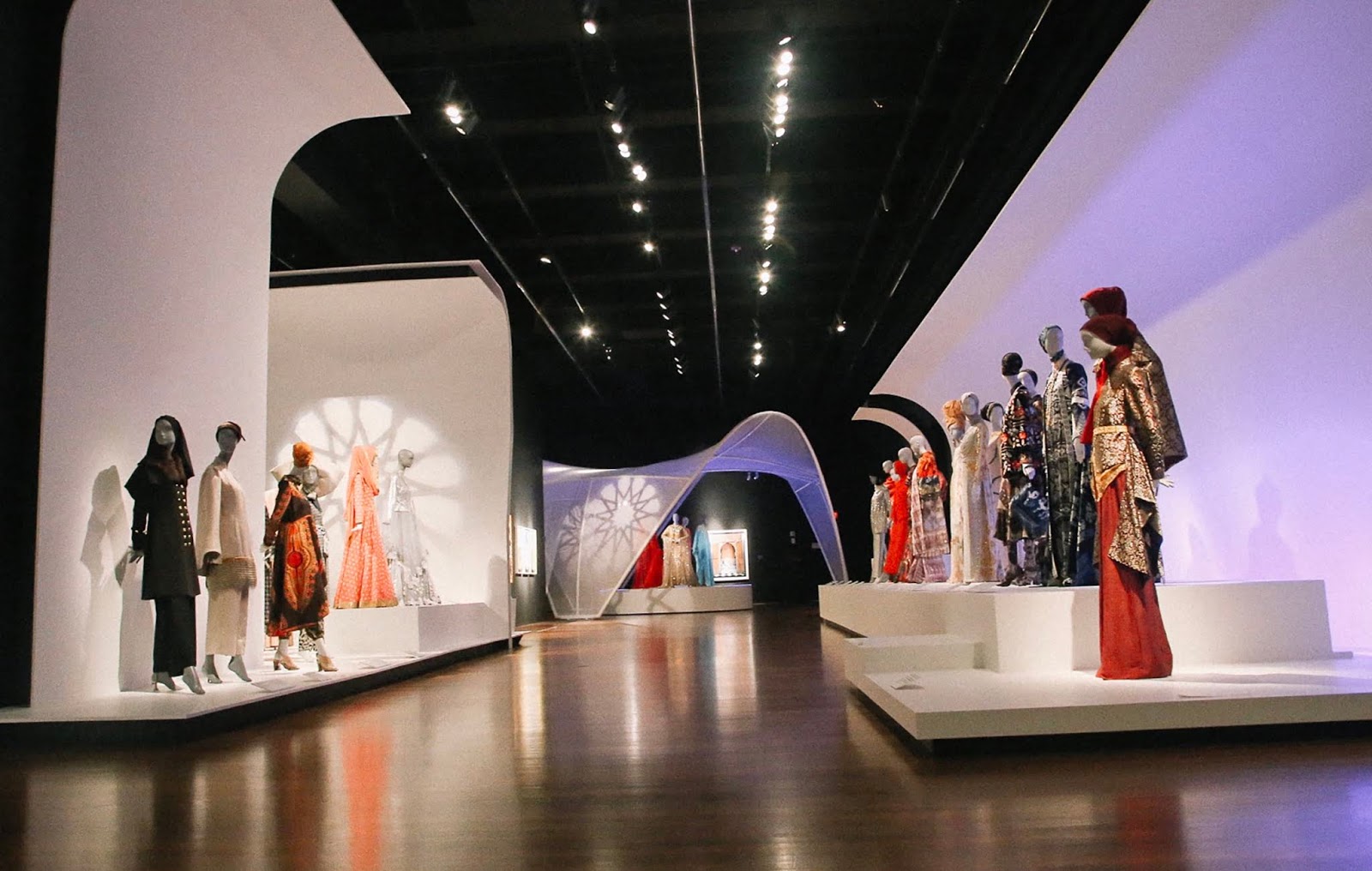
On art and fashion: Contemporary Muslim Fashions

Thanks to social media, I have become Facebook friends with several Tunisian women, all whom are Muslim. Some of them cover their heads in colorful headscarves, known as hijabs; most do not. Each have become individuals of style within and beyond their communities in this North African country bordered by Algeria, Libya and the Mediterranean Sea, as I’ve learned firsthand through many thoughtful online conversations. While the nature of the Muslim dress code worldwide is a complex and diverse one, like it or not, Muslim fashion has become part of the mass-media’s attention drawn to contemporary Muslim life.
Currently, the deYoung Fine Arts Museum in San Francisco is examining Contemporary Muslim Fashions by “spotlighting places, garments, and styles from around the world,” in a show that began in late September and continues through January 6, 2019.

Contemporary Muslim Fashions is the first major museum exhibition to explore “the complex, diverse nature of Muslim dress codes worldwide” by bringing together different religious interpretations and cultures of Islam. The creativity and diversity – and politics – of modest dressing is celebrated.


I’ve learned that this exhibition considers “how Muslims define themselves – and are defined – by their dress and how these sartorial choices can reflect the multifaceted nature of their identities.”

Contemporary Muslim Fashions crosses through many different religious interpretations and cultures, featuring spectacular creations from a dynamic fashion scene by designers from both the Middle East and Southeast Asia – think Malaysia and Indonesia. From street wear to couture, the exhibition includes “high-end fashions, such as those by Malaysia-based Blancheur; street wear, such as modest designs from London-based Sarah Elenany; sportswear, such as the burkini; and commissioned garments from both emerging and established designers.”


The exhibition also includes the use of social media as a primary material – an agent of change. Muslim voices and personal narratives are framed by using runway footage of fashion shows and news clips as well as documentary and fashion photography.

As visitors to Contemporary Muslim Fashions will learn, while Islam is a multicultural faith, the dress of its followers is “shaped not only by religious principles but also by local customs and traditions and global fashion trends.” Thus, a woman from Tunisia is more likely to be contemporary in her fashion attire than a woman living in Saudi Arabia.


In her review of Contemporary Muslim Fashions for The Hollywood Reporter, critic Celine Semaan wrote, “Because of the current political climate from which it is rising, the show carries a message of hope and acceptance. The act itself of organizing this exhibition is nothing if not a peaceful demonstration of the American values written in the First Amendment: freedom of speech, freedom of expression, freedom of religion.”

Laird Borrelli-Persson of Vogue, in reviewing Contemporary Muslim Fashions, quotes curator Jill D’Alessandro, who believes, “Fashion can be an agent for positive change, for understanding, and breaking down barriers; they (fashion designers) want to exhibit in the United States and in Europe because they want their cultures to be understood.”

One thing’s for sure: There’s a diversity in Muslim fashion that is strikingly beautiful, both for its modern aesthetic and for its street-style appeal.

Photos: Cover – Mary Katrantzou skirt and shirt (silk and polyester), and Malone Souliers shoes.  Bottom – Flight jacket with U.S. Constitution written in Arabic on the back and First Amendment written in English inside, by Slow Factory (Courtesy of deYoung Museum and Google Images). Video: Courtesy of YouTube.com.

Tuesday, January 23, 2018

TimesTalks D.C.: Food is what's going to save America


Last Thursday, The New York Times hosted a most interesting and informative "TimesTalks D.C." roundtable on the future of restaurants, the plight of undocumented workers in the food industry and gender equity in the workplace at George Washington University. The "Future of Restaurants" panelists included James Beard Foundation Award-winners José Andrés (Spanish-American chef and Washington, D.C. restaurateur, often credited for bringing the small plates dining concept "tapas" to America), Danny Meyer (CEO of the Union Square Hospitality Group and founder of the popular Shake Shack casual dining cafes), and Aaron Silverman (owner/chef at Rose's Luxury in Washington, D.C.). The multi-Michelin starred panel was moderated by Kim Severson, national food correspondent for The New York Times.

During the frank and lively 80-minute discussion, which was aired live on Facebook.com/nytimes, Severson started by asking each panelist if they have been practicing their "active male listening" in light of recent stories pertaining to sexual harassment in the workplace, including the restaurant industry.

"We are only as good as the people we have around us ... and we need to be calling out when we see something that is not right," said Andrés, the father of three daughters, about the #MeToo movement happening now in every industry, not just the field of food. "It's about humanity. ... I don't want to have any regrets that I didn't do the right thing."

Meyer, whose New York City-based Union Square Hospitality Group includes Union Square Cafe, Gramercy Tavern and Shake Shack concepts, spoke about the future opening of his first Union Square Cafe outside of New York at the Capitol Crossing complex in Mount Vernon triangle. "The thing that I'm most excited about is starting with the great restaurant community (in D.C.)," he said, which also includes creating safe spaces and promoting diversity. "I think we have an amazing moment to talk about who we want to be going forward right now."

Silverman, whose Little Pearl coffee shop and wine bar evolved out of a daytime cafe (Pineapple and Pearls) he used to operate, responded to a question about the elevation of "ethnic" foods: "I think there is a lot of food that isn't 'American' or French or Spanish that is already being elevated. It's totally happening and I hope to see more of it.

"It feels good to be able to say yes to people. We're just trying to make people happy."

Andrés, whose humanitarian relief effort has resulted in more than 3.2 million meals for hurricane-ravaged Puerto Rico, recently wrote a Washington Post op-ed about immigration reform. He said: "America is about pragmatism. We should be creating smart visas to give opportunities for those people to come in, work, get paid, and go back to their communities."

Later, Andrés summed up the evening's wide-ranging discussion perfectly – and it took just one just one sentence to do it. He said: "At the end of the day, food is what's going to save America."

Photo: © Michael Dickens, 2018.

Tuesday, February 7, 2017

Super Bowl ads: Are you paying attention, Mr. President?


How did I spend my Super Bowl Sunday? Watching the big game, of course. As much as I was riveted by the exciting outcome – New England beat Atlanta, 34-28, after coming from behind to force the first overtime game in the 51-year history of the Super Bowl – I focused on the commercials, too.

This year, many ads contained politically charged messages and several TV spots highlighted hot-button themes such as immigration (Budweiser, 84 Lumber), equal pay (Audi) and inclusion (Coca-Cola). Are you paying attention, Mr. President?

Long after the game ends, collectively, we do seem to remember the commercials, especially the good ones. There were a couple of ads that resonated with me for a variety of reasons, for Coca-Cola and for Airbnb. Both aired early during Sunday evening's Super Bowl LI game broadcast.

In "It's Beautiful," Coca-Cola's message was simple: "Together is beautiful." The Atlanta-based soft drink titan scored a touchdown with its Super Bowl ad that aired just before kickoff, in which culturally diverse Americans sang a multilingual version of "America The Beautiful," in English, Hindi, Arabic and Tagalog.

The 60-second spot designed by Wieden + Kennedy debuted during the 2014 Super Bowl to mixed results and was revived during last year's Rio Olympic Games. However, given the current national conversation many Americans have been sharing about immigration and diversity, its message seemed more relevant. "It's Beautiful" featured plenty of beautiful, multicultural images depicting America as a nation of many races, many ethnicities and many religions. It promoted optimism, inclusion and humanity, themes which seem foreign to the dystopian American carnage being propagated by the Trump Administration. It was beautifully filmed and edited, and given today's political climate, "It's Beautiful" took on a certain poignance this time.


Another commercial worth applauding came from Airbnb, whose politically charged message in its "We Accept" ad spoke volumes about diversity and acceptance: "Acceptance starts with all of us." In its Super Bowl commercial, put together on short notice  – perhaps seen as a Silicon Valley response to President Trump's immigration ban – Airbnb reminded us of this simple but important message: "We believe no matter who you are, where you're from, who you love, or who you worship, we all belong. The world is more beautiful the more you accept." Indeed, the world is more beautiful the more #weaccept. The hashtag went viral by halftime.

Afterwards, I learned Airbnb CEO Brian Chesky announced that the company is aiming to provide short-term housing for 100,000 refugees, disaster survivors, and other displaced persons over the next five years. Additionally, over the next four years, Airbnb will donate $4 million to the International Rescue Committee.

"We couldn't talk about the lack of acceptance in the world without pointing out the challenges in our own community at Airbnb," the company said in a statement following the airing of its ad. "The painful truth is that guests on Airbnb have experienced discrimination, something that is the very opposite of our values. We know we have work to do and are dedicated to achieving greater acceptance in our community."


Looking back on both ads – expressions of American values I support – reminded me of this: I have many multicultural friends – thanks, Facebook – who are close and dear to me. They represent many races and ethnic backgrounds, come from many different religious faiths, and speak multiple languages. I have friends who identify with the LGBTQ community. I have friends who are biracial. I have friends who are raising biracial children and friends who are parenting transgendered children. Thus, it's important to see advertisers, representing both legacy and start-up companies, reaching out to all Americans by conveying positive messages about inclusion, diversity and acceptance. After all, there's no larger TV audience than a Super Bowl audience for spreading a good message.

Regardless of what you think, Mr. President, these ads conveyed the true spirit of our America.

Cover photo: Courtesy of Google Images. Videos: Courtesy of YouTube.

Tuesday, January 17, 2017

On art and politics: "We the People ... "

We the People of the United States ...

In just four days, Donald J. Trump will be sworn in as the 45th President of the United States. With a lot of division surfacing throughout the country, many Americans are looking to art as a means of connecting us as human beings.

We the People ...
 are greater than fear.
"We the People are greater than fear," reads the message of a new poster created by Shepard Fairey, the graphic arts, muralist, illustrator and activist behind the iconic 2008 Hope posters he created for Barack Obama. Another new poster reads "We the People protect each other" and the third one says "We the People defend dignity."

There is a lot of division right now. Trump is not a healer," says Fairey. "Art, on the other hand, is healing and inclusive, whether topically it celebrates humanity, or whether it's just compelling visuals to make a human connection."

Interviewed recently by the PBS NewsHour, Fairey said "it was the right time to make a campaign that's about diversity and inclusion, about people seeing the common bonds we have, and our connections as human beings. The idea was to take back a lot of this patriotic language in a way that we see is positive and progressive, and not let it be hijacked by people who want to say that the American flag or American concepts only represent one narrow way of thinking."

Shepard has created three portraits for the "We the People" campaign. One depicts a Muslim woman wrapped in a hijab resembling an American flag. Another shows a young African-American girl and the third features a Latina female.

We the People ...
protect each other.
Two other artists, the Colombian American muralist Jessica Sabogal and the Chicano graphic artist Ernesto Yerena, each contributed to the project in collaboration with the Amplifier Foundation, a nonprofit that works to amplify grassroots movements and which commissioned the project. Together, the artists hope the faces of "We the People" – standing in for traditionally marginalized groups or those specifically targeted during Trump's presidential campaign – will flood Washington, D.C., on Friday during Inauguration Day.

According to Fairey, "All the subjects (in 'We the People') were photographed by people who relate to them somehow. The Muslim woman was shot by a Muslim photographer, the Latina woman shot by a Latino photographer, and the African-American kid shot by a French African-American woman photographer. We realized that this has got to be a diverse coalition of artists for us to do this, and that while it's good for us to be allies, this campaign really has to be authentically diverse."

Fairey went on to say in the PBS NewsHour interview, "We came to a conclusion as a group that in the language (for these posters) we want to say, 'We reject fear-mongering and exclusion.' But we also wanted to do it in a way that doesn't leave the door open for the Fox News type to say, 'This is reverse racism' ..."

We the People ...
defend dignity.
Adds Fairey: "It's hard to encapsulate the complexity of what we're facing, going into this Trump presidency, in three images. But we chose three groups that are vulnerable. In the history of the U.S., there are a lot of people who fled persecution from Europe on the basis of religious identities. The idea of championing the ideals of our forefathers and then limiting the movement of Muslims – it so confounding that this is not riling more people up. And so it's really time to do some (work) that I think is a counterargument to that, and that's not based on division but based on inclusion. We've seen where division has got us."

A Kickstarter campaign has begun that according to Fairey is "getting great traction." He said a goal of his group is funding an ongoing and expanding range of creative projects, with the next wave of people from all different communities. "We want to allow people to express all their social/political views around a number of issues – LGBT rights, women's rights – because a number of those things are going to be under attack under Trump."

Photos: We the People images by Shepard Fairey; U.S. Constitution courtesy of Google Images.

Tuesday, July 19, 2016

Where do you want to live? A simple question, but ...

For the second consecutive year, Tokyo was selected No. 1 in Monocle's
Quality of Life survey.

It's no secret that the best cities in the world are ones which are vibrant and offer the best quality of life for their residents. The best city environments are those which are tolerant and open-minded, celebrate diversity, have great universities and welcome creativity.

Having quality independent bookshops, green spaces and clean streets as well as efficient transportation systems are big pluses, too.

Back in summer 2007 when Monocle was still just a few months old, the London-based monthly briefing that's become a "must-read" – and a favorite of mine – through its focus on global affairs, business, culture and design, launched its inaugural "Quality of Life" survey, naming the best global cities to call home. Munich was the first No. 1. This year, it's Tokyo reigning at the top for the second consecutive year in the 10th year that Monocle has conducted its "Quality of Life" survey. It's both a source of pride for the cities who make the top 25 list – like receiving a prestigious Michelin star – and every year seems to unearth a surprise or two or three.

Monocle: A briefing on Global Affairs,
Business, Culture & Design.
Over the years, Monocle has added new metrics that take into account both intangibles and infrastructure – from nightlight to pet-friendly parks – which have led to some dramatic changes and brought about a new world order.

"We add to the metrics each year and this time we've measured cities' nocturnal qualities too, from closing times to the places that still serve a good meal after 22.00," wrote Monocle executive editor Steve Bloomfield in a preface to this year's "Quality of Life" survey. "Despite these new metrics, when looking back over the previous surveys it's striking to see how the fundamentals of what makes a livable city have remained the same.

"Among the metrics we still count the number of murders and break-ins, and the average response times of emergency services – because if your city isn't safe it doesn't matter how many art galleries there are. We still grade cities on their transport network too, from infrastructure to cost. Cities that encourage cycling and make it cheap and easy to use public transport continue to score well. So too do those that make it easy to get away; the best cities are connected to the rest of the world. And we still judge our cities on their food, drink and retail – the quality, not just the quantity. Those with a high number of independent bookshops prosper; those with a high number of Starbucks less so."

Bloomfield concludes: "The most livable cities are safe, affordable and exciting. And that will probably still be the case in another decade's time."

While London, Paris and Rome remain three of the biggest tourist destinations in the world, their popularity doesn't necessarily translate into great places to live. Hint: none of the Big three made Monocle's top 25 cities list.

Here are Monocle's top 25 cities in this year's "Quality of Life" survey:

•  1. Tokyo, Japan
•  2. Berlin, Germany
•  3. Vienna, Austria
•  4. Copenhagen, Denmark
•  5. Munich, Germany
•  6. Melbourne, Australia
•  7. Fukuoka, Japan
•  8. Sydney, Australia
•  9. Kyoto, Japan
•10. Stockholm, Sweden
•11. Vancouver, B.C. (Canada)
•12. Helsinki, Finland
•13. Zürich, Switzerland
•14. Madrid, Spain
•15. Hamburg, Germany
•16. Lisbon, Portugal
•17. Düsseldorf, Germany
•18. Hong Kong
•19. Barcelona, Spain
•20. Singapore
•21. Amsterdam, Netherlands
•22. Auckland, New Zealand
•23. Honolulu, Hawaii (USA)
•24. Portland, Oregon (USA)
•25. Montréal, Quebec (Canada)

Of the 25 cities, I have experienced seven of them: Copenhagen, Vancouver, Helsinki, Amsterdam, Honolulu, Portland and Montréal. I've been a return visitor to Vancouver, Amsterdam and Portland numerous times and there's much to enjoy in each of these cities. Vancouver was a welcoming host for both the 2010 Olympic Winter Games and the 2015 Women's World Cup football championships and I'm glad to have experienced both events as well as both winter and summer weather in Vancouver.

In justifying Tokyo's No. 1 ranking, Monocle wrote: "... the city's round-the-clock economy is a key feature that makes it one of the most attractive places to live and visit. With a conveniently located international airport open 24 hours a day, bookshops that open at 07.00 and close at 04.00, and restaurants and shops that never close, Tokyo recognizes the pull of being open all hours."

Tuesday, August 11, 2015

Quality of Life: Naming the best places to call home


No. 1 Tokyo / Provides great quality of life for those who live and visit.

"What makes the good life and where can we find it?" asks Monocle, the global affairs and culture magazine that's published in London. While great cities adapt and change like their residents, it's worth asking: How do we create cities that deliver quality of life for everyone?

Stanley Park / Vancouver, B.C. 
It's no secret that the best cities in the world are ones which are vibrant and offer the best quality of life for their residents. The best city environments are those which are tolerant and open-minded, celebrate diversity, have great universities and welcome creativity. Having quality independent bookshops, green spaces and clean streets as well as efficient transportation systems are big pluses, too.

In summer 2007 when the magazine was still just a few months old, Monocle launched its inaugural Quality of Life list, naming the best global cities to call home. Munich was the first No. 1. Over the years, its added new metrics that take into account both intangibles and infrastructure which have led to some dramatic changes and brought about a new world order. While London, Paris and Rome remain three of the biggest tourist destinations in the world, their popularity doesn't necessarily translate into great places to live.

Place de la Concorde / Paris
"Now we know we are not the only people to draw up a ranking of great metropolises but ours is different," writes Monocle editor Andrew Tuck, in the preface to this year's Quality of Life list. "For a start we ensure that we are not just looking at data about the quality of education or the cleanliness of the streets but also the softer elements that inspire you to make a city your base: cinemas, bars, opening hours. And while much of our survey is pretty data-driven we are happy to say that a good amount comes from the views of our correspondents and editors. And it is also tilted to our readers' needs; we know, for example, that while that Alpine city is cute it's also woefully disconnected and lacks even a modest airport -- so it's not in the running for us."

This year, Monocle also took into account another annoyance: "cities where the cost of living prohibits old bookshops from staying in business or young entrepreneurs finding a start-up space." I guess that's why San Francisco didn't make the Top 25 and Portland, Oregon did.

So, when the ninth annual Quality of Life list was published in Monocle's July/August issue, a new number one emerged for 2015 -- say hello to world No. 1 Tokyo.

On Tokyo, Monocle wrote: "A new and worthy winner. Monocle has made little secret of its love for Tokyo through the years and it does something no other global city can: provides great quality of life for those who live and visit. London and New York, take note.

"Tokyo has appealed to many outsiders and for many different reasons: its cleanliness, tolerance, politeness and difference, as well as its sheer scale, which has always allowed foreigners to bathe in comfortable anonymity. ... It was recently identified as the world's safest city, a stereotype that residents can happily attest to. ... At the heart of this unexpected sense of security is Tokyo's defining paradox: its heart-stopping size and concurrent feeling of peace and quiet."

Powell's City of Books / Portland, Oregon
Monocle asked its contributors, which included architects, chefs, writers and directors, to consider what draws them to their favorite cities and what quality of life means to them.

"Quality of life is ... simple pleasures," wrote Mari Shapiro, founding director of Protocinema, which creates contemporary-art exhibitions. "What makes life good is simultaneously a very simple and complicated question. It is about being in a city that allows you to do or have what makes you happy. Ultimately, this issue often comes down to class and economy and the cities with the best quality of life are those in which the basic pleasures -- to be safe, to have the time to enjoy food, to be engaged with culture, with friends and family -- are available to people of any means. At the top of my list is Istanbul: a strong cay or a grilled fish for a few lira by the Bosphorus is available to anyone."

Bloemenmarkt / Amsterdam 
One thing Monocle hopes, as in previous years, is that the Quality of Life list provokes a stimulating and lively debate.

At the very least, for me, it's always interesting to pour over the list and see how many of the cities I've visited in person -- six (Vancouver, Helsinki, Copenhagen, Paris, Amsterdam and Portland).


Here is Monocle's 2015 Quality of Life ranking of the top 25 cities in the world:

  • 1. Tokyo
  • 2. Vienna
  • 3. Berlin
  • 4. Melbourne
  • 5. Sydney
  • 6. Stockholm
  • 7. Vancouver
  • 8. Helsinki
  • 9. Munich
  • 10. (tie) Zürich and Copenhagen
  • 12. Fukuoka
  • 13. Singapore
  • 14. Kyoto
  • 15. Paris
  • 16. Madrid
  • 17. Auckland
  • 18. Lisbon
  • 19. Hong Kong
  • 20. Amsterdam
  • 21. Hamburg
  • 22. Geneva
  • 23. Oslo
  • 24. Barcelona
  • 25. Portland
To watch a film on the Monocle Quality of Life Survey 2015:
http://monocle.com/film/affairs/the-monocle-quality-of-life-survey-2015/

Photographs: Tokyo - Google Images; Amsterdam, Paris, Portland, and Vancouver by Michael Dickens © 2012 and 2015.


Wednesday, July 22, 2015

Renegade Craft Fair: A celebration of all things handmade


Renegade Craft Fair / This annual event has become one of my favorite
San Francisco things to do.

The Renegade Craft Fair at San Francisco's Fort Mason is a celebration of all things handmade in a variety of media. Last weekend's annual Renegade event provided hundreds of artists and craft makers a chance to escape their studios and step into a relaxed, festive and lively atmosphere.

Since its debut in 2003, the Renegade Craft Fair has showcased the best and brightest in Etsy indie craft and design, and it's become a major player in a booming DIY (Do It Yourself) craft movement in the U.S. and elsewhere.

Each year, the Renegade Craft Fair visits seven U.S. cities (Austin, Brooklyn, Chicago, Los Angeles, Portland, San Francisco and Seattle) plus London. The San Francisco summer happening comes in mid-to-late July. I've been a Renegade Craft Fair goer for the past five summers, and it's become one of my favorite San Francisco things to do.

BambuEarth / Natural, sustainable, ethical, vegan, local
handmade soap.
From new and traditional to modern and innovative, there's always a diversity of art and style at the Renegade Craft Fair and this year was no different from the past. For me, I find it truly interesting to see what's new and hip in the areas of art, clothing, jewelry, photography, quilts, toys and other knick-knacks -- and to be able to meet and mingle with the artists behind these creations.

On Sunday, my wife and I were among thousands gathered inside both the Herbst Pavilion and the Festival Pavilion at Fort Mason to see over 450 modern makers of art.

There were arts and crafts enthusiasts, a poetry store, media scouts and taste makers -- even savvy shoppers stocking up early on unique, artist-created gifts for the end of the year holidays.

Of the 2015 Renegade San Francisco craft makers, one in particular garnered my interest and attention: Jordan Graves, a young, twenty-something artist from Savannah, Ga., whose Repeat Offfender -- yes with 3 f's in Offfender -- whose multi-disciplinary approach to art "generates patterns with digital artifacts for surface design, jewelry, and motion graphics."

According to her website, the multidisciplinary work of Repeat Offfender grew out of Graves' work towards a B.F.A. degree in Motion Media Design at the Savannah College of Art and Design.

Sprouted Spirals / 3D printed jewelry by Jordan Graves.
Graves greeted my wife and I with a cute and polite smile as we perused her creative and colorful stud earrings -- she calls them "Sprouted Spirals."

They came in a variety of cool colors, including: white, black, red, blue, pink, purple, orange and yellow.

We were excited and so was Graves.

I asked what inspired her art and without any hesitation, Graves answered my question with interest and enthusiasm by saying it was her interest in textile design combined with a passion for digital roots -- you know, mathematics. Thus, Graves' combination of interests morphed into her unique creation of 3D printed jewelry.

Perusing Graves' website for Repeat Offfender is not only enjoyable, it's also about taking a deeper look into how she bridges her motion graphics background into her work and to see what is influencing her new collections. It's all about happy bright colors.

Photographs: BambuEarth by Michael Dickens ©2015; Repeat Offfender booth and Sprouted Spirals courtesy of RepeatOfffender.com. 

Tuesday, August 14, 2012

Just because: Why we fall in love with the Summer Olympic Games every four years


Golden smiles  x 4 / The American 4 x 100 meter medley relay team
of Allison Schmitt, Dana Vollmer, Rebecca Soni and Missy Franklin
display their gold medals after setting a world record.

Every four years we fall in love with the Summer Olympic Games. And, this year, there were plenty of reasons to fall in love with the London Summer Games.

NPR sports commentator Frank Deford observed that the Olympics are "like an independent movie with foreign actors you've never heard of." Further, he said, it's quite alright if we "cheer for people you've never heard of in a sport you don't care about just because."

During the London Summer Games' fortnight, which wrapped up Sunday night with a smashing three-hour finale that featured a jukebox of British music idols as well as an Eric Idle sing-a-long of "Always Look on the Bright Side of Life," I found myself cheering for athletes I had never heard of in sports that rarely receive any mention in my country just because ... just because I cared enough to want to. And it was fun.

Golden moment for Team GB / Heptathlete Jessica Ennis basked in
triumph as she won the heptathlon 800 meter run
 and secured a gold medal for Great Britain.

As a result of watching a lot of Olympics coverage live on the BBC via the Internet (here in the U.S., the glamor sports of swimming, gymnastics, diving and track and field aired on tape delay to garner larger nighttime audiences), I got caught up in cheering for a lot of Great Britain's Olympic hopefuls like "Team GB" track cyclist Sir Chris Hoy, heptathlete Jessica Ennis and gymnast Beth Tweddle.

Also, thanks to having a lot of Facebook friends from Tunisia, I rooted for their country's athletes like Malek Jaziri (tennis), Habiba Ghribi (athletics) and Oussama Mellouli (indoor and outdoor swimming). And, I marveled at the achievements of David Rudisha of Kenya, who set a world record in winning the men's 800 meters, and little Meseret Defar of Ethiopia (5-feet-3, 95 pounds), who won an exciting women's 5,000 meter race, then pulled a cloth picture of the Virgin Mary from her track top, held it aloft, and kissed it before breaking down in tears of joy, crying: "I won, I won."

David Rudisha / He set a
world record in winning
the gold medal in the
men's 800 meter run.
Mind you, I thrilled in cheering for the U.S. on the basketball court, in the swimming pool and on the Olympic Stadium running track throughout the fortnight, too.

Before the start of the Summer Olympics, Lord Sebastian Coe, the two-time Olympic gold medalist in the 1,500 meters from Great Britain who headed the London organizing committee, said the London Summer Games would be "the Games for everyone."

And they were.

The London Summer Games will be remembered as the most diverse and inclusive Summer Olympics ever.

American gymnast Gabby Douglas in flight / Color her a winner
as she won the gold medal in the women's all-around.

Three traditionally-conservative Islamic nations, known for their cultural and political restrictions of women ~ Saudi Arabia, Brunei and Qatar ~ sent their first female athletes to the Olympics. The London Games will also be remembered for a double-amputee runner (Oscar Pistorius of South Africa, who earned the nickname "The Blade Runner"); an African-American gymnast (Gabby Douglas of the U.S., who became the first woman of color to win the gymnastics all-around gold medal); and an openly gay soccer player whose acceptance by her teammates was very refreshing (Megan Rapinoe of the U.S., who became the first prominent American soccer player to come out in the media).

The world's Olympic athletes, representing 204 nations of the world, came from all walks of life just like the fans who cheered for them. And, their stories were quite compelling, too.

Inclusive but alone, too / Sarah Attar became the first female Saudi
athlete to compete in an Olympic track and field event. 

Last Wednesday, an Olympic milestone was achieved when the first woman track and field athlete representing the Kingdom of Saudi Arabia competed. Sarah Attar, 19, born and raised in the U.S. of a Saudi father and an American mother and who holds dual citizenship, ran in the last heat of the 800 meter run. A cross-country runner at Pepperdine University in Calfornia, Attar's Olympic experience lasted less than three minutes.

Sarah Attar wore a white hijab
and a green and black track suit
that covered her arms and legs
to comply with Saudi Arabia's
strict interpretation of
Islamic law.
Attired in a white hijab and a black and green track suit that covered her arms and legs to comply with Saudi Arabia's strict interpretation of Islamic law, Attar received a standing ovation from many in the crowd at Olympic Stadium as she crossed the finish line alone, well behind the others in her heat. Although she finished last in her heat in 2 minutes 44.95 seconds, about 41 seconds behind the first-place finisher, Attar had much to smile about her experience.

Attar said she wanted to represent Saudi Arabia at the Olympics as a way of inspiring women. "This is such a huge honor and an amazing experience, just to be representing the women," she said, following the conclusion of her race. "I know that this can make a huge difference. Hopefully, this sparks something amazing."

A few other milestones worth sharing from the Olympic fortnight:

  • Malaysian diver Pamg Pandelela Rinong won the first-ever diving medal for Malaysia when she won a bronze medal in the 10 meter platform competition. "I feel a great honor to win the historic medal for my country," said Pamg, who was the flag bearer for Malaysia at the opening ceremonies. "I'm very proud of Malaysia for the breakthrough, and hope my country is also proud of me," she added.
  • The tiny Caribbean nation of Grenada (population 109,000) became the smallest country to win an Olympic gold medal when 19-year-old Kirani James won the men's 400 meter sprint.
  • Before the London Games, the last all-male sport in the Olympics was boxing. No more, as the first gold medals in women's boxing were awarded in three different weight classes. Great Britain's Nicola Adams became the first female to win an Olympic gold medal. Then, Ireland's Katie Taylor won her country's first gold medal of the 2012 Games. Finally, Claressa Shields won the first U.S. women's boxing gold medal. "It's a dream come true," Adams told BBC Sport. "I am so happy and overwhelmed with joy right now. I have wanted this all my life and I have done it."
A bronze moment / Pamg Pandalela Rinong won Malaysia's first-ever
diving medal. "I hope my country is ... proud of me."

The American poet Maya Angelou, who has written about diversity and inclusion throughout her lifetime, observed: "We all should know that diversity makes for a rich tapestry, and we must understand that all the threads of the tapestry are equal in value no matter what their color."

A friend of mine from England shared their perspective about the Games with me that are worth sharing with you: "As a nation, Great Britain has found itself not only through its medal success (Team GB won a total of 65 medals, including 29 golds), but by realizing that we are a truly diverse and inclusive nation who welcome and celebrate the success of all."

While the London Summer Games have been about "inspiring a new generation," these Olympic Games will be remembered for its diversity and inclusiveness, too.

Indeed, breaking down barriers one medal at a time, and welcoming and celebrating the success of all.

Various photographs courtesy of The Guardian.co.uk, 2012.
Photograph of David Rudisha courstesy of nbcolympics.com, 2012.
Image of Sarah Attar courtesy of NBC, 2012.