Showing posts with label travel. Show all posts

Wednesday, January 1, 2020

At the year’s end, one last 2019 travel adventure


Once upon a time, the beloved and respected American actor Alan Alda suggested that you have to leave the city of your comfort and go into the wilderness of your intuition. “What you’ll discover,” he said “will be wonderful. What you’ll discover is yourself.”

As we begin the New Year, 2020, no matter where we may be or reside in the world, it’s worth a moment of our time to consider the meaning of Alda’s words.

Last Sunday, my wife and I returned from a brief but eventful five-day holiday visit to New York City, our fourth trip there during 2019. Each time we go – and it’s only a 3 1/2-hour trip via the Amtrak Northeast Regional – we try to see a different part of what is arguably one of the greatest cities in the world. Our post-Christmas, pre-New Year’s visit rewarded us with a wonderful opportunity to discover new things – and, this time, from a Lower East Side perspective. It was worth it.

Our visit began with theater – we saw the much anticipated “David Byrne’s American Utopia” at the intimate Hudson Theatre (once home to NBC’s “Tonight Show” back in the early 1950s Steve Allen era), featuring a tour de force performance by the Talking Heads superstar that was part TED talk, part rock concert, and very much a bare-footed dance spectacle. There were crowd-favorite hits newly arranged by Byrne like “Once in a Lifetime” and “Burning Down the House,” that complemented songs covering the 67-year-old’s post-Heads solo career. All together, they wove a narrative in which Byrne tried to help his audience find a sense of happiness in these troubled times we all live in.


Our visit included shopping, from loading up on mouth-watering Lindt chocolates to finding new fashion at Uniqlo’s expansive Fifth Avenue headquarters near the Museum of Modern Art just above Rockefeller Plaza, where there was plenty of activity centering around its colorful, larger-than-life Christmas tree and popular skating rink.

We enjoyed a satisfying, educational day visiting two of the city’s finest museums – the newly re-opened MOMA, where we braved the crowds hovering around Van Gogh’s “The Starry Night” and Monet’s “Water Lillies,” and a hidden gem in the Tenement Museum, located at the corner of Orchard and Delaney streets in the Lower East Side, about a five-minute walk from the Hotel Indigo, where we lodged during our stay.


All along our journey in New York City, which the cast of Hamilton describes it as “the greatest city in the world,” there was plenty of wonderful food awaiting us, from the delicious dim sum at Nom Wah Tea Parlor in Chinatown on Christmas Evening (very much worth the 75-minute wait just to get a table); to a pre fixe epicurean delight at Butter in Midtown; to late night posh doughnuts at the Donut Pub in Chelsea; and, finally, deli delights at Russ & Daughters Appetizers (bagels with cream cheese) and Katz’s (cheese blintzes).


New York City is a place in which I could never see myself getting bored. There’s always plenty of interesting things to explore and admire – and to be curious about – any time of the day or night.

As I learned once again, it’s easy to get caught up in the city’s history. I was reminded of this when I learned about late 19th/early 20th-century shop life at 97 Orchard Street while visiting the Tenement Museum. I was reminded of this through the art I saw at MOMA; as well as in the Puerto Rican-infused jazz music I heard at Jazz at Lincoln Center. Also, in the theater I enjoyed on Broadway with “David Byrne’s American Utopia,” and from the tremendous choice of food – where, if you think about it, there’s every imaginable ethnic cuisine to be discovered and eaten.


There’s plenty to explore in New York City. I know I’ll be back, again, soon.

In the meantime, I look forward to 2020 and the New Year that awaits. Hopefully, it will be a year full of new discoveries and new travel adventures. It is truly my hope that yours will be filled with new discoveries and new travel adventures, too.

Safe travels and Happy New Year!

Photographs: Michael Dickens, © 2020.

Tuesday, February 12, 2019

Thoughts on travel: Leaving your baggage behind

Rick Steves /
PBS travel host,
writer and activist
During my recent visit to Seattle while attending the American Library Assocation’s mid-winter conference, I sat in on an engaging and informative lecture by Rick Steves. He’s the longtime PBS travel host, writer and activist, who spoke about the need to understand our fellow human beings in other countries.

During his lively one-hour conversation, Steves emphasized the importance of traveling outside our comfort zone in order to learn about other people and cultures. One of his goals, I learned, has been to inspire and equip Americans to venture beyond Orlando’s Disney World. The Washington native was clearly a man on a mission on this Sunday morning. He was preaching to the choir – and it gave him its undivided attention.

Certainly, Steves is one who is not afraid to travel. In fact, for decades, he’s been crafting European tour experiences for Americans. By his estimation, he’s spent about a third of his adult life traveling throughout Europe. However, it was following the 9/11 tragedy in 2001 that Steves began to view politics as inextricable from travel.

“A life of travel can be a catalyst of peace,” Steves told his Seattle audience. He’s got a book out to back up his talk, ‘Travel As a Political Act,’ which is in its third edition (Hackett Book Group, 2018).

“When someone tells me to have a safe trip, I’m inclined to say, ‘Well, have a safe trip at home,’” said Steves. Despite Europe being statistically safer than the U.S., he noted that “Our country has never been more fearful.

“Fear is for people who don’t get out very much. The flip side of fear is understanding, and we gain understanding when we travel.”

Rick Steves signing
copies of his book,
‘Travel as a Political Act.’
Steves spoke of the importance that travelers need to get out of their comfort zone and show empathy for the rest of the world. “I’m into reality and humanity,” he said. “There’s a lot of baggage we are clueless to. We need to know about other country’s baggage. It’s important to understand baggage.”

If you think about it, and certainly Steves emphasized it, when you meet people along your travels – and take the time to discover their interests – it fosters an understanding of others and of the world at large.

“You go to France and step into a cheese shop, and it’s a festival of mold. The cheesemonger is evangelical,” said Steves. It’s one of many times that he drew laughter. “In Ireland, I enjoy the sensation that I’m understanding a foreign language. Forget your schedule, this is why you’re there. Get into a conversation.

“Europe knows how to work hard, but it knows how to play, too.”

He added, “You travel and realize the American dream is great, but it’s not unpatriotic to recognize there are other dreams.”

Saturday, November 24, 2018

Thoughts on art and travel: Revisiting an artistic interior

An artistic interior /
Interior of the Church of Saint Bavo
by Dutch artist Pieter Saenredam
As I ready to visit Europe next month for the first time in six years, I am reminded of the last time I crossed the Atlantic Ocean. It was during a spring holiday in 2012, and my travel included visits to Amsterdam and Brussels, with a quick day trip by train to Paris. As I recall, I spent part of a Sunday afternoon visiting the Rijksmuseum in Amsterdam. For me, spending time in art museums is always time well spent. And, if you're lucky like I was on that day, you just might learn something new, too.

In an exhibit featuring a retrospective of Dutch artists, I came across a 17th-century painting depicting the interior of the Saint Bavo Church in Haarlem, the Netherlands, by Pieter Jansz. Saenredam.

Saenredam (1597-1665), who was the son of a printmaker and draughtsman, painted this oil on panel of the light-filled interior of Saint Bavo Church in 1636. Saenredam painted no fewer than six "portraits" of Saint Bavo, considered by many as one of the finest Gothic buildings still in existence today. Each time, he focused on one of the organs. Here, he depicted the Resurrection of Christ on the open shutter of the organ. He mixed gold powder with his paint to represent the gold in the painting. In describing the ornamentation of this painting, the Rijksmuseum website wrote: 

"At the time Saenredam painted the Saint Bavo Church, leading music-lovers were campaigning for more organ music to be played in church services. Calvinist ministers object to organ music. Little music was played in church and psalms were sung unaccompanied. The ministers would rather have had no organs at all in church because they felt the beautifully decorated organs were evidence of ostentation and excess. Haarlem's music-lovers handed a petition to the town council, in which they asked to be allowed to use the organ, 'the ornament of the church', everyday. It is possible that Saenredam gave the organs a prominent position in his painting in support of this campaign."

(As an aside, the interior of the church, which was originally Roman Catholic, was stripped of all of its embellishments, including statues and paintings, by the Protestants following the iconoclasm of the Protestant Reformation.)

What I learned in researching the artist and the painting is this: Saenredam was the first Dutch painter to specialize in church interiors. His precise on-the-spot observations and detailed perspectives helped us to have a better understanding and appreciation for these architectural marvels. And, through the addition of including tiny figures, he helped to emphasize the height and immensity of the church. Finally, in some of his interior paintings, the artist used a central perspective: All the lines in the painting disappear in a single point.

The Getty Center in Los Angeles, California, which owns one of Saenredam's interior paintings of Saint Bavo, commented on his work in its website:

"The overall impression is one of strong verticality, soaring space, and penetrating light, a spiritual reference to the heavens above. The inclusion of small figures accentuate the viewer's experience of exalted interior space. Saenredam described architectural elements in great detail: vaulted ceilings, moldings, decorative capitals, clustered pillars, and clerestory windows."

Saenredam made his first drawing of the interior of the church of Saint Bavo in 1626. From then on, he devoted himself almost exclusively to painting church interiors, always using precise perspective. Of his fifty surviving paintings, almost half show the interiors of two churches, Saint Bavo and the Mariakerk in Utrecht.

What can we learn from Saenredam's sacred interior spaces? For one, they were designed for contemplation. Unlike others whose paintings evoked a certain type of pomp, pageantry, and theatre that was usually seen in Roman Catholic churches, Saenredam's surprisingly modern paintings evoked "the whitewashed austerity of the Dutch Reformed church," says the Getty Center.

In describing Saenredam's style and viewpoint, the Getty Center said: "There are no processions, no clusters of worshippers at shrines. He adopted a very low viewpoint and a palette restricted to the palest of tones, and allowed few people into his bare interiors. He concentrated on depicting light, color, and space. Many Dutch artists continued his tradition, but few equaled his inventive vision." 

Indeed, Saenredam's painting of the interior of the Church of Saint Bavo owes its poetry to his desire to paint a faithful rendering, one that is careful and accurate.

Note: An original version of this blog post was published on July 10, 2012.

Tuesday, December 26, 2017

At the year's end, one last 2017 travel adventure

St. Patrick's Cathedral along Fifth Avenue.
It was Alan Alda, one of my country's most beloved and respected actors, whom many of us remember as Hawkeye Pierce in the long-running American TV series "M*A*S*H," who once gave a bit of wise advice that's resonated with me. As we awake to the final week of 2017, no matter where we may be or reside in the world, it's worth a moment of our time to think about what he said.

"You have to leave the city of your comfort and go into the wilderness of your intuition. What you'll discover will be wonderful. What you'll discover is yourself," said Alda.

Now that my wife and I live on the East coast, we enjoy escaping to New York City. It's only 3 1/2 hours by train – and Amtrak has several Northeast Regional trains that travel between Washington D.C.'s Union Station and New York City's Penn Station daily.

Since moving to the Beltway, we've traveled to New York City by train twice, most recently last weekend. Each time, there are new discoveries that await us and it provides us with a chance to rediscover old things from a different perspective.

The Radio City Music Hall Christmas Spectacular.
Whereas, our previous trip over Labor Day weekend was very much an Upper West Side experience, last weekend we found ourselves in the thick of the Christmas holiday revelry as we lodged a block off Times Square at the Hotel Muse on West 46th Street, between Sixth and Seventh Avenues. We were a short walk from Rockefeller Center and Radio City Music Hall, where we caught a glimpse – along with thousands of other tourists – of the tall and majestic Rockefeller Center Christmas tree and ice skating rink. Also, we saw the nearby festive holiday windows of Saks Fifth Avenue, the Neo-Gothic magnificence St. Patrick's Roman Catholic Cathedral, and took in a late Friday evening performance of the Radio City Christmas Spectacular at Radio City Music Hall. The headlining Rockettes are truly a one-of-a-kind New York experience and Radio City Music Hall is an art deco masterpiece that has been truly well-preserved and taken care of over the years.

Grand Central Terminal in New York City.
On Saturday, we rode the subway to Herald Square – to the land of "Believe" – and shopped at Macy's flagship New York City store.

Then, we ventured to Grand Central Terminal to shop at a lovely boutique holiday fair and to also enjoy warm soup on what turned out to be a wet and cold wintry day.

Later, our evening included dining and listening to seasonal holiday music at Jazz at Lincoln Center – and it was most welcome and enjoyable.

We'll be back in 2018 to see Hamilton.
New York City is a place that never sleeps and I could never see myself getting bored. There's always plenty to see and do and admire and be curious about. I know we'll be back next year as we have tickets to see Hamilton.

I look forward to 2018 and the New Year that awaits. Hopefully, it will be a year full of new discoveries and travel adventures. I hope yours will be filled with new discoveries, too.

Safe travels and Happy New Year!

Tuesday, December 6, 2016

Projecting an identity through fashion in flight

Everyday is a fashion show and the world is your runway. – Coco Chanel


Qantas c. 1986 /
Design by YSL
During a recent visit to the International Terminal at San Francisco International Airport, everywhere I looked there were colorful displays showcasing a history of airline uniforms worn by airline passenger-service and safety professionals – once called stewardesses and hostesses, and more recently flight attendants. This distinct type of fashionable attire – from haute couture to comfortable mix and match – has become a part of our popular culture. As I looked over the uniforms and learned more about them, I realized that not only have I been flying as an airline passenger for many years, but it made me nostalgic for travel when flying from destination to destination was fun and exciting instead of a stressful exercise in navigating from Point A to Point B.

Pan American c. 1975
Design by Edith Head
In Fashion in Flight: A History of Airline Uniform Design, on display in SFO's International Terminal Main Hall and the Aviation Museum & Library through January 2017, the seventy uniforms that comprise the exhibition date from 1930 to 2016 and include the work of a veritable who's who of more than thirty designers, including: Bill Blass, Piere Cardin, Oleg Cassini, Halston, Edith Head, Ralph Lauren, Valentino and Yves Saint Laurent. The long list of their clients includes past and present U.S. airlines such as American, Braniff, Continental, Delta, TWA and United, as well as international carriers Aeroméxico, Air France, Cathay Pacific, Japan Airlines, Qantas and Virgin Atlantic.

The vibrant and colorful outfits and accessories in Fashion in Flight are designed to not only "signify a distinct role in the workplace," but they also project a sense of identity for each airline – and they reflect prevailing fashions of the times, too. Through the years as airline fashion evolves and hemlines lift up and touch down, the passenger cabin has become a different kind of fashion runway.

Fashion statement /
United Airlines c. 1968 by Jean Louis.
If style is primarily a matter of instinct, as the American fashion designer Bill Blass suggests, then decade by decade, one notices a transformation from the tailored-suit look of the late 1930s to WWII's military influence, from postwar Paris haute couture to stylish New York designs – even interstellar chic as the 60s space age takes off. With the age of jet travel booming, bringing with it highly expressive uniforms, flight attendant fashion takes center stage. By the late 1970s, I learned, "pluralism and neo-traditionalism are seen emerging" and continuing into the '90s.

Finally, the business-like look of uniforms we see today – especially on U.S.-based carriers such as American, Delta and United – "have allowed greater contrast and noticeability for airlines that continue to engage celebrated designers in order to present contemporary fashion as an important part of the air travel experience."

Cover photo: Braniff International Airways hostess in uniform by Emilio Pucci c. 1965.
Cover photo and United Airlines photo: Courtesy of San Francisco Airport Commission, www.flysfo.com
Qantas and Pan American photos by Michael Dickens © 2016.


Tuesday, July 19, 2016

Where do you want to live? A simple question, but ...

For the second consecutive year, Tokyo was selected No. 1 in Monocle's
Quality of Life survey.

It's no secret that the best cities in the world are ones which are vibrant and offer the best quality of life for their residents. The best city environments are those which are tolerant and open-minded, celebrate diversity, have great universities and welcome creativity.

Having quality independent bookshops, green spaces and clean streets as well as efficient transportation systems are big pluses, too.

Back in summer 2007 when Monocle was still just a few months old, the London-based monthly briefing that's become a "must-read" – and a favorite of mine – through its focus on global affairs, business, culture and design, launched its inaugural "Quality of Life" survey, naming the best global cities to call home. Munich was the first No. 1. This year, it's Tokyo reigning at the top for the second consecutive year in the 10th year that Monocle has conducted its "Quality of Life" survey. It's both a source of pride for the cities who make the top 25 list – like receiving a prestigious Michelin star – and every year seems to unearth a surprise or two or three.

Monocle: A briefing on Global Affairs,
Business, Culture & Design.
Over the years, Monocle has added new metrics that take into account both intangibles and infrastructure – from nightlight to pet-friendly parks – which have led to some dramatic changes and brought about a new world order.

"We add to the metrics each year and this time we've measured cities' nocturnal qualities too, from closing times to the places that still serve a good meal after 22.00," wrote Monocle executive editor Steve Bloomfield in a preface to this year's "Quality of Life" survey. "Despite these new metrics, when looking back over the previous surveys it's striking to see how the fundamentals of what makes a livable city have remained the same.

"Among the metrics we still count the number of murders and break-ins, and the average response times of emergency services – because if your city isn't safe it doesn't matter how many art galleries there are. We still grade cities on their transport network too, from infrastructure to cost. Cities that encourage cycling and make it cheap and easy to use public transport continue to score well. So too do those that make it easy to get away; the best cities are connected to the rest of the world. And we still judge our cities on their food, drink and retail – the quality, not just the quantity. Those with a high number of independent bookshops prosper; those with a high number of Starbucks less so."

Bloomfield concludes: "The most livable cities are safe, affordable and exciting. And that will probably still be the case in another decade's time."

While London, Paris and Rome remain three of the biggest tourist destinations in the world, their popularity doesn't necessarily translate into great places to live. Hint: none of the Big three made Monocle's top 25 cities list.

Here are Monocle's top 25 cities in this year's "Quality of Life" survey:

•  1. Tokyo, Japan
•  2. Berlin, Germany
•  3. Vienna, Austria
•  4. Copenhagen, Denmark
•  5. Munich, Germany
•  6. Melbourne, Australia
•  7. Fukuoka, Japan
•  8. Sydney, Australia
•  9. Kyoto, Japan
•10. Stockholm, Sweden
•11. Vancouver, B.C. (Canada)
•12. Helsinki, Finland
•13. Zürich, Switzerland
•14. Madrid, Spain
•15. Hamburg, Germany
•16. Lisbon, Portugal
•17. Düsseldorf, Germany
•18. Hong Kong
•19. Barcelona, Spain
•20. Singapore
•21. Amsterdam, Netherlands
•22. Auckland, New Zealand
•23. Honolulu, Hawaii (USA)
•24. Portland, Oregon (USA)
•25. Montréal, Quebec (Canada)

Of the 25 cities, I have experienced seven of them: Copenhagen, Vancouver, Helsinki, Amsterdam, Honolulu, Portland and Montréal. I've been a return visitor to Vancouver, Amsterdam and Portland numerous times and there's much to enjoy in each of these cities. Vancouver was a welcoming host for both the 2010 Olympic Winter Games and the 2015 Women's World Cup football championships and I'm glad to have experienced both events as well as both winter and summer weather in Vancouver.

In justifying Tokyo's No. 1 ranking, Monocle wrote: "... the city's round-the-clock economy is a key feature that makes it one of the most attractive places to live and visit. With a conveniently located international airport open 24 hours a day, bookshops that open at 07.00 and close at 04.00, and restaurants and shops that never close, Tokyo recognizes the pull of being open all hours."

Tuesday, January 5, 2016

My New Year's resolution? Read more books!


To read or not to read / So many books ... so little time.

Happy New Year everyone!

We're less than a week into 2016, and just as everyone is writing out their New Year's resolutions, I've jotted down a few of my own.

One resolution that's near the top of my list each year is to read more. "So many books ... so little time," reads the slogan printed on one of my tattered, well-worn navy-colored t-shirts that I bought a few years ago at The Elliott Bay Book Company, one of my favorite independent bookstores in the country, located on Capitol Hill in Seattle, Washington.


Elliott Bay Book Company, Seattle /
One of my favorite independent bookstores in the country. 
When I say "read more" I mean books. Oh, sure. I stay abreast of current events by reading The New York Times, both in print and online, on a daily basis, and I enjoy giving a good read to periodicals like Monocle, the London-based monthly that covers world affairs, culture, food, and design. 

And, of course, there's always perusing my Facebook news feed, to stay current on what's trending, too.

But, what about books, you ask?

Roger Angell / This Old Man: All in Pieces.
This book is on my reading list for 2016.
Yes, books, remember them? It's the foundation behind what made Amazon.com one of the most successful online retailers. Before Twitter, before Facebook, before Netflix, before texting sapped all of our intellectual energy, there were books. I have several bookshelves at home lined with hundreds of titles that I've bought or received as gifts over the years. I'm proud of my collection of books by The New Yorker writers Roger Angell and Calvin Trillin, among many. However, a few years ago, in a space-saving and budget-cutting effort, I trimmed back on the number of new titles I bought and, instead, decided to start making better use of the local public library.

Looking back on 2015, I can say without boasting that I made good use of my Oakland Public Library card. I checked out seven books at our local branch library. One thing I've learned about libraries is this: If you're willing to wait for a popular best-seller or a new title to become available, checking out library books is a good way to save money (and, I might add, bookshelf space) while also showing support for public libraries.

Watching Comedy Central's The Daily Show, I've found, is a pretty good barometer about good books to read, and before he left the show last summer, former host Jon Stewart always brought out the best in authors. You could judge by his interest in a book if it was worth reading. Fortunately, new Daily Show host Trevor Noah is carrying on the tradition begun by Stewart.

Among the books which I read during 2015 were:


Mark Bittman on food / A Bone To Pick 
Where Good Ideas Come From by Steven Johnson
Midnight in Siberia by David Green

A Call to Action: Women, Religion, Violence, and Power by Jimmy Carter

The Children of Willesden Green: Beyond the Kindertransport: A Memoir of Music, Love, and Survival by Mona Golabek

Cooked: A Natural History of Transformation by Michael Pollan

Heretic: Why Islam Needs a Reformation Now by Ayaan Hirsi Ali

You Can't Make This Up by Al Michaels


Mona Golabek / The Children of Willesden Lane:
Beyond the Kindertransport:
A Memoir of Music, Love, and Survival
A Bone to Pick: The Good News and Bad News About Food by Mark Bittman

Leap: Leaving a Job with No Plan B to Find the Career and Life You Really Want by Tess Vigeland

Among the ties that bind these titles are my interest in non-fiction, memoirs, sports, food, travel and public radio personalities, as well as interest in world religions. And, of course, good writing and good stories always garner my attention.

Looking ahead, I wonder if it's possible that I can increase my output to 12 books, thus reading an average of a book a month? Let's see, I've already started a wonderful memoir by the gifted New Orleans actor Wendell Pierce, The Wind in the Reeds: A Storm, a Play, and the City That Would Not Be Broken, and I received Dispatches from Pluto: Lost and Found in the Mississippi Delta by award-winning adventure writer Richard Grant as a Christmas gift from my brother. Plus, I can't wait to begin reading Unfaithful Music & Disappearing Ink, the acclaimed 674-page memoir by Elvis Costello that spans his almost four-decade music career. So, yes, reading a book a month seems like a reasonable goal.

I'm optimistic.

Now, if I can just somehow find a way to unplug my TV set and turn off my iPhone.

Photos of Elliott Bay Book Company by Michael Dickens © 2015. Book illustrations: Courtesy of Google Images. 

Tuesday, April 9, 2013

Sharing a checklist that's always in season


In our garden / A spring white rose blooms after an April shower.


Sharing a spring checklist
 that's been making the rounds, 
but one I admire for its sincerity and purpose.
 And, it's one which is always in season,
rain or shine:

"Be kind.
Work hard.
Stay humble.
Smile often.
Stay loyal.
Keep honest.
Travel when possible.
Never stop learning.
Be thankful always.
And love."

Photograph of white rose by Michael Dickens, copyright 2013. All rights reserved.

Tuesday, June 5, 2012

You've Got Starbucks!


A cafe mocha during my lunch at Le Pain Quotidien in Brussels.

Recently, while channel surfing, I caught a few minutes of the movie "You've Got Mail", the 1998 American romantic comedy film directed by Nora Ephron that stars Tom Hanks and Meg Ryan. It's based on the play "Parfumerie" by Miklós László and tells the story of two e-mailing lovers completely unaware that their sweetheart is, indeed, a person with whom they share a degree of animosity.  The adaptation of "You've Got Mail" traces its lineage back to the 1940 film "The Shop Around the Corner" by Ernst Lubitsch.  There's even a bit of Jane Austen's "Pride and Prejudice" found in the relationship between the characters portrayed by Hanks and Ryan.

While watching "You've Got Mail", I couldn't help but delight in the scene that illustrated America's growing infatuation for Starbucks coffee in the late 1990s, as voiced over by Hanks' character, Joe Fox, whose family owned a chain of mega-bookstores similar to Barnes & Noble:

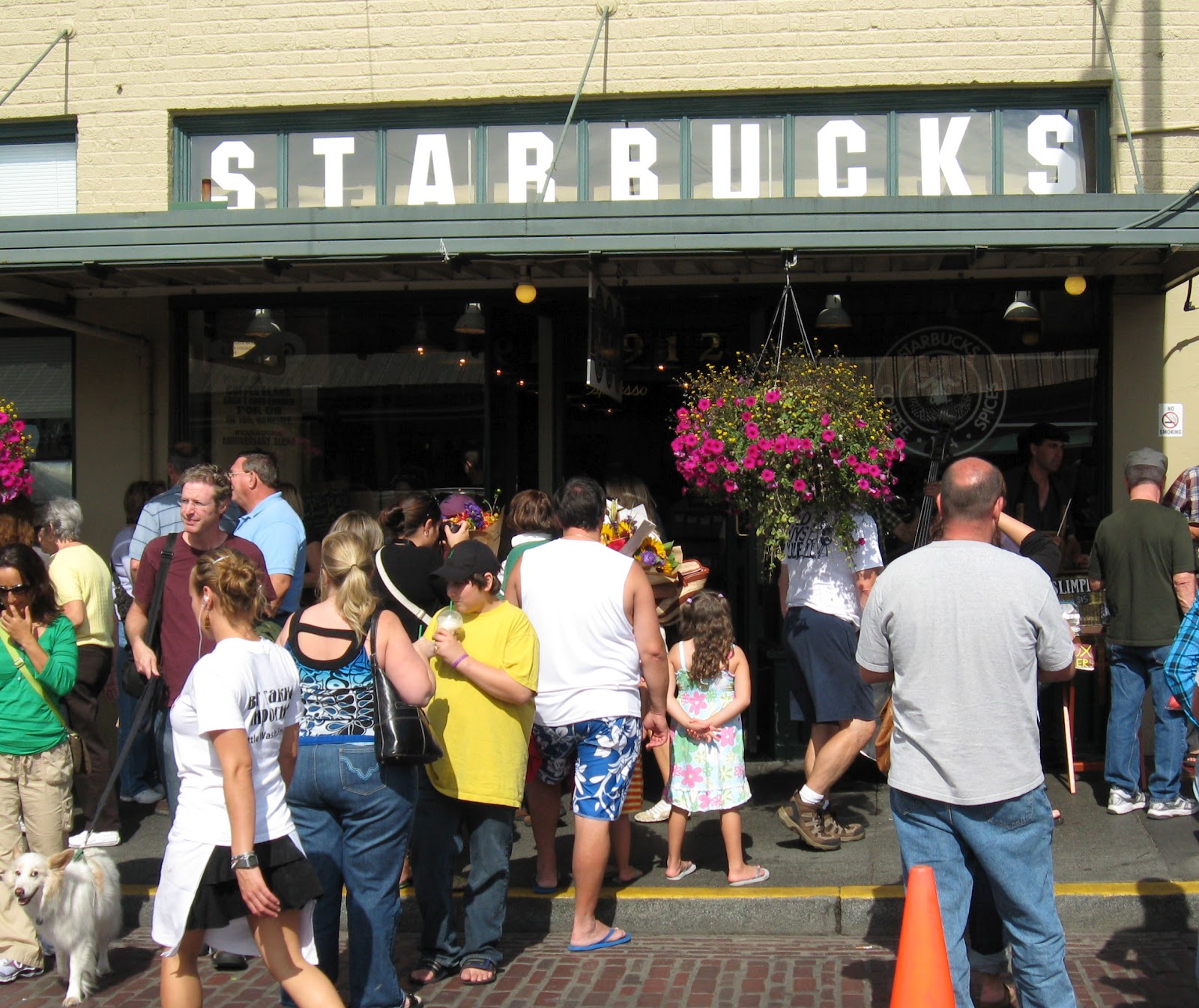
The original Starbucks, located
at Pike Place Market in Seattle,
as seen in my 2009 photo.
"The whole purpose of places like Starbucks is for people with no decision-making ability whatsoever to make six decisions just to buy one cup of coffee.  Short, tall, light, dark, caf, decaf, low-fat, non-fat, etc.  So people who don't know what the hell they're doing or who on earth they are can, for only $2.95, get not just a cup of coffee but an absolutely defining sense of self: Tall. Decaf. Cappuccino."

Perhaps, like Fox Books in the movie, Starbucks has tried hard ~ maybe too hard ~ to promote a sense of self. What they seemingly have created is a pseudo sense of friendliness and hip atmosphere in their stores and cafés, both in America and globally, in countries which they have penetrated the coffee marketplace. Sometimes, it's truly embraced, like I saw last month in Amsterdam on the bustling Leidsestraat near our hotel. There, the number of customers hanging out inside this colorful and particularly busy café, enjoying their cappuccinos in mugs while checking e-mail on their iPhones, far outnumbered those like me, who got their mocha in a to-go cup. To each his own, but I was in a walking mood, with things to see and places to go ~ and, it was lovely spring morning.

Enjoying a cappuccino with my
Saturday morning breakfast at 
Bagels & Beans in Amsterdam.
Thank goodness, during my recent travels in Europe, I discovered a world of coffee beyond Starbucks.  I saw this world in both Brussels and Paris ~ even in Amsterdam, too ~ and, over the course of 12 days, I tasted some very wonderful cappuccinos and mochas as they were meant to be enjoyed: in true café settings, and crafted by baristas, who took their time and turned coffee-making into an art form.  And, it was a delight to observe people unhurried, taking their time sipping and savoring their coffee. It added up to a most delicious and enjoyable experience.

All photographs by Michael Dickens. Copyright 2009, 2012. All rights reserved.

Tuesday, August 10, 2010

Validating our travel experiences

The 19th Century Scottish novelist Robert Louis Stevenson, himself a travel writer, once penned: "For my part, I travel not to go anywhere, but to go.  I travel for travel's sake.  The great affair is to move."

And, if digital cameras had existed during Stevenson's lifetime, perhaps, he would have added to his travel experience by taking pictures, too.

The Eiffel Tower in Paris
2004
Like Stevenson, I enjoy travel for travel's sake.  Europe fascinates me and I can't wait to revisit Chicago and New Orleans, two of my favorite American cities.  There's always a discovery, or two, awaiting me on each trip.  As someone who particularly loves urban travel, I look forward to seeing iconic landmarks ~ not just to admire and learn about them in detail, but to photograph them, too. Up close and personal, they are amazingly larger than life not to mention extremely photogenic, too.

Big Ben in London
2005
For me, documenting iconic landmarks validates my travel. Just a few "icons" I've been fortunate to see and digitally document include:  The Eiffel Tower in Paris, Big Ben in London, and closer to home, the Golden Gate Bridge in San Francisco.

Last weekend, perusing hundreds of digital travel photographs stored on my MacBook Pro reminded me of countless pictures I've shot of the Space Needle in Seattle, both during daylight and at nighttime. Because we have long-time friends living in the Emerald City, Seattle is a frequent and enjoyable travel destination for us ~ and the Space Needle, that iconic landmark of the Pacific Northwest, always is there to welcome us.

Bumbershoot:
The Space Needle
at twilight, 2006
Although I've lost count, we've probably made at least 20 visits to Seattle over the past 15 years.  It's a relative short flight from the Bay Area to Seattle ~ about 90 minutes ~ and, a route well travelled by both Alaska and Southwest airlines. Many of our visits have coincided with attending Bumbershoot, Seattle's annual music and arts festival, held over Labor Day weekend on the Seattle Center grounds where the Space Needle prominently resides.


The Space Needle:
Seattle's iconic landmark
after dark
at Bumbershoot, 2009
Thus, photographing the Space Needle, which was constructed for the 1962 Seattle's World's Fair, is a long-standing tradition of mine whenever we visit.  It doesn't matter that the appearance of the Space Needle, whose top floor observation deck is 520 feet above ground (an antenna extends the height to 605 feet) and provides beautiful views not only of the downtown Seattle skyline but also of Mount Rainier, the Olympic and Cascade mountain ranges and of Elliott Bay and the surrounding islands, hasn't changed much.

A difference of 40 years:
The Experience Music Project
and the Space Needle, 2008
What does matter and makes a difference to me is this: There are so many different and interesting angles and locations to frame a shot of an iconic landmark, like the Space Needle.  Standing in line to enter the Sky Church of the Frank O. Gehry-designed Experience Music Project remains one of my favorite shots because of how it captured in one frame a difference of 40 years of Seattle architecture, the compression of space, and the appearance of a wisp of a cloud ~ and I decided to tilt the camera (something I don't often do) for a different effect.  That's what makes the discovery, and documenting it with a photograph, fun for me.

While a picture may be worth a thousand words, sometimes, it's the touch of a colorful, personal photograph that speaks more eloquently than any picture postcard can.

All photographs by Michael Dickens, copyright 2004, 2005, 2006, 2008, 2009.

Tuesday, June 1, 2010

Why travel matters

My wife and I just returned from a very satisfying, three-day trip to Seattle.  It was a holiday weekend filled with good food, good music, good film, good books and great conversation with friends.

Never underestimate the importance of great conversation with friends.

Oh, sure, there was a little spring rain spread over each of our days in the Emerald City, and we had to carry an umbrella wherever we went.  Yet, we didn't let the rain dampen our enthusiasm for spending quality time among friends, and in one of our favorite urban destinations.   It was simply Seattle being Seattle during springtime.

Since moving to the West Coast 15 years ago, Seattle has become our favorite weekend travel destination, namely because of its many enjoyable cultural offerings, including sport, food, music and art.  In past visits, we've experienced Major League baseball with Ichiro and the Mariners at Safeco Field; meandered through the funky and lively Pike Place Market (home of the original Starbucks), and enjoyed Bumbershoot, Seattle's annual arts and indie music festival, at the Seattle Center ~ often, all in the same weekend.

Also, there's the physical beauty of the Puget Sound and views of the Cascade and Olympic mountains, whether experienced while walking through the colorful Olympic Sculpture Park or from the tranquil bluffs of Discovery Park (at 534 acres, it's the largest city park in Seattle) in the Magnolia neighborhood, that is both vibrant and breathtaking ~ and must not be missed.

Just as important, visiting Seattle also connects us with our friends.

Our long-time friends have resided in Seattle for as long as we've been in the Bay Area and, as they've done before, they very graciously welcomed us into their home this past weekend ~ along with their son and three cats ~ and provided us with comfortable lodging and good company.

Although many of our past visits coincided with Labor Day weekend, this time we decided a trip to Seattle for Memorial Day weekend would be just the right thing to do.

Rain or shine.

After all, we had never been to the Northwest Folklife festival at Seattle Center, and one of our hosts, would be performing Saturday evening in a Pete Seeger sing-along as part of a folk group, Tom Colwell and the Southbound Odyssey.  Also, it would be a wonderful opportunity for me to see a dear friend and classmate from college, who lives in Seattle, and to share in great conversation with her against the backdrop of the folk music at Northwest Folklife.

It turned out to be a delightful Saturday evening for all of us ~ new friendships were made ~ and the rain stayed away for a few hours, too.

The highlights of our visit were plentiful ~ they always are when we visit Seattle.  Here's a few worth sharing:

* A Friday adventure to the Capitol Hill neighborhood provided us with a very hip and delicious French-style lunch at Cafe Presse (near Seattle University), which complemented shopping for books at the newly-relocated indie-bookseller, Elliott Bay Book Company, and shopping for CDs at Elliott Bay Book's next-door neighbor, the eclectic Everyday Music.

* We found time for film on Saturday afternoon by seeing "Ride, Rise, Roar," an informative music documentary revealing the creative process behind David Byrne's 2009 tour.  The screening was part of the Seattle International Film Festival.

* Finally, a return visit to Northwest Folklife on Sunday afternoon allowed us to soak up heartfelt music by some of the many buskers dotting the Seattle Center grounds as well as to enjoy the sound of contemporary Scottish fiddle by The McKassons and a fusion of world percussion by Rhythm Planet Teen Rhythm Ensemble.

By the time we boarded our flight home on Sunday evening, our weekend trip to Seattle reminded me why travel matters.  For me, it's an opportunity to absorb another city's culture, experience a change in decor and landscape, and enjoy great conversation with friends.

Yes, never underestimate the importance of great conversation with friends.