Showing posts with label wonderful. Show all posts

Tuesday, July 29, 2014

Baseball isn't perfect ... but it feels like it is


The Hall of Fame Class of 2014 / (L-R) Bobby Cox, Tony LaRussa,
Tom Glavine, Frank Thomas, Greg Maddux, Joe Torre.

"Baseball isn't perfect, but it feels like it is," said Joe Torre, one of six living inductees, whose speech capped a lively and, at times, emotion-filled day packed with wonderful stories and heartfelt memories as the Class of 2014 was honored in ceremonies and welcomed to Major League Baseball's Hall of Fame in Cooperstown, N.Y. on Sunday afternoon.

On a day when baseball got it right, the tone of Torre's speech was best described by The New York Times "as if designated to deliver the greatness-of-the-game testimonial." 

And he did.

"We're responsible for giving it the respect it deserves," said Torre, who managed the New York Yankees to six American League pennants (1996, 1998-2001, 2003) and won four World Series (1996, 1998-2000).

During the nationally televised three-hour ceremony, Torre was joined at the podium by fellow managers Bobby Cox and Tony LaRussa, slugger Frank Thomas and pitchers Greg Maddux and Tom Glavine. Each living great -- and I saw all of them play or manage -- exemplified the game in the right way. Together, they represented quite an assemblage of accomplishments across the baseball diamond: World Series championships, Cy Young Award winners, Most Valuable Player awards.

Decent men all of them, too.

Roger Angell accepting the J.G. Taylor Spink Award

Baseball also got it right when it enshrined the esteemed Roger Angell, a longtime writer and editor for The New Yorker, who received the J.G. Taylor Spink Award on Saturday, the Baseball Hall of Fame's writing honor. The bespectacled Angell, 93 and thin, is revered for his revealing portraits and essays on baseball, which began appearing in The New Yorker in the early 1960s. Since then, they have been compiled into several books filled full of meditations and observations about our national pastime, most notably The Summer Game, which I first read as a teenager. I still treasure the book's words today like the literary baseball bible it is.

In his debut as a baseball writer for The New Yorker in 1962, Angell wrote a wonderful essay full of humor and insight about attending spring training in Florida. "Big-league ball on the west coast of Florida is a spring sport played by the young for the divertissement of the elderly -- a sun-warmed, sleepy exhibition celebrating the juvenescence of the year and the senescence of the fans."

Many have acclaimed Angell as the greatest baseball writer. "Angell's prose is clear and erudite, elegant and informed; he is a fan with a wicked eye for detail, a sense of humor and a curiosity about the way athletes perform," wrote Richard Sandomir in The New York Times. "He filled his notebooks but did not have to convert his jottings into an article under a tight deadline. He had months to digest his observations and then wrote long -- very long."

Said Angell: "I didn't have to write after a game. That was unforgivable."

Angell's main job for many years at The New Yorker was as a fiction editor, a job once held by his mother, Katherine White. His stepfather was the famous children's author E.B. White, who penned Charlotte's Web. So, it's no surprise that writing became Angell's life-long passion. He was raised in good company.

"When he accepted the award Saturday at Doubleday Field," wrote Sandomir, "Angell said that he collected '.300 lifetime talkers like a billionaire hunting down Cézannes and Matisses' -- loquacious folks like Keith Hernandez, Roger Craig, Bill Rigney and Dan Quisenberry. And he gave his thanks to baseball, 'which has turned out to be so familiar and so startling, so spacious and so exacting, and so easy looking and so heartbreakingly difficult that it filled my notebooks in a rush.'"

Peter Gammons, like Angell, a longtime chronicler of baseball, wrote: "It isn't simply nostalgia, it is a weekend that allows us a sense of where we are. As Angell spoke, one thought about a life of literacy, not tweets, that not only did he wrote so elegantly, but he edited John Updike, he edited John McPhee, which made me recall the sign Angell said McPhee had in his kitchen: 'When everything is going your way, you're probably in the wrong lane.'"

Angell is a "lover of books and words," wrote Maureen Dowd in a wonderful New York Times Sunday Review column that appeared over the weekend. His prose combines his love of language with his passion for baseball. "Who else could use 'venery' in a story and write the world's longest palindrome?" she asked.

"Within the ballpark, time moves differently, marked by no clock except the events of the game," wrote Angell in The Summer Game, the first of his seven books about baseball"This is the unique, unchangeable feature of baseball, and perhaps explains why this sport, for all the enormous changes it has undergone in the past decade or two, remains somehow rustic, unviolent, and introspective. Baseball's time is seamless and invisible, a bubble within which players move at exactly the same pace and rhythms as all their predecessors. This is the way the game was played in our youth and in our fathers' youth, and even back then -- back in the country days -- there must have been the same feeling that time could be stopped. Since baseball time is measured only in outs, all you have to do is succeed utterly; keep hitting, keep the rally alive, and you have defeated time. You remain forever young."

Indeed, baseball hasn't always been perfect, but this past weekend it felt like it was. It made me feel forever young.

Photographs: Courtesy of MLB.com.

Tuesday, April 15, 2014

A remembrance: Jesse Winchester


Jesse Winchester / A songwriter with a sweet Southern heart.

Jesse Winchester was a songwriter with a sweet Southern heart. His songs were covered by an eclectic group of singers: Jimmy Buffett, Joan Baez, the Everly Brothers, Emmylou Harris and Elvis Costello, among many.

I was saddened by the news over the weekend that Winchester, Louisiana-born who was raised in northern Mississippi and the city of Memphis, Tenn., and established himself in Montréal after dodging the Vietnam War, had passed away at age 69. He died "peacefully" at his home in Charlottesville, Va. last Friday.

Word of Winchester's death spread prematurely on social media a week before he succumbed to cancer when singer Janis Ian posted this tribute on Facebook: "RIP Jesse Winchester. As underrated a singer as Chet Baker. As underrated a guitarist as Willie Nelson. A man who held the audience in the palm of his hand without moving an inch. One of the best songwriters on earth."

However, it was because of this that I reconnected with Winchester, whom I had the pleasure of seeing perform in a solo show in the early 1980s at the intimate, old Guthrie Theater in Minneapolis one winter's evening during my college youth. Through Facebook, I reminisced about the humility of Winchester and of his music, both on my page and through a college friend's page, too.

I read about Winchester's death in the New York Times while eating Saturday morning breakfast at home. Music critic Jon Pareles wrote a wonderful remembrance of Winchester, born James Ridout Winchester, which I encourage you to take the time to read.

Nothing But a Breeze 
Winchester's 1977 album Nothing But a Breeze remains a favorite of mine and just last week, I listened to it from beginning to end, delighting in the singer's bonhomie and the joy of his sweet honey voice. Some of his best-known songs were: "Mississippi You're On My Mind," "The Brand New Tennessee Waltz," "Biloxi," and "Say What." While Winchester's songs were rooted in country, soul and gospel, his poetic lyrics reminisced about the South of his long-ago youth.

Earlier this week, PopMatters music columnist Colin McGuire wrote in tribute of Winchester: "There was something that separated him from his contemporaries, an amount of levity, an amount of intellect that brought his tales of heartbreak, innocence, youth and romance to life."

Because Winchester couldn't tour in the U.S. for many years while living in exile in Canada, few Americans knew about him. Yet, Winchester honed his songwriting skills and was nurtured by The Band's Robbie Robertson. It was while in Montréal that he found his poetic, musical voice, too.

Winchester finally returned to the U.S. to live over a decade ago, long after during the presidency of Jimmy Carter that he and other draft dodgers of the Vietnam War era were given amnesty in 1977.


The last time I saw Winchester perform was in 2009 on Elvis Costello's "Spectacle" TV show that aired in the U.S. on the Sundance Channel. He shared a New York City stage one evening with Costello and fellow singer/songwriter guitarists Neko Case, Sheryl Crow and Ron Sexsmith. His poignant song "Sham-A-Ling-Dong-Ding" brought Case to tears and humbled Costello. At the song's conclusion, the misty-eyed host remarked: "That's it, Jesse. The show's over. You finished me off. It happened at rehearsals and it happened now."

The revered Winchester, pitch-perfect and always accompanied by a lightly-plucked acoustic guitar, was one of the best at his craft of songwriting. He was a songwriter's songwriter and he will be sorely missed.

Bless his loving heart.

Photos of Jesse Winchester courtesy of Google Images.
Video courtesy of YouTube.

Tuesday, June 5, 2012

You've Got Starbucks!


A cafe mocha during my lunch at Le Pain Quotidien in Brussels.

Recently, while channel surfing, I caught a few minutes of the movie "You've Got Mail", the 1998 American romantic comedy film directed by Nora Ephron that stars Tom Hanks and Meg Ryan. It's based on the play "Parfumerie" by Miklós László and tells the story of two e-mailing lovers completely unaware that their sweetheart is, indeed, a person with whom they share a degree of animosity.  The adaptation of "You've Got Mail" traces its lineage back to the 1940 film "The Shop Around the Corner" by Ernst Lubitsch.  There's even a bit of Jane Austen's "Pride and Prejudice" found in the relationship between the characters portrayed by Hanks and Ryan.

While watching "You've Got Mail", I couldn't help but delight in the scene that illustrated America's growing infatuation for Starbucks coffee in the late 1990s, as voiced over by Hanks' character, Joe Fox, whose family owned a chain of mega-bookstores similar to Barnes & Noble:

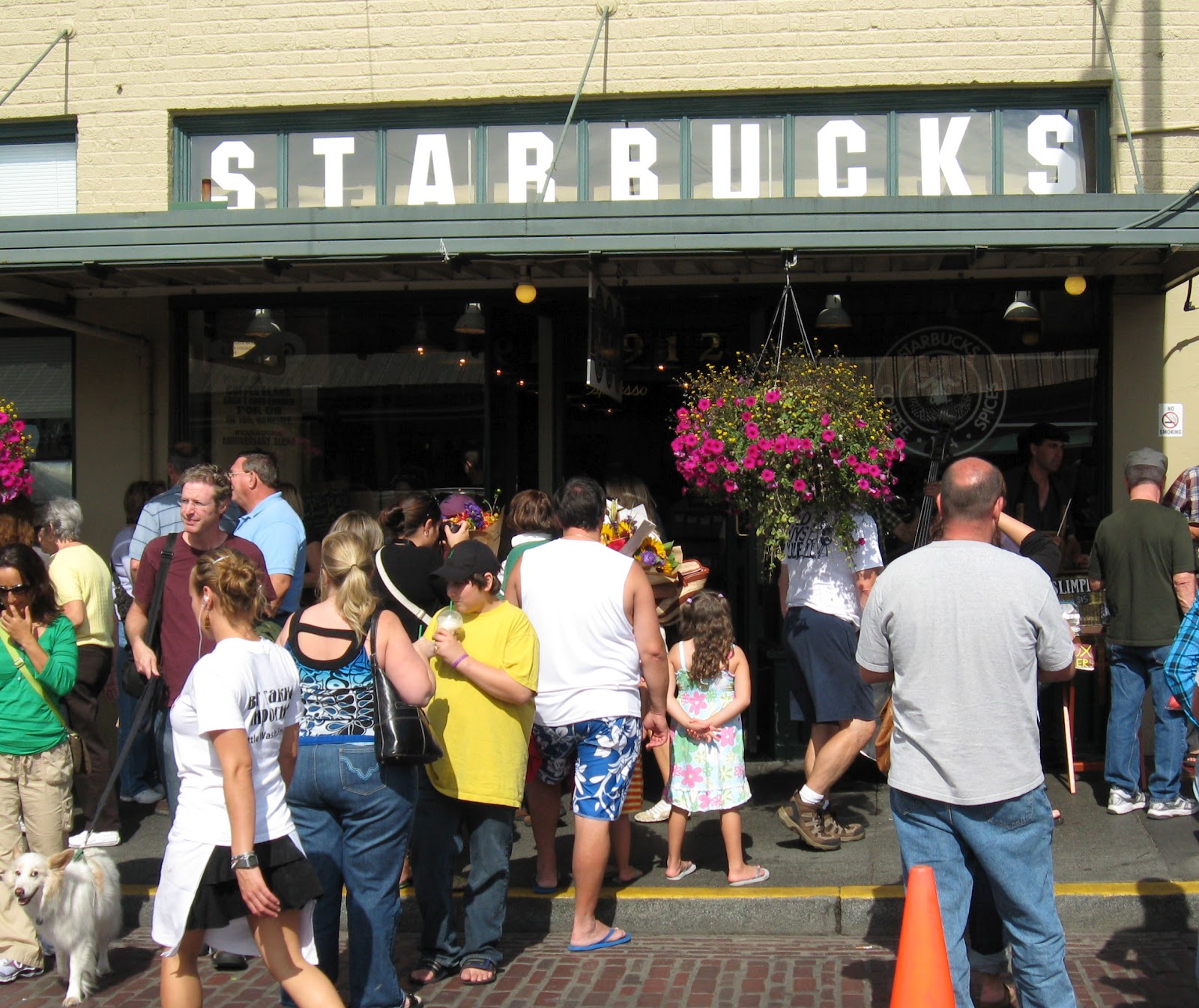
The original Starbucks, located
at Pike Place Market in Seattle,
as seen in my 2009 photo.
"The whole purpose of places like Starbucks is for people with no decision-making ability whatsoever to make six decisions just to buy one cup of coffee.  Short, tall, light, dark, caf, decaf, low-fat, non-fat, etc.  So people who don't know what the hell they're doing or who on earth they are can, for only $2.95, get not just a cup of coffee but an absolutely defining sense of self: Tall. Decaf. Cappuccino."

Perhaps, like Fox Books in the movie, Starbucks has tried hard ~ maybe too hard ~ to promote a sense of self. What they seemingly have created is a pseudo sense of friendliness and hip atmosphere in their stores and cafés, both in America and globally, in countries which they have penetrated the coffee marketplace. Sometimes, it's truly embraced, like I saw last month in Amsterdam on the bustling Leidsestraat near our hotel. There, the number of customers hanging out inside this colorful and particularly busy café, enjoying their cappuccinos in mugs while checking e-mail on their iPhones, far outnumbered those like me, who got their mocha in a to-go cup. To each his own, but I was in a walking mood, with things to see and places to go ~ and, it was lovely spring morning.

Enjoying a cappuccino with my
Saturday morning breakfast at 
Bagels & Beans in Amsterdam.
Thank goodness, during my recent travels in Europe, I discovered a world of coffee beyond Starbucks.  I saw this world in both Brussels and Paris ~ even in Amsterdam, too ~ and, over the course of 12 days, I tasted some very wonderful cappuccinos and mochas as they were meant to be enjoyed: in true café settings, and crafted by baristas, who took their time and turned coffee-making into an art form.  And, it was a delight to observe people unhurried, taking their time sipping and savoring their coffee. It added up to a most delicious and enjoyable experience.

All photographs by Michael Dickens. Copyright 2009, 2012. All rights reserved.