Showing posts with label Europe. Show all posts

Saturday, November 24, 2018

Thoughts on art and travel: Revisiting an artistic interior

An artistic interior /
Interior of the Church of Saint Bavo
by Dutch artist Pieter Saenredam
As I ready to visit Europe next month for the first time in six years, I am reminded of the last time I crossed the Atlantic Ocean. It was during a spring holiday in 2012, and my travel included visits to Amsterdam and Brussels, with a quick day trip by train to Paris. As I recall, I spent part of a Sunday afternoon visiting the Rijksmuseum in Amsterdam. For me, spending time in art museums is always time well spent. And, if you're lucky like I was on that day, you just might learn something new, too.

In an exhibit featuring a retrospective of Dutch artists, I came across a 17th-century painting depicting the interior of the Saint Bavo Church in Haarlem, the Netherlands, by Pieter Jansz. Saenredam.

Saenredam (1597-1665), who was the son of a printmaker and draughtsman, painted this oil on panel of the light-filled interior of Saint Bavo Church in 1636. Saenredam painted no fewer than six "portraits" of Saint Bavo, considered by many as one of the finest Gothic buildings still in existence today. Each time, he focused on one of the organs. Here, he depicted the Resurrection of Christ on the open shutter of the organ. He mixed gold powder with his paint to represent the gold in the painting. In describing the ornamentation of this painting, the Rijksmuseum website wrote: 

"At the time Saenredam painted the Saint Bavo Church, leading music-lovers were campaigning for more organ music to be played in church services. Calvinist ministers object to organ music. Little music was played in church and psalms were sung unaccompanied. The ministers would rather have had no organs at all in church because they felt the beautifully decorated organs were evidence of ostentation and excess. Haarlem's music-lovers handed a petition to the town council, in which they asked to be allowed to use the organ, 'the ornament of the church', everyday. It is possible that Saenredam gave the organs a prominent position in his painting in support of this campaign."

(As an aside, the interior of the church, which was originally Roman Catholic, was stripped of all of its embellishments, including statues and paintings, by the Protestants following the iconoclasm of the Protestant Reformation.)

What I learned in researching the artist and the painting is this: Saenredam was the first Dutch painter to specialize in church interiors. His precise on-the-spot observations and detailed perspectives helped us to have a better understanding and appreciation for these architectural marvels. And, through the addition of including tiny figures, he helped to emphasize the height and immensity of the church. Finally, in some of his interior paintings, the artist used a central perspective: All the lines in the painting disappear in a single point.

The Getty Center in Los Angeles, California, which owns one of Saenredam's interior paintings of Saint Bavo, commented on his work in its website:

"The overall impression is one of strong verticality, soaring space, and penetrating light, a spiritual reference to the heavens above. The inclusion of small figures accentuate the viewer's experience of exalted interior space. Saenredam described architectural elements in great detail: vaulted ceilings, moldings, decorative capitals, clustered pillars, and clerestory windows."

Saenredam made his first drawing of the interior of the church of Saint Bavo in 1626. From then on, he devoted himself almost exclusively to painting church interiors, always using precise perspective. Of his fifty surviving paintings, almost half show the interiors of two churches, Saint Bavo and the Mariakerk in Utrecht.

What can we learn from Saenredam's sacred interior spaces? For one, they were designed for contemplation. Unlike others whose paintings evoked a certain type of pomp, pageantry, and theatre that was usually seen in Roman Catholic churches, Saenredam's surprisingly modern paintings evoked "the whitewashed austerity of the Dutch Reformed church," says the Getty Center.

In describing Saenredam's style and viewpoint, the Getty Center said: "There are no processions, no clusters of worshippers at shrines. He adopted a very low viewpoint and a palette restricted to the palest of tones, and allowed few people into his bare interiors. He concentrated on depicting light, color, and space. Many Dutch artists continued his tradition, but few equaled his inventive vision." 

Indeed, Saenredam's painting of the interior of the Church of Saint Bavo owes its poetry to his desire to paint a faithful rendering, one that is careful and accurate.

Note: An original version of this blog post was published on July 10, 2012.

Tuesday, June 5, 2012

You've Got Starbucks!


A cafe mocha during my lunch at Le Pain Quotidien in Brussels.

Recently, while channel surfing, I caught a few minutes of the movie "You've Got Mail", the 1998 American romantic comedy film directed by Nora Ephron that stars Tom Hanks and Meg Ryan. It's based on the play "Parfumerie" by Miklós László and tells the story of two e-mailing lovers completely unaware that their sweetheart is, indeed, a person with whom they share a degree of animosity.  The adaptation of "You've Got Mail" traces its lineage back to the 1940 film "The Shop Around the Corner" by Ernst Lubitsch.  There's even a bit of Jane Austen's "Pride and Prejudice" found in the relationship between the characters portrayed by Hanks and Ryan.

While watching "You've Got Mail", I couldn't help but delight in the scene that illustrated America's growing infatuation for Starbucks coffee in the late 1990s, as voiced over by Hanks' character, Joe Fox, whose family owned a chain of mega-bookstores similar to Barnes & Noble:

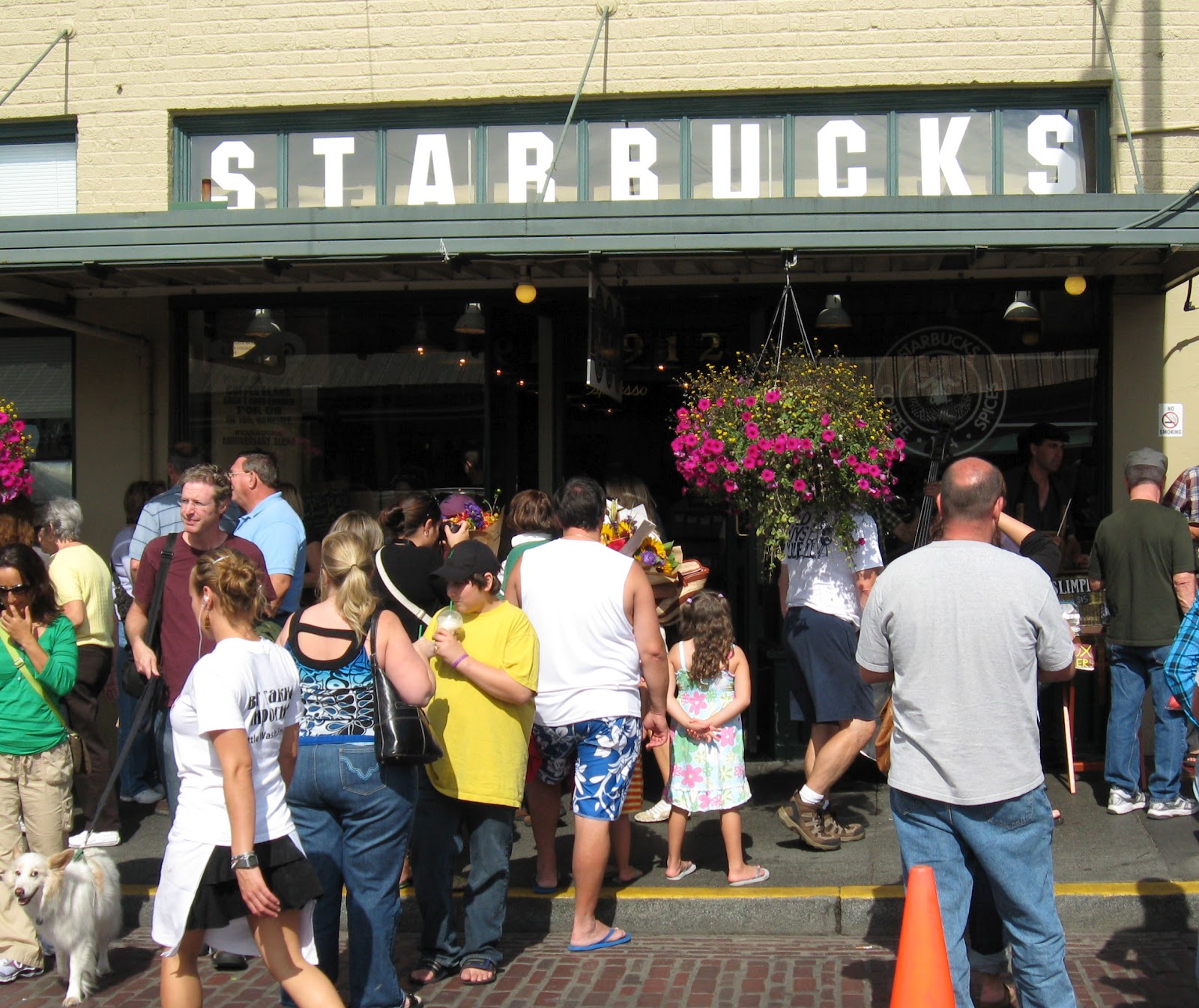
The original Starbucks, located
at Pike Place Market in Seattle,
as seen in my 2009 photo.
"The whole purpose of places like Starbucks is for people with no decision-making ability whatsoever to make six decisions just to buy one cup of coffee.  Short, tall, light, dark, caf, decaf, low-fat, non-fat, etc.  So people who don't know what the hell they're doing or who on earth they are can, for only $2.95, get not just a cup of coffee but an absolutely defining sense of self: Tall. Decaf. Cappuccino."

Perhaps, like Fox Books in the movie, Starbucks has tried hard ~ maybe too hard ~ to promote a sense of self. What they seemingly have created is a pseudo sense of friendliness and hip atmosphere in their stores and cafés, both in America and globally, in countries which they have penetrated the coffee marketplace. Sometimes, it's truly embraced, like I saw last month in Amsterdam on the bustling Leidsestraat near our hotel. There, the number of customers hanging out inside this colorful and particularly busy café, enjoying their cappuccinos in mugs while checking e-mail on their iPhones, far outnumbered those like me, who got their mocha in a to-go cup. To each his own, but I was in a walking mood, with things to see and places to go ~ and, it was lovely spring morning.

Enjoying a cappuccino with my
Saturday morning breakfast at 
Bagels & Beans in Amsterdam.
Thank goodness, during my recent travels in Europe, I discovered a world of coffee beyond Starbucks.  I saw this world in both Brussels and Paris ~ even in Amsterdam, too ~ and, over the course of 12 days, I tasted some very wonderful cappuccinos and mochas as they were meant to be enjoyed: in true café settings, and crafted by baristas, who took their time and turned coffee-making into an art form.  And, it was a delight to observe people unhurried, taking their time sipping and savoring their coffee. It added up to a most delicious and enjoyable experience.

All photographs by Michael Dickens. Copyright 2009, 2012. All rights reserved.

Tuesday, April 10, 2012

On "Miss Sarajevo"

Sarajevo is a city that is historically famous not only for hosting the 1984 Olympic Winter Games, but also for its traditional cultural and religious diversity. There aren't many places in the world where adherents of Islam, Orthodoxy, Catholicism and Judaism have coexisted for centuries. Thanks to its its long and rich history of religious diversity, Sarajevo has often been called the "Jerusalem of Europe".

Scene from the documentary
Miss Sarajevo
And, yet, it's not too far in the past that this leading social, political and cultural center of the current Bosnia and Herzegovina, was entangled from 1992 to 1996 in the Bosnian War.

The Siege of Sarajevo, the longest siege in the history of modern warfare, resulted in large scale destruction as thousands of Sarajevans lost their lives as a result of the constant bombarding and sniper shooting at civilians by Serb forces, whose goal was the creation of a new Serbian State of Republika Srpska that would include a portion of the territory of Bosnia and Herzegovina.

Nearly 12,000 people lost their lives during the Siege of Sarajevo, including over 1,500 children. Additionally, 56,000 people were wounded, including nearly 15,000 children.

Thanks to the passing of time, today, Sarajevo has become one of the fastest developing cities in southeastern Europe. And, yet, I was reminded recently, thanks to hearing Scott Simon's homily entitled "Bosnia Remembers When the World Looked Away" on NPR's Weekend Edition Saturday, last Friday (April 5) marked the 20th anniversary of the start of the Bosnian War.

"The world saw the 'ethnic cleansing' of Muslims and mixed-ethnic people in vivid color. But Europeans looked and saw the ghosts of World War I. Americans saw the ghosts of Vietnam. We changed channels," said Simon, during his NPR commentary.

U2's "Miss Sarajevo" played in the background at the conclusion of Simon's commentary. Hearing this somber tune piqued my interest. I searched the Internet to find a video of the song and to further read about its background and use in the Bill Carter documentary film Miss Sarajevo.


In the words of U2's Bono, he said: "The camera follows the organizers through the tunnels and cellars of the city, giving a unique insight into life during a modern war, where civilians are the targets. The film captures the dark humour of the besieged Sarajevans, their stubborn refusal to be demoralized and suggests that surrealism and Dadaism are the appropriate responses to fanaticism."

Carter's goal was to expose people to the individuals living through the war. "The war is just a backdrop, it could be any war," he said. "The point is the vitality of the human spirit to survive, (to) laugh, to love, and to move on, that is something we will be addressing always."

The song "Miss Sarajevo" not only protested the war in Bosnia. It also criticized the international community for its inability to stop the war or help those who were affected by it.

Bono went on to say that he felt the lyrics to the U2 song, "Miss Sarajevo", reflected what the people of Sarajevo were feeling at the time. It is sung with passion and conviction, and it also includes a solo by the great Italian opera tenor Luciano Pavarotti. The song's lyrics include:

... Is there a time to walk for cover
A time for kiss and tell
Is there a time for different colors
Different names you find it hard to spell

Is there a time for first communion
A time for East 17
Is there a time to turn to Mecca
Is there a time to be a beauty queen. ...

"Over 44 months of war, Sarajevans refused the appeals of governments and prestigious international groups to divide their country into ethnic enclaves," said Simon, at the conclusion of his NPR commentary. "I remember a Bosnian government minister saying, 'After all these centuries trying to build civilization, are we to go back to being tribes?' ... While the world looked away from them, Sarajevans dug a tunnel. They stood up for civilization."

And so, on an autumn night in 1995 in Modena, Italy, with Bono and the other members of U2 beside him, Pavarotti sang with a raw emotion:


Dici che il fiume
Trova la via al mare
E come il fiume
Giungerai a me
Oltre i confini
E le terre assetate
Dici che come il fiume
Come il fiume...
L'amore giungerá
L'amore
E non so piú pregare
E nell'amore non so piú sperare
E quell'amore non so piú aspettare


As I reflect upon this dark and somber period with the help of perspective, thanks to U2 and Scott Simon, one thing seems certain: Sarajevans indeed stood up for civilization.