Showing posts with label politics. Show all posts

Tuesday, December 3, 2019

Seriously Funny ... Exercising First Amendment freedoms through comedy from the desk of ‘The Daily Show’

Jon Stewart
“Seriously Funny: From the Desk of ‘The Daily Show with Jon Stewart’,” on display through Dec. 31 at the Newseum in Washington, D.C., explores humor as a protected form of free speech under the First Amendment.

When I visited the “Seriously Funny” exhibition during Thanksgiving weekend, I saw firsthand the lasting influence that Jon Stewart, former host of The Daily Show, had on political satire. It could be seen through the list of comedians that Stewart mentored during his tenure: Stephen Colbert, John Oliver, Samantha Bee, Hasan Minaj and current The Daily Show host Trevor Noah, among many.

The centerpiece of the “Seriously Funny” display of more than 50 artifacts is The Daily Show desk and globe that was part of the set of The Daily Show with Jon Stewart. There’s also an original Newseum-produced short film that goes behind the scenes at The Daily Show with Trevor Noah and shows how a typical day’s program is developed and produced.

During his years sitting at the anchor desk of The Daily Show, Stewart exercised his First Amendment freedoms through comedy and spurred his audience to think critically about the world. Night after night, he found humor in serious matters. No doubt, there were many who trusted Stewart’s satirical take on the news more than actual broadcast journalists. Imagine that!

Highlighting his tenure as host, Stewart guided us through the tragedy of 9/11, two wars and four presidential elections. He challenged both politicians and the press to do a better job. Later, he became a passionate and vocal advocate for the September 11th Victim Compensation Fund.

Among many who have praised Stewart’s work, former NBC News anchor Tom Brokaw said: “There are more facts and more truths told in the first eight minutes of The Daily Show than most political news conferences in Washington.” Also, David Remnick, editor in chief of The New Yorker, noted: “He set out to be a working comedian, and he ended up an invaluable patriot. He wants his country to be better, more decent, and to think harder.”


“Welcome to ‘The Daily Show,’ Craig Kilborn is on assignment in Kuala Lumpur. I’m Jon Stewart.’” With those words spoken on January 11, 1999, the comedian Stewart became anchor of The Daily Show, broadcast on cable’s Comedy Central. From opening night through 2015 when he stepped down, Stewart transformed the program from what had been a modestly successful parody of TV news into a cultural treasure. Through Stewart’s use of funny, often-pointed video clips and pointed and poignant commentary, The Daily Show became a trusted source of news for many Americans. Over time, Stewart became just as comfortable in satirizing current events as he was in interviewing newsmakers – from world leaders and Nobel laureates to best-selling authors.


I learned that a 2004 video of The Daily Show host became so popular it helped inspire the creation of YouTube a year later. By 2007, a Pew Research Center study ranked Stewart alongside CBS News’ Dan Rather and CNN’s Anderson Cooper as “a trusted source for news.” Stewart was the cover subject of many American magazines, including Rolling Stone, which in October 2004 dubbed him “The Most Trusted Name in News.” In the Rolling Stone cover story, Stewart said, “We need a news organization that puts country over partisanship.” In his last week as host, Stewart compared a Republican presidential candidate forum to a scene from the popular Pixar movie “Toy Story.”

Looking back on Stewart’s 16-year run as host of The Daily Show, he challenged viewers “to think about politics and the press while laughing at the absurd. Whether advocating for legislation, challenging the powerful and political elite, or launching a new generation of comedians, Stewart had a vast impact on American culture.”

MSNBC prime time host Rachel Maddow praised Stewart by saying: “I think his work on The Daily Show at Comedy Central has made our country a better country. I think it has made politics more accountable. I think it has made the news media sharper and more self-conscious and ultimately better.”

On his very last show, Stewart’s parting words were matter-of-fact, bordering baffled anger. He expressed, “So I say to you, friends: The best defense against bullsh*t is vigilance. So if you smell something, say something.”

Credits: Photos by Michael Dickens © 2019. Videos courtesy of YouTube.com, Comedy Central.

Tuesday, February 12, 2019

Thoughts on travel: Leaving your baggage behind

Rick Steves /
PBS travel host,
writer and activist
During my recent visit to Seattle while attending the American Library Assocation’s mid-winter conference, I sat in on an engaging and informative lecture by Rick Steves. He’s the longtime PBS travel host, writer and activist, who spoke about the need to understand our fellow human beings in other countries.

During his lively one-hour conversation, Steves emphasized the importance of traveling outside our comfort zone in order to learn about other people and cultures. One of his goals, I learned, has been to inspire and equip Americans to venture beyond Orlando’s Disney World. The Washington native was clearly a man on a mission on this Sunday morning. He was preaching to the choir – and it gave him its undivided attention.

Certainly, Steves is one who is not afraid to travel. In fact, for decades, he’s been crafting European tour experiences for Americans. By his estimation, he’s spent about a third of his adult life traveling throughout Europe. However, it was following the 9/11 tragedy in 2001 that Steves began to view politics as inextricable from travel.

“A life of travel can be a catalyst of peace,” Steves told his Seattle audience. He’s got a book out to back up his talk, ‘Travel As a Political Act,’ which is in its third edition (Hackett Book Group, 2018).

“When someone tells me to have a safe trip, I’m inclined to say, ‘Well, have a safe trip at home,’” said Steves. Despite Europe being statistically safer than the U.S., he noted that “Our country has never been more fearful.

“Fear is for people who don’t get out very much. The flip side of fear is understanding, and we gain understanding when we travel.”

Rick Steves signing
copies of his book,
‘Travel as a Political Act.’
Steves spoke of the importance that travelers need to get out of their comfort zone and show empathy for the rest of the world. “I’m into reality and humanity,” he said. “There’s a lot of baggage we are clueless to. We need to know about other country’s baggage. It’s important to understand baggage.”

If you think about it, and certainly Steves emphasized it, when you meet people along your travels – and take the time to discover their interests – it fosters an understanding of others and of the world at large.

“You go to France and step into a cheese shop, and it’s a festival of mold. The cheesemonger is evangelical,” said Steves. It’s one of many times that he drew laughter. “In Ireland, I enjoy the sensation that I’m understanding a foreign language. Forget your schedule, this is why you’re there. Get into a conversation.

“Europe knows how to work hard, but it knows how to play, too.”

He added, “You travel and realize the American dream is great, but it’s not unpatriotic to recognize there are other dreams.”

Wednesday, August 22, 2018

On urban travel: Philadelphia Faces

The Signer / Commemorates the spirits and 
deeds of all who devoted their lives
 to the cause of American freedom. 

In October 1682, the Quaker William Penn founded the city of Philadelphia between the banks of the Delaware and Schuylkill rivers in the English Crown Province of Pennsylvania. Within a century, Penn’s “greene countrie town” in eastern Pennsylvania became one of the largest cities in the British Empire with 25,000 inhabitants. By 1790, the year in which the federal capital moved to Philadelphia, the city’s population exceeded 44,000.

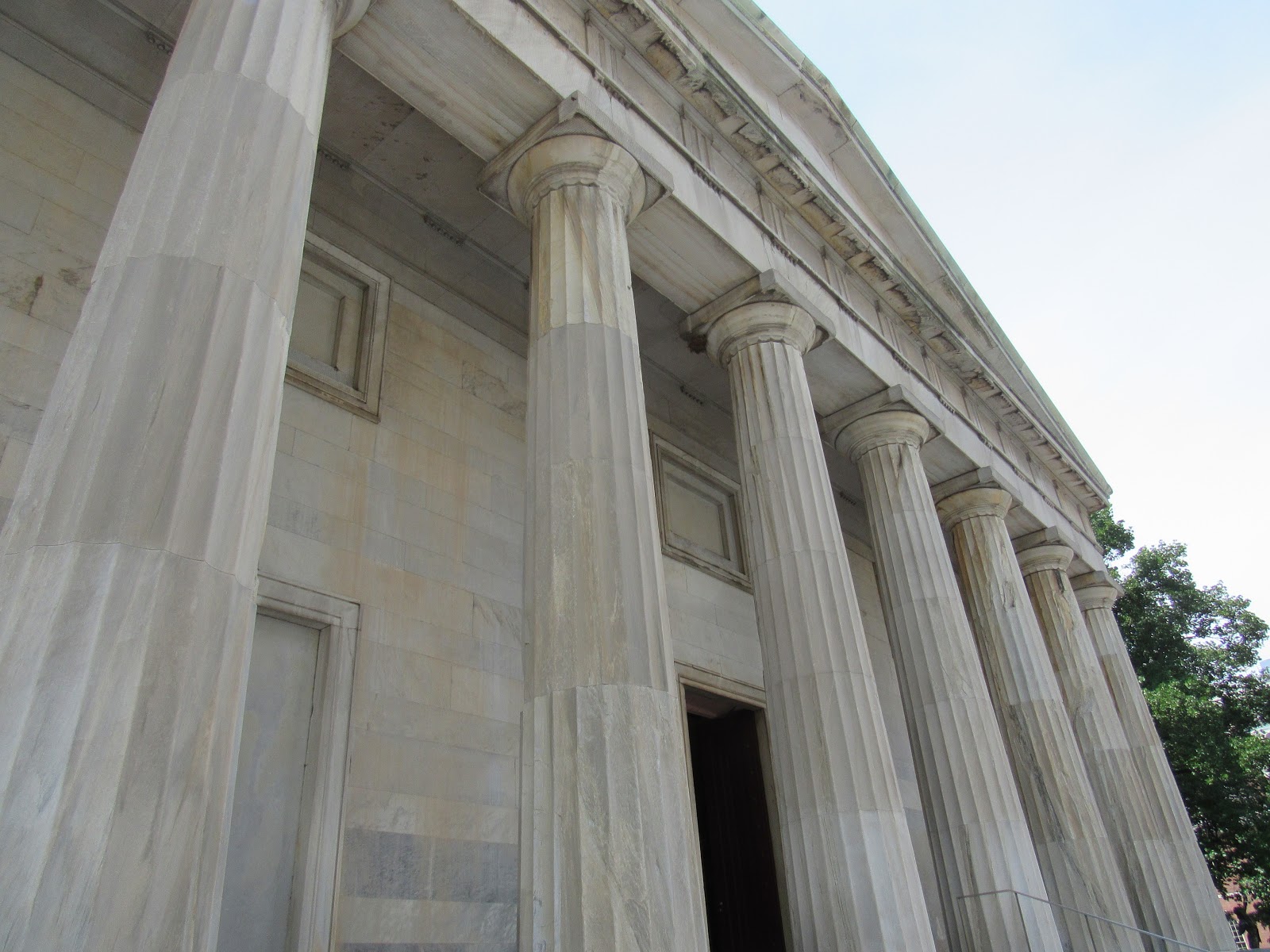
Second Bank of the U.S.
Among the positives of Philadelphia’s rapid 18th century growth, which included the creation of many broad avenues and large city blocks, one need only look at the addition of many languages and cultures to the city’s streets (north-south streets are numbered while east-west streets are named). I learned through a recent visit to the Portrait Gallery at the Second Bank of the U.S. in Philadelphia’s historic Old City district that Europeans throughout the Western world arrived here “to be able to worship freely, to lobby political leaders,” and “to pursue economic gain.” Also, “other cultures brought by free blacks from the Caribbean and enslaved Africans transported across the Atlantic added to Philadelphia’s cosmopolitan character and bustling economy.”

Meanwhile, Philadelphians also experienced many of the same challenges that a young American nation faced, too. As a city, Philadelphia was trying to transform from being a colonial outpost into an independent nation. “Personal experience with the political, economic, and cultural changes sweeping America after the Revolution made life for Philadelphians a mixture of tradition and innovation.”

Benjamin Franklin
Walk about the city – especially in Independence National Historic Park (which includes the Liberty Bell and Independence Hall) and in the Old City – and you’ll see that Philadelphia is Benjamin Franklin’s city. He was the city’s favorite son as well as an innovator and a difference maker.

Franklin’s likeness is found on banners and especially in paintings and sculptures. Beyond, the football stadium on the Ivy League campus of the University of Pennsylvania is named Franklin Field.

Franklin (1706-1790), I learned, was a “true son of the Enlightenment – a self-educated, runaway apprentice who translated his skill as a printer into a prosperous business.”

Although Franklin portrayed himself as a self-made man, in truth he benefited from the assists of many en route to achieving prosperity. In return, Franklin founded many organizations, including the Leather Apron Club and the Library Company of Philadelphia to benefit others. “His civic contributions improved safety, education, and health care in Philadelphia.”

Walking in Rittenhouse Square
During our brief stay in Philadelphia, we enjoyed a pre-dinner stroll through Rittenhouse Square, which at 7 o’clock on a Friday evening was lively with a mixture of millennials, families with dogs, and tourists snapping photographs of the many sculptures that dot the landscape. Of note, on the western side of the square is the Romanesque-style Church of the Holy Trinity, an Episcopal church designed by the Scottish architect John Notman. The first service was held there on March 27, 1859. Afterward, we enjoyed a sausage pizza and glass of wine at Pietro’s (1714 Walnut St.) that was followed by dessert at Capogiro Gelato Artisans (117 S. 20th St.).

On Saturday, we walked from the Hotel Palomar (117 S. 17th St.) to the lively Reading Terminal Market (corner of Market and N. 12th St.) for breakfast crepes at Profi’s Crêperie and a sinfully delicious maple bacon doughnut from Beiler’s Bakery followed by a walk around Independence Square. Later, we rode the Broad Street SEPTA train to Citizens Bank Ballpark to enjoy an afternoon Phillies-Mets baseball game. A quiet Saturday evening dinner at Le Pain Quotidien (1425 Walnut St.), a favorite of ours wherever we travel, was a nice way to relax after the ballgame. A steady, Sunday morning rain after breakfast kept us inside our hotel until it was time to return to the 30th Street Amtrak Station for our trip home.

Citizens Bank Ballpark
Today, the “city of Brotherly Love” (and sisterly affection) is an exceptional cultural and business center, easily accessible by Amtrak train (about two hours north of Washington, D.C., and 1.5 hours south from New York City’s Penn Station).

From Fairmount Park, home to major museums and sculpture gardens, the Philadelphia Zoo and 215 miles of biking and jogging paths, to South Philly, home to Philadelphia’s professional sports teams at Citizens Bank Ballpark (Phillies), Lincoln Financial Field (Eagles) and Well Fargo Center (76ers and Flyers), Philadelphia is a city where independent thinking – and free expression – is both revered and celebrated.

Photos: By Michael Dickens © 2018.

Thursday, February 15, 2018

A commentary: How long will we accept weapons of war being used to slaughter our nation's children?


On Wednesday, President Trump did not address the nation after the Florida high school shooting that left at least 17 dead. While his advisors recommended he say something in the aftermath of the latest horrific mass shooting in America, such as what President Obama did back in December 2012 in dealing with the Sandy Hook Elementary horror in which a gunman killed 20 first graders and six adults at an elementary school in Newtown, Connecticut – a moment he later said in a TV interview was the worst day of his presidency – this President opted not to. Mr. Trump remained silent, hiding behind his Twitter account.

While we have become tired of the empty gestures and platitudes which come with each new national tragedy, it seems that we as a nation should be disturbed by this President, who always wants to provoke, never reassure or commiserate like President Obama did so eloquently more than once during his eight-year stewardship of the White House.

Yesterday, before his team's NBA game in Portland, Oregon – just hours after the Florida shooting – Golden State Warriors head coach Steve Kerr, who has always been open about his views on politics, addressed the matter of gun violence head on – unlike our current commander-in-chief. Kerr spoke out passionately about the need to find a way to curtail gun violence in the United States.

"It doesn't seem to matter to our government that children are being shot to death day after day in schools. It doesn't matter that people are being shot at a concert, in a movie theater. It's not enough apparently to move our leadership – our government – the people who are running this country to actually do anything. That's demoralizing," said Kerr.

Mind you, gun violence is a deeply personal issue for Kerr, whose father, Malcolm H. Kerr, was assassinated in 1984 by two gunmen outside his office in Beirut, Lebanon, where he was president of the American University of Beirut.

"We can actually do something about it. We can vote people in who actually have the courage to protect people's lives and not just bow down to the NRA because they've financed their campaign for them," said Kerr.

"Hopefully, we'll find enough people, first of all, to vote good people in, but hopefully, we can find people with courage to help our citizens remain safe and focus on the real safety issues. Not building some stupid wall for billions of dollars that has nothing to do with our safety, but actually protecting us from what truly is dangerous, which is maniacs with semi-automatic weapons just slaughtering our children. It's disgusting."

Video: Courtesy of YouTube.

Tuesday, February 13, 2018

In Between: Taking on gender politics without apology


On Sunday morning in Washington, D.C., my wife and I attended a sneak preview of In Between (Bar Bahar in Arabic), a bold and brassy Israeli drama written and directed by Palestinian filmmaker Maysaloun Hamoud about living Arab and female in Israel. The "in-your-face-but-not-in-your-face" film is set in freewheeling and secular Tel Aviv, where the fallout from Arab Spring has brought about a new underground of Palestinians who are enjoying never-imagined freedoms – they're caught up in a new social revolution, a new world order, if you will – yet, whose underground nightlife remains contemporary and ethnic.

In Between presents three very different women – a conservative, hijab-wearing Muslim university computer science student; a modern Muslim criminal lawyer who likes to party after hours; and a liberal, Christian underground scene DJ/bartender – who happen to share an apartment where they find themselves balancing their lives between "tradition and modernity, citizenship and culture, fealty and freedom." Each woman tries to shape her own destiny despite living in a conservative Arab society that's entrenched in patriarchy.

In In Between, there's a whole lot of young people who are thinking and behaving differently – a mixture of gay and straight culture – while breaking down sacred and sexual barriers. The film, which stars Palestinian actresses Mouna Hawa (as the beautiful extrovert Laila), Sana Jammelieh (as the artsy and closeted lesbian Salma) and Shaden Kanboura (as the somewhat näive but observant and studious Nour), is presented in Arabic and Hebrew dialogue with English subtitles and includes an exotic and pulsating electronica soundtrack. It is Hamoud's first feature-length film – she did it with Israeli funding – and it earned her a fatwa from her own people because of the frank and explicit subject matter it tackled: homosexuality, intoxication and drug use.

"I couldn't imagine this happening, but I am not surprised," said Hamoud, during a 2017 BBC Newsnight interview. "They didn't want to look in the mirror and see the ugly face that is put in front of them."

As we see during this non-rated 103-minute film, In Between also deals with a Jewish state that treats its Arab citizens with a sense of mistrust, which makes it even more of a challenge for Laila, Salma and Nour to be able to live free in a restricted society and defend their sense of independence from the familial values they no longer share.

Throughout In Between, suggests critic Susan Wloszczyna of RogerEbert.com, what is most intriguing is "how each woman is allowed to make mistakes and learn from them without any judgment on Hamoud's part." Another critic, Ella Taylor of NPR, writes that "Hamoud's narrative instincts can be broad, but she is rarely glib or coy. That she has chosen to focus squarely on internal tensions within the Arab community – the widening cultural and political gulf between the generations – is a mark of her courage, her bravado and her brutal honesty."

In his review of In Between, New York Times film critic A.O. Scott notes that the movie "is fatalistic about the local political situation, pessimistic about men and encouraged by the power of female solidarity. In other words, whether by serendipity or prophetic insight or some combination of the two, it's a perfect movie for the movement."

Adds Hamoud: "The thing that's really touched me is when women come and say 'you are inspiring for us'. I cannot ask for more than this."

In awarding In Between best debut feature film at the Haifa Film Festival, the jury described it as "a powerful creation about women fighting to shape their fate by coping with challenges, through friendship, courage, victory, and by breaking free of shackles, and the price they pay."

In an age of #MeToo, In Between takes on gender politics without apology. I highly recommend this award-winning film, which has received limited release in the U.S.

Photo: Courtesy of Film Movement. Videos: Courtesy of YouTube.


Tuesday, January 17, 2017

On art and politics: "We the People ... "

We the People of the United States ...

In just four days, Donald J. Trump will be sworn in as the 45th President of the United States. With a lot of division surfacing throughout the country, many Americans are looking to art as a means of connecting us as human beings.

We the People ...
 are greater than fear.
"We the People are greater than fear," reads the message of a new poster created by Shepard Fairey, the graphic arts, muralist, illustrator and activist behind the iconic 2008 Hope posters he created for Barack Obama. Another new poster reads "We the People protect each other" and the third one says "We the People defend dignity."

There is a lot of division right now. Trump is not a healer," says Fairey. "Art, on the other hand, is healing and inclusive, whether topically it celebrates humanity, or whether it's just compelling visuals to make a human connection."

Interviewed recently by the PBS NewsHour, Fairey said "it was the right time to make a campaign that's about diversity and inclusion, about people seeing the common bonds we have, and our connections as human beings. The idea was to take back a lot of this patriotic language in a way that we see is positive and progressive, and not let it be hijacked by people who want to say that the American flag or American concepts only represent one narrow way of thinking."

Shepard has created three portraits for the "We the People" campaign. One depicts a Muslim woman wrapped in a hijab resembling an American flag. Another shows a young African-American girl and the third features a Latina female.

We the People ...
protect each other.
Two other artists, the Colombian American muralist Jessica Sabogal and the Chicano graphic artist Ernesto Yerena, each contributed to the project in collaboration with the Amplifier Foundation, a nonprofit that works to amplify grassroots movements and which commissioned the project. Together, the artists hope the faces of "We the People" – standing in for traditionally marginalized groups or those specifically targeted during Trump's presidential campaign – will flood Washington, D.C., on Friday during Inauguration Day.

According to Fairey, "All the subjects (in 'We the People') were photographed by people who relate to them somehow. The Muslim woman was shot by a Muslim photographer, the Latina woman shot by a Latino photographer, and the African-American kid shot by a French African-American woman photographer. We realized that this has got to be a diverse coalition of artists for us to do this, and that while it's good for us to be allies, this campaign really has to be authentically diverse."

Fairey went on to say in the PBS NewsHour interview, "We came to a conclusion as a group that in the language (for these posters) we want to say, 'We reject fear-mongering and exclusion.' But we also wanted to do it in a way that doesn't leave the door open for the Fox News type to say, 'This is reverse racism' ..."

We the People ...
defend dignity.
Adds Fairey: "It's hard to encapsulate the complexity of what we're facing, going into this Trump presidency, in three images. But we chose three groups that are vulnerable. In the history of the U.S., there are a lot of people who fled persecution from Europe on the basis of religious identities. The idea of championing the ideals of our forefathers and then limiting the movement of Muslims – it so confounding that this is not riling more people up. And so it's really time to do some (work) that I think is a counterargument to that, and that's not based on division but based on inclusion. We've seen where division has got us."

A Kickstarter campaign has begun that according to Fairey is "getting great traction." He said a goal of his group is funding an ongoing and expanding range of creative projects, with the next wave of people from all different communities. "We want to allow people to express all their social/political views around a number of issues – LGBT rights, women's rights – because a number of those things are going to be under attack under Trump."

Photos: We the People images by Shepard Fairey; U.S. Constitution courtesy of Google Images.

Wednesday, November 16, 2016

Opinions that matter: When these coaches speak ...


Gregg Popovich /
"Values are more important to me than
anyone's skill in business ... It tells us who
we are, how we want to live and what kind
of people we are."
It's been a week and counting since Election Day 2016. Dazed and confused, we've been trying to make sense of the new world around us. Many of us have felt sucker punched by Donald Trump's victory over Hillary Clinton. Yet, some who are prominent in our sports culture are taking a stand while demonstrating their political activism. When these coaches speak ... I listen. So should you.

San Antonio Spurs head coach Gregg Popovich and Golden State Warriors head coach Steve Kerr, a couple of the best and brightest minds in sports, are among the many professional coaches and athletes who have shared blistering critiques following Donald Trump's election as President of the United States last Tuesday. As coaches in the NBA, where 75 percent of the athletes are black, their opinions matter.

In a recently published ESPN interview, Popovich spoke out in frustration of Trump, who will become the 45th President of the United States when he is inaugurated in January.


"I'm a rich, white guy. And I'm sick to my stomach thinking about it," said Popovich, a graduate of the Air Force Academy. "I couldn't imagine being a Muslim right now or a woman or an African-American, a Hispanic, a handicapped person, and how disenfranchised they might feel." He went on to say that for any one in those groups that voted for Trump, "it's just beyond my comprehension how they ignored all that."

On the day after the election, in an interview with The New York Times, Kerr said: "All of a sudden you're faced with the reality that the man who's going to lead you has routinely used racist, misogynist, insulting words. I didn't think this was The Jerry Springer Show." 

Over the past four years, I've had the pleasure of informally meeting Kerr on several occasions. He is a parent of University of California women's volleyball player Maddy Kerr, and my wife and I have season tickets to Cal volleyball. Kerr is warm, friendly and outgoing – and never one to shy away from societal discourse. As the son of an American academic who specialized in the Middle East, Kerr spent much of his childhood in Lebanon and other Middle East countries before returning to the U.S. to study history and sociology and star as a basketball player at the University of Arizona, then embark on a fruitful professional career in the National Basketball Association.


Steve Kerr (right) with Draymond Green /
The Golden State Warriors head coach is not one to shy
away from societal discourse.
"I didn't think this was 'The Jerry Springer Show.'"
"People are getting paid millions of dollars to go on TV and scream at each other, whether it's in sports or politics or entertainment" said Kerr, a five-time NBA champion as a player who coached the Golden State Warriors to a championship in 2015 in his rookie season as a head coach. "I guess it was only a matter of time before it spilled into politics."

Before a recent home game against the Detroit Pistons, whose own head coach Stan Van Gundy also spoke critically about Trump, Popovich admitted he's sick to his stomach, "and not basically because the Republicans won or anything, but the disgusting tenor, tone and all the comments that have been xenophobic, homophobic, racist, misogynistic. And I live in that country where half the people ignored all that to elect someone. That's the scariest part of (the) whole thing to me.

"It's got nothing to do with the environment, Obamacare and all the other stuff. We live in a country that ignored all those values that we would hold our kids accountable for."

Popovich believes that Trump's words and actions cannot be overlooked or forgotten. He went on to say this: "Everybody wants him to be successful. It's our country; we don't want it to go down the drain. Any reasonable person would come to that conclusion, but it does not take away the fact that he used that fear-mongering and all the comments from day one. The race-baiting with trying to make Barack Obama, our first black president, illegitimate. It leaves me to wonder where I've been living and with whom I'm living."

The Spurs head coach also showed empathy for minority groups which might be adversely affected by the President-elect's remarks made during his campaign.

"What gets lost in the process are African-Americans, Hispanics, women and the gay population, not to mention the eight-grade developmental stage exhibited by him when made fun of the handicapped person," Popovich said. "I mean, come on. That's what an eighth-grade bully does, and he was elected president of the United States. We would have scolded our kids. We would have had discussions and talked until we were blue in the face trying to get them to understand these things. And he is in charge of our country. That's disgusting."

Popovich's frustration with the President-elect goes beyond partisan politics.

Gregg Popovich /
A Trump presidency, he said, is on the same path as the
Roman Empire. "My final conclusion is, my big fear is,
we are Rome."
"Values to me are more important than anybody's skill in business or anything else because it tells who we are, how we want to live and what kind of people we are," he said. "That's why I have great respect for people like Lindsey Graham, John McCain, John Kasich, who I disagree with on a lot of political things. But they had enough fiber and respect for humanity and tolerance for all groups to say what they said about (Trump)."

Popovich continued, by saying "One could go on and on. We didn't make this stuff up. He's angry at the media because they reported what he said and how he acted. It's ironic to me. It just makes no sense. So that's my real fear. And that's what gives me so much pause and makes me feel so badly, that the country is willing to be that intolerant and not understand the empathy that's necessary to understand other groups' situations.

Popovich was finished – or was he? As he ended his remarks, he had one final thought. He said he was concerned that the United States under a Trump presidency is on the same path as the Roman Empire. "My final conclusion is, my big fear is, we are Rome."

Photos: Courtesy of Google Images.

Tuesday, September 20, 2016

Game, set, match = world peace, if for just 71 minutes

Tunisia's Malek Jaziri / 
Center of attention in a political hot-button issue.

In 2013, Tunisia's Malek Jaziri found himself the center of attention in a political hot-button issue no athlete ever wants to be in. The top Arab tennis player in the world was ordered by his country's governing tennis body, the Tunisia tennis federation, to withdraw from an ATP tournament in Tashkent, Uzbekistan, rather than face a Jew, Israel's Amir Weintraub, who happened to his scheduled opponent.

In response to Jaziri's abrupt withdraw, the International Tennis Federation (ITF) banned Tunisia from Davis Cup competition for an entire year, in 2014.

The basic principle is that sports has nothing to do with politics. However, it should be noted that many Arab countries have for decades observed, to varying degrees, boycotts against Israeli athletes as a matter of protest over the situation of Israel's treatment of Palestinians.

"What a lot of people don't understand is that it's a difficult situation for the player no matter what," Reem Abulleil, a Dubai-based tennis journalist for Sport360.com, told the New York Times' Ben Rothenberg during a 2015 tennis podcast No Challenges Remaining. "There's always consequences, whether you like it or not."

Malek Jaziri was the top-seeded player at Istanbul.
Fast forward to this past week in Istanbul, Turkey, where Jaziri was the top-seeded player and Dudi Sela of Israel was the tournament's No. 2 seed in an ATP Challenger Tour tournament, tennis' version of the minor leagues. If the seeds held true – and they did – it would mean an Arab and a Jew would play for the championship of the American Express Istanbul Challenger. Mind you, most tennis fans throughout the world were focused on the semifinal round of the Davis Cup competition.

As the Sunday final approached, despite the fear that the Tunisian tennis authorities may again intervene, the championship match between the 70th-ranked Jaziri and the 74th-ranked Sela went ahead – and without incident. Unlike three years ago, Jaziri's career has been on the upswing this year under the guidance of coach Dejan Petrovic. He's playing better and his visibility on the court has been enhanced by a new clothing endorsement with Hydrogen, an Italian athletic wear company. Earlier this year, the Tunisian achieved a career-best ranking of 53rd. Facing the possibility of further sanctions, perhaps it's safe to assume that the Tunisian tennis federation wised up to the possibility of harsher sanctions by the ITF if it ordered Jaziri off the court. Or, maybe, it has changed its stance on matters of allowing its athletes to compete against all comers without political interference.

Dudi Sela (left), umpire Adel Nour, and Malek Jaziri.
At 3 p.m. Sunday afternoon, Jaziri and Sela, friends off the court, posed for a pre-match photo with Adel Nour, an Egyptian chair umpire. And, the final was on. At the conclusion of their 71-minute match, won by Jaziri, 1-6, 6-1, 6-0, the Tunisian and the Israeli shook hands at the net with sincerity and without any outward appearance of awkwardness. (I must confess, I watched the match at home in the U.S. on my iPhone 6 using the free ATPWorldTour.com feed that was absent of any commentary.) 

The Center Court crowd applauded both players, and when Jaziri returned to the court, he waved and tapped his heart with his right hand. He seemed very genuine in his emotion and appreciative of the reception he received from the fans in attendance.

Malek Jaziri and Dudi Sela shook hands at the net.
The victory gave Jaziri his third ATP Challenger Tour of the season and sixth of his career. Importantly, he earned 90 ATP points, which boosted his ranking to No. 55, as he heads on to his next tournament in Metz, France, this week. The Istanbul champion's purse of $10,800, although modest, was most welcomed by Jaziri.

As the news spread across the Atlantic, a couple of prominent American tennis journalists expressed their sentiment via Twitter. "Forget Davis Cup," tweeted Ben Rothenberg of the New York Times. "This is the biggest thing happening in tennis today. Jaziri-Sela heading toward a third set." Then, after the match, Rothenberg tweeted again: "Game, set match: World Peace. Jaziri, a Tunisian pressured to withdraw against Israelis before, plays, beats Sela." 

Malek Jaziri posed with the championship trophy.
Also, TennisChannel host and commentator Brett Haber tweeted: "Pleased to see Jaziri play Sela in Istanbul final today. I choose to believe motivation was geopolitical progress & acceptance, not Pts & $."

Jaziri got to compete, the fans who attended witnessed a significant match, and the tournament organizers were not short-changed by an empty final. Most importantly, sport overruled decades of Arab-Israeli political differences. 

A source who has been in touch with Jaziri since his victory Sunday suggested to me that there are different people controlling sporting issues within Tunisia than three years ago, which may explain why Jaziri didn't meet any resistance in playing Sela. According to the source, Jaziri suggested that what happened to him in 2013 will not happen again.

For once, there would be no boycott. Instead, it was the players – not the politicians – who decided the outcome of the match.

Photos: Courtesy of Istanbul Challenger Facebook page, Malek Jaziri Facebook page, ATPWorldTour.com live match stream, and @tenisdunyasi via Twitter.

Tuesday, May 10, 2016

"My name is Sadiq Khan and I'm the mayor of London!"


Sadiq Khan / I'm a Londoner, I'm European, I'm British, I'm English,
I'm of Islamic faith, of Asian origin, of Pakistani heritage, a dad, a husband."

London began the week with a new mayor. Meet Sadiq Khan. Not only is he the first Muslim to lead Britain's capital city, he's the first Muslim head of a major European capital.

"I'm a Londoner, I'm European, I'm British, I'm English, I'm of Islamic faith, of Asian origin, of Pakistani heritage, a dad, a husband," said the newly elected, 45-year-old Khan in a recent interview with The New York Times.

Khan, a Labour Party leader, succeeds two-term Conservative Boris Johnson, who was London's mayor since 2008. He was officially sworn in as London's new mayor last Saturday during a ceremony at Southwark Cathedral, and was immediately greeted with cheers and applause.

Sadiq Khan / The first Muslim leader of an important
western city.
Born in Tooting, South London, Khan is the fifth of eight children whose parents immigrated from Pakistan. He grew up in the 1970s in a public-housing project – known as a council estate – where his father drove a London city bus and his mother was a seamstress.

"My parents came here because they saw London as a beacon," Khan told The Guardian. "A place where they could create a better life."

Following a bitter Conservative campaign of personal attacks that was dominated by anxieties over his religion and ethnicity, Khan won a striking and historic victory over Tory candidate Zac Goldsmith, gaining a broad acceptance from the London electorate who supported him with 44 percent of first preference votes (56.8 percent of the vote overall) in a crowded field. His election brushed aside attempts by Conservative Prime Minister David Cameron's government to link Khan to the threat of Islamist extremism and, perhaps, it signaled "a broad acceptance by voters of London's racial and religious diversity just months after jihadi terrorist attacks in Brussels and Paris," wrote the Financial Times of London.

"Sadiq Khan's election as mayor of the British capital – making him the first Muslim leader of an important western city – is a historic moment that will be scrutinized around the world, particularly in other European cities struggling to integrate Muslim communities," wrote the Financial Times. "The victory of the Labour party candidate reaffirms London's multicultural image at a time of rising populist fervor in Europe and the U.S."

Khan has said he hoped that Donald J. Trump – the presumptive Republican Party presidential candidate who has called for barring Muslims from entering the U.S. – "loses badly."

As mayor of London, Khan will have power over transport, housing, air quality and policing. He's promised to make 50 percent of new homes affordable. He takes charge of one of the world's great cities, "a vibrant metropolis where every tongue is heard," wrote The New York Times. "In his victory, a triumph over the slurs that tried to tie him to Islamist extremism, Khan stood up for openness against isolationism, integration against confrontation, opportunity for all against racism and misogyny. He was the anti-Trump."

Khan, married and the father of two daughters, comes to his new leadership post following a career as a human rights lawyer. He was a Labour councillor in Tory-held Wandsworth for 12 years. He entered Parliament in 2005 and in 2010 his orchestrated Ed Miliband's winning Labour leadership campaign. He ran Labour's London campaign in the 2015 general election.

Sadiq Khan / "Proud that London has today chosen
hope over fear and unity over division."
As an observant Muslim, Khan seems well placed to tackle extremism in a city known for its tolerance and respect of each other. Although Britain has not sustained a major terrorist attack since 2005, it's worth noting that unlike France, Britain's Muslim population is well integrated, and one in eight Londoners identify as Muslim. During the campaign, Khan openly proclaimed his Muslim faith and declared that he was "the British Muslim who will take the fight to the extremists."

Still, Khan's election as mayor comes at a time when Europe is struggling with an increase in Islamaphobia, "riven by debates about the flood of Syrian migrants and on edge over religious, ethnic and cultural disputes," wrote The New York Times.

http://www.nytimes.com/video/world/europe/100000004391820/londons-new-mayor-gives-victory-speech.html

During Khan's acceptance speech, he noted that London's mayoral election "was not without controversy," but said he was "proud that London has today chosen hope over fear and unity over division."

He added: "I hope that we will never be offered such a stark choice again. Fear does not make us safer, it only makes us weaker and the politics of fear is simply not welcome in our city."

Photos: Cover photo: Courtesy of Sadiq Khan Facebook page. Others: Courtesy of Google Images. 

Tuesday, March 1, 2016

A narcissist, a liar, and a robot, all in search of power


Donald Trump /
His response is always denial and attack.
A narcissist, a liar, and a robot walk into a Houston debate hall last Thursday night. They are joined by a couple of wallflowers who can barely get in a word edgewise. The evening turns messy and muddled. There's little restraint. Definitely, there's no civility, and no issue is ever really settled.
"When we think of a debate about public policy, we assume facts, arguments, and logic," Robert Reich, Chancellor's Professor of Public Policy at the Univerisity of California, Berkeley, and former U.S. Labor Secretary, wrote on his Facebook page the morning after the latest Republican debate. "But Donald Trump uses none. ... Trump demonstrated once again that he has a handful of slogans and potted remarks on every subject, which he repeats time and again, interspersed with blather about how wonderful he is. When questioned about anything personal – his tax returns or a civil lawsuit against him or whatever – his response is always denial and attack."
I agree with Dr. Reich's common-sense thoughts and support his opinion. Trump has become the antipolitician, a misogynist whose racist, bigoted, and xenophobic campaign has appealed to his party's base. Trump would think nothing of governing by clobbering everyone who disagrees with him. 
In "A Governing Cancer of Our Time," published Friday, New York Times op-ed columnist David Brooks wrote: "Over the past generation we have seen the rise of a group of people who are against politics. These groups – best exemplified by the Tea Party but not exclusive to the right – want to elect people who have no political experience. They want 'outsiders.' They delegitimize compromise and deal-making. They're willing to trample the customs and rules that give legitimacy to legislative decision-making if it helps them gain power."
Brooks continues: "Ultimately, they don't recognize other people. They suffer from a form of political narcissism, in which they don't accept the legitimacy of other interests and opinions. They don't recognize restraints. They want total victories for themselves and their doctrine."
And so you have it, thanks to Messrs. Trump, Cruz, and Rubio, Republican politicians have, in the words of Dr. Reich, "descended into the muck of bigotry, hatefulness, and lies. They're splitting America by race, ethnicity and religion." Further, they are making soaring promises and raising ridiculous expectations. They are all power hungry, yet each wants to deconstruct the U.S. government and isolate us from the outside world at large. Collectively, they love the sound of their own voices – mind you, each is void of any empathy – and those three voices are filled so full of hate and cynicism. To hear each of them during a debate or on the stump, the U.S. has gone to hell and been one big failure over the past seven-plus years under the Obama stewardship of the presidency. They are preaching fear instead of hope to the masses. Their bashing-style rhetoric makes coherent conversation impossible. During Thursday's Republican debate in Houston, candidates Kasich and Carson might as well not even shown up. Their voices were drowned out by the louder and more boisterous voices belonging to Trump, Cruz, and Rubio. Very soon, I wouldn't be surprised if Kasich and Carson become the latest to "suspend" their presidential campaigns.
Survival of the fittest? More like, it's survival of the loudest. All that's missing is Trump's boisterous "You're fired!" that he made famous on his own reality TV series "The Apprentice." Memo to Mr. Trump: This is not reality TV, this is real life. Thanks to demagogues like you, in the words of Dr. Reich, "the moral authority that America once had as a beacon of democracy and common sense is in jeopardy."
"Trump's style is bashing and pummeling," writes Brooks. "Everyone who opposes or disagrees with him is an idiot, a moron or a loser. The implied promise of his campaign is that he will come to Washington and bully his way through." 
Donald Trump /
Do we really want an authoritarian for president?
So, we should ask ourselves: Do we really want an authoritarian for president – a fascist in bespoke suits with a hairstyle that Vanity Fair once described as an "inanimate object that straddles his scalp like a dead, furry lobster" – who would think nothing of insulting world leaders by calling them idiots, morons or losers, and who loves to quote another fascist, Mussolini, because he loves to associate himself with great quotes? Or, for that matter, can either Cruz or Rubio – both very ineffective and unpopular legislators in the U.S. Senate, who lately have been notably absent from their Capitol Hill duties – be worthy of our vote or trusted to carry the "nuclear football" as commander in chief? I truly would be very scared – not to mention very, very much disappointed in my country – if any of the three leading Republican contenders is elected as our next president. It's important to remember that with opportunity comes responsibility.
Thank goodness, on the Democratic side Hillary Clinton and Bernie Sanders, despite their perceived flaws, are discussing issues of substance and importance that really matter in our lives – health care and climate change, among them. Neither of them is an idiot, a moron or a loser – and I would be very comfortable, not to mention very much relieved, with either Hillary or Bernie as our next president. Both of them would be a worthy successor to Barack Obama.
Today's Super Tuesday primaries and caucuses will further define the Republican field. Or will it? God help us all.

Tuesday, October 15, 2013

On Tunisian tennis: A season on the brink?


Malek Jaziri / The No. 1-rated Arab tennis player in the world.

At a glance, the order of play for last Friday's quarterfinal-round of the ATP Challenger event in Tashkent, Uzbekistan, which included three of the top four remaining seeds, seemed ordinary enough.

Except that it wasn't.

At 10 a.m. on Court No. 3, the order of play showed a scheduled match between two unseeded players, one an Arab, the other an Israeli. However, before play began in this lower-tier tennis tournament -- the minor leagues of professional men's tennis, if you will -- Malek Jaziri of Tunisia, ranked 169th in the world at the time but currently the top-rated Arab player, withdrew from his match against Amir Weintraub, an Israeli, who advanced on the walkover to the semifinals.

More often than not, a walkover is the result of one player being too injured to be able to play. Only, this time, Jaziri's inability to play was because of political interference and not because of a knee injury, diplomatic and convenient as it might seem -- regardless of what the tournament's website indicated as the official reason.

Instead, in a move that arguably shocked the tennis world and garnered the attention of both USA Today and Sports Illustrated here in the U.S. as well as various international media abroad, Tunisia's tennis federation ordered its best player off the court, forbidding him from playing. Simply because his opponent-to-be was an Israeli.

In an e-mail provided by Jaziri's brother and manager, Amir, to the Tunisian state news agency on Friday, the Tunisian tennis federation on Thursday stated: "Following a meeting this afternoon with the Ministry of Youth and Sports, I have the immense regret to inform you that you are ordered not to play against the Israeli player."

A sports ministry spokesman, Sadok Touati, confirmed for the Associated Press that the federation sent the e-mail on Thursday after it consulted the ministry.

"The ministry does not interfere in the affairs of the sports federations," said Touati. Meanwhile, the federation president was unavailable for comment.

Although Jaziri, 29, is ranked well below the top players in his sport  -- a little over a year ago he was 100 places higher (69th) before injuries and a string of losses against lower-ranked opponents derailed him -- by all indications he is afraid the Tunisian federation's decision could harm his career. Few besides Jaziri in Tunisia have achieved a world ranking that would garner much notice. And, Jaziri could have risen to 135th had he won the tournament in Tashkent. Instead, when the new rankings were released on Monday, his ranking changed from 169th to 165th following last week's tournament.

Malek Jaziri drapes himself in his country's flag after he won
his first round match in the 2012 French Open.

While Arab countries have over the past decades observed boycotts of varying degrees against Israeli athletes in a protest over Israel's treatment of Palestinians, it's a shame to see athletes today become pawns in a geo-political chess game. And, in a sport which prides itself on global competition and is played worldwide, it's a disturbing interference of politics by a country (Tunisia) which is still searching for a democratic balance after its Jasmine Revolution paved the way for other Arab Spring revolutions a little more than two years ago. Tunisia has been in the midst of a political crisis for many months as a result of deadlocked negotiations between the ruling Islamist party, Ennadha, and the opposition over new parliamentary and presidential elections.

"It's a pity for the athletes who get caught up in these situations that end up hurting their personal career," said Shlomo Glickstein, the director of Israel's tennis association. In a statement, he added that it was sad such incidents such as what happened on Friday still occur.

In an interview with L'Equipe, Selima Sfar, a former Tunisian professional tennis player and the only Arab woman to achieve a top-100 world ranking (she was once ranked 75th in 2001), said she was shocked and worried about the "regressive" behavior shown her country's tennis federation.

Selima Sfar
"I am angry and disappointed," Sfar told the French sports daily. "It is a very bad image for my country. We fought hard to become professionals and now we are not supported."

Sfar, who retired from the tour in 2011, believes that political interference is unbearable. "Our people fought also with blood to move towards democracy and openness, and instead we are moving backwards," she said. "To play against an Israeli does not mean you are being a bad Tunisian Arabic or a bad Muslim. I'm proud to be Tunisian, Arab and Muslim, but I am ashamed of my country when it behaves like that."

In this day and age, it seems to me that if an Indian (Rohan Bophanna) and a Pakistani (Aisam-Ul-Haq Qureshi) can separate their differences and unite as a formidable doubles team, putting the politics of their two warring nations aside and promoting peace on the court, then an Arab nation which is struggling to establish its identity in the world of tennis should allow its best player to face all comers -- even if the player on the other side of the net is Israeli.

Just imagine, Jaziri and Weintraub could have used their match to try to improve relations between their countries. Ironically, both belong to the same French tennis club, Sarcelles Tennis, north of Paris. If they can both get along and be friends on and off the court -- they have known each other for years through their sport -- why can't Tunisia work towards promoting tolerance and understanding with Israel and allow Jaziri and other Tunisian athletes to compete against Israelis?

According to various published reports, the president of the Sarcelles tennis club, Jonathan Chaouat, said he spoke to Jaziri last Thursday night and that the player was upset that he would be unable to play Weintraub.

"He explained to me that he could not play the match," said Chaouat. "When I asked him where the pressure not to play was coming from he replied 'my country.'

"What is certain is that it was not Malek who decided not to play this match. Malek was taken hostage."

Malek Jaziri
Although he was reluctant to discuss the matter, Weintraub told the Jerusalem Post that Malek "is a good friend" and that "he really wanted to play."

While Jaziri has not spoken publicly about last week's incident, earlier he described the challenges of being a professional tennis player in the Arab world in an interview published on the tournament's website.

"In Arabic countries there is not a tradition of tennis except in North African countries like Morocco, Tunisia and Algeria," said Jaziri. "There are, however, professional events in the Arab world like in Dubai and Qatar, but the Arab countries should come out and give more opportunities to players from the region. Giving wild cards is not enough; they need to support players in other ways, too.

"Tennis is a tough sport. We as professional tennis players have to fight it out every day," he said. "One week is good, one week is bad. And, we have to go through these ups and downs. In some countries, the situation is favorable for tennis players because of the support of their associations. But in some countries, like ours, it is really bad. Life for us is a battle every day."

Asked about finding support in his home country, Jaziri said: "I had a national sponsor, but now my country is going through a very bad period economically and politically; it is not easy for me. I have a tough job at hand to manage my tennis. I want to travel with a coach, but can't afford one. But, I'm hoping that the situation will change for the better."

In an interview with Agence France-Presse on Monday, Amir Jaziri blasted the decision of the Tunsian tennis federation as "shocking, because it brings politics into sport. We are totally against that. And Malek is the first victim, because tennis is his career, his bread-winner.

"To be clear, Malek pulled out for sporting reasons, because he was injured. He did his warm up, something was wrong and the doctor found that his knee was swollen," Amir Jaziri said.

"But at the political level, we received an order not to play. It was an e-mail from the Tunisian Tennis Federation, via the technical director."

Amir Jaziri said in the interview with AFP that he didn't know whether his brother would have played the match if it weren't for the knee injury. He said he failed to understand how the Tunisian Tennis Federation could give such an order considering that Jaziri has previously faced Weintraub and Tunisia played against Israel in the 2009 Federation Cup.

"Tennis doesn't normally get much media coverage in Tunisia," said Amir Jaziri. "What happened was only done as part of an electoral campaign, and everyone profits (electorally) from this."

The International Tennis Federation (ITF), which has jurisdiction over federations (while the ATP -- the Association of Tennis Professionals -- has jurisdiction over the players), is investigating the whole matter involving the Tunisian federation forcing Jaziri to withdraw against his wishes at Tashkent. While it is unclear what, if any, sanctions might be imposed against the Tunisian federation, I'm in agreement with the ITF's ideals.

"The ITF believes that sport fosters good collaboration between nations," said ITF spokesman Nick Imison. "And, as such, players should be able to compete freely on the international circuit. If a federation were responsible for a player taking part that would go against the ethos of the organization and against the ITF constitution.

"The most important thing going forward is for Tunisian players to be able to play freely against any opponents in the future. That is the aim of all the tennis governing bodies."

A postscript: On Wednesday, the ATP released a statement saying it had completed its investigation and relieved Malek Jaziri of any culpability.

"We have found no wrongdoing on the part of the player and all of the information we have gathered has been passed  on to the ITF," the statement said.

Meanwhile, the ITF's investigation of the alleged forced pullout remains ongoing, said ITF spokeswoman Barbara Travers.

"The ITF takes any matter regarding discrimination very seriously and this incident will be discussed by the ITF Board of Directors at its regularly scheduled meeting (Oct. 31-Nov. 1) in Cagliari, Italy," Travers wrote in an e-mail. "We have asked the Federation Tunisinne de Tennis to make any relevant submissions to the ITF ahead of that meeting."

While Travers said the ITF would have no further comment until after the board meets, the ITF could bring sanctions against the Tunisian tennis federation, such as bans from Davis Cup competition, if it finds that the federation violated regulations. The ITF is also affiliated with the International Olympic Committee.

Malek Jaziri photographs courtesy of footplus.tn, rolandgarros.com and atpworldtour.com.
Selima Sfar photograph courtesy of tunisienumerique.com.

Wednesday, April 4, 2012

Graceland at 25: Acclaimed and still influential

Graceland at 25/ Still rightly acclaimed and controversial, too

I read with interest recently the news of the 25th anniversary of Graceland, Paul Simon's groundbreaking album, that will be commemorated with musical and film celebrations this year.

On June 5, Graceland 25th anniversary editions will be released to commemorate the anniversary of the acclaimed and influential 1986 album that continues to inspire generations of music fans. Simon will headline the Hard Rock Calling festival in London July 13-15. A film, Under African Skies, which documents the story of the album and its attendant controversies, screens Wednesday in Toronto.

Peter Aspden, a culture columnist for the Financial Times of London, wrote two weeks ago about how Graceland was rightly acclaimed on its release in 1986. Yet, it was also dogged by political controversy, too.

Paul Simon
You see, in collaborating with a talented group of South African musicians that included the a cappella singing group Ladysmith Black Mambazo, Simon was accused of having broken the cultural boycott against the nation's apartheid regime. As Aspden commented, "it was a mess of an argument and it continues to be so today."

Much of Graceland was recorded in South Africa and it featured many South African groups and musicians. And, while Simon faced accusations that he had broken the cultural boycott that was imposed by the rest of the world against the apartheid regime in South Africa, which at the time was in its final years, it was a view that was not supported by the United Nations Anti-Apartheid Committee. This was because the album featured the talents of black South African musicians while offering no support to the white South African government led by State President P.W. Botha.

As Aspden opined: "No one was in any doubt as to Simon's intentions, which were entirely benign. The album brought a relatively obscure musical tradition to the ears of the world (it sold 14 million copies). The South African musicians on the album went into the project with eyes wide open. 'We used Paul as much as Paul used us,' said the guitarist Ray Phiri, one of Simon's collaborators. This was not an obvious case of cultural exploitation."

According to Aspden, Simon had his detractors. They included Jerry Dammers, who wrote the political anthem "Free Nelson Mandela." While Dammers believed it was wrong for Simon to go South Africa in the 1980s, he said it's in the past. "It's the time not to forgive and forget but to remember and forgive." And, added singer/songwriter Billy Bragg: "He was on the wrong side of the argument despite his good intentions. The cultural boycott was part of the economic boycott that brought South Africa to heel."

In traveling to South Africa when it was not politically correct to do so, Aspden said Simon "found an artistic community that was tired of being ostracized and hungry for the outside world." He created an album devoid of anger. "Not because he didn't find any there but because he believed, in that time and place, in art's power to transcend politics."

Graceland became not only Simon's most commercially successful album ~ it reached No. 3 in the national Billboard charts ~ it also drew praise and accolades for its mixture of African polyrhythms, pop, rock, Zydeco and Tex-Mex as well as the South African Zulu isicathamiya and mbaqanga singing styles. Rolling Stone called it "lovely, daring and accomplished." And, Simon said he considered the title track the best song he's ever written.

"Actually, the achievement of Graceland and what it overcame was not a political thing," Simon told the Toronto Globe and Mail. "It was an artistic bridge that was new at the time. And that was really the achievement. But the other is a juicier story."

To read Peter Aspden's March 23 column:  http://www.ft.com/intl/cms/s/2/bc70acc2-7362-11e1-9014-00144feab49a.html#axzz1qlP2VYu1