Showing posts with label Benjamin Franklin. Show all posts

Wednesday, August 22, 2018

On urban travel: Philadelphia Faces

The Signer / Commemorates the spirits and 
deeds of all who devoted their lives
 to the cause of American freedom. 

In October 1682, the Quaker William Penn founded the city of Philadelphia between the banks of the Delaware and Schuylkill rivers in the English Crown Province of Pennsylvania. Within a century, Penn’s “greene countrie town” in eastern Pennsylvania became one of the largest cities in the British Empire with 25,000 inhabitants. By 1790, the year in which the federal capital moved to Philadelphia, the city’s population exceeded 44,000.
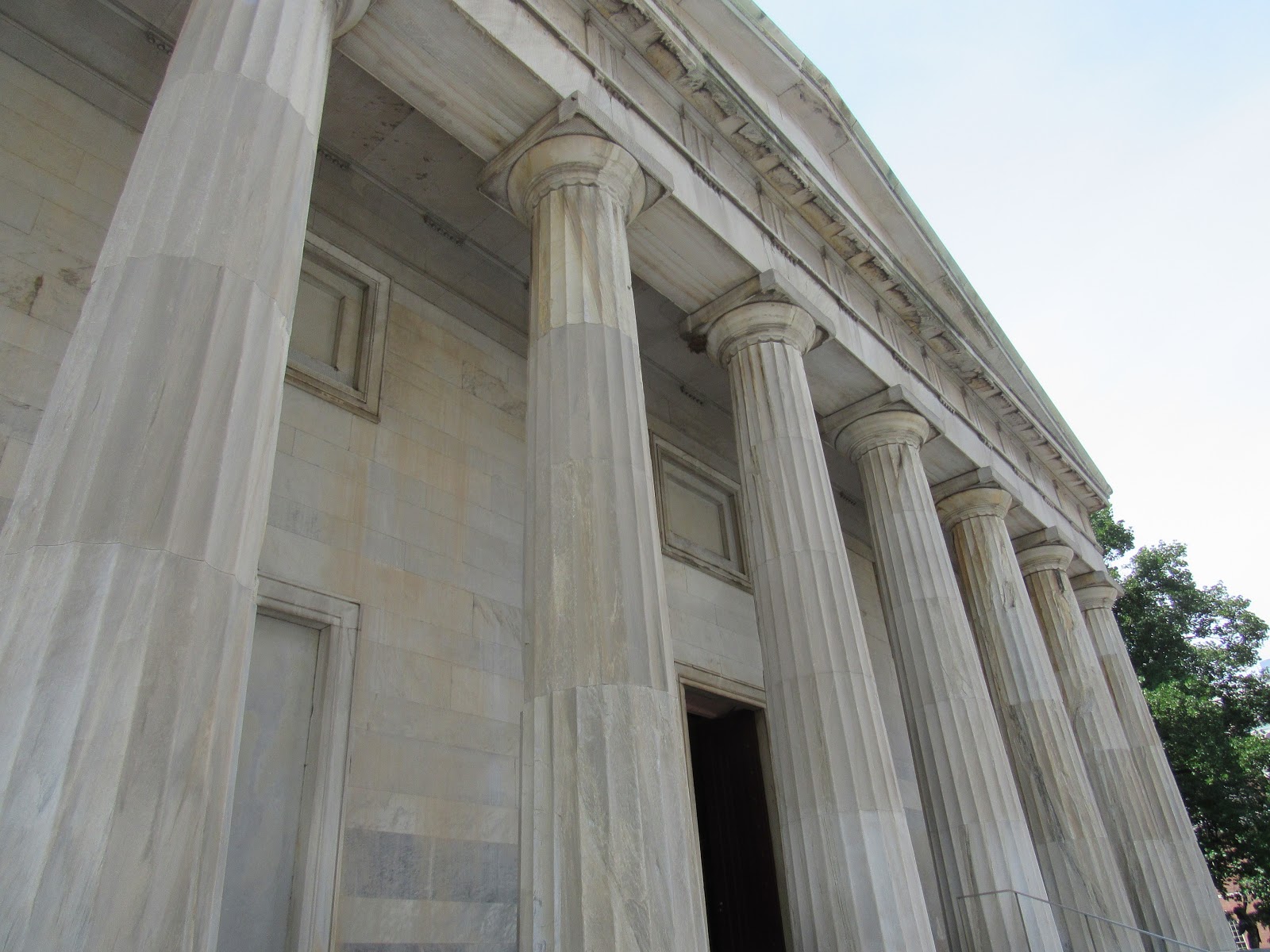
Second Bank of the U.S.
Among the positives of Philadelphia’s rapid 18th century growth, which included the creation of many broad avenues and large city blocks, one need only look at the addition of many languages and cultures to the city’s streets (north-south streets are numbered while east-west streets are named). I learned through a recent visit to the Portrait Gallery at the Second Bank of the U.S. in Philadelphia’s historic Old City district that Europeans throughout the Western world arrived here “to be able to worship freely, to lobby political leaders,” and “to pursue economic gain.” Also, “other cultures brought by free blacks from the Caribbean and enslaved Africans transported across the Atlantic added to Philadelphia’s cosmopolitan character and bustling economy.”

Meanwhile, Philadelphians also experienced many of the same challenges that a young American nation faced, too. As a city, Philadelphia was trying to transform from being a colonial outpost into an independent nation. “Personal experience with the political, economic, and cultural changes sweeping America after the Revolution made life for Philadelphians a mixture of tradition and innovation.”

Benjamin Franklin
Walk about the city – especially in Independence National Historic Park (which includes the Liberty Bell and Independence Hall) and in the Old City – and you’ll see that Philadelphia is Benjamin Franklin’s city. He was the city’s favorite son as well as an innovator and a difference maker.

Franklin’s likeness is found on banners and especially in paintings and sculptures. Beyond, the football stadium on the Ivy League campus of the University of Pennsylvania is named Franklin Field.

Franklin (1706-1790), I learned, was a “true son of the Enlightenment – a self-educated, runaway apprentice who translated his skill as a printer into a prosperous business.”

Although Franklin portrayed himself as a self-made man, in truth he benefited from the assists of many en route to achieving prosperity. In return, Franklin founded many organizations, including the Leather Apron Club and the Library Company of Philadelphia to benefit others. “His civic contributions improved safety, education, and health care in Philadelphia.”

Walking in Rittenhouse Square
During our brief stay in Philadelphia, we enjoyed a pre-dinner stroll through Rittenhouse Square, which at 7 o’clock on a Friday evening was lively with a mixture of millennials, families with dogs, and tourists snapping photographs of the many sculptures that dot the landscape. Of note, on the western side of the square is the Romanesque-style Church of the Holy Trinity, an Episcopal church designed by the Scottish architect John Notman. The first service was held there on March 27, 1859. Afterward, we enjoyed a sausage pizza and glass of wine at Pietro’s (1714 Walnut St.) that was followed by dessert at Capogiro Gelato Artisans (117 S. 20th St.).

On Saturday, we walked from the Hotel Palomar (117 S. 17th St.) to the lively Reading Terminal Market (corner of Market and N. 12th St.) for breakfast crepes at Profi’s Crêperie and a sinfully delicious maple bacon doughnut from Beiler’s Bakery followed by a walk around Independence Square. Later, we rode the Broad Street SEPTA train to Citizens Bank Ballpark to enjoy an afternoon Phillies-Mets baseball game. A quiet Saturday evening dinner at Le Pain Quotidien (1425 Walnut St.), a favorite of ours wherever we travel, was a nice way to relax after the ballgame. A steady, Sunday morning rain after breakfast kept us inside our hotel until it was time to return to the 30th Street Amtrak Station for our trip home.

Citizens Bank Ballpark
Today, the “city of Brotherly Love” (and sisterly affection) is an exceptional cultural and business center, easily accessible by Amtrak train (about two hours north of Washington, D.C., and 1.5 hours south from New York City’s Penn Station).

From Fairmount Park, home to major museums and sculpture gardens, the Philadelphia Zoo and 215 miles of biking and jogging paths, to South Philly, home to Philadelphia’s professional sports teams at Citizens Bank Ballpark (Phillies), Lincoln Financial Field (Eagles) and Well Fargo Center (76ers and Flyers), Philadelphia is a city where independent thinking – and free expression – is both revered and celebrated.

Photos: By Michael Dickens © 2018.

Tuesday, July 4, 2017

Words that built America: Thoughts on this Fourth of July

"Where liberty is, there is my country." 

– Benjamin Franklin, one of the Founding Fathers of the United States.

Today is Independence Day – America's birthday – the day the United States celebrates the adoption of the Declaration of Independence, signed 241 years ago on July 4, 1776, and the separation of the original 13 colonies of Delaware, Pennsylvania, New Jersey, Georgia, Connecticut, Massachusetts Bay, Maryland, South Carolina, New Hampshire, Virginia, New York, North Carolina, and Rhode Island and Providence Plantations from the British Empire.

According to Garrison Keillor, broadcasting in his Writer's Almanac  this morning across National Public Radio stations from coast to coast, I learned this: "Thomas Jefferson wrote most of the Declaration of Independence; everyone else in the room thought he was the most eloquent and the best writer and he offered no dissent. It's said that John Hancock wrote his name in extra large script so that King George would be sure to see it; the king suffered from cataracts. Fifty-six men from 13 colonies signed the document. One out of eight of them had gone to Harvard. Two would go on to become presidents of the United States."

Now it can be told: The signing of the Declaration of Independence actually took place on July 2, not the Fourth of July, and, said Keillor, "this fact always irked John Adams, who decided to protest the date of the new celebration by never, not once, attending a July Fourth celebration as long as he lived."

Also, the first public reading of the Declaration of Independence took place in Philadelphia on July 18, 1776, in Independence Square. Bells were rung and music filled the air. Congress established the Fourth of July as a national holiday in 1870. It became a federal holiday in 1938.

Today, Independence Day throughout the United States is commonly associated with fireworks and parades, backyard barbecues and picnics in city parks and at lakes and beaches. We celebrate family reunions and go to baseball games, too. Indeed, Independence Day is our celebration of our National Day in the United States.

And yet, in recent days, out collective liberties and freedoms have come under attack, thanks to the actions of a few – but with far-reaching consequences. Robert Reich, Chancellor's Professor of Public Policy at the University of California at Berkeley and Senior Fellow at the Blum Center for Developing Economies who served as Secretary of Labor in the Clinton administration, recently wrote that real patriotism "isn't about putting up walls, excluding Muslims and refugees, giving tax cuts to the rich, threatening freedom of the press and attacking the federal courts, or dividing Americans by race and ethnicity." In fact, he goes on to say, it's just the opposite. "Real patriotism requires sharing the burdens and sacrifices of keeping America going, paying taxes in full, cherishing democratic institutions, and bring America together."

Indeed, in this era of Trump, it is important that we remind ourselves what "We the People" truly stands for.

Here's one final thought worth sharing on this Fourth of July, 2017:

"When in the Course of human events, it becomes necessary for one people to dissolve the political bands which have connected them with another, and to assume among the powers of the earth, the separate and equal station to which the Laws of Nature and of Nature's God entitle them, a decent respect to the opinions of mankind requires that they should declare the causes which impel them to the separation."

– And, so began the unanimous Declaration of the thirteen united States of America, the statement adopted by the Continental Congress on July 4, 1776, which announced that the thirteen American colonies, who were then at war with Great Britain, regarded themselves as thirteen newly independent sovereign states, and no longer a part of the British Empire. Instead, they formed a new nation – the United States of America.

Happy Birthday America!