Showing posts with label freedom. Show all posts

Wednesday, December 11, 2019

Rosa Parks: In Her Own Words at the Library of Congress


Rosa Parks: In Her Own Words, the newest Library of Congress multimedia exhibition, opened on December 5, in the Library’s South Gallery of the Jefferson Building in Washington, D.C., to much fanfare and critical praise. By humanizing Rosa Parks, visitors are able to see her greatness in a new light.


“I want to be remembered as a person who stood up to injustice, and most of all, I want to be remembered as a person who wanted to be free and wanted others to be free.”

– Rosa Parks


If you are of a certain age, chances are good you remember the famous photograph of Rosa Parks seated on a Montgomery, Alabama, bus, taken Dec. 21, 1956.

A year earlier, on Dec. 1, 1955, Parks became nationally known for her refusal to give up her seat to a white man on a crowded bus in the same city.

Parks’ arrest was the catalyst that led to the Montgomery Bus Boycott, a pivotal event in the American Civil Rights movement which ultimately brought about the dismantling of Jim Crow segregation in the southern United States.

While Rosa Parks’ refusal to give up her seat on the bus, the Montgomery Bus Boycott and the subsequent fallout from it all happened before I was born, as a student of American history I’ve always been interested in learning more about her life of defiance and how she became a symbol of human dignity and freedom, not only in America but internationally, too.

During a recent visit to Rosa Parks: In Her Own Words at the Library of Congress, I learned that while Rosa Parks (1913-2005) became an icon of the Civil Rights Movement – “celebrated for this single courageous act of civil disobedience” – she has often been characterized by misconceptions. It’s an old and convenient story that is finally being debunked. “Contrary to popular belief, Parks was not a demure seamstress who chose not to stand because she was physically tired.” Instead, as I learned, “her calm demeanor hid a militant spirit forged over decades.”

Among many first-week visitors to the exhibit was E.R. Shipp, a Pulitzer Prize winner for commentary, who is journalist in residence at Morgan State University’s School of Global Journalism and Communication in Baltimore, Maryland. She wrote Parks’ obituary while she was a reporter for The New York Times and gained a keen insight about the civil rights icon – especially after interviewing Mrs. Parks in a New York City church in 1988, in the midst of a voter registration drive. She and I shared a brief conversation in person following a curator’s tour and later continued it via email as we discussed our shared experiences after seeing Rosa Parks: In Her Own Words.

“I was very impressed with the exhibit and think that, for most people, it will be a revelation,” Shipp told me. “Even now, many people only know that Mrs. Parks refused to give up her seat on a bus in Montgomery and that she became known as ‘the Mother of the Civil Rights Movement.’ Those who know that, don’t now much more than that.”

Shipp conveyed to me she was impressed by the quality of Mrs. Parks’ personal writings as much as with the behind-the-scenes insights that her writings offer us. She hopes to make use of the papers as a scholar and journalist in the future. “I did not really know her family lineage and did not realize that many of her forebears could easily have called themselves white. They were what the writer Jill Nelson has called ‘the voluntary Negro,’ she said.”

Shipp, who writes a column every other Wednesday for the Baltimore Sun, shared her insights about Parks with her readers today, noting: “Perhaps it is inevitable that each generation puts a stamp on the past. The power dynamics of who disseminates a history becomes key.”

Rosa Parks: In Her Own Words is presented in a multimedia format in four main areas – Early Life and Activism, The Bus Boycott, Detroit 1957 and Beyond, and A Life of Global Impact – and together, we learn of the complete story about the remarkable life and contributions of the mother of the Civil Rights Movement.


So, just who was Rosa Parks? For one, she was a seasoned activist – an organizer – who organized to free the Scottsboro Boys in the 1930s. Also, she helped operate the NAACP and Brotherhood of Sleeping Car Porters offices in Montgomery during the 1940s and 1950s. Despite her punishment from the bus incident, which included unemployment and dire poverty – not to mention being the subject of death threats – Parks strove for social justice and human rights. She served as an inspiration not only in the U.S. but also around the world, fighting for women’s rights and speaking out against the Vietnam War. She was a prisoner advocate and supported the growing Black Power movement of the 1960s. By the 1980s, she supported the presidential campaigns of Jesse Jackson and also participated in the anti-apartheid protests against South Africa. She was an advocate of nonviolence and peace. What a remarkable life Mrs. Parks lived!

After her death in 2005, Rosa Parks’ body lay in honor at the U.S. Capitol Rotunda, the first woman given that distinction. In 2006, a statue of Mrs. Parks was placed in the National Statuary Hall. Throughout the U.S., there are many schools, parks and streets which are named in her honor.

Thanks to the vast archives of the Library of Congress, which includes the Rosa Parks Collection (a gift to the Library of Congress from the Howard G. Buffett Foundation), visitors to Rosa Parks: In Her Own Words will see a variety of rarely seen materials that offer not only an intimate view of Rosa Parks, but also document her life and activism – “creating a rich opportunity for viewers to discover new dimensions to their understanding of this seminal figure.”

Credits: Cover photo by Michael Dickens. Original photo of Rosa Parks seated on bus from Library of Congress Prints and Photographs Division. Rosa Parks statue photo courtesy of AOC.gov. Video courtesy of YouTube, LOC.gov.

Tuesday, November 20, 2018

On art and fashion: Contemporary Muslim Fashions

Thanks to social media, I have become Facebook friends with several Tunisian women, all whom are Muslim. Some of them cover their heads in colorful headscarves, known as hijabs; most do not. Each have become individuals of style within and beyond their communities in this North African country bordered by Algeria, Libya and the Mediterranean Sea, as I’ve learned firsthand through many thoughtful online conversations. While the nature of the Muslim dress code worldwide is a complex and diverse one, like it or not, Muslim fashion has become part of the mass-media’s attention drawn to contemporary Muslim life.
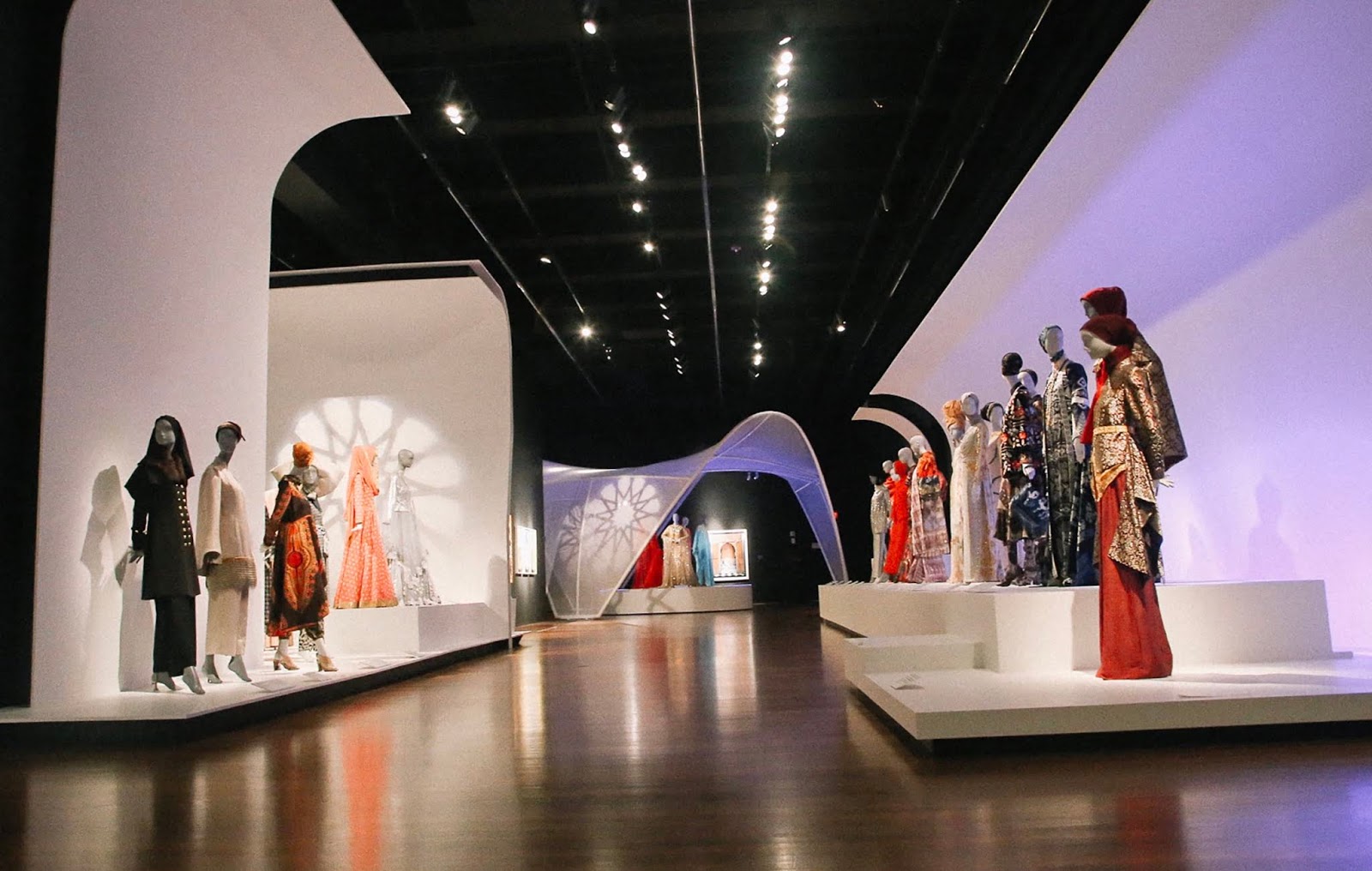
Currently, the deYoung Fine Arts Museum in San Francisco is examining Contemporary Muslim Fashions by “spotlighting places, garments, and styles from around the world,” in a show that began in late September and continues through January 6, 2019.

Contemporary Muslim Fashions is the first major museum exhibition to explore “the complex, diverse nature of Muslim dress codes worldwide” by bringing together different religious interpretations and cultures of Islam. The creativity and diversity – and politics – of modest dressing is celebrated.


I’ve learned that this exhibition considers “how Muslims define themselves – and are defined – by their dress and how these sartorial choices can reflect the multifaceted nature of their identities.”

Contemporary Muslim Fashions crosses through many different religious interpretations and cultures, featuring spectacular creations from a dynamic fashion scene by designers from both the Middle East and Southeast Asia – think Malaysia and Indonesia. From street wear to couture, the exhibition includes “high-end fashions, such as those by Malaysia-based Blancheur; street wear, such as modest designs from London-based Sarah Elenany; sportswear, such as the burkini; and commissioned garments from both emerging and established designers.”


The exhibition also includes the use of social media as a primary material – an agent of change. Muslim voices and personal narratives are framed by using runway footage of fashion shows and news clips as well as documentary and fashion photography.

As visitors to Contemporary Muslim Fashions will learn, while Islam is a multicultural faith, the dress of its followers is “shaped not only by religious principles but also by local customs and traditions and global fashion trends.” Thus, a woman from Tunisia is more likely to be contemporary in her fashion attire than a woman living in Saudi Arabia.


In her review of Contemporary Muslim Fashions for The Hollywood Reporter, critic Celine Semaan wrote, “Because of the current political climate from which it is rising, the show carries a message of hope and acceptance. The act itself of organizing this exhibition is nothing if not a peaceful demonstration of the American values written in the First Amendment: freedom of speech, freedom of expression, freedom of religion.”

Laird Borrelli-Persson of Vogue, in reviewing Contemporary Muslim Fashions, quotes curator Jill D’Alessandro, who believes, “Fashion can be an agent for positive change, for understanding, and breaking down barriers; they (fashion designers) want to exhibit in the United States and in Europe because they want their cultures to be understood.”

One thing’s for sure: There’s a diversity in Muslim fashion that is strikingly beautiful, both for its modern aesthetic and for its street-style appeal.

Photos: Cover – Mary Katrantzou skirt and shirt (silk and polyester), and Malone Souliers shoes.  Bottom – Flight jacket with U.S. Constitution written in Arabic on the back and First Amendment written in English inside, by Slow Factory (Courtesy of deYoung Museum and Google Images). Video: Courtesy of YouTube.com.

Wednesday, August 22, 2018

On urban travel: Philadelphia Faces

The Signer / Commemorates the spirits and 
deeds of all who devoted their lives
 to the cause of American freedom. 

In October 1682, the Quaker William Penn founded the city of Philadelphia between the banks of the Delaware and Schuylkill rivers in the English Crown Province of Pennsylvania. Within a century, Penn’s “greene countrie town” in eastern Pennsylvania became one of the largest cities in the British Empire with 25,000 inhabitants. By 1790, the year in which the federal capital moved to Philadelphia, the city’s population exceeded 44,000.

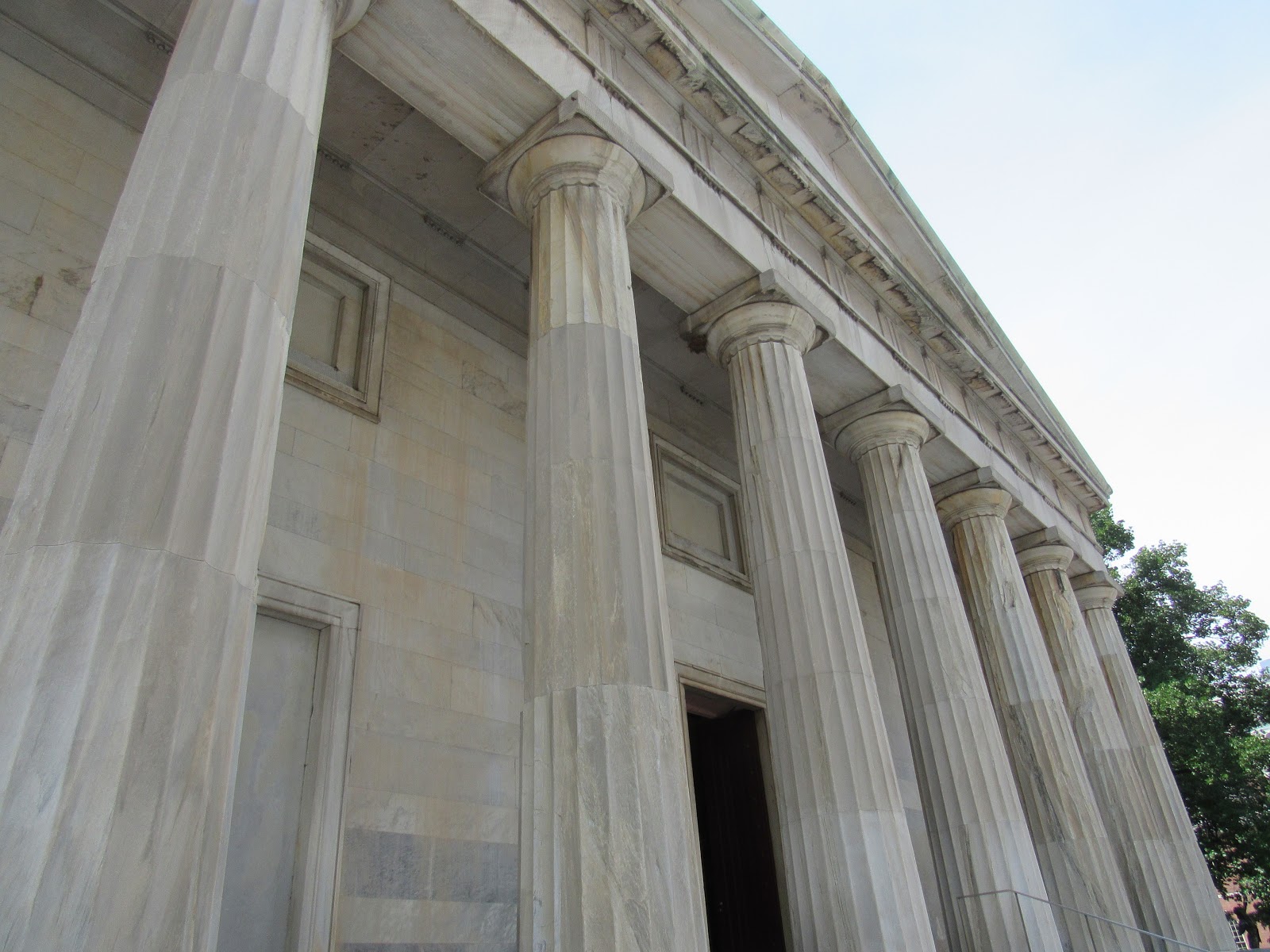
Second Bank of the U.S.
Among the positives of Philadelphia’s rapid 18th century growth, which included the creation of many broad avenues and large city blocks, one need only look at the addition of many languages and cultures to the city’s streets (north-south streets are numbered while east-west streets are named). I learned through a recent visit to the Portrait Gallery at the Second Bank of the U.S. in Philadelphia’s historic Old City district that Europeans throughout the Western world arrived here “to be able to worship freely, to lobby political leaders,” and “to pursue economic gain.” Also, “other cultures brought by free blacks from the Caribbean and enslaved Africans transported across the Atlantic added to Philadelphia’s cosmopolitan character and bustling economy.”

Meanwhile, Philadelphians also experienced many of the same challenges that a young American nation faced, too. As a city, Philadelphia was trying to transform from being a colonial outpost into an independent nation. “Personal experience with the political, economic, and cultural changes sweeping America after the Revolution made life for Philadelphians a mixture of tradition and innovation.”

Benjamin Franklin
Walk about the city – especially in Independence National Historic Park (which includes the Liberty Bell and Independence Hall) and in the Old City – and you’ll see that Philadelphia is Benjamin Franklin’s city. He was the city’s favorite son as well as an innovator and a difference maker.

Franklin’s likeness is found on banners and especially in paintings and sculptures. Beyond, the football stadium on the Ivy League campus of the University of Pennsylvania is named Franklin Field.

Franklin (1706-1790), I learned, was a “true son of the Enlightenment – a self-educated, runaway apprentice who translated his skill as a printer into a prosperous business.”

Although Franklin portrayed himself as a self-made man, in truth he benefited from the assists of many en route to achieving prosperity. In return, Franklin founded many organizations, including the Leather Apron Club and the Library Company of Philadelphia to benefit others. “His civic contributions improved safety, education, and health care in Philadelphia.”

Walking in Rittenhouse Square
During our brief stay in Philadelphia, we enjoyed a pre-dinner stroll through Rittenhouse Square, which at 7 o’clock on a Friday evening was lively with a mixture of millennials, families with dogs, and tourists snapping photographs of the many sculptures that dot the landscape. Of note, on the western side of the square is the Romanesque-style Church of the Holy Trinity, an Episcopal church designed by the Scottish architect John Notman. The first service was held there on March 27, 1859. Afterward, we enjoyed a sausage pizza and glass of wine at Pietro’s (1714 Walnut St.) that was followed by dessert at Capogiro Gelato Artisans (117 S. 20th St.).

On Saturday, we walked from the Hotel Palomar (117 S. 17th St.) to the lively Reading Terminal Market (corner of Market and N. 12th St.) for breakfast crepes at Profi’s Crêperie and a sinfully delicious maple bacon doughnut from Beiler’s Bakery followed by a walk around Independence Square. Later, we rode the Broad Street SEPTA train to Citizens Bank Ballpark to enjoy an afternoon Phillies-Mets baseball game. A quiet Saturday evening dinner at Le Pain Quotidien (1425 Walnut St.), a favorite of ours wherever we travel, was a nice way to relax after the ballgame. A steady, Sunday morning rain after breakfast kept us inside our hotel until it was time to return to the 30th Street Amtrak Station for our trip home.

Citizens Bank Ballpark
Today, the “city of Brotherly Love” (and sisterly affection) is an exceptional cultural and business center, easily accessible by Amtrak train (about two hours north of Washington, D.C., and 1.5 hours south from New York City’s Penn Station).

From Fairmount Park, home to major museums and sculpture gardens, the Philadelphia Zoo and 215 miles of biking and jogging paths, to South Philly, home to Philadelphia’s professional sports teams at Citizens Bank Ballpark (Phillies), Lincoln Financial Field (Eagles) and Well Fargo Center (76ers and Flyers), Philadelphia is a city where independent thinking – and free expression – is both revered and celebrated.

Photos: By Michael Dickens © 2018.

Tuesday, July 4, 2017

Words that built America: Thoughts on this Fourth of July

"Where liberty is, there is my country." 

– Benjamin Franklin, one of the Founding Fathers of the United States.

Today is Independence Day – America's birthday – the day the United States celebrates the adoption of the Declaration of Independence, signed 241 years ago on July 4, 1776, and the separation of the original 13 colonies of Delaware, Pennsylvania, New Jersey, Georgia, Connecticut, Massachusetts Bay, Maryland, South Carolina, New Hampshire, Virginia, New York, North Carolina, and Rhode Island and Providence Plantations from the British Empire.

According to Garrison Keillor, broadcasting in his Writer's Almanac  this morning across National Public Radio stations from coast to coast, I learned this: "Thomas Jefferson wrote most of the Declaration of Independence; everyone else in the room thought he was the most eloquent and the best writer and he offered no dissent. It's said that John Hancock wrote his name in extra large script so that King George would be sure to see it; the king suffered from cataracts. Fifty-six men from 13 colonies signed the document. One out of eight of them had gone to Harvard. Two would go on to become presidents of the United States."

Now it can be told: The signing of the Declaration of Independence actually took place on July 2, not the Fourth of July, and, said Keillor, "this fact always irked John Adams, who decided to protest the date of the new celebration by never, not once, attending a July Fourth celebration as long as he lived."

Also, the first public reading of the Declaration of Independence took place in Philadelphia on July 18, 1776, in Independence Square. Bells were rung and music filled the air. Congress established the Fourth of July as a national holiday in 1870. It became a federal holiday in 1938.

Today, Independence Day throughout the United States is commonly associated with fireworks and parades, backyard barbecues and picnics in city parks and at lakes and beaches. We celebrate family reunions and go to baseball games, too. Indeed, Independence Day is our celebration of our National Day in the United States.

And yet, in recent days, out collective liberties and freedoms have come under attack, thanks to the actions of a few – but with far-reaching consequences. Robert Reich, Chancellor's Professor of Public Policy at the University of California at Berkeley and Senior Fellow at the Blum Center for Developing Economies who served as Secretary of Labor in the Clinton administration, recently wrote that real patriotism "isn't about putting up walls, excluding Muslims and refugees, giving tax cuts to the rich, threatening freedom of the press and attacking the federal courts, or dividing Americans by race and ethnicity." In fact, he goes on to say, it's just the opposite. "Real patriotism requires sharing the burdens and sacrifices of keeping America going, paying taxes in full, cherishing democratic institutions, and bring America together."

Indeed, in this era of Trump, it is important that we remind ourselves what "We the People" truly stands for.

Here's one final thought worth sharing on this Fourth of July, 2017:

"When in the Course of human events, it becomes necessary for one people to dissolve the political bands which have connected them with another, and to assume among the powers of the earth, the separate and equal station to which the Laws of Nature and of Nature's God entitle them, a decent respect to the opinions of mankind requires that they should declare the causes which impel them to the separation."

– And, so began the unanimous Declaration of the thirteen united States of America, the statement adopted by the Continental Congress on July 4, 1776, which announced that the thirteen American colonies, who were then at war with Great Britain, regarded themselves as thirteen newly independent sovereign states, and no longer a part of the British Empire. Instead, they formed a new nation – the United States of America.

Happy Birthday America!

Tuesday, March 8, 2016

Who lives, who dies, who gets to tell your story?

Lin-Manuel Miranda /
Writer, composer, star, genius of "Hamilton".
It's been said that works of art have long informed how people understand the past, and Lin-Manuel Miranda's Hamilton is no exception.

As the writer, composer, and star of the Broadway smash-hit Hamilton, Miranda is changing the way that people consider one of the Founding Fathers and the era he lived in. It puts him in lofty territory, alongside how Shakespeare transformed Richard III, and how the author Leon Uris romanticized the founding of Israel in his novel Exodus.

The recipient of a MacArthur "Genius" grant, the 36-year-old Miranda relies on the core elements of hip-hop and R & B-inspired music as well as jazz, pop and Tin Pan Alley – plus a racially-diverse cast – to make history as relatable as possible. Hamilton has become a certifiable Broadway box office hit – tickets are sold out into early 2017 – and the musical is centered around a story arc that related Hamilton's life story, from his orphaned upbringing in the West Indies to his death in a duel at the hands of Aaron Burr.

"This is a story about America then, told by America now," said Miranda, a native New Yorker, in an interview with The Atlantic, "and we want to eliminate any distance between a contemporary audience and this story."

The real Alexander Hamilton (L) and Lin-Manuel Miranda,
who portrays the First U.S. Treasury Secretary in "Hamilton".
"Hamilton, then, has the potential to strongly influence the way Americans think about the early republic. For one thing ... it understands Thomas Jefferson to be a deeply flawed individual. It presents an American history in which women and people of color share the spotlight with the founding fathers. The primarily black and Hispanic cast reminds audiences that American history is not just the history of white people, and frequent allusions to slavery serve as constant reminders that just as the revolutionaries were fighting for their freedom, slaves were held in bondage," wrote Edward Delman in a September 29, 2015 essay for The Atlantic. 

"Perhaps the most significant lesson the show might teach audiences, and one particular relevance today, is the outsized role immigrants have played in the nation's history. Alexander Hamilton was an immigrant – a fact that Miranda repeatedly emphasizes throughout the show – and the musical also prominently features the Marquis de Lafayette, a French nobleman who played a crucial role during the revolutionary war."

Lin-Manuel Miranda / The artist at work.
The process which Miranda translated the history of the unlikely rise and untimely fall of the first U.S. Treasury Secretary, Alexander Hamilton, onto the stage is a fascinating one. The origin of
Hamilton dates back to May 12, 2009, when Miranda performed "The Hamilton Mixtape" before an audience that included President Barack Obama and First Lady Michelle Obama at the White House Evening of Poetry, Music and the Spoken World, accompanied by pianist Alex Lacamoire.


Lin-Manuel Miranda (center) translated the history of the
unlikely rise and untimely fall of the first U.S. Treasury
Secretary, Alexander Hamilton, in "Hamilton". 
In a February 2015 feature about Hamilton, Rebecca Meade of The New Yorker wrote: "It does not seem accidental that Hamilton was created during the tenure of the first African-American President. The musical presents the birth of the nation in an unfamiliar but necessary light: not solely as a work of élite white men but as the foundational story of all Americans. Thomas Jefferson, James Madison, and George Washington are all played by African-Americans. Miranda also gives prominent roles to women, including Hamilton's wife, Eliza Schuyler (Phillipa Soo), and sister-in-law, Angelica Schuyler (Renée Elise Goldsberry). When they are joined by a third sister, their zigzagging harmonies sound rather like those of Destiny's Child. Miranda portrays the Founding Fathers not as exalted statesmen but as orphaned sons, reckless revolutionaries, and sometimes petty rivals, living at a moment of extreme volatility, opportunity, and risk. The achievements and the dangers of America's current moment – under the Presidency of a fatherless son of an immigrant, born in the country's island margins – are never far from view."

The original cast recording, produced by The Roots' Questlove and Black Thought – which has been a constant companion of mine in my car stereo the past couple of weeks – recently garnered a Grammy Award, and Hamilton most assuredly and deservedly will clean up at this summer's Tony Awards.


"I don't know how many really good ideas you get in a lifetime," Miranda recalled in a December 2015 interview with The Hollywood Reporter, "But the idea of telling Hamilton as a hip-hop story was definitely one because you get to do everything: love and death and a war and duels and revenge and affairs and sex scandals."

One thing's certain: thanks to Miranda's genius, Hamilton is having a positive influence in altering our perception of American history, and the role in which artists are helping shape the historical narrative.

Wednesday, February 17, 2016

Stuart Scott: Every Day He Fought

"When you die, it does not mean that you lose to cancer. You beat cancer by how you live, why you live, and the manner in which you live." – Stuart Scott

As an anchor and commentator for ESPN's SportsCenter, Stuart Scott became the face of his network. He was the most popular and recognized anchor of his generation, and arguably the hippest sports journalist ever. As lead host of the NBA on ABC and ESPN, and as a host of Monday Night Football on ESPN, Scott brought a unique spirit and style to each telecast.

Scott anchored his first SportsCenter with Craig Kilborn back in September 1996. He had a thick dark mustache, and "I wore my hair in a type of baby high-top fade, which was all the rage among young black men at the time; short on the sides, long on top." And there was Scott's big, boxy suits. "This is back in the day in the day when suits were boxy, with big shoulders. Now everything is Euro, slim-fit. Back in the day, big and baggy was cool," Scott wrote. Looking back at that clip in 2014, what he saw was this: "a young black man rocking the style of the day. But I also saw something else, something harder for the naked eye to make out. I saw a dude who had been given the freedom to let his voice fly."

Scott became known for infusing his reports with a blend of pop culture references, hip-hop slang, and exuberant phrases – Boo-yah! – that made him something of a pop culture icon in his own right.

Shortly before Scott died of cancer on January 4, 2015, he completed work on his memoir, Every Day I Fight, that is both a labor of love and love letter to life itself. Looking for something inspiring to read, I checked out Every Day I Fight from my local public library – and it has been my reading companion the past few weeks, and I've fought hard to put it down. I highly recommend it.

Stuart Scott's story is a very personal one, and page after page of Every Day I Fight  he bares his soul, sharing his intimate struggles to beat cancer and stay alive. As I read, I can hear Scott's familiar voice that I remember from his SportsCenter days.

In Every Day I Fight, written with journalist Larry Platt, Scott writes about illness and loss with relentless energy. His words are raw, honest and powerful. At times over the top, other times irresistibly sincere – just like his television personality – Scott had this to say for those who praised his fortitude once his cancer became public. "Trust me, I ain't courageous. I just don't want to die." The two simple reasons he didn't want to die: his daughters, Taelor and Sydni.

–––––
"I'd work out three or four times a week, but the most important workout was the one right after chemo. It was like I was proving a point: While you kick my butt, cancer, I'm gonna kick yours."
–––––

Scott was struck by appendiceal cancer in 2007, a rare disease. He fought cancer the same way that elite athletes train in pursuit of a championship – his desire to remain in control of his health, to fight for others who couldn't fight, and to inspire his daughters, who meant the world to him. Scott wanted to be there for Taelor and Sydni, now teenagers, "not simply as their dad, but as an immutable example of determination of courage."

Scott writes: "I needed to do that, not just to show my girls I was fighting for them, but also to show myself I had some control over the situation. 'Cause cancer wants to take control from you. You've got to very purposefully stand your ground. That's what going to the gym is to me. I decide, cancer. That's what going to work is I decide, cancer. That's what traveling all over the country and abroad is. I decide, cancer."

But let's keep this real, Scott wrote. "I'm forty-nine. There's a good chance I'm going to die a helluva lot earlier than I ever wanted to. There's a good chance I'm going to die soon. And I know it. I know it every moment of every day. And that reality is never not with me.

"So this book is a chronicle of my fight against cancer, but it's even more than that. It's really a memoir of a life well fought; in sports, the media, or the cancer ward, the one true thing I've learned is that life is hard but that there is redemption in the struggle."

Scott embraced life and changed lives. His friend and colleague Robin Roberts, herself once an ESPN SportsCenter anchor before ascending to host ABC's Good Morning America, wrote: "Stu's unshakable courage was inspirational. Cancer never defined him; it's not his life's story but rather a chapter in his life's story. You'll see in these beautifully written pages that he set a stellar example for all of us in so many aspects of life. Stu said when you're too tired to fight, rest and let someone else fight for you. My dear friend, you can rest now, and we will continue to fight for you."

Tuesday, December 10, 2013

Remembering Mabida: He was a universal symbol of tolerance and hope


"I learned that courage was not the absence of fear, but the triumph over it. The brave man is not he who does not feel afraid, but he who conquers that fear."  Nelson Mandela


Nelson Mandela, 1918-2013.

We were all saddened by the news of the passing of Nelson Mandela, South Africa's first black president and an icon of peaceful resistance.

Mr. Mandela died at his home in the Johannesburg suburb of Houghton on Thursday night at age 95. News of his death spread quickly around the world through cable news networks like CNN, in social media such as Facebook and via the internet, and in the days since, there's been no shortage or tumult of remembrances. Mr. Mandela has been memorialized as an icon, a radical, a leader and a luminary.

Beloved by all, Mr. Mandela was a universal symbol of tolerance and hope, a man of great heart and compassion. Following his release prison after 27 years of incarceration, Mr. Mandela led South Africa through emancipation from white minority rule and he won the Nobel Peace Prize in 1993.

"Mr. Mandela's quest for freedom took him from the court of tribal royalty to the liberation underground to a prison rock quarry to the presidential suite of Africa's richest country," wrote The New York Times"And then, when his first term of office was up, unlike so many of the successful revolutionaries he regarded as kindred spirits, he declined a second term and cheerfully handed over power to an elected successor, the country still gnawed by crime, poverty, corruption and disease but a democracy, respected in the word and remarkably at peace."

In announcing Mr. Mandela's death to an entire nation, President Jacob Zuma of South Africa said: "Our nation has lost its greatest son. Our 
people have lost a father. His tireless struggle for freedom earned him the respect of the world. His humility, his compassion and his humanity earned him their love.

Regardless of our race, nationality or country of residence, Mr. Mandela will be remembered by many as the "world's kindly white-haired grandfather." His last public appearance was in 2010, when South Africa hosted football's World Cup.

World leaders across several continents were united in their praise of Mr. Mandela and their tributes were filled with superlatives.

• "A giant among men has passed away. This is as much India's loss as South Africa's." — Prime Minister Manmohan Singh, India.

• "A great light has gone out in the world. Nelson Mandela was a hero of our time." — Prime Minister David Cameron, Britain.

• "All of Canada mourns with the family of Nelson Mandela and the citizens of South Africa. The world has lost one of its great moral leaders." — Prime Minister Stephen Harper.


• "Today we say goodbye to a man who brought hope, a true hero who will continue to inspire us." — Prime Minister Elio Di Rupo, Belgium.

Here in the U.S., President Barack Obama reflected on Mr. Mandela's life by praising him as a man of courage and compassion. "Let us pause and give thanks for the fact that Nelson Mandela lived — a man who took history in his hands and bent the arc of the moral universe toward justice."

And, former U.S. President Bill Clinton noted that history will remember Mr. Mandela as a champion for human dignity and freedom, for peace and reconciliation. "All of us are living in a better world because of the life Madiba lived. He proved that there is a freedom in forgiving, that a big heart is better than a closed mind, and that life's real victories must be shared."

To have an understanding of Mr. Mandela's religious, spiritual and humanist worldview, one need only look to his 1994 autobiography Long Walk to Freedom, which profiled his early life, coming of age, education and 27 years in prison.

"The story told by Mandela's life is not one of infallible human beings and inevitable triumph. It is the story of a man who was willing to risk his own life for what he believed in, and who worked hard to lead the kind of life that would make the world a better place," said Mr. Obama.

Mr. Mandela was also praised by leaders of the religious community, including Archbishop Desmond Tutu, who like Mr. Mandela was a Nobel laureate and a towering figure in South Africa's struggle against apartheid. He said that Mr. Mandela "embodied our hopes and dreams, symbolized our enormous potential."

At the Vatican, Pope Francis praised "the steadfast commitment shown by Nelson Mandela in promoting the human dignity of all the nation's citizens."

In San Francisco, the Very Rev. Dr. Jane Shaw, Dean of Grace Cathedral, said that "it is appropriate to take a moment to thank God for his example and the profound influence for peace he life has had. ... We celebrate his life and will continue in his example to fight against institutionalized racism, poverty and inequality."

Praise also came from the streets from fellow South African citizens like Shadrack Motau, who accompanied Mr. Mandela on a tour of his Soweto neighborhood after his release from prison. He told The New York Times: "The man had so much humility. He treated everyone with respect and dignity, from statesmen to children."

By all accounts, Mr. Mandela loved being in the company of children. He spoke often of the importance that education played with shaping the world's youth. "Young people must take it upon themselves to ensure that they receive the highest education possible so that they can represent us well in the future as future leaders."

Those old enough to remember the struggle against apartheid have flocked for days to Mr. Mandela's home to pay tribute to South Africa's departed leader through means of joyful noise. 

"We should, while mourning, also sing at the top of our voices, dance and do whatever we want to do, to celebrate the life of this outstanding revolutionary who kept the spirit of freedom alive and led us to a new society," South African president Zuma said in a statement over the weekend. "As South Africans, we sing when we are happy, and we also sing when we are sad to make ourselves feel better. 

"Let us celebrate Madiba in this way, which we know best," Mr. Zuma added, referring to Mr. Mandela by his widely used clan name. "Let us sing for Madiba."

On Tuesday, in rain-soaked Soweto townshipPresident Obama, U.N. Secretary General Ban Ki-moon and some of Mandela's grandchildren were among those who spoke during a four-hour memorial service honoring Mr. Mandela, held in the 95,000-capacity FNB Stadium (built for the 2010 World Cup) and attended by more than 100 heads of state and other dignitaries and celebrities. 

"It took a man like Madiba to free not just the prisoner, but the jailer as well; to show that you must trust others so that they may trust you; to teach that reconciliation is not a matter of ignoring a cruel past, but a means of confronting it with inclusion and generosity and truth," Mr. Obama said in a stirring eulogy. "He changed laws, but he also changed hearts."

Worth reading for its comprehensive look at the life of Mr. Mandela is the 6,500-word obit which appeared in The New York Times on Friday. It was written by the paper's former executive editor Bill Keller, who in the 1990s was its Johannesburg bureau chief. The obit was eight years in the making and it included comments from a 2007 interview Keller conducted with Mr. Mandela.

Across a wide spectrum, many have shared their thoughts about Mr. Mandela's passing. Here are a few worth sharing:

• The Rev. Al Sharpton shared the sentiment of many, not only in my country but throughout the world, when he commented on MSNBC in the first hour after the announcement of Mr. Mandela's death: "We've lost one of the world's great citizens." 

• Muhammad Ali, generally considered among the greatest heavyweight boxers in the world  a sport which Mr. Mandela participated in his youth  said in a statement: "He taught us forgiveness on a grand scale. His was a spirit born free, destined to soar above the rainbows. Today his spirit is soaring through the heavens. He is now forever free."

• The American poet Maya Angelou, who unveiled a tribute poem to Mr. Mandela, shared her thoughts about his impact on the world with CBS News, saying: "He showed us how liberating it is to forgive."

• CNN's Christiane Amanpour, who is no stranger to reporting about world leaders, put things into perspective when she said: "Nelson Mandela was the towering moral giant of the 20th and 21st centuries. We will not see the likes of Madiba again for a long, long time."

• Finally, Kofi Annan, who is the chair of The Elders and chairman of the Kofi Annan Foundation and from 1997-2006 served as the secretary-general of the United Nations, wrote in a Financial Times commentary: "Almost 20 years ago, Mandela said South Africa had come as far as it had on the path to peace and democracy only because the world had set his country 'a moral example which we had dared to follow.' As we mourn his passing and honour his memory, the task for leaders and citizens alike is to dare to follow his example  in every corner of Africa and across the world."

Photograph of Nelson Mandela courtesy of Google Images, 2013.

Tuesday, August 20, 2013

Curt Flood: An every day reminder of one of America's past baseball heroes


Beyond boundaries / Outside Curt Flood Field in Oakland, Calif.

As the Major League baseball pennant races heat up across the country, here in the Bay Area, the San Francisco Giants have gone from first to worst while the Oakland A's of Moneyball fame continue to fight for survival, remaining at or near the top of their division, while playing in what one local sports columnist labeled the Oakland Coliseum as "the greatest terrible place on Earth."

While San Francisco has played center stage to many of baseball's greatest stars -- Willie Mays, and Willie McCovey of the Giants come to mind -- as well as one of the game's biggest anti-heroes, Barry Bonds, across the Bay in Oakland, most of its greatest home-grown talent like Frank Robinson, Vada Pinson and Willie Stargell have earned their accolades elsewhere.

Then, there's Curt Flood, a Major League baseball player, who spent much of his career as a center fielder for the St. Louis Cardinals.

Curt Flood / Won seven consecutive Gold Gloves
for the St. Louis Cardinals between 1963-69.
Born in Texas but raised in Oakland, Flood played in the same outfield as Robinson and Pinson at West Oakland's McClymonds High School. Each became a major leaguer with the Cincinnati Reds in the mid-1950s. After two seasons, Flood was traded by the Reds to the Cardinals in December 1957. For the next twelve seasons, Flood became a defensive fixture for the Cardinals, winning seven consecutive Gold Gloves, making three All-Star teams, and winning two World Series titles. In 1969, he collected the first hit in a major league regular season game in Canada. During his career, Flood hit .293, knocked out 1,861 hits and drove in 631 runs.

However, despite his outstanding career on the field, it was outside the lines that Flood developed his principal legacy to the Summer Game. Flood became a pivotal figure in the labor history of baseball when he refused to accept a trade to the Philadelphia Phillies following the 1969 season, and he ultimately appealed his case to the U.S. Supreme Court.

Flood believed that the decades-old reserve clause that Major League Baseball employed was unfair because it "kept players beholden for life to the team with which they originally signed, even when they had satisfied the terms and conditions of those contracts."

Flood's rebellion against the baseball establishment came at a period of time when the U.S. was coming apart at the seams. We were at war in Southeast Asia, marching for civil rights through the South, and dealing with the tragedy of the assassinations of Dr. Martin Luther King Jr. and Sen. Robert F. Kennedy. As a country, we were losing great Americans who were dying for the rights of others.

Curt Flood refused a trade to the
Phillies after the 1969 season.
In his 1971 autobiography, The Way It Is, written with Richard Carter, Flood cited the Phillies' poor record and dilapidated Connie Mack Stadium, and for what he believed were "belligerent -- and, racist -- fans" as reasons for refusing to report to his new team. He forfeited a $100,000 contract for the season and, instead, chose to pursue his legal options with the blessing of the the players' union head Marvin Miller and the union's funding.

In a December 24, 1969 letter addressed to Baseball Commissioner Bowie Kuhn, Flood demanded the commissioner declare him a free agent. He wrote:

After twelve years in the major leagues, I do not feel I am a piece of property to be bought and sold irrespective of my wishes. I believe that any system which produces that result violates my basic rights as a citizen and is inconsistent with the laws of the United States and of the several States.

"It is my desire to play baseball in 1970, and I am capable of playing. I have received a contract offer from the Philadelphia club, but I believe I have the right to consider offers from other clubs before making any decision. I, therefore, request that you make known to all Major League clubs my feelings in this matter, and advise them of my availability for the 1970 season.

No doubt, Flood was influenced by the civil rights events of the 1960s taking place throughout the United States. In Miller's 1991 book A Whole Different Ball Game: The Sport and Business of Baseball, the union head recalled that in a meeting with the executive board of the players' union, Flood said: "I think the change in black consciousness in recent years has made me more sensitive to injustice in every area of my life."

Flood v. Kuhn (U.S. 258) was argued before the Supreme Court on March 20, 1972. Former Supreme Court Justice Arthur Goldberg, Flood's attorney, argued that the reserve clause depressed wages and limited players to one team for life. Meanwhile, the counsel representing Major League Baseball countered that the commissioner had acted "for the good of the game."

On June 19, 1972, the Supreme Court ruled 5-3 with one recusal in favor of Major League Baseball, invoking the principle of stare decisis ("to stand by things decided"). It cited as precedent  a 1922 ruling in Federal Baseball Club v. National League (259 U.S. 200).

While Flood's legal challenge was ultimately unsuccessful, it united major league baseball players in solidarity as they fought against baseball's reserve clause and sought free agency.

Curt Flood / "Left a legacy of fairness."
Flood sat out the 1970 season and returned briefly in the next year and played in 13 games for the Washington Senators, who acquired him from the Phillies and signed him to a $110,000 contract. He hit only .200 and his defensive skills showed deterioration. He retired after the 1971 season. Four years later, baseball's reserve clause was nullified by an arbitrator and it paved the way for free agency.

On January 20, 1997, Flood died of pneumonia from complications due to throat cancer. Later that same year, Flood's legacy was acknowledged in Congress through the Baseball Fans and Communities Protection Act of 1997. It was numbered HR21 (Flood's Cardinals uniform number) and was introduced in the House of Representatives on the first day of the 105th Congress. The legislation established federal antitrust law protection for major league baseball players to the same extent as provided for other professional athletes. The Curt Flood Act of 1998, which was similar to the House's legislation, was introduced in the Senate and enacted into law the following year.

Flood, who San Francisco Chronicle baseball writer Henry Schulman once wrote "left a legacy of fairness," has been described by many as "pioneer, hero, legend, and freedom fighter -- a sort of all-star in the world at large."

In the book Reconstructing Fame: Sport, Race, and Evolving Reputations, David J. Leonard writes about Flood: "The man who was daily denounced and virtually banished from America has since been compared to Dred Scott, Jackie Robinson and Rosa Parks as a great American." In the same book, Leonard quotes journalist George F. Will, who said of Flood's contribution to baseball: "Few have ever matched the grace and craftsmanship Curt Flood brought to it as a player. However, none have matched what he did for the game as a citizen. ... He once said, 'I am pleased that God made my skin black, but I wish He had made it thicker.' Friends of baseball, and of freedom, are pleased that he didn't."

A welcome sign to Curt Flood Field
in Oakland, Calif.
In paying tribute to Flood, the city of Oakland renamed a baseball and athletic field in his honor several years ago, Curt Flood Field, that is a little more than a mile from my home. I've driven by it numerous times. Most of the time, I've noticed, the baseball field lies empty and it looks a bit tired and worn. A local high school baseball team and other youth sports groups use the facility that is located at the well-travelled intersection of Coolidge Avenue and School Street in a mixed-race urban neighborhood.

Sometimes, I wonder, if you were to ask most of the kids who play on the field about who Curt Flood was or what he did for them and the Summer Game, would you get more than just a blank stare?

Photos of Curt Flood Field by Michael Dickens, copyright 2013.
Photos of Curt Flood courtesy of Wikipedia Commons.