Showing posts with label identity. Show all posts

Tuesday, November 20, 2018

On art and fashion: Contemporary Muslim Fashions

Thanks to social media, I have become Facebook friends with several Tunisian women, all whom are Muslim. Some of them cover their heads in colorful headscarves, known as hijabs; most do not. Each have become individuals of style within and beyond their communities in this North African country bordered by Algeria, Libya and the Mediterranean Sea, as I’ve learned firsthand through many thoughtful online conversations. While the nature of the Muslim dress code worldwide is a complex and diverse one, like it or not, Muslim fashion has become part of the mass-media’s attention drawn to contemporary Muslim life.
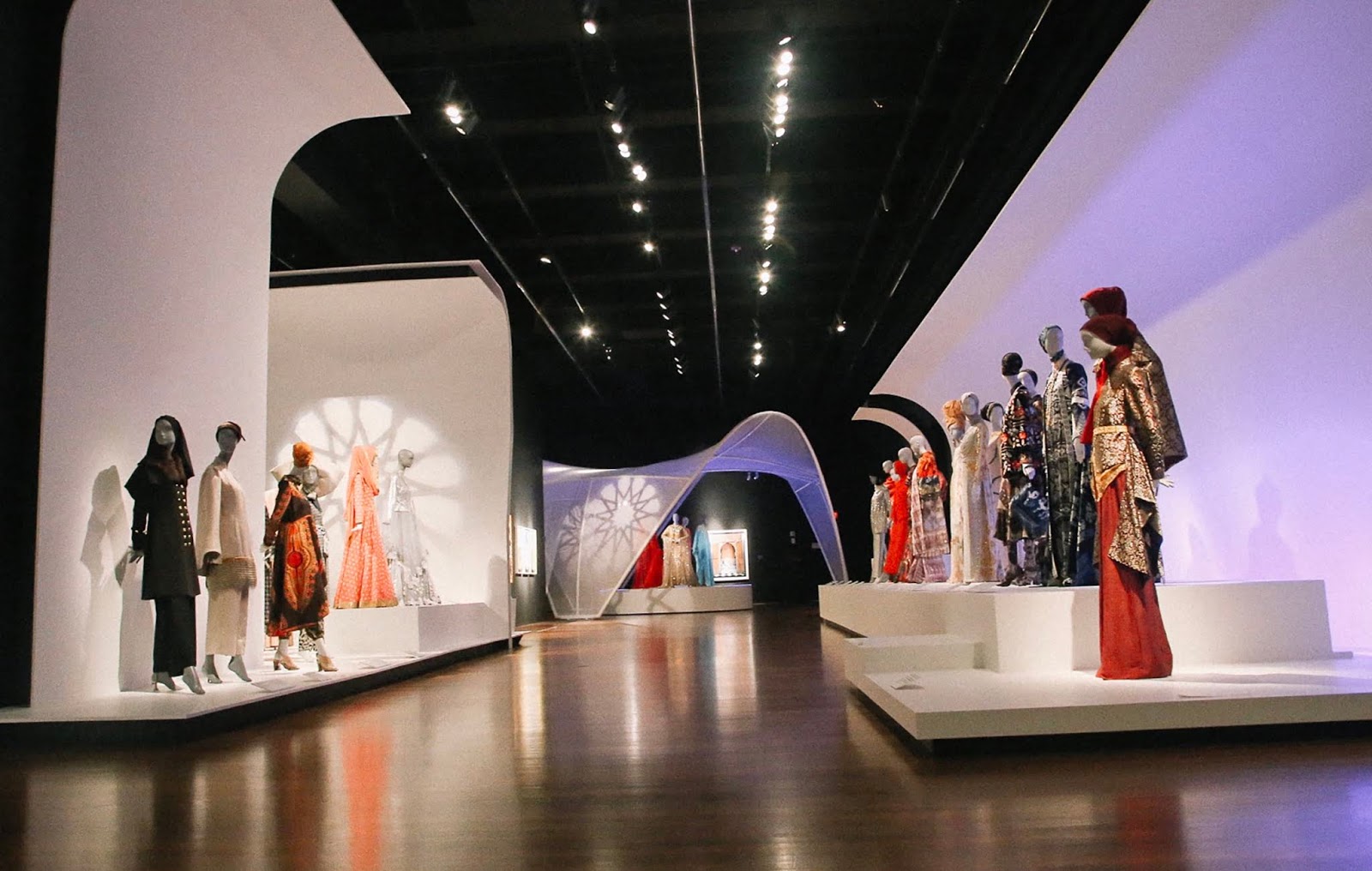
Currently, the deYoung Fine Arts Museum in San Francisco is examining Contemporary Muslim Fashions by “spotlighting places, garments, and styles from around the world,” in a show that began in late September and continues through January 6, 2019.

Contemporary Muslim Fashions is the first major museum exhibition to explore “the complex, diverse nature of Muslim dress codes worldwide” by bringing together different religious interpretations and cultures of Islam. The creativity and diversity – and politics – of modest dressing is celebrated.


I’ve learned that this exhibition considers “how Muslims define themselves – and are defined – by their dress and how these sartorial choices can reflect the multifaceted nature of their identities.”

Contemporary Muslim Fashions crosses through many different religious interpretations and cultures, featuring spectacular creations from a dynamic fashion scene by designers from both the Middle East and Southeast Asia – think Malaysia and Indonesia. From street wear to couture, the exhibition includes “high-end fashions, such as those by Malaysia-based Blancheur; street wear, such as modest designs from London-based Sarah Elenany; sportswear, such as the burkini; and commissioned garments from both emerging and established designers.”


The exhibition also includes the use of social media as a primary material – an agent of change. Muslim voices and personal narratives are framed by using runway footage of fashion shows and news clips as well as documentary and fashion photography.

As visitors to Contemporary Muslim Fashions will learn, while Islam is a multicultural faith, the dress of its followers is “shaped not only by religious principles but also by local customs and traditions and global fashion trends.” Thus, a woman from Tunisia is more likely to be contemporary in her fashion attire than a woman living in Saudi Arabia.


In her review of Contemporary Muslim Fashions for The Hollywood Reporter, critic Celine Semaan wrote, “Because of the current political climate from which it is rising, the show carries a message of hope and acceptance. The act itself of organizing this exhibition is nothing if not a peaceful demonstration of the American values written in the First Amendment: freedom of speech, freedom of expression, freedom of religion.”

Laird Borrelli-Persson of Vogue, in reviewing Contemporary Muslim Fashions, quotes curator Jill D’Alessandro, who believes, “Fashion can be an agent for positive change, for understanding, and breaking down barriers; they (fashion designers) want to exhibit in the United States and in Europe because they want their cultures to be understood.”

One thing’s for sure: There’s a diversity in Muslim fashion that is strikingly beautiful, both for its modern aesthetic and for its street-style appeal.

Photos: Cover – Mary Katrantzou skirt and shirt (silk and polyester), and Malone Souliers shoes.  Bottom – Flight jacket with U.S. Constitution written in Arabic on the back and First Amendment written in English inside, by Slow Factory (Courtesy of deYoung Museum and Google Images). Video: Courtesy of YouTube.com.

Tuesday, January 17, 2017

On art and politics: "We the People ... "

We the People of the United States ...

In just four days, Donald J. Trump will be sworn in as the 45th President of the United States. With a lot of division surfacing throughout the country, many Americans are looking to art as a means of connecting us as human beings.

We the People ...
 are greater than fear.
"We the People are greater than fear," reads the message of a new poster created by Shepard Fairey, the graphic arts, muralist, illustrator and activist behind the iconic 2008 Hope posters he created for Barack Obama. Another new poster reads "We the People protect each other" and the third one says "We the People defend dignity."

There is a lot of division right now. Trump is not a healer," says Fairey. "Art, on the other hand, is healing and inclusive, whether topically it celebrates humanity, or whether it's just compelling visuals to make a human connection."

Interviewed recently by the PBS NewsHour, Fairey said "it was the right time to make a campaign that's about diversity and inclusion, about people seeing the common bonds we have, and our connections as human beings. The idea was to take back a lot of this patriotic language in a way that we see is positive and progressive, and not let it be hijacked by people who want to say that the American flag or American concepts only represent one narrow way of thinking."

Shepard has created three portraits for the "We the People" campaign. One depicts a Muslim woman wrapped in a hijab resembling an American flag. Another shows a young African-American girl and the third features a Latina female.

We the People ...
protect each other.
Two other artists, the Colombian American muralist Jessica Sabogal and the Chicano graphic artist Ernesto Yerena, each contributed to the project in collaboration with the Amplifier Foundation, a nonprofit that works to amplify grassroots movements and which commissioned the project. Together, the artists hope the faces of "We the People" – standing in for traditionally marginalized groups or those specifically targeted during Trump's presidential campaign – will flood Washington, D.C., on Friday during Inauguration Day.

According to Fairey, "All the subjects (in 'We the People') were photographed by people who relate to them somehow. The Muslim woman was shot by a Muslim photographer, the Latina woman shot by a Latino photographer, and the African-American kid shot by a French African-American woman photographer. We realized that this has got to be a diverse coalition of artists for us to do this, and that while it's good for us to be allies, this campaign really has to be authentically diverse."

Fairey went on to say in the PBS NewsHour interview, "We came to a conclusion as a group that in the language (for these posters) we want to say, 'We reject fear-mongering and exclusion.' But we also wanted to do it in a way that doesn't leave the door open for the Fox News type to say, 'This is reverse racism' ..."

We the People ...
defend dignity.
Adds Fairey: "It's hard to encapsulate the complexity of what we're facing, going into this Trump presidency, in three images. But we chose three groups that are vulnerable. In the history of the U.S., there are a lot of people who fled persecution from Europe on the basis of religious identities. The idea of championing the ideals of our forefathers and then limiting the movement of Muslims – it so confounding that this is not riling more people up. And so it's really time to do some (work) that I think is a counterargument to that, and that's not based on division but based on inclusion. We've seen where division has got us."

A Kickstarter campaign has begun that according to Fairey is "getting great traction." He said a goal of his group is funding an ongoing and expanding range of creative projects, with the next wave of people from all different communities. "We want to allow people to express all their social/political views around a number of issues – LGBT rights, women's rights – because a number of those things are going to be under attack under Trump."

Photos: We the People images by Shepard Fairey; U.S. Constitution courtesy of Google Images.

Tuesday, April 12, 2016

Mississippi memo: You don't love your neighbor by discriminating against them


Mississippi / From Hospitality State to Hostility State, thanks to H.B. 1523.

Dear Mississippi,

In case you missed it we've already had this conversation. You don't get to decide who sits at the lunch counter.

Love, America

The above letter that's making the rounds on Facebook sums up a lot of common-sense feelings in just a few words. In a matter of days, Mississippi went from being the "Hospitality State" to the "Hostility State," thanks to the recent passing of a hateful and discriminatory measure (House Bill 1523) by the State Legislature.

Memo to Republican Governor Phil Bryant: "You don't love your neighbors by discriminating against them." Shame on you.

Mississippi / "You're on my mind ... "
Indeed, I've been saddened by the appalling news that my former home state of Mississippi (where I graduated from high school in the Gulf Coast city of Ocean Springs) last week passed legislation and the governor signed into law "The Religious Liberty Accommodations Act," which directly targets the LGBT community throughout the state – from Tupelo to Biloxi, from the Delta to the Gulf Coast and everywhere in between.  The bill is so draconian that the state's largest daily newspaper, the Clarion-Ledger of Jackson called it "an act of oppression."

According to the Human Rights Campaign (HRC), the nation's largest lesbian, gay, bisexual, and transgender (LGBT) civil rights organization, H.B. 1523 "would allow individuals, religious organizations and private associations to use religion to discriminate against LGBT Mississippians in some of the most important aspects of their lives, including at work, at schools, and in their communities."

In an April 6 editorial, The Clarion-Ledger wrote: "Through the swish of  pen, (Governor Phil) Bryant signed away the rights of families, ignored the pleas of residents and businesses, and wrote another page in the state's history that future generations will be shocked – even embarrassed – to read. With a final stroke of that pen, Mississippi welcomed its latest Jim Crow law and displayed a sign for the world to see: Welcome to Mississippi. No gays allowed. Mississippi and its citizens deserve better than this unconscionable law."

In no time at all, Mississippi became the butt of jokes nationwide, as evidenced by a satirical Mississippi Anti-LGBT video released by the comedy website Funny or Die, which has already received 50,000 views on YouTube:


According to an article in the South Mississippi Sun-Herald newspaper over the weekend, Gulf Coast mayors seemed unanimous in their stance against H.B. 1523, saying it didn't reflect the residents of their respective South Mississippi cities. Each worries about the negative publicity and potential economic fallout that might hit the Coast. (On Monday, rock singer Bryan Adams pulled out of a concert scheduled for Thursday in Biloxi to protest the signing of H.B. 1523.)

Ocean Springs Mayor Connie Moran told the Sun-Herald she thought H.B. 1523 was unnecessary and bad legislation. "It is nothing more than codified discrimination," she said. "This just set us back to the 1960s. We're just moving from a sense of bigotry from race to sexual identity.

"Freedom of religious expression is every individual's right, but it has no place in government."

Memo to the Mississippi State Legislature and other supporters of H.B. 1523:  Folks, it's 2016 not 1966! Have you not learned from your past?

Fortunately, there's at least one voice of reason in Mississippi, despite all of the shambles happening at the state capitol. It belongs to independent bookseller Square Books, located on the town square in Oxford, the city which is home to the University of Mississippi. In business since 1979 – and widely known among readers as the hub of William Faulkner's "postage stamp of native soil," Yoknapatawpha – Square Books in its infancy hosted a variety of racially and culturally diverse authors including Toni Morrison, Allen Ginsberg and Alice Walker as well as Mississippians John Grisham, Richard Ford and Willie Morris.

Over the weekend on their Facebook page, the owners of Square Books posted a message that read: "In the wake of HB-1523, we at Square Books want to make sure you know that you are welcome here. Always. 'If you are anyone, from anywhere, we hope you will visit us, and we hope you may find something you would like to read.'"


Square Books gets it – that H.B. 1523 needs to be repealed. Now, let's hope that the state's governor and legislature get it, too. Sooner than later.

As Rev. Susan Russell, an Episcopal priest and activist from Pasadena, Calif., recently wrote on Huffington Post, "Let's get back to work making this a country where the pledge of 'liberty and justice for all' doesn't depend on your zip code. It's what we're all called to do."

Amen.