Showing posts with label contemporary. Show all posts

Tuesday, November 20, 2018

On art and fashion: Contemporary Muslim Fashions

Thanks to social media, I have become Facebook friends with several Tunisian women, all whom are Muslim. Some of them cover their heads in colorful headscarves, known as hijabs; most do not. Each have become individuals of style within and beyond their communities in this North African country bordered by Algeria, Libya and the Mediterranean Sea, as I’ve learned firsthand through many thoughtful online conversations. While the nature of the Muslim dress code worldwide is a complex and diverse one, like it or not, Muslim fashion has become part of the mass-media’s attention drawn to contemporary Muslim life.
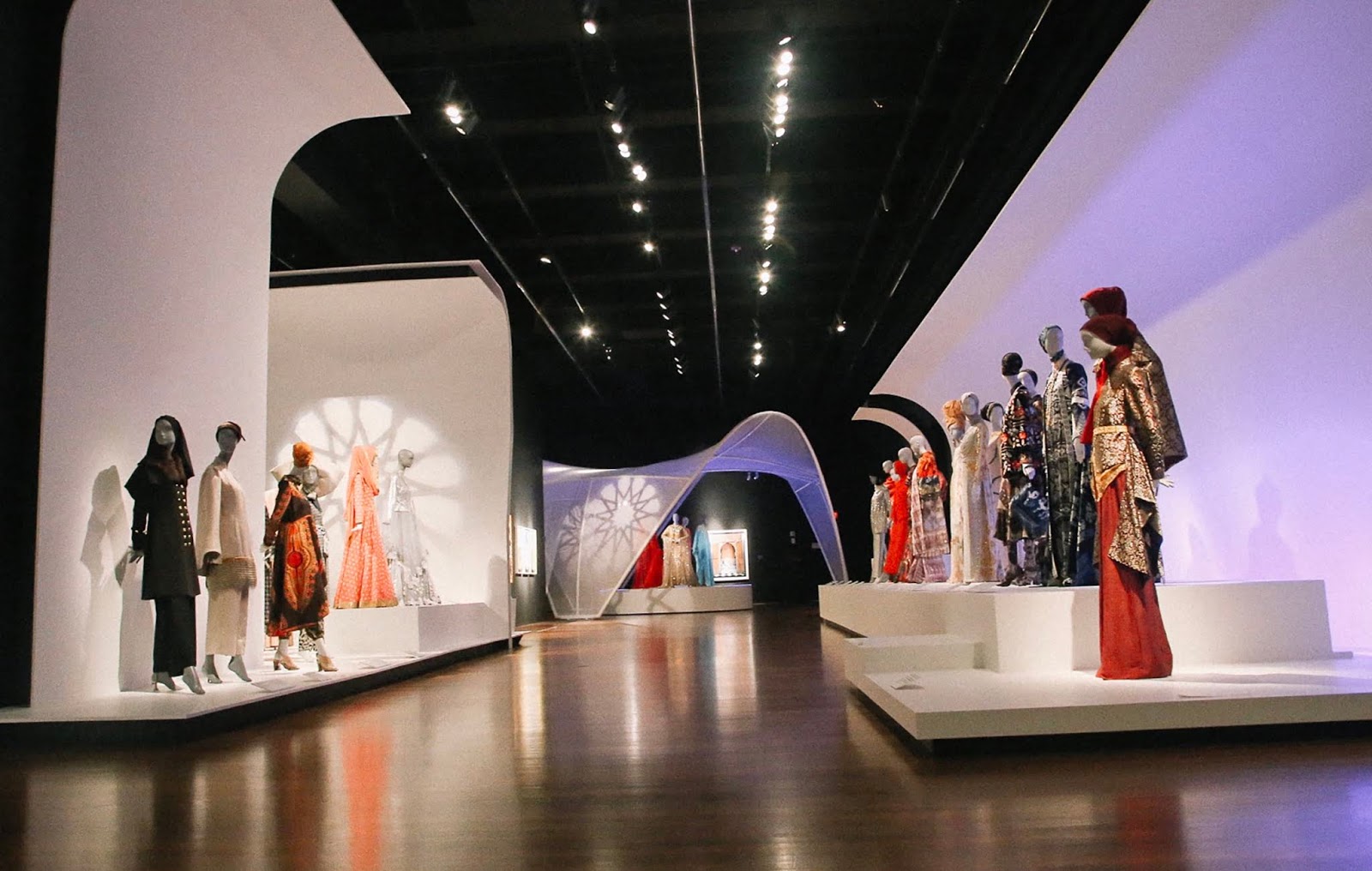
Currently, the deYoung Fine Arts Museum in San Francisco is examining Contemporary Muslim Fashions by “spotlighting places, garments, and styles from around the world,” in a show that began in late September and continues through January 6, 2019.

Contemporary Muslim Fashions is the first major museum exhibition to explore “the complex, diverse nature of Muslim dress codes worldwide” by bringing together different religious interpretations and cultures of Islam. The creativity and diversity – and politics – of modest dressing is celebrated.


I’ve learned that this exhibition considers “how Muslims define themselves – and are defined – by their dress and how these sartorial choices can reflect the multifaceted nature of their identities.”

Contemporary Muslim Fashions crosses through many different religious interpretations and cultures, featuring spectacular creations from a dynamic fashion scene by designers from both the Middle East and Southeast Asia – think Malaysia and Indonesia. From street wear to couture, the exhibition includes “high-end fashions, such as those by Malaysia-based Blancheur; street wear, such as modest designs from London-based Sarah Elenany; sportswear, such as the burkini; and commissioned garments from both emerging and established designers.”


The exhibition also includes the use of social media as a primary material – an agent of change. Muslim voices and personal narratives are framed by using runway footage of fashion shows and news clips as well as documentary and fashion photography.

As visitors to Contemporary Muslim Fashions will learn, while Islam is a multicultural faith, the dress of its followers is “shaped not only by religious principles but also by local customs and traditions and global fashion trends.” Thus, a woman from Tunisia is more likely to be contemporary in her fashion attire than a woman living in Saudi Arabia.


In her review of Contemporary Muslim Fashions for The Hollywood Reporter, critic Celine Semaan wrote, “Because of the current political climate from which it is rising, the show carries a message of hope and acceptance. The act itself of organizing this exhibition is nothing if not a peaceful demonstration of the American values written in the First Amendment: freedom of speech, freedom of expression, freedom of religion.”

Laird Borrelli-Persson of Vogue, in reviewing Contemporary Muslim Fashions, quotes curator Jill D’Alessandro, who believes, “Fashion can be an agent for positive change, for understanding, and breaking down barriers; they (fashion designers) want to exhibit in the United States and in Europe because they want their cultures to be understood.”

One thing’s for sure: There’s a diversity in Muslim fashion that is strikingly beautiful, both for its modern aesthetic and for its street-style appeal.

Photos: Cover – Mary Katrantzou skirt and shirt (silk and polyester), and Malone Souliers shoes.  Bottom – Flight jacket with U.S. Constitution written in Arabic on the back and First Amendment written in English inside, by Slow Factory (Courtesy of deYoung Museum and Google Images). Video: Courtesy of YouTube.com.

Tuesday, May 15, 2018

Encore: Who lives, who dies, who gets to tell your story?

Creative genius / Lin-Manuel Miranda
It's been said that works of art have long informed how people understand the past, and Lin-Manuel Miranda's Hamilton, which I saw for the second time in the past year last weekend in New York City, is no exception.

As the creative genius of the Broadway smash-hit Hamilton, Miranda changed the way that people considered one of the Founding Fathers and the era he lived in. In doing so, it put Miranda in lofty territory, alongside how Shakespeare transformed Richard III, and how the author Leon Uris romanticized the founding of Israel in his novel Exodus.

In revisiting an essay I wrote about Miranda in March 2016, here's some things worth noting:

In creating Hamilton, Miranda relied on the core elements of hip-hop and R & B-inspired music as well as jazz, pop and Tin Pan Alley – plus a racially-diverse cast – to make history as relatable as possible. Soon after its 2015 debut, Hamilton became a certifiable Broadway box office hit – it remains one of the toughest, most-sought after tickets on Broadway – and the musical became centered around a story arc that relates Hamilton's life story, from his orphaned upbringing in the West Indies to his death in a duel at the hands of Aaron Burr.

"This is a story about America then, told by America now," Miranda, a native New Yorker of Puerto Rican heritage, once told The Atlantic, "and we want to eliminate any distance between a contemporary audience and this story."

In a September 29, 2015 essay for The Atlantic, Edward Delman wrote, "Hamilton, then, has the potential to strongly influence the way Americans think about the early republic. For one thing ... it understands Thomas Jefferson to be a deeply flawed individual. It presents an American history in which women and people of color share the spotlight with the founding fathers. The primarily black and Hispanic cast reminds audiences that American history is not just the history of white people, and frequent allusions to slavery serve as constant reminders that just as the revolutionaries were fighting for their freedom, slaves were held in bondage.

"Perhaps, the most significant lesson the show might teach audiences, and one that has particular relevance today, is the outsized role immigrants have played in the nation's history. Alexander Hamilton was an immigrant – a fact that Miranda repeatedly emphasizes throughout the show – and the musical also prominently features the Marquis de Lafayette, a French nobleman who played a crucial role during the revolutionary war."

It's pretty amazing to think back to the fascinating process which Miranda translated the history of the unlikely rise and untimely fall of the first U.S. Treasury Secretary, Alexander Hamilton, onto the stage. He drew upon the Ron Chernow biography of Hamilton for focus and inspiration. Then, flash back to May 12, 2009, when Miranda first performed "The Hamilton Mixtape" before an audience that included President Barack Obama and First Lady Michelle Obama at the White House Evening of Poetry, Music and the Spoken Word, accompanied by pianist Alex Lacamoire.


In looking back at a February 2015 feature about Hamilton, Rebecca Meade of The New Yorker wrote: "It does not seem accidental that Hamilton was created during the tenure of the first African-American President. The musical presents the birth of the nation in an unfamiliar but necessary light: not solely as the world of élite white men but as the foundational story of all Americans. Thomas Jefferson, James Madison, and George Washington are all played by African-Americans. Miranda also gives prominent roles to women, including Hamilton's wife Eliza Schuyler, and sister-in-law Angelica Schuyler. When they are joined by a third sister, their zigzagging harmonies sound rather like those of Destiny's Child.

"Miranda portrays the Founding Fathers not as exalted statesmen but as orphaned sons, reckless revolutionaries, and sometimes petty rivals, living at a moment of extreme volatility, opportunity, and risk. The achievements and the dangers of America's current moment – under the Presidency of a fatherless son of an immigrant, born in the country's island margins – are never far from view."

The Grammy Award-winning original cast recording, produced by The Roots' Questlove and Black Thought – has been a welcome companion of mine on my car stereo for several years – and I never really tire of its songs.


"I don't know how many really good ideas you get in a lifetime," Miranda once told The Hollywood Reporter, "but the idea of telling Hamilton as a hip-hop story was definitely one because you get to do everything: love and death and a war and duels and revenge and affairs and sex scandals."

One thing remains certain: Thanks to Miranda's genius, the Tony Award-winning Hamilton continues to have a positive influence in altering our perception of American history, and the role in which artists are helping shape historical narrative. And, Miranda knows that he can't stop being who he is just because more people are looking at him.

Photo credits: Lin-Manuel Miranda's Twitter feed and Google Images. Video/audio credit: YouTube.com.

Tuesday, October 14, 2014

How We Got to Now: The power and legacy of great ideas


How We Got to Now / The history behind
everyday objects that are a part of our
contemporary life.

Steven Johnson is a bestselling author of nine books, including Where Good Ideas Come From, a founder of a variety of influential websites, and the host and co-creator of the PBS and BBC series How We Got to Now. His newest book is my current reading project, the just-published How We Got to Now: Six Innovations That Made the Modern World.

It is cerebral fun.

In How We Got to Now, Johnson explores the power and legacy of great ideas by investigating the secret histories -- innovation trails -- behind everyday objects that are a part of our contemporary life. He examines "unexpected connections between seemingly unrelated fields: how the invention of air-conditioning enabled the largest migration of human beings in the history of the species to otherwise uninhabitable cities such as Dubai and Phoenix; how pendulum clocks helped trigger the industrial revolution; and how clean water made it possible to manufacture computer chips."

Each of the six innovations that made the modern world, according to Johnson -- glass, cold, sound, cleanliness, time and light -- garners attention in How We Got to Now. 

"Johnson is a polymath," wrote the Los Angeles Times. "It's exhilarating to follow his unpredictable trains of thought. To explain why some ideas upend the world, he draws upon many disciplines: chemistry, social history, geography, even eco-system science."

In the book's opening chapter about glass, for instance, Johnson writes: "Mirrors appeared so magical that they were quickly integrated into somewhat bizarre sacred rituals: During holy pilgrimages, it became common practice for well-off pilgrims to take a mirror with them. When visiting sacred relics, they would position themselves so that they could catch sight of the bones in the mirror's reflection. Back home, they would then show off these mirrors to friends and relatives, boasting that they had brought back physical evidence of the relic by capturing the reflection of the sacred scene. Before turning to the printing press, Gutenberg had the start-up idea of manufacturing and selling small mirrors for departing pilgrims.

"But the mirror's most significant impact would be secular, not sacred. Filippo Brunelleschi employed a mirror to invent linear perspective in painting, by drawing a reflection of the Florence Baptistry instead of his direct perception of it. The art of the late Renaissance is heavily populated by mirrors lurking inside paintings, most famously in Diego Velázquez's inverted masterpiece, Las Meninas, which shows the artist (and the extended royal family) in the middle of painting King Philip IV and Queen Mariana of Spain. The entire image is captured from the point of view of two royal subjects sitting for their portrait; it is, in a very literal sense, a painting about the act of painting. The king and queen are visible only in one small fragment of the canvas, just to the right of Velázquez himself: two small, blurry images reflected back in a mirror.

"As a tool, the mirror became an invaluable asset to painters who could now capture the world around them in a fare more realistic fashion, including the detailed features of their own faces."

Who knew!

In reviewing How We Got to Now, the San Francisco Chronicle wrote: "Monks transcribing religious manuscripts in the 12th and 13th centuries began using pieces of crystal the better to see their work with, and so spectacles were born. And then came Gutenberg, whose printed books created a bigger market for them. In 1610, Galileo used a crystal lens to make the telescope, through which he observed moons orbiting Jupiter, and from there came the doctrine-shattering revelation that the Earth is not the center of the universe.

"The discovery had a reverberating impact that is still being absorbed today. Not only did it reveal a truth about the physical world, it reflected back on the human sense of our place in time and space."

Walter Isaacson, the author of Steve Jobs, calls Johnson "the Darwin of technology. Through fascinating observations and insights, he enlightens us about the origins of ideas."

By connecting all of the important dots through the centuries, Steven Johnson takes us on a wonderful journey through time and innovation. And, in doing so, he makes learning about science and technology great fun.