Showing posts with label power. Show all posts

Tuesday, December 3, 2019

Seriously Funny ... Exercising First Amendment freedoms through comedy from the desk of ‘The Daily Show’

Jon Stewart
“Seriously Funny: From the Desk of ‘The Daily Show with Jon Stewart’,” on display through Dec. 31 at the Newseum in Washington, D.C., explores humor as a protected form of free speech under the First Amendment.

When I visited the “Seriously Funny” exhibition during Thanksgiving weekend, I saw firsthand the lasting influence that Jon Stewart, former host of The Daily Show, had on political satire. It could be seen through the list of comedians that Stewart mentored during his tenure: Stephen Colbert, John Oliver, Samantha Bee, Hasan Minaj and current The Daily Show host Trevor Noah, among many.

The centerpiece of the “Seriously Funny” display of more than 50 artifacts is The Daily Show desk and globe that was part of the set of The Daily Show with Jon Stewart. There’s also an original Newseum-produced short film that goes behind the scenes at The Daily Show with Trevor Noah and shows how a typical day’s program is developed and produced.

During his years sitting at the anchor desk of The Daily Show, Stewart exercised his First Amendment freedoms through comedy and spurred his audience to think critically about the world. Night after night, he found humor in serious matters. No doubt, there were many who trusted Stewart’s satirical take on the news more than actual broadcast journalists. Imagine that!

Highlighting his tenure as host, Stewart guided us through the tragedy of 9/11, two wars and four presidential elections. He challenged both politicians and the press to do a better job. Later, he became a passionate and vocal advocate for the September 11th Victim Compensation Fund.

Among many who have praised Stewart’s work, former NBC News anchor Tom Brokaw said: “There are more facts and more truths told in the first eight minutes of The Daily Show than most political news conferences in Washington.” Also, David Remnick, editor in chief of The New Yorker, noted: “He set out to be a working comedian, and he ended up an invaluable patriot. He wants his country to be better, more decent, and to think harder.”


“Welcome to ‘The Daily Show,’ Craig Kilborn is on assignment in Kuala Lumpur. I’m Jon Stewart.’” With those words spoken on January 11, 1999, the comedian Stewart became anchor of The Daily Show, broadcast on cable’s Comedy Central. From opening night through 2015 when he stepped down, Stewart transformed the program from what had been a modestly successful parody of TV news into a cultural treasure. Through Stewart’s use of funny, often-pointed video clips and pointed and poignant commentary, The Daily Show became a trusted source of news for many Americans. Over time, Stewart became just as comfortable in satirizing current events as he was in interviewing newsmakers – from world leaders and Nobel laureates to best-selling authors.


I learned that a 2004 video of The Daily Show host became so popular it helped inspire the creation of YouTube a year later. By 2007, a Pew Research Center study ranked Stewart alongside CBS News’ Dan Rather and CNN’s Anderson Cooper as “a trusted source for news.” Stewart was the cover subject of many American magazines, including Rolling Stone, which in October 2004 dubbed him “The Most Trusted Name in News.” In the Rolling Stone cover story, Stewart said, “We need a news organization that puts country over partisanship.” In his last week as host, Stewart compared a Republican presidential candidate forum to a scene from the popular Pixar movie “Toy Story.”

Looking back on Stewart’s 16-year run as host of The Daily Show, he challenged viewers “to think about politics and the press while laughing at the absurd. Whether advocating for legislation, challenging the powerful and political elite, or launching a new generation of comedians, Stewart had a vast impact on American culture.”

MSNBC prime time host Rachel Maddow praised Stewart by saying: “I think his work on The Daily Show at Comedy Central has made our country a better country. I think it has made politics more accountable. I think it has made the news media sharper and more self-conscious and ultimately better.”

On his very last show, Stewart’s parting words were matter-of-fact, bordering baffled anger. He expressed, “So I say to you, friends: The best defense against bullsh*t is vigilance. So if you smell something, say something.”

Credits: Photos by Michael Dickens © 2019. Videos courtesy of YouTube.com, Comedy Central.

Tuesday, December 11, 2018

On books: Jon Meacham’s ‘The Soul of America: The Battle for Our Better Angels’ is timely reading


Jon Meacham is a Pulitzer Prize-winning historian and author of Destiny and Power: The American Odyssey of George Herbert Walker Bush, the definitive biography of the recently deceased 41st President of the United States. Last week, Meacham eulogized Mr. Bush, calling him “America’s last great solider-statesman, a 20th-century founding father.”

During Meacham’s eulogy, he said, “Abraham Lincoln’s ‘better angels of our nature’ and George H.W. Bush’s ‘thousand points of light’ are companion verses in America’s national hymn. For Lincoln and Bush both called on us to choose the right over the convenient, to hope rather than to fear and to heed not our worst impulses but our best instincts.”

In Meacham’s latest best-selling book, The Soul of America: The Battle for Our Better Angels, a brilliant and fascinating – if not timely work – we are reminded that from our country’s very beginnings, the United States has, in the words of American historian and law professor Annette Gordon-Reed, “struggled to deliver on the promise of the Declaration of Independence and to make our Union ‘more perfect.’ Race has often been at the heart of those struggles, and The Soul of America persuasively argues that the resilient spirit of those who fought throughout our history to overcome that seemingly intractable problem is still with us. It is that spirit that gives us cause to be hopeful in the face of doubts about our country’s future.”

Meacham writes with both clarity and purpose throughout The Soul of America and explains how our current “Trumpian” climate of partisan fury is not new. He explores other contentious periods of our nation’s history – from the Civil War to World War I to the fight for women’s rights to Lyndon Johnson’s crusade against Jim Crow – to show how presidents and ordinary citizens have united to defeat “the forces of anger, intolerance, and extremism.”

Through each of these periods of our nation’s history, Meacham explains, our national life “has been shaped by the contest to lead the country to look forward rather than back, to assert hope over fear – a struggle that continues even now.” As Meacham told Trevor Noah recently on The Daily Show, “every era is a battle between our best impulses and our worst impulses.”

Careful students of history will be familiar with some of these stories, but as Meacham notes, “if we have learned anything in recent years – years in which the president of the United States has taken pride in his deliberate lack of acquaintance with the most essential historical elements of his office – it is that even the most basic facts of our common past repay attention. ‘Eternal vigilance,’ it has been long said, ‘is the price of liberty’ and a consciousness about what has worked – and what hasn’t – in previous eras is surely a useful form of such vigilance.”

Historian Ken Burns, no stranger to the study of our nation’s past, summed his thoughts about The Soul of America by saying, “Rather than curse the darkness, John Meacham, with his usual eloquence and surpassing knowledge of our history, has offered us all the sublime and calming reassurance that, as threatening as so much of the present moment seems, Americans have weathered such storms before and come out on the other side with fresh and progressive horizons. This is a beautifully expressed and convincing prayer to summon our own ‘better angels’ to meet the obvious challenges of today.”

Meacham concludes The Soul of America by writing, “For all of our darker impulses, for all of our shortcomings, and for all of the dreams denied and deferred, the experiment begun so long ago, carried out so imperfectly, is worth the fight. There is, in fact, no struggle more important, and none nobler, than the one we wage in the serve of those better angels who, however besieged, are always ready for battle.”


Photos: Courtesy of Google images. Video: Courtesy of YouTube.com/The Daily Show.

Tuesday, March 6, 2018

Serena Williams: There's no wrong way to be a woman


Serena Williams didn't necessarily begin her tennis career thinking she was going to be breaking down barriers, but she has done just that. Over the years, as Williams has become more conscious of the impact she's had on both sport and society, she's found herself with a platform and an opportunity to make a difference. Now, at age 36, Williams embraces being a leader who can pave the way for the next generation of female athletes.

On Sunday night, during the 90th Academy Awards telecast, Nike celebrated the life of Serena Williams. In a powerful 30-second spot, which featured a montage of footage of Williams on the tennis court throughout her storied career, the Nike ad included a voice over by the 23-time Grand Slam tennis champion, who made a powerful statement about womanhood, race and motherhood, saying there's no wrong way to be a woman. 

She said:

I've never been the right kind of woman.
Oversized and overconfident,
Too mean if I don't smile.
Too black for my tennis whites.
Too motivated for motherhood.
But I'm proving time and time again ...
There's no wrong way to be a woman.

Against a dark backdrop, the spot concluded with the words "Until we all win" next to a Nike logo.

The ad was created by Wieden + Kennedy of Portland, Oregon. 

A two-page Nike print ad featuring Williams, also created by Wieden + Kennedy, appeared in Sunday's New York Times. It said:

You told a little girl she was too black for her tennis whites. 
And she grew up to be Serena Williams.

In a statement, Nike said, "As we approach International Women's Day, Nike wanted to recognize and celebrate the contributions and achievements of women everywhere and share our belief in gender equality, in this case, delivered by Serena Williams, the greatest athlete of all time."

Nike, it seems, has always maintained a good pulse on cultural relevancy. On Sunday night, it leveraged an opportunity to elevate Williams's stature as athlete, who breaks down barriers and inspires women, before not only a large and captive prime-time audience watching the Oscars telecast in the U.S., but also a worldwide audience, too. 

"I'm still looking to the future, to breaking down additional barriers, like gender equity and pay equality," said Williams, in a statement released by Nike. "It doesn't happen overnight. It takes a lot of work and I'm going to keep on going and working at it, and I encourage others to use their voice and their platforms to do the same."

Becoming a mother has definitely been a game changer for Williams, and she said her fight for change and gender equality is something she's doing on behalf of her six-month-old daughter, Alexis. "I want my daughter to be truthful and honest, strong and powerful; to realize that she can impact those around her," said Williams. "I want her to grow up knowing a woman's voice is extremely powerful. As females, we need to continue to be loud and make sure we are heard."

Video:  Courtesy of Nike YouTube channel. 

Friday, August 18, 2017

Connecting the Bard through words and paintings


We all know Shakespeare was a man of words. Over 400 years after the Bard magically wrote his word masterpieces, look all around us: his words continue to be spoken aloud, they are spoken through sign language, they appear in printed form, and they even appear on some very cool t-shirts.

Now,  in a celebration of 400 years of Shakespeare, the Folger Shakespeare Library in Washington, D.C. is taking a different approach by presenting Painting Shakespeare, a free exhibition that combines the power of Shakespeare as seen through his words and paintings, as well as Shakespeare-related art and memorabilia. It opened on May 13 and continues through February 11, 2018. This remarkable collection has been placed in a building space that's adjacent to both the Library of Congress and the Supreme Court on Capitol Hill, and includes space for researchers, as well as an intimate theater and a lovely exhibition hall.

The Bard
One afternoon recently, I visited this lively and thoughtful exhibition, where I was warmly greeted by the Folger Shakespeare Library staff as soon as I arrived. While I've always known about the impact of Shakespeare's words – think Macbeth, Othello, King Lear, Romeo and Juliet – inside this exhibition, I was invited to explore just how Shakespeare's words could be represented in pictures. I asked myself: Just how do you represent Shakespeare if you've never seen him with your own eyes?

Through nine different sections, from "Looking Back in Time" to "Imagining Shakespeare" to "Lost and Found," there were twenty-one selections from the Folger Shakespeare Library collection of paintings showcased in the exhibition hall that try to portray the Bard for our own eyes.

"It might seem unusual for a library to have a paintings collection, but Henry and Emily Folger knew that it takes more than books and manuscripts alone to understand Shakespeare and his era," I learned, reading an introductory panel that was displayed at the beginning of Painting Shakespeare. "They also collected scrapbooks, posters, programs, figurines, prints, drawings, and photographs."

I spent about an hour walking through Painting Shakespeare, carefully stopping at each area to observe and discover something interesting or unique about each painting – and to study their stories and glories. Let's see, among the memorable paintings I discovered were: Dexter Portrait of Shakespeare, a 19th century oil on canvas by an unknown British painter; The Awakening of King Lear, circa 1792 from King Lear (act 4, scene 7), an oil on canvas by the 18th century British painter Robert Smirke; and Macbeth Meeting the Witches, 1760 from Macbeth (act 1, scene 3), an oil on panel by the 18th century Italian painter Francesco Zuccarelli. One should also take time to look at Henry Fuseli's gothic masterpiece Macbeth Consulting the Vision of the Armed Head that was painted for the Irish Shakespeare Gallery in Dublin in 1793, and is presented in its original frame.

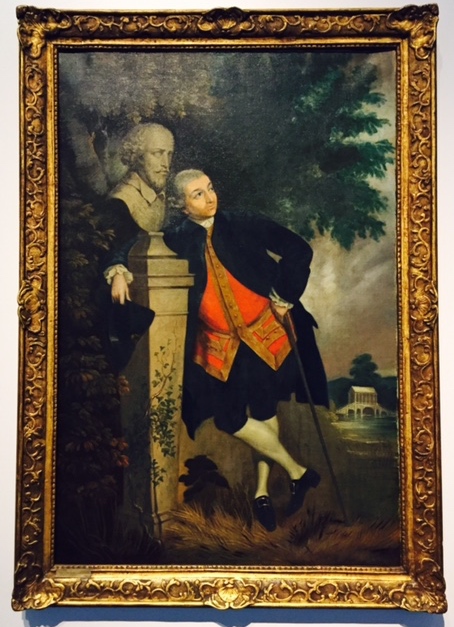
One of my own personal favorites was David Garrick Leaning on a Bust of Shakespeare. In this oil on canvas painting finished after 1769 by an unknown British painter styled after Thomas Gainsborough, I learned this from reading the description card: "David Garrick's devotion to Shakespeare and revolutionarily informal acting style comes across wordlessly here. Viewers familiar with Westminster Abbey will recognize that Garrick's relaxed poise echoes the life-sized marble statue of William Shakespeare in Poets' Corner."

Throughout Painting Shakespeare, visitors are encouraged to share their own personal experiences and connections with Shakespeare and his works. Just because the people in the paintings are standing still doesn't mean we have to, right?

Imagine, using a smartphone or other device to record and share short videos, answering one of these questions:

• When did you first read or see Shakespeare?
• Which words and lines from Shakespeare do you love the most and why?
• Which Shakespeare character speaks to you and why?

The power of Shakespeare allows us to connect with his works and, now, thanks to the Folger Shakespeare Library, through the art of painting, too.

Tuesday, January 24, 2017

Women's March: Inspiration, motivation, galvanization


Unity in numbers / Hundreds of thousands of women (and men), both
white and of color, marched for political activism in Washington, D.C. and
throughout America, and around the world. 

The American writer and poet Alice Walker, who wrote the critically acclaimed novel The Color Purple, once said "Activism is our rent for living on the planet." I think she was on to something because last Saturday women (and men), both white and of color, spanning a variety of economic and religious backgrounds, united for a just cause.

They marched for political activism. Health care, the economy, climate change, immigration, paid family leave, net neutrality, education, freedom of the press.

Millions united worldwide and took to the streets to protest the inauguration of Donald Trump and also to celebrate women's rights. On Saturday, they marched for democracy.

My heart and support goes out to my friends, family and loved ones – and to all – who marched not only in the Women's March in Washington, D.C., but also hundreds of sister marches throughout America and around the world. Through the power of their spoken and written words, as well as through their images and pictures that were shared via social media platforms – and, importantly, in their strength in numbers – we saw that there is such great hope for our country. I'm proud to see so many devote their time and energy towards walking for civil liberties and basic, fundamental human rights for all.

A view of the National Mall as seen from the U.S. Capitol,
during the Women's March in Washington, D.C. The
number of participants far exceeded expectations,
event organizers said, and it eclipsed the crowd attending
President Trump's inauguration a day earlier.
A day after President Trump's inauguration last Friday, in which he shared his uniquely dark and dystopian vision of the U.S., there was much support, love and light shown during the Women's March in Washington, D.C. According to the organizers of the event, the goal was to send a powerful message to the new administration and to the new President. Initial estimates numbered 500,000 participants in the nation's capital alone – considerably more than the 200,000 expected, and far exceeding the number who attended Friday's inauguration of the 45th President. Demonstrations remained peaceful throughout.

Linda Sarsour, a Palestinian-American activist and national co-chair of the Women's March on Washington, said during an interview Monday evening on MSNBC's All In With Chris Hayes that she was extremely overwhelmed by the turnout. "Women showed up (all over the world) and showed their power," she said. Asked why the march exceeded expectations, Sarsour said: "We were able to speak to the values of people. We came together in solidarity to stand with the most marginalized people. We were also intersectional. It wasn't just about reproductive rights. It was climate justice and racial justice and immigrant rights. Everyone found a place to be there. We spoke to every one's inner frustrations. We went from Friday's devastation to Saturday's inspiration, motivation and galvanization."

In a New York Times editorial published on its website Monday, it wrote: "Whether President Trump, newly ensconced in the White House, was surprised or even noticed is unclear. Given his reputation, he may not even care. But the Republican Party should."

We are America /
Marching near the National Museum of
the American Indian in Washington, D.C.
(Photo by Carla Morris.)
Actress America Ferrera, who was one of the first speakers at the Washington, D.C. rally, said: "We march today for the moral core of this nation, against which our new president is waging a war. Our dignity, our character, our rights have all been under attack and a platform of hate and division assumed power yesterday. But the president is not America. ... We are America and we are here to stay."

The feminist icon Gloria Steinem, 82, also speaking in the nation's capital, exulted: "This is the upside of the downside. This is an outpouring of democracy like I've never seen in my very long life."

Senator Elizabeth Warren, Democrat of Massachusetts, marching in Boston, said, "We can whimper. We can whine. Or we can fight back!"

Back in Washington, D.C., singer Madonna said matter-of-factly: "Let's march together through this darkness and with each step know that we are not afraid, that we are not alone that we will not back down. There is power in our unity and no opposing force stands a chance in the face of true solidarity." She added: "Today marks the beginning of our story. The revolution starts here. The fight for the right to be free, to be who we are, to be equal."

Energizing in the name of goodwill /
A sign proclaiming "My Body My Choice" was one of
many causes represented during the Women's March.
(Photo by Carla Morris.)
Among my many Macalester College friends who marched in Washington, D.C., and elsewhere, Carla Morris, an independent consultant who is married and the mother of two young boys, described her march experience like this: "It was like we had all individually and collectively found the real America again! I did not see a single act of unkindness or disrespect all day long." On her Facebook page, Morris called the mood in Washington, D.C. "so jubilant. Everyone on the trains going down to the march beamed at each other, smiled, chanted together, clapped, traded stories, helped each other. ... It was so wonderful. A fabulous, energizing day of goodwill."

Among many speakers whom I saw while watching TV coverage via MSNBC and C-SPAN, I was particularly interested in learning viewpoints from people of color and of different religions, groups which are being marginalized by the Trump administration. I heard the passionate voices of Zahra Billoo, the San Francisco Bay Area Director of the Council on American-Islamic Relations (CAIR), and of Van Jones, founder and president of Rebuild the Dream, an American center-left political organization, and a former Obama Administration advisor.

Billoo, a Muslim-American, said: "Our America ... includes all of us in our beautiful diversity. Our America requires that we march to protect each other. Our America needs us to build a better future. We have our work cut out for us but we are ready."

Marching towards a better future /
The Women's March showed peaceful yet powerful activism.
(Photo by Carla Morris.) 
Meanwhile, Jones, a black male, reached out to both conservatives and liberals during his speech. He said: "This movement has the opportunity to stand up for the underdogs in the red states and the blue states, to stand up for the Muslims and the Dreamers ... but also to stand up for the coal miners who are going to be thrown under the bus by Donald Trump. We're going to stand up for them. All those Rust Belt workers who he doesn't want to mess with but wants to mess over, we've got to stand up for them. We have to have a position that's clear. When it gets harder to love, let's love harder."


Looking back upon this special and unique day, in Washington, D.C., throughout American cities from Seattle and San Francisco to Ann Arbor and Chicago, to Raleigh, Boston and New York, and around the world – a record turnout for protests the likes of which we have not seen since the Vietnam War  – there was great strength found in this peaceful yet powerful activism, and unity in its numbers.

On this memorable day, love truly trumped hate.

Photos: Courtesy of Google images and Carla Morris.

Tuesday, September 27, 2016

Berkeley's talking: Speaking out with Steve Kerr

When Berkeley talks / Golden State Warriors head coach Steve Kerr
in conversation with UC Berkeley chancellor Nicholas Dirks.

Golden State Warriors head coach Steve Kerr is a vocal supporter for social activism as long as it comes from the heart. 

“In my mind, as long as the message is clear, I’m all for people speaking out against injustice no matter what form that takes,” said Kerr, during a recent Berkeley Talks lecture that my wife and I attended on the UC Berkeley campus. “If it’s nonviolent and leads to conversation, then I think that’s beautiful.” 

Golden Warriors head coach Steve Kerr comes from a
family of academics.
The 50-year-old Kerr, who comes from a family of academics, was the featured guest in a hour-long conversation with UC Berkeley chancellor Nicholas Dirks at Zellerbach Hall last Wednesday. The Cal Performances event, which was very well attended and received by students and community, provided a lively forum for a far-reaching discussion that touched upon Kerr's leadership as coach of a world championship-caliber team, the role of sports in building community and identity, and Kerr’s own personal history and ties to the world of academia. The dialogue was engaging and the issues discussed were timely.

Kerr, who has a son and daughter attending UC Berkeley, addressed the subject of social activism and his openness for promoting conversation about it. I was particularly interested in hearing and learning about his thoughts on this matter:

"We talk about current events. We start practice (next) Tuesday. We will absolutely have this discussion (about Colin Kaepernick). We will defintely talk (next week) about the national anthem,” said Kerr.

(Kaepernick, a quarterback for the San Francisco 49ers football team, has been kneeling during the national anthem at his team’s games to protest racial injustice in America. Kaepernick, who is biracial and was adopted by white parents, he said he would not honor a song "nor show pride in a flag for a country that oppresses black people and people of color.")

Steve Kerr / "People need to be more engaged and
active with what is happening around them."
Kerr added: "I'm not going to tell anyone what to do. Everybody gets to do whatever they want to do. But we need to know for each other if anyone is going to kneel or make a demonstration of any point or of any kind because, if so, it somewhat affects the guy next to you. Maybe good or maybe not, we don't know. It's something we have to talk about. I think it's great, I think the conversation is great. 

"People need to be more engaged and active with what is happening around them. I'm very proud, I think the NBA has been very progressive in terms of having these kinds of discussions and being at the forefront of the sports world when it comes to social activism."

I applaud Kerr for engaging his team to talk, whether it’s about basketball or social activism, and that he plans to support his team’s players in their views as long as their message on injustice is “clear.” Looking back, one of the best things that’s come out of the Colin Kaepernick issue is that it’s prompted people to talk about what our flag and national anthem means to us. That is a good thing.

"Let's protest in a non violent way, but it has to be powerful," said Kerr. "I've heard a lot of people say 'I agree with Kaepernick, but I would have done it a different way.' That's fair, but what is a different way? I don't know. What I do know is the only thing that really matters is that it's generating conversation in our country. ... Things do need to change.

“Nobody has to be right. Nobody has to be wrong,” said Kerr. “I would hope everyone would respect each other’s point of view. There are valid points of view on both sides.”

All photos: By Michael Dickens © 2016.

Tuesday, March 15, 2016

The truth or consequences of a Donald Trump presidency

Donald Trump / Same as he ever was: Boastful, volatile, misogynistic,
race-baiting, willfully and strategically ignorant, exploitative fear-monger.

While listening to NPR's Weekend Edition Sunday and perusing the Sunday New York Times, the recurring themes of rage, violence and chaos at Donald Trump's campaign rallies caught my attention – jumped out at me. At nearly every event during the past week, from North Carolina to Illinois to Ohio to Missouri, non-violent protesters have been violently beaten, shoved, kicked and verbally abused by Trump supporters. The abused are often blacks, women, gays, immigrants. The abusers are always white. Candidate – and bully-in-chief – Trump has encouraged his supporters to do his bidding by attacking protesters, then claiming that his and his supporters' First Amendment freedom of speech rights are being trampled upon. It should come as no coincidence that this kind of incendiary behavior isn't seen at rallies by any other candidate running for president, Republican or Democrat.

"There's been nobody injured at my rallies: zero, zero. You're making it sound like everybody's broken down and injured. Give me a break," said Trump over the weekend, appearing on CNN. I guess The Donald's selective memory doesn't take into consideration the young North Carolina protester who was sucker-punched in the face by a Trump supporter – the same Trump supporter who later said afterward that maybe he'd have to "kill him" next time.

"While we have witnessed many divisive campaigns and candidates before, we've never seen such a volatile, social regressive political crusade as Trump's in modern American politics," writes Lincoln Blades in Rolling Stone. "Trump is giving all these hateful people a voice. He's done damage to the country that cannot be undone be merely losing this election."

Throughout many cities in America – among them Fayetteville, N.C., Chicago, St. Louis and Kansas City – people are not standing passively while demagogues like Trump encourage violence against dissenters and advocates for the U.S. to commit war crimes. The protesters are peacefully speaking out against Trump's hateful and divisive rhetoric and extremist politics. It is Trump whose vitriolic comments have set the tone of conflict for his vile campaign. It is Trump who must own up and take responsibility for his actions. "Trump's base is so damn scary because it's not so much made up of people with shared policy ideas – it's more of a battalion filled with angry, mostly white folks who've been hungry for emancipation from the supposed scourges of political correctness and diversity," added Blades in his Rolling Stone article, "What Happens to America If Trump Loses?"

"Everything about Trump's campaign can be explained in terms of substance abuse: He's addicted to attention, demanding regular fixes and going to ever greater lengths – in terms of reckless statements and provocative acts – to get them," wrote Frank Bruni in the Sunday Review section of The New York Times this week. "Imagine what that would mean for a Trump presidency. His agenda wouldn't be conservative, moderate, liberal or for that matter coherent. It would be self-affirming and self-aggrandizing: whatever it takes to remain the focus of everyone's gaze, the syllable tumbling from everyone's lips. Trump, Trump, Trump."

Trump, in the words of New York Times Op-Ed columnist Ross Douthat, "is cut from a very different cloth. He's an authoritarian, not an ideologue, and his antecedents aren't Goldwater or McGovern; they're figures like George Wallace and Huey Long, with a side of the fictional Buzz Windrip from Sinclair Lewis's It Can't Happen Here. No modern political party has nominated a candidate like this; no serious political party ever should."

Nothing makes Trump more acceptable today than yesterday or last week – or six months ago, writes Kathleen Parker, who pens a twice-weekly political and culture column for the Washington Post. "He is still a boastful, volatile, misogynistic, race-baiting, willfully and strategically ignorant, exploitative fear-monger who is guided by profit over principle and whose hair-trigger temperament has the world on edge."

Day after day, Trump has proven time and time again that he isn't like any other candidate running for President of the United States. Instead, the loud, rich and famous Trump marches to his own drummer and plays by his own rules while pathologically spewing lies and untruths to suit himself. He's leading us down a dark, hateful road. That's not leadership folks. That's tyranny.

Dignity for the highest office in the land and decorum be damned, Trump – the ultimate narcissist – doesn't possess an empathetic bone in his body. And, it's become quite obvious that he's no student of public policy or constitutional law, either. As Douthat notes: "A man so transparently unfit for office should not be placed before the American people as a candidate for president under any kind of imprimatur save his own."

Talking points memo to Mr. Trump after watching him – unscripted – spew out poll numbers and other unfettered nuggets of bigotry during a Monday afternoon campaign stop in Tampa, Florida: 1. Stop saying you're going to make America great again. America never stopped being a great nation. And, under President Obama's vision and leadership, it's been done without the hate and feat-mongering your tone of voice and actions exemplify. 2. We aren't going to send ground troops into a war against ISIS. I don't think you're going to find any military advisors who would advocate this ill-thought out strategy. By the way, just who are your military advisors? 3. For goodness sake, we don't need to build a wall across the U.S.-Mexico border to divide us from them. None of the other candidates are advocating the building of a "beautiful wall" that you want to stiff Mexico for the bill. Forget about it, Mr. Trump. Our borders are fine just the way they are now. Walls are for isolationists, and the U.S is certainly not going to enter into a 21st-century cold war with the world and become an isolationist country.

Trump has proven time and again to be a divider and not a uniter. His brand of demagoguery is dividing the U.S. by race, ethnicity, religion, and gender, barriers that Americans have fought hard to overcome during the past 50 years of our nation's history. Funny thing how Trump's bigotry and hatred are not being condemned by the Republican National Committee or Republicans in Congress, or for that matter by former Republican leaders, Republican governors, Republican CEOs and Republicans on Wall Street, as former U.S. Secretary of Labor-turned-academician Robert Reich pointed out on his Facebook page over the weekend.

On Monday, on the eve of key presidential primaries in Florida, Ohio, Illinois and Missouri, U.S. Senator Elizabeth Warren (D-Mass.) spoke out against Trump, saying: "There's a history of demagogues calling those they disagree with 'terrorists' and using that as justification for intimidation and violence – and that history is ugly and dangerous. There's also a history of people staying quiet for too long, hoping for the best but watching silently as the threat metastasizes. Donald Trump is a bigger, uglier threat every day that goes by, and it's time for decent people everywhere – Republication, Democrat, Independent – to say 'No More Donald.' There's no virtue in silence."

The bottom line is this: Fascism has no place in America and, yet, those who support Trump – primarily uneducated, lower class white Americans – appear to be completely blind to this. C'mon, you can do better than be trapped in a sleazy reality TV show. Don't believe any politician who constantly says "Believe me" or tries to sell you raw meat or wine with his name branded on it. Mr. Trump is a terrible choice for our country and, by extension, the world.

We are defined by the choices we make. God help us all.

Tuesday, September 22, 2015

"Baseballet": Baseball meets ballet and it's a perfect fit


Baseballet / When performance art combines with sports
on one of the most scenic sports stages in the world.

The kid can dance.

The "kid" is Weston Krukow, who is the youngest of five children of former Major League baseball pitcher and current San Francisco Giants television analyst Mike Krukow.

As a kid, "I was always dancing," the younger Krukow said. "I never stopped thinking about it." He regularly put on after-dinner shows at home for his family. The older Krukow adds: "We encouraged him to take dance classes." Now, Weston Krukow is a professional dancer for the famed San Francisco company Smuin Ballet. He's expressive, tight with his choreography, entertaining and, most of all, athletic. He can jump, he can tumble.

So, it should come as no surprise that Weston Krukow has created "Baseballet," which combines baseball inspired movements with traditional ballet movements together with athletic prowess set on one of the most scenic sports stages in the world. Interspersed throughout the eight-minute film are candid observations from both Krukows.


http://www.csnbayarea.com/show/baseballet


Weston Krukow (left) and Ben Needham-Wood /
Moving about the AT&T Park infield, the San Francisco
Giants' home ballpark, in "Baseballet."
After watching "Baseballet," the similarity between baseball and ballet movements becomes clear. It is brought out by the various strength-power-movement components that the charismatic Krukow and his dance partner, Ben Needham-Wood, exhibit as they gracefully move about the AT&T Park infield, the Giants' home ballpark, where "Baseballet" was beautifully filmed recently one early morning.

On his Instagram account, Weston Krukow wrote: "Getting up at 4:30 totally worth it."

In "Baseballet," Mike Krukow recalls a dinner conversation between him, his son and Needham-Wood. "They were marveling at how graceful baseball players were," he said. "There's a lot of ballet in baseball, just by the way they move ... there was rhythm. Rhythm was constantly being referred to: the rhythm of the pitcher, the rhythm of the hitter, the rhythm defensively. And, I think that was interesting to the dancers because their whole life is about rhythm."

Said Needham-Wood: "We found there were so many parallels between this idea of legacy where, in baseball, there's the previous generation that has to train the new guys exactly how to throw the perfect pitch, exactly how to come in contact with the ball. So, there a finesse to it you can't learn from a textbook. It has to be taught to you. And, it's the same with dance. One generation has to teach the next generation, otherwise the art form is going to die out."

In a 2014 interview with the San Francisco Chronicle, Mike Krukow said: "Some of the ballet techniques that have been around for a hundred years, I wish I could have used some of them as a pitcher.

Weston and Mike Krukow /
Together, sharing a conversation about life
in "Baseballet."
"I used to think I worked hard. I never did what Wes does. ... He's in a lifestyle directly related to what I did, and I'm reliving my past through him, in a world I knew nothing about. It's opened my eyes not just to dance, but to many things. We've just been intrigued by this journey. It's been one of the most exhilarating things that's ever happened to our entire family. It's fantastic."

Adds the soft-spoken Wes: "I live with my hero," he said, in describing his relationship with his father. "I talk with him all the time about what I'm going through emotionally and physically, and get advice from him."

Is there a baseball lesson that Wes has absorbed from his Dad? Yes, indeed. "As a professional, you have to find a balance and moderation in all of it," he said."The thing I've been able to get from (Mike) is to ground yourself, be humble. You're never as bad as you think you are, and you're never as good as you think you are."

In watching "Baseballet," not only are we witnessing the beauty of sport and dance combined, we are also seeing a loving father and his son sharing a conversation about life. It's one generation passing along wisdom to another.

Seeing the younger Krukow dance is an emotional experience for his Dad. "It's emotional," Mike Krukow says near the end of "Baseballet." He admits: "It brings tears to my eyes every time I watch him dance. I cloud up because he's doing what he's needs to do, what he wants to do. It has made all of us in our family very proud."

When he performs in front of his Dad, it's game on! "I pull out all the stops," Weston Krukow says. "I love it because it's such a nostalgic feeling for me. It's where I can feel like I'm performing for my hero."

Photos: Courtesy of CSNBayArea.com.

Tuesday, June 9, 2015

Roland Garros: From inside the baselines, Wawrinka's moxie and power reigned during this Parisian fortnight

2015 French Open poster art by Chinese artist Du Zhenjun / 
Drawing upon his Asian roots and from contemporary Western art.

Each year in late spring, the French Open in Paris serves as a grading period -- a report card if you will -- for professional tennis. It's the second of the year's four Grand Slam events -- the others are the Australian Open in January, Wimbledon in late June and the U.S. Open in August near the end of summer  -- and all the big names in men's professional tennis came to famed Roland Garros to complete for the Coupe des Mousquetaires, or the Cup of the Musketeers.

A funny thing happened by the end of the red clay fortnight on Sunday: None of the elite Big Four -- Novak Djokovic, Roger Federer, Andy Murray or Rafael Nadal -- won the Coupe. Instead, it was Stan Wawrinka, he of the funny plaid shorts and winner of one previous Grand Slam final -- the 2014 Australian Open -- who prevailed in come-from-behind fashion. At the end of the day, the Swiss raised the champion's trophy after beating Djokovic with moxie and precision power in four sets, 4-6, 6-4, 6-3, 6-4. A year ago, Wawrinka was a first-round loser. What a difference a year made for Stan the Man.

In leading up to Sunday's championship finale on Court Philippe Chatrier, three of the Big Four had fallen by the wayside: Federer was sent packing for Wimbledon in straight sets by Wawrinka in the quarterfinals; and Murray, the Scot who for the past year has been coached by French darling Amelie Mauresmo, took out David Ferrer in a tension-filled quarterfinal before he was stubbornly knocked out by Djokovic in a semifinal match that required two days to complete because of rain.

Meanwhile, last Wednesday, the much-anticipated men's singles quarterfinal match-up between World No. 1 Djokovic of Serbia and nine-time defending champion Nadal of Spain, who arrived in Paris as the sixth seed and whose usually-strong game on clay showing signs of weakness and fatigue, was won convincingly by Djokovic. He stunned Nadal in straight sets -- it wasn't even close -- and, thus, ended the King of Clay's reign in Paris.

What started two weeks ago with a 128-player draw played down to two by the last day: Djokovic, who only needed to win the French Open to complete a career Grand Slam, and Wawrinka, who has spent the past decade playing in the shadows of the more famous and acclaimed Swiss player, Federer. After Djokovic won the opening set 6-4, Wawrinka took his tennis to a new level by winning the next three sets -- playing "the match of my life" -- and, with it, the championship.

Stan Wawrinka /
2015 French Open champion
When the dust had settled on the famed Roland Garros stage, it was Wawrinka who dashed Djokovic's hopes of achieving a career grand slam. Afterwards, the 30-year-old Swiss walked into the interview room inside Court Philippe Chatrier. He hung a pair of his infamous plaid shorts over a table. No explanation was provided, just a sarcastic grin on his face. Later, when he was prompted to explain, Wawrinka said: "Everybody has been talking about these shorts since I put them on. I quite like them. Apparently I'm the only one. It's quite funny that they won the French Open."

Questionable fashion choices aside, Wawrinka was rock solid when it mattered and he showed against Djokovic that he was able to produce "big time tennis" by hitting 60 winners, no easy fete against the top player in the world. Djokovic had held a 17-3 lead over Wawrinka going into the final and had dominated the spring clay-court circuit by winning titles in Monte-Carlo and Rome. Wawrinka's world ranking improved over the fortnight from No. 9 to No. 4 with his French Open triumph, and he sealed the victory with a backhand winner.

"I'm very surprised at the way I finished the fourth set," admitted Wawrinka. "I was relaxed on my backhand side and I could hit some wonderful backhands. It's a rare feeling that you experience in a final against Djokovic. It's a great feeling.

"I'm still surprised that in two months I can win the French Open, because I wasn't in good shape after Monaco. It was a tough, tough moment for me. To say that now I won the French Open, it's something complete crazy."

Novak Djokovic and Stan Wawrinka / 
During the trophy presentation.
When the final ended, Djokovic showed why he is always a class act in defeat. Pushed to tears, he paid full credit to Wawrinka in accepting the runner-up trophy during the on-court ceremony. It was his third final defeat on Court Philippe Chatrier, the others against Nadal.

Djokovic refused to use his own fatigue as a reason for losing. As a result of his forthright honesty, Djokovic received a prolonged standing ovation from the French crowd that was possibly the most emotional moment seen during a fortnight of tennis.

"Obviously was not easy to stand there as a runner-up again, but I lost to a better player who played some courageous tennis and deserved to win," said Djokovic, after his 28-match winning streak was ended by Wawrinka.

"I respect the appreciation the crowd showed me, and it was more or less the same situation like last year in (the) closing ceremony (after losing to Nadal). This is something that definitely gives me even more motivation to come back and keep on trying."

Djokovic continued: "There are two players who want to win this trophy, not just me. So I think people tend to create more of a story where it's just me.

"It feels like I'm the only player who wants to win this trophy and nobody wants to win it as much as I do. This is completely untrue. Every single player who is here, especially the top players, want to win this trophy as much as I do.

"Of course the finals of a grand slam and the grand slam I never won gives a special importance to my approach to the match. But I thought I started well. As I got into the match, that was not a major issue in terms of dealing with the pressure. It's just that he was better.

"At least I'm proud of the fight that I put into this match. I tried my best. It wasn't to be."

Photos: Courtesy of Getty Images; Google Images, 2015.

Tuesday, December 16, 2014

Wanting to be a part of the solution, how the Cal women's basketball team took the steps that were in their power


This is Cal Basketball / These athletes have a voice and a platform.
Now, they want to be part of the solution.

Cal women's basketball coach Lindsay Gottlieb is as competitive an individual as any you'll find in college basketball. Winning is important and she sets pretty high standards for her nationally-ranked team. While losing any game is disappointing -- especially when it's by two points in overtime as the Bears experienced during a 58-56 road loss against unranked Long Beach State on Saturday afternoon -- Gottlieb admitted afterwards that she's not sure she's "ever been more proud of these players or our whole team and staff."

Cal's student-athletes have a voice and a platform -- and, in Gottlieb, the women's basketball team has a mentor who encourages them to speak up and act out. In an ever-changing sports landscape, in which athletes are being encouraged to take a stand and become leaders in social activism, Gottlieb understands that her team "wants to be a part of the solution, and they took the steps that were in their power today."

In an interview with EspnW, Gottlieb said: "I trust our players to express themselves in ways that are proactive and productive and not destructive. Our players know they represent us all the time, whether it's at a protest, or in class or at church, or at the movies."

When the 18th-ranked Bears took the court for their warm-ups at the Walter Pyramid arena in Long Beach, Calif., the entire team -- all 10 players, eight of whom are African-American -- wore plain black t-shirts that brought attention to lives lost -- recently and throughout history. The names, which were written in Sharpie ink on strips of masking tape and affixed to each player's t-shirt, included: Emmett Till, Michael Brown, Eric Garner, Tayvon Martin and Oscar Grant. Each elicited "strong emotions from everyone."


"As student-athletes at Cal, our young women have a voice and a platform, and they chose to use it today."


Across the country in South Bend, Ind., the Notre Dame women's basketball team came out for their pregame warmups at home against Michigan wearing "I Can't Breathe" t-shirts last Saturday. Afterwards, Notre Dame athletic director Jack Swarbrick said he was proud of the stand shown by his players. "They are students first and you want students at a university to be passionate about things, to be engaged in conversations about social issues," he said. "If there's anything I worry it's that our kids get too focused on the athletic side of it and don't do enough of the other things."

Back in Berkeley, which has been a hot bed for protests and has drawn associate head coach Charmin Smith and All-America candidate Brittany Boyd to the streets to participate, it's something echoed by Gottlieb, too. "We can talk about X's and O's all day," she said in a statement released after the game on Calbears.com, the university's athletic website, "but in reality there are bigger life issues and the moral consciousness of our players is something I'm proud of. I don't tell them what to think, but I do encourage them to think."

According to Gottlieb, earlier in the week, the team's captains -- including seniors Boyd and Reshanda Gray -- came to their coach and said that as a team they wanted to wear "I Can't Breathe" t-shirts next Sunday when the Bears play at home against Louisville, a game which is expected to draw their largest crowd of the season to Haas Pavilion. Then, on Saturday, following a morning shootaround, Gottlieb and the team "were quickly met with images from our campus that were disturbing."

According to the San Francisco Chronicle, the images were enlarged photographs of lynched African Americans hanging from the university's famed Sather Gate with the words "I Can't Breathe" affixed to each.

"These images may have been to bring awareness to injustice, or they may have been an act of cruelty; either way, they elicited strong emotions from everyone. The entire team came to me. They were compelled to act. We met for 45 minutes about how to best use our voices. As a group, they decided to wear shirts ... and to stand and say that black lives matter; all lives matter."

Despite showing great fight to the end, Gottlieb labeled Cal's overtime loss to Long Beach State, which was the Bears' second straight defeat after opening the season with seven consecutive victories, as "brutal". Yet, she chose to stress the positives: "Our players wearing handmade shirts to symbolize something poignant and important is what I will remember proudly from today. I love this team and staff for who they are as people."

Waiting for her flight home Saturday night, Gottlieb had some time to pause and reflect. "Sometimes," she wrote on her Facebook page, "it's about so much more than the game."

Photos: Courtesy of Cal women's basketball Twitter feed.