Showing posts with label history. Show all posts

Saturday, September 17, 2022

Federer Brought Joy to a Golden Era of Tennis

Roger Federer 


Within minutes after Roger Federer announced his retirement from tennis on Thursday – the Laver Cup next week in London will be his final ATP event – the tributes began to pour in on social media. There were many and they were all sincere and genuine. They came from players such as Rafael Nadal, Petra Kvitova, Coco Gauff and Carlos Alcaraz as well as from Wimbledon, where he enjoyed many of his greatest moments as a professional tennis player.

Of all the gifts that tennis has given Federer, the greatest without a doubt, he wrote, has been the people he’s met along the way. “My friends, my competitors, and most of all the fans who give the sport its life.”

It is said that timing is everything and Federer, 41, has always shown impeccable timing throughout his storied and artistic career that began as a ball kid growing up in Basel, Switzerland. Federer’s announcement came just five weeks after Serena Williams announced her “evolution” away from from the sport. Who could have imagine that this day would arrive for Federer, too?

In a letter written to his fans from home in Switzerland and posted Thursday on his social media channels, Federer wrote: “As many of you know, the past three years have presented me with challenges in the form of injuries and surgeries. I’ve worked hard to return to full competitive form. But I also know my body’s capacities and limits, and its message to me lately has been clear. I am 41 years old. I have played more than 1500 matches over 24 years. Tennis has treated me more generously than I ever would have dreamt, and now I must recognize when it is time to end my competitive career.

“The Laver Cup next week in London will be my final ATP event. I will play more tennis in the future, of course, but just not in Grand Slams or on the tour.”

Federer has not competed since Wimbledon in July 2021. Since then, he’s undergone multiple surgeries to his left knee and tried to rehabilitate it in order to regain elite form and continue playing competitively. 

Federer expressed that it was a bittersweet decision because “I will miss everything the tour has given me. But at the same time, there is so much to celebrate. I consider myself one of the most fortunate people on Earth. I was given a special talent to play tennis, and I did it at a level that I never imagined, for much longer than I ever thought possible.”

While Federer thanked his wife, Mirka, and his four children; his parents and sister, plus his coaches, business partners and sponsors – as well as the hard-working teams and tournaments on the ATP Tour – he also made a point to thank his competitors on the court.

“I was lucky enough to play so many epic matches that I will never forget. We battled fairly, with passion and intensity, and I always tried my best to respect the history of the game. I feel extremely grateful. We pushed each other, and together we took tennis to new levels.”

Above all else, Federer gave praise to his “unbelievable” fans. “You will never know how much strength and belief you have given me. The inspiring feeling of walking into full stadiums and arenas has been one of the huge thrills in my life. Without you, those successes would have felt lonely, rather than filled with joy and energy.”


Federer’s career began at age 16 in July 1998 in Gstaad, Switzerland, with a 6-4, 6-4 loss to Lucas Arnold Ker of Argentina and ended at age 39 – almost 40 – with a 6-3, 7-6 (4), 6-0 loss to Hubert Hurkacz of Poland in July 2021 at Wimbledon.

Indeed, the last 24 years have been an incredible adventure, thanks to Federer and Williams – global citizens of sport – especially during the Grand Slam fortnights. Federer has played in more than 40 countries and he’s laughed and cried, felt joy and pain – and at his best, his tennis has been incredibly alive and sublime. His eight Wimbledon titles represent some of his greatest moments among the 20 major titles and 103 tour-level crowns he’s won. He surpassed Pete Sampras with a then-leading 15 major titles, then was passed by two of his contemporaries, Rafael Nadal and Novak Djokovic. His battles against his Big Four mates – Nadal and Djokovic, and Andy Murray – were all memorable.

If you are interested in learning more about Federer, two books worth a very good read are: The Master: The Long Run and Beautiful Game of Roger Federer by New York Times tennis correspondent Christopher Clarey, about Federer and this golden age in men’s tennis, published in 2021; and Strokes of Genius: Federer, Nadal, and the Greatest Match Ever Played, by Sports Illustrated tennis writer and Tennis Channel insider L. Jon Wertheim, about the epic Federer-Nadal 2008 Wimbledon final.

On a personal note, Federer has been one of just a very small number of athletes, whom I would drop whatever I doing to watch perform on TV – especially during the Grand Slams. There was always a sense of wonder in watching him play on Centre Court at Wimbledon as well as on Arthur Ashe Stadium at the US Open. He was greatness personified – he showed class and respected the history of the game – and he dressed the part, too. It all added up.

It’s never easy when one of the greats of sports steps down. Federer may be retiring from the competitive arena, but he never retired from a match. Fortunately, Federer leaves the sport of tennis better than when he arrived – and it will be exciting to see if the next generation of men’s players that includes Carlos Alcaraz, Jannik Sinner and Frances Tiafoe are ready to step up and carry on the aesthetics and athleticism that Federer brought to the sport. Hopefully, there will be others who will combine elegance and grace, and a beautiful game, too.

In the meantime, here’s giving thanks to Federer, who definitely made tennis better on and off the court. As he exits the stage, he will be missed. Mind you, I think it will be exciting to see Roger continue to bring joy to the world in other ways. No doubt, he will be just as successful.

“So, I want to thank you all from the bottom of my heart, to everyone around the world who has helped make the dreams of a young Swiss ball kid come true,” Federer concluded in his message.

“Finally, to the game of tennis, I love you and will never leave you.”

Photo: Courtesy of Roger Federer Instagram.

Tuesday, October 12, 2021

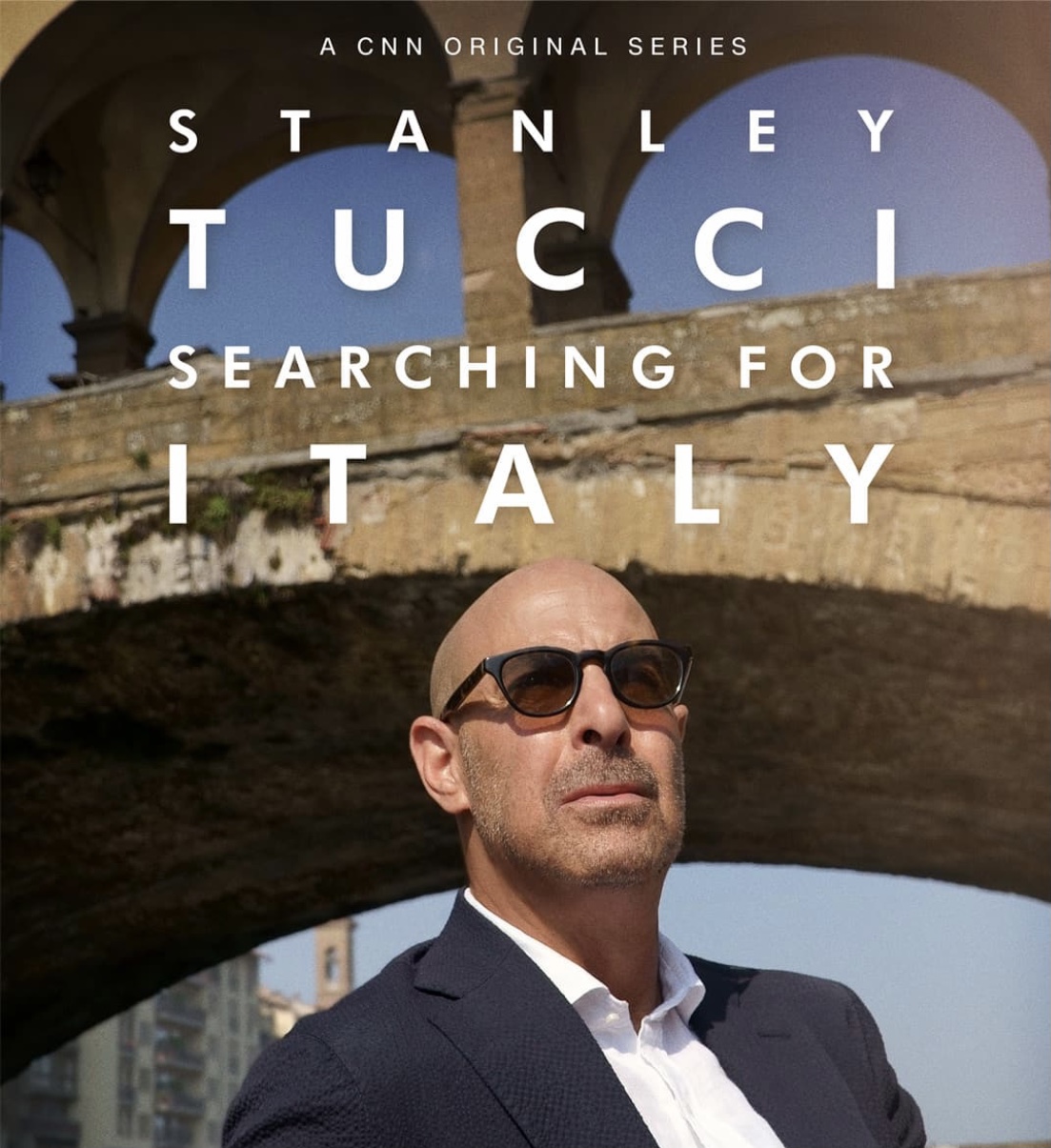
Stanley Tucci: Searching For Italy

I’ll admit I’m a little bit late to discovering Stanley Tucci: Searching For Italy, a six-part CNN Original Series focusing on travel and food, which had its premiere last February. Recently, it’s come to HBO Max and I immediately got hooked.

Stanley Tucci: Searching For Italy follows the Academy Award-nominated actor, who travels around Italy to explore the regional culture, cuisine and history of this boot-shaped southern European country with its lengthy Mediterranean Sea coastline that has left its powerful mark on Western culture and food. The series received two Primetime Emmy Award nominations, including one for Outstanding Hosted Nonfiction Series, and has been renewed for a second season.

In the first season, filmed both in 2019 and during the Covid-19 pandemic that hit Italy in 2020, Tucci explores Naples and the Amalfi Coast, Rome, Bologna, Milan, Tuscany, and Sicily. Each has a particular theme and all of them are well-written and produced as well as nicely paced. Tucci is stylish and entertaining, both as a storyteller and as a conversationalist – and we learn he’s quite comfortable performing in the kitchen, too. His parents are both of Italian descent, and had roots in Calabria. He spent part of his youth living in Florence, so it’s not surprising that the episode about Tuscany feels like a big family homecoming.


After watching all six episodes of Stanley Tucci: Searching For Italy over the past week, it’s easy to make comparisons to Anthony Bourdain’s Parts Unknown, which set the standard for fusing food and travel. However, as Tucci admitted in an interview with The Hollywood Reporter, “The show that we are doing is distinctly different than his: I am not nearly as adventurous as Tony was, not nearly. Or as brave. But what he did is open the doors to all of us who were interested in food, and travel, to explore in our own ways. … He was an extraordinary writer, a nice person, and a great explorer of the human condition through food.”

While not all of the culinary discoveries Tucci introduces us to are new – and many of them come back to traditional Italian cuisine that focuses on pasta and cheese – the way in which he presents them, filled with his warmth and charisma lighting up the screen, makes this series an enjoyable experience. In Naples, it’s the search for the freshest mozzarella and the best San Marzano tomatoes. In Bologna, in the Emilia-Romagna region of the country, it’s about exploring prosciutto de Parma. In Rome, it’s all about enjoying the creamy carbonara. In Sicily, it’s learning about the hospitality.

Each episode is peppered with equal parts cuisine and culture and how Italy’s colorful history ties them all together – and it’s all captured in living color. It’s what I found very charming and entertaining. Of course, what’s not to love about Italian cuisine as well as hearing the Italian language spoken so eloquently and passionately?

Stanley Tucci: Searching For Italy is a smart and endearing series that is revealing about the universal human condition – and how good food and conversation can unite us – and it made me yearn for more after watching each of the six episodes with great interest. May it whet your appetite, too.

Photos: Stanley Tucci: Searching For Italy CNN and HBO Max websites.


Tuesday, December 8, 2020

On books: Jon Meacham’s ‘The Soul of America: The Battle for Our Better Angels’ is still timely reading


Jon Meacham is a Pulitzer Prize-winning historian and presidential biographer whose voice has become a familiar and reassuring one on MSNBC during the Trump Era. He’s a contributing writer to The New York Times Book Review, a contributing editor to Time magazine, and a former Editor-in-Chief of Newsweek. Meacham holds the Carolyn T. And Robert M. Rogers Endowed Chair in American Presidency at Vanderbilt University.

In writing about presidents as varied as Abraham Lincoln and George Herbert Walker Bush, Meacham has noted that “both called on us to choose the right over the convenient, to hope rather than to fear and to heed not our worse impulses but our best instincts.”

In Meacham’s 2018 best-selling book, The Soul of America: The Battle for Our Better Angels, a brilliant and fascinating – if not timely work – which I have found good reading during this pandemic-interrupted year, we are reminded that from our country’s very beginnings, the United States has, in the words of American historian and law professor Annette Gordon-Reed, “struggled to deliver on the promise of the Declaration of Independence and to make our Union ‘more perfect.’ Race has often been at the heart of those struggles, and The Soul of America persuasively argues that the resilient spirit of those who fought throughout our history to overcome that seemingly intractable problem is still with us. It is that spirit that gives us cause to be hopeful in the face of doubts about our country’s future.”

Meacham writes with both clarity and purpose throughout The Soul of America and explains how our current “Trumpian” climate of partisan fury is not new. He explores other contentious periods of our nation’s history – from the Civil War to World War I to the fight for women’s rights to Lyndon Johnson’s crusade against Jim Crow – to show how presidents and ordinary citizens have united to defeat “the forces of anger, intolerance, and extremism.”

Through each of these periods of our nation’s history, Meacham explains, our national life “has been shaped by the contest to lead the country to look forward rather than back, to assert hope over fear – a struggle that continues even now.” As Meacham once explained to Trevor Noah on The Daily Show when he was promoting the book two years ago, “every era is a battle between our best impulses and our worst impulses.”

Careful students of history will be familiar with some of these stories, but as Meacham notes, “if we have learned anything in recent years – years in which the president of the United States has taken pride in his deliberate lack of acquaintance with the most essential historical elements of his office – it is that even the most basic facts of our common past repay attention. ‘Eternal vigilance,’ it has been long said, ‘is the price of liberty’ and a consciousness about what has worked – and what hasn’t – in previous eras is surely a useful form of such vigilance.”

Historian Ken Burns, no stranger to the study of our nation’s past, summed his thoughts about The Soul of America by saying, “Rather than curse the darkness, Jon Meacham, with his usual eloquence and surpassing knowledge of our history, has offered us all the sublime and calming reassurance that, as threatening as so much of the present moment seems, Americans have weathered such storms before and come out on the other side with fresh and progressive horizons. This is a beautifully expressed and convincing prayer to summon our own ‘better angels’ to meet the obvious challenges of today.”

Meacham concludes The Soul of America by writing, “For all of our darker impulses, for all of our shortcomings, and for all of the dreams denied and deferred, the experiment begun so long ago, carried out so imperfectly, is worth the fight. There is, in fact, no struggle more important, and none nobler, than the one we wage in the serve of those better angels who, however besieged, are always ready for battle.”

A footnote: In October, HBO debuted a documentary, “The Soul of America,” based upon Meacham’s 2018 book of the same name. Here is a an interview Meacham gave on NBC’s “The Today Show” to discuss the documentary.


Tuesday, October 15, 2019

Getting lost at the Smithsonian with Aasif Mandvi


Aasif Mandvi is a comedian and actor – and, as I’ve recently learned much to my delight, a pop culture fanatic at heart. In his new podcast series, “Lost at the Smithsonian with Aasif Mandvi,” the former “Daily Show” correspondent who now co-stars in the CBS drama “Evil,” gets up close and personal with some of the most iconic artifacts at the National Museum of American History in Washington, D.C.

Whether exploring vintage clothing (Fonzie’s leather jacket from “Happy Days”), ratty furniture (Archie Bunker’s chair from “All in the Family”) or mismatched shoes (Dorothy’s ruby slippers in “The Wizard of Oz”), there are endless ways to get lost at the Smithsonian. Mandvi and his guests at the Smithsonian share how these and other items – 10 iconic pop culture objects out of 156 million in the Smithsonian collection – each became defining symbols of 20th century American pop culture.

In the opening episode of the series, we learn why Henry Winkler’s portrayal of “The Fonz” became the breakout character in the mid-70s sit-com “Happy Days” and how his leather jacket became a symbol of coolness in an era of Watergate, when Americans yearned for simpler, happy days. Mandvi interviews Winkler to learn how he was able to turn “The Fonz” into an American icon.

“He was everybody who I wanted to be and who I wasn’t, because I was not in control of my life or my psyche,” said Winkler in describing his portrayal of “The Fonz.”

In the second episode, Mandvi explores the acoustic guitar belonging to José Feliciano, who at age 22 was the first artist to perform a “personalized” rendition of the National Anthem. Today, taking liberties with the National Anthem is commonplace before baseball games and many other American sporting events. However, as Feliciano deviated from the norm when he performed “The Star Spangled Banner” before a 1968 World Series game in Detroit, it nearly destroyed his career. But was it an act of protest or patriotism? You might be surprised by the musician’s answer.

“My version was not outlandish,” recalled Feliciano, now 72, during his conversation with Mandvi. “It was a combination of soul, gospel and because I’m Latin, I gave it a little bit of a Latin feel.”

What began as a chat about Feliciano’s legendary guitar ended up morphing into a thoughtful conversation about race, about patriotism, and what it means to be an American. The blind, Grammy Award-winning Puerto Rican artist also performs a private concert when he’s reunited with his guitar at the Smithsonian.

The third episode, which debuted last week, focuses on the ruby slippers Judy Garland wore in the 1939 film classic “The Wizard of Oz.” As Mandvi recently tweeted, “Click your heels 3 times and say ‘There’s no place like @amhistorymuseum,’ & you’ll be transported to an exhibit that’s been viewed 100,000,000+ times. ... Well, not really. But you’ll get pretty close.”

Curator Ryan Lintelman said of Dorothy’s famous ruby slippers: “So we estimate that since 1979 we we got them, a hundred million people have seen them probably. You know, it’s pretty incredible. And other than like maybe the Mona Lisa, I don’t know that any other museum can really claim that one thing has been seen by so many people,” he said.

Thus far, three episodes of “Lost at the Smithsonian” have aired and new podcast episodes drop each week via Stitcher. Those in the know have hinted that among the future items Mandvi explores include Muhammad Ali’s boxing robe and Mr. Spock’s ears from the original “Star Trek” TV series.

I don’t know about you, but I can’t wait to get lost at the Smithsonian.

Listen to “Lost at the Smithsonian” via Stitcher:

https://www.stitcher.com/podcast/stitcher/lost-at-the-smithsonian

A postscript: “Lost at the Smithsonian” concluded its run on November 24. Following is a list of themes for each episode:

1. Fonzie’s Jacket
2. Jose Feliciano’s Guitar
3. Dorothy’s Ruby Slippers
4. Phyllis Diller’s Gag File
5. Muhammad Ali’s Robe
6. Carrie Bradshaw’s Laptop
7. Archie Bunker’s Chair
8. Pele’s #10 Jersey
9. Bee Gees’ Silver Suits
10. The Original Muppets

Tuesday, May 7, 2019

Bill James: Baseball is universe you can figure out


Since 1977, Bill James has written more than two dozen books devoted to baseball history and statistics. During that time, he’s worn many influential hats in and around the National Pastime as a baseball writer, historian and statistician. In 2006, Time named him to the Time 100 as one of the most influential people in the world. Currently, James is a senior advisor on Baseball Operations for the Boston Red Sox.

James coined the term sabermetrics in homage to the Society for American Baseball Research (SABR), in which one scientifically analyzes and studies baseball – think of Moneyball  by Michael Lewis – often through the use of statistical data that goes beyond mere home runs, runs batted in and batting averages in an attempt to determine why teams win and lose.

On Saturday, James visited the Library of Congress in Washington, D.C., where he spoke on a variety of subjects in conversation with D. Bruce Brown, president of the Baltimore Babe Ruth Chapter of the Society of American Baseball Research.

Why do you like baseball?
“You can trace it and study it unlike much of the rest of the world.”

Is research ruining the romance of baseball?
“We can get so wrapped up in what we do that it drives people away, dying the game. It’s a legitimate concern.”

What is the future of baseball?
“It’s old and has the ability to adapt. What I see as the next thing to save the game is – and I don’t know how or where it will happen – but it has to go broader. You can change everything (about the game) and it’s still baseball.”

How does your affiliation with the Red Sox change your outlook on the other 29 teams?
“I may have at times spoken disrespectfully of teams, but I would never write a book telling secrets. You have to have respect for secrets.”

Who was your favorite team growing up?
“I grew up a Kansas City A’s fan and became a Royals fan. (James was born in Holton, Kan.) I’m more of a Red Sox fan (now) than I was ever a Royals fan. It was difficult rooting for a team owned by Charlie Finley.”

What have you changed your mind about in 40 years?
“I used to think if you had a player who played second and shortstop, you made him a shortstop because he was more valuable. Maximize team value.”

James was asked to name his All-Time team:
C – Yogi Berra
1B – Lou Gehrig
2B – Joe Morgan/Eddie Collins
3B – Mike Schmidt
SS – Cal Ripken
OF – Babe Ruth, Willie Mays, Ted Williams
P –  Lefty Grove/Roger Clemens

A few closing thoughts ...

“Younger people now have a better command of the game than before.”

“Are you trying to win or entertain the fans? Many teams now put (those principles) on equal footing.”

Photo: By Michael Dickens

Tuesday, December 11, 2018

On books: Jon Meacham’s ‘The Soul of America: The Battle for Our Better Angels’ is timely reading


Jon Meacham is a Pulitzer Prize-winning historian and author of Destiny and Power: The American Odyssey of George Herbert Walker Bush, the definitive biography of the recently deceased 41st President of the United States. Last week, Meacham eulogized Mr. Bush, calling him “America’s last great solider-statesman, a 20th-century founding father.”

During Meacham’s eulogy, he said, “Abraham Lincoln’s ‘better angels of our nature’ and George H.W. Bush’s ‘thousand points of light’ are companion verses in America’s national hymn. For Lincoln and Bush both called on us to choose the right over the convenient, to hope rather than to fear and to heed not our worst impulses but our best instincts.”

In Meacham’s latest best-selling book, The Soul of America: The Battle for Our Better Angels, a brilliant and fascinating – if not timely work – we are reminded that from our country’s very beginnings, the United States has, in the words of American historian and law professor Annette Gordon-Reed, “struggled to deliver on the promise of the Declaration of Independence and to make our Union ‘more perfect.’ Race has often been at the heart of those struggles, and The Soul of America persuasively argues that the resilient spirit of those who fought throughout our history to overcome that seemingly intractable problem is still with us. It is that spirit that gives us cause to be hopeful in the face of doubts about our country’s future.”

Meacham writes with both clarity and purpose throughout The Soul of America and explains how our current “Trumpian” climate of partisan fury is not new. He explores other contentious periods of our nation’s history – from the Civil War to World War I to the fight for women’s rights to Lyndon Johnson’s crusade against Jim Crow – to show how presidents and ordinary citizens have united to defeat “the forces of anger, intolerance, and extremism.”

Through each of these periods of our nation’s history, Meacham explains, our national life “has been shaped by the contest to lead the country to look forward rather than back, to assert hope over fear – a struggle that continues even now.” As Meacham told Trevor Noah recently on The Daily Show, “every era is a battle between our best impulses and our worst impulses.”

Careful students of history will be familiar with some of these stories, but as Meacham notes, “if we have learned anything in recent years – years in which the president of the United States has taken pride in his deliberate lack of acquaintance with the most essential historical elements of his office – it is that even the most basic facts of our common past repay attention. ‘Eternal vigilance,’ it has been long said, ‘is the price of liberty’ and a consciousness about what has worked – and what hasn’t – in previous eras is surely a useful form of such vigilance.”

Historian Ken Burns, no stranger to the study of our nation’s past, summed his thoughts about The Soul of America by saying, “Rather than curse the darkness, John Meacham, with his usual eloquence and surpassing knowledge of our history, has offered us all the sublime and calming reassurance that, as threatening as so much of the present moment seems, Americans have weathered such storms before and come out on the other side with fresh and progressive horizons. This is a beautifully expressed and convincing prayer to summon our own ‘better angels’ to meet the obvious challenges of today.”

Meacham concludes The Soul of America by writing, “For all of our darker impulses, for all of our shortcomings, and for all of the dreams denied and deferred, the experiment begun so long ago, carried out so imperfectly, is worth the fight. There is, in fact, no struggle more important, and none nobler, than the one we wage in the serve of those better angels who, however besieged, are always ready for battle.”


Photos: Courtesy of Google images. Video: Courtesy of YouTube.com/The Daily Show.

Saturday, October 20, 2018

Thoughts on tennis: Nadal, Djokovic must break silence

Are Rafael Nadal and Novak Djokovic
being used as sporting pawns?

The boldfaced headline in Thursday’s Times of London newspaper spoke loudly: “Novak Djokovic and Rafael Nadal warned over Saudi Arabia event.” In a story by tennis correspondent Stuart Fraser, he wrote that the two tennis superstars “have been warned that their participation in a lucrative exhibition in Saudi Arabia in December could be used used by the country’s controversial regime as ‘a form of sportswashing.’”

While Saudi Arabia has always been viewed as a prominent destination for conducting global big business, tennis – I have learned – is part of a growing Saudi sports propaganda program. Mind you, Saudi Arabia has little or no history when it comes to professional sports. Besides tennis, it has shown recent interest in bringing motor racing, boxing, football – even pro wrestling – to the Arab empire.

Now is the time for Nadal and Djokovic, currently ranked No.1 and No. 2 in the world, to use their global popularity to bring attention to the “truly appalling” human rights record of Saudi Arabia, warns Amnesty International. The world human rights organization made its plea in the aftermath of the disappearance and murder of Saudi journalist Jamal Khashoggi, who for the past year had been writing global op-ed pieces for the Washington Post while living in exile in the United States. Many of Khashoggi’s writings were critical of Crown Prince Mohammed bin Salman and the Saudi royal family.

A day after news about Khashoggi’s disappearance surfaced, a tennis exhibition match billed as the King Salman Tennis Championship in Jeddah, between Nadal and Djokovic, was announced. The financially attractive, end-of-the-year exhibition scheduled for December 22, would see each participant make at least $1 million. Under the present circumstances, it would seem to fly in the face of their humanitarian outlook.

Since the news about Khashoggi emerged, dozens of global business and media conglomerates have withdrawn from attending an upcoming international conference in Riyadh, billed as the Future Investment Initiative – among them: Bloomberg, CNBC, CNN, the Financial Times, the New York Times, the Los Angeles Times, Viacom and the World Bank president, Jim Yong Kim.

In a recent sports blog for The Guardian of London, sports writer Kevin Mitchell notes “the two players appear to have remained deaf to growing clamor over seeming endorsement of Saudi Arabia.” He calls both Nadal and Djokovic “men of conscience and integrity,” but warms they “continue to risk their good name by accepting an invitation to play in a meaningless exhibition in Saudi Arabia, a regime under critical scrutiny for the disappearance of the journalist Jamal Khashoggi.”

(Since the publication of Mitchell’s blog, early Saturday Saudi Arabia confirmed that Khashoggi was dead. He was killed inside the Saudi consulate in Istanbul, Turkey.)

Indeed, I agree with Mitchell. Perhaps, it’s as if both players are waiting for the international embarrassment to pass. Yet, I have to wonder if either is oblivious to the growing criticism that’s gathering around them. Or, simply, are they ignorant of the seriousnous of the greater issue?

“Neither is a good look for athletes who have always been aware of their wider responsibilities,” writes Mitchell. After all, both have foundations that help disadvantaged youth through tennis. Plus, Nadal was widely seen – thanks to social media – helping clear debris in his native Majorca after recent floods hit the Spanish island, and Djokovic has been active in campaigning for flood relief in his home country of Serbia. Bottom line: both Nadal and Djokovic are decent gentlemen.

In hindsight, one wonders whatever possessed Nadal and Djokovic to agree to play in the Saudi exhibition in the first place? Certainly, they don’t need the money. Although December exhibitions in various corners of the world are common and bring the sport to cities not already on the ATP World Tour schedule, the tennis season is already much too long. Pulling out now would make a statement about how the world should view Saudi Arabia’s behavior and pattern of state-sanctioned killing.

I would hate to see Nadal and Djokovic continue to be used as sporting pawns – displayed before a world-wide audience – flaunted by the Saudi government to distract us from their murderous regime. They need to break their silence now.

Wednesday, July 25, 2018

Baseball Americana: celebrating history, community

Baseball Americana at the Library of Congress

Baseball in 1879
Americans, I learned, during a recent visit to see the "Baseball Americana" exhibit at the Library of Congress in Washington, D.C., had been playing baseball for a long time before they agreed upon the rules of the game – or even settled on how to spell it. Baseball, it seemed, was known by some as "town ball" or, more generically, as "round ball." Yet, no matter what form, the sport which has given us Babe Ruth, Ted Williams, Hank Aaron and Mickey Mantle, among so many stars – and broken the color barrier with Jackie Robinson – has endured. But it hasn't stayed the same in anyone's lifetime. One need only look at the use of the designated hitter in the American League since the 1970s.

"Baseball Americana" is a colorful and important showcase of pieces of baseball history curated by the Library of Congress with the help of Major League Baseball, ESPN, and the National Baseball Hall of Fame and Museum, that cannot be found anywhere else – but it's not meant to be a comprehensive history of baseball. Instead, as viewers to the exhibit will see, "Baseball Americana" is a celebration of baseball as community as well as an exploration of the sport's "gritty roots" and its "changing traditions." It's also about the game of baseball as we know it today.

The  American essayist and culture critic Gerald Early once said, "I think there are only three things America will be known for 2,000 years from now ... the Constitution, jazz music, and baseball."

Magna Carta of Baseball
Visitors are given a chance to consider baseball, both in its past and present forms, as it relates to the players and teams and to the communities that it creates. We learn how each of these groups has contributed to the fabric of baseball – its customs and traditions – and how they thrive, evolve or eventually fade into memory.

Front and center, the Magna Carta of Baseball shows the handwritten "laws" of the game. They are the founding documents for the modern version of baseball, going back to 1856, before the Civil War. The evolution of baseball equipment – bats, balls and gloves – are explored. The role that Jackie Robinson and Branch Rickey played in integrating the Major Leagues is discussed in great detail. There are also plenty of vintage black and white photographs, colorful posters, scouting reports and scorecards – even bobble-heads. Also, there are interactive areas that allow visitors to touch and feel bats and balls and gloves, create their own baseball cards, and test their baseball knowledge and IQ.

Free agency and player rights are addressed. The Negro Legues and the role of women's baseball are featured, too. And, the comedy of baseball as seen on TV (Cheers) and in film (Bull Durham) is not to be missed.

Willie Mays ca. 1965
My favorite part of "Baseball Americana" was hearing the "voices of the game" – Mel Allen, Vin Scully, Russ Hodges, to name a few – create colorful word pictures of some of the great moments of our National Pastime, including the final out of Don Larsen's 1956 World Series perfect game, Hank Aaron's record-breaking 714th home run from 1974, and Bobby Thomson's 1951 "shot heard 'round the world." And, nothing beats watching the greats of the game, including Willie Mays, Bob Gibson and Barry Bonds – in black and white and in color – come alive on the video screens.

The late commissioner of baseball, Bart Giamatti, once said, "Baseball breaks your heart. It's designed to break your heart." How else do you explain what the long-time suffering Chicago Cubs fans endured before they finally won a World Series in 2016 after not winning one in the past 118 years?

Time and again, baseball brings us together to watch or play the game – and to discuss it, analyze it, debate it. Heck, it's even spawned an entire cable network devoted to our National Pastime. From visiting "Baseball Americana," which opened on June 29 and continues through next June, I came away with a renewed appreciation of the way the history of baseball illuminates the history of our nation and the role baseball plays in providing us with a shared sense of belonging.

CovePhoto: By Michael Dickens © 2018.
Note: A digital version of "Baseball Americana," can be seen at www.loc. 

Tuesday, May 1, 2018

Telling a story through the Presidents who shaped history

Barack Obama
Recently, while entertaining out of state friends, we happened one evening to visit the nation's only complete collection of presidential portraits outside of the White House at the Smithsonian Institute's National Portrait Gallery in Washington, D.C. The gallery of Presidential Portraits is a timeless exhibition that lies at the heart of the National Portrait Gallery's core mission: telling the American story through the individuals who shaped it.

From George Washington to Barack Obama, presidential portraits have always attracted our interest. Once upon a time – before newspapers, magazines and television – a painted portrait or a sculpted image was the only means that most of us knew of our Presidents. And, as I've learned, throughout much of the 19th century, there was a lively debate over which portrait of George Washington most accurately conveyed his proper image.

Inside the gallery of Presidential Portraits, there are a variety of presidential likenesses, including oil on canvas, marble head busts, engravings – and, there's the Chuck Close portrait of Bill Clinton that is truly amazing and has to be seen. As I took note while walking through the gallery and viewing the presidential portraiture in order of their presidency, from Washington to Obama, I couldn't help but notice that some portraits were more sophisticated and interesting than others. Let's face it – I think Teddy Roosevelt is just a bit more striking a figure than Millard Fillmore. Same goes for JFK compared to Calvin Coolidge. No offense, some presidents are just more interesting than others.

Bill Clinton
As I drew closer to the newest presidential portrait – of Barack Obama – I noticed an orderly queue line and soon I joined it so that I could take a few candid photographs. The portrait of the 44th President by artist Kehinde Wiley was unveiled on February 12 at the National Portrait Gallery and it's become the center of attention – along with the new portrait of former first lady Michelle Obama – inside the entire National Portrait Gallery.

"Historically, portraiture has always been about saying yes to things that we want to celebrate, but I think also the commissioned portrait has often times been about a society saying, 'Who are the people we collectively want to honor?' and particularly with the presidential portrait, this is the highest aspect of that tradition," said Wiley, during a recent interview with Time. "It's been – I can't tell you – an extraordinary honor to be able to participate in that."

The portrait of Obama makes quite a statement. It's anything but drab. The former president is shown wearing a black suit with an open-collared shirt. He's sitting on a wooden chair. And, he's surrounded by flowers and green foliage. The flowers, I learned, include: blue lilies, from his father's home in Kenya; jasmine from Obama's home state of Hawaii; and chrysanthemums, the official flower of Chicago, the former president's hometown.

John F. Kennedy
At the unveiling of his portrait, Obama said, "What I was always struck by whenever I saw (Wiley's) portraits was the degree to which they challenged our conventional views of power and privilege."

Wiley stated, "The ability to be the first African-American painter to paint the first African-American president of the United States is absolutely overwhelming. It doesn't get any better than that."

After seeing the Obama portrait, Brian T. Allen wrote in The National Review, "Obama looks directly at us, as if he reads our minds and challenges our assumptions. It's jarring but effective. He's formal and familiar, both tense and loose. He leans toward the viewer. It's not a position comfortably sustained. It's not repose. It suggests imminent action. For Obama, this probably means he's about to tell us, 'That's not who we are,' instructing us to question some near-universally held sentiment. Wiley builds the figure with straight lines and diagonals. His suit is dark. Aside from his wedding ring, he's unornamented. Obama's open collar softens the effect. It's his trademark look but seems like a uniform. He's a role model, so it works."

Tuesday, April 3, 2018

An understanding of racial justice in the shadow of statues

In the Shadow of Statues, which
was published March 20, is
on the New York Times
Bestseller List.
"These statues are not just stone and metal. They were erected purposefully to send a strong message to all who walked in their shadows about who was still in charge." 

– Mitch Landrieu, from In the Shadow of Statues

New Orleans is one of the great multicultural cities in the world. It is also a racially divided city that has dealt with its fair share of poverty and urban violence. In spite of all of its troubles, the Big Easy remains a beloved cultural treasure to everyone who visits thanks to its rich tradition of funky jazz music and the beauty and grace of its amazing food.

Enter Mitch Landrieu, the mayor of New Orleans since 2010, who has been an important catalyst in helping his city rebuild from the devastation of Hurricane Katrina. As the son of a former state legislator and mayor of New Orleans – who was a huge force in the integration of that city in the 1960s and 1970s – and the brother of a former U.S. senator from Louisiana, Landrieu grew up with a progressive education in the racially divided Crescent City among America's lingering Confederate monuments.

At a time when the issue of racism has become resurgent "with seemingly tacit approval from the highest levels of government and when too many Americans have a misplaced nostalgia for a time and place that never existed," Landrieu has written In the Shadow of Statues – a book that's a must read.

In the Shadow of Statues is equal parts memoir, history, and a "prescription for finally confronting America's most painful legacy." As a white southerner confronting his city's past history, Landrieu contributes a very strong voice to our national conversation about race in America today by taking on many difficult issues related to it, including slavery and inequality.

In praising In the Shadow of Statues, Walter Isaacson, author of Leonardo da Vinci and Steve Jobs, writes: "With a balance of humility and conviction, he recounts his path to a more profound understanding of racial justice and explains how this journey led him to remove the Confederate monuments in New Orleans. It's an important book for everyone in America to read, because it shows how intellectual honesty can lead to moral clarity."

Mitch Landrieu at Politics & Prose Bookstore
in Washington, D.C. last week.
Last week, my wife and I attended a standing room-only book event at Politics & Prose Bookstore in northwest Washington, D.C., featuring a conversation between Landrieu and Jeffrey Goldberg, editor in chief of The Atlantic, before a thoughtful and engaging audience, that was followed by a 30-minute Q & A period and a book signing.

"There's a difference between remembering and revering history," said Landrieu, who addressed the people of New Orleans in May 2017 about his decision to take down and remove four Confederate monuments, including the statue of the famous southern Confederate general Robert E. Lee. The affected statues represent a mere four-year period of U.S. history, from 1861-65, but a searing one, too. While Landrieu said that the decision to remove the monuments was a difficult one, it was a right one, too. It was about eradicating history.

"We were on the wrong side of history," Landrieu told the Politics & Prose audience very matter-of-factly. "These statues were erected to send a strong message to all who walked in their shadows about who was still in charge. For decades, these statues have cast a long shadow on society, particularly African-Americans."

Lee Circle before the Confederate monument
of Robert E. Lee was removed in 2017.
Landrieu says In the Shadow of Statues is an invitation to stand and sit in other people's shoes. He recalled for his Politics & Prose audience a conversation he once shared with his dear friend, the famous jazz musician and educator – and New Orleans native son – Wynton Marsalis, who helped him see the truth about the city's exclusionary attitudes. "'Hey, man,'" Landrieu recalled the trumpeter saying to him. "'You should take the statue of Robert E. Lee down. Do you know how it got there and who put it up?'"

In the book, Landrieu expands on his conversation with Marsalis.

"I don't like the fact that Lee Circle is named Lee Circle."

"Why is that?"

"Let me help you see it through my eyes. Who is he? What does he represent? And in that most prominent space in the city of New Orleans, does that space reflect who we are, who we want to be, or who we are?"

Suddenly, Landrieu was listening.

Later in their conversation, according to the mayor, Marsalis added, "'Did you know Louis Armstrong left the city and never came back because of that statue? He did not even want to be buried in his hometown. You ever think about what Robert E. Lee means to someone black?'"

Landrieu emphasized that there's a difference between remembrance of history and reverence of it. "I think there are a lot of people who are struggling with the notion that the South fought for a cause that was reviled," he said. When you make sense of it, monuments are usually reserved for winners not losers. The Confederate monuments celebrated the losing side of the Civil War.

New Orleans Mayor Mitch Landrieu
As Landrieu remarked back during his May 2017 speech, "For America and New Orleans, it has been a long, winding road, marked by great tragedy and great triumph. But we cannot be afraid of our truth."

And, as Landrieu writes, "Here is the essential truth: We are better together than we are apart.

"Indivisibility is our essence."

Near the end of his conversation at Politics & Prose, Landrieu said, "If we are going to move forward as a country, we must confront the issue of race head on. Our diversity is what makes this country great.

"We need to understand our history. We need to tell the whole story."

Photo credits: Book cover courtesy of Amazon.com. Politics & Prose audience courtesy of @PoliticsProse Twitter. Robert E. Lee statue courtesy of New Orleans Advocate. Mitch Landrieu courtesy of Cheryl Gerber.

Tuesday, January 30, 2018

A Tuesday Night Memo: Thoughts on turning eight

People who know me well know that I've been interested in writing, reporting and storytelling for a long time. So, it's only natural that I turned to blog writing because it gave me an opportunity to hone my writing skills and provided a forum for writing about things that interested me and that I wanted to share with others.

My blog, A Tuesday Night Memo, turned eight last week. Here's a little history about it:

I started writing A Tuesday Night Memo on January 26, 2010, as a means for sharing musings about my life filled with music, sport, and urban travel, and to foster community with my friends, family and Facebook acquaintances. More recently, as I added a Twitter profile, it allowed me to reach a wider audience across the country and beyond.

People who know me well know that I'm passionate about music, sport, and urban travel. Additionally, I have used my blog as a vehicle for writing about art, food, fashion, religion and gardening – and, more recently, about politics. Before we moved to the east coast, sharing news and photos about our former Oakland, Calif., flower gardens at home always seem to generate great interest and enthusiasm. Maybe, it was the pretty shapes and colors of our flowers that others found appealing, especially since we could maintain a garden all year long.

Up to now, I have "blogged" 391 entries for A Tuesday Night Memo, which collectively have received more than 142,000 page views. Among the many subjects I have written about include: my appreciation of tennis champion Roger Federer, how the city of Seattle fosters community through international cinema, a history of the world as seen through 100 objects, classical music conductor Gustavo Dudamel, Golden State Warriors head coach Steve Kerr, my love affair with Pink Martini, validating our travel through our photographs, and Jerry Seinfeld's Internet comedy Comedians in Cars Getting Coffee. Some of my recent posts have focused on new books written by actor Tom Hanks and veteran newsman Dan Rather. My most recent post focused on the future of the food industry in light of recent sexual harassment allegations made against many high profile chefs across the country. I have shared my interest in digital photography since beginning my blog, which has enabled me to illustrate many if not all of my posts with colorful visuals to match the words I've written.

The feedback many have shared is not only very much appreciated, but I also find it very useful. Much of it has been positive, but sometimes it's also been critical. Whether good or bad, I've found the feedback readers provide to be a valuable learning tool. Occasionally, I like to sneak a look at my blog's statistics, which are the key indicators that show how many total "hits" my blog has received, which stories have been read the most, and what countries comprise the blog's readership. The numbers are modest but nevertheless interesting.

Here are a few fun facts about A Tuesday Night Memo I thought you might enjoy:

Since my blog's debut, it has been read in dozens of countries, including the U.S., Canada, Mexico, France, Morocco, Tunisia, Turkey and Hong Kong – even Brazil, India, Vietnam, and Australia. The top five countries reading my blog include the U.S, Russia, Germany, France, and the United Kingdom. I hope Russia's interest in my blog has nothing to do with their wanting to hack me because of my occasional blog posts about President Donald Trump.

Looking ahead, the Trump presidency will continue to garner my interest and attention from time to time. How could it not? However, there's so much more to write about. Among things that I look forward to learning about include my continuing interest in exploring museums – and what we can learn from them. Also, I would like to explore the effect digital music and media have in connecting our world.

In the meantime, I thoroughly enjoy sharing my writing week in and week out, and I look forward to contributing more of my words and thoughts in what is shaping up to be another exciting year awaiting all of us.

Stay tuned!

Tuesday, November 14, 2017

Reflections on patriotism: Dan Rather on what unites us

Dan Rather reads from his book 'What Unites Us.'
Dan Rather finds himself thinking deeply about what it means to love America as he surely does in the age of President Donald Trump.

At a time in our nation's history when there's a crisis over our national identity, the longtime broadcast journalist has surfaced as a calm, measured voice of reason and integrity. At 86, he has embraced social media, where he regularly contributes his thoughts and wisdom via his Facebook page, which has more than 2.5 million followers.

Last week, Rather's new book, What Unites Us: Reflections on Patriotism, written with Emmy Award-winning journalist Elliot Kirschner, was published. In it, Rather has written a collection of 16 original and passionate essays that reflect on what it means to be an American in the 21st century.

During a recent book tour lecture at George Washington University in Washington, D.C., I listened attentively to Rather, in conversation with Washington Post editorial writer Jonathan Capehart. He discussed a variety of topics including patriotism and freedom of the press, whose values have transformed us and represent institutions that sustain our nation.

On the subject of patriotism, Rather read from his book: "Patriotism – active, constructive patriotism – takes work. It takes knowledge, engagement with those who are different from you, and fairness in law and opportunity. It takes coming together for good causes," he said. "This is one of the things I cherish most about the United States: we are a nation not only of dreamers but also of fixers. We have looked at our land and people , and said, time and again, this is not good enough; we can be better."

When asked about Capehart to discuss freedom of the press, Rather didn't hesitate when he responded: "We are the witness to the truth and there's a lot of good reporting going on out there. This president is pushing us toward a 'post-truth' and 'post-fact' political era.

"American journalism is at a crossroads," he continued. "News is what the public needs to know and it's generally what somebody else doesn't want you to know about."

Rather's storied career – he spent more than 40 years with CBS News and succeeded the legendary Walter Cronkite in the anchor chair for The CBS Evening News – has made him one of the world's best-known journalists. He's interviewed every president since Eisenhower. With decades spent on the front lines covering the world's biggest stories – from the assassination of President John F. Kennedy to the Vietnam War to the Watergate crisis that ended with the resignation of President Richard Nixon – Rather is able to offer his readers a unique if not intimate view of America's history and its historical change.

It's easy to gain from reading What Unites Us and by listening to Rather that regardless of the state of our current national political climate, he maintains a fundamental sense of hope that comes from sharing our nation's transformative values, from empathy to inclusion to service.

Photo of Dan Rather by Michael Dickens © 2017.

Tuesday, June 20, 2017

Welcome to my new life


The east side of U.S. Capitol Building in Washington, D.C.

We shall not cease from exploration, and the end of all our exploring will be to arrive where we started and know the place for the first time. – T. S. Eliot

On April 22, after 21-plus years of enjoying the landscapes and rhythms of northern California, my wife, Jodi, and I waved goodbye to the San Francisco Bay Area and headed east on Interstate 80. Our final destination? None other than the greater Washington, D.C. area, our new home.

As it happened, over the next week, we drove 2,950.6 miles – covering 13 states starting from California. We crossed the finish line in Maryland on Saturday afternoon, April 29, after beginning the final day of our journey in Morgantown, West Virginia.

Our Passivhaus town home in
Mount Rainier, Maryland.
Our travel week was very busy for us, but one in which we both embraced. After all, we had purchased a brand new house, a Passivhaus town home, in funky Mount Rainier, Maryland, just a couple of short blocks across the District line from Washington and about 15 minutes by car south of the University of Maryland campus in College Park. And, on May 1, my wife began a dream job in research and development at the Library of Congress, which served as the impetus for our leaving California for the Mid-Atlantic east coast.

As we drove across our beautiful and diverse country observing – through the snow-capped Sierra Mountains of California and Nevada, across the massive and great Salt Lake of Utah, alongside the majestic Rocky Mountains of Colorado, across acres and acres of Kansas wheat fields, near the picturesque Gateway Arch of St. Louis, through the Big Ten country of Indiana University in Bloomington, beside the Great American city of Cincinnati and up and down the hilltops of Morgantown – I was reminded often of how Mother Nature often holds up a mirror to us so that we can see more clearly the ongoing processes of growth, of renewal and of transformation in our lives. Our hours and days on the road were also filled with an abundance of music CDs – Pink Martini, Paul Simon, Elvis Costello, Valerie June, Diana Reeves – a variety of NPR podcasts like "Make Me Smart," and we tried to limit our driving to daytime hours so we could rest and renew ourselves at night.

The scenic beauty of the Donner Summit as seen driving
along Interstate 80 through the California Sierra Mountains.
Fortunately, social media and the Internet enable us to stay more easily connected than ever before with family and friends and we still plan to follow and support our favorite Bay Area professional and collegiate sports teams – just from a different city and time zone. So far, we are enjoying the fine public radio offerings from WAMU in Washington, D.C. as well as reading the Washington Post and the national print edition of The New York Times. And, we've learned thanks to the University of Maryland, which won both the men's and women's national championships in lacrosse, that people in this part of the country do take their lacrosse seriously. We've got tickets to see a Washington Nationals baseball game against the San Francisco Giants, and already we've been to a WNBA women's professional basketball game, too. Yes, there's plenty of rich of history and culture that awaits us in and around the nation's capital city, through its many museums and monuments, parks and trails – and I'm sure our free summer weekends will fill up fast with things to see and do. Already, we've explored historic Annapolis (which I'll write more about in the weeks to come) – it's only about 40 minutes away by car – and I'm sure we'll be back, soon.

Our future looks bright – and it doesn't even have anything to do with the abundance of sunshine we've experienced during the past month. Indeed, as the French novelist Marcel Proust once said, "the real voyage of discovery consists not in seeking new landscapes but in having new eyes."

Tuesday, June 13, 2017

This year, the City ruled the Land

With a near-perfect 16-1 postseason, the Golden State Warriors won their
second NBA Championship in three years on Monday night.

If you're a Golden State Warriors fan, like I am, you're probably in a pretty good mood today. After all, this is the year that the City ruled the Land.

Congratulations are in order for the Golden State Warriors on the occasion of winning their second NBA Championship in three seasons. On a late, spring Monday night at Oracle Arena in Oakland, Calif., the Warriors defeated the Cleveland Cavaliers, 129-120, to win their best-of-7 NBA Final, four games to one.

Indeed, as Warriors fans know, there's strength in numbers.

The much-heralded Kevin Durant, who joined the Warriors family nearly a year ago on July 4, 2016, in search of his first championship, garnered the Finals MVP by pouring in 39 points in the clincher. Teammate Stephen Curry, himself a Finals MVP when the Warriors won it all in 2015, added 34. Together, they were virtually unstoppable. In defeat, LeBron James scored a game-high 41 points for the Cavaliers. After the final buzzer sounded, James found both Durant and Curry on the court and offered props to both. Very classy move.

Looking back, the Warriors won the NBA Championship for a reason – they had the best collection of committed players and a coaching staff who molded this group of highly talented and motivated athletes into a winning team. They played with joy and enthusiasm, beauty and unity. Throughout their historic 16-1 post-season run, there was always a sense of passion on display and their desire to achieve a common goal of winning the title was always in focus. On any given night, in any given game, the Warriors always hustled and more often than not, found a way to win.

Thank you, players: Matt, Ian, Stephen, Kevin, Draymond, Andre, Damian, Shaun, Kevon, James Michael, Patrick, JaVale, Zaza, Klay and David. Thank you coaches: Steve, Mike, Ron, Jarron, Bruce, Chris and Willie.

Long after the game ended but not before the celebration had waned, Golden State Warriors head coach Steve Kerr, sporting a championship tee to go with his Champagne-soaked-and-spiked coiffure, reflected on the championship moment during a televised interview outside Oracle Arena, among a hearty group of blue and gold-clad Warriors fans. As always, with the right sense of thought and tone of voice – and with graciousness, too –  his words spoke volumes:

"There's so much joy, so much love. It's an incredible group of guys," said Kerr. "We know how talented they are. They are so committed to each other and to the greater good. That's ultimately what puts you over the top. We have the talent – obviously – to compete for a title every year, but what puts you over the top, I think, is when you have that level of respect and commitment to each other."

This year, it was the Warriors turn to win it all.

Tuesday, February 14, 2017

Nike: Equality has no boundaries

LeBron James during the filming of Nike's "Equality" commercial. /
"We can be equals everywhere."

On Sunday evening during the nationally televised Grammy Awards program, Nike debuted a short film about #EQUALITY. It's message was clear: Equality has no boundaries.

This extraordinary 90-second spot, filmed in black in white, was directed by Melina Matsoukas who has two Grammy Awards for her work on Beyoncé's "Formation" and Rihanna's "We Found Love." It features NBA great LeBron James and co-stars American athletes Serena Williams, Kevin Durant, Megan Rapinoe, Gabby Douglas, Victor Cruz, and Dalilah Muhammad.

"Equality" has already received more than 4 million views on YouTube.


The central theme of "Equality," which also features actor Michael B. Jordan in a cameo as well as narrating the script, and singer Alicia Keys covering Sam Cooke's "A Change Is Gonna Come," is this: "The Equality and fairness prevalent in major professional sports should transcend into broader society."

As part of Nike's Black History Month campaign, their initiative aims to "inspire people to take action in their communities."

The voice over in the film (Jordan) says "if we can be equals here," referring to a basketball court, then James says "we can be equals everywhere."

Writing in ESPN's "The Undefeated" sports, race and culture website, writer Clinton Yates said: "Using a street art metaphor to make a point about in-your-face activism is not only effective, but for many who'll likely see this ad, perhaps familiar."

It made an impact with me; I hope it makes an impact with you.

#EQUALITY
Is this the land history promised?
Here within these lines.
On this concrete court. 
This patch of turf.
Here, you're defined by your actions, not your looks or beliefs.
Equality should have no boundaries.
The bonds we find here should run past these lines.
Opportunity should not discriminate.
The ball should bounce the same for everyone.
Worth should outshine color.
If we can be equals here, we can be equals everywhere.

A postscript: Nike has released a behind-the-scenes look at "Equality," which is worth a good look. It showed what equality means to each of the athletes involved. Said Rapinoe: "Being a woman in sport, first of all, equality is not always something that we're privy to. And being a gay woman in this country, in sport, wherever I am in the conversation, it's there. It's my responsibility of making sure that I speak up about it, and speak up for other people. Hopefully, it can grow that movement in that way."

Adds James: "At the end of the day, we're always just trying to find a way that we can all feel equal, we can all be equal, have the same rights, have the same feelings, being able to be in the same place no matter the color."


• Nike, which plans to air the "Equality" film during next Sunday's NBA All-Star Game, is currently promoting "Equality" t-shirts on its website. According to Adweek, Nike will donate $5 million during this calendar year to "numerous organizations that advance equality in communities across the U.S., including Mentor and PeacePlayers."


Tuesday, November 3, 2015

Wendell Pierce: A soaring and eloquent voice speaks out about the redemptive and healing power of art

Wendell Pierce's memoir, 'The Wind in the Reeds:
A Storm, A Play, and the City That Would Not Be Broken'
is about the redemptive and healing power of art and
about New Orleans, a city he loves so dearly.

From his leading roles in HBO's The Wire and Treme to his feature film appearances in Selma, Ray and Waiting to Exhale, I've admired the work of the Tony Award-winning actor and producer Wendell Pierce for many years.

When I learned a few months ago that Pierce would be coming to the Bay Area to speak at the Jewish Community Center of San Francisco on October 30, I marked it on my calendar and bought tickets to this Arts & Ideas lecture. For more than an hour last Friday evening, Pierce spoke in both a soaring and eloquent tone of voice about the redemptive and healing power of art and about New Orleans, the city of his birthplace and the origin of his creativity. It is a city that he loves so dearly.

Pierce has written a new memoir, The Wind in the Reeds: A Storm, A Play, and the City That Would Not Be Broken, that is truly a page-turner.

'The Wind in the Reeds' is truly
a page-turner.
Both poignant and redemptive, in The Wind in the Reeds, Pierce tells the stories of his family, his city and his creative journey in the arts, and how they are all connected to one another. And, just as importantly, how they are "precious and worth saving, and how art has been critically important in revitalizing this unique American city."

On the back of the book's dust jacket, James McBride, author of The Color of Water and The Good Lord Bird, writes:

"This is more than a memoir. It's an adventure in history, encompassing the timeless elements that propelled this fourth-generation grandson of a slave into one of the most important dramatic actors of our age: family, art, truth, religion, and of course a mother's love. This is a story of sacrifice and blood struggle, of victory and selflessness, told with deep humility and grace by one of the most important American artists of our generation."

Pierce, 51, writes in his memoir: "We know who we are by the stories we tell about ourselves and our world. We know who we are through the family and community of whose stories we are a part.

"We make our stories. And our stories make us.

"I am not sure the stories of my family are art, exactly. After all, they came down to me not as objects to be admired for their beauty. Then again, they contain so much truth and goodness that they cannot help being beautiful as well. Their trials, their triumphs, the virtues that gave them the strength to overcome -- all of these things live in the stories my family shares as an inheritance that grows as we invest in it each successive generation.

"I draw creative strength from my roots buried deep in south Louisiana. Until the storm, I did not appreciate how much those roots were the veins connecting my heart to the body of historical experience that gave birth to the man I am today, and the man -- and the artist -- I am becoming every day."

Since Hurricane Katrina devastated his native New Orleans in 2005, Pierce has devoted much time and energy helping to rebuild the flood-ravaged Pontchartrain Park, a black middle-class neighborhood which became the first African-American post-war suburb, where was raised by his parents -- his father retired from the military and became a photographer and his mother was a school teacher. "In my family, we have a motto: Don't ever tell me you can't do something."

Throughout the evening, Pierce kept returning to the themes of a love of family and community in describing what brought him back to his roots and the need to do something positive to help in the city's recovery, to pick up the pieces. He so very much wanted to see his city to come back. So, he became a community rebuilder.

Wendell Pierce (right) performing in 'Waiting for Godot'.
The actor said it was a cathartic experience for him
and it reminded him of the power of art.
"It was an awakening."
"After Katrina, there were miles and miles of destruction and nothing there, nothing was right. And yet, we stagger onward rejoicing," said Pierce. One of the ways the actor helped his community rebuild -- and by extension his city -- was by performing in what became a legendary production of Waiting for Godot, which was staged in two of the neighborhoods that were most damaged by Hurricane Katrina. It became a chance for the city of New Orleans to come together and to celebrate "the human capacity for resilience."

In a recent NPR interview, Pierce said performing Waiting for Godot was a cathartic experience for him and it reminded him of the power of art. "It was an awakening. Waiting for Godot, this existential play about two men in this void with only a tree and a road, with no sense of who they are, where they've been, where they hope to do -- a real sense of desperation and loss, awaiting for something to help them something to guide them, to find who they are. They're waiting for Godot. They don't even know what or who Godot is.

"And it's in that moment that they come to the realization in this play that the power that they truly have is within themselves. And Vladimir says, 'At this place in this moment of time all mankind is us.  Let us do something while we have the chance.'"

In his book, Pierce writes of the "collaborative potential that art has to heal ourselves, our families and our communities." On Friday, Pierce reminded us of this, saying: "We reflect on who we are as a society and community. The legacy of New Orleans can be seen through the arts. Everything comes together as we deal with life."

Photo of Wendell Pierce at JCCSF Arts & Ideas: © Michael Dickens, 2015.
Photo of Wendell Pierce in 'Waiting for Godot': Courtesy of Google Images.