Showing posts with label appreciation. Show all posts

Tuesday, December 15, 2020

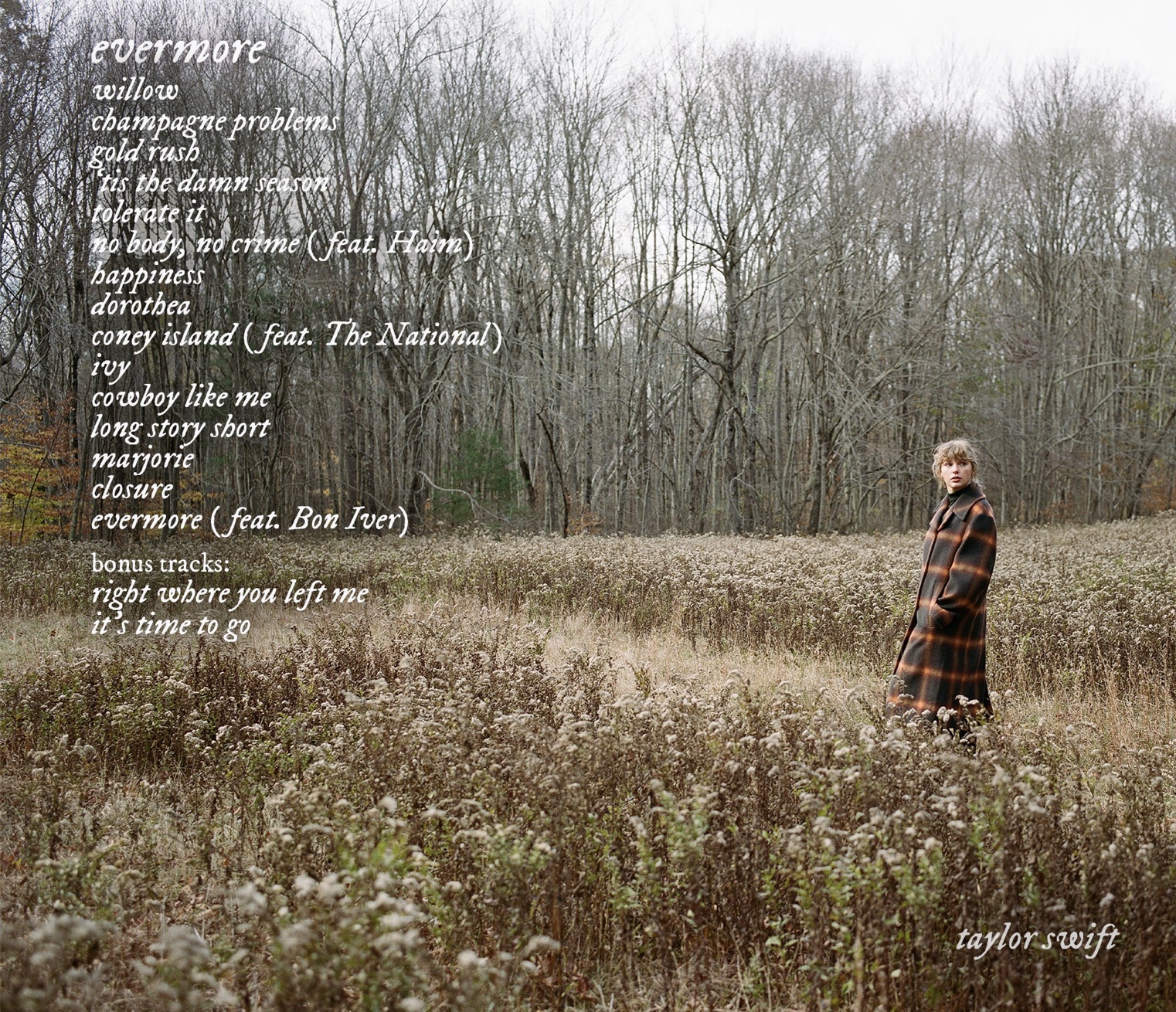
Evermore: Taylor Swift continues alchemy and teamwork started with Folklore


Last Friday, music megastar Taylor Swift released her ninth studio album on very short notice, Evermore. It’s the sister record to her eighth studio release from earlier this year, the Grammy-nominated Folklore

“To put it plainly,” Swift wrote on her Instagram, “we just couldn’t stop writing songs. To try and put it more poetically, it feels like we were standing on the edge of the folklorian woods and had a choice: to turn and go back or to travel further into the forest of this music. We chose to wander deeper in.

“I’ve never done this before. In the past I’ve always treated albums as one-off eras and moved onto planning the next one after an album was released. There was something different with Folklore.

“In making it, I felt less like I was departing and more like I was returning. I loved the escapism I found in these imaginary/not imaginary tales. I loved the ways you welcomed the dreamscapes and tragedies and epic tales of love lost and found into your lives. So, I just kept writing them.”

What immediately caught my attention – and I’ve never spent much time listening to or exploring the immensely popular music canon of Taylor Swift – is Swift’s collaboration with members of one of my favorite indie rock music groups, The National. In particular, Swift worked closely with the multitalented Aaron Dessner and she shared vocals on “Coney Island,” a song that deals with losing oneself in a relationship, with The National’s melancholy frontman, baritone vocalist Matt Berninger. In listening to both the song and the album, there’s a sense of artistic freedom and a break away from Swift’s conventional pop radio sensibility to create a folk album that’s full of sound and texture.

 Taylor Swift / Evermore

Meanwhile, sitting across the kitchen table, here’s what Aaron Dessner wrote on his Instagram: “It’s only been five months since Folklore was released. But truth be told, Taylor Swift and I never actually stopped exchanging ideas and somehow we’ve finished a sister record called Evermore that I love just as much. 

“These songs are wilder and freer, sometimes in strange time signatures and darker hues, but very much a continuation of what we started with Folklore. 

“I can’t begin to express my gratitude and respect for Taylor – I never cease to wonder at her seemingly boundless talent as a singer and a songwriter and storyteller. It’s been the experience of a lifetime to work so fast and furiously with her. ...

“My band mates in The National – Matt, Bryan and Scott, along with Bryce – are here, too. Hearing Matt sing with Taylor and the entire band perform on “Coney Island” – things have come full circle.”

Perhaps, Berninger put it best. He wrote on Twitter: “Singing a song with Taylor Swift is like dancing with Gene Kelly. She made me look good and didn’t drop me once. ‘Coney Island’ is an incredibly beautiful song she and Aaron Dessner wrote together. It really made me miss Brooklyn. Such a blast being a part of Evermore.”

Hearing the Swift-Berninger duet “Coney Island” for the first time recently was very intriguing and it’s what nudged me into giving the entire Evermore album a good listen on Spotify – and I like what I heard. If you’re someone who has always had an appreciation for the sense and sensibility – and seriousness – of The National, I think you’ll like what you hear from Swift with backing from The National on Evermore.


Cover photos: Beth Garrabrant (@taylorswift13/Twitter). Video: Courtesy YouTube.


Tuesday, March 3, 2020

A Tuesday Night Memo at 10: Getting to know me ...

My blog, “A Tuesday Night Memo,” recent turned 10. Yes, I’ve been writing a blog for a decade!

People who know me well know that I’ve been interested in writing, reporting and storytelling for much of my life. So, it’s only natural that I turned to blog writing because it gave me an opportunity to hone my writing skills and provided a forum for writing about things that truly interested me that I wanted to share with others.

Here’s a little touch of history about my blog:

I started writing “A Tuesday Night Memo” on January 26, 2010, as a means for sharing musings about my life filled with music, sport and urban travel, and to foster community with my friends, family and Facebook acquaintances. More recently, I added a Twitter profile, which has allowed me to reach a wider audience across the country and the world. Finally, I jumped onto the Instagram bandwagon earlier this year in order to share and comment on some of my favorite photographs and subjects.

Folks who read my blog know that I’m passionate about music, sport and urban travel Additionally, I have used “A Tuesday Night Memo” as a vehicle for writing from time to time about art, food, fashion, gardening and religion – and in the age of Trump about politics. Before we moved to the east coast nearly three years ago, sharing news about our former Oakland, Calif., flower gardens at home always seemed to generate great interest and enthusiasm. Maybe, it was the pretty shapes and colors of our flowers that others found appealing, especially since we could maintain a garden all year long. Here in Maryland, thanks to having four distinct seasons of the year, our gardening and gardens are limited to certain times of the year.

The feedback I’ve received from the 482 “blogged” entries for “A Tuesday Night Memo,” which collectively have received more than 179,000 page views, not only is very much appreciated but also very useful. Among the many subjects I have written about, some of my favorites have been: my appreciation of tennis champion Roger Federer; how the city of Seattle fosters community through international cinema; a history of the world as seen through 100 objects; classical music conductor Gustavo Dudamel; Golden State Warriors head coach Steve Kerr; my music love affairs with Elvis Costello and Pink Martini; validating our travel experiences through the photographs we take; and Jerry Seinfeld’s internet comedy Comedians in Cars Getting Coffee.

Among my recent posts, I have written about: An appreciation of women’s tennis grand slam champion Ashleigh Barty; a look at what makes makes a good city great; figuring out adulthood through the web series “The Female Gaze”; a profile of Rhiannon Giddens and a look at her global voice that resonates with curiosity and purpose in these troubled times; and “Getting Lost at the Smithsonian,” a podcast crafted by comedian Aasif Mandvi.

In the meantime, I thoroughly enjoy sharing my writing week in and week out, and I look forward to contributing more of my words and thoughts in what is shaping up to be another exciting year awaiting all of us. With a shoutout to Monocle, the London-based global briefing magazine that covers international affairs, business, culture and design, here’s a Q & A so you can learn a little more about me:

Where do we find you this week?
On Sunday, I was at The Cinema Club in northwest Washington, D.C., discussing the best new American and foreign independent films. This week, we saw Saint Frances, written by Kelly O’Sullivan, which is filled with plenty of empathy, humor and grace. It’s definitely worth seeing. On Monday evening, I was at Politics & Prose listening to a lively discussion about college basketball with John Feinstein, whose new book, The Back Roads to March is a must read for NCAA March Madness.

What’s the ideal start to your Sunday?
I’m an early riser, so I like to pull out one of my three French presses and make a pot of coffee to enjoy while perusing the Sunday “fat papers” – The Washington Post and The New York Times. Also, it’s a chance to update my status on Facebook and check Instagram.

Soundtrack of choice?
Lately, I’ve been enjoying the music of George Gershwin, from Gershwin Plays Gershwin: The Piano Rolls and other light classical fare based on my choice via Spotify. I always have dreamed of being a pianist giving recitals in small concert halls or playing in sporty jazz clubs. Gershwin’s music always puts me in or leaves me in a good mood.

What’s for breakfast?
I love a good bowl of granola cereal with maple yogurt and, perhaps, a slice of toast with peanut butter. On weekends, when I’ve got more time, I enjoy springing for a cinnamon raisin bagel with cream cheese. Coupled with a small glass of orange juice and coffee, my breakfast puts me in a good mood for the remainder of the day.

News or not?
Always in the morning. I tune in to listen to “Morning Edition” on NPR and peruse the online editions of  The Washington Post and The New York Times. I often use my Twitter feed as a means of tapping in to NPR and other media like The San Francisco Chronicle (from living in the San Francisco Bay Area for 20+ years) and The Guardian. I also try to keep up with a variety of long-form articles from The New Yorker and my favorite magazine is Monocle, the London-based monthly that focuses on world affairs, art and architecture, and cultural arts.

Some exercise?
I enjoy riding an exercise bicycle every chance I get – which isn’t often enough – but I’ve always been an avid walker and the flatness of the National Mall in Washington, D.C., makes walking very inviting. 

Cultural musts?
Living five miles from Capitol Hill in Washington, D.C., as well as being a docent at the Library of Congress, I’ve learned there’s so much culture to tap into – if you’ve got the time and interest. The National Gallery of Art has become a favorite destination and, of course, I never tire of exploring the Jefferson Building at the Library of Congress.

A glass of something you’d recommend?
I enjoy a glass of wine with dinner. During the winter months, I drink mostly reds and quite often it’s Pinot Noir. During summertime, when the weather is warm and I’m often grilling on our patio deck, I enjoy drinking a Pinot Grigio from Oregon or a California Sauvignon Blanc.

Ideal dinner venue?
I’m fond of many of the Chef José Andrés concepts in Washington, D.C., including Jaleo and China Chilcano. Closer to home, about five minutes by car, is Franklins – our go-to place for ourselves and when we’re hosting out-of-town friends. I love their shrimp and grits and Carolina pulled pork.

Favorite look?
This time of the year, I enjoy wearing Lands End traditional fit blue jeans, a Navy blue or black turtleneck shirt with a Uniqlo down vest, knitted socks crafted by my wife, and either a pair of Navy blue Cole Haan or charcoal black Adidas sneakers. I like to coordinate my colors!

Stay tuned!
Saturday, December 8, 2018

On style: An eco-friendly, eclectic and enduring look


Fashion designers are resourceful types. Often, they’re inspired by the spirit and trends they discover while exploring big urban cities – all the while keeping their focus on enduring styles. Good ones even show respect for our planet while exercising a little bit of social equality.

During a recent, Friday evening visit to the month-long Holiday Market in Washington, D.C., located in front of the Smithsonian National Portrait Gallery (8th St. NW & F St. NW)– and just a quick slap shot from Capital One Arena, where the Stanley Cup champion Washington Capitals were playing – I happened upon the “Naturally Forward” collection from Aria Handmade, an eclectic artisan series of handcrafted apparel inspired by eco-consciousness.

Based in High Point, N.C., Aria Handmade uses hand-harvested seeds from the Amazon rain forest as well as recycled metals and fibers in which to create a variety of apparel, jewelry and recycled handbags. It has designed a line of accessories that incorporate recycled tire tubes into eco-friendly fashion.

As I perused the holiday merchandise displayed in Aria Handmade’s booth, I became smitten by its Optimus Collection men’s wallet. Upon first glance, I realized it’s both fun and practical – and, let’s face it, its urban look definitely gives it a fashion-forward look.

The product details incorporated into the Optimus Collection men’s wallet are impressively cool:

• Made from recycled rubber from truck tire inner tubes and synthetic vinyl from repurposed car seat upholstery.
• Interior water resistant nylon fabric.
• Two interior sleeves for bills.
• Six credit card slots.
• Three multipurpose pockets.
• Zippered coin pocket.
• Clear plastic ID display.
• Snap closure.

According to Aria Handmade’s website, the blending of recycled tire tubes and reclaimed leather together “culminate into stylish, affordable eco-friendly designs that stay true to our commitment of promoting sustainable, eco-friendly accessories that are aesthetically beautiful and functional to use.”

Looking back, it didn’t take much convincing from the very polite and observant salesperson. He picked up on my interest in the wallet as well as a small tote that would be a perfect fit for either my iPad or camera. Let’s face it, the Optimus Collection men’s wallet is just what I had been searching for. After all, for the past half-dozen or so years, I’ve been sporting an Etsy-designed wallet by Prix-Prix created out of fabric from an old men’s necktie mixed with a men’s wool dress coat interior – and lately, it’s started to wear a little thin.

You see, I’ve always had an appreciation for something a little bit different.

Wednesday, July 25, 2018

Baseball Americana: celebrating history, community

Baseball Americana at the Library of Congress

Baseball in 1879
Americans, I learned, during a recent visit to see the "Baseball Americana" exhibit at the Library of Congress in Washington, D.C., had been playing baseball for a long time before they agreed upon the rules of the game – or even settled on how to spell it. Baseball, it seemed, was known by some as "town ball" or, more generically, as "round ball." Yet, no matter what form, the sport which has given us Babe Ruth, Ted Williams, Hank Aaron and Mickey Mantle, among so many stars – and broken the color barrier with Jackie Robinson – has endured. But it hasn't stayed the same in anyone's lifetime. One need only look at the use of the designated hitter in the American League since the 1970s.

"Baseball Americana" is a colorful and important showcase of pieces of baseball history curated by the Library of Congress with the help of Major League Baseball, ESPN, and the National Baseball Hall of Fame and Museum, that cannot be found anywhere else – but it's not meant to be a comprehensive history of baseball. Instead, as viewers to the exhibit will see, "Baseball Americana" is a celebration of baseball as community as well as an exploration of the sport's "gritty roots" and its "changing traditions." It's also about the game of baseball as we know it today.

The  American essayist and culture critic Gerald Early once said, "I think there are only three things America will be known for 2,000 years from now ... the Constitution, jazz music, and baseball."

Magna Carta of Baseball
Visitors are given a chance to consider baseball, both in its past and present forms, as it relates to the players and teams and to the communities that it creates. We learn how each of these groups has contributed to the fabric of baseball – its customs and traditions – and how they thrive, evolve or eventually fade into memory.

Front and center, the Magna Carta of Baseball shows the handwritten "laws" of the game. They are the founding documents for the modern version of baseball, going back to 1856, before the Civil War. The evolution of baseball equipment – bats, balls and gloves – are explored. The role that Jackie Robinson and Branch Rickey played in integrating the Major Leagues is discussed in great detail. There are also plenty of vintage black and white photographs, colorful posters, scouting reports and scorecards – even bobble-heads. Also, there are interactive areas that allow visitors to touch and feel bats and balls and gloves, create their own baseball cards, and test their baseball knowledge and IQ.

Free agency and player rights are addressed. The Negro Legues and the role of women's baseball are featured, too. And, the comedy of baseball as seen on TV (Cheers) and in film (Bull Durham) is not to be missed.

Willie Mays ca. 1965
My favorite part of "Baseball Americana" was hearing the "voices of the game" – Mel Allen, Vin Scully, Russ Hodges, to name a few – create colorful word pictures of some of the great moments of our National Pastime, including the final out of Don Larsen's 1956 World Series perfect game, Hank Aaron's record-breaking 714th home run from 1974, and Bobby Thomson's 1951 "shot heard 'round the world." And, nothing beats watching the greats of the game, including Willie Mays, Bob Gibson and Barry Bonds – in black and white and in color – come alive on the video screens.

The late commissioner of baseball, Bart Giamatti, once said, "Baseball breaks your heart. It's designed to break your heart." How else do you explain what the long-time suffering Chicago Cubs fans endured before they finally won a World Series in 2016 after not winning one in the past 118 years?

Time and again, baseball brings us together to watch or play the game – and to discuss it, analyze it, debate it. Heck, it's even spawned an entire cable network devoted to our National Pastime. From visiting "Baseball Americana," which opened on June 29 and continues through next June, I came away with a renewed appreciation of the way the history of baseball illuminates the history of our nation and the role baseball plays in providing us with a shared sense of belonging.

CovePhoto: By Michael Dickens © 2018.
Note: A digital version of "Baseball Americana," can be seen at www.loc. 

Tuesday, March 27, 2018

Hearing "I'll Still Love You" sung in a very unusual way


Elvis Costello wrote "I'll Still Love You" in 10 minutes.

Johnny Cash: Forever Words, an upcoming compilation of various all-star artists performing songs based upon the unrecorded poetry, lyrics and letters of the late Johnny Cash that's due out April 6, includes a lovely and elaborately orchestrated piano ballad featuring Cash's poem, "I'll Still Love You," performed by Elvis Costello. 

More than a dozen different country, blues, gospel, rock and R&B artists, including Willie Nelson, Roseanne Cash, Kris Kristofferson, Alison Krauss, T Bone Burnett, and the late Chris Cornell from Soundgarden, contributed to Johnny Cash: Forever Words, which was produced by Cash's son, John Carter Cash. Thanks to its recent sneak preview, Costello's composition is already drawing lots of praise from music critics for its non-Johnny Cash-like approach.

Although Cash (who died in 2003) was known throughout much of his legendary career as a country artist, Costello's composition for Johnny Cash: Forever Words shouldn't necessarily be labeled a country song despite the songsmith's appreciation toward country music. Rather, think of it as a mature pop tune about extending love into the afterlife which "brings to mind the likes of Harry Nilsson and Paul McCartney with, thanks to its jazz chording and crooner inflections, a touch of Frank Sinatra," writes Spin music critic Winston Cook-Wilson. 

Another critic suggests that Costello's contribution is "a breathtaking ballad with dramatic strings and a gorgeous sense of melody, sung with a vulnerability that suits the lyrics as Cash poetically reflects on mortality."

"I'll Still Love You" reminds me very much of Costello's original song "You Shouldn't Look At Me This Way" from last year, which he penned for the motion picture Film Stars Don't Die in Liverpool.

In a video interview that accompanied the release of "I'll Still Love You," Costello muses about how everything fell into place. "The folio of lyrics was before me on the kitchen table, and there was one lyric that was thought to be one that might suit me," he recalls. "And then I was glancing through the folio and that particular lyric was on the page, and the next thing I could hear it in a very unusual way."

As Costello explains, he didn't hear Cash's musical sensibility in the poem. Instead, he says, "I knew right away it wasn't meant to be played. ... You could hear his musical voice on many of the lyrics on the page but not this one; not me anyway. I heard something completely different."

In this case, according to Costello, he went downstairs to his upright piano and "pretty much wrote what you hear in 10 minutes," in putting the Man in Black's poem to music.


One of these mornings
I'm going rise up flying
One of these mornings
I'll sail away

Beyond the blue
I've gotta promise
There's a world ahead
I want you to know that when I come
I'll still love you

I won't be a stranger
When I get to heaven
'Cause you gave me heaven
Right here on earth
If I get rewarded
With an ancient heart of gold
and for what it's worth
I'll still love you

One of these mornings
When my trouble's over
One of these mornings
When all my suffering is through
I'll go out singing
It'll be a day to sing about
And I'll guarantee for eternity
I'll still love you
I'll still love you

I'll still love you
I'll still love you.

Screenshot photograph of Elvis Costello and "I'll Still Love You" video courtesy of YouTube.com.

Tuesday, April 28, 2015

Drought or not, our flowers continue to bloom and thrive


Sharing the beauty of our garden / a Queen Elizabeth rose.

Springtime means new growth for our rose bushes -- drought or no drought. Our Queen Elizabeth rose bush has been an early bloomer this year. Ditto for our First Prize roses. It's also the season for our irises and rhododendrons to bloom and thrive.

Calla lily / few as lovely.
As a caretaker and devoted photographer of nine rose bushes that shine brilliantly throughout much of the year in our backyard garden, relying on rain and a few hours of weekly watering via a water drip system, my appreciation for roses has grown exponentially over the 15-plus years I have resided in the foothills above Oakland in the San Francisco Bay Area.

Irises / the time for them to
bloom is spring.
Plus, there are few flowers as lovely as the calla lily, and we're blessed to welcome dozens of them every year to our quiet, east side garden from winter to early summer.

Roses have become an everyday part of my life, and as an amateur gardener -- especially because of the ongoing drought taking place throughout California -- celebrating Earth Day has taken on a greater meaning for me.

First Prize / shining brightly.
Yet, in photographing our roses and other flowers in our gardens -- and sharing them with my friends via my Facebook page -- I have gained a new appreciation for their colorful beauty and their fragrance, too.

If our gardens are a form of autobiography, as the author and gardener Sydney Eddison once suggested, I am happy to say that our flowers keep getting more photogenic. They ask for so little and, yet, give us so much in return.

Indeed, as it has been said, a healthy garden is a reflection of a healthy soul.

All photographs by Michael Dickens © 2015.

Tuesday, March 10, 2015

Revisiting: A History of the World in 100 Objects, and the importance of protecting our past during troubled times

Talking points: If great art and architecture belongs to humanity, do we have a responsibility to save it during wartime? If so, should the recent barbaric destruction of Iraq's ancient artifacts by Islamic State militants be treated as a war crime?

What began with the shocking videos that went viral showing Islamic State militants destroying priceless Iraqi antiquities at a Mosul museum has escalated into the wholesale destruction of Iraq's heritage as ancient archeological sites in Nimrud and Hatra lay in ruins. Nimrud is an ancient Assyrian city while Hatra dates to the first century B.C.

Reading about these recent disturbing events brought to mind a book I read a few years ago, A History of the World in 100 Objects by Neil MacGregor. It is a book which upon further review has given me a renewed appreciation for our past and made me realize why we should care about preserving it for future generations. 


From the handaxe to the credit card /
There's a lot we can learn through ordinary objects.
A History of the World in 100 Objects is based on the popular BBC Radio 4 series, and in the book the author "takes a dramatically original approach to the history of humanity" by using objects left behind by previous civilizations -- often accidentally -- and describes them as "prisms through which we can explore past worlds and the lives of the men and women who lived in them."

Imagine a book that is both an intellectual and visual feast, and allows you to travel back in time and across the globe to see how the human experience has shaped the world and been shaped by it over the past two million years.

In February 2012, I wrote about A History of the World in 100 Objects. 

In light of the tragic destruction of antiquities in Iraq, it is worth revisiting what I wrote three years ago so that we may appreciate the heritage of art and its humanity:


A History of the World in 100 Objects begins with the story of a chopping tool from the Olduvai Gorge in Tanzania, Africa, a relic that is between 1.8-2 million years old and is one of the earliest surviving objects made by human hands. This hefty, 707-page book, which we recently checked out from our local public library, concludes with a story about an object from the modern, twenty-first century: a solar-powered lamp and charger manufactured in Shenzhen, Guandong, China, that is representative of the world we live in today.

A History of the World in 100 Objects /
Exploring world history from two million years ago to the present.

According to the book's dust jacket, Neil MacGregor's aim "is not simply to describe these remarkable things, but to show us their significance ~ how a stone pillar tells us about a great Indian emperor preaching tolerance to his people, how Spanish pieces of eight tell us about the beginning of a global currency, or how an early Victorian tea set tells us about the impact of empire."

MacGregor, who has been the director of the British Museum since 2002, writes: "The story is told exclusively through the things that humans have made -- all sorts of things, carefully designed and then either admired and preserved, or used, broken and thrown away. I've chosen just a hundred objects from different points on our journey -- from a cooking pot to a golden galleon, from a Stone Age tool to a credit card, and each object comes from the collection of the British Museum."

Through these 100 objects, MacGregor describes history as a kaleidoscope -- "shifting, interconnected, constantly surprising, and shaping our world today in ways that most of us have never imagined."

At the time of the book's publishing, Carol Vogel of the New York Times wrote: "These objects, some humble, some glorious, embody intriguing tales of politics and power, social history and human behavior."

The British Museum / As I saw it in 2005.
During a 2005 spring vacation trip to London, I took advantage of the opportunity to explore the British Museum. What's truly remarkable about this museum, replete with its Greek Revival facade and first opened to the public in 1759, is that its holdings do not including any paintings. However, what this museum does include is an impressive collection of antiquities. As it turned out, my visit to the British Museum was one of the most enjoyable afternoons I have ever spent at a museum.

Among many things that stood out for me in the breadth of the museum's collections was seeing the Rosetta Stone up close and personal. Like the Mona Lisa at the Louvre in Paris, everyone crowded around, wanting to catch a glimpse of the Rosetta Stone and photograph it.

The Rosetta Stone, found at el-Rashid, Egypt in 196 B.C., is the 33rd of 100 objects whose story is told by MacGregor and, among visitors to the museum, it is definitely a must-see attraction.

"Every day when I walk through the Egyptian sculpture gallery at the British Museum there are tour guides speaking every imaginable language addressing groups of visitors, all craning to see this object. It is on every visitor's itinerary, and, with the mummies, it's the most popular object in the British Museum," writes MacGregor.

The Rosetta Stone /
The most popular object in
the British Museum.
"Why? It's decidedly dull to look at -- a grey stone about the size of one of those large suitcases you see people trundling around on wheels at airports," adds MacGregor. "The rough edges show that it's been broken from a larger stone, with the fractures cutting across the text that covers one side. And when you read that text, it's pretty dull too -- it's mostly bureaucratic jargon about tax concessions. But, as so often in the Museum, appearances are deceptive."

MacGregor continues: "This dreary bit of broken granite has played a starring role in three fascinating and different stories: the story of the Greek kings who ruled in Alexandria after Alexander the Great conquered Egypt; the story of the French and British imperial competition across the Middle East after Napoleon invaded Egypt; and the extraordinary but peaceful scholarly contest that led to the most famous decipherment in history -- the cracking of hieroglyphics."

What matters now, writes MacGregor, "is not what the stone says but that it says it three times in three different languages: in Classical Greek, the language of the Greek rules and the state administration, and then in two forms of ancient Egyptian: the everyday writing of the people (known as Demotic) and the priestly hieroglyphics which had for centuries baffled Europeans. It was the Rosetta Stone that changed all that; it dramatically opened up the entire world of ancient Egypt to scholarship."

What I find truly amazing after reading the chapter about the Rosetta Stone is that it survived unread through 2,000 years of various occupations, including the Greeks, Romans, Byzantines, Persians, Muslim Arabs and Ottoman Turks. Eventually, the 1798 Napoleon-led French military invasion of Egypt ("they wanted to cut the British route to India") yielded the Rosetta Stone. "The French seized the stone as a trophy of war, but it never made it back to Paris. With his fleet destroyed by Nelson at the Battle of the Nile, Napoleon himself returned to France, leaving the French army behind. In 1801, the French surrendered to the British and Egyptian generals. The terms of the Treaty of Alexandria included the handing over of antiquities, among them the Rosetta Stone."

Soon, the stone found its way to Great Britain for good after its capture by the British Army where it was presented to the British Museum by King George III. The Rosetta Stone has been displayed in the public domain at the British Museum since 1802.

Today, the Rosetta Stone is freely available for the world's scholars to see. Ironically, it was a French scholar, Jean-Francois Champollion, who finally cracked the stone's hieroglyphics in 1822. For the British Museum's many visitors, who wait patiently like I did on a Sunday afternoon in March 2005 for a fleeting glimpse, seeing the Rosetta Stone is a thrill of a lifetime and a chance opportunity to photograph it for posterity.

Photographs of the British Museum and the Rosetta Stone by Michael Dickens, copyright 2005. 

Tuesday, March 25, 2014

The pleasure of our gardens: Welcoming the spring equinox to our backyard garden


Rose is a rose is a rose is a rose. ~ Gertrude Stein

How lovely a rose smells when left on its stem.

Spring's recent arrival in the Northern Hemisphere offers all of us a chance for reflection as we begin our break away from winter and welcome the new season.

Maybe it's just me, but it seems as if the sun's just a bit warmer and the flowers are a little brighter than they were just a week or two ago.

Speaking of flowers ...

Springtime means new growth for our rose bushes. Our First Prize rose bush has been an early bloomer this year and, at the time of this writing, we have five First Prize roses blooming.

As a caretaker and devoted photographer of nine rose bushes that shine brilliantly throughout much of the year in our backyard garden, my appreciation for roses has grown exponentially over the 14-plus years I have resided in the foothills above Oakland in the San Francisco Bay Area.

Roses have become an everyday part of my life, and in photographing and sharing them with my friends via my Facebook page, I have gained a new appreciation for their colorful beauty and their fragrance, too.

Remember, it's always about how lovely a rose smells when left on its stem.

Photograph of First Prize rose by Michael Dickens © 2014.

Tuesday, October 22, 2013

Autumn colors: Let's take a road trip


Road Trip # 1 scarf / Inspired by autumn colors.

Inspiration comes in all forms, shapes and colors. Sometimes, it comes from an appreciation of our natural world observed while taking a road trip by automobile.

"The leaves had not really started to change to other colors rather having mellowed to old greens as they prepared for true autumn," remembered Babs Ausherman, known throughout the online yarn and fiber community as "Miss Babs".

A year ago, Ausherman was in search of natural surroundings to nurture her creative side as a fiber artist. Her "road trip" by car led her through the scenic and colorful mountains of Tennessee.

"The roadside grasses had gone tan with burgundy/russet seed heads, the sky was clear and blue," Miss Babs observed.

What she chronicled in vivid detail became the inspiration for a lovely, autumn-colored scarf design she created last year. The notes she wrote for the pattern read like a travelogue.

A hard-working, insightful fiber artist, Ausherman is the owner of Miss Babs Hand-Dyed Yarns & Fibers, Inc., an online retailer of hand-dyed yarn and fiber and patterns based in Mountain City, Tenn., the county seat of Johnson County, located in the northeasternmost corner of the Volunteer State. She was raised in a family of creative types and entrepreneurs. Miss Babs believes a good day's work is good for the soul.

I've had the pleasure to renew acquaintances with Miss Babs each of the past several years when she comes to California for Stitches West, an annual yarn and fiber expo held each February in Santa Clara. I've come to appreciate her sharp wit, artistic and creative flair, and thoughtfulness.

As I gazed upon the completed "Road Trip #1" scarf while perusing the Miss Babs booth at Stitches West earlier this year, immediately, I fell in love not only with the beautiful palette of autumn colors, but also with the design and feel of the scarf.

The Road Trip #1 scarf / 
Each section represents
the colors of the land and sky --

and it's a wonderful project
to knit on a road trip.
There are five colors that comprise the "Road Trip #1" scarf: "The original scarf is knit in Moss, Russet, Candied Pecan, Wheaten, and Coos Bay. The scarf takes a full skein of one color, and partial skeins of the other four colors," writes Miss Babs in describing the scarf on Ravelry, an online social media site for knitters and fiber artists.

"The sections represent the colors of the land and sky, but they also seem to be reminiscent of the concrete roads that we sometimes travel on. They make a thumpity-thump rhythmic sound," she adds in describing the scarf's design. "In addition to being inspired by the colors of a road trip, this scarf is a wonderful project to knit on during a road trip, since it is all garter stitch!"

My wife, who has knitted several scarfs for me, respects my taste in knitted arts. So, the "Road Trip #1 scarf seemed a natural fit. Because of its unisex pattern, I hinted that I would love to have one of these "road trip" scarves for my very own. Without hesitation, we purchased a copy of the pattern and picked out the requisite skeins of Heartland Worsted hand-painted 3-ply Merino yarn, much to the delight of Miss Babs.

My very own
Road Trip #1 scarf.
Fast forward through the remainder of winter, spring and summer to a few weeks ago. Just in time for autumn, I now have my completed scarf that's filled with its own autumn colors. During the time my wife knitted this project, it was both interesting and enjoyable to see my very own "Road Trip #1" scarf take shape, color by color and section by section. The finished scarf looks just as beautiful as the pictures that illustrate the easy-to-follow pattern.

Looking ahead, the Stitches West 2014 show is only a few months away, and I'm looking forward to attending so I can show off my "Road Trip #1" scarf for Miss Babs. I'm confident she'll be pleased by how it turned out. Now, if only I can find the time to go on a road trip.

All photographs of the Road Trip #1 scarf by Michael Dickens, copyright 2013.

Tuesday, September 18, 2012

Love thou the rose, yet leave it on its stem


"Love thou the rose, yet leave it on its stem."
~ Edward Robert Bulwer Lytton, 19th century English poet and statesman, from A Night in Italy.


A rose is a rose is a rose ...

Being a caretaker and photographer of nine rose bushes that shine brilliantly in our backyard garden, my appreciation for roses has grown exponentially over the past 13 years we have resided in the foothills above Oakland in the San Francisco Bay Area. Roses have become an everyday part of my life.

In photographing our roses and sharing them with my friends via my Facebook page, I have gained a new appreciation for their colorful beauty and their fragrance, too. It's always about how lovely a rose smells when left on its stem.

As it happened, earlier this month while on holiday in Portland, Oregon, we spent one morning visiting the International Rose Test Garden in the City of Roses. Founded in 1917, it is the oldest official, continuously operated public rose test garden in the United States.

While the primary purpose of the International Rose Test Garden is to serve as a testing ground for new rose varieties, in the beginning, hybridists sent roses from around the world to the Portland garden for testing and to keep them safe from the destruction of the bombing that was taking place in Europe during World War I.

On the day of our visit, the sun shone brightly in the Portland sky overhead. The vista looking out from the hills where the International Rose Test Garden and its companion gardens reside was very inviting to us. Walking through the various gardens gave us an up-close view of many different hybrids of roses and a chance to study their color, form, foliage and fragrance. And, simply to admire all of the beautiful nature surrounding us.

A beautiful summer day at the Portland Rose Gardens.

Operated by the Parks and Recreation Department, Portland's Rose Gardens are open in the spring, summer and fall seasons and closed in winter from December 23 to March 12. Admission is free and photographing of the hundreds of beautiful roses is highly encouraged.

Photographs by Michael Dickens, copyright 2012. All rights reserved.