Showing posts with label future. Show all posts

Tuesday, December 8, 2020

On books: Jon Meacham’s ‘The Soul of America: The Battle for Our Better Angels’ is still timely reading


Jon Meacham is a Pulitzer Prize-winning historian and presidential biographer whose voice has become a familiar and reassuring one on MSNBC during the Trump Era. He’s a contributing writer to The New York Times Book Review, a contributing editor to Time magazine, and a former Editor-in-Chief of Newsweek. Meacham holds the Carolyn T. And Robert M. Rogers Endowed Chair in American Presidency at Vanderbilt University.

In writing about presidents as varied as Abraham Lincoln and George Herbert Walker Bush, Meacham has noted that “both called on us to choose the right over the convenient, to hope rather than to fear and to heed not our worse impulses but our best instincts.”

In Meacham’s 2018 best-selling book, The Soul of America: The Battle for Our Better Angels, a brilliant and fascinating – if not timely work – which I have found good reading during this pandemic-interrupted year, we are reminded that from our country’s very beginnings, the United States has, in the words of American historian and law professor Annette Gordon-Reed, “struggled to deliver on the promise of the Declaration of Independence and to make our Union ‘more perfect.’ Race has often been at the heart of those struggles, and The Soul of America persuasively argues that the resilient spirit of those who fought throughout our history to overcome that seemingly intractable problem is still with us. It is that spirit that gives us cause to be hopeful in the face of doubts about our country’s future.”

Meacham writes with both clarity and purpose throughout The Soul of America and explains how our current “Trumpian” climate of partisan fury is not new. He explores other contentious periods of our nation’s history – from the Civil War to World War I to the fight for women’s rights to Lyndon Johnson’s crusade against Jim Crow – to show how presidents and ordinary citizens have united to defeat “the forces of anger, intolerance, and extremism.”

Through each of these periods of our nation’s history, Meacham explains, our national life “has been shaped by the contest to lead the country to look forward rather than back, to assert hope over fear – a struggle that continues even now.” As Meacham once explained to Trevor Noah on The Daily Show when he was promoting the book two years ago, “every era is a battle between our best impulses and our worst impulses.”

Careful students of history will be familiar with some of these stories, but as Meacham notes, “if we have learned anything in recent years – years in which the president of the United States has taken pride in his deliberate lack of acquaintance with the most essential historical elements of his office – it is that even the most basic facts of our common past repay attention. ‘Eternal vigilance,’ it has been long said, ‘is the price of liberty’ and a consciousness about what has worked – and what hasn’t – in previous eras is surely a useful form of such vigilance.”

Historian Ken Burns, no stranger to the study of our nation’s past, summed his thoughts about The Soul of America by saying, “Rather than curse the darkness, Jon Meacham, with his usual eloquence and surpassing knowledge of our history, has offered us all the sublime and calming reassurance that, as threatening as so much of the present moment seems, Americans have weathered such storms before and come out on the other side with fresh and progressive horizons. This is a beautifully expressed and convincing prayer to summon our own ‘better angels’ to meet the obvious challenges of today.”

Meacham concludes The Soul of America by writing, “For all of our darker impulses, for all of our shortcomings, and for all of the dreams denied and deferred, the experiment begun so long ago, carried out so imperfectly, is worth the fight. There is, in fact, no struggle more important, and none nobler, than the one we wage in the serve of those better angels who, however besieged, are always ready for battle.”

A footnote: In October, HBO debuted a documentary, “The Soul of America,” based upon Meacham’s 2018 book of the same name. Here is a an interview Meacham gave on NBC’s “The Today Show” to discuss the documentary.


Tuesday, March 17, 2020

The way it is: Find your joy whatever it may be


On the grounds of the Library of Congress,
Washington, D.C.

What a difference two weeks makes.

Two weeks ago, my wife and I attended a book signing event at Politics & Prose Bookstore in Washington, D.C., featuring Washington Post sports columnist John Feinstein talking about college basketball – telling some wonderful and funny stories – and signing copies of his new book The Back Roads to March, and also scored tickets to two outstanding concerts. One feted Garth Brooks, who was awarded the 2020 Gershwin Prize for Popular Song by the Library of Congress at DAR Constitution Hall and the other featured Bruce Hornsby and yMusic at the Strathmore Music Center in Bethesda, Md., a beautifully constructed, small hall with breathtaking architecture and sight lines and awesome acoustic qualities.

How could I know then that soon after, the coronavirus would shake up our lives and shut down the country? No longer would it be arts and sports as usual. Within a matter of hours and days, professional and college sports were sidelined in the nation’s interest to combat the spreading of the coronavirus. Soon, the arts and entertainment world followed. This is a time of year when we’re used to having basketball, ice hockey, baseball, soccer, tennis, golf, and March Madness with the NCAA basketball tournament all going on at the same time and fighting for our attention and interest. There’s also plenty of great Broadway theater this time of year in New York City and we recently had bought tickets for a Broadway musical and an off-Broadway play at the Brooklyn Academy of Music scheduled over Easter weekend. Now, nothing. Broadway is dark for the foreseeable future and our trip effectively scrubbed. We hope to trek to New York City when times are safer and our health isn’t in danger.

Bruce Hornsby and yMusic
Many of us are asking this simple question: How can we get by when arts and sports – so much of our civic life and pastime – are shut down? After all, each in its own way fosters human connection and a sense of community. Just about all of us are suffering, whether it be mentally, physically or emotionally.

There’s plenty of anxiety for everyone to handle and no one knows just when we can expect a sense of normalcy, again. Will it come in June, July? Maybe. Will it come by September or October? I hope so. Nobody really knows for sure.

As we practice social distancing as a means of overcoming the coronavirus pandemic, through working at home and going out only when necessary to buy groceries, visit pharmacies or pickup a take-away meal – self quarantining – it becomes more important to have family and friends to stay in contact with, through picking up the telephone, through FaceTime and Skype, through texting and email. Thank goodness for modern technology while we are all sequestered and following the rules.

Take breaks to find your joy whatever it may be. Each day, turn off the news for a little while and turn on to your favorite kind of music. Mine includes everything from Elvis Costello to Pink Martini to Wynton Marsalis to Emmylou Harris. I’ve got plenty of great CDs to enjoy – and Spotify to fill in the gaps. Washington, D.C., has an outstanding classical music station, WETA-FM, which my car radio is always tuned to, and it’s accessible via the NPR app as well as online via the station’s website. There’s no better time than now to appreciate listening to music.

For those who can, going for a good solitary walk or a run through the park is seen as essential for our health and wellbeing. For half an hour yesterday afternoon, my wife and I went for a walk through our neighborhood and explored some streets we weren’t familiar with. Our journey was maybe a mile in duration but it felt so good. Perhaps, planting a garden or watering early-season flowers is a possibility as spring begins soon. Anything that allows us to escape the mundane, anything to get away from cable news or Twitter overload is a plus in my book.

A glimpse of my Roger Angell books
Speaking of books, it’s a great time to make time to read. I’ve got plenty of books on my bookshelves ready for me to turn their pages. With baseball usually in the spring air this time of year, I’m always eager to read one of Roger Angell’s excellent books on baseball like The Summer Game.

Remember, we are all in this together and however we can, each of us must help one another – whether through simple politeness while we queue for our groceries at the local market or by stepping up to the plate and showing responsibility in matters of importance. Don’t do anything daring or stupid. Indeed, the coronavirus makes no sense and how dare it take over our lives – but it has, and we hope our federal government finally shows some of the same leadership that many in the private sector have been showing for over a week.

One of these days, things will start to come back around. We just don’t know when – and that’s a pretty scary thought. In the meantime, do take care of yourself and those whom are nearest and dearest to you, too.

Tuesday, February 26, 2019

On sustainable mobility: Uber Bike by Jump is affordable, reliable transportation that looks smart, too


Imagine a future where everyone, regardless of their income or where they live, has access to affordable, reliable transportation. The future is now.

During a recent visit to Seattle, it struck me that on nearly every downtown street corner – and especially near the trendy W Hotel (1112 4th Avenue, corner Seneca Street) where I stayed – there was an abundance of smart and safe red Uber Bike by Jump bicycles, a dockless, bike share option that is built of the smartest technology platform in micro-mobility.

The latest generation of these flashy, pedal-assist electric Jump bikes includes a lot of likable and useful features: phone mount, front dashboard, swappable battery and cable lock. Now, riders can use their smart phones for navigation hands free. The swappable battery ensures that bikes are readily available and charged and the cable lock is a good, flexible safety measure that enables bikes to be secured to a rack or permanent structure.

With a smarter and safer fleet of bikes offering its users an optimum performance experience, it will be interesting to see if these sleek Jump bikes, like the ones I saw in Seattle, become commonplace in other urban cities. Upon returning home to Washington, D.C., I started noticing more of them in and around the Capitol Hill and Eastern Market areas of the city as well as near Union Station. Like Seattle, in Washington, D.C., the target demo seems to be under-30-year-old Millennials.

Uber Bike by Jump are available in the following U.S. cities: Atlanta, Austin, Texas; Chicago, Dallas, Denver, Los Angeles, Nashville, New York, Phoenix, Providence, Sacramento, San Antonio, San Diego, San Francisco, Santa Cruz, Calif.; Seattle, and Washington, D.C.

Recently, Nick Foley, Jump’s head of product, was quoted by bikebiz.com as saying “With 4G connectivity, the booking experience – whether reserving remotely or walking up to a bike – is much faster. The ride experience is more reliable, since the bike can now self-diagnose its most common failures.

“And with full connectivity for all on-board vehicle systems, our fleets will be smarter and safer over time, as we use the live diagnostic data from each vehicle to uniquely optimize its performance with algorithms running in our cloud.”

Certainly, with Uber’s ability to mobilize its Jump bikes and place them in locations where they’ll enjoy a high profile, users should never have to trek too far to rent one.

Last fall, Uber announced it was committing $10 million over three years to support sustainable mobility in New York and other cities in which it operates. On Monday, the Sacramento Bee reported that an October study “found more Sacramentans were renting Jump bikes than using Uber’s car service by a 53 to 47 percent margin. That makes Sacramento, Calif., the first of 16 Uber cities that have both bike and car service where the bikes are more popular, company officials said.”

In cities with good weather, a flat terrain and a pro-bike mindset, it certainly looks like Jump bikes are here to stay.

Photo: Uber Bike by Jump by Michael Dickens, © Seattle, 2019.


Tuesday, July 17, 2018

There's no better place in the world to make a comeback

Wimbledon Centre Court /
The thrill of victory 

on the most famous rectangle in tennis.

One year ago, Novak Djokovic left Wimbledon injured and uncertain of his future. On Sunday, the Serbian left the All England Club as the 2018 Wimbledon gentlemen's singles champion for the fourth time. As a further reward, he even got to share a dance with this year's ladies' singles champion, Angelique Kerber, at Sunday night's Champions' Dinner.

While the past couple of years have seen some dark, barren times for the 13-time Grand Slam champion, his 6-2, 6-2, 7-6 (3) win over 32-year-old Kevin Anderson of South Africa in this year's Wimbledon final proved without a doubt that Djokovic is back – and, now, he's the newly ranked No. 10 player in the world.

Meanwhile, Anderson's memorable fortnight, which included a five-set victory over No. 1 seed Roger Federer in the quarterfinals that propelled him toward reaching his second Grand Slam final in less than a year, lifted him to No. 5 in the latest ATP rankings.

"Even though today is not the result I was looking for, I think in the next few days, just seeing my new career-high ranking is going to mean a lot to me," said Anderson during the trophy presentation following Sunday's final. "Looking back at some of the matches, especially my quarterfinal and semifinal match, it will really set, in what I've accomplished. I can be happy with that and use it for continued motivation."

At No. 21, Djokovic became the lowest-ranked male to win Wimbledon since Goran Ivanisevic won in 2001 while ranked No. 125.

Novak Djokovic celebrates his Wimbledon 
victory by waving to his family.
While the 12th-seeded Djokovic's victory, which came a day after his epic five-set semifinal win over World No. 1 Rafael Nadal, lifted him back into the Top 10, it's worth asking: just how good was Djokovic during this Wimbledon fortnight? Does this put him in the right frame of mind with the United States Open just a few weeks away? Can Djokovic win any more majors?

Tackling these pressing  questions one at a time, Djokovic remains the best returner in men's tennis, bar none, and it made a big difference against the 6-foot-8 Anderson, who was hobbled by mental and physical fatigue brought on from his six plus-hour marathon semifinal on Friday against John Isner, in which the fifth set alone was stretched to 50 games (26-24 in favor of Anderson) and lasted nearly three hours alone. Understandably, the personable giant, who is one of the nicest and most polite professionals on tour, had little left for the final. Indeed, by winning Wimbledon, it gives Djokovic a big psychological boost heading into the North America hard court season leading up to the United States Open, which begins the final week of August. And yes, if Federer can still win Grand Slams at age 36, there's  no reason that Djokovic can't win a few more, too – he's just 31.

The past couple of years have seen a decline in Djokovic's desire – not to mention turmoil among his coaching team – coupled with a serious injury to his right elbow that required surgery following this year's Australian Open. On Sunday, it was great to see the champion, nicknamed "Nole," back on Centre Court playing in a Grand Slam final, reunited with his longtime coach Marian Vajda who sat perched in the players' box just above Centre Court. Djokovic played solid-if-not-patient tennis throughout much of the two hour and 19 minute match. He won 76 percent (52 of 68) of his first-serve points, hit 20 winners against 13 unforced errors and broke his opponent four times in four tries. Although Anderson finished with 10 service aces and hit 26 winners, he committed 32 unforced errors and was zero-for-seven in break-point conversions. Djokovic outpointed Anderson 100-74.

On match point, with Djokovic serving at 6-3 in the third set tie-break, he forced Anderson into netting a forehand return. The final was over. After meeting Anderson at the net to shake hands and exchange pleasantries, Djokovic lifted his arms in triumph – much to the delight of the cheering crowd. Soon after, the new champion knelt down to nibble a few blades of grass in celebration – giving a literal interpretation to tasting victory.

Three-year-old Stefan Djokovic, secure in the
arms of his mother, Novak Djokovic's wife
Jelena, during the trophy ceremony.
Shortly after the ancient silver gilt cup that is awarded to the winner was solidly in Novak's hands, the BBC's cameras quickly cut to Djokovic's box where the charming sight of his three-year-old son, Stefan, secure in the arms of his mother, Djokovic's wife Jelena, applauded his papa's accomplishment.

"It feels amazing – the first time in my life I have someone screaming 'Daddy! Daddy!'," said Djokovic, beaming a smile during his on-court interview with the BBC's Sue Barker.

"I'm very emotional with him being there, and my wife and while team. I cherish this moment."

Polite and gracious, Djokovic continued: "I would like to congratulate Kevin. I was quite lucky to get through. I'm very grateful to everyone who has been supporting me. The last couple of years haven't been easy, facing for the first time a severe injury. I had many moments of doubt and didn't know if I could come back. But there's no better place in the world to make a comeback. I always dreamed of holding this trophy as a boy. This is a sacred place for tennis. It's very special."

Indeed, as Djokovic showed everyone on Sunday, there's no better place in the world than Centre Court at Wimbledon – the most famous rectangle in tennis – to make a comeback.

Photos: Courtesy of Google Images.

Tuesday, March 10, 2015

Revisiting: A History of the World in 100 Objects, and the importance of protecting our past during troubled times

Talking points: If great art and architecture belongs to humanity, do we have a responsibility to save it during wartime? If so, should the recent barbaric destruction of Iraq's ancient artifacts by Islamic State militants be treated as a war crime?

What began with the shocking videos that went viral showing Islamic State militants destroying priceless Iraqi antiquities at a Mosul museum has escalated into the wholesale destruction of Iraq's heritage as ancient archeological sites in Nimrud and Hatra lay in ruins. Nimrud is an ancient Assyrian city while Hatra dates to the first century B.C.

Reading about these recent disturbing events brought to mind a book I read a few years ago, A History of the World in 100 Objects by Neil MacGregor. It is a book which upon further review has given me a renewed appreciation for our past and made me realize why we should care about preserving it for future generations. 


From the handaxe to the credit card /
There's a lot we can learn through ordinary objects.
A History of the World in 100 Objects is based on the popular BBC Radio 4 series, and in the book the author "takes a dramatically original approach to the history of humanity" by using objects left behind by previous civilizations -- often accidentally -- and describes them as "prisms through which we can explore past worlds and the lives of the men and women who lived in them."

Imagine a book that is both an intellectual and visual feast, and allows you to travel back in time and across the globe to see how the human experience has shaped the world and been shaped by it over the past two million years.

In February 2012, I wrote about A History of the World in 100 Objects. 

In light of the tragic destruction of antiquities in Iraq, it is worth revisiting what I wrote three years ago so that we may appreciate the heritage of art and its humanity:


A History of the World in 100 Objects begins with the story of a chopping tool from the Olduvai Gorge in Tanzania, Africa, a relic that is between 1.8-2 million years old and is one of the earliest surviving objects made by human hands. This hefty, 707-page book, which we recently checked out from our local public library, concludes with a story about an object from the modern, twenty-first century: a solar-powered lamp and charger manufactured in Shenzhen, Guandong, China, that is representative of the world we live in today.

A History of the World in 100 Objects /
Exploring world history from two million years ago to the present.

According to the book's dust jacket, Neil MacGregor's aim "is not simply to describe these remarkable things, but to show us their significance ~ how a stone pillar tells us about a great Indian emperor preaching tolerance to his people, how Spanish pieces of eight tell us about the beginning of a global currency, or how an early Victorian tea set tells us about the impact of empire."

MacGregor, who has been the director of the British Museum since 2002, writes: "The story is told exclusively through the things that humans have made -- all sorts of things, carefully designed and then either admired and preserved, or used, broken and thrown away. I've chosen just a hundred objects from different points on our journey -- from a cooking pot to a golden galleon, from a Stone Age tool to a credit card, and each object comes from the collection of the British Museum."

Through these 100 objects, MacGregor describes history as a kaleidoscope -- "shifting, interconnected, constantly surprising, and shaping our world today in ways that most of us have never imagined."

At the time of the book's publishing, Carol Vogel of the New York Times wrote: "These objects, some humble, some glorious, embody intriguing tales of politics and power, social history and human behavior."

The British Museum / As I saw it in 2005.
During a 2005 spring vacation trip to London, I took advantage of the opportunity to explore the British Museum. What's truly remarkable about this museum, replete with its Greek Revival facade and first opened to the public in 1759, is that its holdings do not including any paintings. However, what this museum does include is an impressive collection of antiquities. As it turned out, my visit to the British Museum was one of the most enjoyable afternoons I have ever spent at a museum.

Among many things that stood out for me in the breadth of the museum's collections was seeing the Rosetta Stone up close and personal. Like the Mona Lisa at the Louvre in Paris, everyone crowded around, wanting to catch a glimpse of the Rosetta Stone and photograph it.

The Rosetta Stone, found at el-Rashid, Egypt in 196 B.C., is the 33rd of 100 objects whose story is told by MacGregor and, among visitors to the museum, it is definitely a must-see attraction.

"Every day when I walk through the Egyptian sculpture gallery at the British Museum there are tour guides speaking every imaginable language addressing groups of visitors, all craning to see this object. It is on every visitor's itinerary, and, with the mummies, it's the most popular object in the British Museum," writes MacGregor.

The Rosetta Stone /
The most popular object in
the British Museum.
"Why? It's decidedly dull to look at -- a grey stone about the size of one of those large suitcases you see people trundling around on wheels at airports," adds MacGregor. "The rough edges show that it's been broken from a larger stone, with the fractures cutting across the text that covers one side. And when you read that text, it's pretty dull too -- it's mostly bureaucratic jargon about tax concessions. But, as so often in the Museum, appearances are deceptive."

MacGregor continues: "This dreary bit of broken granite has played a starring role in three fascinating and different stories: the story of the Greek kings who ruled in Alexandria after Alexander the Great conquered Egypt; the story of the French and British imperial competition across the Middle East after Napoleon invaded Egypt; and the extraordinary but peaceful scholarly contest that led to the most famous decipherment in history -- the cracking of hieroglyphics."

What matters now, writes MacGregor, "is not what the stone says but that it says it three times in three different languages: in Classical Greek, the language of the Greek rules and the state administration, and then in two forms of ancient Egyptian: the everyday writing of the people (known as Demotic) and the priestly hieroglyphics which had for centuries baffled Europeans. It was the Rosetta Stone that changed all that; it dramatically opened up the entire world of ancient Egypt to scholarship."

What I find truly amazing after reading the chapter about the Rosetta Stone is that it survived unread through 2,000 years of various occupations, including the Greeks, Romans, Byzantines, Persians, Muslim Arabs and Ottoman Turks. Eventually, the 1798 Napoleon-led French military invasion of Egypt ("they wanted to cut the British route to India") yielded the Rosetta Stone. "The French seized the stone as a trophy of war, but it never made it back to Paris. With his fleet destroyed by Nelson at the Battle of the Nile, Napoleon himself returned to France, leaving the French army behind. In 1801, the French surrendered to the British and Egyptian generals. The terms of the Treaty of Alexandria included the handing over of antiquities, among them the Rosetta Stone."

Soon, the stone found its way to Great Britain for good after its capture by the British Army where it was presented to the British Museum by King George III. The Rosetta Stone has been displayed in the public domain at the British Museum since 1802.

Today, the Rosetta Stone is freely available for the world's scholars to see. Ironically, it was a French scholar, Jean-Francois Champollion, who finally cracked the stone's hieroglyphics in 1822. For the British Museum's many visitors, who wait patiently like I did on a Sunday afternoon in March 2005 for a fleeting glimpse, seeing the Rosetta Stone is a thrill of a lifetime and a chance opportunity to photograph it for posterity.

Photographs of the British Museum and the Rosetta Stone by Michael Dickens, copyright 2005. 

Tuesday, October 1, 2013

On 'Eleven Rings: The Soul of Success'


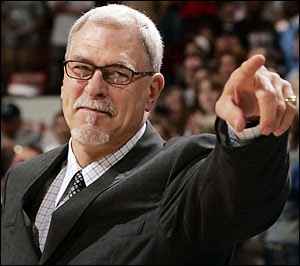
Phil Jackson / "The soul of success is surrendering to what is."

For the past two weeks, my bedtime reading has been Eleven Rings: The Soul of Success by Phil Jackson, written with Hugh Delehanty, that was published earlier this year. It is one of those books that's been a truly wonderful read. It's hard to set it down and I don't want it to end. The book is as much a primer for getting in the mood for the upcoming professional basketball season that starts later this month as it is a memoir with candid insights into the alchemy of leadership.

At more than 300 pages, there's plenty to absorb in Eleven Rings: The Soul of Success, and Jackson quotes from the Grateful Dead, William James, Thelonius Monk, Abraham Maslow and Lao-Tzu, among many. The book reflects Jackson's polymathy.

"In the space of a page, he toggles from psychotherapy to Native American customs to Christianity to Buddhism and back to 'two recent studies published in the Journal of Experimental Social Psychology'," the New York Times wrote in its review of Eleven Rings.

As those of you who follow American professional basketball know, Jackson enjoyed a storied career as head coach of the NBA's Chicago Bulls (1989-98) and the Los Angeles Lakers (1999-2004, 2005-11), and he won more championships -- eleven -- than any coach in the history of professional sports. Delehanty is a former editor for Sports Illustrated, who previously co-authored Jackson's best-selling memoir Sacred Hoops.

Jackson, who grew up the son of Pentecostal preachers in North Dakota, learned the secrets of mindfulness and team chemistry during his playing career with the New York Knicks in the 1970s. Later, as a coach for the Bulls, he managed arguably the greatest basketball player in the world, Michael Jordan, and as coach of the Lakers, Jackson is credited with turning Kobe Bryant into a mature leader of a championship team.

"When you play the game the right
way, it makes sense to the players
and winning is the likely outcome."
~ Phil Jackson
It was in his "quest to reinvent himself," that Jackson became an explorer, learning about humanistic psychology, Native American philosophy and Zen meditation. His approach to leadership was based upon "freedom, authenticity, and selfless teamwork that turned the hyper-competitive world of professional sports on its head." He is not afraid to quote from various religions' holy scriptures.

In teaching his players an abbreviated version of mindfulness meditation that's based on the Zen practice, Jackson writes: "I was interested in getting them to take a more mindful approach to the game and to their relationships with one another. At its heart, mindfulness is about being present in the moment as much as possible, not weighed down by thoughts of the past or the future."

On winning and losing, Jackson writes: "When you play the game the right way, it makes sense to the players and winning is the likely outcome."

"But there's another kind of faith that's even more important," he adds. "The faith that we're all connected on some level that surpasses understanding. That's why I have players sit together in silence. Sitting silently in a group without any distractions can make people resonate with one another in profound ways. As Friedrich Nietzsche said, 'Invisible threads are the strongest ties'."

At the beginning of each chapter, Jackson shares a quote that illustrates the theme of his message. For instance:

Life is a journey. Time is a river. The door is ajar.
~ Jim Butcher

The greatest carver does the least cutting.
~ Lao-Tzu

The privilege of a lifetime is being who you are.
~ Joseph Campbell

Think lightly of yourself and think deeply of the world.
~ Miyamoto Musashi

In the end, Jackson shares this thought:

"Buddhist sages say that there's only a 'tenth of an inch of difference' between heaven and earth. And I think the same can be said about basketball. Winning a championship is a delicate balancing act, and there's only so much you can accomplish by exerting your will. As a leader your job is to do everything in your power to create the perfect conditions for success by benching your ego and inspiring your team to play the game the right way. But at some point, you need to let go and turn yourself over to the basketball gods.

"The soul of success is surrendering to what is."

One thing that Eleven Rings shows us -- and you don't have to be a fan of basketball or sports to appreciate it -- is this: When it comes to the most important lessons in life, we still have much to learn.

Photos of Phil Jackson and of the cover of Eleven Rings: The Soul of Success courtesy of Google images.

Tuesday, February 26, 2013

Teaching her children well: The remarkable life of Fawzia Koofi and her fight for a better future


Fawzia Koofi / The Favored Daughter

"As you grow older you will learn about loyalty," writes Fawzia Koofi in her courageous memoir The Favored Daughter: One Woman's Fight to Lead Afghanistan into the Future. In a letter to her daughters, Shurha and Shaharzad, that precedes the chapter entitled "The War Within," Koofi says: "Loyalty to your faith, to family, to friends, to your neighbors, and to your country. In times of war our loyalty can be sorely tested."

Indeed, these are challenging times for everyone throughout much of the world. For some of us, our homelands are facing political upheavals, while others are battling through the economic reality of uncertainty. 

Our loyalty is being tested every day.

In Afghanistan, one of the world's poorest and most volatile countries, Koofi, 38, who is her country's first female Parliament Speaker and a noted activist for women's and children's rights, is currently a leading candidate for the 2014 presidential elections. Mind you, in a country where women have been struggling for generations just to achieve gender equality, a woman has never been elected president of Afghanistan.

Recently, Koofi appeared on The Daily Show with Jon Stewart and spoke at Harvard Law School as part of a visit to the U.S. to drum up support for her candidacy as well as to promote her book. Immediately, after seeing Koofi's interview with Jon Stewart, I went online to put a hold on her book, and checked it out from my local public library by the weekend.

Since obtaining a copy of Koofi's book, I have not been able to put it down. It has been my reading companion at home and at work, even at the gym. It is both a highly fascinating and riveting read. And, I highly encourage anyone wanting to learn more about her life's journey ~ from being rejected at birth and left for death to becoming an author and a presidential candidate ~ or what life in Afghanistan is really like, as seen through this remarkable woman's eyes, should read Koofi's book.

In a review of The Favored Daughter: One Woman's Fight to Lead Afghanistan into the Future, which Koofi wrote with Nadene Ghouri, an award-winning journalist and former Al Jazeera and BBC broadcaster, the Kirkus Reviews wrote: "An affecting inside look at the making of an Afghan woman leader, in spite of the repression by traditional Islamic society and the Taliban ... With moving letters to her daughters opening each chapter, Koofi delivers an important message."

The Globe and Mail wrote: "A powerful and moving book, not just for Koofi's daughters, but for all the daughters of the world."

Indeed, Koofi's message is an important one that needs to be shared and passed along from one generation to the next. And while her letters to her two teenage daughters focus on life in Afghanistan, I think it is a message that is germane to us all no matter where in the world we reside, and it's one we can all appreciate reading and learning from.

Koofi continues in her letter to her daughters about the importance of loyalty: 
"You must be loyal to the true and good nature of your Islamic faith, helping and loving those around you even when you might feel you cannot.
 "It is important to be loyal to your family, both those alive and dead. Our bonds of family do not cease at the grave, but we must also be careful not to remember the dead at the expense of the living.
"You must be loyal to your friends, because it is the action of a true friend. And if they are true friends then they will also be loyal to you, and ready to act when you need their help.
"You must be loyal to your fellow Afghans. There are many of us and we are not all the same. But you must be able to see past those ethnic and cultural differences and remember the thing that unites us together ~ Afghanistan.
"And you must be loyal to your country. Without loyalty to our country we have nothing as a nation. We must work hard and wisely to improve our country for your children and their children."
Loyalty can be a hard lesson to learn sometimes, as Koofi has reminded us. Yet, there are few lessons more valuable.

Tuesday, November 6, 2012

Moving forward: Fired up, ready to go!


Barack Obama / One voice can change the world.

"One voice can change a room. And if it can change a room, it can change a city. And if it can change a city, it can change a state. And if it can change a state, it can change a nation. And if it can change a nation, it can change the world."

~ President Barack Obama, from his final 2012 campaign speech in Des Moines, Iowa, on Monday night, November 5, 2012

I woke up this morning on our nation's Election Day feeling hopeful and inspired. Fired up, ready to go!

I voted ~ and, I've been encouraging all of my friends through social media via Facebook of the importance to get out and perform their civic duty and to vote their conscience today. Using our voice to speak out by exercising the right to vote is one of great tenets of our American democratic society.

This is an important Presidential election for the future of our country and it has Americans engaged for many different reasons. And, it has also caught the attention of my Facebook friends in Europe, Asia and North Africa, who are keenly following today's election outcome with hope and patience for a brighter future.

I am supporting the re-election of our President, Barack Obama, because he best represents what I support: Equal rights for women, children, minorities, and gays and lesbians; a strong and improving economy; sound environmental protection; and an end to the foreign wars our troops are currently engaged in. I believe President Obama's vision for America provides our country with the best hope for its future.

I'm fired up and ready to move forward. I hope everyone will join me. Our work is not done.

Indeed, one voice can change the world.

Image of Barack and Michelle Obama courtesy of Barack Obama official Facebook page.