Showing posts with label leader. Show all posts

Tuesday, August 12, 2014

A tremendous challenge, a tremendous responsibility


Becky Hammon / "There have been so many other women that are doing
really, really great things, and I'm just kind of following in their paths."

Last week, the San Antonio Spurs showed why they're trailblazers in American professional basketball by announcing they've hired six-time WNBA All-Star point guard Becky Hammon as the first full-time, paid female assistant on an NBA coaching staff.

The reigning champion Spurs have been innovative, outside-the-box leaders in bringing in internationally-talented players for the past two decades -- France's Tony Parker, Argentina's Manu Ginobili and Australia's Patty Mills come to mind -- and, earlier this summer, hired European coach Ettore Messina to join head coach Gregg Popovich's staff. So, it was not surprising that fresh off winning their fifth NBA championship, the Spurs would add to their history of forward-thinking moves by hiring Hammon. 

Becky Hammon / She's a trailblazer on court.
Now, she's a joining the San Antonio Spurs as 

the NBA's first full-time female assistant coach.
At age 37, the 5-foot-6 Hammon is retiring this month from a 16-season playing career in the WNBA in which she ranks fourth in career assists and seventh in points scored. The South Dakota native starred collegiately at Colorado State where she was a three-time All-American point guard, then became a naturalized Russian citizen in 2008 and represented the Russian national team in the 2008 and 2012 Olympics. She becomes the second woman to serve on an NBA coaching staff -- the first was Lisa Boyer, who was a part-time, non-paid member of the Cleveland Cavaliers staff in the 2001-02 season -- but the first who has been hired to a full-time, paid position.

"It's a tremendous challenge, and it comes with tremendous responsibility," said Hammon. "There have been so many other women that are doing really, really great things, and I'm just kind of following in their paths."

During the 2013-14 season, not only did Hammon attend Spurs practices, coaching meetings and film-review sessions, she also sat behind the bench for the NBA champions during home games while coming off a knee injury.

"I very much look forward to the addition of Becky Hammon to our staff," said Poppovich. "Having observed her working with our team this past season, I'm confident her basketball IQ, work ethic and interpersonal skills will be a great benefit to the Spurs."

Hammon said it was made clear to her by Poppovich that her hiring was strictly related to her qualifications in basketball. "He says, 'It just so happens you're a woman,'" said Hammon during a press conference.

In an interview with Jeré Longman of The New York Times, Hammon "called her role as a pioneer 'a tremendous honor.' But, she added of Popovich: 'Honestly, I don't think he gives two cents that I'm a woman. And I don't want to be hired because I'm a woman.' The important point, Hammon said, was 'I'm getting hired because I'm capable.'"

Another basketball trialblazer, Nancy Lieberman, who is the assistant general manager of the Texas Legends, the NBA Development League affiliate of the Dallas Mavericks, told The New York Times that Hammon's hiring "was a crucial step for the NBA and for women.

"First and foremost, this means respect," said Lieberman. "She did not get hired just because she is a woman. She was hired because she was qualified, because they know her personality, how she interacts with players, how she understands X's and O's."

"I think it's no surprise to anybody that they think a little bit different down here," said Hammon of the Spurs. Indeed, and as espnW columnist Kate Fagan wrote: "A very high, very thick glass wall cracked.

"Realistically, the league had no model in place for hiring a female coach; a team neded to be the first, to prove it could work. And it makes sense that San Antonio, the reigning NBA champs, a franchise that has always marched very effectively to the beat of its own drum, has stepped forward and done just that."

Other media reaction has largely been positive. San Francisco Chronicle sports columnist Ann Killion wrote: "The Spurs are an organization that doesn't need fake publicity or splashy headlines. Hammon wasn't hired for looks or her Nike endorsement or her name; name many people outside hard-core WNBA fans and former Colorado State fans even know who she is.

"She was hired by the best head coach in the league. Gregg Popovich is a man who doesn't suffer fools, media, phoniness or distractions gladly. He hired Hammon because he thought she would do a good job. Period."

Killion's colleague at the San Francisco Chronicle, NBA columnist Bruce Jenkins, said of Hammon: "She could not be more ready to become the first female assistant on an NBA bench."

In his New York Times story, Longman noted that around the NBA, Hammon's hiring "has been met with wide congratulations. 'Very bright basketball mind,' Kobe Bryant posted on Twitter."

Even President Obama took time out to congratulate Hammon. The White House tweeted: "Congrats to @BeckyHammon, @NBA's first full-time female coach. When #WomenSucceed, America succeeds -- and we know the @Spurs will, too. -bo"

While naysayers might think of the Spurs hiring of Hammon as a publicity stunt, I don't. It's obvious that her hiring came after extensive research and interviews, and that the rest of the Spurs' staff would be amenable to what Jenkins labeled as Popovich's "brave new world."

Hopefully, Hammon's hire will open doors for other female coaches and prove there shouldn't be gender barriers anywhere. Kudos to the San Antonio Spurs. After all, they're a team that's ahead of the NBA in a league that's ahead of the game when it comes to racial and gender inclusiveness.

Photos: Courtesy of NBA.com and WNBA.com.

Tuesday, December 10, 2013

Remembering Mabida: He was a universal symbol of tolerance and hope


"I learned that courage was not the absence of fear, but the triumph over it. The brave man is not he who does not feel afraid, but he who conquers that fear."  Nelson Mandela


Nelson Mandela, 1918-2013.

We were all saddened by the news of the passing of Nelson Mandela, South Africa's first black president and an icon of peaceful resistance.

Mr. Mandela died at his home in the Johannesburg suburb of Houghton on Thursday night at age 95. News of his death spread quickly around the world through cable news networks like CNN, in social media such as Facebook and via the internet, and in the days since, there's been no shortage or tumult of remembrances. Mr. Mandela has been memorialized as an icon, a radical, a leader and a luminary.

Beloved by all, Mr. Mandela was a universal symbol of tolerance and hope, a man of great heart and compassion. Following his release prison after 27 years of incarceration, Mr. Mandela led South Africa through emancipation from white minority rule and he won the Nobel Peace Prize in 1993.

"Mr. Mandela's quest for freedom took him from the court of tribal royalty to the liberation underground to a prison rock quarry to the presidential suite of Africa's richest country," wrote The New York Times"And then, when his first term of office was up, unlike so many of the successful revolutionaries he regarded as kindred spirits, he declined a second term and cheerfully handed over power to an elected successor, the country still gnawed by crime, poverty, corruption and disease but a democracy, respected in the word and remarkably at peace."

In announcing Mr. Mandela's death to an entire nation, President Jacob Zuma of South Africa said: "Our nation has lost its greatest son. Our 
people have lost a father. His tireless struggle for freedom earned him the respect of the world. His humility, his compassion and his humanity earned him their love.

Regardless of our race, nationality or country of residence, Mr. Mandela will be remembered by many as the "world's kindly white-haired grandfather." His last public appearance was in 2010, when South Africa hosted football's World Cup.

World leaders across several continents were united in their praise of Mr. Mandela and their tributes were filled with superlatives.

• "A giant among men has passed away. This is as much India's loss as South Africa's." — Prime Minister Manmohan Singh, India.

• "A great light has gone out in the world. Nelson Mandela was a hero of our time." — Prime Minister David Cameron, Britain.

• "All of Canada mourns with the family of Nelson Mandela and the citizens of South Africa. The world has lost one of its great moral leaders." — Prime Minister Stephen Harper.


• "Today we say goodbye to a man who brought hope, a true hero who will continue to inspire us." — Prime Minister Elio Di Rupo, Belgium.

Here in the U.S., President Barack Obama reflected on Mr. Mandela's life by praising him as a man of courage and compassion. "Let us pause and give thanks for the fact that Nelson Mandela lived — a man who took history in his hands and bent the arc of the moral universe toward justice."

And, former U.S. President Bill Clinton noted that history will remember Mr. Mandela as a champion for human dignity and freedom, for peace and reconciliation. "All of us are living in a better world because of the life Madiba lived. He proved that there is a freedom in forgiving, that a big heart is better than a closed mind, and that life's real victories must be shared."

To have an understanding of Mr. Mandela's religious, spiritual and humanist worldview, one need only look to his 1994 autobiography Long Walk to Freedom, which profiled his early life, coming of age, education and 27 years in prison.

"The story told by Mandela's life is not one of infallible human beings and inevitable triumph. It is the story of a man who was willing to risk his own life for what he believed in, and who worked hard to lead the kind of life that would make the world a better place," said Mr. Obama.

Mr. Mandela was also praised by leaders of the religious community, including Archbishop Desmond Tutu, who like Mr. Mandela was a Nobel laureate and a towering figure in South Africa's struggle against apartheid. He said that Mr. Mandela "embodied our hopes and dreams, symbolized our enormous potential."

At the Vatican, Pope Francis praised "the steadfast commitment shown by Nelson Mandela in promoting the human dignity of all the nation's citizens."

In San Francisco, the Very Rev. Dr. Jane Shaw, Dean of Grace Cathedral, said that "it is appropriate to take a moment to thank God for his example and the profound influence for peace he life has had. ... We celebrate his life and will continue in his example to fight against institutionalized racism, poverty and inequality."

Praise also came from the streets from fellow South African citizens like Shadrack Motau, who accompanied Mr. Mandela on a tour of his Soweto neighborhood after his release from prison. He told The New York Times: "The man had so much humility. He treated everyone with respect and dignity, from statesmen to children."

By all accounts, Mr. Mandela loved being in the company of children. He spoke often of the importance that education played with shaping the world's youth. "Young people must take it upon themselves to ensure that they receive the highest education possible so that they can represent us well in the future as future leaders."

Those old enough to remember the struggle against apartheid have flocked for days to Mr. Mandela's home to pay tribute to South Africa's departed leader through means of joyful noise. 

"We should, while mourning, also sing at the top of our voices, dance and do whatever we want to do, to celebrate the life of this outstanding revolutionary who kept the spirit of freedom alive and led us to a new society," South African president Zuma said in a statement over the weekend. "As South Africans, we sing when we are happy, and we also sing when we are sad to make ourselves feel better. 

"Let us celebrate Madiba in this way, which we know best," Mr. Zuma added, referring to Mr. Mandela by his widely used clan name. "Let us sing for Madiba."

On Tuesday, in rain-soaked Soweto townshipPresident Obama, U.N. Secretary General Ban Ki-moon and some of Mandela's grandchildren were among those who spoke during a four-hour memorial service honoring Mr. Mandela, held in the 95,000-capacity FNB Stadium (built for the 2010 World Cup) and attended by more than 100 heads of state and other dignitaries and celebrities. 

"It took a man like Madiba to free not just the prisoner, but the jailer as well; to show that you must trust others so that they may trust you; to teach that reconciliation is not a matter of ignoring a cruel past, but a means of confronting it with inclusion and generosity and truth," Mr. Obama said in a stirring eulogy. "He changed laws, but he also changed hearts."

Worth reading for its comprehensive look at the life of Mr. Mandela is the 6,500-word obit which appeared in The New York Times on Friday. It was written by the paper's former executive editor Bill Keller, who in the 1990s was its Johannesburg bureau chief. The obit was eight years in the making and it included comments from a 2007 interview Keller conducted with Mr. Mandela.

Across a wide spectrum, many have shared their thoughts about Mr. Mandela's passing. Here are a few worth sharing:

• The Rev. Al Sharpton shared the sentiment of many, not only in my country but throughout the world, when he commented on MSNBC in the first hour after the announcement of Mr. Mandela's death: "We've lost one of the world's great citizens." 

• Muhammad Ali, generally considered among the greatest heavyweight boxers in the world  a sport which Mr. Mandela participated in his youth  said in a statement: "He taught us forgiveness on a grand scale. His was a spirit born free, destined to soar above the rainbows. Today his spirit is soaring through the heavens. He is now forever free."

• The American poet Maya Angelou, who unveiled a tribute poem to Mr. Mandela, shared her thoughts about his impact on the world with CBS News, saying: "He showed us how liberating it is to forgive."

• CNN's Christiane Amanpour, who is no stranger to reporting about world leaders, put things into perspective when she said: "Nelson Mandela was the towering moral giant of the 20th and 21st centuries. We will not see the likes of Madiba again for a long, long time."

• Finally, Kofi Annan, who is the chair of The Elders and chairman of the Kofi Annan Foundation and from 1997-2006 served as the secretary-general of the United Nations, wrote in a Financial Times commentary: "Almost 20 years ago, Mandela said South Africa had come as far as it had on the path to peace and democracy only because the world had set his country 'a moral example which we had dared to follow.' As we mourn his passing and honour his memory, the task for leaders and citizens alike is to dare to follow his example  in every corner of Africa and across the world."

Photograph of Nelson Mandela courtesy of Google Images, 2013.

Tuesday, October 1, 2013

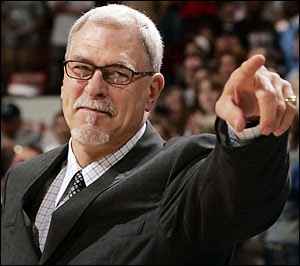
On 'Eleven Rings: The Soul of Success'


Phil Jackson / "The soul of success is surrendering to what is."

For the past two weeks, my bedtime reading has been Eleven Rings: The Soul of Success by Phil Jackson, written with Hugh Delehanty, that was published earlier this year. It is one of those books that's been a truly wonderful read. It's hard to set it down and I don't want it to end. The book is as much a primer for getting in the mood for the upcoming professional basketball season that starts later this month as it is a memoir with candid insights into the alchemy of leadership.

At more than 300 pages, there's plenty to absorb in Eleven Rings: The Soul of Success, and Jackson quotes from the Grateful Dead, William James, Thelonius Monk, Abraham Maslow and Lao-Tzu, among many. The book reflects Jackson's polymathy.

"In the space of a page, he toggles from psychotherapy to Native American customs to Christianity to Buddhism and back to 'two recent studies published in the Journal of Experimental Social Psychology'," the New York Times wrote in its review of Eleven Rings.

As those of you who follow American professional basketball know, Jackson enjoyed a storied career as head coach of the NBA's Chicago Bulls (1989-98) and the Los Angeles Lakers (1999-2004, 2005-11), and he won more championships -- eleven -- than any coach in the history of professional sports. Delehanty is a former editor for Sports Illustrated, who previously co-authored Jackson's best-selling memoir Sacred Hoops.

Jackson, who grew up the son of Pentecostal preachers in North Dakota, learned the secrets of mindfulness and team chemistry during his playing career with the New York Knicks in the 1970s. Later, as a coach for the Bulls, he managed arguably the greatest basketball player in the world, Michael Jordan, and as coach of the Lakers, Jackson is credited with turning Kobe Bryant into a mature leader of a championship team.

"When you play the game the right
way, it makes sense to the players
and winning is the likely outcome."
~ Phil Jackson
It was in his "quest to reinvent himself," that Jackson became an explorer, learning about humanistic psychology, Native American philosophy and Zen meditation. His approach to leadership was based upon "freedom, authenticity, and selfless teamwork that turned the hyper-competitive world of professional sports on its head." He is not afraid to quote from various religions' holy scriptures.

In teaching his players an abbreviated version of mindfulness meditation that's based on the Zen practice, Jackson writes: "I was interested in getting them to take a more mindful approach to the game and to their relationships with one another. At its heart, mindfulness is about being present in the moment as much as possible, not weighed down by thoughts of the past or the future."

On winning and losing, Jackson writes: "When you play the game the right way, it makes sense to the players and winning is the likely outcome."

"But there's another kind of faith that's even more important," he adds. "The faith that we're all connected on some level that surpasses understanding. That's why I have players sit together in silence. Sitting silently in a group without any distractions can make people resonate with one another in profound ways. As Friedrich Nietzsche said, 'Invisible threads are the strongest ties'."

At the beginning of each chapter, Jackson shares a quote that illustrates the theme of his message. For instance:

Life is a journey. Time is a river. The door is ajar.
~ Jim Butcher

The greatest carver does the least cutting.
~ Lao-Tzu

The privilege of a lifetime is being who you are.
~ Joseph Campbell

Think lightly of yourself and think deeply of the world.
~ Miyamoto Musashi

In the end, Jackson shares this thought:

"Buddhist sages say that there's only a 'tenth of an inch of difference' between heaven and earth. And I think the same can be said about basketball. Winning a championship is a delicate balancing act, and there's only so much you can accomplish by exerting your will. As a leader your job is to do everything in your power to create the perfect conditions for success by benching your ego and inspiring your team to play the game the right way. But at some point, you need to let go and turn yourself over to the basketball gods.

"The soul of success is surrendering to what is."

One thing that Eleven Rings shows us -- and you don't have to be a fan of basketball or sports to appreciate it -- is this: When it comes to the most important lessons in life, we still have much to learn.

Photos of Phil Jackson and of the cover of Eleven Rings: The Soul of Success courtesy of Google images.