Showing posts with label winning. Show all posts

Tuesday, July 16, 2019

On Wimbledon: Gentlemen’s final was like none before it


Throughout the gentlemen’s singles final at the Wimbledon Championships Sunday, the margins were so small, the tension and excitement of a five-hour classic so great. It didn’t matter who won or lost. Novak Djokovic and Roger Federer entertained the world their excellence, in which the winner saved two match points and the outcome was decided in a first-of-its-kind tiebreaker.

The No. 1 seed Djokovic, 32, captured his fifth Wimbledon crown and his 16th Grand Slam title overall, outlasting the 37-year-old Federer 7-6 (5), 1-6, 7-6 (4), 4-6, 13-12 (3). The fifth set, alone, which was decided by a 12-games-all seven-point tie break, lasted two hours.

For much of the match, it was Federer who seemed to be the better player on Centre Court. But in the end, although he was on top of most of the statistical categories – which one Twitter pundit likened to winning the policy debates and popular vote in a U.S. presidential election, but ultimately losing to the Electoral College count – statistics didn’t count for a thing.

The latest Djokovic-Federer clash had something for everyone. It was tense, it was brilliant, it was bold, it was baffling, it had star power. It had royalty, movie stars, dot.com titans and Hall of Famers watching from the Royal Box. At times, Federer’s wife, Mirka, could be seen – picked up by the BBC cameras – with her head buried in her hands, too nervous and unable to look up at the action down on the court. Other times, Djokovic’s mother, Dijana, was shown clutching a religious pendant with both hands, perhaps, seeking divine intervention. Interspersed, there was plenty of superior, high-quality play displayed by both superstars. Each took time looking for weaknesses in each other’s game. There was much creative shotmaking throughout by both Federer and Djokovic to appreciate. Long, back-and-forth rallies were plentiful and not uncommon.

At times, both played like they were the best player in the world. Djokovic is the current No. 1 and Federer is a longtime former No. 1, who is currently ranked third. In losing, Federer came close to winning. In the fifth set, he had two championship points on his racquet, serving for the match at 8-7, 40-15, and was unable to convert either of them into his ninth Wimbledon singles championship, which would have tied him with Hall of Famer Martina Navratilova. He won 36 games during the match to 32 for Djokovic. He hit 94 winners compared to 54 for Djokovic. He hit more aces, 25-10, converted seven of 13 break point chances and, more often than not, controlled many of the points until he didn’t.


When he was asked during his post-match interview session what went wrong at the critical point of the championship match, Federer said simply, “One shot I guess. Don’t know which one to pick. Your choice.”

However, in the tightest moments of the match – the three tie-break deciders that came in the first, third and fifth sets – Djokovic reigned supreme. He proved more mentally fit and physically tougher. Meanwhile, Federer made some questionable decisions in each of the tie breaks, and each time, they came back to haunt him.

“I thought most of the match I was on the back foot,” Djokovic said during his news conference about beating Federer for the third time in a Wimbledon final. “I was defending. He was dictating the play. I just tried to fight and find a way when it mattered the most, which is what happened.”

In the end, on Djokovic’s championship point, Federer shanked a return high into the air – and it cost him dearly. The native of Belgrade, Serbia won the match and his fifth Wimbledon crown, not because he was necessarily the best player on Centre Court Sunday. Instead, Djokovic played the best when he needed to the most.

Roger Federer / Post-match news conference
Reflecting on what might have been, Federer said, “I just feel like it’s such an incredible opportunity missed, I can’t believe it.”

Federer was asked how his latest Grand Slam setback at Wimbledon compared to his epic 2008 loss to Rafael Nadal. “This one is more straightforward maybe in some ways because we didn’t have the rain delays, we didn’t have the night coming in and all that stuff,” he recalled. “But sure, epic ending, so close, so many moments. I mean, sure there’s similarities. But you’ve got to go dig, see what they are. I’m the loser both times, so that’s the only similarity I see.”

And what did Djokovic think of winning his 16th career major after being on the brink of defeat? “It was kind of a flashback,” he said, remembering that he saved two match points against Federer in the semifinals at the U.S. Open in both 2010 and 2011. “But look, in those kind of moments, I just try to never lose self-belief, just stay calm, just focus on trying to get the ball back, return, which wasn’t serving me very well today.”

Djokovic called his latest classic encounter with Federer, which was his fifth straight win over the Swiss star and fifth straight in Grand Slam play, “the most mentally demanding match” of his career. While he said that his nearly-six hour 2012 Australian Open final against Nadal was “the most physically demanding match” he’s ever played, against Federer Sunday, “mentally this was a different level because of everything.

“You need to be constantly playing well throughout five hours if you want to win a match like this. I guess there is an endurance part. But I think there is always this self-belief. You have to keep reminding yourself that you’re there for a reason and that you are better than the other guy.”

Photos: Courtesy of Wimbledon.com. Video: Courtesy of Wimbledon Twitter.

Sunday, March 4, 2018

A Winter Olympic memory that brought joy and heartbreak

Russian silver medalist Evgenia Medvedeva /
She created brilliant figure skating moments.
Over two weeks and three weekends, the PyeongChang Winter Olympics filled our hearts and television screens with lots of excitement. For my wife and I, much of it took place on the Olympic figure skating ice.

Sometimes, it was colorful and loud, oftentimes it was elegant. There were plenty of thrills and excitement, just a few spills and disappointments, but enough flash and panache to make it all seem worthwhile.

Because of the 14-hour time difference between South Korea and the U.S. east coast, we tuned in to watch figure skating following our nightly dinner – and, occasionally, it kept us awake past our bedtime. Sometimes, we watched online. Because we cared, learning about the human side of many of the Olympic figure skaters competing as well as about the sport's history was a real treat.

During the final two nights of figure skating last week, after the excitement of the team, men's and ice dance competitions, we had the noblest pleasure of watching the 18-year-old Russian Evgenia Medvedeva make her Olympic individual debut in the ladies' singles event. Performing to "Nocturne" by Frederic Chopin, Medvedeva performed her short program, which included a triple flip/triple toe loop combo, triple loop and double Axel, flawlessly. Her score of 81.61 points placed her second behind her Russian teammate Alina Zagitova, who scored 82.92.

Medvedeva's skating maturity and artistic presentation were well beyond her years. From watching her skate and in listening to the comments expressed by the NBC figure skating commentators, it gave us a joy of understanding Medvedeva, both as an athlete and as an individual. Among the things we learned about her: Medvedeva likes studying foreign languages, enjoys drawing, is fond of listening to music (such as K-pop), and loves Japanese culture (such as anime). She may skate like an adult, but she's a kid at heart – and that's the beauty and joy of it all.

Two days after skating her short program, Medvedeva returned to the Olympic ice. She was the last of 24 skaters to present her long program, which decided the gold medal – and was won by Zagitova by the slimmest of margins, 239.57 to 238.26. Medvedeva, skated as Tolstoy's tragic "Anna Karenina" with music composed by Dario Marianelli. 

As she skated, we rooted for Medvedeva, a two-time world champion and consensus favorite to win the gold before she broke a bone in her right foot last fall. As The New York Times wrote, "Medvedeva was forced to confront a sobering reality on Friday at age 18: Experience and artistry and expressiveness did not prevail over mathematics."

Before her final performance, Medvedeva said, "I'm not chasing numbers, I'm chasing feelings."

There was a beautiful, athletic bounce to Medvedeva's skating, a lovely expression on her face throughout her four-minute free skate to a classic Russian story. Medvedeva was Anna Karenina – and she gave it her all. She was mentally tough and she skated brilliantly. It was a perfect, balanced and mistake-free performance – Medvedeva didn't do anything wrong – even if it didn't earn her the gold medal.

What a way to win if you're Zagitova. What a way to lose if you're Medvedeva – even if losing means winning the silver medal.

Evgenia Medvedeva and Alina Zagitova.
Indeed at age 15, Zagitova became the second-youngest women's skater to win the Olympic gold medal. With shrewd design and stamina, precision jumping and a sense of "youthful certainty," Zagitova landed all 11 of her jumps in the second half of her balletic "Don Quixote" free skate long program, compared to eight for Medvedeva. As The New York Times explained: "This is known as back loading, and is meant to gobble up a 10 percent bonus awarded for each jump beyond the halfway point of a routine, as skaters' legs begin to tire." 

Skating with calm and endurance, Zagitova's strategy – which was within the rules even if it broke the spirit of them – worked to her advantage, even if it wasn't as emotional and captivating as Medvedeva's long program.

The two Russian figure skaters each scored 156.65 in the free skate and Medvedeva was ranked first ahead of Zagitova. Looking back, Medvedeva's technical elements included: a triple flip/triple toe loop combo, a triple Lutz, a triple flip, a triple loop, a double Axel/double toe loop/double toe loop combo, a triple Salchow/triple toe loop combo and a double Axel. Her interpretation of her music was superb. 

"If most skaters skate with their brains," said NBC figure skating analyst Johnny Weir, as he watched Medvedeva perform, "Evgenia skates with her entire soul throughout her performance."

At the conclusion of Medvedeva's performance, NBC figure skating commentator Terry Gannon was moved to say, "I don't know if we just watched gold, but we watched greatness."

As it happened, Zagitova's victory was the second consecutive gold medal won by Russian women. Because they operate in a centralized training facility, unlike in the U.S., the top skaters challenge each other on a daily basis in practice. Thus, Zagitova was challenged by her friend and training partner Medvedeva – and it paid off. 

Looking back, as Medvedeva received the plaudits of the appreciative crowd before skating off the ice after to await her adjudication, she shed tears of joy – maybe of relief, too. Despite facing enormous pressure, she skated marvelously – a season-best performance. In our eyes – and many others, too – Medvedeva was a winner. And, yet, she handled her defeat so graciously. 

"She created brilliant moments," said NBC figure skating analyst and 1998 Olympic gold medalist Tara Lapinski in describing what she had just seen Medvedeva perform. "This was one of the best ever competitions."

After receiving her silver medal, Medvedeva had time to reflect. "It's life and it's a lesson," she said. "Every year, every moment, every day, every week, every month, we must become stronger. ... Today, we proved ourselves here."

Photos: Courtesy of Google Images.

Tuesday, January 31, 2017

Federer-Nadal: A welcome respite from American politics

Victorious / Roger Federer kisses the Norman Brookes Challenge Cup
trophy Sunday night after winning the 2017 Australian Open

men's singles championship for his 18th career Grand Slam title.

The Australian Open tennis fortnight down under in Melbourne, which wrapped up over the weekend first with the all-Williams women's final between Serena and Venus (won by Serena) and followed by the renewal of the great men's rivalry between Roger Federer and Rafael Nadal, was a very welcome respite for those of us here in the United States as we came to grips with a narcissistic president, who in his first week in office undermined many fundamental principles that shape our American democracy.

While the talk of Federer's stunning comeback – reaching the AO final after being out six months while recovering from a knee injury that required surgery – Nadal's return from a wrist injury was a welcome one, too. The Federer-Nadal final, which didn't exist on most fan's minds at the beginning of the tournament, left them feeling a bit giddy. Going the distance and playing five sets will do that.

There was a buzz of nostalgia in the air when Federer emerged victorious with a 6-4, 3-6, 6-1, 3-6, 6-3 win that was his 18th career Grand Slam title. The Swiss is the all-time men's leader and Nadal, tied with Pete Sampras, is a distant second with 14.

Nadal said it was a special thing for both him and Federer to be playing together in the final of a Grand Slam, especially after a couple of years of having problems.

"I am a positive person (so) I never say never because I worked very hard to be where I am," Nadal said after his almost-five hour semifinal victory over Grigor Dimitrov that began last Friday night and finished in the wee hours of Saturday morning, a day before the Federer match. "I really have been working very hard. ... I always had the confidence that if I am able to win some matches, then anything can happen."

If President Donald Trump thrives on his own culture of self-inflicted conflict and chaos, Nadal thrives on a raw emotion that's filled with clinched fists and screams of "Vamos!" However, unlike the American reality TV host-turn-populist commander in chief, Nadal possesses many fine and likable qualities. He's a positive person, polite, mannered and respectful on court – even in defeat. These are a few attributes our new president could benefit from learning from Nadal.

With the old guard on the rise Sunday night, the AO final marked the ninth time that the 35-year-old Federer – the oldest male finalist in 43 years – and Nadal, 30, played for a Grand Slam title. Before Sunday, Nadal had won six of the previous eight finals meetings. Remarkably, they had not met for a major championship since the 2011 French Open, in which Nadal won his sixth of nine titles at Roland Garros. Nadal has long dominated his lifetime series against Federer, 23-12. Although if you eliminate matches on clay in which Nadal has a huge edge, the series tally is now even, 10-10.

"Being honest, in these kinds of matches I won a lot of times against him. Today he beat me, and I just congratulate him," Nadal said.

As Sunday night's final neared its conclusion, it became evident while studying the body language and facial expressions of both Federer and Nadal that neither wanted to lose. After all, there's joy in winning. With joy, it makes the suffering during big matches so much the better – especially ones that go five sets. Federer went the distance in each of his final three AO matches, Nadal in his last two. In victory or defeat, Nadal always shows an indomitable spirit – and it was on display again for the Rod Laver Arena crowd and a worldwide TV audience to enjoy when he and the always gracious Federer, who are friends off the court and foes on it, met for the 35th time in their storied careers.

Federer was thrilled to be back in the spotlight of another Grand Slam final. "Yeah. It's real now," he said. ... "I never ever in my wildest dreams thought I'd come this far in Australia. But here I am.

"Against Rafa it's always epic. This one means a lot to me because he's caused me problems over the years."

When match point was decided by a replay review that was upheld, Federer pumped his arms above his head and leapt up and down with much delight. Both happy and relieved, emotions poured out of Federer. He admitted afterward that it was an awkward way to win.

"I'm out of words, said Federer, as he addressed Nadal during an on-court interview while clutching the champion's trophy. "I don't think either of us believed we'd be in the final here when we were at your academy five, six months ago. Here we stand in the finals.

"I'm happy for you. I would have been happy to lose to you. The comeback was perfect as it was. It's been a difficult last six months, let's be honest. I wasn't sure I was going to be here, but here I am. This was a wonderful run, and I can't be more happy to win tonight."

Photo: Courtesy of Google Images.

Tuesday, December 23, 2014

A Kerr-ific start for a first-time head coach


Steve Kerr / "I'm the luckiest coach in NBA history..."

Two months into the new pro basketball season, the Golden State Warriors have been the darlings of the National Basketball Association. Nightly, the "Splash Brothers" duo of Stephen Curry and Klay Thompson are providing a highly-entertaining -- and potent -- 1-2 scoring punch in the back court. The "Dubs" achieved a franchise best 16-game winning streak, going five weeks without losing a game.

One of the reasons for the Warriors' new-found success is simple: they have one of the brightest minds in the game in their new head coach, Steve Kerr. He's off to the hottest start of any first-year NBA head coach with a 23-3 record, the best record in the league. He's coached the Warriors to an impressive 10-1 record at home, including a 128-108 victory over the Sacramento Kings on Monday night, and they're 13-2 on the road.

"I'm the luckiest coach in NBA history because I inherited a team that was already this good," Kerr recently told the San Jose Mercury-News.

Before the start of the season, I had the opportunity to meet and talk with Kerr far away from Oracle Arena, where the Warriors regularly sell out their home games. Our paths crossed following a couple of University of California, Berkeley women's volleyball matches, where his daughter Maddy excels as the team's libero. It was back in September during the first week of basketball practice, long before anyone could imagine Kerr's good fortune as a first-time coach.

My first impressions of Kerr were positive. Although our first chat was brief and mostly introductory, he was very gracious with his time and took a genuine interest in getting to know me and my wife. His role on this night was that of a college volleyball parent -- not an NBA head coach. He came dressed the part of a parent, too -- wearing chino slacks, a long-sleeved t-shirt and casual sneakers.

The second time we chatted occurred a few weeks after our first meeting. I wanted to ask Kerr, an avid reader and learner, about his reading interests and he eagerly shared with me that during the summer he read a 600-page biography about one of his basketball idols, legendary UCLA head coach John Wooden. I sensed from our brief conversation that Kerr, 49, wished he could have been old enough to play for Wooden. As someone who is a few years older, I remember the UCLA glory years as a kid growing up in southern California. I believe Kerr would have fit in well, both as a good team player and as an eager student of the game.

Even though Kerr wasn't old enough to play for Wooden, the Wizard of Westwood, he was well schooled, learning valuable tools of basketball wisdom from Lute Olson during his collegiate days at Arizona. Then, as a pro, he was mentored by the two of the best: Phil Jackson in Chicago and Greg Popovich in San Antonio. Kerr is a five-time NBA champion, having won three titles with the the Bulls, alongside Michael Jordan, and two with the Spurs, where his teammates included Tim Duncan, Manu Ginobili and Tony Parker. As a broadcaster following his 15-year playing career, Kerr teamed with one of basketball's best in Marv Albert, and he applied his skills learned as player towards becoming a knowledgable and good-humored analyst.

After reading Eleven Rings, in which Jackson chronicled the 11 NBA titles he won coaching the Chicago Bulls and Los Angeles Lakers, I was intrigued to find out what books Kerr was given to read by his coach during his playing days with the Chicago Bulls. Jackson was legendary for assigning books to his players to keep them engaged during road trips. Kerr said the most memorable one he received from the Zen Master was the novel All The Pretty Horses by American author Cormac McCarthy.

"I want to keep stimulating my mind and keep fresh things coming in," Kerr told the San Francisco Chronicle. It's one reason why his staff regularly brings him articles of a non-basketball nature for him to read, and Kerr enjoys doing things away from the basketball court like watching his daughter's volleyball matches.

Here's what I've learned from observing Kerr: He's a very affable, down-to-earth guy who blends in easily with other Cal volleyball parents and, while sitting high up in Haas Pavilion out of the spotlight -- he graciously takes time to greet fans who approach him and willingly poses for photos -- always smiling. He's humble while also being likable, and both on and off the court, he's a credible communicator.

After I introduced myself as a long-time fan of Cal volleyball and complemented him on behalf of Maddy's gutsy on-court performance in a Cal victory, I also offered him congratulations on becoming the Warriors head coach. Little did either of us realize in September the tremendous success Kerr would enjoy during the start of his inaugural season. It's a work in progress that's still being written, but has all the makings of a becoming a best-seller.

Photo: Courtesy of espn.com and Google images.

Tuesday, February 18, 2014

Four minutes of brilliance in front of the world


Terry, Tara and Johnny / Candid, colorful, compelling.

"Along with Tara Lipinksi and Johnny Weir, I'm Terry Gannon, the one wearing the suit."

One of the joys of the Sochi Winter Olympics on TV for me has been watching the live figure skating competition, which airs here in the U.S. during the morning hours on NBCSN. At times, it's been outlandish and outspoken, but thanks to the candid and colorful commentary of Tara Lipinski and Johnny Weir, it's made for compelling viewing. And, thanks to Weir, every day we're rewarded with a fabulous fashion show, too.

If you've only been watching NBC's limited -- and heavily edited -- prime-time coverage featuring veteran commentator Tom Hammond partnered with choreographer Sandra Bezic and former Olympic champion Scott Hamilton, which focuses only on the Americans and the top skaters shown on tape hours after they've skated, you've been missing out on all of the fun.

The live coverage airing on NBCSN (NBC Sports Network), with the trio of commentator Terry Gannon, and Lipinksi and Weir, showcases each session from start to finish -- every skater from best to worst -- and the fun also includes getting to see Weir's flamboyant wardrobe come to life. It may be morning in the States, but in Sochi where it's nine hours ahead of New York and 12 hours ahead of San Francisco, it's night time -- and the stars are shining brightly, on and off the ice.

Weir, 29, who is openly gay, enjoys being free and open in sharing his opinion about what's happening on and off the ice -- including being critical of Russia's LGBT laws. The two-time Olympian's wardrobe choices have included a bright pink Chanel blazer for Valentine's Day that accentuated a lace top underneath and a gold brooch around his collar. Another day, he wore a Kelly green jacket with a matching tiara. Most days, he's the one wearing the most jewelry and sporting the loudest hairdo.

One day last week, Lipinski, 31, wore charming flowers in her hair, and for Valentine's Day, her attire featured a lovely blouse with little pink hearts. On some days, Lipinski and Weir coordinate their appearances. There's a wonderful spark between them. They're fun and energetic.

Meanwhile, Gannon is the one who is simply attired in dark suits and skinny neckties. And, sometimes, he's the one with the best throw-away lines. During Monday's broadcast, Gannon described American ice dancer Evan Bates' wardrobe by tossing out this pop culture gem: "That's the second puffy shirt from Seinfeld we've seen tonight."

Tara Lipinski and Johnny Weir
One thing that I've found refreshing about both Weir and Lipinski, who won an Olympic gold medal at age 15 at the Nagano Games in 1998, is that both of them are extremely knowledgeable about figure skating -- its history, its artistry and its social dynamics -- and they offer a fresh and thoughtful perspective as former champion skaters without being arrogant. An added bonus: They talk in a friendly, conversational tone of voice. Neither feels compelled to shout to be heard and they play off of each other well.

On the ice dancing rivalry between Canadians Tessa Virtue and Scott Moir, who won the gold medal at the 2010 Vancouver Games, and their chief rivals and 2010 silver medalists, Americans Meryl Davis and Charlie White, Lipinski said: "Obviously, they have great respect for each other, but they're competitors." 

Weir knows all the competitors thoroughly, can anticipate what's going through their minds as they skate, and what it takes to win. "It's going to be such a showdown. Meryl and Charlie seem to have such an advantage. It's going to come down to what happens today."

Not since the legendary Dick Button has there been an American figure skating commentator like Weir, who's been unafraid to express his opinion -- even if it sometimes upsets the figure skating community.

Tara and Johnny /
A mischievous rapport.
The camaraderie and chemistry that Weir and Lipinski bring to their broadcast -- one critic described it as a "mischievous rapport" -- has been a joy.

"It's a Michael Jackson kind of night," said Weir, after the American ice dancing siblings, Maia and Alex Shibutani, became the second team to dance to a Michael Jackson medley during Monday night's free dance.

As much as I enjoy listening to the BBC's insightful and, at times, bubbly commentary offered by Sue Barker and Robin Cousins -- I've been listening to the British duo live online while taping Weir and Lipinski for later viewing -- I feel both Tara and Johnny have found just the right mix in offering enough technical expertise to educate their viewers in what they are seeing while also knowing the value of silence, something that Bezic, Hamilton and ice dancing analyst Tracy Wilson haven't learned or shown during NBC's prime-time broadcasts from the Iceberg Skating Palace.

After Virtue and Moir's elegant and heartfelt performance, a display of ease and unison skated to the music by Russian composers Alexander Glazunov and Alexander Scriabin, here's how Lipinksi, Weir and Gannon summarized it so succinctly:

Tara: "That was flawless. Their performance wrapped up their career so perfectly. It was effortless and smooth."

Johnny: "It was impeccable. The whole arena was silent soaking it all up. It was a beautiful, pitch-perfect moment. Their performance painted a beautiful picture."

Terry: "Their 114.66 is the best score we've ever seen."

Sometimes, letting a figure skater's performance talk -- as Gannon, Lipinski and Weir did during Monday's ice dancing final when they remained silent for four minutes during both Virtue and Moir's beautiful free skate as well as the impeccable and energetic gold medal performance by Davis and White -- speaks volumes.

As they took the ice, Gannon very tersely set the scene for Davis and White's free skate as the cameras zoomed in close on the Americans, who've skated together 18 years: "They've been dreaming about this moment since coming together as kids on ice growing up in Michigan."

Then, Davis and White exuded a dramatic tension of love and escape in skating to "Scheherazade." They engaged the judges, the fans and, just as importantly, a world-wide TV audience.

After Davis and White concluded their four minutes of brilliance in front of the world, culminating in the first gold medal by an American ice dancing couple, here's how Gannon, Lipinski and Weir described what had just happened:

Terry: "Four minutes to gold and it's over; not in their hands right now."

Tara: "Terry, when you think about it, Torvill and Dean are the most famous names in ice dancing. But, Charlie and Meryl are going to carry that same weight with what they're doing for U.S. ice dancing now. That program was pure perfection. ... So much pressure."

Johnny: "The pressure was so intense and they handled it beautifully. They fought the whole way through that performance. You could see it in the last minute. Charlie doing those very expressive stop and spins, stop and spins. ... "Whew! It was breathless. When you go for a gold medal, you fight for it."

Terry: "Three times Americans have medaled at the Olympics in ice dance. In 1976, then it wasn't until 2006 with Belbin and Agosto the silver, and in 2010 Davis and White with the silver medal. This right now, was it a gold medal performance? The number they need to win is 112.11. There's only one time that they haven't reached that moment."

Tara: "Every moment of their program was so precise. From the finger tips to the toes, the emotion telling the story of 'Sheherazade.'"

Johnny: "When you're a team, this is what you're all about. You're all about this moment. It's hard to explain to people that haven't been there. That amount of pressure. Four years of your life down to four minutes in front of the world. If one little thing goes wrong, then you completely lose the last four years of your life. (Davis and White) owned it. They fought from top to bottom."

Tara: "You have to stay in the moment." 

After a brief pause, the scores for Davis and White are finally announced to the crowd at the Palace and to the world-wide audience tuned in. They scored 116.63 points, for an overall score of 195.52. The crowd erupts in thunderous applause for the winners. Hugs for all in the kiss-and-cry box.

Terry: "A U.S. ice dance team will stand atop the podium. Meryl Davis and Charlie White are the gold medalists.

Tara: "They're Olympic champions."

Johnny: "They were stunning. They deserved it. It wasn't a political weirdness situation that we've come to think of when we come to ice dancing. They earned it. This night was so special. I can't remember the last time I sat through a whole free dance -- and I loved it! I loved every second of it. They entertained, they wowed us. We marveled at the lifts and the spins and the beauty. It was just so enjoyable."

During a recent USA Today interview, Weir wore his feelings for figure skating on his sleeve. "We take great responsibility for what we say and how we teach people about the sport," he said. "Honestly, as a broadcaster, all I want is for people to skate so well that we're struck dumb, that we're unable to speak. But when it's called for, I'm not afraid to explain the judging system or why somebody beat somebody else. That's who I am.

"My job is to help bring skating back, and to help educate masses about what's going on in skating."

A postscript: In a New York Times column Wednesday, "Amid Blunders on Ice, Only a Few Signs of Grace," dance critic Gia Kourlas wrote:

"The only sure thing left is off the ice: the sparkling commentary of Tara Lipinski and Johnny Weir, who, along with the sportscaster Terry Gannon, call the daytime live broadcast. They make it possible to suffer through wretched performances, not because they make fun of bad skating -- though you can usually count on priceless giggles at just the right moment -- but because they take it so seriously.

Tara and Johnny /
Always fashionable.
"While never short of opinions, they're generally quiet during performances. While they get to the nitty-gritty of technique -- pointing out when skaters are flat on their feet, or why they fall out of synchronization -- they also have information about more obscure aspects of skating, like how ice temperature affects a performance (speed skating requires harder ice than figure skating) or how male ice dancers have been known to build up their heels for extra height.

"It helps that Mr. Weir is a champion of inspired one-liners. While watching several near collisions during a men's warm-up, he blurted, 'It is Nascar out here in the world of rhinestones.' "

Screenshot images via the internet courtesy of NBCSN.

Tuesday, October 1, 2013

On 'Eleven Rings: The Soul of Success'


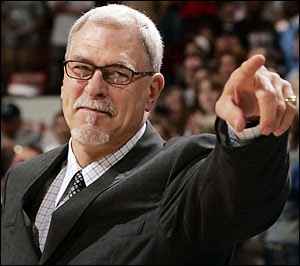
Phil Jackson / "The soul of success is surrendering to what is."

For the past two weeks, my bedtime reading has been Eleven Rings: The Soul of Success by Phil Jackson, written with Hugh Delehanty, that was published earlier this year. It is one of those books that's been a truly wonderful read. It's hard to set it down and I don't want it to end. The book is as much a primer for getting in the mood for the upcoming professional basketball season that starts later this month as it is a memoir with candid insights into the alchemy of leadership.

At more than 300 pages, there's plenty to absorb in Eleven Rings: The Soul of Success, and Jackson quotes from the Grateful Dead, William James, Thelonius Monk, Abraham Maslow and Lao-Tzu, among many. The book reflects Jackson's polymathy.

"In the space of a page, he toggles from psychotherapy to Native American customs to Christianity to Buddhism and back to 'two recent studies published in the Journal of Experimental Social Psychology'," the New York Times wrote in its review of Eleven Rings.

As those of you who follow American professional basketball know, Jackson enjoyed a storied career as head coach of the NBA's Chicago Bulls (1989-98) and the Los Angeles Lakers (1999-2004, 2005-11), and he won more championships -- eleven -- than any coach in the history of professional sports. Delehanty is a former editor for Sports Illustrated, who previously co-authored Jackson's best-selling memoir Sacred Hoops.

Jackson, who grew up the son of Pentecostal preachers in North Dakota, learned the secrets of mindfulness and team chemistry during his playing career with the New York Knicks in the 1970s. Later, as a coach for the Bulls, he managed arguably the greatest basketball player in the world, Michael Jordan, and as coach of the Lakers, Jackson is credited with turning Kobe Bryant into a mature leader of a championship team.

"When you play the game the right
way, it makes sense to the players
and winning is the likely outcome."
~ Phil Jackson
It was in his "quest to reinvent himself," that Jackson became an explorer, learning about humanistic psychology, Native American philosophy and Zen meditation. His approach to leadership was based upon "freedom, authenticity, and selfless teamwork that turned the hyper-competitive world of professional sports on its head." He is not afraid to quote from various religions' holy scriptures.

In teaching his players an abbreviated version of mindfulness meditation that's based on the Zen practice, Jackson writes: "I was interested in getting them to take a more mindful approach to the game and to their relationships with one another. At its heart, mindfulness is about being present in the moment as much as possible, not weighed down by thoughts of the past or the future."

On winning and losing, Jackson writes: "When you play the game the right way, it makes sense to the players and winning is the likely outcome."

"But there's another kind of faith that's even more important," he adds. "The faith that we're all connected on some level that surpasses understanding. That's why I have players sit together in silence. Sitting silently in a group without any distractions can make people resonate with one another in profound ways. As Friedrich Nietzsche said, 'Invisible threads are the strongest ties'."

At the beginning of each chapter, Jackson shares a quote that illustrates the theme of his message. For instance:

Life is a journey. Time is a river. The door is ajar.
~ Jim Butcher

The greatest carver does the least cutting.
~ Lao-Tzu

The privilege of a lifetime is being who you are.
~ Joseph Campbell

Think lightly of yourself and think deeply of the world.
~ Miyamoto Musashi

In the end, Jackson shares this thought:

"Buddhist sages say that there's only a 'tenth of an inch of difference' between heaven and earth. And I think the same can be said about basketball. Winning a championship is a delicate balancing act, and there's only so much you can accomplish by exerting your will. As a leader your job is to do everything in your power to create the perfect conditions for success by benching your ego and inspiring your team to play the game the right way. But at some point, you need to let go and turn yourself over to the basketball gods.

"The soul of success is surrendering to what is."

One thing that Eleven Rings shows us -- and you don't have to be a fan of basketball or sports to appreciate it -- is this: When it comes to the most important lessons in life, we still have much to learn.

Photos of Phil Jackson and of the cover of Eleven Rings: The Soul of Success courtesy of Google images.