Showing posts with label feelings. Show all posts

Sunday, March 4, 2018

A Winter Olympic memory that brought joy and heartbreak

Russian silver medalist Evgenia Medvedeva /
She created brilliant figure skating moments.
Over two weeks and three weekends, the PyeongChang Winter Olympics filled our hearts and television screens with lots of excitement. For my wife and I, much of it took place on the Olympic figure skating ice.

Sometimes, it was colorful and loud, oftentimes it was elegant. There were plenty of thrills and excitement, just a few spills and disappointments, but enough flash and panache to make it all seem worthwhile.

Because of the 14-hour time difference between South Korea and the U.S. east coast, we tuned in to watch figure skating following our nightly dinner – and, occasionally, it kept us awake past our bedtime. Sometimes, we watched online. Because we cared, learning about the human side of many of the Olympic figure skaters competing as well as about the sport's history was a real treat.

During the final two nights of figure skating last week, after the excitement of the team, men's and ice dance competitions, we had the noblest pleasure of watching the 18-year-old Russian Evgenia Medvedeva make her Olympic individual debut in the ladies' singles event. Performing to "Nocturne" by Frederic Chopin, Medvedeva performed her short program, which included a triple flip/triple toe loop combo, triple loop and double Axel, flawlessly. Her score of 81.61 points placed her second behind her Russian teammate Alina Zagitova, who scored 82.92.

Medvedeva's skating maturity and artistic presentation were well beyond her years. From watching her skate and in listening to the comments expressed by the NBC figure skating commentators, it gave us a joy of understanding Medvedeva, both as an athlete and as an individual. Among the things we learned about her: Medvedeva likes studying foreign languages, enjoys drawing, is fond of listening to music (such as K-pop), and loves Japanese culture (such as anime). She may skate like an adult, but she's a kid at heart – and that's the beauty and joy of it all.

Two days after skating her short program, Medvedeva returned to the Olympic ice. She was the last of 24 skaters to present her long program, which decided the gold medal – and was won by Zagitova by the slimmest of margins, 239.57 to 238.26. Medvedeva, skated as Tolstoy's tragic "Anna Karenina" with music composed by Dario Marianelli. 

As she skated, we rooted for Medvedeva, a two-time world champion and consensus favorite to win the gold before she broke a bone in her right foot last fall. As The New York Times wrote, "Medvedeva was forced to confront a sobering reality on Friday at age 18: Experience and artistry and expressiveness did not prevail over mathematics."

Before her final performance, Medvedeva said, "I'm not chasing numbers, I'm chasing feelings."

There was a beautiful, athletic bounce to Medvedeva's skating, a lovely expression on her face throughout her four-minute free skate to a classic Russian story. Medvedeva was Anna Karenina – and she gave it her all. She was mentally tough and she skated brilliantly. It was a perfect, balanced and mistake-free performance – Medvedeva didn't do anything wrong – even if it didn't earn her the gold medal.

What a way to win if you're Zagitova. What a way to lose if you're Medvedeva – even if losing means winning the silver medal.

Evgenia Medvedeva and Alina Zagitova.
Indeed at age 15, Zagitova became the second-youngest women's skater to win the Olympic gold medal. With shrewd design and stamina, precision jumping and a sense of "youthful certainty," Zagitova landed all 11 of her jumps in the second half of her balletic "Don Quixote" free skate long program, compared to eight for Medvedeva. As The New York Times explained: "This is known as back loading, and is meant to gobble up a 10 percent bonus awarded for each jump beyond the halfway point of a routine, as skaters' legs begin to tire." 

Skating with calm and endurance, Zagitova's strategy – which was within the rules even if it broke the spirit of them – worked to her advantage, even if it wasn't as emotional and captivating as Medvedeva's long program.

The two Russian figure skaters each scored 156.65 in the free skate and Medvedeva was ranked first ahead of Zagitova. Looking back, Medvedeva's technical elements included: a triple flip/triple toe loop combo, a triple Lutz, a triple flip, a triple loop, a double Axel/double toe loop/double toe loop combo, a triple Salchow/triple toe loop combo and a double Axel. Her interpretation of her music was superb. 

"If most skaters skate with their brains," said NBC figure skating analyst Johnny Weir, as he watched Medvedeva perform, "Evgenia skates with her entire soul throughout her performance."

At the conclusion of Medvedeva's performance, NBC figure skating commentator Terry Gannon was moved to say, "I don't know if we just watched gold, but we watched greatness."

As it happened, Zagitova's victory was the second consecutive gold medal won by Russian women. Because they operate in a centralized training facility, unlike in the U.S., the top skaters challenge each other on a daily basis in practice. Thus, Zagitova was challenged by her friend and training partner Medvedeva – and it paid off. 

Looking back, as Medvedeva received the plaudits of the appreciative crowd before skating off the ice after to await her adjudication, she shed tears of joy – maybe of relief, too. Despite facing enormous pressure, she skated marvelously – a season-best performance. In our eyes – and many others, too – Medvedeva was a winner. And, yet, she handled her defeat so graciously. 

"She created brilliant moments," said NBC figure skating analyst and 1998 Olympic gold medalist Tara Lapinski in describing what she had just seen Medvedeva perform. "This was one of the best ever competitions."

After receiving her silver medal, Medvedeva had time to reflect. "It's life and it's a lesson," she said. "Every year, every moment, every day, every week, every month, we must become stronger. ... Today, we proved ourselves here."

Photos: Courtesy of Google Images.

Tuesday, December 15, 2015

Pink Martini: The "little orchestra" that's bringing joy to the world in these troubled times


Pink Martini / The "little orchestra" that's inclusive, full of warmth and
represents many human experiences.

Pink Martini is an internationally acclaimed "little orchestra" from Portland, Oregon, founded by a couple of Harvard classmates, pianist Thomas Lauderdale and vocalist China Forbes, that mixes glamour and sophisticated easy-listening music. Since 1994, the band that the Washington Post once called "utterly cosmopolitan yet utterly unpretentious," have amassed an impressive repertoire of festive songs drawn from around the globe, including many timeless classics and a few rarely heard chestnuts.

A typical Pink Martini show -- and I speak from experience have seen the band perform nine times over the past decade in a variety of California settings -- is both multilingual and multicultural, and at holiday time it's also multi-denominational. Above all, it's inclusive -- full of warmth -- and represents many human experiences.

Through the energy and creativity of their music, Pink Martini brings joy to the world in these troubled times -- something which should make all of us feel grateful and appreciative.

"We're very much an American band," said Lauderdale, "but we spend a lot of time abroad and therefore, have the incredible diplomatic opportunity to represent a broader, more inclusive America... the America which remains the most heterogeneously populated country in the world... composed of people of every country, every language, every religion."

Pink Martini has performed on concert stages and with symphony orchestras throughout Europe and Asia, as well as in Greece, Turkey, the Middle East, Northern Africa, Australia, New Zealand, South America and North America. I have seen them perform both as a "little orchestra" as well as in concert with the San Francisco Symphony Orchestra. When his schedule allows, NPR "All Things Considered" host Ari Shapiro, also a Portland native, joins Pink Martini as a guest vocalist.

Pink Martini's 'Joy to the World'
Last Monday in Livermore, about 30 miles inland from Oakland, my wife and I saw our most recent Pink Martini show. It was part of a two-week "Joy to the World" bus tour through northern and coastal California towns, including Arcata, Davis, Monterey, Redding, and Santa Barbara.

On this night, the 12-member band delighted their audience at the Livermore Valley Performing Arts Center's 507-seat Bankhead Theater by performing from their expansive catalog of pop, jazz, classical and holiday songs that were beautifully sung in Latin, Hebrew, Arabic, German, Turkish, Armenian, Spanish, Italian, French, Romanian, Croatian, Chinese, Japanese and, oh yes, English, too. There was a nice mixture of charm, elegance and humor throughout the band's two-hour performance.

In a recent interview with the Santa Barbara Independent, co-lead vocalist Storm Large said: "Every language expresses love, pain, joy or grief, in whatever song I'm singing, in whatever language, it's just a matter of being honest in the feeling I'm expressing." This was plainly evident when Large sang the very serious Romanian folk tune "Pâna când nu te iubeam" ("Until I Loved You") as well as a long-time favorite of mine, the spine-tingling Croatian song "Eu plavu zoru" ("At Blue Dawn"), accompanied by violinist Nicholas Crosa.

Pink Martini performs their "Joy to the World" holiday
show in Livermore, California on Dec. 7.
Among the sacred and secular holiday songs which Pink Martini performed in Livermore were: "Little Drummer Boy," "We Three Kings," "A Snowglobe Christmas," "Talj, Talj," "La Vergine Degli Angeli," "O Holy Night," and "Have Yourself a Merry Little Christmas."

"Christmas music is so inherently joyful for me, as well as for the audience," said Large. "People just have so many good feelings around the holidays. It's a marvelous reason to sing."

Pink Martini's unique vision can be attributed to its inclusiveness of language, culture, and religion, musically. The band wants anyone and everyone to feel welcome at its shows and, if they are so encouraged, to jump up and dance. And many did dance in Livermore. The evening was complete  with an encore performance of the band's signature tune "Brazil" in which many in the audience at Large's urging formed a conga line while others danced at their seats and in the aisles.

If you think about it, said Large, "It's really the perfect recipe for 'Peace on Earth and Good Will' we hear about so often during the holidays, but sadly have witnessed quite the opposite in the world of late."

Note ~ Hear Pink Martini's "Joy to the World: A Holiday Spectacular" that's airing this month via NPR:

http://www.npr.org/2015/12/09/458905971/pink-martinis-joy-to-the-world-a-holiday-spectacular

Tuesday, May 6, 2014

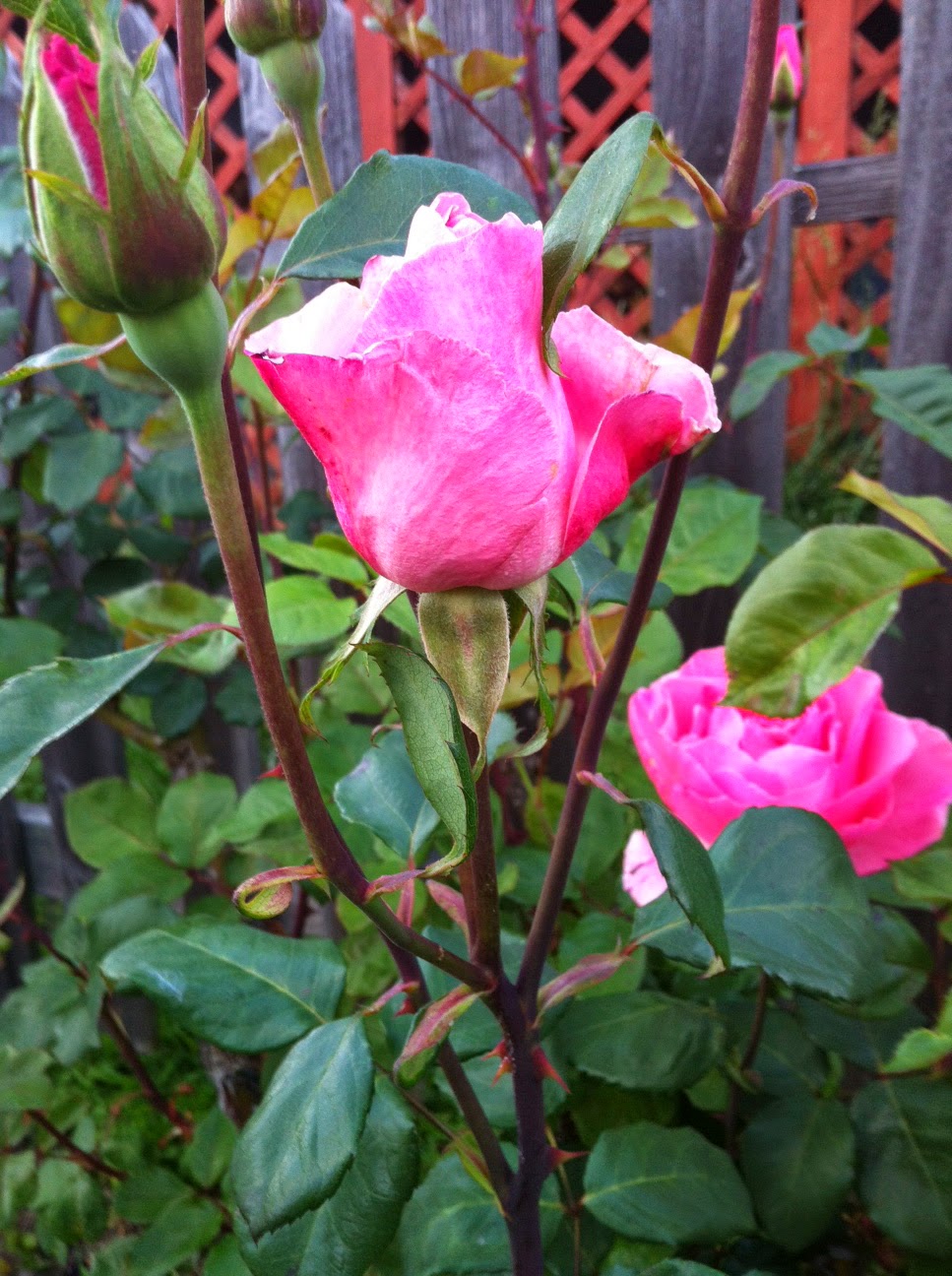
Here's to our colorful May flowers


Pristine rose / The beauty of our May flowers

It's the first week of May and our backyard garden has started to bloom. Lots of colors -- orange, white, pink, red, purple.

Mr. Lincoln red rose
Looking back, the April showers we enjoyed here in the San Francisco Bay Area, indeed, brought an abundance of May flowers to our garden. Our Queen Elizabeth, First Prize and Pristine roses are blooming very nicely. The same for our Mr. Lincoln, white, orange and rainbow-colored roses. Just the other day, I witnessed our first All That Jazz bloom of the season  -- a lovely shade of red.

And, let's not forget that this is the time of the year our purple irises are blooming, too.

For most of us, flowers are an important part of our every-day lives. They have the ability to make us happy and cheerful. And, we offer our friends and loved ones flowers as a means of showing our sympathy.

Different types of flowers can express different kinds of feelings and emotions, from birthdays to graduations to weddings to funerals.

Queen Elizabeth roses
One thing's for sure: May flowers are a wonderful sight to behold -- and, I would would like to share with you a few of our May roses, which I photographed during the first few days of May.

Finally, let me leave you with this thought about flowers that's just as meaningful now in the 21st century as it was when it was written near the end of the 18th century:

"'Tis my faith that every flower
Enjoys the air it breathes!"

-- William Wordsworth, "Lines Written in Early Spring"
From Lyrical Ballads (1798)

Tuesday, February 18, 2014

Four minutes of brilliance in front of the world


Terry, Tara and Johnny / Candid, colorful, compelling.

"Along with Tara Lipinksi and Johnny Weir, I'm Terry Gannon, the one wearing the suit."

One of the joys of the Sochi Winter Olympics on TV for me has been watching the live figure skating competition, which airs here in the U.S. during the morning hours on NBCSN. At times, it's been outlandish and outspoken, but thanks to the candid and colorful commentary of Tara Lipinski and Johnny Weir, it's made for compelling viewing. And, thanks to Weir, every day we're rewarded with a fabulous fashion show, too.

If you've only been watching NBC's limited -- and heavily edited -- prime-time coverage featuring veteran commentator Tom Hammond partnered with choreographer Sandra Bezic and former Olympic champion Scott Hamilton, which focuses only on the Americans and the top skaters shown on tape hours after they've skated, you've been missing out on all of the fun.

The live coverage airing on NBCSN (NBC Sports Network), with the trio of commentator Terry Gannon, and Lipinksi and Weir, showcases each session from start to finish -- every skater from best to worst -- and the fun also includes getting to see Weir's flamboyant wardrobe come to life. It may be morning in the States, but in Sochi where it's nine hours ahead of New York and 12 hours ahead of San Francisco, it's night time -- and the stars are shining brightly, on and off the ice.

Weir, 29, who is openly gay, enjoys being free and open in sharing his opinion about what's happening on and off the ice -- including being critical of Russia's LGBT laws. The two-time Olympian's wardrobe choices have included a bright pink Chanel blazer for Valentine's Day that accentuated a lace top underneath and a gold brooch around his collar. Another day, he wore a Kelly green jacket with a matching tiara. Most days, he's the one wearing the most jewelry and sporting the loudest hairdo.

One day last week, Lipinski, 31, wore charming flowers in her hair, and for Valentine's Day, her attire featured a lovely blouse with little pink hearts. On some days, Lipinski and Weir coordinate their appearances. There's a wonderful spark between them. They're fun and energetic.

Meanwhile, Gannon is the one who is simply attired in dark suits and skinny neckties. And, sometimes, he's the one with the best throw-away lines. During Monday's broadcast, Gannon described American ice dancer Evan Bates' wardrobe by tossing out this pop culture gem: "That's the second puffy shirt from Seinfeld we've seen tonight."

Tara Lipinski and Johnny Weir
One thing that I've found refreshing about both Weir and Lipinski, who won an Olympic gold medal at age 15 at the Nagano Games in 1998, is that both of them are extremely knowledgeable about figure skating -- its history, its artistry and its social dynamics -- and they offer a fresh and thoughtful perspective as former champion skaters without being arrogant. An added bonus: They talk in a friendly, conversational tone of voice. Neither feels compelled to shout to be heard and they play off of each other well.

On the ice dancing rivalry between Canadians Tessa Virtue and Scott Moir, who won the gold medal at the 2010 Vancouver Games, and their chief rivals and 2010 silver medalists, Americans Meryl Davis and Charlie White, Lipinski said: "Obviously, they have great respect for each other, but they're competitors." 

Weir knows all the competitors thoroughly, can anticipate what's going through their minds as they skate, and what it takes to win. "It's going to be such a showdown. Meryl and Charlie seem to have such an advantage. It's going to come down to what happens today."

Not since the legendary Dick Button has there been an American figure skating commentator like Weir, who's been unafraid to express his opinion -- even if it sometimes upsets the figure skating community.

Tara and Johnny /
A mischievous rapport.
The camaraderie and chemistry that Weir and Lipinski bring to their broadcast -- one critic described it as a "mischievous rapport" -- has been a joy.

"It's a Michael Jackson kind of night," said Weir, after the American ice dancing siblings, Maia and Alex Shibutani, became the second team to dance to a Michael Jackson medley during Monday night's free dance.

As much as I enjoy listening to the BBC's insightful and, at times, bubbly commentary offered by Sue Barker and Robin Cousins -- I've been listening to the British duo live online while taping Weir and Lipinski for later viewing -- I feel both Tara and Johnny have found just the right mix in offering enough technical expertise to educate their viewers in what they are seeing while also knowing the value of silence, something that Bezic, Hamilton and ice dancing analyst Tracy Wilson haven't learned or shown during NBC's prime-time broadcasts from the Iceberg Skating Palace.

After Virtue and Moir's elegant and heartfelt performance, a display of ease and unison skated to the music by Russian composers Alexander Glazunov and Alexander Scriabin, here's how Lipinksi, Weir and Gannon summarized it so succinctly:

Tara: "That was flawless. Their performance wrapped up their career so perfectly. It was effortless and smooth."

Johnny: "It was impeccable. The whole arena was silent soaking it all up. It was a beautiful, pitch-perfect moment. Their performance painted a beautiful picture."

Terry: "Their 114.66 is the best score we've ever seen."

Sometimes, letting a figure skater's performance talk -- as Gannon, Lipinski and Weir did during Monday's ice dancing final when they remained silent for four minutes during both Virtue and Moir's beautiful free skate as well as the impeccable and energetic gold medal performance by Davis and White -- speaks volumes.

As they took the ice, Gannon very tersely set the scene for Davis and White's free skate as the cameras zoomed in close on the Americans, who've skated together 18 years: "They've been dreaming about this moment since coming together as kids on ice growing up in Michigan."

Then, Davis and White exuded a dramatic tension of love and escape in skating to "Scheherazade." They engaged the judges, the fans and, just as importantly, a world-wide TV audience.

After Davis and White concluded their four minutes of brilliance in front of the world, culminating in the first gold medal by an American ice dancing couple, here's how Gannon, Lipinski and Weir described what had just happened:

Terry: "Four minutes to gold and it's over; not in their hands right now."

Tara: "Terry, when you think about it, Torvill and Dean are the most famous names in ice dancing. But, Charlie and Meryl are going to carry that same weight with what they're doing for U.S. ice dancing now. That program was pure perfection. ... So much pressure."

Johnny: "The pressure was so intense and they handled it beautifully. They fought the whole way through that performance. You could see it in the last minute. Charlie doing those very expressive stop and spins, stop and spins. ... "Whew! It was breathless. When you go for a gold medal, you fight for it."

Terry: "Three times Americans have medaled at the Olympics in ice dance. In 1976, then it wasn't until 2006 with Belbin and Agosto the silver, and in 2010 Davis and White with the silver medal. This right now, was it a gold medal performance? The number they need to win is 112.11. There's only one time that they haven't reached that moment."

Tara: "Every moment of their program was so precise. From the finger tips to the toes, the emotion telling the story of 'Sheherazade.'"

Johnny: "When you're a team, this is what you're all about. You're all about this moment. It's hard to explain to people that haven't been there. That amount of pressure. Four years of your life down to four minutes in front of the world. If one little thing goes wrong, then you completely lose the last four years of your life. (Davis and White) owned it. They fought from top to bottom."

Tara: "You have to stay in the moment." 

After a brief pause, the scores for Davis and White are finally announced to the crowd at the Palace and to the world-wide audience tuned in. They scored 116.63 points, for an overall score of 195.52. The crowd erupts in thunderous applause for the winners. Hugs for all in the kiss-and-cry box.

Terry: "A U.S. ice dance team will stand atop the podium. Meryl Davis and Charlie White are the gold medalists.

Tara: "They're Olympic champions."

Johnny: "They were stunning. They deserved it. It wasn't a political weirdness situation that we've come to think of when we come to ice dancing. They earned it. This night was so special. I can't remember the last time I sat through a whole free dance -- and I loved it! I loved every second of it. They entertained, they wowed us. We marveled at the lifts and the spins and the beauty. It was just so enjoyable."

During a recent USA Today interview, Weir wore his feelings for figure skating on his sleeve. "We take great responsibility for what we say and how we teach people about the sport," he said. "Honestly, as a broadcaster, all I want is for people to skate so well that we're struck dumb, that we're unable to speak. But when it's called for, I'm not afraid to explain the judging system or why somebody beat somebody else. That's who I am.

"My job is to help bring skating back, and to help educate masses about what's going on in skating."

A postscript: In a New York Times column Wednesday, "Amid Blunders on Ice, Only a Few Signs of Grace," dance critic Gia Kourlas wrote:

"The only sure thing left is off the ice: the sparkling commentary of Tara Lipinski and Johnny Weir, who, along with the sportscaster Terry Gannon, call the daytime live broadcast. They make it possible to suffer through wretched performances, not because they make fun of bad skating -- though you can usually count on priceless giggles at just the right moment -- but because they take it so seriously.

Tara and Johnny /
Always fashionable.
"While never short of opinions, they're generally quiet during performances. While they get to the nitty-gritty of technique -- pointing out when skaters are flat on their feet, or why they fall out of synchronization -- they also have information about more obscure aspects of skating, like how ice temperature affects a performance (speed skating requires harder ice than figure skating) or how male ice dancers have been known to build up their heels for extra height.

"It helps that Mr. Weir is a champion of inspired one-liners. While watching several near collisions during a men's warm-up, he blurted, 'It is Nascar out here in the world of rhinestones.' "

Screenshot images via the internet courtesy of NBCSN.