Showing posts with label Roger Federer. Show all posts

Tuesday, September 27, 2022

Team World Brought All The Right Stuff Together To Win Their First Laver Cup Title

Team World lifts the Laver Cup in London

Team World entered the final day of Laver Cup 2022 in London trailing four-time champion Team Europe 8-4 and needing to win three of four matches. While it wasn’t an impossible task, it would take everyone on John McEnroe’s Team World squad coming together and playing inspired and focused tennis on Sunday.

With each win worth three points, match by match, Team World turned this year’s Laver Cup upside down and won three straight matches – all with exciting outcomes – to win the Laver Cup title for the first time.

It was quite a weekend to remember in London, which drew more than 96,000 tennis enthusiasts to the O2 Arena, first to bid farewell to Roger Federer, then to see Novak Djokovic’s return to the ATP Tour after winning his seventh Wimbledon title, and, finally, to see Team World’s remarkable final-day comeback, in which Canada’s Felix Auger-Aliassime and Frances Tiafoe of the United States shouldered the load and carried the team on their shoulders to triumph.

Auger-Aliassime gave Team World the lead on the final day thanks to a pair of wins, first by partnering with Jack Sock to edge Matteo Berrettini and Andy Murray, 2-6, 6-3, 10-8, then by defeating Djokovic, 6-3, 7-6 (3). Next, Tiafoe, fought off four match points during a second-set tie-break to beat Stefanos Tsitsipas, 1-6, 7-6 (11), 10-8, which clinched the 13-8 victory for Team World. 

When one considers what transpired, it’s pretty wild that a team with zero Grand Slam singles titles beat a team with 66 that featured Federer (20), Rafael Nadal (22), Djokovic (21) and Andy Murray (3). But that’s exactly what happened. 

In praising his team during the trophy ceremony, Team World captain McEnroe said: “They brought the energy, belief and intensity.”

Later, McEnroe admitted: “It beats losing, that’s for sure. The difference was that we kept battling. There was a great team spirit. We knew we had a shot at it, but it was an uphill battle.”

While McEnroe likely would have been second-guessed for playing Auger-Aliassime back-to-back in Sunday’s first two matches – especially if the young, 21-year-old Canadian faltered against the veteran Djokovic, 35 – in hindsight it was a brilliant and tactical decision.

“This is something that’s discussed among all of us,” he said. “These guys know the ins and outs of what’s going to work best. Felix was ready for it, he had debuted last year, and now he was ready to step up to the big time.”

Auger-Aliassime said he enjoys the challenge that comes from playing in team events, “feeling I can bring something not only to myself but to the team. I feel like it pushes me also to stay positive, to dig deep, that feeling that I’m not only playing for myself, I’m trying to bring something to the team, bring a point to the team.”

Tiafoe added: “All week leading up I kept saying this was our year. The guys showed up. Felix beat Novak, Jack and Felix also played unbelievable doubles. We did it all together, it wasn’t just me.”

Coming off a semifinal run at the US Open, which boosted his ranking to a career-best World No. 19, Tiafoe has been playing some of the best tennis of his career. He said he would rank his Laver Cup-clinching victory over Tsitsipas among his best.

“To do it here in Laver Cup, to win for the first time, given how bad Mac wanted it, how bad everybody else wanted it, seeing what Felix and Jack did – I thought it was just time. It was time to get it done,” Tiafoe said during his team’s final press conference. 

Looking back, as New York Times tennis correspondent Christopher Clarey suggested in a tweet Sunday evening, “[the] Laver Cup has proven that it is value added for tennis.

“Its future is up to the players. If the best ones commit to it consistently and continue to care about the outcome it will thrive.”

A postscript

Roger Federer said this year’s Laver Cup competition would remain special to him – especially the sendoff he received Friday evening after playing in the final match of his pro career.

“Being on court on Friday and having such a huge moment in my career, being surrounded by my biggest rivals like Novak and Andy and Rafa was truly unique, and I can never thank them enough for being there and staying there and going through it with me,” he said.

“I hope that their farewell will also be unique and special, that it works for them, because it was beautiful for me.”

Cover photo: Courtesy Getty Images for Laver Cup.

Saturday, September 17, 2022

Federer Brought Joy to a Golden Era of Tennis

Roger Federer 


Within minutes after Roger Federer announced his retirement from tennis on Thursday – the Laver Cup next week in London will be his final ATP event – the tributes began to pour in on social media. There were many and they were all sincere and genuine. They came from players such as Rafael Nadal, Petra Kvitova, Coco Gauff and Carlos Alcaraz as well as from Wimbledon, where he enjoyed many of his greatest moments as a professional tennis player.

Of all the gifts that tennis has given Federer, the greatest without a doubt, he wrote, has been the people he’s met along the way. “My friends, my competitors, and most of all the fans who give the sport its life.”

It is said that timing is everything and Federer, 41, has always shown impeccable timing throughout his storied and artistic career that began as a ball kid growing up in Basel, Switzerland. Federer’s announcement came just five weeks after Serena Williams announced her “evolution” away from from the sport. Who could have imagine that this day would arrive for Federer, too?

In a letter written to his fans from home in Switzerland and posted Thursday on his social media channels, Federer wrote: “As many of you know, the past three years have presented me with challenges in the form of injuries and surgeries. I’ve worked hard to return to full competitive form. But I also know my body’s capacities and limits, and its message to me lately has been clear. I am 41 years old. I have played more than 1500 matches over 24 years. Tennis has treated me more generously than I ever would have dreamt, and now I must recognize when it is time to end my competitive career.

“The Laver Cup next week in London will be my final ATP event. I will play more tennis in the future, of course, but just not in Grand Slams or on the tour.”

Federer has not competed since Wimbledon in July 2021. Since then, he’s undergone multiple surgeries to his left knee and tried to rehabilitate it in order to regain elite form and continue playing competitively. 

Federer expressed that it was a bittersweet decision because “I will miss everything the tour has given me. But at the same time, there is so much to celebrate. I consider myself one of the most fortunate people on Earth. I was given a special talent to play tennis, and I did it at a level that I never imagined, for much longer than I ever thought possible.”

While Federer thanked his wife, Mirka, and his four children; his parents and sister, plus his coaches, business partners and sponsors – as well as the hard-working teams and tournaments on the ATP Tour – he also made a point to thank his competitors on the court.

“I was lucky enough to play so many epic matches that I will never forget. We battled fairly, with passion and intensity, and I always tried my best to respect the history of the game. I feel extremely grateful. We pushed each other, and together we took tennis to new levels.”

Above all else, Federer gave praise to his “unbelievable” fans. “You will never know how much strength and belief you have given me. The inspiring feeling of walking into full stadiums and arenas has been one of the huge thrills in my life. Without you, those successes would have felt lonely, rather than filled with joy and energy.”


Federer’s career began at age 16 in July 1998 in Gstaad, Switzerland, with a 6-4, 6-4 loss to Lucas Arnold Ker of Argentina and ended at age 39 – almost 40 – with a 6-3, 7-6 (4), 6-0 loss to Hubert Hurkacz of Poland in July 2021 at Wimbledon.

Indeed, the last 24 years have been an incredible adventure, thanks to Federer and Williams – global citizens of sport – especially during the Grand Slam fortnights. Federer has played in more than 40 countries and he’s laughed and cried, felt joy and pain – and at his best, his tennis has been incredibly alive and sublime. His eight Wimbledon titles represent some of his greatest moments among the 20 major titles and 103 tour-level crowns he’s won. He surpassed Pete Sampras with a then-leading 15 major titles, then was passed by two of his contemporaries, Rafael Nadal and Novak Djokovic. His battles against his Big Four mates – Nadal and Djokovic, and Andy Murray – were all memorable.

If you are interested in learning more about Federer, two books worth a very good read are: The Master: The Long Run and Beautiful Game of Roger Federer by New York Times tennis correspondent Christopher Clarey, about Federer and this golden age in men’s tennis, published in 2021; and Strokes of Genius: Federer, Nadal, and the Greatest Match Ever Played, by Sports Illustrated tennis writer and Tennis Channel insider L. Jon Wertheim, about the epic Federer-Nadal 2008 Wimbledon final.

On a personal note, Federer has been one of just a very small number of athletes, whom I would drop whatever I doing to watch perform on TV – especially during the Grand Slams. There was always a sense of wonder in watching him play on Centre Court at Wimbledon as well as on Arthur Ashe Stadium at the US Open. He was greatness personified – he showed class and respected the history of the game – and he dressed the part, too. It all added up.

It’s never easy when one of the greats of sports steps down. Federer may be retiring from the competitive arena, but he never retired from a match. Fortunately, Federer leaves the sport of tennis better than when he arrived – and it will be exciting to see if the next generation of men’s players that includes Carlos Alcaraz, Jannik Sinner and Frances Tiafoe are ready to step up and carry on the aesthetics and athleticism that Federer brought to the sport. Hopefully, there will be others who will combine elegance and grace, and a beautiful game, too.

In the meantime, here’s giving thanks to Federer, who definitely made tennis better on and off the court. As he exits the stage, he will be missed. Mind you, I think it will be exciting to see Roger continue to bring joy to the world in other ways. No doubt, he will be just as successful.

“So, I want to thank you all from the bottom of my heart, to everyone around the world who has helped make the dreams of a young Swiss ball kid come true,” Federer concluded in his message.

“Finally, to the game of tennis, I love you and will never leave you.”

Photo: Courtesy of Roger Federer Instagram.

Tuesday, July 12, 2022

Novak Djokovic: Reflections On Becoming a Seven-Time Wimbledon Champion


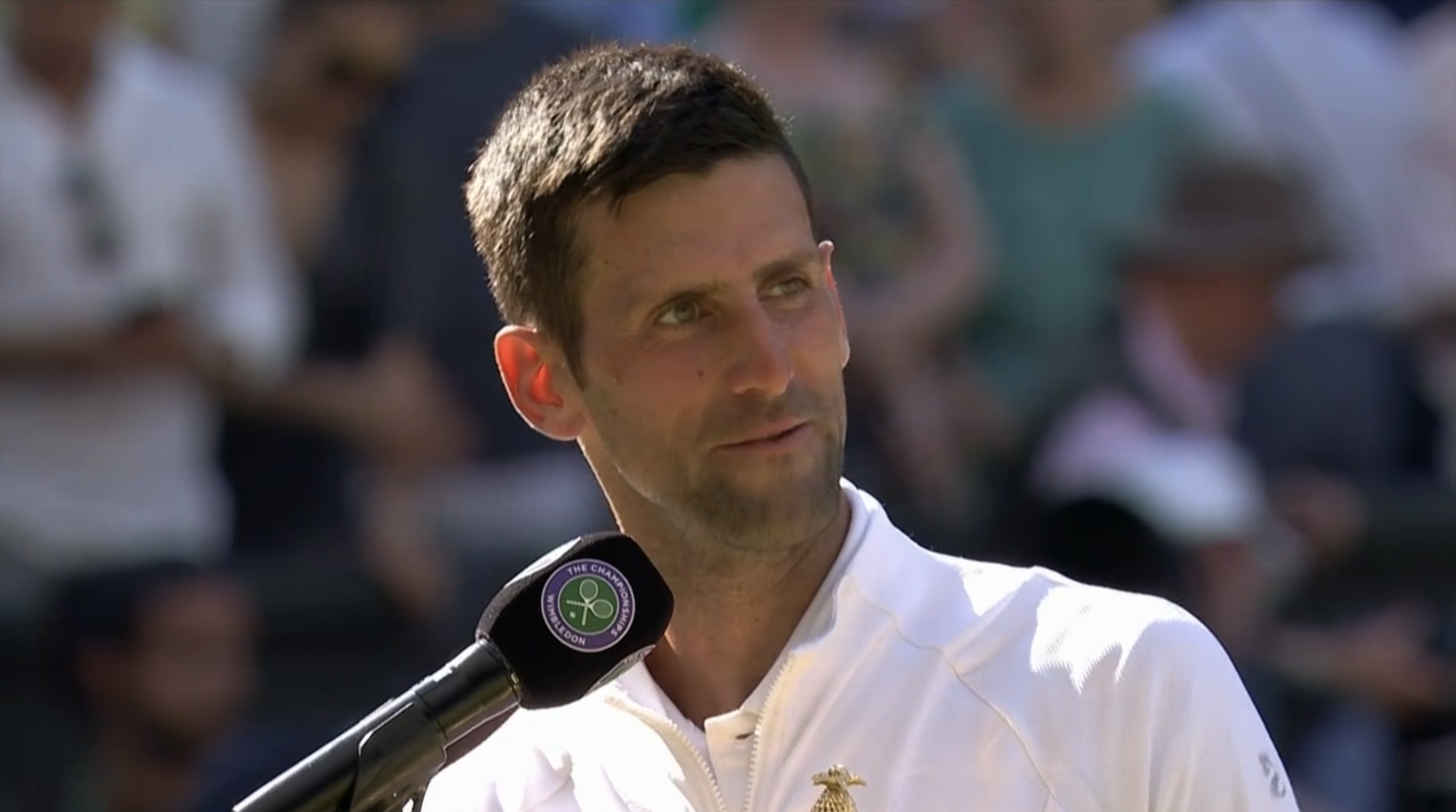
As Novak Djokovic won his fourth straight Wimbledon Championships gentlemen’s singles title and seventh crown overall, which leveled him with his boyhood idol Pete Sampras, one quality among many stood out. He remained quietly focused – not to mention calm and cool – throughout the three-hour and one-minute final that took place on a sun-drenched, sold-out Centre Court Sunday afternoon. It was in stark contrast to his opponent, the chuntering Nick Kyrgios, who repeatedly lost his cool. You really didn’t expect anything else from the mercurial one, did you?


Yet, one can only wonder what if Kyrgios had kept his mouth quiet instead of incessantly chattering to himself, shouting at his entourage in his box, or at the tennis gods above – often using profanity-laced language not suitable for the ears of young eight-year-old Prince George of Cambridge, who was seated in the first row of the Royal Box in between his dad and mum, Their Royal Highnesses the Duke of Cambridge and Duchess of Cambridge. The Royal Box was also filled with plenty of tennis royalty, too. Among the notables were Hall of Famers Rod Laver, John Newcombe, Stan Smith, Chris Evert and Jan Kodes – all of them past Wimbledon champions from bygone years, back when decorum mattered. 

As it happened, Djokovic won the final, 4-6, 6-3, 6-4, 7-6 (3), for his 21st Grand Slam singles title, which moved him one ahead of Roger Federer and placed him one behind Rafael Nadal. It was a fitting way for the Serbian great to celebrate his eighth wedding anniversary with his wife, Jelena. His two young children, Stefan, 7, and Tara, 4, have been in tow throughout the Wimbledon fortnight, too. Nothing like keeping it all in the family, right?

Djokovic managed to shut out the temper tantrums and overcame all of the obstacles Kyrgios could toss at him – including the booming 130 mile-per-hour first serves that produced 30 aces and helped contribute toward the 62 winners the Aussie hit. He also took advantage of the 33 unforced errors made by Kyrgios. Meanwhile, Djokovic, whose head was in the right place, put together a steady, steely and, at times, brilliant shotmaking performance that resulted in 15 aces and 46 winners. His serve was broken just once. He outpointed Kyrgios 132-112.

After securing victory in his 32nd career Grand Slam final – compared to just one final for Kyrgios – Djokovic, as has been his custom after winning Wimbledon on six previous occasions, pulled up a few blades of Centre Court grass to munch on. Djokovic’s winning streak on grass had extended to 28 matches, a streak that began in 2018.

At least, to his credit afterward, Kyrgios showed he could be polite. He shared a good laugh with Djokovic as the competitors walked off the court and was courteous and gracious in accepting his runner-up plate from the Duchess of Cambridge, who is the All England patron.

“He’s a bit of a god, I’m not going to lie,” Kyrgios said during his on-court interview with the BBC’s Sue Barker during the trophy ceremony. Kyrgios also made a point of thanking the ball kids, who put up with his antics over the past two weeks. 

When the volatile and acrobatic Kyrgios, 27, was asked if he would return to the All England Club, he laughed at the thought and quipped: “Absolutely not. I’m set for life. Myself, my team, I think we’re all exhausted. We’ve played so much tennis. I definitely need a well-earned vacation after this. … Maybe, one day I’ll be here again, but I don’t know about that.”

Meanwhile, Djokovic, a member of the All England Club since winning his first Wimbledon title in 2011, definitely will be back. It’s like a home away from home for him. He also suggested that Kyrgios will be back, too. Say what you will, Kyrgios is good for box office and TV ratings.

“Nick, you’ll be back,” he said. “I know it’s tough to find consolation words after a tough loss like this, but you sowed why you deserve to be one of the world’s best, particularly on this surface.”

Djokovic added: “I never thought I was going to say so many nice things about you, considering the relationship. … It’s officially a bromance. Hopefully, this is the start of a wonderful relationship off the court as well.”

During his on-court remarks after lifting the Wimbledon champion’s trophy for the seventh time, the 35-year-old Djokovic got serious for a moment. “I lost words for what this tournament, what this trophy means to me, my family, my team,” he said. “It was the one that motivated me to play tennis. Then, he added: “It’s also a relief as well, considering what I’ve been through of course this year. It adds more value and more significance and more emotions, of course.”

A postscript

Novak Djokovic remains unvaccinated and, as such, he goes off to an uncertain future with the US Open looming next month. It’s likely he won’t get to play in the year’s final Grand Slam. That’s because the United States has a vaccine mandate that likely won’t be relaxed just for him. Currently, noncitizen nonresident internationals, such as Djokovic, aren’ allowed to enter the country if they aren’t vaccinated against COVID-19.

During his post-match news conference Sunday, Djokovic stood adamant about his decision not to get the required shots to be able to travel to the U.S. “Yeah, I mean, I’m not vaccinated and I’m not planning to get vaccinated,” he said. “So the only good news I can have is them removing the mandated green vaccine card – or whatever you call it – to enter [the] United States, or exemption. 

“I don’t know. I don’t think exemption is realistically possible. If that is a possibility, I don’t know what exemption would be about. I don’t know. I don’t have much answer there. I think it’s just whether or not they remove this in time for me to get to U.S.A.”

At the same time, despite Djokovic’s Wimbledon triumph, he fell four slots in the new ATP rankings, released Monday, from No. 3 to No. 7. That’s because the ATP Tour didn’t award rankings points for this year’s Wimbledon because of the tournament’s ban on Russian and Belarusian players, which Wimbledon enacted because of Russia’s invasion of Ukraine earlier this year.

Looking ahead, Djokovic’s future remains uncertain, he’s still unbeatable on Wimbledon’s famed Centre Court.

Photo credits: Courtesy Wimbledon video. 

A version of this blog previously appeared in Tennis-TourTalk.com.


Tuesday, June 14, 2022

Stephen Curry and Roger Federer: Sharing a zest for life and just joy for the process


While observing Stephen Curry throughout the NBA Finals, it’s easy to see and admire how the Golden State Warriors superstar guard values and loves his routine of beautiful basketball. However, as easy as it may seem to us on the surface, the 34-year-old Curry, who is in his 13th season in the NBA, has put in a lot of time and energy – hard work – to become the player he is.
In Game 4 Friday in Boston, Curry’s 43-point performance showed why he’s one of the best to ever play the sport. While the Warriors prepared for Game 5 of the NBA Finals series against the Boston Celtics in San Francisco Monday night – a game which Golden State won 104-94 to take a 3-2 series lead – it was interesting to learn from their head coach, Steve Kerr, that Curry and the Warriors once drew inspiration from a meeting the team had with tennis great Roger Federer five years ago in Shanghai, China. 

Kerr told reporters that Curry was greatly inspired by how the 20-time Grand Slam champion Federer comported himself. What he learned from the Swiss icon centered around how the love of his routine helped to keep him motivated and to keep playing tennis.

As Kerr described the meeting, Federer was asked by one of the Warriors, Draymond Green, just how he managed to keep doing this for 20 years?

“And his answer was just simple, yet profound,” Kerr explained. “He said, ‘I love my daily ritual.’ He said, ‘I get up, make my kids breakfast, drop them off at school, go train and I’ve figured out the right training methods to keep me in the best position at my age. I love competing.’ He said, ‘But every single day, I put my head on the pillow at the end of the day and think, Man, what a great day.’

“So, I think of Steph a lot when I think of that story from Roger Federer. Very, very similar just sort of zest for life and just joy for the process.”

Like Federer, there’s a lot of work routine for Curry that includes time devoted to the training room, the weight room and, finally, the basketball court, where he practices taking shots from a variety of locations. If it seems like there’s a sense of clockwork, you’re right.

Kerr went on to describe in detail that for Curry, there’s a “sense of joy and energy within that work. 

“He enjoys it so much. He loves the process. I that’s one of the things that ties all great athletes together, like talking about the superstar athletes, the Roger Federers of the world, the Steph Currys of the world. There’s a routine that not only is super-disciplined but it’s really enjoyed each day.

“There’s a passion that comes with it, and that’s what sustains it over time. When you love something like those guys do, you work at it, you get better and you just keep going.”

It should come as no surprise, then, that over the weekend Federer, 40, shared his goals for the remainder of the 2022 season. He’s been idle since last year’s Wimbledon and has undergone two surgeries on his right knee. Federer plans to resurface in September at the Laver Cup in London, then finish out the season at in October the Swiss Indoors in Basel. Beyond that, who knows? 

“After Basel, the season is over anyway,” Federer told Swiss tennis journalist Simon Graf on Saturday. “It’s important for me to get fit again so that I can train fully. Once I’ve done that, I can choose how many tournaments I play and where. The Laver Cup is a good start, I don’t have to play five matches in six days.

“I will have to be able to do that in Basel. That’s why I have to prepare for it in practice. I’m curious myself what’s still to come. But I’m hopeful, I’ve come a long way. I’m not far away. The next three or four months will be extremely important.”

Asked by Graf if he wishes to return to the ATP Tour in 2023 at age 41, if his knee cooperates, Federer replied affirmatively. “Yes, definitely. How and where, I don’t know yet. But that would be the idea. Definitely.”

In the meantime, like Curry, Federer will continue sharing a zest for life and just joy for the process of routine.

Photos: Stephen Curry, courtesy of Golden State Warriors Twitter; Roger Federer, courtesy of Instagram.

Tuesday, June 7, 2022

Rafael Nadal: The King of Clay Will Always Have Paris


“Victory belongs to the most tenacious,” are words inscribed in both English and French and appear on the upper-deck facing on either side of Court Philippe-Chatrier. They are very visible to players and fans alike. These words are attributed to French aviation and World War I hero Roland Garros, whose name is synonymous with the French Open. They serve as a reminder to those who play on the famed terre battue at Stade Roland Garros in Paris, the City of Lights.

On Sunday afternoon, Rafael Nadal, looking and playing unbeatable, won his 14th French Open title. He extended his remarkable men’s record of 22 major singles titles with 6-3, 6-3, 6-0 victory over Casper Ruud, 10 years his junior. Nadal won the last 11 games of the two hour, 18-minute title match before a sellout crowd of 15,000. 

At the end of the day, the King of Clay reigned, again, 17 years to the day he hoisted his first Coupe de Mousquetaires trophy as a long-haired, 19-year-old teenager in toreador pants, after defeating Mariano Puerta. His latest triumph was filled with emotion and it was important to him, too.

Nadal was asked by NBC’s Maria Taylor during a post-trophy ceremony interview to describe what it felt like to hold the trophy this time. He replied: “It’s amazing, much more emotional than the first time. It’s completely unexpected for me to be where I am at this age, at this stage of my career. It means everything.

“I have been going through tough times the last couple of months. To have this trophy with me here is something unbelievable.”

Like the previous 13 times, the French Open served as Nadal’s wake-up call to the rest of the tennis world. Through the latest Parisian fortnight, Nadal became the third man in the Open Era to beat four Top-10 opponents in a single major. Three days after he celebrated his 36th birthday, Nadal became the oldest man to win Roland Garros, surpassing another Spaniard, Andrés Gimeno, who set the record at age 34 half a century ago.

Nadal extended his perfect record to 14-0 in Roland Garros finals, and also extended his record of most career major titles to 22, which now puts him two ahead of his closest rivals, Novak Djokovic, whom he beat in the quarterfinals, and Roger Federer, who is still recovering from knee surgery. Nadal solidified his place in the tennis Hall of Fame and his records will certainly be unbeatable for the foreseeable future, if at all.

During the trophy ceremony that followed Nadal’s latest French triumph, he expressed his appreciation and also thanked his legions of faithful fans, many whom were holding up banners and waving Spanish flags throughout the stadium.

“I for sure never believed I would be here at 36 being competitive again, playing in the most important court of my career one more time in the final,” Nadal said. “It means a lot to me, means everything. It just means a lot of energy to try to keep going.”

Indeed, Nadal kept going and his latest French Open title was an historic run for him and for tennis. He began with a trio of straight-set wins over Jordan Thompson of Australia, wild card Corentin Moutet of France, and No. 26 seed Botic van de Zandschulp of the Netherlands. 

Then, Nadal came from behind to beat No. 9 seed Felix Auger-Aliassime of Canada in five sets, and followed it with a four-hour-plus, four-set victory over the World No. 1 and top seed Djokovic in the 59th renewal of their storied rivalry. On Friday, his semifinal against No. 3 seed Alexander Zverev was cut short when the German severely rolled his ankle and suffered ligament damage to his right foot that forced him to retire in the second set. Finally, the Spaniard mastered No. 8 seed Ruud, who was making his first Grand Slam final appearance. He won the last 11 games in a row and surrendered just eight total points to Ruud in the final set.

From first ball to last ball, Nadal showed great control and tolerated frustration. By the end, he showed how special a man he is. It’s not often that you get to perform in front of tennis royalty – among those who attended the final were Billie Jean King, Stan Smith, Stefan Edberg and Gustavo Kuerten – and monarchs, too. King Felipe VI of Spain and the the crown prince of Norway had front-row seats for Nadal’s coronation. 

The 23-year-old Ruud, who made history by being the first male player from Norway to appear in a major final, has been a student at Nadal’s tennis academy in Mallorca, Spain, and Nadal has nurtured him. Ruud said in press after his semifinal victory over No. 20 seed Marin Cilic on Friday that Nadal was his childhood idol. He could even recite whom the champion beat in each of his 13 previous French Open title matches. Imagine Ruud’s surprise that the first time he would meet Nadal would be in a major final, the title match of the French Open.


Looking back on the experience, Ruud can be forgiven for struggling at times and not playing his best in the final. It’s not a surprise that trying to beat Nadal can turn dreams into nightmares. However, by the end of the match, all was good between the two competitors – both were cheerful and smiling – and Nadal had plenty of kind things to say about Ruud during the trophy ceremony after Ruud was highly complementary of Nadal.

“The most important thing is to congratulate Rafa,” Ruud said after receiving his runner-up trophy. “It is your 14th time here and 22nd [title] at Grand Slams. We all know what a champion you are and today I got to feel how it is to play against you in the final and it is not easy. I am not the first victim; I know there have been many before.

“To you Rafa, your team, your family. You have taken me into your academy with open arms. So, thank you a lot. You are a true inspiration to me and everyone who follows tennis around the world. We all hope you will continue for some more time.”

Soon, when it was Nadal’s turn to give his valedictory speech, he said: “I don’t know what can happen in the future but I’m going to keep fighting to try to keep going.” The applause that followed was deafening but sincere. Plenty of cheers of “Rafa! Rafa! Rafa!” were audible throughout Court Philippe-Chatrier. 

After, when Nadal addressed the media in his final Roland Garros news conference, he said that for him, having the Coupe de Mousquetaires next to him, again, meant everything.

“It has been an emotional victory, without a doubt,” he said. “Unexpected in some ways. I am very happy. It has been a great two weeks. I played from the beginning, improving every day. Finishing by playing a good final. I am super happy and can’t thank everybody enough for the support since the first day that I arrived here. It is very emotional.”

Additionally, Nadal said that it was not his intention to continue to play in tournaments with pain-killing injections that numbed his chronically-injured left foot, like he did in Paris to combat his condition known as Müller-Weiss syndrome. 

“Everybody knows how much this tournament means to me,” Nadal expressed. “That was the only way to give myself a chance here, no? So, I did it. And I can’t be happier and I can’t thank enough my doctor for all the things he did during all my tennis career, helping me in every tough moment. But it’s obvious that I can’t keep competing with the foot asleep.”

Nadal ruled out taking further painkilling injections in order to play Wimbledon, which begins June 27. Instead, he will seek an alternate means to be able to play pain free. For now, Nadal declined to rule out playing Wimbledon. He still has the desire to compete, to fight. It’s in his DNA.

“It’s not about being the best [in] history. It’s not about the records,” Nadal stressed. “It’s about what I do. I like to play tennis. And I like the competition. As I said a couple of times in the past, and is not a thing that I repeat, is not the thing that I don’t feel for me, we achieved our dreams. Me, Roger, Novak, we achieved things that probably we never expected.

“For me, what drives me to keep going is not about the competition to try to be the best or win more Grand Slams than the others. What drives me to keep going is the passion for the game, live moments that stay inside me forever, and play in front of the best crowds in the world and the best stadiums.”

For now, we can appreciate the remarkable and incredible 2022 season Nadal has enjoyed thus far – a 30-3 win-loss record and four ATP Tour titles won – and hope there are more historic days ahead. After all, there were fewer finer hours than Sunday in Paris, a place that has always been unique for Nadal. This time, he ended his latest title victory by solidly hitting his 37th winner of the match, a beautiful down-the-line backhand that landed in the sunshine end of the court. It lifted Nadal’s all-time mark at Roland Garros to an astonishing 112-3. The outcome allowed him, once again, to wear his emotions on his sleeve for all of the world to bear witness. 

Indeed, the King of Clay will always have Paris.

An alternate version of this first appeared in Tennis-TourTalk.com.

Photos: Courtesy Roland-Garros video, Roland-Garros Twitter.


Tuesday, February 1, 2022

A Champion’s Heart Guides Rafael Nadal to His Most Important Victory


Early Monday morning, Rafael Nadal scored the most important comeback victory of his storied career when he won the 2022 Australian Open men’s singles title on Rod Laver Arena in Melbourne. It happened before a partisan crowd that cheered madly for his every winner hit through the duration of his five-hour and 24-minute title match against Daniil Medvedev, which Nadal won 2-6, 6-7 (5), 6-4, 6-4, 7-5.

When it was finally over, Nadal didn’t know whether to laugh or cry, so he did a little of both.

For Nadal, 35, a man on a mission during the Australian fortnight, he became the first to secure a men’s record 21st major singles title, breaking the tie he shared with his biggest rivals, Roger Federer, and Novak Djokovic, who are now tied for second with 20. While Federer remained home in Switzerland rehabbing from knee surgery, Djokovic was sent home by the country’s immigration minister, who declared the unvaccinated Serbian to be a threat to public health and order. 

A day after Ashleigh Barty won the women’s singles title and became the first homegrown player to win an Australian Open singles title in 44 years, Nadal showed the Melbourne fans and a worldwide television audience who tuned in at all hours around the globe why he’s the fiercest competitor in the sport of tennis.

Against Medvedev, who denied Djokovic of a calendar-year Grand Slam by winning the US Open in straight sets last September, Nadal produced some of his best tennis – especially after spotting the 25-year-old Russian a two-sets-to-love advantage while committing some very un-Nadal-like unforced errors. 

By the time that Nadal garnered victory at 1:12 a.m, which made him the sport’s most decorated Grand Slam men’s singles champion, the match had gone through a variety of momentum swings and there were plenty of memorable rallies – some as long as 40 shots – and dazzling winners hit by both competitors that will be remembered for a long time. The two worthy finalists, Nadal and Medvedev, played a total of 371 points, with the Russian winning 189 and Nadal 182.


“I was repeating to myself during the whole match that I lost a lot of times here having chances,” Nadal recalled during his post-match press conference, which took place in the wee hours of Monday morning as it neared 3 a.m. After his 2009 Australian Open title victory over Federer, which lasted five sets and took four hours and 23 minutes to complete, there were a series of four straight difficult losses in Melbourne finals before Nadal ended the skid against Medvedev. “Sometimes I was a little bit unlucky. I just wanted to keep believing until the end, no? I just wanted to give myself a chance.”

After securing championship point, Nadal stood motionless for a moment – captured perfectly by the TV cameras – and beamed a big smile while soaking in the plaudits of the fans who stood and cheered for him. Judging from the expression on his face, there was a mixture of laugher and tears of joy permeating Nadal. After all, Nadal hadn’t experienced the feeling of winning a major since capturing the 2020 French Open.

After Nadal shook hands with Medvedev, he returned to the center of the court and, as is his custom after winning an important match, punched the air, flexed his arms and pumped his fists toward the heavens. It was as if to signify that all was well and Nadal’s mission was successfully completed. In addition to winning his 21st major title, he also became just the fourth man in the Open Era to capture every major twice.

“This has been one of the most emotional nights of my tennis career,” Nadal said during the trophy ceremony, in which he lifted the Norman Brookes Challenger Cup for the second time in his storied career. Considering all the adversity the Spaniard had been through in recent months in being sidelined with a chronic foot injury that wasn’t always responding to therapy, then contracting Covid-19 after returning home from a December exhibition Abu Dhabi, it prompted him to say later on during his post-match press conference: “If we put everything together, the scenario, the momentum, what it means, yeah, without a doubt probably have been the biggest come back of my tennis career.”


The Spaniard told the crowd: “One month and a half [ago], I would say that maybe there is a chance that this was going to be my last Australian Open, but now I have plenty of energy to keep going. I really can’t explain the feelings that I have right now, but I am going to keep trying my best to keep coming next year.”

Nadal admitted how taxing it had been stringing together seven straight wins over the past two weeks at Melbourne Park, which included a five-set quarterfinal victory against Canada’s Denis Shapovalov last Tuesday. Yet, after breaking the all-time record for Grand Slam men’s singles titles and becoming the third-oldest Australian Open men’s winner, Nadal seemed energized – even blessed – by his success.

“I was not ready physically for these kinds of battles, honestly,” Nadal said. “I am super, super tired in all ways. I even can’t celebrate. But it was the day to give everything, no? I enjoyed it. I enjoyed the fight. I enjoyed the emotions. At the end to have this trophy with me means everything.”

A version of this blog first appeared in Tennis-TourTalk.com.

Photo: Courtesy of Tennis Australia.


Tuesday, September 28, 2021

Behind the writing of Christopher Clarey’s ‘The Master: The Long Run and Beautiful Game of Roger Federer’


The Master: The Long Run and Beautiful Game of Roger Federer is the story of Roger Federer’s life and the longevity of his brilliant career, told on both an intimate and grand scale by New York Times tennis correspondent extraordinaire Christopher Clarey – and it’s done in a way that no one else could possible tell it.

The process of writing the book ‘The Master’ that Clarey undertook is not unlike his job of being tennis correspondent for the New York Times. After all, Clarey leveraged his 30 years of covering global sports for the New York Times and International Herald Tribune, where he was chief sports correspondent and a longtime columnist. Clarey, who covered his first Grand Slam tournament in 1990 at Wimbledon, is one of the world’s leading authorities on tennis – an award-winning journalist who isn’t afraid to communicate honestly and critically. He’s traveled in and reported from more than 70 countries and six continents.

Clarey has covered Roger Federer since the beginning of his pro days, and witnessed the Swiss superstar’s first Grand Slam main draw match – on Court Suzanne-Lenglen at the French Open in 1999 – long before he became a tennis icon.

Throughout the book’s 421 pages (published last month in the U.S., Canada, the United Kingdom and the Netherlands by Twelve/Hachette Book Group, and subsequently elsewhere in the weeks following), Clarey follows Federer’s long, rich and rewarding career across the globe, from South Africa and South America to the Middle East and in Federer’s native Switzerland. He’s witnessed all of Federer’s 20 major titles at all four Grand Slam venues and been there for his biggest victories and most crushing defeats.

“I have followed Federer on six continents; interviewed him more than twenty times over twenty years for the New York Times and the International Herald Tribune. Our meetings have taken place everywhere from a private plane to a backcourt at Wimbledon to Times Square to Alpine restaurants in Switzerland to a suite at the Hôtel de Crillon in Paris with a ridiculously good view of the Place de la Concorde while his future wife, Mirka Vavrinec, tried on designer clothes.

“One habit that separates Federer from most other elite athletes I have encountered is that he will ask you first and not in a perfunctory manner: inquiring about your own journey to this particular place, your own perceptions of the tournament, the country, the people,” Clarey writes in ‘The Master.’

“‘The reason Roger is so interesting is because he’s so interested,’ Paul Annacone, his former coach, once told me.”

Clarey relied upon more than 20 exclusive interviews he’s enjoyed with the former World No. 1 Federer over the years to tell the story of one of the greatest tennis players and defining athletes of our time with keen insights from many who are closest to him. In ‘The Master,’Clarey conducted interviews specifically for the book with the like of Federer’s support team: his wife, Mirka; his childhood coach, the late Peter Carter; and his longtime fitness trainer and confidant Pierre Paganini, all who have been fundamental to Federer’s success.

Federer: From temperamental teen to elegant shot maker

We see and learn how Federer has changed over the years – from a temperamental teenager with the bleach-blond ponytailed hair who had difficulty losing to being put on a lofty pedestal thanks to his self-posted manner, elegant shotmaking and competitive instincts.

Over the decades, Federer has shared his gift of polished athleticism and made it look easy – gliding about Wimbledon’s Centre Court like a dapper and handsome Fred Astaire on a dance floor – even when it always wasn’t. After Federer learned to manage his temper and expectations – and became a Zen master on the tennis court – he became composed and took his game to a totally different level. His career took off and he began to win major titles. Now, there’s always the friendly smile and gentle demeanor that transcends Federer’s ability to easily communicate with fans and media in multiple languages of English, Swiss-German and French. After all, as Federer told Clarey, “I consider myself really like a regular guy with a fascinating life as a tennis player.”

Clarey writes of Federer: “‘We are sort of returning guests at most of the cities and tournaments, and we’ve also created a lot of friends around the world,’ he said. ‘It’s that home-away-from-home feeling. I’m able to reproduce that quite easily now, especially now with the kids. I want to keep reproducing that for them so they always feel comfortable everywhere we go.’”

The author continues: “Federer’s curiosity – be it polite or from the heart – sets the tone for a conversation rather than a strutted interview. It is disarming, although that does not seem to be his intent. What it creates, most of all, is an air of normalcy amid the extraordinary, and that is something Federer projects very intentionally. Federer can handle being on a pedestal (he has had hots of practice), but he often emphasizes that he is happier seeing eye-to-eye Hi smother, Lynette, might well have passed this on. When someone hears her surname or a shopkeeper sees it on her credit card and asks if she is related to ‘that’ Federer, she answers in the affirmative but then quickly shifts the focus by inquiring if they have children of their own.”

Federer: Mastering both himself and the game of tennis

As Clarey points out, Federer not only was able to master himself but also the American of tennis. It extended to Federer’s business career as well, where despite coming from a small but wealthy country, he built himself into the most financially successful tennis player the sport has ever seen. While Federer’s career earnings on the tennis court have exceeded $130 million, his off-court earnings have pushed his combined earnings power well over $1 billion, thanks to his many endorsements such as Rolex, Uniqlo, Credit Susie, Lindt, Mercedes Benz, Barilla and On. He has also accumulated more than $50 million for his foundation. His charity takes care of more than one million children in Africa. 

“Federer is widely perceived as a natural,” Clarey writes, “and yet he is a meticulous planner who has learned to embrace routine and self-discipline, plotting out his schedule well in advance and in considerable detail.

“‘I usually have an idea of the next one and a half years, and a very good idea about the next nine months,’ [Federer] said in Argentina. ‘I can tell you what I’ll be doing on Monday before Rotterdam’s or what I’m doing Saturday before Indian Wells. I mean, not hour by hour, but I pretty much talk it through day by day.’”

In ‘The Master,’ we also see how Federer’s longtime rivalries with his contemporaries, Rafael Nadal Novak Djokovic and Andy Roddick, have changed him, too.

As Clarey writes: “Though it is rare to see Federer sweat, there has been tremendous toil and ample self-doubt behind the scenes. He has played in pain for more than most of us realize. There has also been no shortage of bruising setbacks in the spotlight. One could easily argue that the two greatest matches in which he has played were the 2008 Wimbledon final against Rafael Nadal and the 2019 Wimbledon final against Novak Djokovic. Both ended in bitter defeats in tight fifth sets that extended past regulation. 

“He has been a big winner, racking up more than a hundred tour titles and twenty-three consecutive Grand Slam semifinals, but also a big loser.

“That has no doubted contributed to his Everyman appeal, helping to humanize him. To his credit, Federer has absorbed the blows, both public and private, and rebounded with the accent on positive energy and the long run.”

Clarey knew the time was right to write ‘The Master’

After achieving so much – being the first to win 20 Grand Slam singles titles, 103 titles overall and a record 237 weeks ranked No. 1 in the world – Federer, who just turned 40 last month, finds himself in an unusual if not poignant situation after more than two decades filled with hard work, according to Clarey. In early August, Federer announced he would be having a fourth surgery on his right knee that would not only for him to miss the US Open, but it would also shut down his 2021 season and keep him sidelined indefinitely. 

After maintaining his physical health for so long and being able to play well into his thirties, which had been a blessing, we learn that Federer is human after all. Inevitably, as Federer has shown in the years since winning his 20th major title at the 2018 Australian Open, the game is very grueling. “Your body is going to break down at some point,” Clarey said in a recent interview for the NPR radio program Hear & Now. 

Clarey knew the time was right to write a book about Federer after his heartbreaking, five-set 7-6 (5), 1-6, 7-6 (4), 4-6, 13-12 (3) loss to Djokovic in the 2019 Wimbledon Championships final and the way the season ended for him. “I sensed that the main body of work was done,” Clarey told me during a recent telephone conversation. 

When I asked him what, if anything, we should expect from Federer going forward, Clarey suggested that the Swiss maestro’s best days may be behind him. “I didn’t see him winning another Slam,” he said. “The pandemic has put a further delay on everything. I felt like this was the right time to work on a project like this.”

So, Clarey took leave and stepped aside from the pro tennis beat the New York Times the first half of 2021 to complete the writing of the book.

As Clarey explained to Hear & Now: “I feel like the book has a elegiac tone to it in places and valedictory tone to it as well.”

A footnote to ‘The Master’

Advance praise for ‘The Master’ has been plentiful. Among the plaudits, Hall of Famer and former World No. 1 player and 12-time Grand Slam singles champion Billie Jean King wrote:

 “Roger Federer is the most beautiful and balletic player I’ve ever seen. In this entertaining and deeply researched book, Christopher Clarey, the top tennis writer of today, tells the story of how Federer became one of our greatest champions and how much harder it was than he made it look.”

Also, another Hall of Fame great, Chris Evert, the former World No. 1 and 18-time Grand Slam singles champion, wrote:

 “An iconic master in his own field, Christopher Clarey is the perfect writer to wrap up the gift that is Roger Federer’s career. You’re not going to get a better look into his life, personality and character. Christopher got close but not too close to Roger to compromise his perspective on this great champion. He shows sides and layers of Roger through conversations and stories that we have never been privy to before. I have deep respect for Christopher’s fair and thoughtful journalism.”

Cover photos and photo of Christopher Clarey courtesy of Twelve/Hachette Book Group.

Tuesday, March 3, 2020

A Tuesday Night Memo at 10: Getting to know me ...

My blog, “A Tuesday Night Memo,” recent turned 10. Yes, I’ve been writing a blog for a decade!

People who know me well know that I’ve been interested in writing, reporting and storytelling for much of my life. So, it’s only natural that I turned to blog writing because it gave me an opportunity to hone my writing skills and provided a forum for writing about things that truly interested me that I wanted to share with others.

Here’s a little touch of history about my blog:

I started writing “A Tuesday Night Memo” on January 26, 2010, as a means for sharing musings about my life filled with music, sport and urban travel, and to foster community with my friends, family and Facebook acquaintances. More recently, I added a Twitter profile, which has allowed me to reach a wider audience across the country and the world. Finally, I jumped onto the Instagram bandwagon earlier this year in order to share and comment on some of my favorite photographs and subjects.

Folks who read my blog know that I’m passionate about music, sport and urban travel Additionally, I have used “A Tuesday Night Memo” as a vehicle for writing from time to time about art, food, fashion, gardening and religion – and in the age of Trump about politics. Before we moved to the east coast nearly three years ago, sharing news about our former Oakland, Calif., flower gardens at home always seemed to generate great interest and enthusiasm. Maybe, it was the pretty shapes and colors of our flowers that others found appealing, especially since we could maintain a garden all year long. Here in Maryland, thanks to having four distinct seasons of the year, our gardening and gardens are limited to certain times of the year.

The feedback I’ve received from the 482 “blogged” entries for “A Tuesday Night Memo,” which collectively have received more than 179,000 page views, not only is very much appreciated but also very useful. Among the many subjects I have written about, some of my favorites have been: my appreciation of tennis champion Roger Federer; how the city of Seattle fosters community through international cinema; a history of the world as seen through 100 objects; classical music conductor Gustavo Dudamel; Golden State Warriors head coach Steve Kerr; my music love affairs with Elvis Costello and Pink Martini; validating our travel experiences through the photographs we take; and Jerry Seinfeld’s internet comedy Comedians in Cars Getting Coffee.

Among my recent posts, I have written about: An appreciation of women’s tennis grand slam champion Ashleigh Barty; a look at what makes makes a good city great; figuring out adulthood through the web series “The Female Gaze”; a profile of Rhiannon Giddens and a look at her global voice that resonates with curiosity and purpose in these troubled times; and “Getting Lost at the Smithsonian,” a podcast crafted by comedian Aasif Mandvi.

In the meantime, I thoroughly enjoy sharing my writing week in and week out, and I look forward to contributing more of my words and thoughts in what is shaping up to be another exciting year awaiting all of us. With a shoutout to Monocle, the London-based global briefing magazine that covers international affairs, business, culture and design, here’s a Q & A so you can learn a little more about me:

Where do we find you this week?
On Sunday, I was at The Cinema Club in northwest Washington, D.C., discussing the best new American and foreign independent films. This week, we saw Saint Frances, written by Kelly O’Sullivan, which is filled with plenty of empathy, humor and grace. It’s definitely worth seeing. On Monday evening, I was at Politics & Prose listening to a lively discussion about college basketball with John Feinstein, whose new book, The Back Roads to March is a must read for NCAA March Madness.

What’s the ideal start to your Sunday?
I’m an early riser, so I like to pull out one of my three French presses and make a pot of coffee to enjoy while perusing the Sunday “fat papers” – The Washington Post and The New York Times. Also, it’s a chance to update my status on Facebook and check Instagram.

Soundtrack of choice?
Lately, I’ve been enjoying the music of George Gershwin, from Gershwin Plays Gershwin: The Piano Rolls and other light classical fare based on my choice via Spotify. I always have dreamed of being a pianist giving recitals in small concert halls or playing in sporty jazz clubs. Gershwin’s music always puts me in or leaves me in a good mood.

What’s for breakfast?
I love a good bowl of granola cereal with maple yogurt and, perhaps, a slice of toast with peanut butter. On weekends, when I’ve got more time, I enjoy springing for a cinnamon raisin bagel with cream cheese. Coupled with a small glass of orange juice and coffee, my breakfast puts me in a good mood for the remainder of the day.

News or not?
Always in the morning. I tune in to listen to “Morning Edition” on NPR and peruse the online editions of  The Washington Post and The New York Times. I often use my Twitter feed as a means of tapping in to NPR and other media like The San Francisco Chronicle (from living in the San Francisco Bay Area for 20+ years) and The Guardian. I also try to keep up with a variety of long-form articles from The New Yorker and my favorite magazine is Monocle, the London-based monthly that focuses on world affairs, art and architecture, and cultural arts.

Some exercise?
I enjoy riding an exercise bicycle every chance I get – which isn’t often enough – but I’ve always been an avid walker and the flatness of the National Mall in Washington, D.C., makes walking very inviting. 

Cultural musts?
Living five miles from Capitol Hill in Washington, D.C., as well as being a docent at the Library of Congress, I’ve learned there’s so much culture to tap into – if you’ve got the time and interest. The National Gallery of Art has become a favorite destination and, of course, I never tire of exploring the Jefferson Building at the Library of Congress.

A glass of something you’d recommend?
I enjoy a glass of wine with dinner. During the winter months, I drink mostly reds and quite often it’s Pinot Noir. During summertime, when the weather is warm and I’m often grilling on our patio deck, I enjoy drinking a Pinot Grigio from Oregon or a California Sauvignon Blanc.

Ideal dinner venue?
I’m fond of many of the Chef José Andrés concepts in Washington, D.C., including Jaleo and China Chilcano. Closer to home, about five minutes by car, is Franklins – our go-to place for ourselves and when we’re hosting out-of-town friends. I love their shrimp and grits and Carolina pulled pork.

Favorite look?
This time of the year, I enjoy wearing Lands End traditional fit blue jeans, a Navy blue or black turtleneck shirt with a Uniqlo down vest, knitted socks crafted by my wife, and either a pair of Navy blue Cole Haan or charcoal black Adidas sneakers. I like to coordinate my colors!

Stay tuned!

Tuesday, February 4, 2020

On tennis: Novak Djokovic turns a perfect night Down Under into winning his seventeenth major title


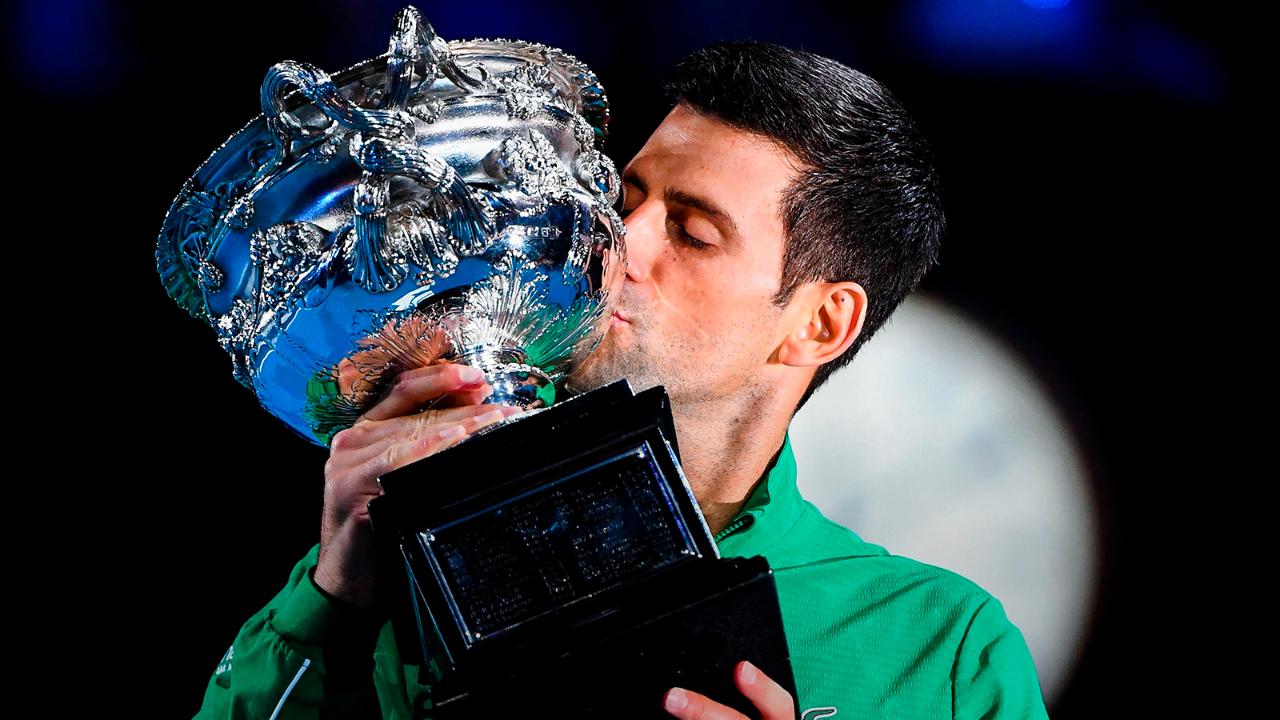
On a perfect night for tennis in Melbourne, with clear skies and an open roof in Rod Laver Arena, Novak Djokovic won his seventeenth Grand Slam singles title with a five-set victory over Dominic Thiem in the Australian Open men’s singles final Sunday. Once again, Djokovic proved himself unconquerable. He remains hungry and driven.

Djokovic’s 6-4, 4-6, 2-6, 6-3, 6-4 triumph that lasted four hours rewarded him with his eighth Norman Brookes Challenge Cup trophy and returned the Serbian to No. 1 in the world rankings.

“I’ve had (the) privilege to win this big tournament for eight times,” said Djokovic, 32, during his post-match press conference that didn’t start until the early hours of Monday morning. “To start off the season with a Grand Slam win significantly boosts your confidence and your expectations are quite high for the rest of the season. But whatever happens, this season is already successful.”

Djokovic arrived in Melbourne a fortnight ago after he won all of his singles matches and contributed significantly to Serbia’s triumph in the inaugural ATP Cup team title in Sydney. In the year’s first Grand Slam, which took place amid difficult circumstances from the blazing bush fires that blanketed much of southeastern Australia, the second-seeded Djokovic began a run of good form by dropping just one set before the final. En route, he beat No. 14 seed Diego Schwartzman in the fourth round, No. 32 seed Milos Raonic in the quarterfinals and No. 3 seed Roger Federer in a much-anticipated semifinal – all in straight sets – before the 26-year old Thiem, whom New York Times tennis columnist Christopher Clarey characterized as one “with thunder in his ground strokes and highlights in his dark hair,” pushed him to five sets in the title match. 

Although Thiem had won four of five previous matches against Djokovic – and built a two-sets-to-one lead Sunday thanks to stringing together six straight games at one point – he hadn’t beaten him on an outdoor hard court. This time, although No. 4 seed Thiem had some chances – especially when Djokovic began to struggle with both his consistency as well as his level of energy – the Austrian just couldn’t reach the finish line in time.

Thiem was broken in the third game of the decisive set and never quite recovered. His last chance to pull even came as Djokovic served at 4-3, 15-30. Then, the Serbian won the next three points to hold serve and the end drew nearer.

On this memorable night and in this particular final, Djokovic was at times defiant. To wit, twice he was cited for time violations. But always, Djokovic was tenacious – especially in long rallies – as he gutted out his victory over Thiem by serving nine aces and hitting 46 winners. 

With his latest major title, Djokovic moved to within three of Federer, the all-time leader with 20 Grand Slam titles, and he’s now two behind Rafael Nadal’s 19. Once again, the old guard fended off the new blood. However, one thing’s certain: Thiem proved he’s more than just a clay-court specialist. He can play heroically on hard courts. After all, Thiem beat No. 29 seed Taylor Fritz, No. 10 seed Gaël Monfils, top seed Nadal and No. 7 seed Alexander Zverev in his four matches leading up to Sunday’s final against Djokovic. Thiem also spent six hours more than Djokovic on court throughout the tournament.

“Huge congrats to Novak, an unreal achievement,” said Thiem, gracious in his remarks during the trophy ceremony. “You have helped to raise the level, and I’m proud and happy I can compete in this time and period of tennis.”

When it was Djokovic’s turn to address the crowd, he remarked: “This is definitely my favorite court, my favorite stadium in the world, and I’m blessed to hold this trophy once again.”

Then, looking toward Thiem as he spoke in a complimentary tone of voice, Djokovic said: “I would like to congratulate Dominic on an amazing tournament. It wasn’t meant to be tonight. But you were very close to winning. 

“You definitely have a lot more time in your career and I’m sure you’ll get more than one Grand Slam trophy in your career.”

Thiem, who was attempting to become the first new major winner since Marin Cilic won the 2014 US Open, fell short in a Grand Slam final for the third time in his young professional career. His Australian Open set back followed two previous defeats against Nadal in the finals of the 2018 and 2019 French Open.

“I think there’s not much to change,” Thiem said during his final Melbourne press conference. “In the last two sets, I definitely gave everything I had. Novak is part of three guys who are by far the best players who ever played tennis. If you play a Grand Slam final against him, it’s always going to be a match where small details are deciding.

“ ... It’s unique in sports history that the three best players by far are playing in the same ere a,” Thiem acknowledged. “That’s what makes it very, very difficult for players to break through.”

Indeed, Djokovic, along with Federer, 38, and Nadal, 33 – The Big Three of men’s tennis – have combined to win the past 13 majors. One has to go back to Stan Wawrinka’s 2016 US Open victory to find a Grand Slam winner other than Djokovic, Federer and Nadal. Wawrinka and Andy Murray, with three Grand Slams apiece, are the next best active players behind the Big Three. For sure, Djokovic isn’t quite ready to rest on his laurels. Not now, anyway. 

“Grand Slams are one of the main reasons why I am still competing and still playing full season, trying to obviously get the historic No. 1. That’s the other big goal,” Djokovic said. “I put myself in this position that is really good at the moment. I’m super happy with the way I started the season. It kind of sets the tone for the rest of the year.”

Original commentary written for Tennis-TourTalk.com.
Photo: Courtesy of Australian Open website.