Team World entered the final day of Laver Cup 2022 in London trailing four-time champion Team Europe 8-4 and needing to win three of four matches. While it wasn’t an impossible task, it would take everyone on John McEnroe’s Team World squad coming together and playing inspired and focused tennis on Sunday.
With each win worth three points, match by match, Team World turned this year’s Laver Cup upside down and won three straight matches – all with exciting outcomes – to win the Laver Cup title for the first time.
It was quite a weekend to remember in London, which drew more than 96,000 tennis enthusiasts to the O2 Arena, first to bid farewell to Roger Federer, then to see Novak Djokovic’s return to the ATP Tour after winning his seventh Wimbledon title, and, finally, to see Team World’s remarkable final-day comeback, in which Canada’s Felix Auger-Aliassime and Frances Tiafoe of the United States shouldered the load and carried the team on their shoulders to triumph.
Auger-Aliassime gave Team World the lead on the final day thanks to a pair of wins, first by partnering with Jack Sock to edge Matteo Berrettini and Andy Murray, 2-6, 6-3, 10-8, then by defeating Djokovic, 6-3, 7-6 (3). Next, Tiafoe, fought off four match points during a second-set tie-break to beat Stefanos Tsitsipas, 1-6, 7-6 (11), 10-8, which clinched the 13-8 victory for Team World.
When one considers what transpired, it’s pretty wild that a team with zero Grand Slam singles titles beat a team with 66 that featured Federer (20), Rafael Nadal (22), Djokovic (21) and Andy Murray (3). But that’s exactly what happened.
In praising his team during the trophy ceremony, Team World captain McEnroe said: “They brought the energy, belief and intensity.”
Later, McEnroe admitted: “It beats losing, that’s for sure. The difference was that we kept battling. There was a great team spirit. We knew we had a shot at it, but it was an uphill battle.”
While McEnroe likely would have been second-guessed for playing Auger-Aliassime back-to-back in Sunday’s first two matches – especially if the young, 21-year-old Canadian faltered against the veteran Djokovic, 35 – in hindsight it was a brilliant and tactical decision.
“This is something that’s discussed among all of us,” he said. “These guys know the ins and outs of what’s going to work best. Felix was ready for it, he had debuted last year, and now he was ready to step up to the big time.”
Auger-Aliassime said he enjoys the challenge that comes from playing in team events, “feeling I can bring something not only to myself but to the team. I feel like it pushes me also to stay positive, to dig deep, that feeling that I’m not only playing for myself, I’m trying to bring something to the team, bring a point to the team.”
Tiafoe added: “All week leading up I kept saying this was our year. The guys showed up. Felix beat Novak, Jack and Felix also played unbelievable doubles. We did it all together, it wasn’t just me.”
Coming off a semifinal run at the US Open, which boosted his ranking to a career-best World No. 19, Tiafoe has been playing some of the best tennis of his career. He said he would rank his Laver Cup-clinching victory over Tsitsipas among his best.
“To do it here in Laver Cup, to win for the first time, given how bad Mac wanted it, how bad everybody else wanted it, seeing what Felix and Jack did – I thought it was just time. It was time to get it done,” Tiafoe said during his team’s final press conference.
Looking back, as New York Times tennis correspondent Christopher Clarey suggested in a tweet Sunday evening, “[the] Laver Cup has proven that it is value added for tennis.
“Its future is up to the players. If the best ones commit to it consistently and continue to care about the outcome it will thrive.”
A postscript
Roger Federer said this year’s Laver Cup competition would remain special to him – especially the sendoff he received Friday evening after playing in the final match of his pro career.
“Being on court on Friday and having such a huge moment in my career, being surrounded by my biggest rivals like Novak and Andy and Rafa was truly unique, and I can never thank them enough for being there and staying there and going through it with me,” he said.
“I hope that their farewell will also be unique and special, that it works for them, because it was beautiful for me.”
As Novak Djokovic won his fourth straight Wimbledon Championships gentlemen’s singles title and seventh crown overall, which leveled him with his boyhood idol Pete Sampras, one quality among many stood out. He remained quietly focused – not to mention calm and cool – throughout the three-hour and one-minute final that took place on a sun-drenched, sold-out Centre Court Sunday afternoon. It was in stark contrast to his opponent, the chuntering Nick Kyrgios, who repeatedly lost his cool. You really didn’t expect anything else from the mercurial one, did you?
Yet, one can only wonder what if Kyrgios had kept his mouth quiet instead of incessantly chattering to himself, shouting at his entourage in his box, or at the tennis gods above – often using profanity-laced language not suitable for the ears of young eight-year-old Prince George of Cambridge, who was seated in the first row of the Royal Box in between his dad and mum, Their Royal Highnesses the Duke of Cambridge and Duchess of Cambridge. The Royal Box was also filled with plenty of tennis royalty, too. Among the notables were Hall of Famers Rod Laver, John Newcombe, Stan Smith, Chris Evert and Jan Kodes – all of them past Wimbledon champions from bygone years, back when decorum mattered.
As it happened, Djokovic won the final, 4-6, 6-3, 6-4, 7-6 (3), for his 21st Grand Slam singles title, which moved him one ahead of Roger Federer and placed him one behind Rafael Nadal. It was a fitting way for the Serbian great to celebrate his eighth wedding anniversary with his wife, Jelena. His two young children, Stefan, 7, and Tara, 4, have been in tow throughout the Wimbledon fortnight, too. Nothing like keeping it all in the family, right?
Djokovic managed to shut out the temper tantrums and overcame all of the obstacles Kyrgios could toss at him – including the booming 130 mile-per-hour first serves that produced 30 aces and helped contribute toward the 62 winners the Aussie hit. He also took advantage of the 33 unforced errors made by Kyrgios. Meanwhile, Djokovic, whose head was in the right place, put together a steady, steely and, at times, brilliant shotmaking performance that resulted in 15 aces and 46 winners. His serve was broken just once. He outpointed Kyrgios 132-112.
After securing victory in his 32nd career Grand Slam final – compared to just one final for Kyrgios – Djokovic, as has been his custom after winning Wimbledon on six previous occasions, pulled up a few blades of Centre Court grass to munch on. Djokovic’s winning streak on grass had extended to 28 matches, a streak that began in 2018.
At least, to his credit afterward, Kyrgios showed he could be polite. He shared a good laugh with Djokovic as the competitors walked off the court and was courteous and gracious in accepting his runner-up plate from the Duchess of Cambridge, who is the All England patron.
“He’s a bit of a god, I’m not going to lie,” Kyrgios said during his on-court interview with the BBC’s Sue Barker during the trophy ceremony. Kyrgios also made a point of thanking the ball kids, who put up with his antics over the past two weeks.
When the volatile and acrobatic Kyrgios, 27, was asked if he would return to the All England Club, he laughed at the thought and quipped: “Absolutely not. I’m set for life. Myself, my team, I think we’re all exhausted. We’ve played so much tennis. I definitely need a well-earned vacation after this. … Maybe, one day I’ll be here again, but I don’t know about that.”
Meanwhile, Djokovic, a member of the All England Club since winning his first Wimbledon title in 2011, definitely will be back. It’s like a home away from home for him. He also suggested that Kyrgios will be back, too. Say what you will, Kyrgios is good for box office and TV ratings.
“Nick, you’ll be back,” he said. “I know it’s tough to find consolation words after a tough loss like this, but you sowed why you deserve to be one of the world’s best, particularly on this surface.”
Djokovic added: “I never thought I was going to say so many nice things about you, considering the relationship. … It’s officially a bromance. Hopefully, this is the start of a wonderful relationship off the court as well.”
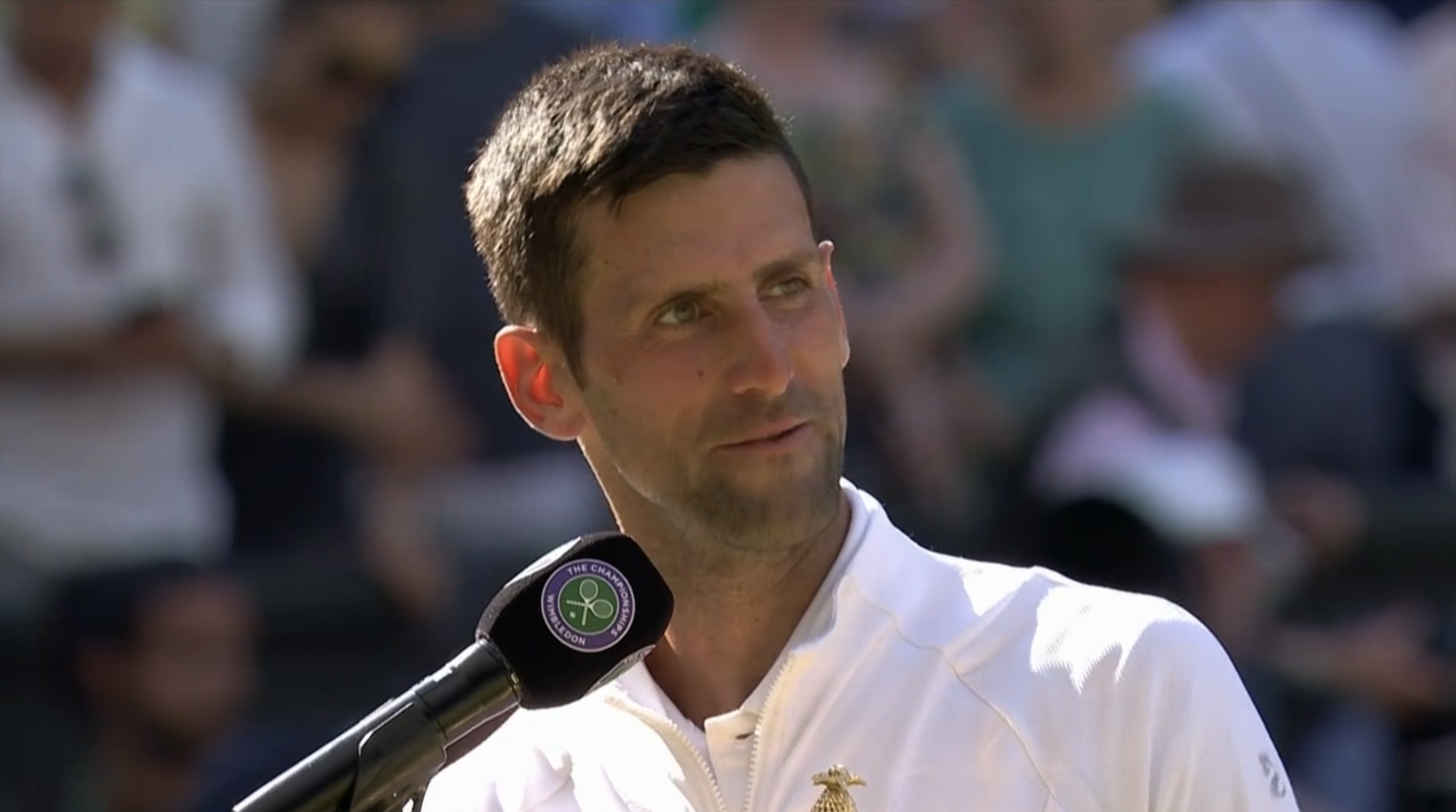
During his on-court remarks after lifting the Wimbledon champion’s trophy for the seventh time, the 35-year-old Djokovic got serious for a moment. “I lost words for what this tournament, what this trophy means to me, my family, my team,” he said. “It was the one that motivated me to play tennis. Then, he added: “It’s also a relief as well, considering what I’ve been through of course this year. It adds more value and more significance and more emotions, of course.”
A postscript
Novak Djokovic remains unvaccinated and, as such, he goes off to an uncertain future with the US Open looming next month. It’s likely he won’t get to play in the year’s final Grand Slam. That’s because the United States has a vaccine mandate that likely won’t be relaxed just for him. Currently, noncitizen nonresident internationals, such as Djokovic, aren’ allowed to enter the country if they aren’t vaccinated against COVID-19.
During his post-match news conference Sunday, Djokovic stood adamant about his decision not to get the required shots to be able to travel to the U.S. “Yeah, I mean, I’m not vaccinated and I’m not planning to get vaccinated,” he said. “So the only good news I can have is them removing the mandated green vaccine card – or whatever you call it – to enter [the] United States, or exemption.
“I don’t know. I don’t think exemption is realistically possible. If that is a possibility, I don’t know what exemption would be about. I don’t know. I don’t have much answer there. I think it’s just whether or not they remove this in time for me to get to U.S.A.”
At the same time, despite Djokovic’s Wimbledon triumph, he fell four slots in the new ATP rankings, released Monday, from No. 3 to No. 7. That’s because the ATP Tour didn’t award rankings points for this year’s Wimbledon because of the tournament’s ban on Russian and Belarusian players, which Wimbledon enacted because of Russia’s invasion of Ukraine earlier this year.
Looking ahead, Djokovic’s future remains uncertain, he’s still unbeatable on Wimbledon’s famed Centre Court.
Photo credits: Courtesy Wimbledon video.
A version of this blog previously appeared in Tennis-TourTalk.com.
“Victory belongs to the most tenacious,” are words inscribed in both English and French and appear on the upper-deck facing on either side of Court Philippe-Chatrier. They are very visible to players and fans alike. These words are attributed to French aviation and World War I hero Roland Garros, whose name is synonymous with the French Open. They serve as a reminder to those who play on the famed terre battue at Stade Roland Garros in Paris, the City of Lights.
On Sunday afternoon, Rafael Nadal, looking and playing unbeatable, won his 14th French Open title. He extended his remarkable men’s record of 22 major singles titles with 6-3, 6-3, 6-0 victory over Casper Ruud, 10 years his junior. Nadal won the last 11 games of the two hour, 18-minute title match before a sellout crowd of 15,000.
At the end of the day, the King of Clay reigned, again, 17 years to the day he hoisted his first Coupe de Mousquetaires trophy as a long-haired, 19-year-old teenager in toreador pants, after defeating Mariano Puerta. His latest triumph was filled with emotion and it was important to him, too.
Nadal was asked by NBC’s Maria Taylor during a post-trophy ceremony interview to describe what it felt like to hold the trophy this time. He replied: “It’s amazing, much more emotional than the first time. It’s completely unexpected for me to be where I am at this age, at this stage of my career. It means everything.
“I have been going through tough times the last couple of months. To have this trophy with me here is something unbelievable.”
Like the previous 13 times, the French Open served as Nadal’s wake-up call to the rest of the tennis world. Through the latest Parisian fortnight, Nadal became the third man in the Open Era to beat four Top-10 opponents in a single major. Three days after he celebrated his 36th birthday, Nadal became the oldest man to win Roland Garros, surpassing another Spaniard, Andrés Gimeno, who set the record at age 34 half a century ago.
Nadal extended his perfect record to 14-0 in Roland Garros finals, and also extended his record of most career major titles to 22, which now puts him two ahead of his closest rivals, Novak Djokovic, whom he beat in the quarterfinals, and Roger Federer, who is still recovering from knee surgery. Nadal solidified his place in the tennis Hall of Fame and his records will certainly be unbeatable for the foreseeable future, if at all.
During the trophy ceremony that followed Nadal’s latest French triumph, he expressed his appreciation and also thanked his legions of faithful fans, many whom were holding up banners and waving Spanish flags throughout the stadium.
“I for sure never believed I would be here at 36 being competitive again, playing in the most important court of my career one more time in the final,” Nadal said. “It means a lot to me, means everything. It just means a lot of energy to try to keep going.”
Indeed, Nadal kept going and his latest French Open title was an historic run for him and for tennis. He began with a trio of straight-set wins over Jordan Thompson of Australia, wild card Corentin Moutet of France, and No. 26 seed Botic van de Zandschulp of the Netherlands.
Then, Nadal came from behind to beat No. 9 seed Felix Auger-Aliassime of Canada in five sets, and followed it with a four-hour-plus, four-set victory over the World No. 1 and top seed Djokovic in the 59th renewal of their storied rivalry. On Friday, his semifinal against No. 3 seed Alexander Zverev was cut short when the German severely rolled his ankle and suffered ligament damage to his right foot that forced him to retire in the second set. Finally, the Spaniard mastered No. 8 seed Ruud, who was making his first Grand Slam final appearance. He won the last 11 games in a row and surrendered just eight total points to Ruud in the final set.
From first ball to last ball, Nadal showed great control and tolerated frustration. By the end, he showed how special a man he is. It’s not often that you get to perform in front of tennis royalty – among those who attended the final were Billie Jean King, Stan Smith, Stefan Edberg and Gustavo Kuerten – and monarchs, too. King Felipe VI of Spain and the the crown prince of Norway had front-row seats for Nadal’s coronation.
The 23-year-old Ruud, who made history by being the first male player from Norway to appear in a major final, has been a student at Nadal’s tennis academy in Mallorca, Spain, and Nadal has nurtured him. Ruud said in press after his semifinal victory over No. 20 seed Marin Cilic on Friday that Nadal was his childhood idol. He could even recite whom the champion beat in each of his 13 previous French Open title matches. Imagine Ruud’s surprise that the first time he would meet Nadal would be in a major final, the title match of the French Open.
Looking back on the experience, Ruud can be forgiven for struggling at times and not playing his best in the final. It’s not a surprise that trying to beat Nadal can turn dreams into nightmares. However, by the end of the match, all was good between the two competitors – both were cheerful and smiling – and Nadal had plenty of kind things to say about Ruud during the trophy ceremony after Ruud was highly complementary of Nadal.
“The most important thing is to congratulate Rafa,” Ruud said after receiving his runner-up trophy. “It is your 14th time here and 22nd [title] at Grand Slams. We all know what a champion you are and today I got to feel how it is to play against you in the final and it is not easy. I am not the first victim; I know there have been many before.
“To you Rafa, your team, your family. You have taken me into your academy with open arms. So, thank you a lot. You are a true inspiration to me and everyone who follows tennis around the world. We all hope you will continue for some more time.”
Soon, when it was Nadal’s turn to give his valedictory speech, he said: “I don’t know what can happen in the future but I’m going to keep fighting to try to keep going.” The applause that followed was deafening but sincere. Plenty of cheers of “Rafa! Rafa! Rafa!” were audible throughout Court Philippe-Chatrier.
After, when Nadal addressed the media in his final Roland Garros news conference, he said that for him, having the Coupe de Mousquetaires next to him, again, meant everything.
“It has been an emotional victory, without a doubt,” he said. “Unexpected in some ways. I am very happy. It has been a great two weeks. I played from the beginning, improving every day. Finishing by playing a good final. I am super happy and can’t thank everybody enough for the support since the first day that I arrived here. It is very emotional.”
Additionally, Nadal said that it was not his intention to continue to play in tournaments with pain-killing injections that numbed his chronically-injured left foot, like he did in Paris to combat his condition known as Müller-Weiss syndrome.
“Everybody knows how much this tournament means to me,” Nadal expressed. “That was the only way to give myself a chance here, no? So, I did it. And I can’t be happier and I can’t thank enough my doctor for all the things he did during all my tennis career, helping me in every tough moment. But it’s obvious that I can’t keep competing with the foot asleep.”
Nadal ruled out taking further painkilling injections in order to play Wimbledon, which begins June 27. Instead, he will seek an alternate means to be able to play pain free. For now, Nadal declined to rule out playing Wimbledon. He still has the desire to compete, to fight. It’s in his DNA.
“It’s not about being the best [in] history. It’s not about the records,” Nadal stressed. “It’s about what I do. I like to play tennis. And I like the competition. As I said a couple of times in the past, and is not a thing that I repeat, is not the thing that I don’t feel for me, we achieved our dreams. Me, Roger, Novak, we achieved things that probably we never expected.
“For me, what drives me to keep going is not about the competition to try to be the best or win more Grand Slams than the others. What drives me to keep going is the passion for the game, live moments that stay inside me forever, and play in front of the best crowds in the world and the best stadiums.”
For now, we can appreciate the remarkable and incredible 2022 season Nadal has enjoyed thus far – a 30-3 win-loss record and four ATP Tour titles won – and hope there are more historic days ahead. After all, there were fewer finer hours than Sunday in Paris, a place that has always been unique for Nadal. This time, he ended his latest title victory by solidly hitting his 37th winner of the match, a beautiful down-the-line backhand that landed in the sunshine end of the court. It lifted Nadal’s all-time mark at Roland Garros to an astonishing 112-3. The outcome allowed him, once again, to wear his emotions on his sleeve for all of the world to bear witness.
Indeed, the King of Clay will always have Paris.
An alternate version of this first appeared in Tennis-TourTalk.com.
On a perfect night for tennis in Melbourne, with clear skies and an open roof in Rod Laver Arena, Novak Djokovic won his seventeenth Grand Slam singles title with a five-set victory over Dominic Thiem in the Australian Open men’s singles final Sunday. Once again, Djokovic proved himself unconquerable. He remains hungry and driven.
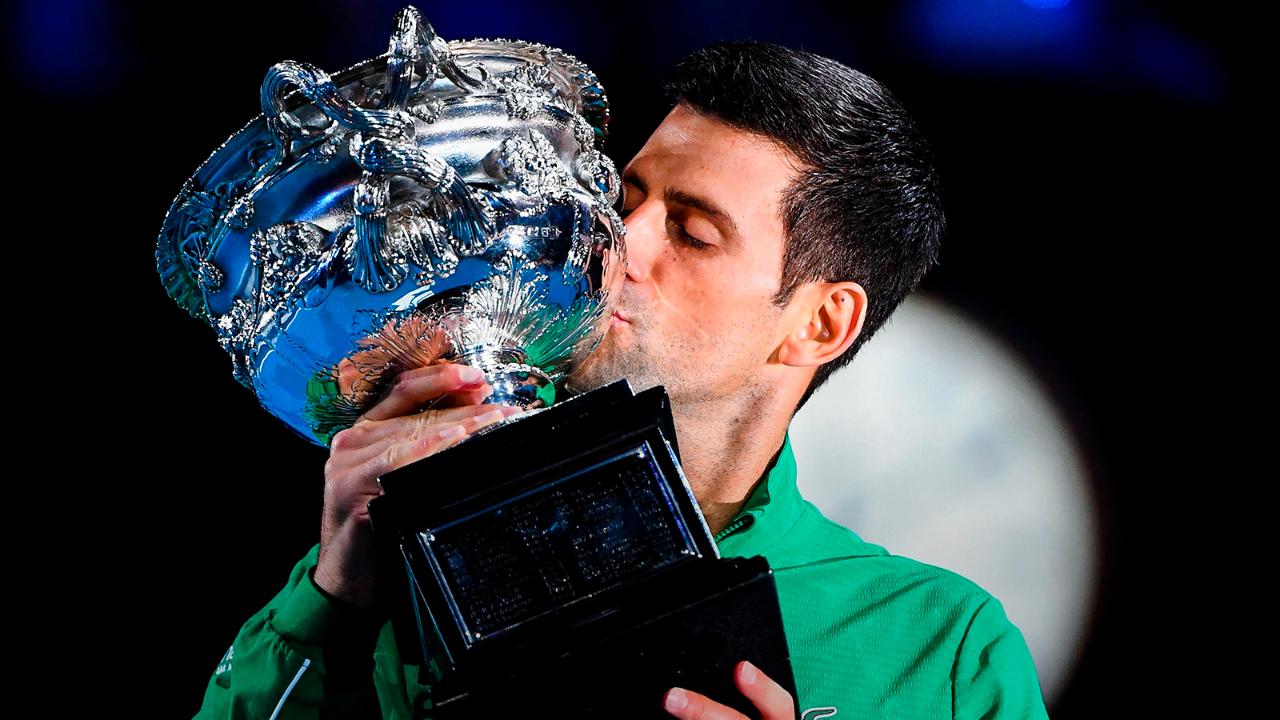
Djokovic’s 6-4, 4-6, 2-6, 6-3, 6-4 triumph that lasted four hours rewarded him with his eighth Norman Brookes Challenge Cup trophy and returned the Serbian to No. 1 in the world rankings.
“I’ve had (the) privilege to win this big tournament for eight times,” said Djokovic, 32, during his post-match press conference that didn’t start until the early hours of Monday morning. “To start off the season with a Grand Slam win significantly boosts your confidence and your expectations are quite high for the rest of the season. But whatever happens, this season is already successful.”
Djokovic arrived in Melbourne a fortnight ago after he won all of his singles matches and contributed significantly to Serbia’s triumph in the inaugural ATP Cup team title in Sydney. In the year’s first Grand Slam, which took place amid difficult circumstances from the blazing bush fires that blanketed much of southeastern Australia, the second-seeded Djokovic began a run of good form by dropping just one set before the final. En route, he beat No. 14 seed Diego Schwartzman in the fourth round, No. 32 seed MilosRaonic in the quarterfinals and No. 3 seed Roger Federer in a much-anticipated semifinal – all in straight sets – before the 26-year old Thiem, whom New York Times tennis columnist Christopher Clarey characterized as one“with thunder in his ground strokes and highlights in his dark hair,” pushed him to five sets in the title match.
Although Thiem had won four of five previous matches against Djokovic – and built a two-sets-to-one lead Sunday thanks to stringing together six straight games at one point – he hadn’t beaten him on an outdoor hard court. This time, although No. 4 seed Thiem had some chances – especially when Djokovic began to struggle with both his consistency as well as his level of energy – the Austrian just couldn’t reach the finish line in time.
Thiem was broken in the third game of the decisive set and never quite recovered. His last chance to pull even came as Djokovic served at 4-3, 15-30. Then, the Serbian won the next three points to hold serve and the end drew nearer.
On this memorable night and in this particular final, Djokovic was at times defiant. To wit, twice he was cited for time violations. But always, Djokovic was tenacious – especially in long rallies – as he gutted out his victory over Thiem by serving nine aces and hitting 46 winners.
With his latest major title, Djokovic moved to within three of Federer, the all-time leader with 20 Grand Slam titles, and he’s now two behind Rafael Nadal’s 19. Once again, the old guard fended off the new blood. However, one thing’s certain: Thiem proved he’s more than just a clay-court specialist. He can play heroically on hard courts. After all, Thiem beat No. 29 seed Taylor Fritz, No. 10 seed Gaël Monfils, top seed Nadal and No. 7 seed AlexanderZverev in his four matches leading up to Sunday’s final against Djokovic. Thiem also spent six hours more than Djokovic on court throughout the tournament.
“Huge congrats to Novak, an unreal achievement,” said Thiem, gracious in his remarks during the trophy ceremony. “You have helped to raise the level, and I’m proud and happy I can compete in this time and period of tennis.”
When it was Djokovic’s turn to address the crowd, he remarked:“This is definitely my favorite court, my favorite stadium in the world, and I’m blessed to hold this trophy once again.”
Then, looking toward Thiem as he spoke in a complimentary tone of voice, Djokovic said: “I would like to congratulate Dominic on an amazing tournament. It wasn’t meant to be tonight. But you were very close to winning.
“You definitely have a lot more time in your career and I’m sure you’ll get more than one Grand Slam trophy in your career.”
Thiem, who was attempting to become the first new major winner since Marin Cilic won the 2014 US Open, fell short in a Grand Slam final for the third time in his young professional career. His Australian Open set back followed two previous defeats against Nadal in the finals of the 2018 and 2019 French Open.
“I think there’s not much to change,” Thiem said during his final Melbourne press conference. “In the last two sets, I definitely gave everything I had. Novak is part of three guys who are by far the best players who ever played tennis. If you play a Grand Slam final against him, it’s always going to be a match where small details are deciding.
“ ... It’s unique in sports history that the three best players by far are playing in the same ere a,” Thiem acknowledged. “That’s what makes it very, very difficult for players to break through.”
Indeed, Djokovic, along with Federer, 38, and Nadal, 33 – The Big Three of men’s tennis – have combined to win the past 13 majors. One has to go back toStan Wawrinka’s 2016 US Open victory to find a Grand Slam winner other than Djokovic, Federer and Nadal. Wawrinka andAndy Murray, with three Grand Slams apiece, are the next best active players behind the Big Three. For sure, Djokovic isn’t quite ready to rest on his laurels. Not now, anyway.
“Grand Slams are one of the main reasons why I am still competing and still playing full season, trying to obviously get the historic No. 1. That’s the other big goal,” Djokovic said. “I put myself in this position that is really good at the moment. I’m super happy with the way I started the season. It kind of sets the tone for the rest of the year.”
Original commentary written for Tennis-TourTalk.com.
When Novak Djokovic won his ninth consecutive match on hard courts against Rafael Nadal in a pivotal singles rubber between Serbia and Spain at the ATP Cup final Sunday night, he continued the mastery he’s enjoyed over the World No. 1 by winning 19 consecutive sets going back to the 2013 US Open final.
Djokovic’s 6-2, 7-6 (4) win over Nadal inside a packed and loud Ken Rosewall Arena leveled the inaugural ATP Cup final at 1-1 and overturned the momentum Spain had established when Roberto Bautista Agut gave his country a 1-0 lead following his 7-5, 6-1 win over Dusan Lajovic in the opening rubber. Djokovic extended his ATP Cup singles unbeaten streak to six and improved his career head-to-head record against Nadal to 29-26.
It also meant the first ATP Cup, which began with 24 teams playing in three Australian cities amid the country’s blazing bushfires and ended with the final two in Sydney at the end of the 10-day tournament, would come down to a winner-take-all live doubles rubber that would decide which country would lift the title trophy. What a way to start the 2020 tennis season!
Looking back, Djokovic dominated Nadal from the beginning of their one hour and 55 minute match. He put the Spaniard on the defensive, both with his returns and during some prolonged and grueling rallies. After Djokovic broke Nadal in the opening game and later in the seventh game of the first set, he hit four consecutive aces to close out the first set. Djokovic maintained his level of intensity in the second set – he would finish with 12 aces and win 84 percent (41 of 49) of his first-serve points – and forced Nadal into a defensive posture that took him out of his comfort zone. As Djokovic later recalled, “I started the match perfectly with everything working for me.
“I was trying to take away as much time as possible from him. I was serving very well, definitely the best serving match I had in the tournament. Just extremely satisfied with the way I performed.”
Djokovic outpointed Nadal 75-59 and saved five of five break points.
Nadal was matter of fact in his assessment: “Happy the way that I was able to compete. I had my chances. I was very close. Not happy with the loss, of course, but the feeling in that second set is positive.”
Now, with plenty of flag-waving fans repping both countries and with the arena’s namesake, Australian Hall of Famer Ken Rosewall in attendance, it was game on for the champion’s trophy.
While Spain opted not to play Nadal in doubles because he had run out of energy, Djokovic still had something left in the tank to offer Serbia. He was in the Serbian doubles lineup, where he teamed with his longtime friend and teammate Viktor Troicki. Together, they proved clutch against Pablo Carreño Busta and Feliciano Lopez of Spain and won the decider, 6-3, 6-4.
“We won against a really, really good doubles team,” Djokovic said during Serbia’s team press conference. “It was a surprise that Nadal was not on the court, but nevertheless, we had to do the job and the job was done very well.”
Throughout, Team Serbia received tremendous and loud fan support, especially in Sydney, where there is a large Serbia population – and Djokovic fed off of the energy that their vocal cheers of “No-le” and “Ser-bia” created. As New York Times tennis correspondent Ben Rothenberg tweeted, “Every Serbia match felt like a home game, both in Brisbane and Sydney.”
“I’ve never experienced an atmosphere like this on a tennis court. ... You carried us to victory and we owe you a big, big thanks,” Djokovic said during the trophy ceremony in thanking the Serbian fans. “We are part of an individual sport where we play by ourselves. But even when we were playing singles, it never felt like it was only you out there. You always have a team in your corner giving you strength and focus. This was the highlight of the competition, along with the support of fans and the flags.”
As soon as Djokovic served out the final game of the match and the tournament, his Serbian teammates and their captain, Nenad Zimonjic, sprinted from the team zone on to the court and surrounded him and Troicki. Together, they broke into a celebratory group hug that was both genuine and giddy – and thoroughly enjoyable to see.
“I’ll remember this experience for the rest of my life as definitely one of the nicest moments in my career,” said Djokovic following his team’s jubilant celebration. That says something coming from the 16-time Grand Slam champion who will begin his title defense of the Australian Open next week in Melbourne. Djokovic has lifted the Norman Brookes Challenge Cup seven times.
“Ive been very fortunate and blessed to have an amazing career the last 15 years, but playing for the team, playing for the country with some of my best friends for a long time, you can’t match that. That’s just too special.”
A version of this story first appeared on Tennis-TourTalk.com.
Screenshot photo courtesy of ATP world video stream.
Throughout the gentlemen’s singles final at the Wimbledon Championships Sunday, the margins were so small, the tension and excitement of a five-hour classic so great. It didn’t matter who won or lost. Novak Djokovic and Roger Federer entertained the world their excellence, in which the winner saved two match points and the outcome was decided in a first-of-its-kind tiebreaker.
The No. 1 seed Djokovic, 32, captured his fifth Wimbledon crown and his 16th Grand Slam title overall, outlasting the 37-year-old Federer 7-6 (5), 1-6, 7-6 (4), 4-6, 13-12 (3). The fifth set, alone, which was decided by a 12-games-all seven-point tie break, lasted two hours.
For much of the match, it was Federer who seemed to be the better player on Centre Court. But in the end, although he was on top of most of the statistical categories – which one Twitter pundit likened to winning the policy debates and popular vote in a U.S. presidential election, but ultimately losing to the Electoral College count – statistics didn’t count for a thing.
The latest Djokovic-Federer clash had something for everyone. It was tense, it was brilliant, it was bold, it was baffling, it had star power. It had royalty, movie stars, dot.com titans and Hall of Famers watching from the Royal Box. At times, Federer’s wife, Mirka, could be seen – picked up by the BBC cameras – with her head buried in her hands, too nervous and unable to look up at the action down on the court. Other times, Djokovic’s mother, Dijana, was shown clutching a religious pendant with both hands, perhaps, seeking divine intervention. Interspersed, there was plenty of superior, high-quality play displayed by both superstars. Each took time looking for weaknesses in each other’s game. There was much creative shotmaking throughout by both Federer and Djokovic to appreciate. Long, back-and-forth rallies were plentiful and not uncommon.
At times, both played like they were the best player in the world. Djokovic is the current No. 1 and Federer is a longtime former No. 1, who is currently ranked third. In losing, Federer came close to winning. In the fifth set, he had two championship points on his racquet, serving for the match at 8-7, 40-15, and was unable to convert either of them into his ninth Wimbledon singles championship, which would have tied him with Hall of Famer Martina Navratilova. He won 36 games during the match to 32 for Djokovic. He hit 94 winners compared to 54 for Djokovic. He hit more aces, 25-10, converted seven of 13 break point chances and, more often than not, controlled many of the points until he didn’t.
When he was asked during his post-match interview session what went wrong at the critical point of the championship match, Federer said simply, “One shot I guess. Don’t know which one to pick. Your choice.”
However, in the tightest moments of the match – the three tie-break deciders that came in the first, third and fifth sets – Djokovic reigned supreme. He proved more mentally fit and physically tougher. Meanwhile, Federer made some questionable decisions in each of the tie breaks, and each time, they came back to haunt him.
“I thought most of the match I was on the back foot,” Djokovic said during his news conference about beating Federer for the third time in a Wimbledon final. “I was defending. He was dictating the play. I just tried to fight and find a way when it mattered the most, which is what happened.”
In the end, on Djokovic’s championship point, Federer shanked a return high into the air – and it cost him dearly. The native of Belgrade, Serbia won the match and his fifth Wimbledon crown, not because he was necessarily the best player on Centre Court Sunday. Instead, Djokovic played the best when he needed to the most.
Roger Federer / Post-match news conference
Reflecting on what might have been, Federer said, “I just feel like it’s such an incredible opportunity missed, I can’t believe it.”
Federer was asked how his latest Grand Slam setback at Wimbledon compared to his epic 2008 loss to Rafael Nadal. “This one is more straightforward maybe in some ways because we didn’t have the rain delays, we didn’t have the night coming in and all that stuff,” he recalled. “But sure, epic ending, so close, so many moments. I mean, sure there’s similarities. But you’ve got to go dig, see what they are. I’m the loser both times, so that’s the only similarity I see.”
And what did Djokovic think of winning his 16th career major after being on the brink of defeat? “It was kind of a flashback,” he said, remembering that he saved two match points against Federer in the semifinals at the U.S. Open in both 2010 and 2011. “But look, in those kind of moments, I just try to never lose self-belief, just stay calm, just focus on trying to get the ball back, return, which wasn’t serving me very well today.”
Djokovic called his latest classic encounter with Federer, which was his fifth straight win over the Swiss star and fifth straight in Grand Slam play, “the most mentally demanding match” of his career. While he said that his nearly-six hour 2012 Australian Open final against Nadal was “the most physically demanding match” he’s ever played, against Federer Sunday, “mentally this was a different level because of everything.
“You need to be constantly playing well throughout five hours if you want to win a match like this. I guess there is an endurance part. But I think there is always this self-belief. You have to keep reminding yourself that you’re there for a reason and that you are better than the other guy.”
Photos: Courtesy of Wimbledon.com. Video: Courtesy of Wimbledon Twitter.
Are Rafael Nadal and Novak Djokovic being used as sporting pawns?
The boldfaced headline in Thursday’s Times of London newspaper spoke loudly: “Novak Djokovic and Rafael Nadal warned over Saudi Arabia event.” In a story by tennis correspondent Stuart Fraser, he wrote that the two tennis superstars “have been warned that their participation in a lucrative exhibition in Saudi Arabia in December could be used used by the country’s controversial regime as ‘a form of sportswashing.’”
While Saudi Arabia has always been viewed as a prominent destination for conducting global big business, tennis – I have learned – is part of a growing Saudi sports propaganda program. Mind you, Saudi Arabia has little or no history when it comes to professional sports. Besides tennis, it has shown recent interest in bringing motor racing, boxing, football – even pro wrestling – to the Arab empire.
Now is the time for Nadal and Djokovic, currently ranked No.1 and No. 2 in the world, to use their global popularity to bring attention to the “truly appalling” human rights record of Saudi Arabia, warns Amnesty International. The world human rights organization made its plea in the aftermath of the disappearance and murder of Saudi journalist Jamal Khashoggi, who for the past year had been writing global op-ed pieces for the Washington Post while living in exile in the United States. Many of Khashoggi’s writings were critical of Crown Prince Mohammed bin Salman and the Saudi royal family.
A day after news about Khashoggi’s disappearance surfaced, a tennis exhibition match billed as the King Salman Tennis Championship in Jeddah, between Nadal and Djokovic, was announced. The financially attractive, end-of-the-year exhibition scheduled for December 22, would see each participant make at least $1 million. Under the present circumstances, it would seem to fly in the face of their humanitarian outlook.
Since the news about Khashoggi emerged, dozens of global business and media conglomerates have withdrawn from attending an upcoming international conference in Riyadh, billed as the Future Investment Initiative – among them: Bloomberg, CNBC, CNN, the Financial Times, the New York Times, the Los Angeles Times, Viacom and the World Bank president, Jim Yong Kim.
In a recent sports blog for The Guardian of London, sports writer Kevin Mitchell notes “the two players appear to have remained deaf to growing clamor over seeming endorsement of Saudi Arabia.” He calls both Nadal and Djokovic “men of conscience and integrity,” but warms they “continue to risk their good name by accepting an invitation to play in a meaningless exhibition in Saudi Arabia, a regime under critical scrutiny for the disappearance of the journalist Jamal Khashoggi.”
(Since the publication of Mitchell’s blog, early Saturday Saudi Arabia confirmed that Khashoggi was dead. He was killed inside the Saudi consulate in Istanbul, Turkey.)
Indeed, I agree with Mitchell. Perhaps, it’s as if both players are waiting for the international embarrassment to pass. Yet, I have to wonder if either is oblivious to the growing criticism that’s gathering around them. Or, simply, are they ignorant of the seriousnous of the greater issue?
“Neither is a good look for athletes who have always been aware of their wider responsibilities,” writes Mitchell. After all, both have foundations that help disadvantaged youth through tennis. Plus, Nadal was widely seen – thanks to social media – helping clear debris in his native Majorca after recent floods hit the Spanish island, and Djokovic has been active in campaigning for flood relief in his home country of Serbia. Bottom line: both Nadal and Djokovic are decent gentlemen.
In hindsight, one wonders whatever possessed Nadal and Djokovic to agree to play in the Saudi exhibition in the first place? Certainly, they don’t need the money. Although December exhibitions in various corners of the world are common and bring the sport to cities not already on the ATP World Tour schedule, the tennis season is already much too long. Pulling out now would make a statement about how the world should view Saudi Arabia’s behavior and pattern of state-sanctioned killing.
I would hate to see Nadal and Djokovic continue to be used as sporting pawns – displayed before a world-wide audience – flaunted by the Saudi government to distract us from their murderous regime. They need to break their silence now.
Wimbledon Centre Court / The thrill of victory on the most famous rectangle in tennis.
One year ago, Novak Djokovic left Wimbledon injured and uncertain of his future. On Sunday, the Serbian left the All England Club as the 2018 Wimbledon gentlemen's singles champion for the fourth time. As a further reward, he even got to share a dance with this year's ladies' singles champion, Angelique Kerber, at Sunday night's Champions' Dinner.
While the past couple of years have seen some dark, barren times for the 13-time Grand Slam champion, his 6-2, 6-2, 7-6 (3) win over 32-year-old Kevin Anderson of South Africa in this year's Wimbledon final proved without a doubt that Djokovic is back – and, now, he's the newly ranked No. 10 player in the world.
Meanwhile, Anderson's memorable fortnight, which included a five-set victory over No. 1 seed Roger Federer in the quarterfinals that propelled him toward reaching his second Grand Slam final in less than a year, lifted him to No. 5 in the latest ATP rankings.
"Even though today is not the result I was looking for, I think in the next few days, just seeing my new career-high ranking is going to mean a lot to me," said Anderson during the trophy presentation following Sunday's final. "Looking back at some of the matches, especially my quarterfinal and semifinal match, it will really set, in what I've accomplished. I can be happy with that and use it for continued motivation."
At No. 21, Djokovic became the lowest-ranked male to win Wimbledon since Goran Ivanisevic won in 2001 while ranked No. 125.
Novak Djokovic celebrates his Wimbledon victory by waving to his family.
While the 12th-seeded Djokovic's victory, which came a day after his epic five-set semifinal win over World No. 1 Rafael Nadal, lifted him back into the Top 10, it's worth asking: just how good was Djokovic during this Wimbledon fortnight? Does this put him in the right frame of mind with the United States Open just a few weeks away? Can Djokovic win any more majors?
Tackling these pressing questions one at a time, Djokovic remains the best returner in men's tennis, bar none, and it made a big difference against the 6-foot-8 Anderson, who was hobbled by mental and physical fatigue brought on from his six plus-hour marathon semifinal on Friday against John Isner, in which the fifth set alone was stretched to 50 games (26-24 in favor of Anderson) and lasted nearly three hours alone. Understandably, the personable giant, who is one of the nicest and most polite professionals on tour, had little left for the final. Indeed, by winning Wimbledon, it gives Djokovic a big psychological boost heading into the North America hard court season leading up to the United States Open, which begins the final week of August. And yes, if Federer can still win Grand Slams at age 36, there's no reason that Djokovic can't win a few more, too – he's just 31.
The past couple of years have seen a decline in Djokovic's desire – not to mention turmoil among his coaching team – coupled with a serious injury to his right elbow that required surgery following this year's Australian Open. On Sunday, it was great to see the champion, nicknamed "Nole," back on Centre Court playing in a Grand Slam final, reunited with his longtime coach Marian Vajda who sat perched in the players' box just above Centre Court. Djokovic played solid-if-not-patient tennis throughout much of the two hour and 19 minute match. He won 76 percent (52 of 68) of his first-serve points, hit 20 winners against 13 unforced errors and broke his opponent four times in four tries. Although Anderson finished with 10 service aces and hit 26 winners, he committed 32 unforced errors and was zero-for-seven in break-point conversions. Djokovic outpointed Anderson 100-74.
On match point, with Djokovic serving at 6-3 in the third set tie-break, he forced Anderson into netting a forehand return. The final was over. After meeting Anderson at the net to shake hands and exchange pleasantries, Djokovic lifted his arms in triumph – much to the delight of the cheering crowd. Soon after, the new champion knelt down to nibble a few blades of grass in celebration – giving a literal interpretation to tasting victory.
Three-year-old Stefan Djokovic, secure in the arms of his mother, Novak Djokovic's wife Jelena, during the trophy ceremony.
Shortly after the ancient silver gilt cup that is awarded to the winner was solidly in Novak's hands, the BBC's cameras quickly cut to Djokovic's box where the charming sight of his three-year-old son, Stefan, secure in the arms of his mother, Djokovic's wife Jelena, applauded his papa's accomplishment.
"It feels amazing – the first time in my life I have someone screaming 'Daddy! Daddy!'," said Djokovic, beaming a smile during his on-court interview with the BBC's Sue Barker.
"I'm very emotional with him being there, and my wife and while team. I cherish this moment."
Polite and gracious, Djokovic continued: "I would like to congratulate Kevin. I was quite lucky to get through. I'm very grateful to everyone who has been supporting me. The last couple of years haven't been easy, facing for the first time a severe injury. I had many moments of doubt and didn't know if I could come back. But there's no better place in the world to make a comeback. I always dreamed of holding this trophy as a boy. This is a sacred place for tennis. It's very special."
Indeed, as Djokovic showed everyone on Sunday, there's no better place in the world than Centre Court at Wimbledon – the most famous rectangle in tennis – to make a comeback.
The 21st World Cup of football – the international variety not the American kind – is one of the biggest quadrennial sporting events in the entire world. It began last week in Russia and it's set to distract sports fans across Planet Earth through Sunday, July 15, which happens to be the same day as the gentlemen's singles final at Wimbledon.
Speaking of tennis, it's not a surprise that many of the world's best tennis professionals are showing an avid interest – an emotional involvement, if you will – in the World Cup tournament. After all, it's probably the pipe dream of many players that if they weren't carving out a nice career on tennis courts while globe trekking around the world, they would be sporting their skills playing the "beautiful game" on grassy pitches and in front of thousands of die-hard football fans.
When it comes to the World Cup, I've learned, it's okay for players to become emotionally involved and to have a sense of fighting spirit – not only for their team, but for everyone in the entire country.
Last Sunday, after he won the MercedesCup tournament in Stuttgart, Germany, for his 98th career title, Roger Federer tweeted a photo of himself driving home to Basel, Switzerland via the German autobahn. His tweet read: "Made it back home on time to watch Switzerland vs. Brazil. Great effort team Switzerland, good luck Brazil for the rest of the way."
Roger Federer/Driving on the German autobahn.
Elena Vesnina of Russia, ranked No. 1 in the world in doubles with her partner Ekaterina Makarova, was in attendance for the World Cup opener between host Russia and Saudi Arabia in Moscow's Luzhniki Stadium on June 14. She produced live content for the WTA's Instagram feed.
Speaking of which, an Instagram video posted by the WTA has drawn a lot of position attention. The WTA tweeted: "The #FIFAWorldCup is here! #WTA stars will be watching ... Will you?"
The one-minute video shows a variety of WTA stars, including Vesnina, Simona Halep of Romania, Caroline Garcia of France, Karolina Pliskova and Petra Kvitova of the Czech Republic, Daria Kasatkina of Russia, Caroline Wozniacki of Denmark, Anastasija Sevastova and Jelena Ostapenko of Latvia, Johanna Konta of Great Britain, Madison Keys of the United States, and Julia Goerges of Germany. Each is shown trying their skills at dribbling and passing a football. Clearly, their talent has no limits, does it?
Meanwhile, Germany's Andrea Petkovic tweeted a list of things that she likes about the World Cup: "1. No more awkward silences in elevators with strangers. 2. Always something to watch on TV. 3. Iceland and their chiseled chins. 4. Hair fashion."
Last weekend, Kristina Mladenovic of France tweeted, "ALLEZ LES BLEUS" in support of her country's entry in the World Cup. France beat Australia in its opener.
Among the men, Rafael Nadal, long a fan of Real Madrid in the Spanish League, is leading the cheers for Spain – of course – and Novak Djokovic has a vested interest in Serbia. Also, Tunisia's Malek Jaziri, a long-time football fan, is cheering for his home country's team from afar while competing in Halle, Germany this week at the Gerry Weber Open.
According to David Law of BBC5 Live and co-host of "The Tennis Podcast," of all of the Fever-Tree Championships player lounge World Cup player goal celebrations so far, those of Novak Djokovic and his team "are the most ecstatic by far. Basically, he did a lap of the entire room."
Djokovic has built up a good relationship with several of the Serbia World Cup team and often picks their brains about different ways to improve his training regime. In a press conference on Sunday before the start of the Fever-Tree Championships at Queen's Club in London, Djokovic, who is an avid fan of the Serbian national team that won its opener over Costa Rica, insists he would happily miss a first appearance for Serbia in the World Cup final if it means he is back in the Wimbledon men's title match.
Fortunately, it appears the World Cup final match has a later kick off time than the start for the Wimbledon men's singles final, but only by a couple of hours. Otherwise ...
"Really? I didn't know that. Wow," said Djokovic. "Ive been fortunate to win Wimbledon three times and play well there. If that happens I would obviously be very happy to miss the World Cup final."
Cover photo: Courtesy of TennisTV Twitter feed. Roger Federer photo: Courtesy of Roger Federer Twitter feed.
Novak Djokovic / Kissing the Coupe, basking in the glory of tennis history.
What more could you ask for – No. 1 playing No. 2, Novak Djokovic versus Andy Murray. At stake was an opportunity for one player to be the first in 47 years to hold all four Grand Slam titles at once, while for the other it was a chance to be the first British male player since Fred Perry in 1935 to be champion of Roland Garros. Neither had won the French Open before. On Sunday, one of them would win, and when they did, they would get to hoist the Coupe de Mousquetaires, one of the great and exciting moments in tennis.
Pour le gagnant va la Coupe. À votre santé!
At Roland Garros, the Parisian crowd loves to embrace its winners.
As evening began to fall over Court Philippe Chatrier, it became apparent to everyone witnessing the spectacle in person as well as to a world-wide television audience that this Grand Slam was Djokovic's to win. After losing in the final three of the last four years, Djokovic finally had reason to feel joyous. He finally got to experience the thrill of victory instead of the agony of defeat when he beat Murray, 3-6, 6-1, 6-2, 6-4, to win the title.
When the last point had been played, Djokovic became the eighth man to complete a career Grand Slam in tennis – and the first since the iconic Rod Laver of Australia in 1969 to hold all four of the Grand Slam singles titles at the same time – when he won the 2016 French Open. Call it a Djoker Slam, if you wish. Soon, he used his tennis racquet to create a heart in the clay, then promptly lay down inside of it spread eagle, happy, and smiling all the while.
"It's a very special day, perhaps the biggest moment of my career," Djokovic, a 29-year-old from Serbia, said in French to what New York Times tennis columnist Christopher Clarey described as "the tough-to-conquer Parisian crowd that had gradually come to embrace him and his quest."
In witnessing Djokovic's historic four-set victory over Murray, Clarey wrote of the World No. 1: "He is quite a conundrum for the opposition with his elastic ground strokes, big serve and world-class returns. He can make a tennis court look dauntingly cramped as you face him across the net."
Gracious in defeat, Murray, the No. 2 seed from Great Britain, said of Djokovic: "This is his day today. What he's achieved in the last 12 months is phenomenal. Winning all four of the Grand Slams in one year is an amazing achievement. it's something that is so rare in tennis. You know it's not happened for an extremely long time, and it's going to take a long time for it to happen again. Everyone here who came to watch is extremely lucky to see it."
The champion and the Coupe / Djokovic enjoys the day after in Paris.
Each year in late spring, the French Open in Paris serves as a grading period – a report card if you will – for professional tennis. It's the second of the year's four Grand Slam events – the others are the Australian Open in January, Wimbledon in late June and the U.S. Open in August near the end of summer – and all the big names in men's professional tennis except 17-time Grand Slam winner Roger Federer, seeded third, who pulled out with a back injury, came to famed Roland Garros to complete for the Coupe.
Soon after, No. 4 seed Rafael Nadal, himself the owner of 14 Grand Slam titles – including nine at Roland Garros – pulled out just before his third-round match with an injury to his left wrist that he developed coming into the tournament. His status for Wimbledon remains uncertain. So, it was left to Djokovic and Murray, among the Big Four, to carry on the fight to the end while dodging many rain delays – and worthy opponents, including last year's champion Stan Wawrinka – along the way during the second week of the fortnight. To the amazement of many, both the men's final as well as the women's final the day before, won by Garbiñe Muguruza of Spain in a huge upset over Serena Williams of the U.S., went on as scheduled.
"In the beginning, I was not glad to be part of their era," Djokovic said in reference to Federer and Nadal. Now, with 12 Grand Slams to his name, tying him with Australian great Roy Emerson for fourth on the career list and putting him within of Federer and Nadal, his attitude has changed. He said: "Later on I realized that everything happens for a reason. You're put in this position with a purpose, a purpose to learn and grow and evolve."
Photos: Courtesy of Google Images, 2016; Official Roland Garros poster art by Marc Desgrandchamps,