Showing posts with label defeat. Show all posts

Monday, March 4, 2019

On sports: Federer win the latest battle of the generations


When Roger Federer beat Stefanos Tsitsipas in bookend-like fashion, 6-4, 6-4, to win his eighth Dubai Duty Free Tennis Championship crown on Saturday night, it marked his 100th career title.

Federer gave a stunning performance that lit up the Emirates. He needed just 69 minutes to beat one of the rising stars of tennis, Tsitsipas, who is almost half as old as the 37-year-old tennis icon. Federer proved once and for all that age is just a number.

In the latest battle of the generations between Federer and Tsitsipas – their third this year and first since Tsitsipas ousted Federer in the round of 16 at the Australian Open in January – the evening belonged to Federer, much to the delight of so many in this Arabian Desert city.

Before the match, Federer was quoted as saying, “I’m just going to try to focus and play good tennis.”

Federer did more than just play good tennis. He came out focused from the start and broke Tsitsipas in the opening game. OK, game on! Playing brilliantly at times, and with a chess master’s mentality lining up his moves, Federer kept Tsitsipas thinking on his feet. He opened up the court and continually applied pressure, moving the young Greek star back and forth across the hard-court surface. Although Tsitsipas attacked Federer’s backhand often, the Swiss maestro proved up to the task and even capped one particular 23-shot rally with a lovely, back-handed half volley winner that brought the capacity crowd to its feet. Later, Federer saved the only two break points he faced after going up 40-0 while serving for the first set. Finally, on his fourth set-point opportunity, Federer secured the elusive point to move to within one set of making tennis history.

Next, the two finalists stayed on serve through the opening eight games of the second set, before Federer was able to put together a string of four straight brilliant points on his return that broke the 20-year-old Tsitsipas. The service break pushed Federer ahead for good and put himself in the position of serving for the match. Title No. 100 suddenly loomed big. As it happened, Federer wasted no time in wrapping up the historic evening by winning at love – game, set, match, championship – which closed the book on his eighth Dubai title.

Immediately after his milestone victory, Federer spoke about winning his 100th career title meant to him. He also hinted at how long he’ll be around chasing trophies. “I’m delighted, I’m so happy. It’s an absolute dream come true right now,” he said. Federer gave credit to Tsitsipas after he defeated the Greek hero, saying, “I don’t know if he was born when I won my first title. I think barely. ... Tennis is in good hands, regardless if I’m there or not.” Afterward, it was announced by tournament organizers that Federer will return to defend his Dubai title in 2020.

The free-spirited Tsitsipas, who won the Open 13 Provence in Marseille just a week earlier, took his defeat in stride. He knows there will be better days ahead for him. Tsitsipas managed to crack a smile while he was interviewed by longtime British tennis commentator David Mercer during the trophy ceremony. He spoke positively about watching Federer as a child growing up in Greece. Tsitsipas congratulated him on his career achievements. “I’ve been idolizing him since the age of six ... and now sharing the court, it’s even better,” he said. 

When it was Federer’s turn to wax poetically during the ceremony for his 100th, Federer told Mercer, “It’s been a long, wonderful journey. I have loved every minute. It’s been tough, but the sacrifice has been very, very worthwhile, and we’ll see how much more I’ve got left in the tank.

“I’m so happy I’m still playing. It all started as a junior world champion. It’s been great. I wouldn’t do it any differently.”

The history-making victory moved the 20-time Grand Slam championship to within nine titles of tying Jimmy Connors, the men’s all-time leader. While it took Federer 152 finals to reach No. 100, Connors reached his 100th in only 141 finals. 

Soon, Federer received many plaudits from current and former players and the media, via Twitter. Connors chimed in with his congratulations. “Welcome to the ‘Triple Digit’ tournament victory club @rogerfederer – I’ve been a bit lonely – glad to have the company!!!”

No doubt, Federer is a future Hall of Famer and his C.V. is an impressive one. Yet, despite his advanced age – for a tennis player – Federer continues to add milestones to it.

For instance, Federer has lifted a trophy in at least one tournament in 18 of the past 19 years. Since 2001, when he won the first of his 100 titles, the only year that Federer has come up empty was during his injury-plagued 2016 season. Also, with his 100th singles title, Federer moved twenty ahead of Rafael Nadal, who has won 80. World No. 1 Novak Djokovic has 73 singles titles. Meanwhile, the remaining 97 players in the current Top 100 have garnered a combined total of 333. Let’s not forget, one-fifth (20 percent) of Federer’s singles titles have come at Grand Slams. He’s won eight Wimbledon crowns, six Australian Open, five U.S. Open and one French Open. Also, he’s won 27 ATP Masters 1000 titles, 22 ATP 500 series titles, 25 ATP 250 series titles and six ATP Tour Finals titles. 

During his press conference following his Dubai triumph, Federer was asked if he’s ready to go after 10 more titles to break Connors’ 109. He replied, “We live in a world where every record has to be shattered. Not for me, I’m just happy I’m still healthy. If I reach milestones along the way, it’s wonderful, but I’m really not here to shatter all the records.”

Putting it all in perspective. That’s Roger Federer.

Tuesday, January 31, 2017

Federer-Nadal: A welcome respite from American politics

Victorious / Roger Federer kisses the Norman Brookes Challenge Cup
trophy Sunday night after winning the 2017 Australian Open

men's singles championship for his 18th career Grand Slam title.

The Australian Open tennis fortnight down under in Melbourne, which wrapped up over the weekend first with the all-Williams women's final between Serena and Venus (won by Serena) and followed by the renewal of the great men's rivalry between Roger Federer and Rafael Nadal, was a very welcome respite for those of us here in the United States as we came to grips with a narcissistic president, who in his first week in office undermined many fundamental principles that shape our American democracy.

While the talk of Federer's stunning comeback – reaching the AO final after being out six months while recovering from a knee injury that required surgery – Nadal's return from a wrist injury was a welcome one, too. The Federer-Nadal final, which didn't exist on most fan's minds at the beginning of the tournament, left them feeling a bit giddy. Going the distance and playing five sets will do that.

There was a buzz of nostalgia in the air when Federer emerged victorious with a 6-4, 3-6, 6-1, 3-6, 6-3 win that was his 18th career Grand Slam title. The Swiss is the all-time men's leader and Nadal, tied with Pete Sampras, is a distant second with 14.

Nadal said it was a special thing for both him and Federer to be playing together in the final of a Grand Slam, especially after a couple of years of having problems.

"I am a positive person (so) I never say never because I worked very hard to be where I am," Nadal said after his almost-five hour semifinal victory over Grigor Dimitrov that began last Friday night and finished in the wee hours of Saturday morning, a day before the Federer match. "I really have been working very hard. ... I always had the confidence that if I am able to win some matches, then anything can happen."

If President Donald Trump thrives on his own culture of self-inflicted conflict and chaos, Nadal thrives on a raw emotion that's filled with clinched fists and screams of "Vamos!" However, unlike the American reality TV host-turn-populist commander in chief, Nadal possesses many fine and likable qualities. He's a positive person, polite, mannered and respectful on court – even in defeat. These are a few attributes our new president could benefit from learning from Nadal.

With the old guard on the rise Sunday night, the AO final marked the ninth time that the 35-year-old Federer – the oldest male finalist in 43 years – and Nadal, 30, played for a Grand Slam title. Before Sunday, Nadal had won six of the previous eight finals meetings. Remarkably, they had not met for a major championship since the 2011 French Open, in which Nadal won his sixth of nine titles at Roland Garros. Nadal has long dominated his lifetime series against Federer, 23-12. Although if you eliminate matches on clay in which Nadal has a huge edge, the series tally is now even, 10-10.

"Being honest, in these kinds of matches I won a lot of times against him. Today he beat me, and I just congratulate him," Nadal said.

As Sunday night's final neared its conclusion, it became evident while studying the body language and facial expressions of both Federer and Nadal that neither wanted to lose. After all, there's joy in winning. With joy, it makes the suffering during big matches so much the better – especially ones that go five sets. Federer went the distance in each of his final three AO matches, Nadal in his last two. In victory or defeat, Nadal always shows an indomitable spirit – and it was on display again for the Rod Laver Arena crowd and a worldwide TV audience to enjoy when he and the always gracious Federer, who are friends off the court and foes on it, met for the 35th time in their storied careers.

Federer was thrilled to be back in the spotlight of another Grand Slam final. "Yeah. It's real now," he said. ... "I never ever in my wildest dreams thought I'd come this far in Australia. But here I am.

"Against Rafa it's always epic. This one means a lot to me because he's caused me problems over the years."

When match point was decided by a replay review that was upheld, Federer pumped his arms above his head and leapt up and down with much delight. Both happy and relieved, emotions poured out of Federer. He admitted afterward that it was an awkward way to win.

"I'm out of words, said Federer, as he addressed Nadal during an on-court interview while clutching the champion's trophy. "I don't think either of us believed we'd be in the final here when we were at your academy five, six months ago. Here we stand in the finals.

"I'm happy for you. I would have been happy to lose to you. The comeback was perfect as it was. It's been a difficult last six months, let's be honest. I wasn't sure I was going to be here, but here I am. This was a wonderful run, and I can't be more happy to win tonight."

Photo: Courtesy of Google Images.

Tuesday, August 23, 2016

2016 Rio Olympics: Just because ...

Fireworks exploded during the Closing Ceremonies
for the Summer Olympic Games at Maracanã Stadium
in Rio de Janeiro, Brazil, on Sunday night.

Every four years I fall in love with the Summer Olympic Games.

Just because.

It goes beyond just the thrill of victory and the agony of defeat.

NPR sports commentator Frank Deford once observed that the Olympics are "like an independent movie with foreign actors you've never heard of." Further, he said, it's quite all right if we "cheer for people you've never heard of in a sport you don't care about just because."

David Rudisha of Kenya won the men's 800-meter run.
During the Rio fortnight that just concluded Sunday night, in addition to rooting for American athletes like the swimmer Michael Phelps and Simone Biles, and for the American teams in basketball and volleyball to win and do well, I found myself:

• Urging on Kenyan and Ethiopian runners, such as David Rudisha and Almaz Ayana, who moved so gracefully about the track, excelling in the middle and long distances. Rudisha became the first male runner to successful defend his 800-meter gold since 1964 while Ayana shattered the women's 10,000-meter world record by 14 seconds.

Sanne Wevers of the Netherlands
displays her gymnastics gold medal.
• Cheering on a Dutch gymnast, Sanne Wevers, from the Netherlands, who steadied herself on the four-inch-wide balance beam and flawlessly performed a gold-medal routine. In doing so, she became the first Dutch gymnast to earn an individual medal of any color.

• Applauding a South African sprinter, Wayde van Niekerk, who broke a 17-year-old world record in winning the 400-meter run, then seeing the priceless joy expressed by his coach, a white-haired, 74-year-old grandmother named Ans Botha, who sat in the stands with van Niekerk's mother, watching over her pupil with admiration, confidence and enthusiasm.

• Smiling for the charismatic host Brazilian men's and women's football teams, with their iconic one-named stars like Neymar Jr. and Marta, as they provided their country with many thrills, none bigger than Neymar's decisive penalty kick that clinched the gold medal for Brazil over Germany.

• And, I think everyone around the world cheered for Jamaica's Usain Bolt as he once again ran faster than anyone in the world in collecting three gold medals in athletics for the third consecutive Olympics.

Malek Jaziri of Tunisia competed in the
Olympic Tennis Event.
Also, thanks to having a lot of Facebook friends from Tunisia, I rooted for their country's athletes like Malek Jaziri (tennis), Habiba Ghribi (athletics), Ines Boubakri (fencing) and Oussama Mellouli (indoor and outdoor swimming) to do well. This proud North African nation collected three bronze medals, earned in fencing, taekwondo and wrestling.

Closer to home, I thrilled in cheering for the United States on the basketball court, in the swimming pool, in the gymnastics arena and on the Olympic Stadium running track throughout the past two weeks. I ached for Kerri Walsh-Jennings, whose quest for a fourth consecutive gold medal in beach volleyball was dashed by Brazil, but delighted in seeing her and teammate April Ross rebound the next night to win a bronze medal. They were elated and so was I. The same goes for the U.S. women's indoor volleyball team, arguably the best women's volleyball team in the world. After going through pool play undefeated and winning their quarterfinal-round match, they stumbled against Serbia in the semifinals. Their gold-medal hopes were broken, but the Americans regrouped nicely to win the bronze medal with a satisfying four-set win over the Netherlands – and they were beaming with their bronze medals around their necks on the awards platform. Sometimes, medals can be color-blind. It's the thrill of achievement, sometimes under adversity, that we'll remember years from now.

Fencer Ibtihaj Muhammad became the first American woman
of Muslim faith to compete wearing a hijab.
The late American poet Maya Angelou, who wrote about diversity and inclusion throughout her distinguished lifetime, once observed: "We all should know that diversity makes for a rich tapestry, and we must understand all the threads of the tapestry are equal in value no matter what their color."

Swimmer Simone Manuel became the first African-American
woman to win an individual swimming gold medal.
I was so very proud to see the swimmer Simone Manuel break a color barrier in becoming the first African-American woman to win an individual swimming gold medal, when she tied for first with Canada's Penny Oleksiak in the 100-meter freestyle, setting an Olympic record along the way.

Afterward, Manual said the gold medal wasn't just for her. "It was for people that came before me and inspired me to stay in the sport. For people who believe that they can't do it, I hope I'm an inspiration to others to get out there and try swimming. You might be pretty good at it."

I was just as proud of American fencer Ibtihaj Muhammad for being the first American woman of Muslim faith to wear a hijab while competing in the Olympics. There were many other first set during the Rio Games – most of them positive – and I applaud those nations who won gold medals for the first time, including: Singapore (swimming), Vietnam (air pistol), Kosovo (judo), Fiji (rugby sevens) and Puerto Rico (tennis).

The Parade of flags during Sunday's closing ceremonies.
Throughout this Olympic fortnight, the host nation Brazil displayed for the world to see why they are a sports-loving country.

I found myself rooting for athletes from around the world I had never heard of in sports that rarely receive any mention in my country like team handball, judo, and weightlifting.

Just because ... just because I cared enough to want to. And it was fun.


Photos: A variety of sources was used for the photographs included in this blog post.

Tuesday, June 7, 2016

At Roland Garros, Djokovic and his quest both embraced

Novak Djokovic / Kissing the Coupe, basking in the glory of tennis history.

What more could you ask for – No. 1 playing No. 2, Novak Djokovic versus Andy Murray. At stake was an opportunity for one player to be the first in 47 years to hold all four Grand Slam titles at once, while for the other it was a chance to be the first British male player since Fred Perry in 1935 to be champion of Roland Garros. Neither had won the French Open before. On Sunday, one of them would win, and when they did, they would get to hoist the Coupe de Mousquetaires, one of the great and exciting moments in tennis.

Pour le gagnant va la Coupe. À votre santé!

At Roland Garros, the Parisian crowd
loves to embrace its winners.
As evening began to fall over Court Philippe Chatrier, it became apparent to everyone witnessing the spectacle in person as well as to a world-wide television audience that this Grand Slam was Djokovic's to win. After losing in the final three of the last four years, Djokovic finally had reason to feel joyous. He finally got to experience the thrill of victory instead of the agony of defeat when he beat Murray, 3-6, 6-1, 6-2, 6-4, to win the title.

When the last point had been played, Djokovic became the eighth man to complete a career Grand Slam in tennis – and the first since the iconic Rod Laver of Australia in 1969 to hold all four of the Grand Slam singles titles at the same time – when he won the 2016 French Open. Call it a Djoker Slam, if you wish. Soon, he used his tennis racquet to create a heart in the clay, then promptly lay down inside of it spread eagle, happy, and smiling all the while.

"It's a very special day, perhaps the biggest moment of my career," Djokovic, a 29-year-old from Serbia, said in French to what New York Times tennis columnist Christopher Clarey described as "the tough-to-conquer Parisian crowd that had gradually come to embrace him and his quest."

In witnessing Djokovic's historic four-set victory over Murray, Clarey wrote of the World No. 1: "He is quite a conundrum for the opposition with his elastic ground strokes, big serve and world-class returns. He can make a tennis court look dauntingly cramped as you face him across the net."

Gracious in defeat, Murray, the No. 2 seed from Great Britain, said of Djokovic: "This is his day today. What he's achieved in the last 12 months is phenomenal. Winning all four of the Grand Slams in one year is an amazing achievement. it's something that is so rare in tennis. You know it's not happened for an extremely long time, and it's going to take a long time for it to happen again. Everyone here who came to watch is extremely lucky to see it."

The champion and the Coupe / Djokovic enjoys
the day after in Paris.
Each year in late spring, the French Open in Paris serves as a grading period – a report card if you will – for professional tennis. It's the second of the year's four Grand Slam events – the others are the Australian Open in January, Wimbledon in late June and the U.S. Open in August near the end of summer  – and all the big names in men's professional tennis except 17-time Grand Slam winner Roger Federer, seeded third, who pulled out with a back injury, came to famed Roland Garros to complete for the Coupe.

Soon after, No. 4 seed Rafael Nadal, himself the owner of 14 Grand Slam titles – including nine at Roland Garros – pulled out just before his third-round match with an injury to his left wrist that he developed coming into the tournament. His status for Wimbledon remains uncertain. So, it was left to Djokovic and Murray, among the Big Four, to carry on the fight to the end while dodging many rain delays – and worthy opponents, including last year's champion Stan Wawrinka – along the way during the second week of the fortnight. To the amazement of many, both the men's final as well as the women's final the day before, won by Garbiñe Muguruza of Spain in a huge upset over Serena Williams of the U.S., went on as scheduled.

"In the beginning, I was not glad to be part of their era," Djokovic said in reference to Federer and Nadal. Now, with 12 Grand Slams to his name, tying him with Australian great Roy Emerson for fourth on the career list and putting him within of Federer and Nadal, his attitude has changed. He said: "Later on I realized that everything happens for a reason. You're put in this position with a purpose, a purpose to learn and grow and evolve."

Photos: Courtesy of Google Images, 2016; Official Roland Garros poster art by Marc Desgrandchamps, 

Friday, September 18, 2015

Yes, folks, fairytales do come true at the U.S. Open


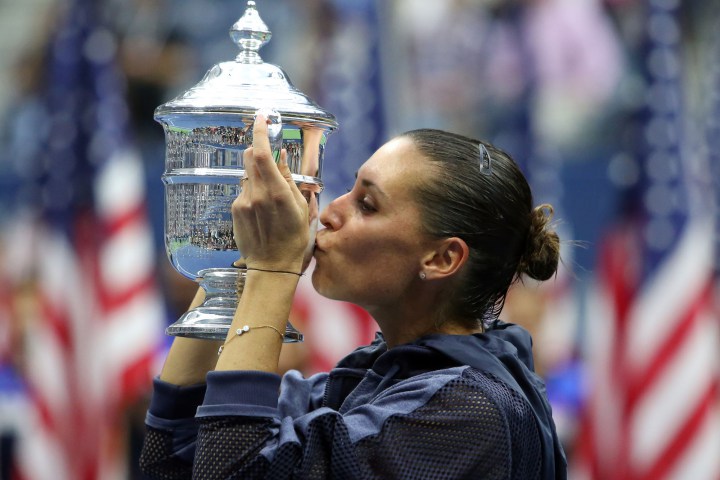
Flavia Pennetta / Unlikely but refreshing rise to the top; going out a champion.

Yes, folks, fairytales do come true -- even in tennis.

One need only look at Flavia Pennetta's unlikely rise to the top in winning the 2015 U.S. Open women's singles championship last Saturday over her long-time friend and former childhood doubles partner, Roberta Vinci. It was a refreshing conclusion to what had been a tense and anxious two weeks of hard-court tennis that included Serena Williams' dream of winning all four Grand Slams (Australian, French, Wimbledon, U.S. Open) during the same calendar year crushed only 24 hours earlier by Vinci in an improbable three-set defeat. It came after Pennetta upset No. 2 seed Simona Halep in the other semifinal.

When the 23rd-seeded Penneta beat the unseeded Vinci 7-6 (4), 6-2 on Arthur Ashe Stadium in the first All-Italian U.S. Open, she became a first-time Grand Slam champion. It broke a string of four straight Grand Slams won by Williams. The Pennetta-Vinci match was a throwback to what tennis once was circa the 1970s: lots of serve and volley, one-handed backhands, drop volleys, angled shots and, best of all, no grunting.

Joy and jubilitation /
Pennetta (right) is embraced by Vinci at the net.
As one might imagine, the scene at the net with Pannetta and Vinci turned into a celebration of unadulterated joy and jubilation. It showed on their faces. It showed in their body language, too, which included a long and embracing hug.

There were plenty of tears to go around for everyone to share.

Pennetta's triumph at the U.S. Open was witnessed by Italian Prime Minister Matteo Renzi, who flew across the Atlantic from Italy on short notice just to watch the final. He brought along Pennetta's fiancé, Fabio Fognini, himself a tennis pro, who earlier in the tournament banished Rafael Nadal in the third round before bowing in the next round. He had flown home to prepare for Italy's Davis Cup tie this weekend.

Roberta Vinci (left) and Flavia Pennetta /
Happy together during the trophy presentation.
During the post-match awards presentation on the court, the 26th-ranked Pennetta (she rose to No. 8 with her U.S. Open triumph) shared a confession with the sell-out crowd.

"Before I started this tournament, like one month ago, I made a big decision in my life," she said. "This is the way I would like to say goodbye to tennis."

Pennetta, who at the tennis-old age of 33 years and 201 days, shockingly announced her retirement from tennis. She revealed her news to Vinci just prior to the trophy presentation while the two were seated on chairs together at court side sharing a moment of laughter.

Pennetta will finish her off her tennis commitments by playing in a few tournaments in Europe and Asia this fall, then call it a career year's end.


"I'm really happy," she admitted. "It's what all players think to want to do, going out with this kind of big trophy. ... I can't think to finish a better way."

So, just what does Pennetta plan to do with her life after tennis?

"I would like to have a family in the future," she said, during a post-match press conference, "but it's not something I would love to have right now." First is "to know who I am," away from tennis, "what I like to do" and "how is the life with Fabio going to be."

Photos: Courtesy of Google Images. Video: Courtesy of YouTube.

Wednesday, July 2, 2014

2014 FIFA World Cup: Still much drama to come


American true grit / U.S. goalie Tim Howard's 16 saves against
Belgium was the most in a World Cup match since 1966.

If there's one thing I've learned during the first three week's of the 2014 FIFA World Cup tournament, it's this: International football (still referred to by most in my country as soccer) is a truly global game, but with a new world order in the making.

Old Europe -- as represented by England, Italy and Spain -- are out. New Europe -- defined by Belgium, the Netherlands and Switzerland -- are in. Somehow, France just keeps on winning by the slimmest of margins while Germany just plain wins.

Meanwhile, Central and South America, represented by Argentina, upstart Costa Rica and host nation Brazil, have played very well, and Colombia is all business-like in this year's World Cup. Lionel Messi has been, well ... Messi the Great, always a treat to watch when he has the ball on his left foot. He rescues his team -- and, by extension, his country -- when they need him the most. And, both the Canarinho and the Ticos, that's Brazil and Costa Rica, respectively, were blessed to have advanced to the quarterfinals last weekend, thanks to winning on penalty kicks -- the ultimate tie-break experience.

Among those who advanced out of group play, Mexico, Nigeria and Algeria each acquitted themselves nicely and each showed they belonged in the new world order.

Two of the remaining teams, Costa Rica and Colombia, have reached the quarterfinals -- the last eight -- for the first time. There are four repeat teams from four years ago: Brazil, Germany, the Netherlands and Argentina.

Further north up the Americas, the United States gained a lot of attention and national interest even when it wasn't always winning. On Tuesday, Team USA got its chance to play OT when it fought to a nil-nil tie after 90+ minutes of regulation time against Belgium. Like four years ago when it lost to Ghana, lightening struck twice against the Americans and Belgium scored early during the extra time period en route to a thrilling 2-1 victory in Salvador, Brazil.

Here in the U.S., we're used to clear-cut outcomes in our sporting events. So, imagine our surprise when a recent draw against Portugal felt like a victory and we celebrated after a 1-0 loss to Germany because it still advanced the Stars and Stripes out of their vaunted "Group of Death" and into the "Knockout Round" against Belgium. What we've learned is this: International football can be won by the slimmest of margins and lost by the slimmest of margins, too. And, they play on during stoppage time until the referee blows his whistle.

Sometimes, it's alright to be valiant in defeat.

In describing the Americans' grit following their elimination by Belgium, Jeré Longman wrote in The New York Times: "All the great rush and fevered desperation were spent now, the tension released. Their bodies and chances exhausted, the Americans bent over, collapsed to the ground on their backs, stared ahead at what might have been.

"In another epic game in a mesmerizing World Cup, the United States took Belgium to the edge of its marvelous capability. The Americans absorbed wave after wave of attacks, countered with the fearlessness of youth and survived for long stretches on the gymnastic goalkeeping of Tim Howard, whose dexterous arms and legs seemed to be playing soccer, hockey and basketball all at once."

U.S. Coach Jurgen Klinsmann said of his team: "I think they all went to their limits." Goalie Tim Howard, still one of the world's best at age 35, made 16 saves Tuesday, the most by a goalie in a World Cup match since 1966. Howard single-handedly kept the game within reach for the Americans.

The U.S. took us for quite a thrilling ride through its four matches: a victory over Ghana, a draw against Portugal, and close losses to Germany and Belgium. "It's really awesome getting through the group, but it means nothing," Howard said before the Belgium match. "The sting of failure is the same if you lose in this round as if you didn't get out of the group."

Collectively, five of the eight Round of 16 games went to extra time, the most since the round was introduced in the 1986 World Cup. Each of the eight games was won by the team that won its group.

Throughout the U.S., there has been been plenty of national attention given the World Cup, coast to coast, from New York to San Francisco, as well as in heartland cities like Kansas City and Chicago. Our eyes have been glued to the action. It's been a national, shared experience for sports fans of all ages. Personally, the World Cup has given me an opportunity to talk international football with Facebook friends from Mexico, Costa Rica and Algeria, and to learn what it's like to be a fan of in each of those countries -- even to care about those teams, too.

ESPN, the U.S.-based global cable and satellite television channel that is primarily owned by The Walt Disney Company, has provided North American fans with tremendous TV coverage, both visually and in its studio and match commentary. In print, The New York Times has devoted countless column inches and pages each day to cover the action on and off the pitch and it's given its readers a keen, socio-economic perspective to the story of this futebol nation, a sport which has helped define Brazil's place in the world.

It's been a pleasure to see, read and learn the fascinating history of the beautiful game, and to listen to the now-familiar voice of Englishman play-by-play commentator Ian Darke calling all of the important matches on ESPN. Darke, a veteran of the network's 2010 World Cup broadcasts, has a wonderful command of the English language and, sometimes -- OK, always -- he enjoys a lovely flair for the dramatic. Last week, in its soccer blog, The San Francisco Chronicle spun its own version of a classic Aesop fable, "If Ian Darke recounted the tale of the tortoise and the hare", that's worth a good read. Meanwhile, there's still much to be said and written about this year's World Cup, which culminates with the championship match on Sunday, July 13. And, there's the beautiful visuals of the Copacabana Beach in Rio, too.

Like an enjoyable West End theatrical, the 2014 FIFA World Cup has had its share of divas and dives as well as its thrills, spills and pratfalls. Yet, with seven matches remaining to decide this year's World Cup champion nation -- and eight countries still very much in contention -- we all look forward to much drama and excitement ahead in the World Cup's next act.

Photo: Courtesy of Google images.