Showing posts with label quality. Show all posts

Saturday, February 23, 2019

Here are 25 cities you may wish to call home

Some random thoughts while drinking coffee and enjoying a snow dayat home ...


Our cities are designed for living, working, cultural entertainment and late nights. Even fresh starts, like I experienced when I moved to Washington, D.C. in 2017, after spending 21-plus years living in the San Francisco Bay Area.

Some cities have it figured out, some don’t.

From transportation to green space, retail possibilities and residential settlements, it’s always interesting to find out what makes a good city a great place to live.

Every summer, Monocle, the London-based global magazine that’s always been a must-read for me, for its coverage of international affairs, business, culture and design, presents a special quality of life rankings with a top of the world list of the 25 best global cities.

Although I’ve written about Monocle’s Quality of Life rankings before, it’s been a few years – and, somehow, I haven’t visited the subject since 2016. So, as snow begins to blanket the Beltway, I’ve decided to take a look back at what Monocle had to say about last year’s quality of life rankings.

Here’s Monocle’s Top 25 cities in the world:

 1. Munich
 2. Tokyo
 3. Vienna
 4. Zurich
 5. Copenhagen
 6. Berlin
 7. Madrid
 8. Hamburg
 9. Melbourne
10. Helsinki
11. Stockholm
12. Lisbon
13. Sydney
14. Hong Kong
15. Vancouver
16. Amsterdam
17. Kyoto
18. Düsseldorf
19. Barcelona
20. Paris
21. Singapore
22. Fukuoka
23. Auckland
24. Brisbane
25. Oslo

“Cities are the future,” writes Monocle in discussing its 12th annual Quality of Life survey about the Top 25 global cities. You’ll notice the list is heavy on European and Pacific Asian cities, but it doesn’t include London, Paris or Rome. Only one North American city – Vancouver – made this year’s list. “You want a city that’s well run, delivers on life’s essentials and is fun, too.”

According to Monocle, “By 2030 urban areas are projected to house 60 percent of the global population. But while city halls need to prepare for that future – think grand infrastructure projects and investments in housing – they need to offer their residents a decent quality of life in the present. The best cities manage to find a healthy balance between planning for tomorrow and managing today.”

It makes us ask: What’s my city doing to change? Is it reviving former industrial neighborhoods for more housing stock and new cultures space? Is it expanding its airport or adding new routes to its train network? How well does my city do in putting on a welcoming face to outside businesses, newcomers and tourists?

Monocle suggests that getting it all right is “a challenge but some cities are getting it right.

“Take for instance, our winning city this year, which returned to the top spot: Munich. Safe and efficient with plenty of green space and good restaurants, the German city is thriving and more cosmopolitan than ever. Not only is Munich drawing an increasing number of students (it’s home to 18 universities) and entrepreneurs (its mobility, tech and IT sectors are booming), it’s been managing an influx of refugees and their integration.”

Looking ahead, as cities continue to expand, it seems that maintaining a great quality of life that gets recognized will be a challenge – even for the most forward thinking of cities. Monocle concludes, “Those that will prosper will be open and secure, ambitious and practical, with an eye on the future and a respect for the past.”

Photos and illustrations courtesy of Monocle/Monocle.com.


Tuesday, January 31, 2017

Federer-Nadal: A welcome respite from American politics

Victorious / Roger Federer kisses the Norman Brookes Challenge Cup
trophy Sunday night after winning the 2017 Australian Open

men's singles championship for his 18th career Grand Slam title.

The Australian Open tennis fortnight down under in Melbourne, which wrapped up over the weekend first with the all-Williams women's final between Serena and Venus (won by Serena) and followed by the renewal of the great men's rivalry between Roger Federer and Rafael Nadal, was a very welcome respite for those of us here in the United States as we came to grips with a narcissistic president, who in his first week in office undermined many fundamental principles that shape our American democracy.

While the talk of Federer's stunning comeback – reaching the AO final after being out six months while recovering from a knee injury that required surgery – Nadal's return from a wrist injury was a welcome one, too. The Federer-Nadal final, which didn't exist on most fan's minds at the beginning of the tournament, left them feeling a bit giddy. Going the distance and playing five sets will do that.

There was a buzz of nostalgia in the air when Federer emerged victorious with a 6-4, 3-6, 6-1, 3-6, 6-3 win that was his 18th career Grand Slam title. The Swiss is the all-time men's leader and Nadal, tied with Pete Sampras, is a distant second with 14.

Nadal said it was a special thing for both him and Federer to be playing together in the final of a Grand Slam, especially after a couple of years of having problems.

"I am a positive person (so) I never say never because I worked very hard to be where I am," Nadal said after his almost-five hour semifinal victory over Grigor Dimitrov that began last Friday night and finished in the wee hours of Saturday morning, a day before the Federer match. "I really have been working very hard. ... I always had the confidence that if I am able to win some matches, then anything can happen."

If President Donald Trump thrives on his own culture of self-inflicted conflict and chaos, Nadal thrives on a raw emotion that's filled with clinched fists and screams of "Vamos!" However, unlike the American reality TV host-turn-populist commander in chief, Nadal possesses many fine and likable qualities. He's a positive person, polite, mannered and respectful on court – even in defeat. These are a few attributes our new president could benefit from learning from Nadal.

With the old guard on the rise Sunday night, the AO final marked the ninth time that the 35-year-old Federer – the oldest male finalist in 43 years – and Nadal, 30, played for a Grand Slam title. Before Sunday, Nadal had won six of the previous eight finals meetings. Remarkably, they had not met for a major championship since the 2011 French Open, in which Nadal won his sixth of nine titles at Roland Garros. Nadal has long dominated his lifetime series against Federer, 23-12. Although if you eliminate matches on clay in which Nadal has a huge edge, the series tally is now even, 10-10.

"Being honest, in these kinds of matches I won a lot of times against him. Today he beat me, and I just congratulate him," Nadal said.

As Sunday night's final neared its conclusion, it became evident while studying the body language and facial expressions of both Federer and Nadal that neither wanted to lose. After all, there's joy in winning. With joy, it makes the suffering during big matches so much the better – especially ones that go five sets. Federer went the distance in each of his final three AO matches, Nadal in his last two. In victory or defeat, Nadal always shows an indomitable spirit – and it was on display again for the Rod Laver Arena crowd and a worldwide TV audience to enjoy when he and the always gracious Federer, who are friends off the court and foes on it, met for the 35th time in their storied careers.

Federer was thrilled to be back in the spotlight of another Grand Slam final. "Yeah. It's real now," he said. ... "I never ever in my wildest dreams thought I'd come this far in Australia. But here I am.

"Against Rafa it's always epic. This one means a lot to me because he's caused me problems over the years."

When match point was decided by a replay review that was upheld, Federer pumped his arms above his head and leapt up and down with much delight. Both happy and relieved, emotions poured out of Federer. He admitted afterward that it was an awkward way to win.

"I'm out of words, said Federer, as he addressed Nadal during an on-court interview while clutching the champion's trophy. "I don't think either of us believed we'd be in the final here when we were at your academy five, six months ago. Here we stand in the finals.

"I'm happy for you. I would have been happy to lose to you. The comeback was perfect as it was. It's been a difficult last six months, let's be honest. I wasn't sure I was going to be here, but here I am. This was a wonderful run, and I can't be more happy to win tonight."

Photo: Courtesy of Google Images.

Tuesday, September 13, 2016

On being selective: To have fewer, but better things


Organize + Tidying Up = Spark Joy
Whether it was a desire to have fewer things in our lives or merely say thank you and bid adieu to things that fail to "spark joy" – or that we no longer value – my wife and I both agreed that we needed less.

In recent years, our buying habits have changed. Rather than rush out to buy books, we've made better use of our local public library as a resource to check out books we've read about in The New York Times or garnered an interest in from seeing an author appear on Comedy Central's The Daily Show. And, our music purchases have shifted away from physical CDs to mp3s via iTunes, which we can play on our iPhones (and I still have a classic iPod I use at the gym). Plus, thanks to streaming movies and binge-watching TV series using Netflix, buying DVDs has become irrelevant. There's definitely an ease of portability that we are using to our advantage.


Now, our living room space is neither minimalist or lacking in abundance – just decluttered.

We used the occasion of a remodeling project to "declutter" our living room, following in the success of the decluttering superstar Marie Kondo, who has written a couple of best-sellers on the subject, including The Life-Changing Magic of Tidying Up: The Japanese Art of Decluttering and Organizing and Spark Joy: An Illustrated Master Class on the Art of Organizing and Tidying Up.

On a recent Sunday afternoon, we assessed four bookcases-worth of books as well as several hundred CDs and DVDs. Following Kondo's guideline, we "dumped" the contents of both collections – first our books and later our CDs and DVDs – in the middle of the living room floor and decided what could stay and what needed to go among our material excess of living.

Following Kondo's guidelines, it forced us to ask ourselves whether each object was achieving a purpose. Did it spark joy in our lives? I'm happy to report that things went much smoother than I anticipated. There were no tug-of-wars or endless debates about what to keep or what to let go. By the end of our back-to-back sessions, we had earmarked 55 books to donate to the Friends of the Oakland Public Library store and close to 100 CDs and DVDs to sell for credit at our favorite record store in Berkeley.

It's taken time, but we have become more selective about what we buy and own – following a trend of having fewer, but perhaps better, things. We no longer feel the need to rush out the first day an author publishes a new book or a music artist releases a new album to purchase it. Now, our trips to our favorite bookseller or record store are fewer but more meaningful.

If I've learned anything from this exercise, it's this: Having fewer things of a higher quality – things which we can adore and enjoy – is a decluttering philosophy unto itself.


Tuesday, April 26, 2016

In our garden: Reflections on Earth Day 2016


Purple iris

Earth Day, a day that inspires awareness and appreciation of all the gifts earth and nature gives us, was observed worldwide on April 22.

It is often said that love begins in the home. And, so does our love for our planet earth. Last week, in preparation for Earth Day, I took advantage of our moderate temperatures that we who live in the San Francisco Bay Area enjoy throughout the year. The opportunity to be outside allowed me to spend some quality time in our garden.

As I looked around, I thought to myself: "If I love the earth, all will bloom naturally."

We are blessed to have nine different rose bushes as well as irises, calla lilies, fuchsias, rhododendrons and camellias surrounding our house. Indeed, we have an abundance of beautiful blooms throughout the entire year, especially during the month of April when all of them are in bloom at the same time. They get plenty of sunshine and clean air, and as we are aware that northern California is in a drought, we are mindful not to be careless in how much we water our flowers and plants.

And, so, in celebration of Earth Day, as I do so often throughout the year, I grabbed my camera and took lots of photographs, recording these colorful moments in our garden for others to appreciate and enjoy. Consider it  as my random act of kindness. 

May every day be like Earth Day to us.

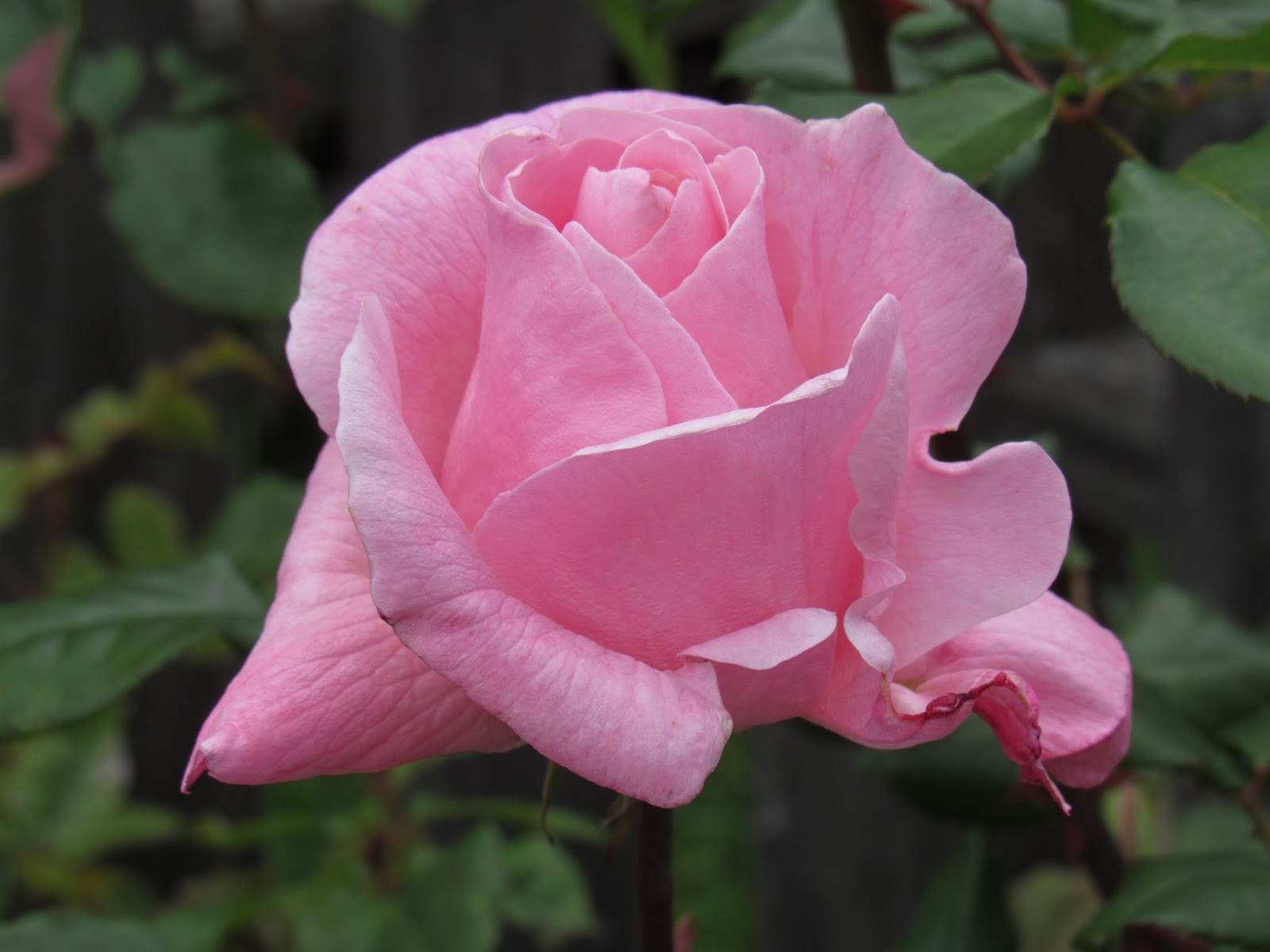
Queen Elizabeth rose

All That Jazz rose

Purple rhododendron

Calla lily

Rainbow-colored rose

All photographs © Michael Dickens, 2016.


Tuesday, July 14, 2015

Yountville: Come for the food and wine, stay for the art

A New Spin / Napa Valley artist Freeland Tanner's 2014 sculpture is
comprised of Cedar and Redwood grape stakes and repurposed poplar wood.

The town of Yountville is quickly becoming synonymous with art as it is with food and wine. Look around and you'll see how the influences from vintner culture, wine industry, culinary and arts converge in this lovely destination situated along Highway 29 in the heart of California's Napa Valley, about 60 miles outside San Francisco.

Bouchon / One of Yountville's
 world-class dining experiences.
While French Laundry and Bouchon brought Michelin stars and accolades -- and helped transform Yountville into a world-class destination for food -- there's been a push to show a creative, artsy side in a very public and profound way thanks to the installation of outdoor sculptures. The output of artwork doting Yountville has been very inspiring and has helped turn this wine country town into an outdoor art gallery.

Balance by Sherry Tobin.
Locals or tourists who walk along Yountville's Washington Street, the town's main thoroughfare, will notice about three dozen pieces of outdoor sculpture. The town went on an art binge beginning about three years ago by installing sculptures by local artists and some internationally-known ones, too.

While some of the sculptures are subtle in their quality, most are quite colorful and grab one's attention. Each is a welcome sight and during a recent visit, I noticed, many were magnets for both serious photographers as well as tourists stopping to take selfies.

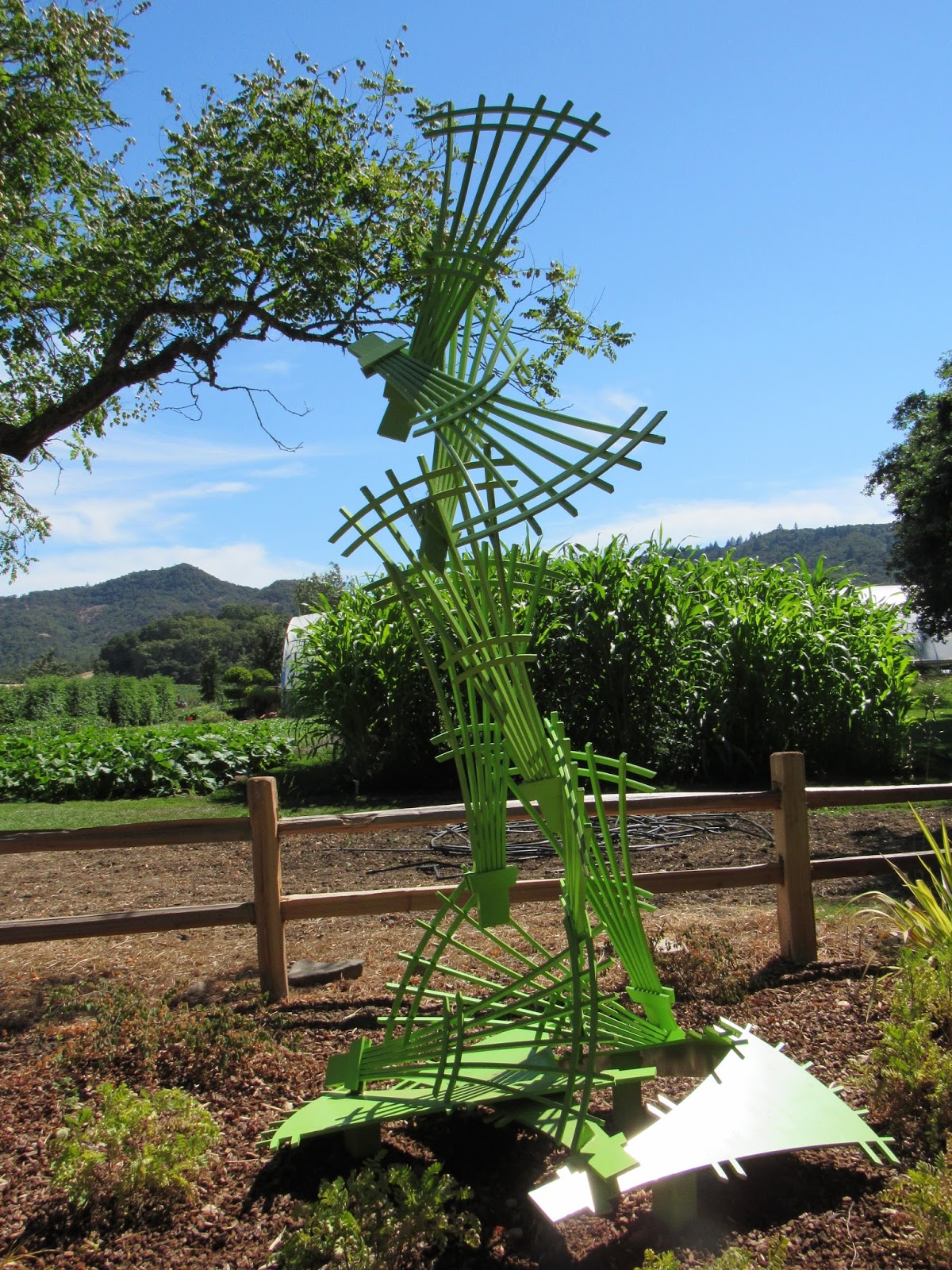
Trellis Way to the Sky
by Freeland Tanner.
Each sculpture is well signed with information such as title, artist and composition. And, best of all, each is for sale with a percentage of the sales benefitting the Yountville Arts Fund which helps provide continued support for arts related activities and events in Yountville.

As someone who has returned often to Yountville to enjoy its culinary aspects, at Bouchon as well as Ad Hoc and Redd Wood, I've seen the town evolve nicely over the past 20 years. Now, the outdoor sculptures have become an essential and enjoyable component of the Yountville experience just like the puff pastries and macarons at Bouchon Bakery.

Indeed, come for the food and wine, stay for the art.

All photographs by Michael Dickens © 2015.