 |
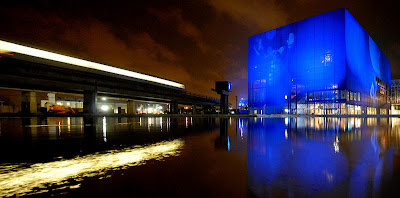
Copenhagen Concert Hall at night. /
The No. 1 best global city according to Monocle. |
Our cities are designed for living, working, cultural entertainment and late nights. Even fresh starts. Some cities have it figured out, some don't.
From transportation to green space, retail possibilities and residential settlements, it's always interesting to find out what makes a good city a great place to live.
 |
The July/August issue of Monocle
rates the 25 best global cities. |
Each summer for the past seven years,
Monocle, the London-based global magazine that's a must-read for its coverage of international affairs, business, culture and design, has presented a special quality of life rankings with a top of the world list of the 25 best global cities.
"Too many major cities, including some of our top 25, all but shut down on a Sunday -- we believe a city should be a seven-day operation," writes
Monocle's Steve Bloomfield and Michael Booth, in the introduction to this year's top of the world list, which appears in the magazine's July/August 2013 issue (issue 65, volume 07). "We asked our team or correspondents and researchers to judge how easy it is to arrange a spontaneous dinner with friends on a Sunday night. Are the restaurants open? Can you buy groceries and wine?"
Other common factors which
Monocle studied include: crime rates, weather, education, health care, transportation and "an airport with a host of international destinations." Of course, it helps if a city has good plazas and outdoor cafés as well as art galleries that stay open late and museums that are free, too.
It did not surprise me that few U.S. or North American cities made
Monocle's Top 25 -- Honolulu at No. 17 was highest ranked while my beloved San Francisco ranked 24th. Nor, should it be surprising that six of the top 10 were European cities, including this year's No. 1 Copenhagen.
 |
No. 14 Paris /
The Pyramid at the Louvre is always a buzz of activity. |
Why did Copenhagen rank No. 1 and not Paris (ranked No. 14) or London (which did not even rank in the top 25)? Here's why: "World-conquering urban quality of life requires the trickiest of balancing acts -- between progress and preservation, stimulation and security, global and local. Perfection is unobtainable, of course, but Copenhagen is striking one of the best deals right now.
"The Danish capital has hit the top spot this year not just because of its daring art scene, its matrix of cycle super-highways and its pioneering approach to street culture but also its ability to define itself as a global city. Copenhagen's wonderful self-reinvention continues to impress."
As for what the magazine said about San Francisco, in a nutshell it wrote: "Northern California's spectacular city scores high on tolerance and urban verve but tech-dollars continue to drive up the cost of living." I'd have to agree. As much as I would enjoy living in the Inner Sunset, within walking distance of Golden Gate Park, the cost of buying or renting is somewhat prohibitive. Thus, living across the bay in Oakland, I believe, is a better value.
 |
No. 19 Vancouver, B.C. /
This western Canadian city hosted the 2010 Winter Olympic Games. |
Here's
Monocle's world list of the 25 best global cities for 2013:
1. Copenhagen
2. Melbourne
3. Helsinki
4. Tokyo
5. Vienna
6. Zürich
7. Stockholm
8. Munich
9. Sydney
10. Auckland
11. Hong Kong
12. Fukuoka
13. Kyoto
14. Paris
15. Singapore
16. Hamburg
17. Honolulu
18. Madrid
19. Vancouver
20. Berlin
21. Barcelona
22. Amsterdam
23. Portland (Oregon, U.S.)
24. San Francisco
25. Düsseldorf
 |
No. 22 Amsterdam /
The city's bicycle culture and canals are an appealing. |
In looking over
Monocle's top 25 best global cities list, I've been lucky enough to have visited eight of these cities in my lifetime -- Copenhagen, Helsinki, Paris, Honolulu, Vancouver, Amsterdam, Portland and, of course, San Francisco, which I get to see nearly every day. There are many more on
Monocle's list I would love to visit some day in the future like Sydney and Berlin.
Does the perfect city exist? Not likely. Will it ever? Probably not. And, of course, what works for some of us, doesn't for all of us. Yet, it's nice know that there are a handful of good cities throughout the world whose quality of life makes me want to live there some day.
 |
No. 24 San Francisco /
The de Young Fine Arts Museum in Golden Gate Park. |
By the way, one reason the San Francisco Bay Area (which has been my home for nearly 18 years) is a great place to live is because it
is easy to arrange a spontaneous dinner with friends on a Sunday night; great restaurants
are open on Sunday nights; and you
can buy groceries and wine on Sundays, day or night.
And, having a Major League baseball team -- the San Francisco Giants -- that's won two World Series titles in the past three years is a nice bonus and adds to the quality of life, too.
Where do you want to live?
Photo of Copenhagen Concert Hall courtesy of Wikipedia Commons.
Photo of Monocle courtesy of monocle.com.
All other photos by Michael Dickens, copyright 2010, 2012 and 2013.


