Showing posts with label champion. Show all posts

Tuesday, February 4, 2020

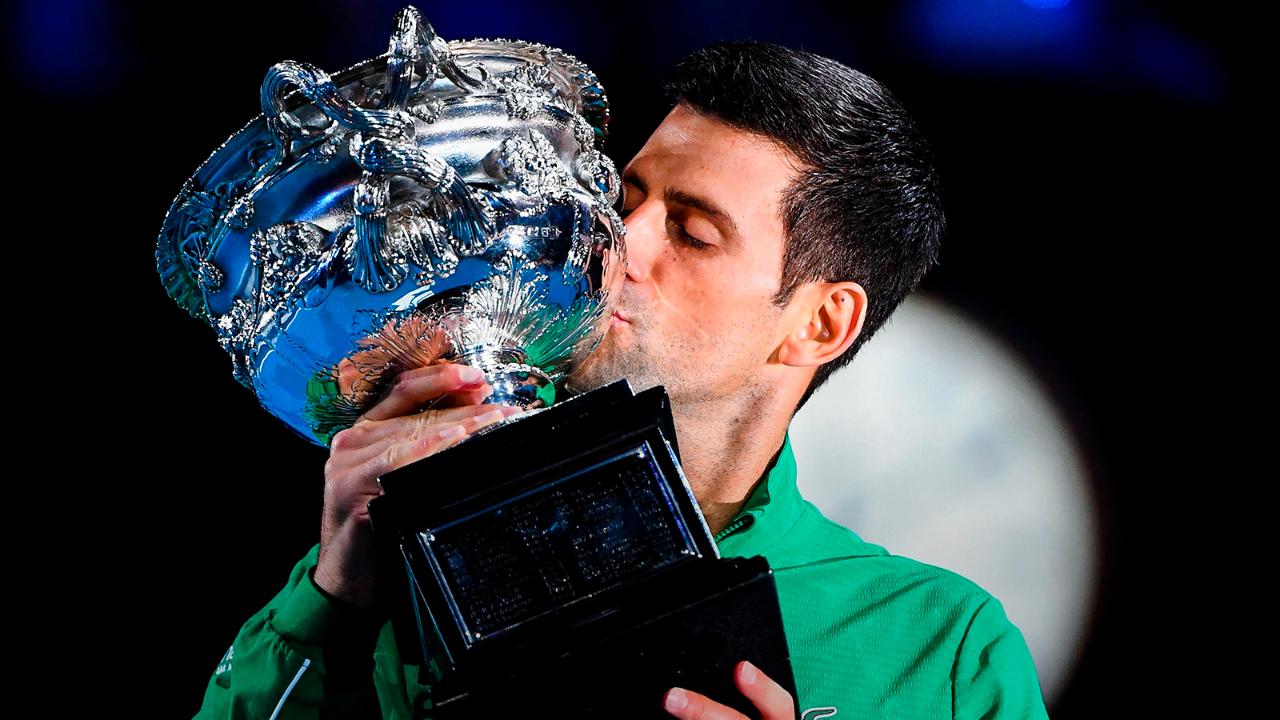
On tennis: Novak Djokovic turns a perfect night Down Under into winning his seventeenth major title


On a perfect night for tennis in Melbourne, with clear skies and an open roof in Rod Laver Arena, Novak Djokovic won his seventeenth Grand Slam singles title with a five-set victory over Dominic Thiem in the Australian Open men’s singles final Sunday. Once again, Djokovic proved himself unconquerable. He remains hungry and driven.

Djokovic’s 6-4, 4-6, 2-6, 6-3, 6-4 triumph that lasted four hours rewarded him with his eighth Norman Brookes Challenge Cup trophy and returned the Serbian to No. 1 in the world rankings.

“I’ve had (the) privilege to win this big tournament for eight times,” said Djokovic, 32, during his post-match press conference that didn’t start until the early hours of Monday morning. “To start off the season with a Grand Slam win significantly boosts your confidence and your expectations are quite high for the rest of the season. But whatever happens, this season is already successful.”

Djokovic arrived in Melbourne a fortnight ago after he won all of his singles matches and contributed significantly to Serbia’s triumph in the inaugural ATP Cup team title in Sydney. In the year’s first Grand Slam, which took place amid difficult circumstances from the blazing bush fires that blanketed much of southeastern Australia, the second-seeded Djokovic began a run of good form by dropping just one set before the final. En route, he beat No. 14 seed Diego Schwartzman in the fourth round, No. 32 seed Milos Raonic in the quarterfinals and No. 3 seed Roger Federer in a much-anticipated semifinal – all in straight sets – before the 26-year old Thiem, whom New York Times tennis columnist Christopher Clarey characterized as one “with thunder in his ground strokes and highlights in his dark hair,” pushed him to five sets in the title match. 

Although Thiem had won four of five previous matches against Djokovic – and built a two-sets-to-one lead Sunday thanks to stringing together six straight games at one point – he hadn’t beaten him on an outdoor hard court. This time, although No. 4 seed Thiem had some chances – especially when Djokovic began to struggle with both his consistency as well as his level of energy – the Austrian just couldn’t reach the finish line in time.

Thiem was broken in the third game of the decisive set and never quite recovered. His last chance to pull even came as Djokovic served at 4-3, 15-30. Then, the Serbian won the next three points to hold serve and the end drew nearer.

On this memorable night and in this particular final, Djokovic was at times defiant. To wit, twice he was cited for time violations. But always, Djokovic was tenacious – especially in long rallies – as he gutted out his victory over Thiem by serving nine aces and hitting 46 winners. 

With his latest major title, Djokovic moved to within three of Federer, the all-time leader with 20 Grand Slam titles, and he’s now two behind Rafael Nadal’s 19. Once again, the old guard fended off the new blood. However, one thing’s certain: Thiem proved he’s more than just a clay-court specialist. He can play heroically on hard courts. After all, Thiem beat No. 29 seed Taylor Fritz, No. 10 seed Gaël Monfils, top seed Nadal and No. 7 seed Alexander Zverev in his four matches leading up to Sunday’s final against Djokovic. Thiem also spent six hours more than Djokovic on court throughout the tournament.

“Huge congrats to Novak, an unreal achievement,” said Thiem, gracious in his remarks during the trophy ceremony. “You have helped to raise the level, and I’m proud and happy I can compete in this time and period of tennis.”

When it was Djokovic’s turn to address the crowd, he remarked: “This is definitely my favorite court, my favorite stadium in the world, and I’m blessed to hold this trophy once again.”

Then, looking toward Thiem as he spoke in a complimentary tone of voice, Djokovic said: “I would like to congratulate Dominic on an amazing tournament. It wasn’t meant to be tonight. But you were very close to winning. 

“You definitely have a lot more time in your career and I’m sure you’ll get more than one Grand Slam trophy in your career.”

Thiem, who was attempting to become the first new major winner since Marin Cilic won the 2014 US Open, fell short in a Grand Slam final for the third time in his young professional career. His Australian Open set back followed two previous defeats against Nadal in the finals of the 2018 and 2019 French Open.

“I think there’s not much to change,” Thiem said during his final Melbourne press conference. “In the last two sets, I definitely gave everything I had. Novak is part of three guys who are by far the best players who ever played tennis. If you play a Grand Slam final against him, it’s always going to be a match where small details are deciding.

“ ... It’s unique in sports history that the three best players by far are playing in the same ere a,” Thiem acknowledged. “That’s what makes it very, very difficult for players to break through.”

Indeed, Djokovic, along with Federer, 38, and Nadal, 33 – The Big Three of men’s tennis – have combined to win the past 13 majors. One has to go back to Stan Wawrinka’s 2016 US Open victory to find a Grand Slam winner other than Djokovic, Federer and Nadal. Wawrinka and Andy Murray, with three Grand Slams apiece, are the next best active players behind the Big Three. For sure, Djokovic isn’t quite ready to rest on his laurels. Not now, anyway. 

“Grand Slams are one of the main reasons why I am still competing and still playing full season, trying to obviously get the historic No. 1. That’s the other big goal,” Djokovic said. “I put myself in this position that is really good at the moment. I’m super happy with the way I started the season. It kind of sets the tone for the rest of the year.”

Original commentary written for Tennis-TourTalk.com.
Photo: Courtesy of Australian Open website.

Tuesday, June 11, 2019

From tennis prodigy to cricket and back again, Ashleigh Barty is now a Grand Slam champion


Ashleigh Barty went from being a tennis prodigy who briefly traded her racquet for a cricket bat to becoming a skilled tennis professional with a solid all-court game. Only 23 years-old, the native of Ipswich, Queensland, is now the queen of the red clay and the pride of Australia.

On Saturday, the affable and talented Barty triumphed over Marketa Vondrousova, 19, from the Czech Republic, 6-1, 6-3, to win her first Grand Slam title at the French Open while playing in her first Grand Slam final. She became the first Australian woman to win the French Open since Margaret Court in 1973.

“For the last fortnight, the stars have aligned for me. I have been able to play really good tennis when I’ve needed it,” said the No. 8 seed Barty during her post-match press conference.

“This is just incredible. I never dreamt that I’d be sitting here with this trophy here at the French Open. I mean, obviously, we have dreams and goals as children, but this is incredible.

“I just kept saying to myself, I may never get this opportunity ever again, so try and grab it with both hands.”

At just 5-feet-5-inches (1.66 m), Barty possesses an abundance of natural skills, lower body strength and tremendous hand-eye coordination. Her overall game is technically sound – and she trusts it. With Barty, her game includes a dynamic kick serve, plenty of topspin forehands, lots of slice, and for an element of surprise, a few timely and well-placed drop shots.

“It’s been a natural progression of becoming stronger, not growing any taller, but getting stronger and being able to trust myself and hit my spots on my serve,” explained Barty.

“My serve is a massive part of my game, and I try and think my way around the court. I know where opponents like to return, and if they shift their position, where they return. And I try and expose those spots as best that I can.”


Ashleigh Barty reacts to winning
her first Grand Slam title.
Throughout the Paris fortnight, it became apparent how Barty developed her talent into a game that’s full of artistry as well as movement and power.

Against the left-handed Vondrousova, whom she had already beaten twice, the beguiling Barty took control of the match early by winning points with her forehand, using her sliced backhand to force her opponent into committing errors (22 unforced errors), and hitting winners (27). Her adroit volley skills enabled her to win 15 of 20 points at the net. It seemed the was little Barty could do wrong.

“I felt like for me it was the perfect tennis match, considering the situation, the conditions. It was amazing,” said Barty.

It’s a testament to what Barty’s done in just three years after taking a gap year to step away from the sport after she struggled with the expectations she had set after being a tennis prodigy and winning the Wimbledon junior girls’ title at age 15. She was ranked in the WTA Top 50 in doubles when she left the sport.

“For me, I needed time to step away, to live a normal life, because this tennis life certainly isn’t normal. I think I needed time to grow as a person, to mature,” recalled Barty.

So, Barty took up professional cricket in Australia in 2015. Then, after missing the “one-on-one battle, the ebbs and flows, the emotions you get from winning and losing matches,” she came back to tennis.

“You can only get them when you are playing and when you put yourself out on the line and you become vulnerable and try and do things that no one thinks of,” said Barty.

“I think it was just a natural progression for me coming back to tennis. Certainly, it’s alway been a big part of my life. Tennis will always be a big part of my life.”

Starting from the bottom, ranked 623rd, she had to qualify just to get into main draws. Now, with her first Grand Slam title secured, she is now ranked No. 2 in the world, behind No. 1 Naomi Osaka. This year, she’s won tournaments on both a hard court (Miami) and clay (Roland Garros), and compiled a 33-6 win-loss record in all competitions (27-5 in WTA tour events).

“It’s about creating your own path, creating your own journey, and embracing it,” expressed Barty. “There’s no formula how to, you know, become a professional tennis player. It’s your own, it’s unique, your own journey, your own path, your own experiences.

“I think the best thing to do is learn from your mistakes, learn from every single experience that you have, whether it’s good or bad. That’s the only way to go about it, only way to grow as a person and as a player.”

Ashleigh Barty shares a hug with
Marketa Vondrousova after their French Open final.
Throughout Australia and the rest of the tennis world, fellow pros offered hardy congratulations via social media for the engaging Barty soon after she won her first Grand Slam championship. She heard from Hall of Fame great Evonne Goolagong Cawley, one of her idols, who like her is an indigenous Australian and won Roland Garros in 1971. Barty was touched when she lifted the Coupe Suzanne Lenglen and saw Cawley’s name inscribed on the trophy.

“What a wonderful result for Australia and how exciting that another Aboriginal has won at the French. I’m almost scared to say it but it’s now 48 years ago since I won my first Slam there too,” Cawley expressed via Tennis Australia.

“Tennis Australia and all lovers of tennis here and around the world will be delighted by the natural skills and flair Ash possesses.”

In sharing her personal narrative during her post-match press conference, Barty admitted that there’s no way she would have won the French Open title if she hadn’t taken a sabbatical from tennis. Now that she’s back, she credits her team – coach Craig Tyzzer and mentor and performance coach Ben Crowe – for helping her thrive.

“I’m not the only person out there. I have an extraordinary group of people around me,” said Barty. “I love working with them every single day. “They’re with me at the hardest times of my life, and there with me in some of the most amazing times. I think, for us, it’s a celebration of the journey we have been on for the last three years.”

Cover photo: courtesy of rolandgarros.com. Screenshot photos: courtesy of NBC Sports images.
An original version of this story appeared in Tennis TourTalk (www.Tennis-TourTalk.com).


Tuesday, July 17, 2018

There's no better place in the world to make a comeback

Wimbledon Centre Court /
The thrill of victory 

on the most famous rectangle in tennis.

One year ago, Novak Djokovic left Wimbledon injured and uncertain of his future. On Sunday, the Serbian left the All England Club as the 2018 Wimbledon gentlemen's singles champion for the fourth time. As a further reward, he even got to share a dance with this year's ladies' singles champion, Angelique Kerber, at Sunday night's Champions' Dinner.

While the past couple of years have seen some dark, barren times for the 13-time Grand Slam champion, his 6-2, 6-2, 7-6 (3) win over 32-year-old Kevin Anderson of South Africa in this year's Wimbledon final proved without a doubt that Djokovic is back – and, now, he's the newly ranked No. 10 player in the world.

Meanwhile, Anderson's memorable fortnight, which included a five-set victory over No. 1 seed Roger Federer in the quarterfinals that propelled him toward reaching his second Grand Slam final in less than a year, lifted him to No. 5 in the latest ATP rankings.

"Even though today is not the result I was looking for, I think in the next few days, just seeing my new career-high ranking is going to mean a lot to me," said Anderson during the trophy presentation following Sunday's final. "Looking back at some of the matches, especially my quarterfinal and semifinal match, it will really set, in what I've accomplished. I can be happy with that and use it for continued motivation."

At No. 21, Djokovic became the lowest-ranked male to win Wimbledon since Goran Ivanisevic won in 2001 while ranked No. 125.

Novak Djokovic celebrates his Wimbledon 
victory by waving to his family.
While the 12th-seeded Djokovic's victory, which came a day after his epic five-set semifinal win over World No. 1 Rafael Nadal, lifted him back into the Top 10, it's worth asking: just how good was Djokovic during this Wimbledon fortnight? Does this put him in the right frame of mind with the United States Open just a few weeks away? Can Djokovic win any more majors?

Tackling these pressing  questions one at a time, Djokovic remains the best returner in men's tennis, bar none, and it made a big difference against the 6-foot-8 Anderson, who was hobbled by mental and physical fatigue brought on from his six plus-hour marathon semifinal on Friday against John Isner, in which the fifth set alone was stretched to 50 games (26-24 in favor of Anderson) and lasted nearly three hours alone. Understandably, the personable giant, who is one of the nicest and most polite professionals on tour, had little left for the final. Indeed, by winning Wimbledon, it gives Djokovic a big psychological boost heading into the North America hard court season leading up to the United States Open, which begins the final week of August. And yes, if Federer can still win Grand Slams at age 36, there's  no reason that Djokovic can't win a few more, too – he's just 31.

The past couple of years have seen a decline in Djokovic's desire – not to mention turmoil among his coaching team – coupled with a serious injury to his right elbow that required surgery following this year's Australian Open. On Sunday, it was great to see the champion, nicknamed "Nole," back on Centre Court playing in a Grand Slam final, reunited with his longtime coach Marian Vajda who sat perched in the players' box just above Centre Court. Djokovic played solid-if-not-patient tennis throughout much of the two hour and 19 minute match. He won 76 percent (52 of 68) of his first-serve points, hit 20 winners against 13 unforced errors and broke his opponent four times in four tries. Although Anderson finished with 10 service aces and hit 26 winners, he committed 32 unforced errors and was zero-for-seven in break-point conversions. Djokovic outpointed Anderson 100-74.

On match point, with Djokovic serving at 6-3 in the third set tie-break, he forced Anderson into netting a forehand return. The final was over. After meeting Anderson at the net to shake hands and exchange pleasantries, Djokovic lifted his arms in triumph – much to the delight of the cheering crowd. Soon after, the new champion knelt down to nibble a few blades of grass in celebration – giving a literal interpretation to tasting victory.

Three-year-old Stefan Djokovic, secure in the
arms of his mother, Novak Djokovic's wife
Jelena, during the trophy ceremony.
Shortly after the ancient silver gilt cup that is awarded to the winner was solidly in Novak's hands, the BBC's cameras quickly cut to Djokovic's box where the charming sight of his three-year-old son, Stefan, secure in the arms of his mother, Djokovic's wife Jelena, applauded his papa's accomplishment.

"It feels amazing – the first time in my life I have someone screaming 'Daddy! Daddy!'," said Djokovic, beaming a smile during his on-court interview with the BBC's Sue Barker.

"I'm very emotional with him being there, and my wife and while team. I cherish this moment."

Polite and gracious, Djokovic continued: "I would like to congratulate Kevin. I was quite lucky to get through. I'm very grateful to everyone who has been supporting me. The last couple of years haven't been easy, facing for the first time a severe injury. I had many moments of doubt and didn't know if I could come back. But there's no better place in the world to make a comeback. I always dreamed of holding this trophy as a boy. This is a sacred place for tennis. It's very special."

Indeed, as Djokovic showed everyone on Sunday, there's no better place in the world than Centre Court at Wimbledon – the most famous rectangle in tennis – to make a comeback.

Photos: Courtesy of Google Images.

Wednesday, July 4, 2018

UNIQLO For the Win – New Apparel, Same Federer


Roger Federer/UNIQLO Global Brand Ambassador

When the eight-time Wimbledon champion and No. 1 seed Roger Federer walked out on Centre Court to christen the start of this year's Wimbledon Championship and begin his title defense on Monday afternoon, he wore a new brand, Tokyo-based UNIQLO - not Nike, his long-time apparel partner. The decades-long Federer-Nike era was over. It was a stunning sight to the start of this year's fortnight.

The 36-year-old Federer's nearly all-white attire – collarless shirt with a two-button front and a red pinstripe accent, shorts, bandana-style headband, socks and warm-up jacket – had the minimal and slim-cut red and white UNIQLO logo. His white shoes, which are custom made, were still Nike and bore the familiar swoosh logo. Federer's new UNIQLO kit bore the design of the Japanese brand's artistic director Christophe Lemaire.

Within minutes after the 20-time Grand Slam winner took Centre Court for his first-round match against 57th-ranked Dusan Lajovic of Serbia, UNIQLO UK tweeted:

"UNIQLO is honoured to welcome Roger Federer as our new Global Brand Ambassador!"

In a statement released by UNIQLO, Tadashi Yanai, UNIQLO's founder and chairman, said, "Mr. Federer is one of the greatest champions in history – my respect for him goes beyond sport.

"Our partnership will be about innovation on and off the court. We share a goal of making positive change in the world, and I hope together we can bring the highest quality of life to the greatest number of people. UNIQLO will help Mr. Federer continue taking tennis to new places while exploring innovations in a number of areas including technology and design with him."

Federer said, "I am deeply committed to tennis and to winning championships. But like UNIQLO, I also have great love for life, culture and humanity. We share a strong passion to have a positive impact on the world around us and look forward to combining our creative endeavors."

Soon after the announcement, Sports Illustrated executive editor and senior writer Jon Wertheim tweeted:

Roger Federer debuts his new Uniqlo kit
at Wimbledon on Monday.
"Uniqlo for the win. #Wimbledon"

Wertheim added, "As we see a global athlete wearing Uniqlo, a reminder: Tokyo will host the 2020 Olympics. $30 million per year, sources tell us. Do they get into performance footwear now?"

According to Darren Rovell of ESPN.com, the deal "is worth more than $300 million guaranteed over 10 years and has an unprecedented clause that says that Federer will still collect the money even if he doesn't play." He can also sell patches on his shirt, which he couldn't do with Nike.

When you take a look at Federer's $300 million UNIQLO deal, consider this: his career on-court earnings over the past two decades are a mere $116.6 million.

Federer's deal with Nike expired on March 1. He continued to wear Nike without a deal during recent grass-court tournaments in Stuttgart and Halle, Germany, last month. He appeared for his Wimbledon pre-tournament press conference on Sunday wearing an open-collar dress shirt and sports jacket. By all appearances, Federer looked like he was dressed up for a dinner out the Wimbledon village with his family and team instead of coming in from the practice courts.

Christopher Clarey, tennis columnist for The New York Times, said in a tweet that "Federer's Nike deal is done but have been told by industry sources that the RF logo will revert to Federer at some stage in the next few years. Am told they do not own the rights to it in perpetuity so it may well rise again."

As it happened, Federer beat Lajovic in the opening round, 6-1, 6-3, 6-4, in a tidy 1 hour and 19 minutes, then returned on Wednesday afternoon to Centre Court and beat 94th-ranked Lukas Lacko of Slovakia in straight sets, 6-4, 6-4, 6-1. He is undefeated wearing UNIQLO and has now won 26 consecutive sets at Wimbledon. Although it might take a few matches to get used to seeing Federer in UNIQLO instead of Nike, I think the change is a good one for the Swiss maestro. He's playing inspired, efficient tennis and – still – is the player to beat at Wimbledon this year.

"We're going to have to get adjusted to not seeing the Nike swoosh," said Hall of Famer Jim Courier, who analyzed Federer's opening-day match for Tennis Channel. "It's like Superman without the 'S'. We'll see if it has any impact on him. I doubt it."

While Federer's fashion choices will be debated by the media and his legion of worldwide fans, one thing's certain: the new UNIQLO grand brand ambassador still looks fabulous in white. His new adornments highlight his graceful movement and masterful strokes – and, as Federer has shown so far, he still knows how to play superb tennis.

Photos: Courtesy of Uniqlo Twitter feed and Google images.

Tuesday, March 6, 2018

Serena Williams: There's no wrong way to be a woman


Serena Williams didn't necessarily begin her tennis career thinking she was going to be breaking down barriers, but she has done just that. Over the years, as Williams has become more conscious of the impact she's had on both sport and society, she's found herself with a platform and an opportunity to make a difference. Now, at age 36, Williams embraces being a leader who can pave the way for the next generation of female athletes.

On Sunday night, during the 90th Academy Awards telecast, Nike celebrated the life of Serena Williams. In a powerful 30-second spot, which featured a montage of footage of Williams on the tennis court throughout her storied career, the Nike ad included a voice over by the 23-time Grand Slam tennis champion, who made a powerful statement about womanhood, race and motherhood, saying there's no wrong way to be a woman. 

She said:

I've never been the right kind of woman.
Oversized and overconfident,
Too mean if I don't smile.
Too black for my tennis whites.
Too motivated for motherhood.
But I'm proving time and time again ...
There's no wrong way to be a woman.

Against a dark backdrop, the spot concluded with the words "Until we all win" next to a Nike logo.

The ad was created by Wieden + Kennedy of Portland, Oregon. 

A two-page Nike print ad featuring Williams, also created by Wieden + Kennedy, appeared in Sunday's New York Times. It said:

You told a little girl she was too black for her tennis whites. 
And she grew up to be Serena Williams.

In a statement, Nike said, "As we approach International Women's Day, Nike wanted to recognize and celebrate the contributions and achievements of women everywhere and share our belief in gender equality, in this case, delivered by Serena Williams, the greatest athlete of all time."

Nike, it seems, has always maintained a good pulse on cultural relevancy. On Sunday night, it leveraged an opportunity to elevate Williams's stature as athlete, who breaks down barriers and inspires women, before not only a large and captive prime-time audience watching the Oscars telecast in the U.S., but also a worldwide audience, too. 

"I'm still looking to the future, to breaking down additional barriers, like gender equity and pay equality," said Williams, in a statement released by Nike. "It doesn't happen overnight. It takes a lot of work and I'm going to keep on going and working at it, and I encourage others to use their voice and their platforms to do the same."

Becoming a mother has definitely been a game changer for Williams, and she said her fight for change and gender equality is something she's doing on behalf of her six-month-old daughter, Alexis. "I want my daughter to be truthful and honest, strong and powerful; to realize that she can impact those around her," said Williams. "I want her to grow up knowing a woman's voice is extremely powerful. As females, we need to continue to be loud and make sure we are heard."

Video:  Courtesy of Nike YouTube channel. 

Tuesday, February 20, 2018

Forever: At 36, Roger Federer rewrites tennis history


Roger Federer arrived in the Dutch port city of Rotterdam last week with an unexpected opportunity of reclaiming the title of No. 1 male tennis player. He was given a wild card entry and a top seed in the ABN AMRO World Tennis Tournament in exchange for interrupting his winter family vacation at home in Switzerland.

A perfect draw scenario required that Federer, ranked No. 2 in the world, need only to reach the semifinals of this ATP 500 event – where he would earn 180 ATP rankings points – and if successful, the No. 1 ranking would be his by a mere 25 points over the current World No. 1 Rafael Nadal.

After a pair of straight-set wins advanced him to the quarterfinals, Federer played for history on Friday night against his good friend, the unseeded No. 42 Robin Haase of the Netherlands, on Centre Court, in front of a sellout crowd at the Rotterdam Ahoy arena – plus a world wide TV audience.

The Swiss maestro didn't disappoint anyone.

In an emotional touchstone, Federer beat Haase, 4-6, 6-1, 6-1, in just 79 minutes, and he received a standing ovation from the appreciative Dutch crowd, many of them waving signs and banners. Federer briefly broke down after his meaningful and historic achievement was completed. Then, he was honored by the tournament's director, Richard Krajicek, who presented Federer with a commemorative trophy for becoming the oldest player to reach the ATP No. 1.

"I think reaching No. 1 is one of if not the ultimate achievement in our sport," said Federer, addressing the crowd after his record-breaking achievement. "So, sometimes at the beginning you just all of a sudden get there just because you're playing so well. Later, you sometimes try to fight it back and you wrestle it back from somebody else who deserved to be there. And when you're older, you know you feel like you have to put maybe sometimes double the work in. So, this one maybe means the most to me (of any achievement) throughout my career, getting to No. 1 and enjoying it right here at 36, almost 37 years old. (It) is an absolute dream come true, I can't believe it."

Although recapturing the No. 1 ranking for the first time since Nov. 4, 2012 – and supplanting Andre Agassi by more than three years to become the oldest male tennis player to be ranked World No. 1 – hasn't been a primary goal of his in 2018, everything has fallen into place very nicely for the 20-time Grand Slam champion. First, Federer helped Switzerland win the Hopman Cup in Perth to begin the year. Then, he won the Australian Open for a record-tying sixth time on Jan. 28. While other former No. 1 champions such as Nadal, Novak Djokovic and Andy Murray have struggled with injuries, Federer remains healthy and undefeated with a perfect 12-0 tour-level record (16-0 in all competitions).

Chasing after his 97th career ATP singles title on Sunday afternoon, Federer routed World No. 5 Grigor Dimitrov, 6-2, 6-2, to win the Rotterdam title. Looking fully focused and ready, Federer's victory marked the 30th time that he's defeated a Top 5 opponent in the final to earn a tour-level title.

"What a week it's been; absolutely amazing," said Federer, during the trophy presentation. "The goal was to make it to the semis – and I won the tournament. So, of course, I'm incredibly excited and so very happy. ... I'm still living the dream."

Indeed, in the past 14 months since January 2017, Federer has won three of his 20 Grand Slams (two Australian Opens and Wimbledon). In a professional career spanning 20 years, Federer has played 1,394 matches and won 1,144 of them – simply, an amazing achievement.

It's amazing to see Federer playing so well at age 36 – breaking records on court while balancing family life away from it – and according to U.S. Davis Cup captain and former No. 1 and Grand Slam champion Jim Courier, in a recent New York Times interview, "That he can make another run at the No. 1 ranking ... is a testament to his immense talent, diligent work habits and intelligent scheduling over the course of his career."

After his triumphant return to No. 1, the American apparel and footwear corporation Nike recognized Federer. who has long worn the familiar Nike swoosh on his tennis attire and shoes, and has an exclusive line that is marketed around the world. "Federer should be making history," the full-page advertisement in The New York Times read. "But Federer is too busy making it."

Federer's career has come full circle. He played his first tournament as World No. 1 in 2004 in Rotterdam, and now he's returned to No. 1 a day after winning Rotterdam in 2018. "It's definitely one of those weeks I will never forget in my life," he said. "It's unbelievable to get my 97th title and get back to World No. 1. It's very special."

Photo: Courtesy of Google Images.


Tuesday, July 11, 2017

Ways of Grace: How sports can bring us together

James Blake left Harvard to become a professional tennis player in 1999, playing until he retired at the U.S. Open in 2013. He received the Comeback Player of the Year Award in 2005 following a horrific injury, and was named the Arthur Ashe Humanitarian of the Year in 2008.

In his newly published book, Ways of Grace: Stories of Activism, Adversity, and How Sports Can Bring Us Together written with Carol Taylor (which I recently checked out from my local branch of the D.C. Public Library), Blake reflects on his experiences as a professional and shows how athletes have long been at the forefront of social change throughout our history. He pays tribute to those who were willing to raise a fist, take a stand or take a knee.

From Olympians Muhammad Ali to John Carlos and Tommie Smith; from trailblazing female athletes Billie Jean King to Brittney Griner; and from outspoken professional football players Chris Kluwe to Colin Kaepernick, many athletes have used their public roles not only to overcome adversity but also to effect social change and to advocate for a broader social justice. We learn through the stories Blake uncovers how athletes have used sports to unite rather than to divide – and how "simply being in the game," these activists fought against the barriers of oppression, discrimination, inequality and bias, in whatever form they might take.

In praising Ways of Grace, Wimbledon champion Venus Williams wrote that Blake "reminds us all of the power of sports." And John McEnroe said that in Ways of Grace, Blake "proves the vital role athletes have played in further discussion around society's most pressing issues. It is an inspiring and important work."

The 36-year-old Blake's journey to becoming an activist athlete – and the impetus for writing Ways of Grace – came to him when in August 2015, he found himself standing outside his high-rise hotel on a busy Manhattan sidewalk preparing to head to the U.S. Open – he's the chairman of the United States Tennis Association Foundation – and, soon, was tackled and handcuffed by a police officer in a case of "mistaken identity."

Although the feeling of rage would have been totally justified, instead, Blake faced the incident with a sense of dignity. He used this experience as an opportunity to raise awareness about the dangers of racial profiling.

James Blake
"It should not matter that I am a tennis star, or a public figure with access to the media, to be treated respectfully and not have my rights taken for granted by law enforcement," wrote Blake.

"All people, regardless of race, gender, religion, sexual orientation, or perceived socioeconomic standing, should know that police officers will treat them respectfully and issue an accurate and timely report of any incident or altercation between them and law enforcement.

"That I have a platform and access to the media should not make what happened to me any more significant. No one should be manhandled without due process and definitely not because of a vague likeness to someone else."

In this age of social media, where 140-character tweets can have an immediate and lasting impact, many well-known professional superstar athletes such as LeBron James have not been afraid to further dialogue about our most pressing issues, "despite the risks that have often accompanied that self-expression." Rather, they are "leading the charge to preserve a diverse and tolerant world."

Not only is winning on the court and playing field important, but so is standing up for their beliefs off of it – and Blake wanted to use his voice and his role as an athlete to make a difference, to turn a very unfortunate incident into a catalyst for change in the relationship between the police and the public that they serve, "in a way that would be helpful to both."

In writing Ways of Grace, Blake was inspired by Arthur Ashe's memoir, Days of Grace. "Illuminating and insightful, his life story is a testament to how moments of adversity can actually move you in a direction of grace, and how you can respond to life in a graceful way as opposed to a reactionary, divisive way," wrote Blake. "Ashe showed us you can use adversity to heal and not hurt; we can use it to unite and not to divide."

As a Wimbledon champion, Ashe also fought apartheid, fought for those who were less fortunate, fought for those who were in bad situations. He had the ability and resources to help. Towards the end of his life, when he had HIV, when he contracted AIDS, Ashe was helping others who did not have the means to the same treatment he had, who did not have the money he had. Even as he struggled physically, Ashe sought to help the cause of HIV/AIDS research.

"Ashe taught me that despite the situation you are in, no matter how grave, how embarrassing, or how devastating, you can try to find a positive way to affect the world. As I considered Ashe and his profound impact on not only sports but also the world, I considered other sports figures who have sparked change, on the field and off," wrote Blake.

"I wanted to bring to light their stories of activism, advocacy, and courage even as they faced a harsh personal, societal, and financial backlash. As I researched, I was struck by how many athletes – past and present – have championed causes they are passionate about and have created change in positive and uplifting ways, publicly and privately. I want to tell their stories."

To read a sample of the book:
https://sample-1948d0a6fd79f1c5d308464b4b9df2f7.read.overdrive.com/?p=ways-of-grace-d7f2cc

Cover photo: Courtesy of HarperCollins.com.

Tuesday, September 17, 2013

Rafael Nadal: Returning to form and structure


Rafael Nadal / Thirteen is an amazing number.

When Rafael Nadal won the 2013 U.S. Open singles championship last week with a convincing 6-2, 3-6, 6-4, 6-1 victory over his new arch rival, No. 1 Novak Djokovic, it marked the completion of a remarkable comeback that even the 27-year-old Spaniard would deem astonishing.

Nadal won in 3 hours and 20 minutes on a hard court surface that, while it remains his least favorite, he has been a perfect 22-0 on this summer.

What an enjoyable run it has been for Nadal. He has won two Grand Slams, eight other ATP titles and amassed a 61-3 record in 2013. Then, last weekend, he kept his commitment to represent Spain in the Davis Cup playoffs and contributed wins in both singles and doubles that clinched a berth for his country in the 2014 World Group.

Consider this: A year ago, Nadal watched the U.S. Open from his home on the Spanish island of Majorca, his knees battered and his ego bruised. His 2012 ended unceremoniously with an early, second-round exit from Wimbledon, and he didn't play again until February of this year. Following Nadal via social media, his fans worldwide feared the worst for their beloved hero and many turned away from tennis altogether.

After skipping the Australian Open, Nadal resurfaced after a seven-month sabbatical to play in a clay-court event in Chile. Although he didn't win in his first tournament back on tour, he began to reinvent himself.

The hands of a champion. 
Soon, Nadal began to win nearly every tournament in sight: Sao Paulo, Acapulco, Indian Wells, Barcelona, Madrid, Rome, Roland Garros, Montreal and Cincinnati leading up to the U.S. Open. His only setback on clay was losing to Djokovic in the final at Monte Carlo. It remains a mystery as to why he lost in the first round on grass at Wimbledon after a successful clay-court season. However, throughout much of the year, Nadal has looked more fit -- both mentally and physically -- and the mood, both in his camp and among his fans, improved tremendously with each title he won.

At the U.S. Open, the relentless Nadal, who by then had discarded his familiar knee wrap, was a favorite among fans and became a huge drawing card at Arthur Ashe Stadium. When he beat Djokovic in the final, he joyfully sobbed while rolling around on the surface of the world's largest tennis arena. Then, he basked in the glow of the lights shining down upon him as he hoisted the winner's trophy for a world-wide audience to enjoy. Before he flew home to Spain, Nadal made the rounds of the New York media, including an appearance on PBS's Charlie Rose, clutching the trophy.

"For a few things, this is probably the most emotional one in my career," said Nadal, after winning his second U.S. Open crown. He has faced Djokovic in three of the last four Open finals. "I felt that I did everything right to have my chance here. You play one match against one of the best players in the history in Novak and No. 1 in the world on probably his favorite surface. I knew I had to be almost perfect to win. It means a lot for me to have this trophy with me today."

Although Djokovic enjoys an 11-7 edge on hard courts, he's managed to win only three of his 11 encounters in Grand Slams against Nadal, who now leads what many consider the most prolific series in Open era history 22-15.

After losing to No. 2 Nadal on a cool evening in Arthur Ashe Stadium, Djokovic praised his opponent, saying: "He was too good. He definitely deserved to win this match and this trophy."

At work chasing after No. 1.
Nadal now owns 13 major titles, which places him third all-time behind Roger Federer (17) and Pete Sampras (14). Nadal has won eight French Opens, two Wimbledons, two U.S. Opens and one Australian Open. He has won at least one Grand Slam title in each of the past nine years, and he holds a winning record against his biggest rivals -- Djokovic, Federer and Andy Murray. So, his chances of catching -- and, maybe, surpassing -- Sampras next year are very good. And, if his knees remain healthy, why shouldn't he be in the conversation about catching and surpassing Federer?

"Thirteen is an amazing number," said Nadal, whose self-belief and competitive nature on the court are among his biggest attributes and contributes to his immense popularity among tennis fans. Adds Djokovic: "He's definitely one of the best tennis players to ever play the game."

Although Djokovic retained his No. 1 ranking despite losing the U.S. Open final, Nadal has a good chance of regaining the No. 1 ranking before the end of the year on the basis of accrued points over the past calendar year. Indeed, there's still a lofty goal for Nadal to achieve before the end of the year -- returning to a form and structure that lifted him to become the No. 1-ranked player twice, in 2009 and again in 2011, totaling 102 weeks at the top of the tennis world.

"Let me enjoy today," Rafa told reporters after winning the U.S. Open when asked about "greatest-ever" comparisons. "For me, is much more than what I ever thought. Means a lot this one for me. I will say the same like I do every time. I'm going to keep working hard, doing my things to have more chances in the future."

Photographs of Rafael Nadal courtesy of AFP/Getty Images.

Wednesday, May 4, 2011

A love of American team sports: At what price?


The rest of the sporting world is catching up to America.

In his weekly sports commentary this morning on National Public Radio, commentator Frank Deford opined about how America's love of team sports comes at a price.

I have a deep admiration for Deford, an author and writer whose reporting and commentary includes: senior contributing writer for Sports Illustrated, commentator for NPR and correspondent for HBO's monthly sports magazine 'Real Sports'. Today, Deford said: "I've always thought that one of the best things about American sport is that we aren't dominated by one team game, as so much of the rest of the world is soccer-centric. That's why we can have our own American dream.  The dream of most other countries is simply to have their national soccer team do well." (Note to my friends around the world: What you call football, in the U.S. we call it soccer.)

Deford is absolutely right.  In America, we've always focused our devotion to team sports ~ baseball, American-style football, basketball and ice hockey come to mind ~ and we've turned college sports into a big multi-million-dollar business. Can high school sports be fare behind?

Looking up at No. 1 /
Vamos Rafa!
Meanwhile, I have found through many friendships I've made on Facebook that in other nations, their sports affection and devotion are monogamous.  For instance, my friends either root for Rafa Nadal or Novak Djokovic, but not for both. It's either "Vamos Rafa" or "Ajdee Nole". Switzerland's Roger Federer, like his native country, is a neutral presence. And, on the football pitch, the line is clearly drawn between fans rooting for either Real Madrid or Barcelona. For Cristiano Ronaldo or Lionel Messi. You see, there's no waffling among my international friends when it comes to showing one's rooting interest.  It is pinned to their heart or worn on their sleeve for everyone to see ~ and I've grown to appreciate this.

Here in the U.S., Deford refers to American sports fans as "serial team fans". What this means is simple: You're either for the Yankees or the Mets if you live in New York, but dare not root for both. And, if you live in Chicago, you're either a Cubs fan ~ especially if you live on the North Side ~ or a White Sox fan if you're from the South Side. But you can't be a true Chicago baseball fan and root for both teams.

In a topsy turvy week that began with deadly tornadoes whipping through Alabama and beyond in the U.S., then continued with the splendid Will and Kate's Royal Wedding in London, and, finally, concluded Sunday night with President Obama announcing to the nation and the world the killing of Osama bin Laden, the U.S. has shown it has become less of a power in individual sports like tennis.

From the hard courts of Melbourne and Flushing Meadows to the red clay of Roland Garros to the pristine grass of Wimbledon, all of the reigning Grand Slam champions, except for Serena Williams at Wimbledon, are foreigners.  Sure, the Williams sisters have mostly been injured on and off for the past year. But, even if they were healthy, who's to say the outcome of any of the Grand Slam tournaments would have been any different? Still, it's a far cry from the days when John McEnroe, Pete Sampras, Andre Agassi and Chris Evert were part of a dominating American presence in the Grand Slams.

Roger Federer/
In search of his 17th
Grand Slam singles title.
Now that the tennis calendar has shifted to the European clay court season in the lead up to this month's French Open, the focus is clearly on rest of the world.  The top four men's seeds at this week's Mutua Madrid Open ~ Rafa Nadal, Novak Djokovic, Roger Federer and Andy Murray ~ are from Spain, Serbia, Switzerland and Great Britain, respectively. After the first day of competition, all of the Americans except one had lost.  The lone exception, John Isner, had to defeat another American, Mardy Fish, to advance to the second round.   And, it was yet another clay-court disappointment for America's best player, Andy Roddick. The red clay that is a universal playing surface for much of the rest of the world, is still so very foreign to the American players.  It seems they can't wait to get to Wimbledon so they can play on grass, or to return home to America for the summer hard-court season leading up to the U.S. Open in August.

Yes, it is painfully obvious that the rest of the world has caught up with America in sports as it has in many other respects. And, as Deford concluded his commentary this morning, he said: "The cliche is that there's no 'I' in team. But more and more, when it comes to tennis and golf, there's no 'U.S' in world champion."

I couldn't agree more.