Showing posts with label Centre Court. Show all posts

Tuesday, July 12, 2022

Novak Djokovic: Reflections On Becoming a Seven-Time Wimbledon Champion


As Novak Djokovic won his fourth straight Wimbledon Championships gentlemen’s singles title and seventh crown overall, which leveled him with his boyhood idol Pete Sampras, one quality among many stood out. He remained quietly focused – not to mention calm and cool – throughout the three-hour and one-minute final that took place on a sun-drenched, sold-out Centre Court Sunday afternoon. It was in stark contrast to his opponent, the chuntering Nick Kyrgios, who repeatedly lost his cool. You really didn’t expect anything else from the mercurial one, did you?


Yet, one can only wonder what if Kyrgios had kept his mouth quiet instead of incessantly chattering to himself, shouting at his entourage in his box, or at the tennis gods above – often using profanity-laced language not suitable for the ears of young eight-year-old Prince George of Cambridge, who was seated in the first row of the Royal Box in between his dad and mum, Their Royal Highnesses the Duke of Cambridge and Duchess of Cambridge. The Royal Box was also filled with plenty of tennis royalty, too. Among the notables were Hall of Famers Rod Laver, John Newcombe, Stan Smith, Chris Evert and Jan Kodes – all of them past Wimbledon champions from bygone years, back when decorum mattered. 

As it happened, Djokovic won the final, 4-6, 6-3, 6-4, 7-6 (3), for his 21st Grand Slam singles title, which moved him one ahead of Roger Federer and placed him one behind Rafael Nadal. It was a fitting way for the Serbian great to celebrate his eighth wedding anniversary with his wife, Jelena. His two young children, Stefan, 7, and Tara, 4, have been in tow throughout the Wimbledon fortnight, too. Nothing like keeping it all in the family, right?

Djokovic managed to shut out the temper tantrums and overcame all of the obstacles Kyrgios could toss at him – including the booming 130 mile-per-hour first serves that produced 30 aces and helped contribute toward the 62 winners the Aussie hit. He also took advantage of the 33 unforced errors made by Kyrgios. Meanwhile, Djokovic, whose head was in the right place, put together a steady, steely and, at times, brilliant shotmaking performance that resulted in 15 aces and 46 winners. His serve was broken just once. He outpointed Kyrgios 132-112.

After securing victory in his 32nd career Grand Slam final – compared to just one final for Kyrgios – Djokovic, as has been his custom after winning Wimbledon on six previous occasions, pulled up a few blades of Centre Court grass to munch on. Djokovic’s winning streak on grass had extended to 28 matches, a streak that began in 2018.

At least, to his credit afterward, Kyrgios showed he could be polite. He shared a good laugh with Djokovic as the competitors walked off the court and was courteous and gracious in accepting his runner-up plate from the Duchess of Cambridge, who is the All England patron.

“He’s a bit of a god, I’m not going to lie,” Kyrgios said during his on-court interview with the BBC’s Sue Barker during the trophy ceremony. Kyrgios also made a point of thanking the ball kids, who put up with his antics over the past two weeks. 

When the volatile and acrobatic Kyrgios, 27, was asked if he would return to the All England Club, he laughed at the thought and quipped: “Absolutely not. I’m set for life. Myself, my team, I think we’re all exhausted. We’ve played so much tennis. I definitely need a well-earned vacation after this. … Maybe, one day I’ll be here again, but I don’t know about that.”

Meanwhile, Djokovic, a member of the All England Club since winning his first Wimbledon title in 2011, definitely will be back. It’s like a home away from home for him. He also suggested that Kyrgios will be back, too. Say what you will, Kyrgios is good for box office and TV ratings.

“Nick, you’ll be back,” he said. “I know it’s tough to find consolation words after a tough loss like this, but you sowed why you deserve to be one of the world’s best, particularly on this surface.”

Djokovic added: “I never thought I was going to say so many nice things about you, considering the relationship. … It’s officially a bromance. Hopefully, this is the start of a wonderful relationship off the court as well.”

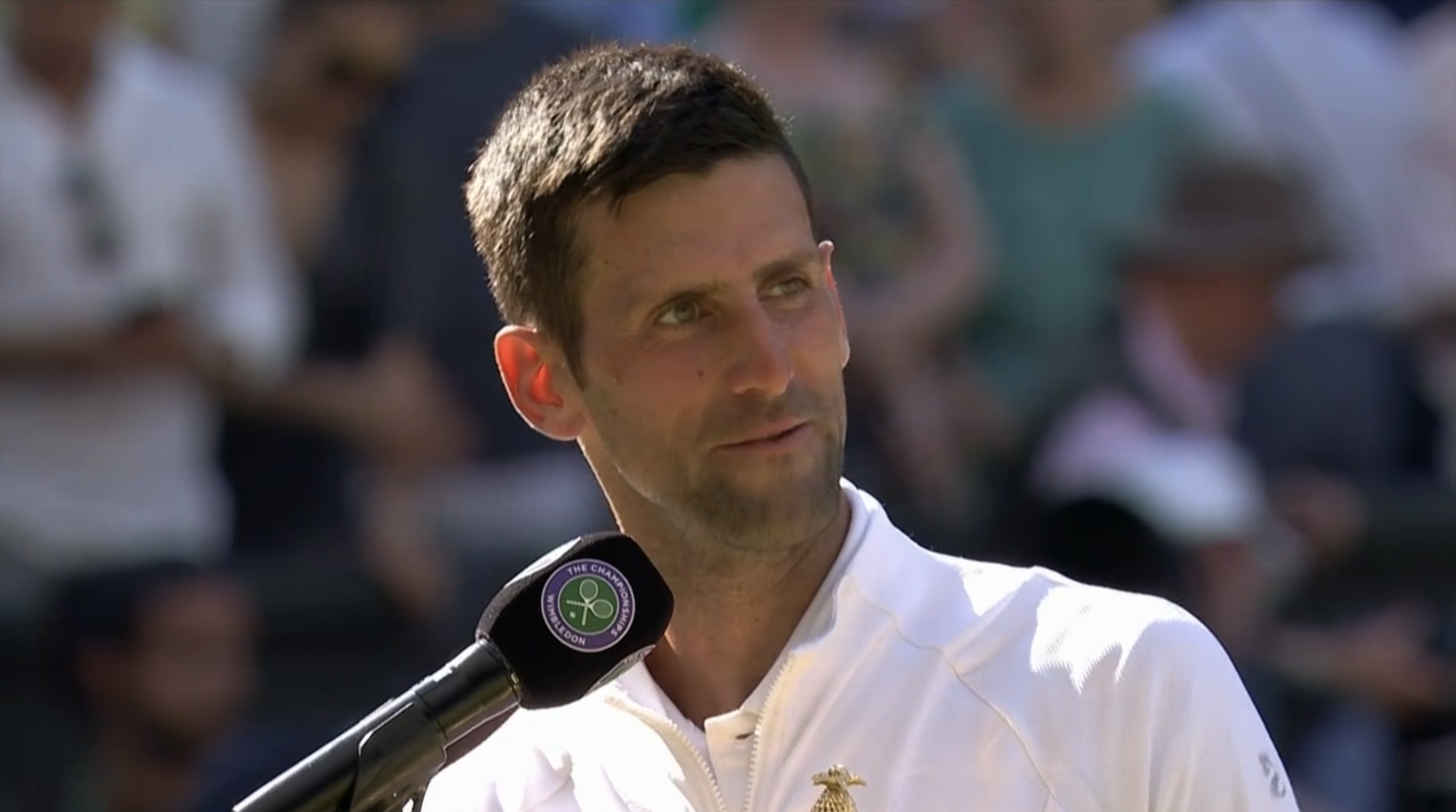
During his on-court remarks after lifting the Wimbledon champion’s trophy for the seventh time, the 35-year-old Djokovic got serious for a moment. “I lost words for what this tournament, what this trophy means to me, my family, my team,” he said. “It was the one that motivated me to play tennis. Then, he added: “It’s also a relief as well, considering what I’ve been through of course this year. It adds more value and more significance and more emotions, of course.”

A postscript

Novak Djokovic remains unvaccinated and, as such, he goes off to an uncertain future with the US Open looming next month. It’s likely he won’t get to play in the year’s final Grand Slam. That’s because the United States has a vaccine mandate that likely won’t be relaxed just for him. Currently, noncitizen nonresident internationals, such as Djokovic, aren’ allowed to enter the country if they aren’t vaccinated against COVID-19.

During his post-match news conference Sunday, Djokovic stood adamant about his decision not to get the required shots to be able to travel to the U.S. “Yeah, I mean, I’m not vaccinated and I’m not planning to get vaccinated,” he said. “So the only good news I can have is them removing the mandated green vaccine card – or whatever you call it – to enter [the] United States, or exemption. 

“I don’t know. I don’t think exemption is realistically possible. If that is a possibility, I don’t know what exemption would be about. I don’t know. I don’t have much answer there. I think it’s just whether or not they remove this in time for me to get to U.S.A.”

At the same time, despite Djokovic’s Wimbledon triumph, he fell four slots in the new ATP rankings, released Monday, from No. 3 to No. 7. That’s because the ATP Tour didn’t award rankings points for this year’s Wimbledon because of the tournament’s ban on Russian and Belarusian players, which Wimbledon enacted because of Russia’s invasion of Ukraine earlier this year.

Looking ahead, Djokovic’s future remains uncertain, he’s still unbeatable on Wimbledon’s famed Centre Court.

Photo credits: Courtesy Wimbledon video. 

A version of this blog previously appeared in Tennis-TourTalk.com.


Tuesday, July 17, 2018

There's no better place in the world to make a comeback

Wimbledon Centre Court /
The thrill of victory 

on the most famous rectangle in tennis.

One year ago, Novak Djokovic left Wimbledon injured and uncertain of his future. On Sunday, the Serbian left the All England Club as the 2018 Wimbledon gentlemen's singles champion for the fourth time. As a further reward, he even got to share a dance with this year's ladies' singles champion, Angelique Kerber, at Sunday night's Champions' Dinner.

While the past couple of years have seen some dark, barren times for the 13-time Grand Slam champion, his 6-2, 6-2, 7-6 (3) win over 32-year-old Kevin Anderson of South Africa in this year's Wimbledon final proved without a doubt that Djokovic is back – and, now, he's the newly ranked No. 10 player in the world.

Meanwhile, Anderson's memorable fortnight, which included a five-set victory over No. 1 seed Roger Federer in the quarterfinals that propelled him toward reaching his second Grand Slam final in less than a year, lifted him to No. 5 in the latest ATP rankings.

"Even though today is not the result I was looking for, I think in the next few days, just seeing my new career-high ranking is going to mean a lot to me," said Anderson during the trophy presentation following Sunday's final. "Looking back at some of the matches, especially my quarterfinal and semifinal match, it will really set, in what I've accomplished. I can be happy with that and use it for continued motivation."

At No. 21, Djokovic became the lowest-ranked male to win Wimbledon since Goran Ivanisevic won in 2001 while ranked No. 125.

Novak Djokovic celebrates his Wimbledon 
victory by waving to his family.
While the 12th-seeded Djokovic's victory, which came a day after his epic five-set semifinal win over World No. 1 Rafael Nadal, lifted him back into the Top 10, it's worth asking: just how good was Djokovic during this Wimbledon fortnight? Does this put him in the right frame of mind with the United States Open just a few weeks away? Can Djokovic win any more majors?

Tackling these pressing  questions one at a time, Djokovic remains the best returner in men's tennis, bar none, and it made a big difference against the 6-foot-8 Anderson, who was hobbled by mental and physical fatigue brought on from his six plus-hour marathon semifinal on Friday against John Isner, in which the fifth set alone was stretched to 50 games (26-24 in favor of Anderson) and lasted nearly three hours alone. Understandably, the personable giant, who is one of the nicest and most polite professionals on tour, had little left for the final. Indeed, by winning Wimbledon, it gives Djokovic a big psychological boost heading into the North America hard court season leading up to the United States Open, which begins the final week of August. And yes, if Federer can still win Grand Slams at age 36, there's  no reason that Djokovic can't win a few more, too – he's just 31.

The past couple of years have seen a decline in Djokovic's desire – not to mention turmoil among his coaching team – coupled with a serious injury to his right elbow that required surgery following this year's Australian Open. On Sunday, it was great to see the champion, nicknamed "Nole," back on Centre Court playing in a Grand Slam final, reunited with his longtime coach Marian Vajda who sat perched in the players' box just above Centre Court. Djokovic played solid-if-not-patient tennis throughout much of the two hour and 19 minute match. He won 76 percent (52 of 68) of his first-serve points, hit 20 winners against 13 unforced errors and broke his opponent four times in four tries. Although Anderson finished with 10 service aces and hit 26 winners, he committed 32 unforced errors and was zero-for-seven in break-point conversions. Djokovic outpointed Anderson 100-74.

On match point, with Djokovic serving at 6-3 in the third set tie-break, he forced Anderson into netting a forehand return. The final was over. After meeting Anderson at the net to shake hands and exchange pleasantries, Djokovic lifted his arms in triumph – much to the delight of the cheering crowd. Soon after, the new champion knelt down to nibble a few blades of grass in celebration – giving a literal interpretation to tasting victory.

Three-year-old Stefan Djokovic, secure in the
arms of his mother, Novak Djokovic's wife
Jelena, during the trophy ceremony.
Shortly after the ancient silver gilt cup that is awarded to the winner was solidly in Novak's hands, the BBC's cameras quickly cut to Djokovic's box where the charming sight of his three-year-old son, Stefan, secure in the arms of his mother, Djokovic's wife Jelena, applauded his papa's accomplishment.

"It feels amazing – the first time in my life I have someone screaming 'Daddy! Daddy!'," said Djokovic, beaming a smile during his on-court interview with the BBC's Sue Barker.

"I'm very emotional with him being there, and my wife and while team. I cherish this moment."

Polite and gracious, Djokovic continued: "I would like to congratulate Kevin. I was quite lucky to get through. I'm very grateful to everyone who has been supporting me. The last couple of years haven't been easy, facing for the first time a severe injury. I had many moments of doubt and didn't know if I could come back. But there's no better place in the world to make a comeback. I always dreamed of holding this trophy as a boy. This is a sacred place for tennis. It's very special."

Indeed, as Djokovic showed everyone on Sunday, there's no better place in the world than Centre Court at Wimbledon – the most famous rectangle in tennis – to make a comeback.

Photos: Courtesy of Google Images.

Tuesday, April 17, 2018

On film: Borg vs. McEnroe, tightly strung rivalry


For 1 hour and 37 minutes on a recent Sunday morning, I felt like I had gone back in time to the summer of 1980 and Sweden's Björn Borg was the top tennis player in the world, in pursuit of a record-breaking fifth Wimbledon gentlemen's singles championship. 

From 1974 to 1981, Borg dominated tennis, both on and off the court. He became the first male player in the Open Era to win 11 Grand Slam singles titles. He possessed a powerful forehand, perfected the two-fisted backhand, and was rigorously disciplined to a fault. On the other side of the net from the 24-year-old Borg was none other than John McEnroe, three years Borg's junior: young, American, talented, abrasive. When you think of Borg vs. McEnroe, you think of tennis, former rivals, best enemies. They were the antithesis of each other.

During a screening at the Cinema Club in Washington, D.C. on March 25, I watched Borg vs. McEnroe, which premiered in limited release in the U.S. last Friday. (It played last fall on the film festival circuit in Europe.) It is directed by Danish filmmaker Janus Metz with the screenplay provided by Swedish writer and director Ronnie Sandahl. Sverrir Gudnason is a dead ringer for Borg while Shia LaBeouf portrays McEnroe.

Borg vs. McEnroe focuses on Borg's rise to prominence, starting from his youth through the 1980 Wimbledon Championships. We learn how Borg's coach, Lennart Bergelin (played brilliantly by Stellan Skarsgård), helps him to channel his competitive – obsessive – behavior off the court so that he can focus on his impulsive game on the court. Meanwhile, we also learn of McEnroe's complete obsession with Borg prior to their big Centre Court championship match.

"Essentially, the movie implies that, despite appearances to the contrary, Borg and McEnroe were inwardly very similar – and different mainly in their behavior. What the drama suggests is that the pressure to maintain appearances, to keep his furies under control and channeled, exacted a very high emotional price on Borg," writes critic Richard Brody in The New Yorker.

"I'm just like everybody else ... I'm not a machine," says Borg, during a testy exchange with a reporter on the eve of his showdown with McEnroe.

Overall, I found Borg vs. McEnroe enjoyable. The fourth set, 34-point tie-break, during which McEnroe saved five match points, takes up nearly the final third of the film. It is at times very riveting and played to its full dramatic effect. The points are fast and so are the edits. While the film focuses on the "Fire and Ice" rivalry between the two future Hall of Fame players, I feel I learned a lot more about the complexity of Borg's character – think tightly strung perfectionist – than I did of McEnroe. However, seeing McEnroe's bad on-court behavior recreated – yelling at both the chair umpire and at pigeons, too – brought back memories for which he's forever remembered. "You cannot be serious!"

Borg vs. McEnroe is presented in both English and Swedish with subtitles. I highly recommend this film.


Tuesday, July 8, 2014

The latest chapter in an amazing tennis story


Novak Djokovic kisses the most coveted trophy in tennis after
winning the 2014 Wimbledon gentlemen's singles championship.

You can learn a lot about world-class athletes by the way they comport themselves during an awards ceremony and in post-match interviews. Such was the case following Sunday's nearly-four hour epic Wimbledon gentlemen's singles final between the seven-time champion, Roger Federer, and the world's no. 1 player, Novak Djokovic. It was their 35th meeting and, always, there's familiarity when these two meet on court.

Sunday's match did not produce a storybook finish to this year's Championships at Wimbledon that many, including myself, had hoped for as Djokovic won 6-7 (7), 6-4, 7-6 (4), 5-7, 6-4 to prevent Federer from winning an eighth Wimbledon title. However, it did give everyone who witnessed the Centre Court clash of titans, in which Federer came from down 2-5 in the fourth set to win five straight games while holding off one match point, a sense of hope that there are more chapters remaining to be written in Federer's amazing story.

From perspective, Federer knows he can't go on forever and each Grand Slam final is a precious opportunity. He expects a lot of himself. Had Federer, a living legend just a month shy of his 33rd birthday, won on Sunday, he would have become the oldest Wimbledon champion since the beginning of the Open Era in 1968 and his eighth Wimbledon crown would have meant his 18th career Grand Slam title, too.

"It was a great final. I can't believe I made it to five. It wasn't looking good for a while," said Federer, during his on-court interview with the BBC's Sue Barker following the trophy presentation. "Going into a match with Novak, it's always going to be tough and physical. He plays athletic points. I can only say 'congratulations' today. Amazing match; amazing tournament once again. Well deserved.

"I enjoyed myself a lot. See you next year."

Federer and his family have been royalty at Wimbledon's Centre Court since he won the junior boys' title in 1998. This year, his parents, wife Mirka and his twin daughters, Myla and Charlene, attired in matching floral dresses, were all there to bear witness. Always gracious in victory or defeat, the very public Federer shed no tears in accepting his runner-up plate. Later, he said: "It's even more memorable when I see my kids there with my wife and everything. That's what touched me the most, to be quite honest. The disappointment of the match itself went pretty quickly."

Meanwhile, the 27-year-old Djokovic's seventh Grand Slam title was special for him. The way in which he bounced back during the ultimate fifth set against Federer -- overcoming mental and physical frailties -- showed a lot of determination.

When it was time for his name to be called out during the trophy presentation, Djokovic lifted his head and raised his arms to the sky, partly in jubilation and partly as a means of giving thanks. During his post-match interview with Barker, Djokovic fought back a lot of emotions.

Novak Djokovic and Roger Federer
with their Wimbledon trophies.
"First of all, I want to congratulate Roger for a great tournament and a great fight today," said Djokovic. "It was a great match to be proud of. He's a magnificent champion, a great athlete."

Turning to look Federer in the eye, Djokovic remarked: "I respect your career and everything you've done. Thank you for letting me win today!" It drew a smile from Federer.

Continuing his praise of Federer, Djokovic said: "In important moments, he comes up with his best shots. That's why he's won 17 Grand Slams and is the best in the game. After dropping the fourth set, it wasn't easy to regroup. I had to compose myself and find the necessary energy to win the fifth. I don't know how I managed to do it."

Asked to put winning this year's Wimbledon title into perspective, Djokovic said: "This is the tournament I always dreamed of winning. It's the best tournament in the world, the most valuable one. The first tennis match I ever saw, when I was five-years-old, was Wimbledon. That image has always stuck in my mind. To be able to compete at such a high level, I'm so grateful for this opportunity and to be able to hold this trophy."

Finally, it was time for Djokovic to recognize those who played a role in his victory: "I dedicate it to a few people," he said. "First of all, I would like to dedicate it to my future wife (Jelena Ristic), and our future baby. I'm going to become a father soon. I'm still preparing for that. It's a great joy in life. I would like to dedicate it to my family: my parents, my brother, and all of the family in my team." Djokovic's team included his coach, three-time Wimbledon champion Boris Becker. "Of course, they've sacrificed a lot of their free time and life in order to live the dream and be where I am at this moment. And, last but not least, I would like to dedicate this title to my first coach that taught me all the basics of tennis shots and behavior and everything I know about tennis, Jelena Gencic. She passed away last year. This is for her."

Djokovic lifted the winner's trophy aloft and kissed it. He was grateful for the opportunity to so publicly share a poignant moment. The Wimbledon final was broadcast to over 180 countries around the world.

Off the court, Djokovic called Sunday's Wimbledon victory "the most special Grand Slam final I've played. At the time in my career, for this Grand Slam trophy to arrive is crucial, especially after losing several Grand Slam finals in a row. I started doubting, of course, a little bit. I needed this win a lot."

Looking back on Sunday's championship match with a day's-worth of perspective, one thing is certain. What a treat for tennis fans around the world this year's final provided us with to remember: Five sets of extremely high level of play stretched out over almost four hours -- with lots of resilience and mental and physical fortitude -- was exuded by both athletes. Regardless of whom you wanted to win, you had to admire and appreciate the level of tennis that Djokovic and Federer brought to Centre Court.

No doubt, both players left the Wimbledon grounds with their heads held high.

A postscript: Four days after winning his second Wimbledon title, Novak Djokovic married his long-time girlfriend, Jelena Ristic, in the grounds of Montenegro's Aman Sveti Stefan resort.

Photos courtesy AELTC/Google Images. 

Tuesday, July 3, 2012

You cannot be (too) serious!

John McEnroe / He not only makes watching tennis interesting,
he's affable, opinionated and makes each story line believable.

One of the joys of watching the Wimbledon fortnight unfold on TV is listening to the entertaining and insightful commentary of former world no. 1 tennis player John McEnroe.

During McEnroe's illustrious Hall of Fame career, he won seven Grand Slam singles titles, including three Wimbledon championships. McEnroe was a superb shot-making artist and a gifted volleyer. He was both a winner and a whiner.

Throughout his career, McEnroe was often confrontational on the court with chair umpires and linesmen, and his famous catchphrase "You cannot be serious!" grew out of an exchange he had with a chair umpire at Wimbledon in 1981.

Now 53, not only is "Johnny Mac" graying gracefully around the temples, he's much less controversial in the broadcast booth than he was on the court. In fact, McEnroe has become much more mellow and affable now that he speaks in the hushed tones favored by tennis commentators.

As a super-talented commentator much in demand ~ at this year's Wimbledon he is commenting on men's matches for both U.S. (ESPN) and British (BBC) audiences ~ McEnroe not only makes watching tennis interesting, he's not afraid to voice his opinion. He's honest and all about accountability. And, yet, he also enjoys drawing upon an historical perspective of the sport like few others can do, except, maybe Bud Collins, to enhance his gravitas.

Chances are good that over the course of a five-set match, McEnroe will bring up his epic 1980 championship match against his great rival Bjorn Borg ~ his first Wimbledon final. His recall of this famous match is very detailed and spot-on. McEnroe was booed by the crowd as he walked on Centre Court following heated exchanges he had with officials after his semifinal victory over Jimmy Connors. He saved five match points in a 20-minute, fourth-set tie-break and won it 18-16. Borg went on to win the fifth set 8-6 and the match, considered by many to be the greatest Wimbledon men's final of all time.

In sharing his opinion of today's players and of the sport he dearly loves, McEnroe makes excellent use of the English language that's part lyrical, part plain-spoken, part New York state of mind. In a 2008 interview with the New York Times, McEnroe said his "vow" as a broadcaster was "giving people an idea of what it's like to be out there." Still a competitor in the booth, this is what makes listening to McEnroe such great entertainment.

Last week, McEnroe observed the match involving seven-time French Open champion and world no. 2 Rafael Nadal, who was knocked out in the second round at Wimbledon by Lukas Rosol, the 100th-ranked player in the world. It was an outcome that stunned the Centre Court audience and nearly left McEnroe speechless after the match ~ well almost:

"I can't believe what I just witnessed," said McEnroe on ESPN's broadcast. "At the end of the day, (Rosol) had more energy than Rafa Nadal. He challenged (Rafa) every step of the way and stepped up like no one could ever imagine.

"Rafa's not only physically one of the most gifted players ever to play, but mentally he's so tough. He imposes his will eventually on you and wears you out both physically and emotionally. And, to think that this complete unknown (Rosol) could step it up ... Nadal was the guy who looked perplexed."

And speaking of Rosol, whom not many tennis fans had ever heard of before his epic upset of Nadal, McEnroe opined:

"Lukas who? Three aces and a forehand winner. He looked really tight in that last game. It's going to be inspirational to a lot of guys. It was an inspirational performance. Talk about unpredictable. In my wildest dreams, I never thought it would happen."

McEnroe was also in ESPN's broadcast booth at Centre Court last Friday night for Roger Federer's five-set, come-from-behind victory over journeyman Julien Benneteau. Naturally, he had plenty to comment upon. As Federer was serving for the match, ahead 5-1, McEnroe said:

"It's a formality now, but  you've got to hand it to Benneteau. He's really persevered out here tonight." After match point, he added: "It's torture that Roger's put himself through, but in the end it's all worth it."

McEnroe isn't afraid to give props to the losers, especially if they've given their all out on the court. On Benneteau's spirit, he said:

"It's a brutal game; he's played the match of his life and now, he's limping off the court. But he gets a standing ovation. Now, he doesn't want to leave the court and you can hardly blame him."

Often, McEnroe is given the opportunity by his broadcast partners ~ Ted Robinson of NBC (McEnroe comments on the French Open for NBC), Bill Macatee of CBS (McEnroe also comments on the U.S. Open for CBS) and Chris Fowler of ESPN ~ to get in the last word before signing off. In his postmortem of the Federer-Benneteau match, he shared these final thoughts:

"Julien Benneteau played the match of his life and swung for the fences. He played an intelligent match and deserved to have the crowd appreciate his efforts. At the end of the day, a lot of people, including myself, picked Federer to win this. You would like to see him win another Slam. The fact he's already got six (Wimbledon titles), he's still hungry. He still finds a way to dig deeper and beat an unknown like Benneteau."

Like Federer, McEnroe's still hungry. Just a tad mellower. The Grand Slams are his time to shine. He understands the characters of tennis and their emotions ~ and, best of all, he makes each story line believable.

John McEnroe photograph courtesy of AELTC, copyright 2012.

Friday, June 25, 2010

Greatest match ever in the greatest place

It took 11 hours, 5 minutes and 183 games ~ spread over three days ~ before the longest match in tennis history finally ended at 4:48 p.m. local time on Thursday afternoon with American John Isner prevailing 70-68 in the fifth set over Nicolas Mahut of France in a first-round gentlemen's singles match at Wimbledon.

If the final tally looked impossible or, worse, a misprint in your morning newspaper, make no mistake.  The final result on the Court No. 18 scoreboard, which had to be reprogrammed after Wednesday evening's suspension of play, was full of a lot of crooked numbers ~ and most of them were in Isner's favor: 6-4, 3-6, 6-7, 7-6, 70-68.

The headline in Friday's New York Times hailed the epic match:

Game, Set, and 3 Days Later, Match.

It drew a hardy mention from a World Cup announcer during the broadcast of the Italy-Slovakia match on ESPN when the score of the last set was 67-all.

By Day 3, the Isner-Mahut marathon match had become the talk of the tournament, if not the world, and nearly upstaged the royal visit by Her Majesty The Queen.  It's too bad Queen Elizabeth II didn't make time to stay late and venture over to the quaint Court No. 18 during her first visit to the All England Club in 33 years. If she had, she could have rubbed shoulders with a few hundred enthusiastic spectators, including John McEnroe and Woody Allen.  Imagine, a tea time threesome with the queen, McEnroe and Allen.  Instead, the queen, 84, preferred to call it a day after spending a couple of hours in the Royal Box at Centre Court watching Andy Murray, Britain's best and only hope for winning a singles title this year, who put on a pretty good show for everyone in defeating Jarkko Nieminen of Finland in conventional straight sets, 6-3, 6-4, 6-2.

In fairness, the queen's itinerary was scripted to the minute, which earlier included a brief walk about the hallowed grounds, lunch with tennis royalty, including Roger Federer and Martina Navratilova (the main course: orange and honey marinated chicken on fruity couscous with roasted vegetables), and an appearance in the front row of the Royal Box surrounded by her cousin, the Duke of Kent, and Virginia Wade, the last Englishwoman to win Wimbledon in 1977 ~ coincidentally, the last time the queen paid a visit to Wimbledon, during her Silver Jubilee year.

For the record, Queen Elizabeth II arrived on schedule at Centre Court at 1 p.m. sharp, attired in a light blue dress and matching hat and sunglasses.  The crowd gave the queen a standing ovation and she acknowledged the crowd with a polite, royal wave with her white-gloved left hand.  At least, that's how I remember seeing it on TV, although I admit I was still half-asleep at 5 a.m. Pacific Time. The British newspaper, The Guardian, described Her Majesty's arrival in a slightly more colorful manner:  "The crowd whooped and cheered as she materialised, resplendent in a turquoise gown with matching inverted flower-pot hat."

No worries, the important matter is this: By all accounts, it appeared that Queen Elizabeth II enjoyed a pretty good time during her visit to SW19 on Thursday, and in return, the All England Club put on a jolly good show for the royals  ~ and, the tradition of bowing on Centre Court, albeit for one match, made a nice comeback.

A postscript: OK, I'll admit it.  Like many tennis fans who collectively held their breath, I became hooked by the Isner-Mahut marathon of all matches, starting from twentysomething-all on Wednesday.  I invested about four hours of my time on Wednesday, watching and tracking the tennis match on TV, which followed the euphoria of the Landon Donovan goal that gave the U.S. a stunning 1-0 victory over Algeria in the World Cup.  So, coming back to watch the conclusion of the tennis match on Thursday morning was a given.

Even though I didn't favor one player over the other, I hoped the match would have a happy ending.  Finally, it did after Isner held serve to go ahead 69-68 and, then, for the first time in the decisive fifth set, broke Mahut.  In the end, both Isner and Mahut were winners, and they will be forever linked by this match.  Even, if only one player would emerge as the victor and earn the right to play on in the second round.

After being embraced at the net by Isner, his opponent for three days, Mahut put things in proper perspective. "We played the greatest match ever in the greatest place to play tennis."

Friday, May 21, 2010

Bard at work: serving up stanzas at SW19

Quiet please!

Bard at work.


Earlier this week, the All England Lawn Tennis and Croquet Club appointed a resident poet for The Championships. Matt Harvey, a regular on BCC Radio 4's Saturday Live, is the anointed bard of this summer's Wimbledon fortnight. His duty is daunting: serve and volley a poem a day that captures the flavor of London SW19 (the postcode area for Wimbledon), filling stanzas with verse full of strawberries and cream, Pimm's Cups, queue lines, ball boys, changes of dress, recollections of classic John McEnroe tantrums, and rain.

Following the previous lead of resident writers for Heathrow Airport and Marks & Spencer, Wimbledon organizers teamed up with the Poetry Trust on this writer-in-residence program. Harvey's musings will be published online via The Poetry Trust and the official Wimbledon websites, www.thepoetrytrust.org and www.wimbledon.org, and in special podcasts. He'll also recite his poems to the queue lines waiting to enter the club grounds.

"Quite simply I'm delighted, with a little bit of anxiety thrown in," said Harvey, quoted in the U.K.'s Guardian newspaper. "It's an honour, and I'm acutely conscious it's the only time I'll come first in anything at Wimbledon, unless you county the queue for strawberries."

Perhaps, Harvey can look to Rudyard Kipling's "If you can meet with Triumph and Disaster and treat those two impostors just the same" that's inscribed above the player's entrance to Centre Court for inspiration. Or, merely reflect on Roger Federer's sustained excellence on the hollowed green. Whether relying on whimsy or perspective, there's plenty of history and lore for Harvey to draw upon.

Harvey's already penned his first poem as Championships Poet 2010:

Excuse me. I'm sorry. I speak as an
Englishman.
For the game of lawn tennis there's no
better symbol than Wimbledon,
The place where the game's flame was
sparked and then kindled in,
Where so many spines have sat straight
and then tingled in
Wimbledon,
Where strawberries and cream have
traditionally been sampled in,
Kids' eyes have lit up and their cheeks
have been dimpled in
Wimbledon,
Where tough tennis cookies have
cracked and then crumbled in,
Top seeds have stumbled, have
tumbled, been humbled in
Wimbledon,
Where home-grown heroes' hopes have
swelled up and then dwindled in
Wimbledon.
The Grand Slams' best of breed -- it's the
whizz, it's the biz,
The temple where physics expresses
it's fizz.
There's one word for tennis and that
one word is
Wimbledon.

Now, then, can poetry slams on Centre Court be far behind?