Showing posts with label London. Show all posts

Tuesday, September 27, 2022

Team World Brought All The Right Stuff Together To Win Their First Laver Cup Title

Team World lifts the Laver Cup in London

Team World entered the final day of Laver Cup 2022 in London trailing four-time champion Team Europe 8-4 and needing to win three of four matches. While it wasn’t an impossible task, it would take everyone on John McEnroe’s Team World squad coming together and playing inspired and focused tennis on Sunday.

With each win worth three points, match by match, Team World turned this year’s Laver Cup upside down and won three straight matches – all with exciting outcomes – to win the Laver Cup title for the first time.

It was quite a weekend to remember in London, which drew more than 96,000 tennis enthusiasts to the O2 Arena, first to bid farewell to Roger Federer, then to see Novak Djokovic’s return to the ATP Tour after winning his seventh Wimbledon title, and, finally, to see Team World’s remarkable final-day comeback, in which Canada’s Felix Auger-Aliassime and Frances Tiafoe of the United States shouldered the load and carried the team on their shoulders to triumph.

Auger-Aliassime gave Team World the lead on the final day thanks to a pair of wins, first by partnering with Jack Sock to edge Matteo Berrettini and Andy Murray, 2-6, 6-3, 10-8, then by defeating Djokovic, 6-3, 7-6 (3). Next, Tiafoe, fought off four match points during a second-set tie-break to beat Stefanos Tsitsipas, 1-6, 7-6 (11), 10-8, which clinched the 13-8 victory for Team World. 

When one considers what transpired, it’s pretty wild that a team with zero Grand Slam singles titles beat a team with 66 that featured Federer (20), Rafael Nadal (22), Djokovic (21) and Andy Murray (3). But that’s exactly what happened. 

In praising his team during the trophy ceremony, Team World captain McEnroe said: “They brought the energy, belief and intensity.”

Later, McEnroe admitted: “It beats losing, that’s for sure. The difference was that we kept battling. There was a great team spirit. We knew we had a shot at it, but it was an uphill battle.”

While McEnroe likely would have been second-guessed for playing Auger-Aliassime back-to-back in Sunday’s first two matches – especially if the young, 21-year-old Canadian faltered against the veteran Djokovic, 35 – in hindsight it was a brilliant and tactical decision.

“This is something that’s discussed among all of us,” he said. “These guys know the ins and outs of what’s going to work best. Felix was ready for it, he had debuted last year, and now he was ready to step up to the big time.”

Auger-Aliassime said he enjoys the challenge that comes from playing in team events, “feeling I can bring something not only to myself but to the team. I feel like it pushes me also to stay positive, to dig deep, that feeling that I’m not only playing for myself, I’m trying to bring something to the team, bring a point to the team.”

Tiafoe added: “All week leading up I kept saying this was our year. The guys showed up. Felix beat Novak, Jack and Felix also played unbelievable doubles. We did it all together, it wasn’t just me.”

Coming off a semifinal run at the US Open, which boosted his ranking to a career-best World No. 19, Tiafoe has been playing some of the best tennis of his career. He said he would rank his Laver Cup-clinching victory over Tsitsipas among his best.

“To do it here in Laver Cup, to win for the first time, given how bad Mac wanted it, how bad everybody else wanted it, seeing what Felix and Jack did – I thought it was just time. It was time to get it done,” Tiafoe said during his team’s final press conference. 

Looking back, as New York Times tennis correspondent Christopher Clarey suggested in a tweet Sunday evening, “[the] Laver Cup has proven that it is value added for tennis.

“Its future is up to the players. If the best ones commit to it consistently and continue to care about the outcome it will thrive.”

A postscript

Roger Federer said this year’s Laver Cup competition would remain special to him – especially the sendoff he received Friday evening after playing in the final match of his pro career.

“Being on court on Friday and having such a huge moment in my career, being surrounded by my biggest rivals like Novak and Andy and Rafa was truly unique, and I can never thank them enough for being there and staying there and going through it with me,” he said.

“I hope that their farewell will also be unique and special, that it works for them, because it was beautiful for me.”

Cover photo: Courtesy Getty Images for Laver Cup.

Tuesday, January 1, 2019

At the year’s end, one last 2018 travel adventure


A view from St. James’s Park in London.

Alan Alda, one of America’s most beloved and respected actors, once suggested that you have to leave the city of your comfort and go into the wilderness of your intuition. “What you’ll discover,” he said “will be wonderful. What you’ll discover is yourself.”

As we awake to the beginning of 2019, no matter where we may be or reside in the world, it’s worth a moment of our time to consider the meaning of Alda’s words.

Last Friday, my wife and I returned from a 10-day holiday visit to London, our first time being British since 2007. Each time we’ve been to England – three times in all since 2005 – there have been new discoveries awaiting us, and this trip provided a wonderful opportunity to rediscover old things from a different perspective.

Upon arrival, we found ourselves in the thick of Christmas holiday revelry as we lodged in a charming, one-bedroom apartment on quiet Lamb’s Passage, an equal walking distance in either direction to the Barbican and Moorgate Underground stations. Within minutes, thanks to the efficiency of the Underground tube, we were able to arrive at a variety of destinations around London: Borough Market, the Tate Modern, St. Paul’s Cathedral, Leicester Square, Oxford Street and Westminster Abbey, to name just a few that we visited.

Our visit began with theater – we saw a wonderful performance of “Company” at the Sir John Gielgud Theatre, in which we met the musical’s star, Rosalie Craig, afterward, and showered her with praise. We followed it with our second Hamilton experience of the year (and third overall), a matinee at the Victoria Palace that we did on the spur of the moment.

We got a feel for British shopping during our excursion to Oxford Street, which included buying music CDs at HMV, clothes at Uniqlo and in perusing holiday merchandise at the elegant Selfridges. Nearby, we enjoyed a charming lunch at the Monocle Cafe in Marylebone. We made time for seeing the new “Mary Poppins Returns” film at the lovely Barbican Centre Cinema.

There were days spent at museums, such as the Queen’s Gallery near Buckingham Palace and the British Museum, which is one of the great museums devoted to human history and culture.

We also enjoyed a lovely walk through St. James’s Park, where we were welcomed by ducks, geese and pelicans.

Finally, we experienced the Holy Trinity of Anglican Church worship experiences, at St. Martin in the Fields, in Westminster Abbey and St. Paul’s Cathedral.

Each Anglican Eucharist was special in its own way. I’ll fondly remember the beautiful four-part choir performing throughout much of the early-afternoon Eucharist at St. Martin in Fields on our first full day in London. Then, there was sitting in the Quire next to the Choir of Men and Boys during Sunday morning Eucharist at Westminster Abbey, a holy shrine steeped deep in British and Anglican history. Finally, there was Midnight Eucharist on Christmas Eve in the venerable and cavernous St. Paul’s Cathedral, where we were the only American couple seated in a row among Germans and Austrians and British worshipers – and feeling at home in our surroundings.

We returned to Westminster Abbey near the end of our stay and it was a pleasure to stand in Poet’s Corner as well as to see the new David Hockney “Queen’s Window” stained glass window.

London is a city in which I could never see myself getting bored. There’s always plenty of interesting things to explore and admire and be curious about.

It’s easy enough to get caught up in the city’s history, its art, its architecture, the Royal Family.

There’s plenty to explore. I know we’ll be back, again.

In the meantime, I look forward to 2019 and the New Year that awaits. Hopefully, it will be a year full of new discoveries and travel adventures. It is truly my hope that yours will be filled with new discoveries, too.

Safe travels and Happy New Year!

Tuesday, May 10, 2016

"My name is Sadiq Khan and I'm the mayor of London!"


Sadiq Khan / I'm a Londoner, I'm European, I'm British, I'm English,
I'm of Islamic faith, of Asian origin, of Pakistani heritage, a dad, a husband."

London began the week with a new mayor. Meet Sadiq Khan. Not only is he the first Muslim to lead Britain's capital city, he's the first Muslim head of a major European capital.

"I'm a Londoner, I'm European, I'm British, I'm English, I'm of Islamic faith, of Asian origin, of Pakistani heritage, a dad, a husband," said the newly elected, 45-year-old Khan in a recent interview with The New York Times.

Khan, a Labour Party leader, succeeds two-term Conservative Boris Johnson, who was London's mayor since 2008. He was officially sworn in as London's new mayor last Saturday during a ceremony at Southwark Cathedral, and was immediately greeted with cheers and applause.

Sadiq Khan / The first Muslim leader of an important
western city.
Born in Tooting, South London, Khan is the fifth of eight children whose parents immigrated from Pakistan. He grew up in the 1970s in a public-housing project – known as a council estate – where his father drove a London city bus and his mother was a seamstress.

"My parents came here because they saw London as a beacon," Khan told The Guardian. "A place where they could create a better life."

Following a bitter Conservative campaign of personal attacks that was dominated by anxieties over his religion and ethnicity, Khan won a striking and historic victory over Tory candidate Zac Goldsmith, gaining a broad acceptance from the London electorate who supported him with 44 percent of first preference votes (56.8 percent of the vote overall) in a crowded field. His election brushed aside attempts by Conservative Prime Minister David Cameron's government to link Khan to the threat of Islamist extremism and, perhaps, it signaled "a broad acceptance by voters of London's racial and religious diversity just months after jihadi terrorist attacks in Brussels and Paris," wrote the Financial Times of London.

"Sadiq Khan's election as mayor of the British capital – making him the first Muslim leader of an important western city – is a historic moment that will be scrutinized around the world, particularly in other European cities struggling to integrate Muslim communities," wrote the Financial Times. "The victory of the Labour party candidate reaffirms London's multicultural image at a time of rising populist fervor in Europe and the U.S."

Khan has said he hoped that Donald J. Trump – the presumptive Republican Party presidential candidate who has called for barring Muslims from entering the U.S. – "loses badly."

As mayor of London, Khan will have power over transport, housing, air quality and policing. He's promised to make 50 percent of new homes affordable. He takes charge of one of the world's great cities, "a vibrant metropolis where every tongue is heard," wrote The New York Times. "In his victory, a triumph over the slurs that tried to tie him to Islamist extremism, Khan stood up for openness against isolationism, integration against confrontation, opportunity for all against racism and misogyny. He was the anti-Trump."

Khan, married and the father of two daughters, comes to his new leadership post following a career as a human rights lawyer. He was a Labour councillor in Tory-held Wandsworth for 12 years. He entered Parliament in 2005 and in 2010 his orchestrated Ed Miliband's winning Labour leadership campaign. He ran Labour's London campaign in the 2015 general election.

Sadiq Khan / "Proud that London has today chosen
hope over fear and unity over division."
As an observant Muslim, Khan seems well placed to tackle extremism in a city known for its tolerance and respect of each other. Although Britain has not sustained a major terrorist attack since 2005, it's worth noting that unlike France, Britain's Muslim population is well integrated, and one in eight Londoners identify as Muslim. During the campaign, Khan openly proclaimed his Muslim faith and declared that he was "the British Muslim who will take the fight to the extremists."

Still, Khan's election as mayor comes at a time when Europe is struggling with an increase in Islamaphobia, "riven by debates about the flood of Syrian migrants and on edge over religious, ethnic and cultural disputes," wrote The New York Times.

http://www.nytimes.com/video/world/europe/100000004391820/londons-new-mayor-gives-victory-speech.html

During Khan's acceptance speech, he noted that London's mayoral election "was not without controversy," but said he was "proud that London has today chosen hope over fear and unity over division."

He added: "I hope that we will never be offered such a stark choice again. Fear does not make us safer, it only makes us weaker and the politics of fear is simply not welcome in our city."

Photos: Cover photo: Courtesy of Sadiq Khan Facebook page. Others: Courtesy of Google Images. 

Tuesday, October 20, 2015

This "Hamlet" needs to be seen and not just heard


National Theatre Live: Coming to a cinema near you. /
Benedict Cumberbatch in "Hamlet."

Ever wanted to experience the best of British theatre without having to trek to London? Now you can, thanks to National Theatre Live, where all the world's a stage even if the stage is on a big movie screen.

One night recently, my wife and I drove to the Century 14 cineplex in downtown Walnut Creek, Calif., about a half-hour's drive from our East Bay home, where we thrilled to an enjoyable evening of London West End theatre come alive on the big screen.

For just $20 a ticket, we were treated to the National Theatre Live's cinematic presentation of the critically-acclaimed "Hamlet," Lyndsey Turner's monumental Barbican production of the 1603 iconic William Shakespeare play about the melancholy prince of Denmark, that was broadcast to a global audience of more than 225,000 on 1,400 movie theater screens in 25 countries around the world.

I was one of those near quarter-million experiencing one of the greatest moments of theatre I had ever experienced. Yet, what I was watching was more a film than a play, but without any compromise to the live appeal of theatre.

That total represents the largest global audience for a live broadcast of any title in National Theatre Live history. Not to worry if you missed out on the excitement. Additional encores of "Hamlet" are scheduled to be shown in movie theaters later this month.

Since its debut in 2009, among the National Theatre Live presentations beamed to theaters include: "Frankenstein" with Benedict Cumberbatch and Jonny Lee Miller alternating between the title role and Dr. Jekyll; "King Lear," produced by Sam Mendes; and "A Streetcar Named Desire," which starred Gillian Anderson.

Throughout, "Hamlet" had plenty of "visual swagger" and, of course, there was an infinitely touching prince, played by Benedict Cumberbatch, whom U.S. audiences have grown to love from his portrayal of Sherlock Holmes in "Sherlock" on PBS's Masterpiece.

"If there's one good thing about the avalanche of hype surrounding the (Hamlet) production, it's that it made Shakespeare seem sexy. That's quite a feat," wrote Lyn Gardner in The Guardian, one of London's pre-eminent newspapers and news websites.

"The production has been accused by several critics of being overly cinematic, but its visual swagger,  with its indigo hues, comes into its own on the screen. It would be worrying if this production set a precedent for stage shows that are directed and designed with an eye to the live screening and a global audience rather than those seeing it in a theatre," added Gardner.

On the night we watched "Hamlet" -- October 15 -- the audience was comprised mostly of middle-aged suburban adults. There were the curious fans like us, who were eager to see Cumberbatch tackle the title role of Hamlet -- both as a prep-school misfit and as a toy soldier -- and to embrace and enjoy outstanding theatre. In addition to Cumberbatch, there were stellar performances given by Ciarán Hinds as Claudius and Sian Brooke as Ophelia.

The only thing missing that would have made our night more complete -- and something that makes attending West End theatre unique to an American -- was a vendor selling ice cream cups in the stalls during intermission.

Seeing National Theatre Live's "Hamlet" reinvented for a 21st Century audience reminded me of this: "Hamlet" needs to be seen and not just heard. And, seeing a larger-than-life Cumberbatch up-close and personal for three hours added up to one hell of a wonderful night of theatre on the big screen.

Photo: Courtesy of Google Images.

Tuesday, July 24, 2012

Two wheels good: Citius, Altius, Fortius?

Two wheels good / A simple two-wheeler is the bicycle of choice
 for residents navigating the narrow streets and canals of Amsterdam.

With the London Summer Games just days away, it is with great interest that I read of the triumph of Bradley Wiggins, the first British winner in the storied history of the Tour de France.

Cycling's premier event finished its annual, three-week endurance trek Sunday afternoon under bright, sunny skies along the famous cobble-stoned Avenue des Champs-Élysées.

The Tour has become controversial in recent years due to doping allegations against seven-time Tour de France champion Lance Armstrong as well as the suspected and apparent use of performance-enhancing drugs in more recent years that has seen two champions ~ Floyd Landis and Alberto Contador ~ stripped of their titles. In fact, until this year, only two Tour de France champions since 1995 ~ Carlos Saestre in 1998 and Cadel Evans last year ~ have not become embroiled in controversy surrounding performance-enhancing drugs. Thus, it was very refreshing to see Wiggins, 32, vehemently deny that he was doping during this year's Tour.

Looking good in yellow /
Bradley Wiggins rides into Paris.
Wiggins won the Tour de France the old-fashioned way:

He e-a-r-n-e-d it.

Which brings us to the subject of the London Summer Games. The Olympic motto is the hendiatrus Citius, Altius, Fortius, which is Latin for "Faster, Stronger, Higher". The motto was introduced for the Paris Summer Games in 1924. Fast forward more than eight decades and, certainly, today's athletes, for better or worse, emulate the Olympic motto. They run faster, they are certainly of stronger build than ever before, and athletes definitely can leap higher, too.

But is it really necessary? Is it worth paying this price?

Through the looking glass /
Cyclists enjoy their ride

along Binnenamstel
 canal in Amsterdam.
Just for a moment, imagine this: Picture a modern-day Tour de France being contested using a simple, two-wheeler like those that are refreshingly commonplace in cities like Amsterdam, the Dutch capital of the Netherlands. Sure, it might take more than the currently-alloted three weeks to complete the Tour, but who cares? And, ask yourself, too: How would a modern-day Tour cyclist handle the demanding climbs of both the Alps or Pyrenees mountains riding a simple two-wheeler?
The answer is simple:
It wouldn't be easy. Yet, it sure would be pure sports.

Citius, Altius, Fortius?

Let the London Summer Games begin.

Amsterdam photographs by Michael Dickens, copyright 2012. All rights reserved.
Photograph of Bradley Wiggins courtesy of The Guardian.

Tuesday, February 14, 2012

A History of the World in 100 Objects

The British Museum / 
One of the world's greatest museums
of human history and culture.

Imagine a book that is both an intellectual and visual feast, and allows you to travel back in time and across the globe to see how the human experience has shaped the world and been shaped by it over the past two million years.

In A History of the World in 100 Objects, based on the audacious and popular BBC Radio 4 series, author Neil MacGregor "takes a dramatically original approach to the history of humanity" by using objects left behind by previous civilizations – often accidentally – as "prisms through which we can explore past worlds and the lives of the men and women who lived in them."

A History of the World in 100 Objects begins with the story of a chopping tool from the Olduvai Gorge in Tanzania, Africa, a relic that is between 1.8-2 million years old and is one of the earliest surviving objects made by human hands. This hefty, 707-page book, which we recently checked out from our local public library, concludes with a story about an object from the modern, twenty-first century: a solar-powered lamp and charger manufactured in Shenzhen, Guandong, China, that is representative of the world we live in today.

A History of the World /
From the handaxe to the credit card.

According to the book's dust jacket, Neil MacGregor's aim "is not simply to describe these remarkable things, but to show us their significance – how a stone pillar tells us about a great Indian emperor preaching tolerance to his people, how Spanish pieces of eight tell us about the beginning of a global currency, or how an early Victorian tea set tells us about the impact of empire."

MacGregor, 65, who has been the director of the British Museum since 2002, writes: "The story is told exclusively through the things that humans have made – all sorts of things, carefully designed and then either admired and preserved, or used, broken and thrown away. I've chosen just a hundred objects from different points on our journey – from a cooking pot to a golden galleon, from a Stone Age tool to a credit card, and each object comes from the collection of the British Museum."

Through these 100 objects, MacGregor describes history as a kaleidoscope – "shifting, interconnected, constantly surprising, and shaping our world today in ways that most of us have never imagined."

At the time of the book's publishing last October, Carol Vogel of the New York Times wrote: "These objects, some humble, some glorious, embody intriguing tales of politics and power, social history and human behavior."

During a 2005 spring vacation trip to London, I took advantage of the opportunity to explore the British Museum. What's truly remarkable about this museum, replete with its Greek Revival facade and first opened to the public in 1759, is that its holdings do not including any paintings. However, what this museum does include is an impressive collection of antiquities. As it turned out, my visit to the British Museum was one of the most enjoyable afternoons I have ever spent at a museum.

The Rosetta Stone / This must-see
attraction was added to
the museum's collection in 1802.
Among many things that stood out for me in the breadth of the museum's collections was seeing the Rosetta Stone up close and personal.

Like the Mona Lisa at the Louvre in Paris, everyone crowded around, wanting to catch a glimpse of the Rosetta Stone and photograph it.

The Rosetta Stone, found at el-Rashid, Egypt in 196 B.C., is the 33rd of 100 objects whose story is told by MacGregor and, among visitors to the museum, it is definitely a must-see attraction.

"Every day when I walk through the Egyptian sculpture gallery at the British Museum there are tour guides speaking every imaginable language addressing groups of visitors, all craning to see this object. It is on every visitor's itinerary, and, with the mummies, it's the most popular object in the British Museum," writes MacGregor.

"Why? It's decidedly dull to look at – a grey stone about the size of one of those large suitcases you see people trundling around on wheels at airports," adds MacGregor. "The rough edges show that it's been broken from a larger stone, with the fractures cutting across the text that covers one side. And when you read that text, it's pretty dull too – it's mostly bureaucratic jargon about tax concessions. But, as so often in the Museum, appearances are deceptive."

MacGregor continues: "This dreary bit of broken granite has played a starring role in three fascinating and different stories: the story of the Greek kings who ruled in Alexandria after Alexander the Great conquered Egypt; the story of the French and British imperial competition across the Middle East after Napoleon invaded Egypt; and the extraordinary but peaceful scholarly contest that led to the most famous decipherment in history – the cracking of hieroglyphics."

What matters now, writes MacGregor, "is not what the stone says but that it says it three times in three different languages: in Classical Greek, the language of the Greek rules and the state administration, and then in two forms of ancient Egyptian: the everyday writing of the people (known as Demotic) and the priestly hieroglyphics which had for centuries baffled Europeans. It was the Rosetta Stone that changed all that; it dramatically opened up the entire world of ancient Egypt to scholarship."

What I find truly amazing after reading the chapter about the Rosetta Stone is that it survived unread through 2,000 years of various occupations, including the Greeks, Romans, Byzantines, Persians, Muslim Arabs and Ottoman Turks. Eventually, the 1798 Napoleon-led French military invasion of Egypt ("they wanted to cut the British route to India") yielded the Rosetta Stone. "The French seized the stone as a trophy of war, but it never made it back to Paris. With his fleet destroyed by Nelson at the Battle of the Nile, Napoleon himself returned to France, leaving the French army behind. In 1801, the French surrendered to the British and Egyptian generals. The terms of the Treaty of Alexandria included the handing over of antiquities, among them the Rosetta Stone."

Soon, the stone found its way to Great Britain for good after its capture by the British Army where it was presented to the British Museum by King George III. The Rosetta Stone has been displayed in the public domain at the British Museum since 1802.

Today, the Rosetta Stone is freely available for the world's scholars to see. Ironically, it was a French scholar, Jean-Francois Champollion, who finally cracked the stone's hieroglyphics in 1822. For the British Museum's many visitors, who wait patiently like I did on a Sunday afternoon in March 2005 for a fleeting glimpse, seeing the Rosetta Stone is a thrill of a lifetime and a chance opportunity to photograph it for posterity.

Photographs of the British Museum and the Rosetta Stone by Michael Dickens, copyright 2005. 

Wednesday, March 23, 2011

An appreciation of daffodils


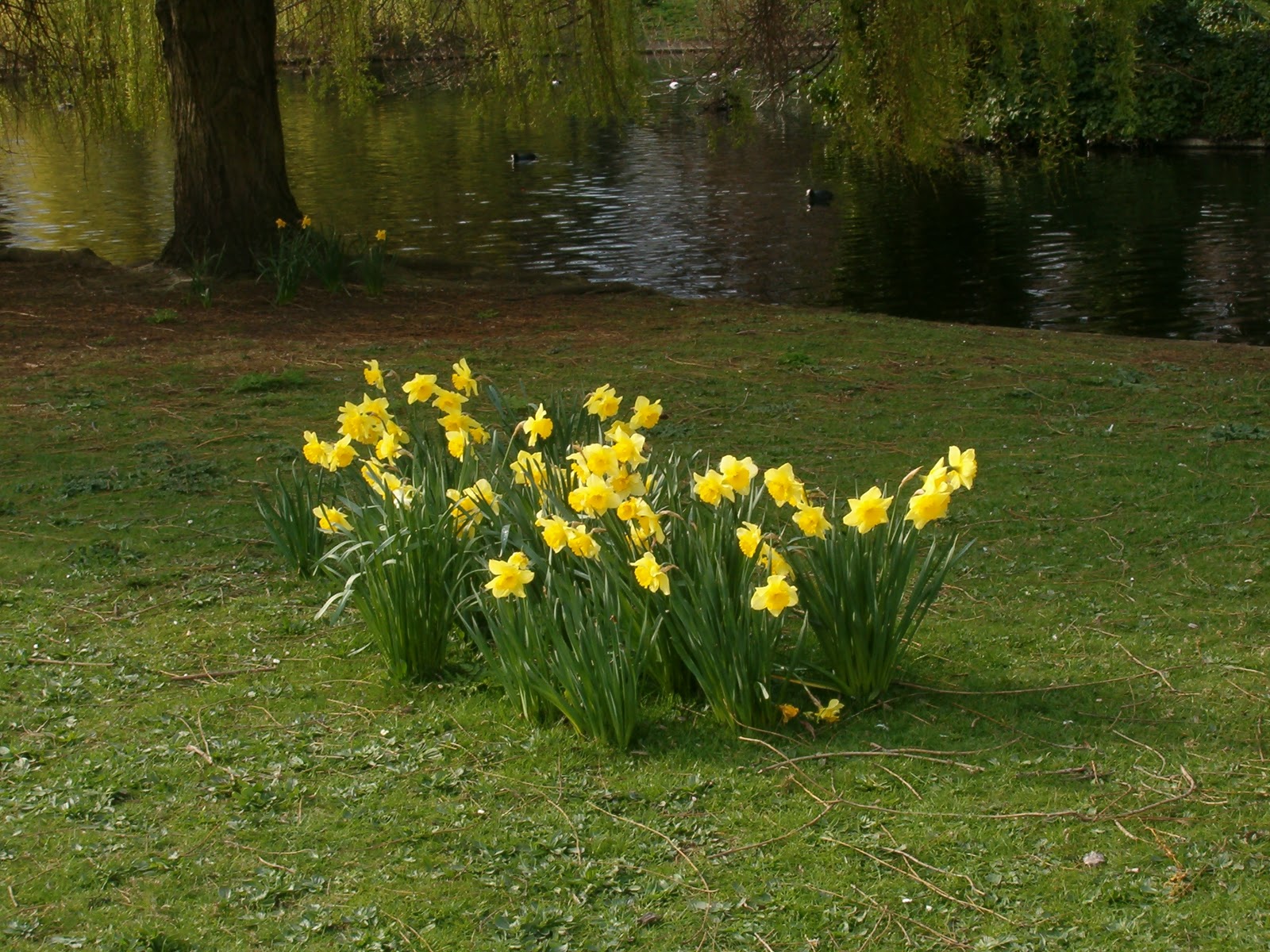
Daffodils / Fond memories of spring time in London

I have fond memories of visiting London in spring time.

Let's see, where to start: There's world-class museums like the Tate Modern and the British Museum to lose yourself in; there's the sight of Big Ben and Buckingham Palace to admire; there's walking across the Millennium Bridge with St. Paul's Cathedral looming bigger than ever as it draws nearer to you; and, there's a plethora of wonderful theatre awaiting on both sides of the Thames that's guaranteed to leave you feeling gobsmacked.

Yes, March is a great time to drop in for a bit of fresh air and fresh culture ~ I've done it twice, in 2005 and 2007 ~ and I can't wait to do it again.  If you go in March, you'll get to enjoy the daffodils that seem to be everywhere you walk throughout all of London's beautiful parks.

It's spring time and the daffodils are in bloom.

Daffodils in bloom /
 St. James's Park (2005)
There's an intellectual quality about daffodils worth admiring. They are hardy flowers.

Their perianth and corona are very detailed and they exude a beautiful yellow hue, although sometimes daffodils contain more than one shade or color.

Daffodils in bloom /
Regent's Park (2007)
And, personally, I like that daffodils mature very quickly. They don't waste time blooming.

My photo of our daffodils (top), in a vase, was shot just three days after we bought them last Saturday at our favorite local grocery store.


Here are a few things worth noting about daffodils:

* Daffodils are the national flower of Wales.
* Daffodils were a central part of e.e. cummings' poem, in time of daffodils.
* The Irish band The Cranberries once sang about daffodils in their song, "Daffodil Lament."
* In Nantucket, Mass., there's even a Daffodil Festival held annually during the last weekend of April that celebrates the flower.

So, you see, there is a bit of shared history ~ and meaning ~ for the daffodil.

Finally, I think daffodils are indeed a sweet image amidst all of the upheaval, disaster and tragedy that is happening throughout our world these days.

It's spring time and the daffodils are in bloom.

Wednesday, December 1, 2010

CNN International: Connecting the world

Have you ever wanted to see what's possible when you seek a world beyond your own?  Take the world of international news, for instance.  Sometimes, you just need to know where to look.

Becky Anderson, host of CNN International's Connect the World. 

"News isn't just about what you see on TV," says Becky Anderson, host of Connect the World, a nightly prime-time program originating from CNN's London bureau.  In an advertisement for the world-wide TV network, CNN International, she adds: "It's about connecting the world with different views and new discoveries."

Whether reporting from bureaux in London, Abu Dhabi or Hong Kong, CNN International's on-going mission ~ its raison d'etre ~ is all about going beyond borders to report the day's biggest stories. "Go beyond the impossible," is one of CNN International's current slogans.

I'm happy to report that CNN International delivers its news and information brand in an intelligent ~ albeit sometimes irreverent ~ manner and, unlike their American cousin, CNN (based in Atlanta), the international version keeps their opinions in check.

I recently discovered a reliable Internet link to watch CNN International.  I invite you to check it out and see for yourself.  You just might come away with a fresh and different perspective about the news.

Last week, while the U.S. awaited Bristol Palin's fate in Dancing With the Stars, some of the biggest stories CNN International covered in depth included:
* the NATO Summit in Lisbon;
* the saga and tragedy of the New Zealand coal mining disaster;
* the unfolding of Ireland's economic crisis.

CNN International recently featured an exclusive interview
with Myanmar pro-democracy activist Aung San Suu Kyi. 

The international network also trumpeted an exclusive, 23-minute interview with recently released Myanmar pro-democracy activist Aung San Suu Kyi, who was awarded the Nobel Peace Prize in 1991.  Highlights of the interview (which first aired on Nov. 19) were packaged and shown throughout the day on several of CNN International's news programs, including: International Desk, Prism and News One.

This week, there's been plenty of ongoing coverage on CNN International about:
* the WikiLeaks disclosure of secret U.S. diplomatic documents;
* the winter weather blast hitting the United Kingdom and western Europe;
* World AIDS Day activities.

Hala Gorani hosts International Desk on CNN International.

Whether focusing on politics, technology, infrastructure, architecture, or the arts, CNN International covers many different but important bases very well.  Call it an exercise in expanding one's horizons.  Among its many monthly, featured programs which "go beyond borders" are:  Talk Asia, Urban Planet, I-List, Icons, Inside the Middle East, Business Traveller, Going Green and Earth's Frontiers.  On the current, 30-minute episode of Earth's Frontiers, one of the program's segments focused on how to balance commerce and conservation in Australian wilderness tourism areas.

While CNN International enjoys a great amount of autonomy from CNN Center headquarters in Atlanta, it's programming also includes American favorites such as Larry King Live and Anderson Cooper 360, as well as Wolf Blitzer's The Situation Room, some of them airing live others pre-recorded. Also, its news programs air some of the same news stories and utilize some of the same field reporters that appear on the U.S. version of CNN.

Richard Quest hosts the lively business program Quest Means Business.

One of CNN International's signature programs is Quest Means Business, a nightly one-hour business news program that originates in London and is hosted by Richard Quest.  On Quest Means Business, the lively and talkative host gets to the right people, asks the right questions, and ~ not surprisingly ~ all at the right time.  Quest Means Business airs at 19:00 in London (2 p.m. ET/11 a.m. PT).  Over the course of an hour, it's not uncommon for the bespoke-attired Quest to weave together interviews and stories that combine elements of business, politics, lifestyle and sport.  Unfortunately, it's a program you won't see on CNN in the U.S., which is too bad.  I think Quest would play well for an American audience.  Who doesn't like an English accent?  Still, you've got to admire a host whose regular sign-off each weekday evening is catchy, if not memorable: "Whatever you're up to in the coming hours, I hope it's profitable."

At CNN International, even the weather has a world perspective.

After watching several hours of CNN International programming over the past couple of weeks, it's easy to get hooked on it, not only for its quality and its voice, but also its cultural perspective.  And, there's something pretty amazing about seeing an international weather forecast that includes Iceland, Turkey and Vietnam, too.  Plus, the commercials it airs are much more interesting and informative, from advertisers such as the Qatar Foundation, Turkish Airlines, Unido and South Korea's 2022 World Cup bid.

The differences between CNN International and CNN U.S. are clear and evident.  For one, CNN International isn't driven by ratings and, for the most part, its programs are the stars not its presenters ~ except, maybe, for Richard Quest.  Also, CNN International is not a politically slanted brand, like Fox News or MSNBC, because it's not in the business of covering all things U.S.A. or acting as a political mouthpiece or operative. Instead, it's a world-wide network watched by English-speaking citizens and travelers of the world, who happen to be in or reside in places such as Sydney, Doha, Helsinki and Paris.

CNN International wants us to Go Beyond Borders.

CNN International is a risk-taker, willing and able to air longer, in-depth, relevant pieces that deliver a different angle on the news.  It's news for the thinking-person, English-speaking world that's beamed around the planet 24/7/365.  Always there.

Yes, understanding the world is within our grasp.  Sometimes, you just have to go beyond borders.

Sunday, October 17, 2010

No 'chuntering' allowed on the House floor

One of my favorite bits of TV occurs early each Wednesday at 4 a.m. (Pacific Time) while I am still sound asleep. Across the Atlantic, eight time zones away from California, as London's Big Ben strikes noon (British Time), it's time for Prime Minister's Questions. Thank goodness for my DVR.

You just never know what you might learn from the British.

Big Ben and the Palace of Westminster,
home of the British Parliament.
(Photo: Michael Dickens, 2005.)

Each Wednesday, when Parliament is in session, Prime Minister's Questions (PMQ) takes place on the floor of the British House of Commons, and it is broadcast live in the United States by C-SPAN2 (7 a.m ET/4 a.m. PT). If you've never seen PMQ, it can be best described as a verbal boxing match, full of high drama, that lasts for about 30 minutes and allows for the opposition leader and other members of Parliament of all parties to grill the Prime Minister with questions on important matters of state and foreign affairs.

PMQ also serves its American audience with an up-close, yet entertaining, look at the art and style of British political culture.  Perhaps, our politicians could learn a thing or two from their British counterparts.

My favorite part of PMQ happens early on when David Cameron, the current prime minister, goes face-to-face with the opposition leader.  Until earlier this year, Mr. Cameron was the opposition leader, and believe me, he found utter joy in sparing with former prime minister Gordon Brown. Often, the lively and passionate Cameron got the best of the droll Brown in these exchanges of spirited oratory and debate. Most weeks, Brown looked like he would rather be anywhere than on the floor of the House being put to task by the Tories. Before Brown, Tony Blair took great delight in being quick-witted with his answers and defending the dignity of the Labour Party.


Last week, Mr. Cameron faced new opposition leader Ed Miliband for the first time.


While this first exchange between the leaders of the Conservative (Tory) and Labour parties wasn't particularly memorable ~ in fact, Mr. Miliband appeared a bit nervous ~ what struck me as funny, and got my attention, was when the Speaker of the House, John Bercow, used the power of the English language to defuse the cantankerous cat calls coming from Tory MPs, who were trying to fluster the young Mr. Miliband, while also lecturing them on decorum.

While PMQ isn't quite a no-holds-barred exchange, there's plenty of partisan bantering, whistling, shouts of "Hear, hear" and, occasionally, laughter.  For a moment, you might have thought you were taking in a night of British theater in the West End.  

Thank goodness, the Speaker, who presides over PMQ and determines which members may speak, steps in from time to time to maintain order and civility during the debate and lecture the MPs on courtesy and manners.  This week, not only was Bercow a master thespian, he also played the role of college professor very well, indeed.  To wit:


Mr Speaker: "Order. The Leader of the Opposition will be heard, and if there are colleagues chuntering away who then hope to catch the eye of the Chair, I am afraid they are deluded."

Immediately, I made a mental note to myself:  "Need to look up the word 'chunter' and find out what the Speaker was lecturing the MPs about."  Sure enough, I typed the world "chunter" into the search engine for dictionary.com and here's what I found:


chun·ter:


Verb (used without object) British Informal; to grumble or to grouse mildly, or tediously.

Origin: 1590-1600;  original dialect (Midlands, N. England) chunter, chunder, chunner;  cf. Scots channer in same sense; expressive word of obscure origin.

So, there you have it, a new word for the day: chunter.  It rhymes with punter. Now, if only I can find a way to work chunter into a proper conversation among friends.

Yes, you just never know what you might learn from our friends across the ocean.

Friday, April 30, 2010

Tate Modern at 10

The Tate Modern is London's museum of international art. It sits along the south bank of the river Thames ~ the unfashionable side ~ in a former power station connected by the Millennium Bridge to mass culture and historic architecture.

Yet, as the Tate Modern celebrates it 10th birthday on May 13, it's become anything but unfashionable. The building, home to England's most important collection of modern and contemporary art, is one of London's most sought out attractions. It's helped transform a previously underdeveloped area of London and also given the city a new image as a leader in contemporary culture.

The Tate Modern's galleries are located inside what used to be the Bankside Power Station, originally designed by Sir Giles Gilbert Scott, which closed in 1981. When it reopened in 2000, instead of displaying its collections in chronological order, the Tate Modern decided upon themes: Material Gestures, Poetry and Dream, Energy and Process, and States and Flux. Displaying art since 1900, it's an inviting place to see modern and contemporary works of Monet, Matisse, Picasso, Lichtenstein and Warhol.

In September, the Tate Modern hosts the first important Gaugin exhibition in Britain in 50 years featuring paintings and drawings from around the world by the master French Post-Impressionist.

During two visits to London, in 2005 and 2007, the Tate Modern was on my "Do List" of places to see ~ and Time Out London readers have nominated the Tate Modern as their favorite London landmark.

The Tate Modern's popularity with both tourists and locals is evident. Forty-five million visitors have ventured through its cavernous entrance since its debut only to be confronted by what The Guardian calls "the strange wonder" of Turbine Hall, "in which, in the annual Unilever Series of installations, they have been whispered to and disoriented, sun-worshiped and helter-skeltered."

I encourage you to explore the Tate Modern both in daytime and at night and to experience how the effect of outside light changes the personality of Turbine Hall inside. No doubt, you'll also enjoy the stunning panoramic view of the city walking along Millennium Bridge, which connects the Tate Modern facing to the south with historic St. Paul's Cathedral facing in the north.

Entry to the Tate Modern is free except for major exhibitions ~ it offers many activities for families with children ~ and it's an especially great place to hang after dark on Friday and Saturday evenings when it has extended hours until 10 p.m. The nearest Underground station is Southwerk (Jubilee Line), about a 600-meter walk from the museum, while the nearest mainline train station is about 800 meters away at Blackfriars. The museum can also be reached from several bus lines.