Showing posts with label Shakespeare. Show all posts

Friday, August 18, 2017

Connecting the Bard through words and paintings


We all know Shakespeare was a man of words. Over 400 years after the Bard magically wrote his word masterpieces, look all around us: his words continue to be spoken aloud, they are spoken through sign language, they appear in printed form, and they even appear on some very cool t-shirts.

Now,  in a celebration of 400 years of Shakespeare, the Folger Shakespeare Library in Washington, D.C. is taking a different approach by presenting Painting Shakespeare, a free exhibition that combines the power of Shakespeare as seen through his words and paintings, as well as Shakespeare-related art and memorabilia. It opened on May 13 and continues through February 11, 2018. This remarkable collection has been placed in a building space that's adjacent to both the Library of Congress and the Supreme Court on Capitol Hill, and includes space for researchers, as well as an intimate theater and a lovely exhibition hall.

The Bard
One afternoon recently, I visited this lively and thoughtful exhibition, where I was warmly greeted by the Folger Shakespeare Library staff as soon as I arrived. While I've always known about the impact of Shakespeare's words – think Macbeth, Othello, King Lear, Romeo and Juliet – inside this exhibition, I was invited to explore just how Shakespeare's words could be represented in pictures. I asked myself: Just how do you represent Shakespeare if you've never seen him with your own eyes?

Through nine different sections, from "Looking Back in Time" to "Imagining Shakespeare" to "Lost and Found," there were twenty-one selections from the Folger Shakespeare Library collection of paintings showcased in the exhibition hall that try to portray the Bard for our own eyes.

"It might seem unusual for a library to have a paintings collection, but Henry and Emily Folger knew that it takes more than books and manuscripts alone to understand Shakespeare and his era," I learned, reading an introductory panel that was displayed at the beginning of Painting Shakespeare. "They also collected scrapbooks, posters, programs, figurines, prints, drawings, and photographs."

I spent about an hour walking through Painting Shakespeare, carefully stopping at each area to observe and discover something interesting or unique about each painting – and to study their stories and glories. Let's see, among the memorable paintings I discovered were: Dexter Portrait of Shakespeare, a 19th century oil on canvas by an unknown British painter; The Awakening of King Lear, circa 1792 from King Lear (act 4, scene 7), an oil on canvas by the 18th century British painter Robert Smirke; and Macbeth Meeting the Witches, 1760 from Macbeth (act 1, scene 3), an oil on panel by the 18th century Italian painter Francesco Zuccarelli. One should also take time to look at Henry Fuseli's gothic masterpiece Macbeth Consulting the Vision of the Armed Head that was painted for the Irish Shakespeare Gallery in Dublin in 1793, and is presented in its original frame.
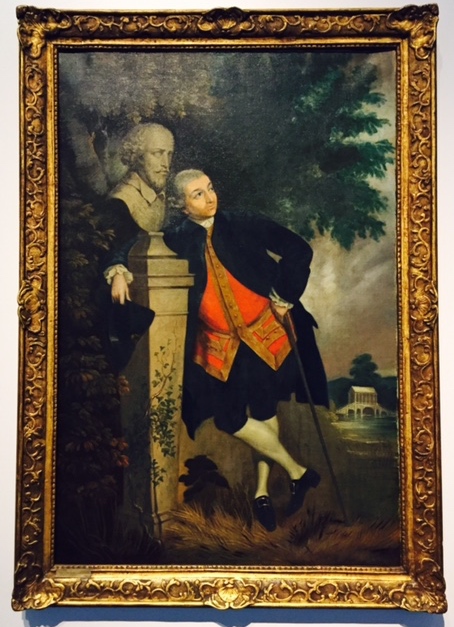
One of my own personal favorites was David Garrick Leaning on a Bust of Shakespeare. In this oil on canvas painting finished after 1769 by an unknown British painter styled after Thomas Gainsborough, I learned this from reading the description card: "David Garrick's devotion to Shakespeare and revolutionarily informal acting style comes across wordlessly here. Viewers familiar with Westminster Abbey will recognize that Garrick's relaxed poise echoes the life-sized marble statue of William Shakespeare in Poets' Corner."

Throughout Painting Shakespeare, visitors are encouraged to share their own personal experiences and connections with Shakespeare and his works. Just because the people in the paintings are standing still doesn't mean we have to, right?

Imagine, using a smartphone or other device to record and share short videos, answering one of these questions:

• When did you first read or see Shakespeare?
• Which words and lines from Shakespeare do you love the most and why?
• Which Shakespeare character speaks to you and why?

The power of Shakespeare allows us to connect with his works and, now, thanks to the Folger Shakespeare Library, through the art of painting, too.

Tuesday, October 20, 2015

This "Hamlet" needs to be seen and not just heard


National Theatre Live: Coming to a cinema near you. /
Benedict Cumberbatch in "Hamlet."

Ever wanted to experience the best of British theatre without having to trek to London? Now you can, thanks to National Theatre Live, where all the world's a stage even if the stage is on a big movie screen.

One night recently, my wife and I drove to the Century 14 cineplex in downtown Walnut Creek, Calif., about a half-hour's drive from our East Bay home, where we thrilled to an enjoyable evening of London West End theatre come alive on the big screen.

For just $20 a ticket, we were treated to the National Theatre Live's cinematic presentation of the critically-acclaimed "Hamlet," Lyndsey Turner's monumental Barbican production of the 1603 iconic William Shakespeare play about the melancholy prince of Denmark, that was broadcast to a global audience of more than 225,000 on 1,400 movie theater screens in 25 countries around the world.

I was one of those near quarter-million experiencing one of the greatest moments of theatre I had ever experienced. Yet, what I was watching was more a film than a play, but without any compromise to the live appeal of theatre.

That total represents the largest global audience for a live broadcast of any title in National Theatre Live history. Not to worry if you missed out on the excitement. Additional encores of "Hamlet" are scheduled to be shown in movie theaters later this month.

Since its debut in 2009, among the National Theatre Live presentations beamed to theaters include: "Frankenstein" with Benedict Cumberbatch and Jonny Lee Miller alternating between the title role and Dr. Jekyll; "King Lear," produced by Sam Mendes; and "A Streetcar Named Desire," which starred Gillian Anderson.

Throughout, "Hamlet" had plenty of "visual swagger" and, of course, there was an infinitely touching prince, played by Benedict Cumberbatch, whom U.S. audiences have grown to love from his portrayal of Sherlock Holmes in "Sherlock" on PBS's Masterpiece.

"If there's one good thing about the avalanche of hype surrounding the (Hamlet) production, it's that it made Shakespeare seem sexy. That's quite a feat," wrote Lyn Gardner in The Guardian, one of London's pre-eminent newspapers and news websites.

"The production has been accused by several critics of being overly cinematic, but its visual swagger,  with its indigo hues, comes into its own on the screen. It would be worrying if this production set a precedent for stage shows that are directed and designed with an eye to the live screening and a global audience rather than those seeing it in a theatre," added Gardner.

On the night we watched "Hamlet" -- October 15 -- the audience was comprised mostly of middle-aged suburban adults. There were the curious fans like us, who were eager to see Cumberbatch tackle the title role of Hamlet -- both as a prep-school misfit and as a toy soldier -- and to embrace and enjoy outstanding theatre. In addition to Cumberbatch, there were stellar performances given by Ciarán Hinds as Claudius and Sian Brooke as Ophelia.

The only thing missing that would have made our night more complete -- and something that makes attending West End theatre unique to an American -- was a vendor selling ice cream cups in the stalls during intermission.

Seeing National Theatre Live's "Hamlet" reinvented for a 21st Century audience reminded me of this: "Hamlet" needs to be seen and not just heard. And, seeing a larger-than-life Cumberbatch up-close and personal for three hours added up to one hell of a wonderful night of theatre on the big screen.

Photo: Courtesy of Google Images.

Tuesday, August 27, 2013

Thoughts: Of Shakespeare, summer and sonnets


One of my favorite urban escapes is Shakespeare Garden, tucked away near the California Academy of Science and the de Young Fine Arts Museum in San Francisco's Golden Gate Park. It's quiet, serene, and meditative. It's filled with shady trees and an abundance of pretty flowers. There's even a sun dial.

The garden is absolutely beautiful. I love, love, love it.

At the entrance to Shakespeare Garden
in San Francisco's Golden Gate Park.

As the number of remaining summer weekends can be counted on one hand, it only seems fitting to take time out from our hurried lives and think fondly of Shakespeare, sonnets and summer days.

Shakespeare Garden sun dial /
Count only sunny hours.

Shall I compare thee to a summer's day?
Thou art more lovely and more temperate;
Rough winds do shake the darling buds of May,
And summer's lease hath all too short a date;

Sometime too hot the eye of heaven shines,
And too often is his gold complexion dimm'd;
And every fair from fair sometimes declines,
By chance or nature's changing course untrimm'd;

By thy eternal summer shall not fade,
Nor lose possession of that fair thou ow'st;
Nor shall Death brag thou wander'st in his shade,
When in eternal lines to time thou grow'st:

So long as men can breathe or eyes can see,
So long lives this and this gives life to thee.

~ William Shakespeare, Sonnet 18


Of Shakespeare, summer and sonnets.

The history of Shakespeare Garden in Golden Gate Park dates back to 1928 and was the brainchild of Alice Eastwood, who served as the long-running director of botany for the Academy of Sciences. The California Spring Blossom and Wildflower Association originally established the space as the Garden of Shakespeare's Flowers.

Flowers and plants have always played an important tool of imagery throughout Shakespeare's literary masterpieces. In this Shakespeare Garden, there are over 200 flowers and plants dotting the beautiful and colorful landscape, including: poppies, mandrakes, daisies, violets, lilies and roses.

The quiet and the beauty inside Shakespeare Garden /
Standing near the back wall looking towards the entrance.

All photographs of Shakespeare Garden by Michael Dickens, copyright 2013.