Showing posts with label painting. Show all posts

Friday, August 18, 2017

Connecting the Bard through words and paintings


We all know Shakespeare was a man of words. Over 400 years after the Bard magically wrote his word masterpieces, look all around us: his words continue to be spoken aloud, they are spoken through sign language, they appear in printed form, and they even appear on some very cool t-shirts.

Now,  in a celebration of 400 years of Shakespeare, the Folger Shakespeare Library in Washington, D.C. is taking a different approach by presenting Painting Shakespeare, a free exhibition that combines the power of Shakespeare as seen through his words and paintings, as well as Shakespeare-related art and memorabilia. It opened on May 13 and continues through February 11, 2018. This remarkable collection has been placed in a building space that's adjacent to both the Library of Congress and the Supreme Court on Capitol Hill, and includes space for researchers, as well as an intimate theater and a lovely exhibition hall.

The Bard
One afternoon recently, I visited this lively and thoughtful exhibition, where I was warmly greeted by the Folger Shakespeare Library staff as soon as I arrived. While I've always known about the impact of Shakespeare's words – think Macbeth, Othello, King Lear, Romeo and Juliet – inside this exhibition, I was invited to explore just how Shakespeare's words could be represented in pictures. I asked myself: Just how do you represent Shakespeare if you've never seen him with your own eyes?

Through nine different sections, from "Looking Back in Time" to "Imagining Shakespeare" to "Lost and Found," there were twenty-one selections from the Folger Shakespeare Library collection of paintings showcased in the exhibition hall that try to portray the Bard for our own eyes.

"It might seem unusual for a library to have a paintings collection, but Henry and Emily Folger knew that it takes more than books and manuscripts alone to understand Shakespeare and his era," I learned, reading an introductory panel that was displayed at the beginning of Painting Shakespeare. "They also collected scrapbooks, posters, programs, figurines, prints, drawings, and photographs."

I spent about an hour walking through Painting Shakespeare, carefully stopping at each area to observe and discover something interesting or unique about each painting – and to study their stories and glories. Let's see, among the memorable paintings I discovered were: Dexter Portrait of Shakespeare, a 19th century oil on canvas by an unknown British painter; The Awakening of King Lear, circa 1792 from King Lear (act 4, scene 7), an oil on canvas by the 18th century British painter Robert Smirke; and Macbeth Meeting the Witches, 1760 from Macbeth (act 1, scene 3), an oil on panel by the 18th century Italian painter Francesco Zuccarelli. One should also take time to look at Henry Fuseli's gothic masterpiece Macbeth Consulting the Vision of the Armed Head that was painted for the Irish Shakespeare Gallery in Dublin in 1793, and is presented in its original frame.
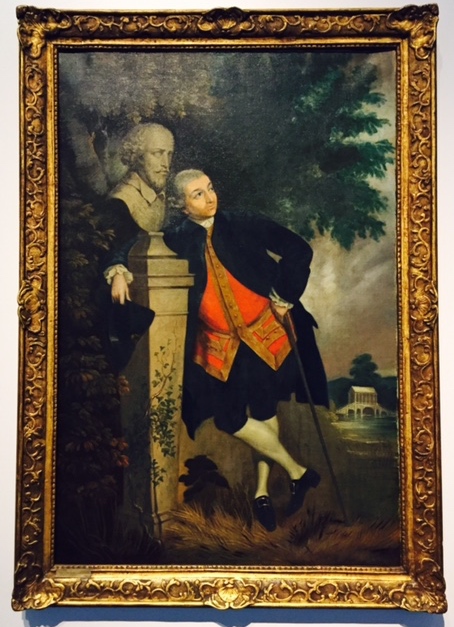
One of my own personal favorites was David Garrick Leaning on a Bust of Shakespeare. In this oil on canvas painting finished after 1769 by an unknown British painter styled after Thomas Gainsborough, I learned this from reading the description card: "David Garrick's devotion to Shakespeare and revolutionarily informal acting style comes across wordlessly here. Viewers familiar with Westminster Abbey will recognize that Garrick's relaxed poise echoes the life-sized marble statue of William Shakespeare in Poets' Corner."

Throughout Painting Shakespeare, visitors are encouraged to share their own personal experiences and connections with Shakespeare and his works. Just because the people in the paintings are standing still doesn't mean we have to, right?

Imagine, using a smartphone or other device to record and share short videos, answering one of these questions:

• When did you first read or see Shakespeare?
• Which words and lines from Shakespeare do you love the most and why?
• Which Shakespeare character speaks to you and why?

The power of Shakespeare allows us to connect with his works and, now, thanks to the Folger Shakespeare Library, through the art of painting, too.

Tuesday, May 19, 2015

Botticelli to Braque: Highlighting the great and the familiar

Sandro Botticelli / The Virgin Adoring the Sleeping Christ 

Sandro Botticelli was one of the most celebrated artists of the Early Renaissance, which was known as a golden age of artistic painting in Italy. His 1485 masterpiece, "The Virgin Adoring the Sleeping Christ Child," welcomes museum-goers to the "Botticelli to Braque: Masterpieces from the National Galleries of Scotland" exhibition on display at the de Young Fine Arts Museum in San Francisco through the end of May. 

Sir Henry Raeburn /
Skating on Duddingston Loch.
The depth and breadth of "Botticelli to Braque" spans more than 400 years of artistic production and the 55 paintings shown in the red-walled Herbst Exhibition Galleries highlight works by many great and familiar painters from the Renaissance to the early 20th century. In addition to Botticelli, the collection includes masterpieces by Diego Velázquez, Johannes Vermer, Rembrandt van Rijn, Sir Henry Raeburn, Frederic Edwin Church, Claude Monet, Paul Gaugin, Georges Seurat, Pablo Picasso and Georges Braque.

The lender of these impressive works of art is the Scottish National Art Collection, which has linked three Edinburgh institutions that contributed to the show: the Scottish National Gallery, Scottish National Portrait Gallery and Scottish National Gallery of Modern Art.

There is always a lot to learn and absorb from seeing any art exhibition, and I became fascinated from the very beginning of "Botticelli to Braque" after viewing "The Virgin Adoring the Sleeping Christ Child". Afterwards, I researched Botticelli's tempera and learned this: The Italian painter drew inspiration from the work of Filippo Lippi, and it's unusual because he painted his masterpiece on canvas not wood and the Christ Child was rarely portrayed asleep.

"This variation could be interpreted as a reminder of Christ's death," according to nationalgalleries.org, the National Galleries of Scotland's website. "His future suffering for Mankind may also be symbolized by the detailed plants and fruits. The red strawberries, for example, may refer to Christ's blood. They also complement the beautiful rose bower which forms an 'enclosed garden', a symbol of the Virgin derived from the Old Testament Song of Solomon."

Johannes Vermeer / Christ in the House
of Martha and Mary.
Meanwhile, of the 36 paintings by the Dutch Master Johannes Vermeer that are known to still exist in the world, "Christ in the House of Martha and Mary" is the largest one and the only one that illustrates a biblical subject. Vermeer is one of my favorite artists and I looked forward to seeing his contribution to the "Botticelli to Braque" exhibition. After all, any Vermeer is worth seeing.

Vermeer (1632-1675), who was regarded as one of the greatest painters of the Dutch Golden Age, was known for painting quiet human interaction, and in "Christ in the House of Martha and Mary" (ca. 1654-1655), he depicts the story of Saint Luke's Gospel (10:38-42) that tells of Christ's visit to the sister's house.

According to nationalgalleries.org, "Christ praised Mary's willingness to sit and listen to his teachings, unlike Martha who was preoccupied with housekeeping. The strong play of shadow and light, the characterization of the figures and broad handling of paint were probably inspired by the work of artists from Utrecht, who in turn were influenced by Caravaggio's art."

Rembrandt van Rijn /
Self portrait, aged 51.
When the "Botticelli to Braque" exhibition opened in March, San Francisco Chronicle art critic Kenneth Baker wrote: "An art historian might plot many lines through the selection of paintings on view, tracing the secularization of subject matter, or the evolution of patronage. But the show's most entwining intellectual thread may be the very question of representational fidelity.

"Why, besides the clerical demand of compelling faith, did what we think of as realism matter so much that it brought forth prodigies of depiction such as Vermeer, Rembrandt and Diego Velazquez?"

Baker's conclusion: "Take any direction through "Botticelli to Braque" and prepare to be blindsided by artistic miracles."

Photos: Courtesy of nationalgalleries.org.