Showing posts with label D.C.. Show all posts

Tuesday, September 21, 2021

A sobering thought about Covid-19


Vietnam Veterans Memorial / Washington, D.C. (Spring 2019)


I came across a very sobering thought last week about Covid-19, courtesy of a tweet I read that was written by California-based New York Times writer John Branch. He wrote:

“You know the Vietnam Memorial? 

“If you replicated the design for those Americans who have died of Covid-19, the wall of names would be about 11 times longer than that – or more than a mile long.

“And with 2,000 Americans dying a day, the wall would grow about 17 feet each night.”

Indeed, definitely something to thing about. 

Friends, the bottom line is simple: 

Get vaccinated.

Wear a mask. 

Don’t think twice. 

Do your part.

Be a good citizen. 


Photos of Vietnam Veterans Memorial: © Michael Dickens, 2019.


Tuesday, November 7, 2017

In the age of internet, why public libraries are still relevant

Woodridge Neighborhood Library in Washington, D.C.

After moving to Maryland earlier this year, one of my top priorities was finding a good local public library. And I did, even if its across the District line in Washington. I visit the Woodridge Neighborhood Library, a branch of the District of Columbia Public Library system regularly – it's only a mile from our new home – and depending upon the time of the day, the library is often filled with people availing themselves to some of the many services offered. Indeed, it's a very positive environment, which opened to the public on September 28, 2016, to much fanfare.

I've seen high school students doing their homework, college students writing their dissertations, younger kids enjoying reading time, adults searching electronic job boards. A public library is a living room where one can go and feel human instead of feeling threatened. For some, including many young students, a neighborhood public library like Woodridge represents the only wi-fi source available to them for free. With 40 desktop computers with internet access available for use, this public library's value isn't lost on its patrons.

There is a warm, community-oriented ambiance inside the 20,000 square-foot Woodridge Neighborhood Library – not to mention a modern design by Wiencek + Associates and Bing Thom Architects that spreads throughout the library's two floors. It's open seven days a week and stays open late Monday through Thursday until 9 p.m.

Indeed, public libraries serve as a valuable bridge between the information-rich and the information-poor. Within these welcoming confines – and the Woodridge Branch is very welcoming – librarians provide a highly skilled service that meets the needs of the general public. I speak with the authority of someone who is married to a librarian.

As our public libraries play a vital role bridging the digital divide and teaching people how to get reliable information from the internet – something that's become very important following the Russian meddling scandal during the 2016 presidential election – it is for this very reason that we need our public libraries now more than ever despite living in an age when most everyone has broadband and can access information without recourse to a librarian.

While I appreciate that my local public library is open seven days a week, many public libraries have limited hours. Federal funding of public libraries has decreased by nearly 40 percent since 2000 and now – more than ever – they need our support not our dismantling.

There is something of important value gained from the physical, communal space of a library, and our public libraries need to continue to be able to provide highly skilled services in order to meet the needs of the general public – not to mention continuing their valuable mission of being repositories for books. I believe they ought to continue to innovate in order to take advantage of the way people are interacting with their libraries, which differs today than it did 10 years ago – even five years ago. There is a digital gap we need to continue bridging between those who have access to the internet and those who do not.

At local public libraries, there are core services such as book loans, study materials for local and national elections, availability of federal and state income tax guides and forms, and weekday and Saturday story hours for children, that remain vital. And, of course, where would we be without our librarians? They may be physical people – hopefully never replaceable by robots – and in the age of Google, their purpose remains valuable.

It's my hope that everyone does what they can to support their own local public libraries, especially now in the age of President Trump's self-proclaimed "fake news." After all, an ill-informed society that is ill-equipped to prosper in today's "information age" is a dangerous prospect for any democracy.

Learn more about the Woodridge Neighborhood Library by clicking on the link.

Photo: Courtesy of DCLibrary.org.

Friday, August 18, 2017

Connecting the Bard through words and paintings


We all know Shakespeare was a man of words. Over 400 years after the Bard magically wrote his word masterpieces, look all around us: his words continue to be spoken aloud, they are spoken through sign language, they appear in printed form, and they even appear on some very cool t-shirts.

Now,  in a celebration of 400 years of Shakespeare, the Folger Shakespeare Library in Washington, D.C. is taking a different approach by presenting Painting Shakespeare, a free exhibition that combines the power of Shakespeare as seen through his words and paintings, as well as Shakespeare-related art and memorabilia. It opened on May 13 and continues through February 11, 2018. This remarkable collection has been placed in a building space that's adjacent to both the Library of Congress and the Supreme Court on Capitol Hill, and includes space for researchers, as well as an intimate theater and a lovely exhibition hall.

The Bard
One afternoon recently, I visited this lively and thoughtful exhibition, where I was warmly greeted by the Folger Shakespeare Library staff as soon as I arrived. While I've always known about the impact of Shakespeare's words – think Macbeth, Othello, King Lear, Romeo and Juliet – inside this exhibition, I was invited to explore just how Shakespeare's words could be represented in pictures. I asked myself: Just how do you represent Shakespeare if you've never seen him with your own eyes?

Through nine different sections, from "Looking Back in Time" to "Imagining Shakespeare" to "Lost and Found," there were twenty-one selections from the Folger Shakespeare Library collection of paintings showcased in the exhibition hall that try to portray the Bard for our own eyes.

"It might seem unusual for a library to have a paintings collection, but Henry and Emily Folger knew that it takes more than books and manuscripts alone to understand Shakespeare and his era," I learned, reading an introductory panel that was displayed at the beginning of Painting Shakespeare. "They also collected scrapbooks, posters, programs, figurines, prints, drawings, and photographs."

I spent about an hour walking through Painting Shakespeare, carefully stopping at each area to observe and discover something interesting or unique about each painting – and to study their stories and glories. Let's see, among the memorable paintings I discovered were: Dexter Portrait of Shakespeare, a 19th century oil on canvas by an unknown British painter; The Awakening of King Lear, circa 1792 from King Lear (act 4, scene 7), an oil on canvas by the 18th century British painter Robert Smirke; and Macbeth Meeting the Witches, 1760 from Macbeth (act 1, scene 3), an oil on panel by the 18th century Italian painter Francesco Zuccarelli. One should also take time to look at Henry Fuseli's gothic masterpiece Macbeth Consulting the Vision of the Armed Head that was painted for the Irish Shakespeare Gallery in Dublin in 1793, and is presented in its original frame.

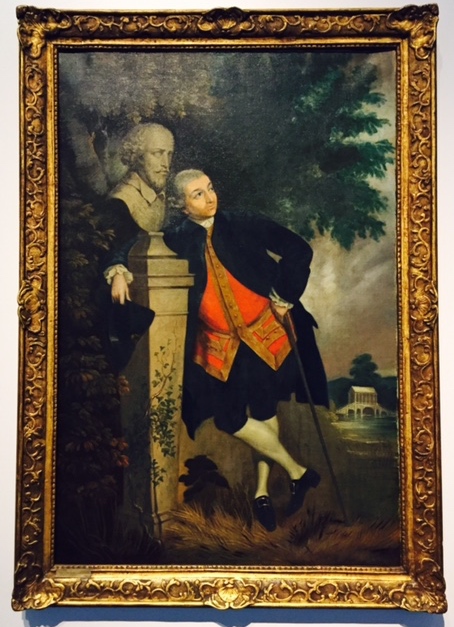
One of my own personal favorites was David Garrick Leaning on a Bust of Shakespeare. In this oil on canvas painting finished after 1769 by an unknown British painter styled after Thomas Gainsborough, I learned this from reading the description card: "David Garrick's devotion to Shakespeare and revolutionarily informal acting style comes across wordlessly here. Viewers familiar with Westminster Abbey will recognize that Garrick's relaxed poise echoes the life-sized marble statue of William Shakespeare in Poets' Corner."

Throughout Painting Shakespeare, visitors are encouraged to share their own personal experiences and connections with Shakespeare and his works. Just because the people in the paintings are standing still doesn't mean we have to, right?

Imagine, using a smartphone or other device to record and share short videos, answering one of these questions:

• When did you first read or see Shakespeare?
• Which words and lines from Shakespeare do you love the most and why?
• Which Shakespeare character speaks to you and why?

The power of Shakespeare allows us to connect with his works and, now, thanks to the Folger Shakespeare Library, through the art of painting, too.

Tuesday, August 8, 2017

#NextGen star Zverev is so scary good, he's #NowGen

Sascha Zverev / The champion kisses the trophy.
The German writer and poet Johann Wolfgang von Goethe once said that personality is everything in art and poetry. Perhaps, it's possible to include tennis players like Sascha Zverev, too?"
The 20-year-old from Germany with the rockstar appeal and charming mop top hair-do, who is currently ranked at a career-high No. 8 in the Emirates ATP Rankings, Zverev has been his sport's hottest player. He's won four titles in 2017, including the Rome Masters. On Sunday, the ATP #NextGen star added his first ATP 500 crown to his C.V. with his steamrolling 6-4, 6-4 victory over Kevin Anderson in the final of the Citi Open in Washington, D.C. 
For an all too brief 69 minutes, Zverev played very focused and dominating tennis in dismantling Anderson. Coming into Washington, he'd won three titles in the past six months, including the Rome Masters over then-No. 2 Novak Djokovic. Now with his fourth 2017 crown secured, Zverev's total equals Rafael Nadal and trails only his idol, Roger Federer. 
"I don't know if this was my best tennis (today), but I got better and better every match I played," Zverev said after his victory over Anderson. "I'm just happy to win."
Alexander "Sascha" Zverev paints word pictures with his racquet and his ballet-like artistry on the court is a thing of beauty that's worth appreciating. He also inspires haiku poets:
His idol is Fed.
Like Roger, he's amazing.
He's Sascha Zverev!
Sasha Zverev faced no break points
in his final two matches.
Zverev, who improved his 2017 win-loss record to 41-13 and earlier in the week won his 100th career match, didn't leave any of the fans who packed the Stadium Court at the Rock Creek Park Tennis Center for the final feeling disappointed. The consistency and exactitude of both his right-handed forehands and two-fisted backhands were truly amazing and the payoff – $355,460 for winning not to mention the 500 ATP points he earned – indeed was handsome. Zverev hit 23 winners, committed just seven unforced errors, and he won 88% (30 of 34) of his first-serve points and 67% (10 of 15) on his second serve on the speedy hard-court surface.
A semifinalist last year at the Citi Open, the six-foot-six-inch Zverev broke Anderson once in each set, lost just nine points on his own serve, and he faced no break points for the second straight match. He dominated the baseline rallies throughout both sets.
To the 15th seed Anderson's credit, the tall (six-foot-eight-inch) and agile, 31-year-old South African fired eight aces and placed 70% of his booming first-serves in play, and he won 80% of his first-serve points. He also hit 27 winners, but committed 17 unforced errors. Against many others, those numbers would have been good enough for the 45th-ranked Anderson to capture the Citi Open or most any other ATP 500 title. On Sunday against Zverev, it wasn't – but not for a lack of trying. En route to the final, Anderson knocked off Malek Jaziri of Tunisia on Wednesday evening, then upset the tournament's top seed, World No. 7 Dominic Thiem of Austria late on Thursday night, following a lengthy rain delay. In the quarterfinals on Friday afternoon, he beat a surprising Yuki Bhambri of India, then looked impressive in his straight-set semifinal win over the last American standing, Jack Sock, on Saturday afternoon.
"The last few months have been tricky for me," Anderson said, during the trophy presentation. "This is my first final in a while. I congratulate Alex on a great week."
Anderson, who has been trying to get his career back on track after battling a variety of injuries last year, has now lost to Zverev in all three of their meetings, including a three-set loss in Washington two years ago when a teenaged Zverev was beginning to burst onto the World Tour scene.
Now, the young and mature tennis wunderkind affectionately known to all as Sascha is scary good – and he's still improving. He dropped just one set this week (against Australian Jordan Thompson) and made quick work of his other opponents before the final: American Tennys Sandgren, Daniil Medvedev of Russia, and World No. 9 Kei Nishikori from Japan. At times, his play looked effortless but it was always entertaining. Throughout the tournament, Zverev moved about the hard court surface with great confidence and authority, and he always played with a keen instinct well beyond his years.
Sascha Zverev on the TennisChannel set
discussing his Citi Open title. 
During a post-match interview with TennisChannel's Jim Courier, after he received the champion's trophy, Zverev gave props to the newest member of his team, former French Open champion Juan Carlos Ferrero. It was a decision to add Ferrero that Zverev made with the blessing of his father and longtime coach, Alexander Zverev, Sr. "He's a great guy to bring in and has brought a positive balance to our team," the junior Zverev said. "He's one of the smartest guys, a former World No. 1. He can teach me things, how to deal with pressure. We've just started, but we've done well so far."
The dividends are starting to show for Zverev. Now, not only is he in fourth place on the road to the this year's ATP Finals in London with 3,165 points, he's also far away the leader in the Race to Milan among the ATP's #NextGen players by 2,285 points over his nearest competitor, Karen Khachanov of Russia. Sascha's got a Masters 1000 and a 500 title under his belt this year, plus he made it to the second week of a Grand Slam, the fourth round of Wimbledon last month. What's next?
"The farthest I've been in a Grand Slam is fourth round. I would like to change that. I would like to go further and I still have to improve a lot. Honestly, that's my main goal," Zverev said. "I know that I have to keep working hard and keep improving my game to be able to go far in the big tournaments. I just want to keep improving and win these kind of tournaments."
In leading up to the U.S. Open later this month, the year's final Grand Slam, Zverev will be seeded fourth at this week's Rogers Cup in Montréal, and he will also be one of the top seeds at next week's Western & Southern Open in Cincinnati, both Masters 1000 events. The media and fan interest has only just begun.
"My goal is to qualify for London this year," Zverev said. "I know I'm playing good tennis at the moment. I can win big matches. It will be a dream come true to play in the O2 Arena against the best players in the world. Obviously, this is something that is quite special for every player. For me to qualify at the age of 20 will be something amazing."

Photos: Trophy photo courtesy of Citi Open and ATPWorldTour.com; interview photo courtesy of TennisChannel.com; Sascha Zverev serving photo by Michael Dickens © 2017.

Tuesday, June 20, 2017

Welcome to my new life


The east side of U.S. Capitol Building in Washington, D.C.

We shall not cease from exploration, and the end of all our exploring will be to arrive where we started and know the place for the first time. – T. S. Eliot

On April 22, after 21-plus years of enjoying the landscapes and rhythms of northern California, my wife, Jodi, and I waved goodbye to the San Francisco Bay Area and headed east on Interstate 80. Our final destination? None other than the greater Washington, D.C. area, our new home.

As it happened, over the next week, we drove 2,950.6 miles – covering 13 states starting from California. We crossed the finish line in Maryland on Saturday afternoon, April 29, after beginning the final day of our journey in Morgantown, West Virginia.

Our Passivhaus town home in
Mount Rainier, Maryland.
Our travel week was very busy for us, but one in which we both embraced. After all, we had purchased a brand new house, a Passivhaus town home, in funky Mount Rainier, Maryland, just a couple of short blocks across the District line from Washington and about 15 minutes by car south of the University of Maryland campus in College Park. And, on May 1, my wife began a dream job in research and development at the Library of Congress, which served as the impetus for our leaving California for the Mid-Atlantic east coast.

As we drove across our beautiful and diverse country observing – through the snow-capped Sierra Mountains of California and Nevada, across the massive and great Salt Lake of Utah, alongside the majestic Rocky Mountains of Colorado, across acres and acres of Kansas wheat fields, near the picturesque Gateway Arch of St. Louis, through the Big Ten country of Indiana University in Bloomington, beside the Great American city of Cincinnati and up and down the hilltops of Morgantown – I was reminded often of how Mother Nature often holds up a mirror to us so that we can see more clearly the ongoing processes of growth, of renewal and of transformation in our lives. Our hours and days on the road were also filled with an abundance of music CDs – Pink Martini, Paul Simon, Elvis Costello, Valerie June, Diana Reeves – a variety of NPR podcasts like "Make Me Smart," and we tried to limit our driving to daytime hours so we could rest and renew ourselves at night.

The scenic beauty of the Donner Summit as seen driving
along Interstate 80 through the California Sierra Mountains.
Fortunately, social media and the Internet enable us to stay more easily connected than ever before with family and friends and we still plan to follow and support our favorite Bay Area professional and collegiate sports teams – just from a different city and time zone. So far, we are enjoying the fine public radio offerings from WAMU in Washington, D.C. as well as reading the Washington Post and the national print edition of The New York Times. And, we've learned thanks to the University of Maryland, which won both the men's and women's national championships in lacrosse, that people in this part of the country do take their lacrosse seriously. We've got tickets to see a Washington Nationals baseball game against the San Francisco Giants, and already we've been to a WNBA women's professional basketball game, too. Yes, there's plenty of rich of history and culture that awaits us in and around the nation's capital city, through its many museums and monuments, parks and trails – and I'm sure our free summer weekends will fill up fast with things to see and do. Already, we've explored historic Annapolis (which I'll write more about in the weeks to come) – it's only about 40 minutes away by car – and I'm sure we'll be back, soon.

Our future looks bright – and it doesn't even have anything to do with the abundance of sunshine we've experienced during the past month. Indeed, as the French novelist Marcel Proust once said, "the real voyage of discovery consists not in seeking new landscapes but in having new eyes."