Showing posts with label Library of Congress. Show all posts

Tuesday, May 7, 2019

Bill James: Baseball is universe you can figure out


Since 1977, Bill James has written more than two dozen books devoted to baseball history and statistics. During that time, he’s worn many influential hats in and around the National Pastime as a baseball writer, historian and statistician. In 2006, Time named him to the Time 100 as one of the most influential people in the world. Currently, James is a senior advisor on Baseball Operations for the Boston Red Sox.

James coined the term sabermetrics in homage to the Society for American Baseball Research (SABR), in which one scientifically analyzes and studies baseball – think of Moneyball  by Michael Lewis – often through the use of statistical data that goes beyond mere home runs, runs batted in and batting averages in an attempt to determine why teams win and lose.

On Saturday, James visited the Library of Congress in Washington, D.C., where he spoke on a variety of subjects in conversation with D. Bruce Brown, president of the Baltimore Babe Ruth Chapter of the Society of American Baseball Research.

Why do you like baseball?
“You can trace it and study it unlike much of the rest of the world.”

Is research ruining the romance of baseball?
“We can get so wrapped up in what we do that it drives people away, dying the game. It’s a legitimate concern.”

What is the future of baseball?
“It’s old and has the ability to adapt. What I see as the next thing to save the game is – and I don’t know how or where it will happen – but it has to go broader. You can change everything (about the game) and it’s still baseball.”

How does your affiliation with the Red Sox change your outlook on the other 29 teams?
“I may have at times spoken disrespectfully of teams, but I would never write a book telling secrets. You have to have respect for secrets.”

Who was your favorite team growing up?
“I grew up a Kansas City A’s fan and became a Royals fan. (James was born in Holton, Kan.) I’m more of a Red Sox fan (now) than I was ever a Royals fan. It was difficult rooting for a team owned by Charlie Finley.”

What have you changed your mind about in 40 years?
“I used to think if you had a player who played second and shortstop, you made him a shortstop because he was more valuable. Maximize team value.”

James was asked to name his All-Time team:
C – Yogi Berra
1B – Lou Gehrig
2B – Joe Morgan/Eddie Collins
3B – Mike Schmidt
SS – Cal Ripken
OF – Babe Ruth, Willie Mays, Ted Williams
P –  Lefty Grove/Roger Clemens

A few closing thoughts ...

“Younger people now have a better command of the game than before.”

“Are you trying to win or entertain the fans? Many teams now put (those principles) on equal footing.”

Photo: By Michael Dickens

Monday, February 18, 2019

On Learning: What’s new at the Library of Congress

A 1939 Frank Warner Banjo /
Acquired by the Library of Congress.

One of my favorite days each year at the Library of Congress is the annual “New Acquisitions” display, when the public is invited to view 100 of the most interesting items in all formats that the Library has obtained during the past fiscal year.

During this year’s open house last week, there were holograph manuscript sketches for Beethoven’s monumental “Hammerklavier” Piano Sonata, Op. 106, presented by the Music Division; the 1941 Japanese Pearl Harbor damage assessment map used to brief Emperor Hirohito, presented by the Asian Division; and one of the most famous issues of the New York Daily News, which contains a front page with one of the most iconic baseball cartoons of all time, “Who’s a Bum!” by cartoonist Leo O’Mealia, presented by the Serial & Government Publictions Division.

Multi-faceted French Toy Theatre
There were many fascinating items from a variety of curatorial divisions in the Library, and curators were on hand to answer visitor questions and provide commentary. For instance, I shared a wonderful discussion with Sybille Jagusch, chief of the Children’s Literature Center (which is part of the Library’s Rare Books and Special Collections) about her recent purchase of a superb, multi-faceted French Toy Theatre, with small hand cranks which move color images across the back of a hollow box. I learned that the chromolithgraphed scenes included in this French toy theatre are lovely and handsome images of the Paris Exposition of 1900.

Also, I engaged with Raymond White, a senior music specialist with the Library’s Music Division, to learn about what the Library has added to its wealth of original Felix Mendelssohn (1808-1847) holdings. I did not realize that the Library is a well-known repository for its sources of Mendelssohn research, which includes approximately 20 music manuscripts, nearly 400 autograph letters and a large collection of first and early printed editions, in addition to portraits, contemporaneous clippings, and other documents. It all combines to make the Library of Congress the leading American source for all things Mendelssohn.

Among other new items of interest:

• A World’s Fair New York “Straight to the Gate” print by German-born artist Sasha Maurer that depicts a couple admiring the vista of a train streaming through Manhattan’s Penn State to the brightly glowing World’s Fair Station, presented by the Prints & Photographs Division.

• A beautifully illustrated Book of Hours for an English Market, made in Flanders for exportation to England during the middle years of the 15th century in an era of religious reform, presented by the Rare Book and Special Collections Division.

• A Frank Warner banjo, signed by more than 200 performers, made in 1939. The banjo is made of walnut, with walnut tuning pegs, steel strings and animal skin. The signatories include Alan Lomax, Odetta, Woody Guthrie and Pete Seeger, presented by the American Folklife Center.

• Copies of Besuboru magajin (“Baseball magazine”), which belong to a set of 66 issues recently acquired by the Asian Division. These issues span from 1946 to 1951, a period that coincides with the U.S. occupation of Japan (1945-1952) and “marks a time of profound political, social and cultural change.” Besuboru magajin, I learned, appeared shortly after Japanese professional baseball officially returned in November 1945, after a year of inactivity due to World War II.

Photos: By Michael Dickens © 2019.


Tuesday, March 20, 2018

The story of ordinary women doing extraordinary things

Hidden Figures:
In conversation with the Library of Congress.

Author Margot Lee Shetterly might not be a household name, but through her book, Hidden Figures: The Story of the African-American Women Who Helped Win the Space Race, and the Academy Award-winning film Hidden Figures that was inspired by it, we've learned about a group of NASA black female professional mathematicians – "human computers" – who helped propel the United States to victory in the space race. Who knew?

"Why haven't I heard this story before?" is a familiar question the Hampton, Va. native, University of Virginia graduate Shetterly hears, more than a year and half after her book was published and turned into a big screen biographical drama starring Taraji P. Henson, Octavia Spencer, and Janelle Monáe. Both the book (published by William Morrow/HarperCollins) and the film (distributed by 20th Century Fox) highlight the remarkable stories of pioneering black women mathematicians at NASA whose calculations fueled great achievements for the U.S. space program as it was competing for supremacy against Russia during the Cold War. These pioneers included: Katherine Goble Johnson, a mathematician who calculated flight trajectories for Project Mercury; Dorothy Vaughan, a NASA supervisor; and Mary Jackson, a NASA engineer.

These women weren't household names like NASA astronauts John Glenn and Alan Shepard. Yet, they accomplished great things and led extraordinary lives in eras of limited opportunity for women. They broke barriers before gender, race, science and politics became a rallying cry for females.

Hidden Figures author Margot Lee Shetterly.
Through Shetterly's storytelling, we learn there are scores of other black women – hidden figures – who worked for decades in anonymity as professional mathematicians, scientists and engineers. They overcame gender and racial hardships, and through their perseverance, they were all bright lights.

"Of course, the factors making their narrative so compelling to modern audiences are the same that conspired to keep the story under wraps for so long: racial segregation, gender bias and the arcane, sensitive nature of the work being done at NASA kept these women in the national blindspot," Shetterly wrote in the March/April issue of the Library of Congress Magazine. 

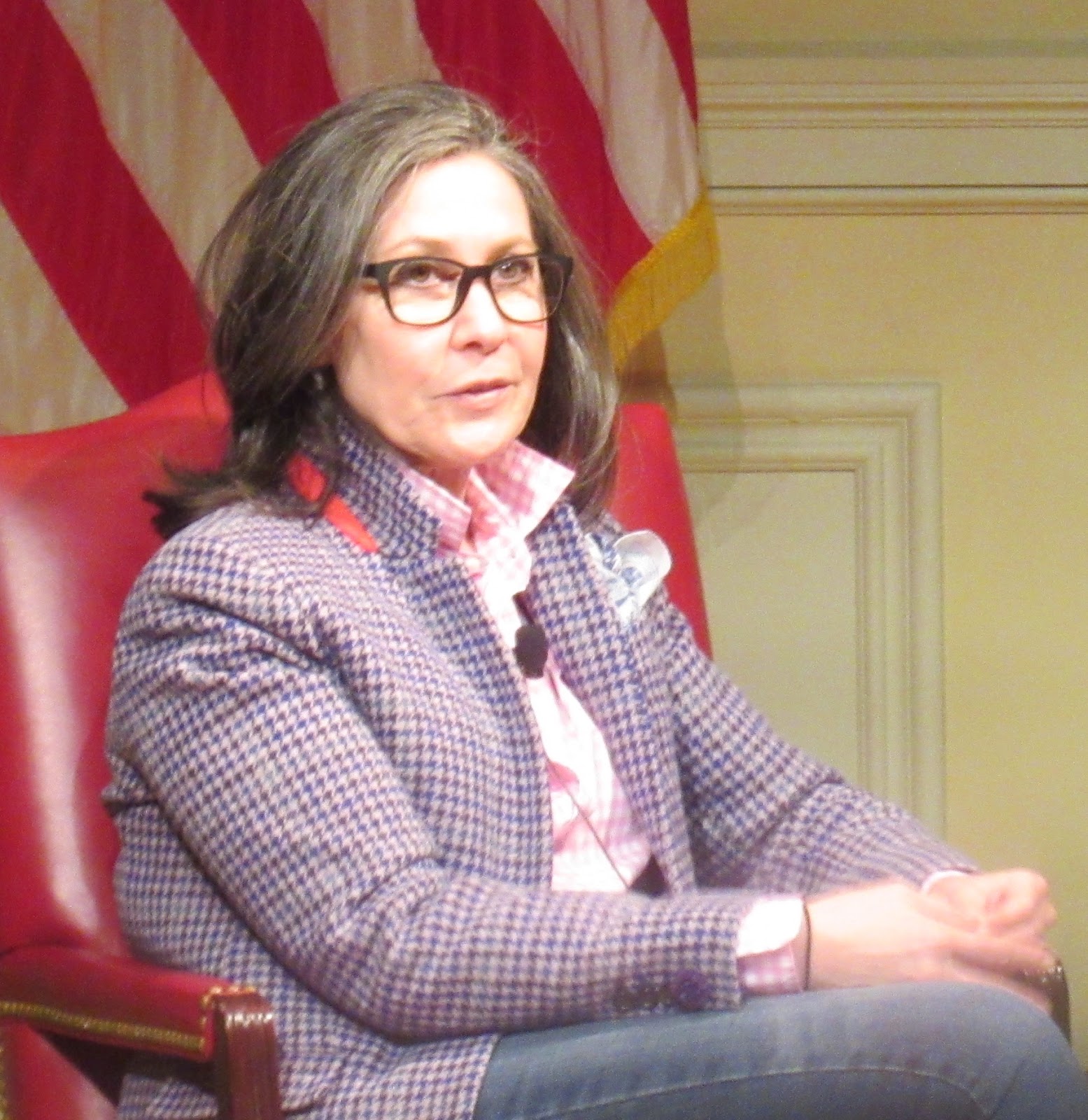
Last week, Shetterly and American film producer Donna Gigliotti, who developed Hidden Figures into an Academy Award-winning movie, appeared at the Library of Congress in Washington, D.C. as part of the Library's Women's History Month, in an hour-long forum, "Hidden Figures: Courage, Command, and Human Computers." As both spoke in conversation with Marie Arana, the Literary Advisor of the Library of Congress, black and white images of Johnson, Vaughan and Jackson were projected onto the stage celebrating these real-life hidden figures.

Hidden Figures producer Donna Gigliotti
"The truth is Margot was really onto something with her book that I could feel, that I knew it," said Gigliotti. "It was about American women not getting their due, African-American women not getting their due. It was about space, a confluence of things. I never doubted it wouldn't be successful."

Asked to describe how she researched Hidden Figures, Shetterly said, "The chain of knowledge was so interesting. One fact led to another. The first interview was with Katherine Johnson. She mentioned a number of people in that interview, such as Dorothy Vaughan. She mentioned Mary Jackson, who I did know because she worked with my father in the early part of his career.

"Every time I got a clue, I would just have to go off kind of like an archeologist and excavate the information. The information was really there, but it had never been collated into one place."

Shetterly said that the National Archives and the NASA History Office were particularly useful in her research as well as the interviews she conducted with principal hidden figures, such as Johnson, Vaughan and Jackson, and their children.

"There was so much information," said Shetterly. "Spending so much time with the math and the science and the engineering and with the reports was useful and it was like being in a time machine. I went back to 1943. Sometimes, it was about airplanes – because they were working with airplanes before space ships – other times it was about civil rights legislation that opened up public schools and public accommodations. Sometimes, it was about breakthroughs made by women during World War II. I got an incredible history lesson in doing this research. These people came back to life."

According to Shetterly, wrestling the information into a narrative was the hardest thing for her to accomplish. "It was important that the people led the story. It was always a human story and not just historical facts," she said.

Donna Gigliotti and Margot Lee Shetterly.
From listening to Shetterly and Gigliotti, I learned why storytelling matters and why, through books and films like Hidden Figures, it has the power to transform how each of us sees both our world and ourselves.

"When writers, historians and storytellers strive to present a more expansive – and truer – view of our shared past," said Shetterly, "we open the door to a more inclusive and equitable vision of our shared future."


Photos: All photos by Michael Dickens, © 2018.

Tuesday, December 12, 2017

Drawn to Purpose: Bringing to light the many contributions of American women illustrators and cartoonists

Drawn to Purpose: American Women Illustrators and Cartoonists is the newest Library of Congress exhibition (it opened November 18), and it brings to light many remarkable but little-known contributions by North American women which have been made in the popular art forms of illustration and cartooning.

The exhibition of nearly 70 works by 43 artists on display in the Thomas Jefferson Building's Graphic Arts Galleries at the Library of Congress in Washington, D.C. (through October 20, 2018) includes selected original works from the late 1800s to the present, and it shows the "gradual broadening in both the private and public spheres of women's roles and interests addressing such themes as evolving ideals of feminine beauty, new opportunities emerging for women in society, changes in gender relations, and issues of human welfare."

Drawn to Purpose features works from the Prints and Photographs Division of the Library of Congress, and selections in the exhibition are grouped by type, including: Golden Age illustration, early comics, new voices in comics, editorial illustration, magazine covers and cartoons, and political cartoons.

During a recent visit to Drawn to Purpose, I learned that in the fields of illustration and cartooning – fields it should be noted that have been traditionally dominated by men – many women have earned their livelihoods creating wonderful and expressive art that has found wide dissemination in not only newspapers but also in books and periodicals, too.

Some of the artists and their works will be familiar to visitors who come see the exhibition, such as Grace Drayton, whose wide-eyed, red-cheeked "Campbell Kids" debuted in 1909. Also, there's the longtime comic strip favorite "For Better or For Worse," created by Lynn Johnston; Persian Gulf War editorial illustrations drawn by Sue Coe and Frances Jetter; and "Mixed Marriage" by New Yorker cartoonist Roz Chast. A personal favorite of mine is Giséle by Elizabeth Shippen Green.

Although there was incremental progress made by women in illustration and cartooning from the 19th century into the early decades of the 20th century, it wasn't until the later 20th and early 21st century – as educational and professional opportunities grew – that we've finally witnessed women receive major acclaim from their peers.

Here's my takeaway: Drawn to Purpose demonstrates to us that although women were once constrained by gender bias, today, they have gained an immense number of new opportunities to self-express and discover. We are so fortunate.

Tuesday, June 20, 2017

Welcome to my new life


The east side of U.S. Capitol Building in Washington, D.C.

We shall not cease from exploration, and the end of all our exploring will be to arrive where we started and know the place for the first time. – T. S. Eliot

On April 22, after 21-plus years of enjoying the landscapes and rhythms of northern California, my wife, Jodi, and I waved goodbye to the San Francisco Bay Area and headed east on Interstate 80. Our final destination? None other than the greater Washington, D.C. area, our new home.

As it happened, over the next week, we drove 2,950.6 miles – covering 13 states starting from California. We crossed the finish line in Maryland on Saturday afternoon, April 29, after beginning the final day of our journey in Morgantown, West Virginia.

Our Passivhaus town home in
Mount Rainier, Maryland.
Our travel week was very busy for us, but one in which we both embraced. After all, we had purchased a brand new house, a Passivhaus town home, in funky Mount Rainier, Maryland, just a couple of short blocks across the District line from Washington and about 15 minutes by car south of the University of Maryland campus in College Park. And, on May 1, my wife began a dream job in research and development at the Library of Congress, which served as the impetus for our leaving California for the Mid-Atlantic east coast.

As we drove across our beautiful and diverse country observing – through the snow-capped Sierra Mountains of California and Nevada, across the massive and great Salt Lake of Utah, alongside the majestic Rocky Mountains of Colorado, across acres and acres of Kansas wheat fields, near the picturesque Gateway Arch of St. Louis, through the Big Ten country of Indiana University in Bloomington, beside the Great American city of Cincinnati and up and down the hilltops of Morgantown – I was reminded often of how Mother Nature often holds up a mirror to us so that we can see more clearly the ongoing processes of growth, of renewal and of transformation in our lives. Our hours and days on the road were also filled with an abundance of music CDs – Pink Martini, Paul Simon, Elvis Costello, Valerie June, Diana Reeves – a variety of NPR podcasts like "Make Me Smart," and we tried to limit our driving to daytime hours so we could rest and renew ourselves at night.

The scenic beauty of the Donner Summit as seen driving
along Interstate 80 through the California Sierra Mountains.
Fortunately, social media and the Internet enable us to stay more easily connected than ever before with family and friends and we still plan to follow and support our favorite Bay Area professional and collegiate sports teams – just from a different city and time zone. So far, we are enjoying the fine public radio offerings from WAMU in Washington, D.C. as well as reading the Washington Post and the national print edition of The New York Times. And, we've learned thanks to the University of Maryland, which won both the men's and women's national championships in lacrosse, that people in this part of the country do take their lacrosse seriously. We've got tickets to see a Washington Nationals baseball game against the San Francisco Giants, and already we've been to a WNBA women's professional basketball game, too. Yes, there's plenty of rich of history and culture that awaits us in and around the nation's capital city, through its many museums and monuments, parks and trails – and I'm sure our free summer weekends will fill up fast with things to see and do. Already, we've explored historic Annapolis (which I'll write more about in the weeks to come) – it's only about 40 minutes away by car – and I'm sure we'll be back, soon.

Our future looks bright – and it doesn't even have anything to do with the abundance of sunshine we've experienced during the past month. Indeed, as the French novelist Marcel Proust once said, "the real voyage of discovery consists not in seeking new landscapes but in having new eyes."