Showing posts with label storytelling. Show all posts

Tuesday, October 1, 2019

Rhiannon Giddens: A global voice that resonates with curiosity and purpose in these troubled times


Rhiannon Giddens / there is no Other

When Rhiannon Giddens released her latest album, the intense and sparsely-arranged there is no Other – recorded with Italian multi-instrumentalist Francesco Turrisi – earlier this year, it “at once was a condemnation of ‘othering’ as well as a celebration of the spreading of ideas and connectivity and of a shared experience.”

Together, Giddens and Turrisi traced an overlooked movement of sounds originating from Africa and the Arabic world and found common ground in how those sounds influenced European and American music. The original songs which Giddens penned for there is no Other as well as interpretations of others such as Ola Belle Reed’s “I’m Gonna Write Me a Letter,” Oscar Brown Jr.’s “Brown Baby” and the Italian traditional “Pizzica di San Vito,” collectively illustrate both her adoration of Appalachian bluegrass, gospel, opera and traditional Italian music and the commonality it brings to the human experience. Her interpretation of the gospel standard “Wayfaring Stranger” ranks up there with those of Emmylou Harris and Johnny Cash.

It was in this spirit that I saw Giddens and Turrisi perform selections from there is no Other last week in the 450-seat Terrace Theater at the Kennedy Center for the Performing Arts in Washington, D.C. It was the first time I had seen Giddens in concert. I hope it’s not the last.

Giddens, 42, is a celebrated Grammy Award-winning artist and MacArthur “Genius” Grant recipient, who loves to dig through the past to reveal bold and candid truths about our present. The messages in her songs have drawn upon slave narratives as well as African American experiences, including the 1960s Civil Rights movement, and are often told from the point of view of black women’s suffering and resilience. In concert, Giddens painstakingly takes the time to weave her excellent storytelling skills to put each song into an historical context.

Giddens recently was featured in the Ken Burns Country Music documentary film series. In an interview with the Greensboro (N.C.) News & Record, she said, “I have played country, I have sung country. I’ve listened to country or what we say is country. I’ve played a lot of music that has been funneled into what became country. I play music that country has been borrowed from.

“But it’s just a strand of what I do. You can’t box the music that I do. People ask me all the time, ‘What do you play?’ Well, I play American music. That includes what we would call country.”

Rhiannon Giddens and Francesco Turrisi
During her performance with Turrisi, the North Carolina-born Giddens sang in a beautiful contralto voice – she’s a conservatory-trained opera singer – and played a 1858 replica of a minstrel banjo as well as octave violin. Meanwhile, the jazz-inspired Turrisi performed on piano, accordion, frame drum, tamburello, banjo and colascione among many instruments.

Over the course of their two-hour show that was full of interplay between these two gifted musicians, Giddens and Turrisi criss-crossed cultures – African, Arabic, European and American – that reflected a wide global sensibility and brought together old and familiar – and new – stories. It was as if a music appreciation master class broke out extemporaneously. There’s a sense of curiosity and purpose in Giddens’ music that is both thoughtful and reflective – and, on this night last week, it was refreshing to hear it resonate clearly during these troubled times we live in.


Credits: Cover photo – courtesy of Google Images. Story photo – courtesy of rhiannongiddens.com. Video – courtesy of NPR Music.

Tuesday, March 20, 2018

The story of ordinary women doing extraordinary things

Hidden Figures:
In conversation with the Library of Congress.

Author Margot Lee Shetterly might not be a household name, but through her book, Hidden Figures: The Story of the African-American Women Who Helped Win the Space Race, and the Academy Award-winning film Hidden Figures that was inspired by it, we've learned about a group of NASA black female professional mathematicians – "human computers" – who helped propel the United States to victory in the space race. Who knew?

"Why haven't I heard this story before?" is a familiar question the Hampton, Va. native, University of Virginia graduate Shetterly hears, more than a year and half after her book was published and turned into a big screen biographical drama starring Taraji P. Henson, Octavia Spencer, and Janelle Monáe. Both the book (published by William Morrow/HarperCollins) and the film (distributed by 20th Century Fox) highlight the remarkable stories of pioneering black women mathematicians at NASA whose calculations fueled great achievements for the U.S. space program as it was competing for supremacy against Russia during the Cold War. These pioneers included: Katherine Goble Johnson, a mathematician who calculated flight trajectories for Project Mercury; Dorothy Vaughan, a NASA supervisor; and Mary Jackson, a NASA engineer.

These women weren't household names like NASA astronauts John Glenn and Alan Shepard. Yet, they accomplished great things and led extraordinary lives in eras of limited opportunity for women. They broke barriers before gender, race, science and politics became a rallying cry for females.

Hidden Figures author Margot Lee Shetterly.
Through Shetterly's storytelling, we learn there are scores of other black women – hidden figures – who worked for decades in anonymity as professional mathematicians, scientists and engineers. They overcame gender and racial hardships, and through their perseverance, they were all bright lights.

"Of course, the factors making their narrative so compelling to modern audiences are the same that conspired to keep the story under wraps for so long: racial segregation, gender bias and the arcane, sensitive nature of the work being done at NASA kept these women in the national blindspot," Shetterly wrote in the March/April issue of the Library of Congress Magazine. 

Last week, Shetterly and American film producer Donna Gigliotti, who developed Hidden Figures into an Academy Award-winning movie, appeared at the Library of Congress in Washington, D.C. as part of the Library's Women's History Month, in an hour-long forum, "Hidden Figures: Courage, Command, and Human Computers." As both spoke in conversation with Marie Arana, the Literary Advisor of the Library of Congress, black and white images of Johnson, Vaughan and Jackson were projected onto the stage celebrating these real-life hidden figures.

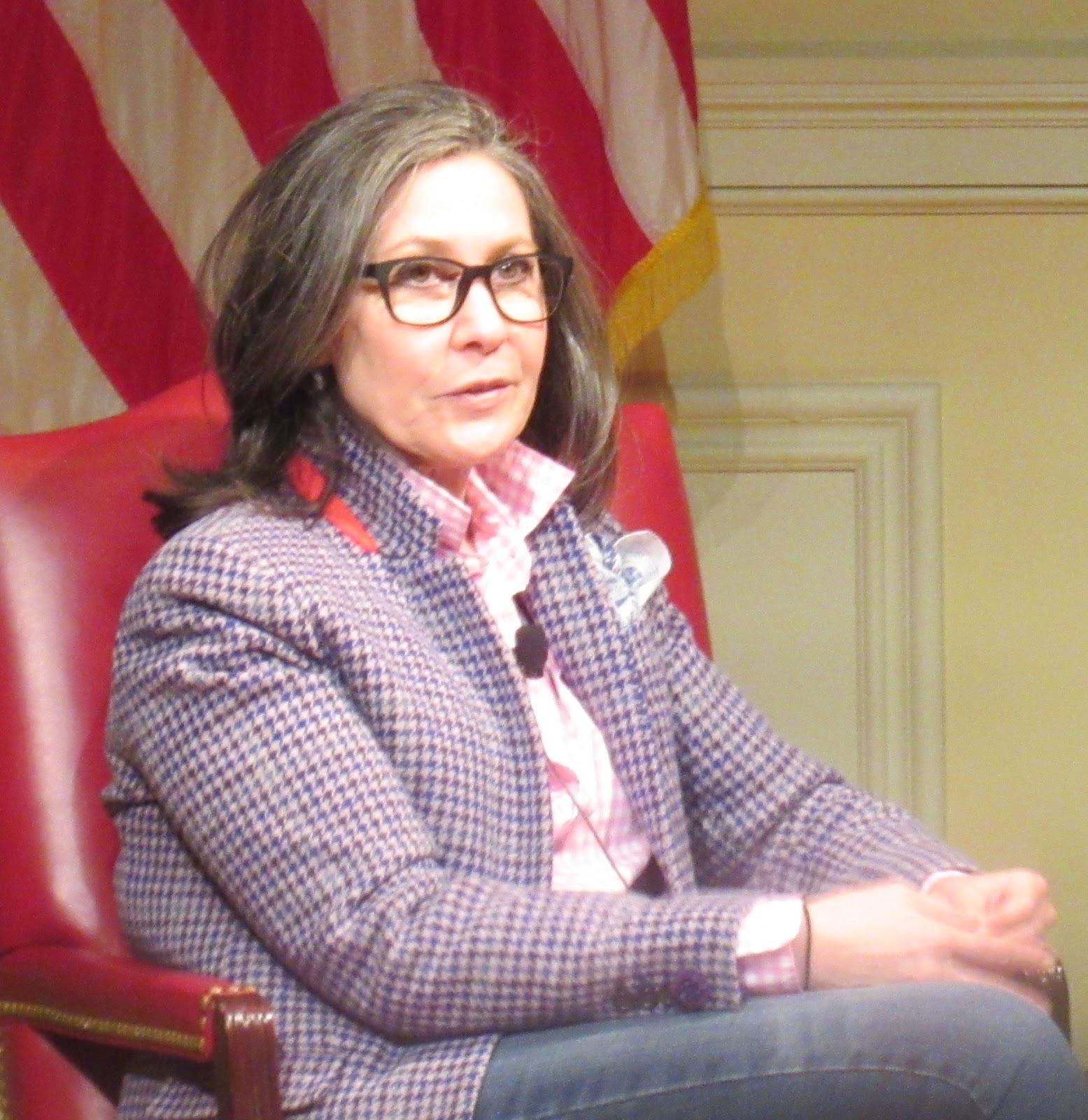
Hidden Figures producer Donna Gigliotti
"The truth is Margot was really onto something with her book that I could feel, that I knew it," said Gigliotti. "It was about American women not getting their due, African-American women not getting their due. It was about space, a confluence of things. I never doubted it wouldn't be successful."

Asked to describe how she researched Hidden Figures, Shetterly said, "The chain of knowledge was so interesting. One fact led to another. The first interview was with Katherine Johnson. She mentioned a number of people in that interview, such as Dorothy Vaughan. She mentioned Mary Jackson, who I did know because she worked with my father in the early part of his career.

"Every time I got a clue, I would just have to go off kind of like an archeologist and excavate the information. The information was really there, but it had never been collated into one place."

Shetterly said that the National Archives and the NASA History Office were particularly useful in her research as well as the interviews she conducted with principal hidden figures, such as Johnson, Vaughan and Jackson, and their children.

"There was so much information," said Shetterly. "Spending so much time with the math and the science and the engineering and with the reports was useful and it was like being in a time machine. I went back to 1943. Sometimes, it was about airplanes – because they were working with airplanes before space ships – other times it was about civil rights legislation that opened up public schools and public accommodations. Sometimes, it was about breakthroughs made by women during World War II. I got an incredible history lesson in doing this research. These people came back to life."

According to Shetterly, wrestling the information into a narrative was the hardest thing for her to accomplish. "It was important that the people led the story. It was always a human story and not just historical facts," she said.

Donna Gigliotti and Margot Lee Shetterly.
From listening to Shetterly and Gigliotti, I learned why storytelling matters and why, through books and films like Hidden Figures, it has the power to transform how each of us sees both our world and ourselves.

"When writers, historians and storytellers strive to present a more expansive – and truer – view of our shared past," said Shetterly, "we open the door to a more inclusive and equitable vision of our shared future."


Photos: All photos by Michael Dickens, © 2018.

Tuesday, January 30, 2018

A Tuesday Night Memo: Thoughts on turning eight

People who know me well know that I've been interested in writing, reporting and storytelling for a long time. So, it's only natural that I turned to blog writing because it gave me an opportunity to hone my writing skills and provided a forum for writing about things that interested me and that I wanted to share with others.

My blog, A Tuesday Night Memo, turned eight last week. Here's a little history about it:

I started writing A Tuesday Night Memo on January 26, 2010, as a means for sharing musings about my life filled with music, sport, and urban travel, and to foster community with my friends, family and Facebook acquaintances. More recently, as I added a Twitter profile, it allowed me to reach a wider audience across the country and beyond.

People who know me well know that I'm passionate about music, sport, and urban travel. Additionally, I have used my blog as a vehicle for writing about art, food, fashion, religion and gardening – and, more recently, about politics. Before we moved to the east coast, sharing news and photos about our former Oakland, Calif., flower gardens at home always seem to generate great interest and enthusiasm. Maybe, it was the pretty shapes and colors of our flowers that others found appealing, especially since we could maintain a garden all year long.

Up to now, I have "blogged" 391 entries for A Tuesday Night Memo, which collectively have received more than 142,000 page views. Among the many subjects I have written about include: my appreciation of tennis champion Roger Federer, how the city of Seattle fosters community through international cinema, a history of the world as seen through 100 objects, classical music conductor Gustavo Dudamel, Golden State Warriors head coach Steve Kerr, my love affair with Pink Martini, validating our travel through our photographs, and Jerry Seinfeld's Internet comedy Comedians in Cars Getting Coffee. Some of my recent posts have focused on new books written by actor Tom Hanks and veteran newsman Dan Rather. My most recent post focused on the future of the food industry in light of recent sexual harassment allegations made against many high profile chefs across the country. I have shared my interest in digital photography since beginning my blog, which has enabled me to illustrate many if not all of my posts with colorful visuals to match the words I've written.

The feedback many have shared is not only very much appreciated, but I also find it very useful. Much of it has been positive, but sometimes it's also been critical. Whether good or bad, I've found the feedback readers provide to be a valuable learning tool. Occasionally, I like to sneak a look at my blog's statistics, which are the key indicators that show how many total "hits" my blog has received, which stories have been read the most, and what countries comprise the blog's readership. The numbers are modest but nevertheless interesting.

Here are a few fun facts about A Tuesday Night Memo I thought you might enjoy:

* Since my blog's debut, it has been read in dozens of countries, including the U.S., Canada, Mexico, France, Morocco, Tunisia, Turkey and Hong Kong – even Brazil, India, Vietnam, and Australia. The top five countries reading my blog include the U.S, Russia, Germany, France, and the United Kingdom. I hope Russia's interest in my blog has nothing to do with their wanting to hack me because of my occasional blog posts about President Donald Trump.

Looking ahead, the Trump presidency will continue to garner my interest and attention from time to time. How could it not? However, there's so much more to write about. Among things that I look forward to learning about include my continuing interest in exploring museums – and what we can learn from them. Also, I would like to explore the effect digital music and media have in connecting our world.

In the meantime, I thoroughly enjoy sharing my writing week in and week out, and I look forward to contributing more of my words and thoughts in what is shaping up to be another exciting year awaiting all of us.

Stay tuned!

Tuesday, October 27, 2015

Elvis Costello: A master of high fidelity and storytelling, too


Elvis Costello / Charming crowds with his music and storytelling.

Elvis Costello knows how to charm the pants off an audience. He's done it successfully for the past 40 years as one of his generation's greatest songwriters. Now, with a simple wink, a friendly smile, or just the right choice of words and upbeat tone of voice, the bespectacled and iconic English musician who was once described by a critic as a "pop encyclopedia," is delighting crowds with his good-natured manner and geniality of conversation. He's become a master of the craft of storytelling.

Last Thursday evening's City Arts & Lectures event at the Nourse in San Francisco provided Costello with a forum for talking at length about his new memoir -- 'Unfaithful Music & Disappearing Ink' -- that (at a hefty but very readable 670 pages) shows Costello to be an intelligent, thoughtful, witty and lyrical writer.

In conversation with Dan Stone, editor-in-chief of Radio Silence, Costello showed why he's a wonderful conversationalist and gifted storyteller. Costello stood and read several passages from his memoir that recalled a mostly happy childhood growing up in a musical family in Liverpool, England, and the special relationship he shared with his father, Ross MacManus, who was a professional singer in a popular dance band. The younger MacManus recalled with clarity watching his father play afternoon dance gigs at the Hammersmith Palais in the 1961. By the end of the decade, Costello had gone into the family business, following in both his father's and grandfather's footsteps, and he took the popular music world by storm by the age of 24, replete with his black-framed Buddy Holly glasses.

Over the course of about 80 minutes, there were many funny and good-natured reminisces about Costello's coming of age, including: one of his first jobs as a data-entry clerk for cosmetics giant Elizabeth Arden; the influence of the Beatles on both his and his father's musical careers; coming to play San Francisco for the first time in his early twenties back in the 1970s; and his infamous TV appearance on Saturday Night Live. Costello punctuated his fluid storytelling by sharing many candid family photos that were projected overhead on a giant movie screen for the audience to delight in.

While 'Unfaithful Music & Disappearing Ink' doesn't adhere to a linear chronology, what I have read thus far has been a fun and enjoyable read, and each chapter presents colorful highlights in Costello's remarkable life. The New York Times called 'Unfaithful Music & Disappearing Ink' "some of the best writing -- funny, strange, spiteful, anguished -- we've ever had from an important musician."

Throughout last Thursday's conversation and later, during a Question and Answer period with the house lights turned up, we learned why Costello, 61, is truly a music fan and delights in championing the works of other musicians such as country star George Jones, jazz pianist Allen Toussaint, pop composer Burt Bacharach, rock guitarist and producer T Bone Burnett, English singer/songwriter Nick Lowe, former Beatles icon Paul McCartney, and hip hop/neo soul band The Roots, to name just a few whom Costello has collaborated with over the years.

But wait, the best part of the night was yet to come. Without any prompting, Costello asked the audience: "Hey, you wanna hear a song?" The sold-out audience at the Nourse responded by amping up their already enthusiastic applause. Before the cheering could fade, an acoustic Gibson guitar was brought out and handed to Costello to play and, quickly, a stool, microphone and music stand were in place for "the show" to go on.

Thus, Elvis began an impromptu "mini concert" by performing a very meaningful and moving -- and slowed-down -- version of "Every Day I Write the Book" from 1983's Punch the Clock, followed by "I Hear a Melody," originally recorded in 1977 for his debut album My Aim is True. Finally, a medley of "Radio Sweetheart/What Jackie Wilson Said," the former penned by Costello and the latter composed by Van Morrison, brought the crowd to its feet. The night was complete.

Photo images: Courtesy of 'Unfaithful Music & Disappearing Ink', 2015.