Showing posts with label racial. Show all posts

Tuesday, April 3, 2018

An understanding of racial justice in the shadow of statues

In the Shadow of Statues, which
was published March 20, is
on the New York Times
Bestseller List.
"These statues are not just stone and metal. They were erected purposefully to send a strong message to all who walked in their shadows about who was still in charge." 

– Mitch Landrieu, from In the Shadow of Statues

New Orleans is one of the great multicultural cities in the world. It is also a racially divided city that has dealt with its fair share of poverty and urban violence. In spite of all of its troubles, the Big Easy remains a beloved cultural treasure to everyone who visits thanks to its rich tradition of funky jazz music and the beauty and grace of its amazing food.

Enter Mitch Landrieu, the mayor of New Orleans since 2010, who has been an important catalyst in helping his city rebuild from the devastation of Hurricane Katrina. As the son of a former state legislator and mayor of New Orleans – who was a huge force in the integration of that city in the 1960s and 1970s – and the brother of a former U.S. senator from Louisiana, Landrieu grew up with a progressive education in the racially divided Crescent City among America's lingering Confederate monuments.

At a time when the issue of racism has become resurgent "with seemingly tacit approval from the highest levels of government and when too many Americans have a misplaced nostalgia for a time and place that never existed," Landrieu has written In the Shadow of Statues – a book that's a must read.

In the Shadow of Statues is equal parts memoir, history, and a "prescription for finally confronting America's most painful legacy." As a white southerner confronting his city's past history, Landrieu contributes a very strong voice to our national conversation about race in America today by taking on many difficult issues related to it, including slavery and inequality.

In praising In the Shadow of Statues, Walter Isaacson, author of Leonardo da Vinci and Steve Jobs, writes: "With a balance of humility and conviction, he recounts his path to a more profound understanding of racial justice and explains how this journey led him to remove the Confederate monuments in New Orleans. It's an important book for everyone in America to read, because it shows how intellectual honesty can lead to moral clarity."

Mitch Landrieu at Politics & Prose Bookstore
in Washington, D.C. last week.
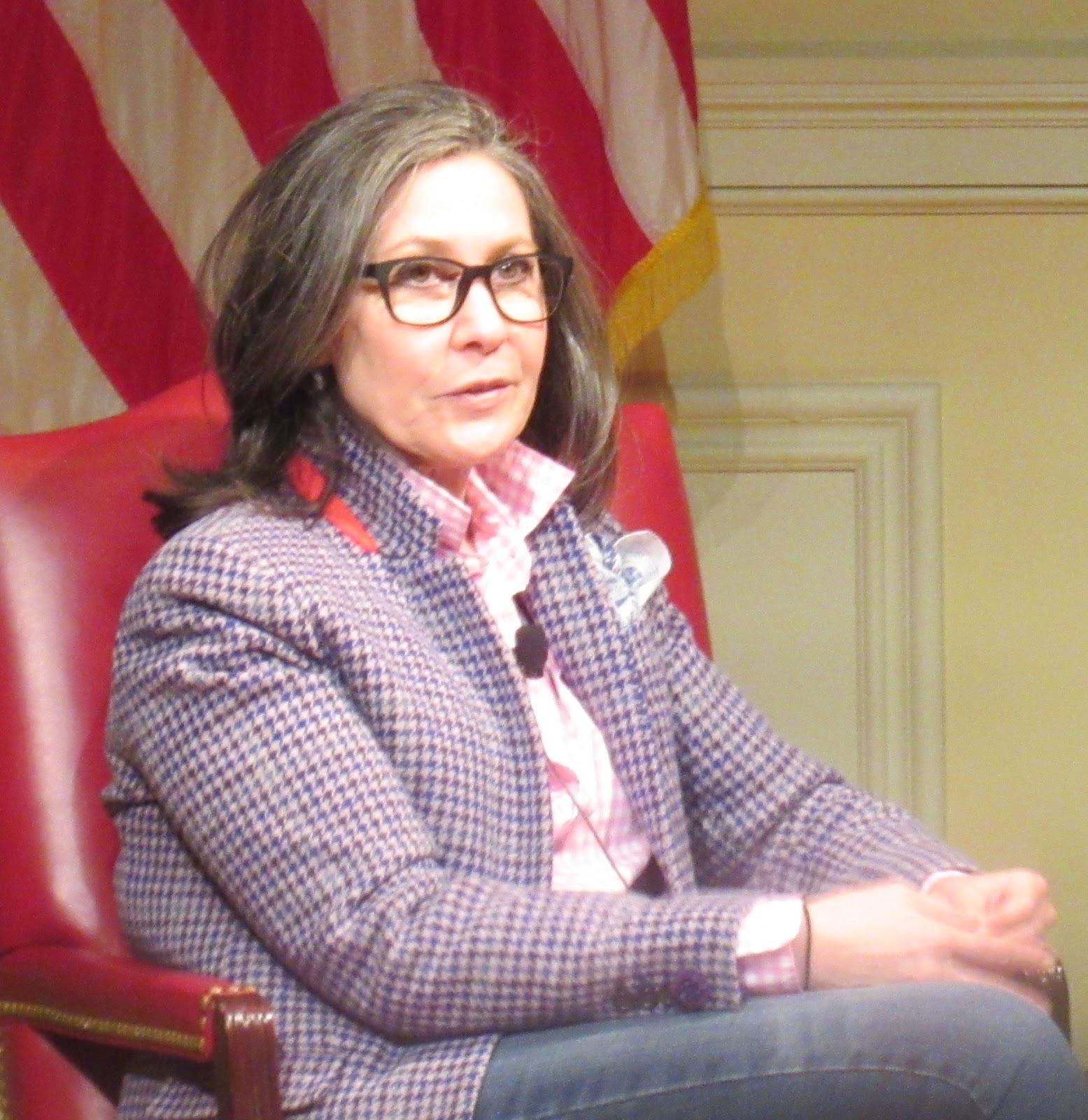
Last week, my wife and I attended a standing room-only book event at Politics & Prose Bookstore in northwest Washington, D.C., featuring a conversation between Landrieu and Jeffrey Goldberg, editor in chief of The Atlantic, before a thoughtful and engaging audience, that was followed by a 30-minute Q & A period and a book signing.

"There's a difference between remembering and revering history," said Landrieu, who addressed the people of New Orleans in May 2017 about his decision to take down and remove four Confederate monuments, including the statue of the famous southern Confederate general Robert E. Lee. The affected statues represent a mere four-year period of U.S. history, from 1861-65, but a searing one, too. While Landrieu said that the decision to remove the monuments was a difficult one, it was a right one, too. It was about eradicating history.

"We were on the wrong side of history," Landrieu told the Politics & Prose audience very matter-of-factly. "These statues were erected to send a strong message to all who walked in their shadows about who was still in charge. For decades, these statues have cast a long shadow on society, particularly African-Americans."

Lee Circle before the Confederate monument
of Robert E. Lee was removed in 2017.
Landrieu says In the Shadow of Statues is an invitation to stand and sit in other people's shoes. He recalled for his Politics & Prose audience a conversation he once shared with his dear friend, the famous jazz musician and educator – and New Orleans native son – Wynton Marsalis, who helped him see the truth about the city's exclusionary attitudes. "'Hey, man,'" Landrieu recalled the trumpeter saying to him. "'You should take the statue of Robert E. Lee down. Do you know how it got there and who put it up?'"

In the book, Landrieu expands on his conversation with Marsalis.

"I don't like the fact that Lee Circle is named Lee Circle."

"Why is that?"

"Let me help you see it through my eyes. Who is he? What does he represent? And in that most prominent space in the city of New Orleans, does that space reflect who we are, who we want to be, or who we are?"

Suddenly, Landrieu was listening.

Later in their conversation, according to the mayor, Marsalis added, "'Did you know Louis Armstrong left the city and never came back because of that statue? He did not even want to be buried in his hometown. You ever think about what Robert E. Lee means to someone black?'"

Landrieu emphasized that there's a difference between remembrance of history and reverence of it. "I think there are a lot of people who are struggling with the notion that the South fought for a cause that was reviled," he said. When you make sense of it, monuments are usually reserved for winners not losers. The Confederate monuments celebrated the losing side of the Civil War.

New Orleans Mayor Mitch Landrieu
As Landrieu remarked back during his May 2017 speech, "For America and New Orleans, it has been a long, winding road, marked by great tragedy and great triumph. But we cannot be afraid of our truth."

And, as Landrieu writes, "Here is the essential truth: We are better together than we are apart.

"Indivisibility is our essence."

Near the end of his conversation at Politics & Prose, Landrieu said, "If we are going to move forward as a country, we must confront the issue of race head on. Our diversity is what makes this country great.

"We need to understand our history. We need to tell the whole story."

Photo credits: Book cover courtesy of Amazon.com. Politics & Prose audience courtesy of @PoliticsProse Twitter. Robert E. Lee statue courtesy of New Orleans Advocate. Mitch Landrieu courtesy of Cheryl Gerber.

Tuesday, March 20, 2018

The story of ordinary women doing extraordinary things

Hidden Figures:
In conversation with the Library of Congress.

Author Margot Lee Shetterly might not be a household name, but through her book, Hidden Figures: The Story of the African-American Women Who Helped Win the Space Race, and the Academy Award-winning film Hidden Figures that was inspired by it, we've learned about a group of NASA black female professional mathematicians – "human computers" – who helped propel the United States to victory in the space race. Who knew?

"Why haven't I heard this story before?" is a familiar question the Hampton, Va. native, University of Virginia graduate Shetterly hears, more than a year and half after her book was published and turned into a big screen biographical drama starring Taraji P. Henson, Octavia Spencer, and Janelle Monáe. Both the book (published by William Morrow/HarperCollins) and the film (distributed by 20th Century Fox) highlight the remarkable stories of pioneering black women mathematicians at NASA whose calculations fueled great achievements for the U.S. space program as it was competing for supremacy against Russia during the Cold War. These pioneers included: Katherine Goble Johnson, a mathematician who calculated flight trajectories for Project Mercury; Dorothy Vaughan, a NASA supervisor; and Mary Jackson, a NASA engineer.

These women weren't household names like NASA astronauts John Glenn and Alan Shepard. Yet, they accomplished great things and led extraordinary lives in eras of limited opportunity for women. They broke barriers before gender, race, science and politics became a rallying cry for females.

Hidden Figures author Margot Lee Shetterly.
Through Shetterly's storytelling, we learn there are scores of other black women – hidden figures – who worked for decades in anonymity as professional mathematicians, scientists and engineers. They overcame gender and racial hardships, and through their perseverance, they were all bright lights.

"Of course, the factors making their narrative so compelling to modern audiences are the same that conspired to keep the story under wraps for so long: racial segregation, gender bias and the arcane, sensitive nature of the work being done at NASA kept these women in the national blindspot," Shetterly wrote in the March/April issue of the Library of Congress Magazine. 

Last week, Shetterly and American film producer Donna Gigliotti, who developed Hidden Figures into an Academy Award-winning movie, appeared at the Library of Congress in Washington, D.C. as part of the Library's Women's History Month, in an hour-long forum, "Hidden Figures: Courage, Command, and Human Computers." As both spoke in conversation with Marie Arana, the Literary Advisor of the Library of Congress, black and white images of Johnson, Vaughan and Jackson were projected onto the stage celebrating these real-life hidden figures.

Hidden Figures producer Donna Gigliotti
"The truth is Margot was really onto something with her book that I could feel, that I knew it," said Gigliotti. "It was about American women not getting their due, African-American women not getting their due. It was about space, a confluence of things. I never doubted it wouldn't be successful."

Asked to describe how she researched Hidden Figures, Shetterly said, "The chain of knowledge was so interesting. One fact led to another. The first interview was with Katherine Johnson. She mentioned a number of people in that interview, such as Dorothy Vaughan. She mentioned Mary Jackson, who I did know because she worked with my father in the early part of his career.

"Every time I got a clue, I would just have to go off kind of like an archeologist and excavate the information. The information was really there, but it had never been collated into one place."

Shetterly said that the National Archives and the NASA History Office were particularly useful in her research as well as the interviews she conducted with principal hidden figures, such as Johnson, Vaughan and Jackson, and their children.

"There was so much information," said Shetterly. "Spending so much time with the math and the science and the engineering and with the reports was useful and it was like being in a time machine. I went back to 1943. Sometimes, it was about airplanes – because they were working with airplanes before space ships – other times it was about civil rights legislation that opened up public schools and public accommodations. Sometimes, it was about breakthroughs made by women during World War II. I got an incredible history lesson in doing this research. These people came back to life."

According to Shetterly, wrestling the information into a narrative was the hardest thing for her to accomplish. "It was important that the people led the story. It was always a human story and not just historical facts," she said.

Donna Gigliotti and Margot Lee Shetterly.
From listening to Shetterly and Gigliotti, I learned why storytelling matters and why, through books and films like Hidden Figures, it has the power to transform how each of us sees both our world and ourselves.

"When writers, historians and storytellers strive to present a more expansive – and truer – view of our shared past," said Shetterly, "we open the door to a more inclusive and equitable vision of our shared future."


Photos: All photos by Michael Dickens, © 2018.