Showing posts with label acclaim. Show all posts

Tuesday, June 14, 2016

Paul Simon: Still creative after all these years


Paul Simon / Feeling groovy late in the evening.

Paul Simon's 13th solo album, Stranger to Stranger, is just out to critical acclaim, and following two recent weekend concerts at UC-Berkeley's Greek Theater, the 74-year-old singer/songwriter stopped by City Arts & Lectures in San Francisco last week for an insightful conversation with Dave Eggers that was a benefit for the writer's 826 Valencia project.

For over 90 minutes, Simon, whom New Yorker critic Kelefa Sanneh recently labeled as "one of the most accomplished overthinkers in the history of popular music," spoke both thoughtfully and haltingly about a variety of things, including: his new album, a series of songs filled with experiments in rhythm and texture throughout its lithe 37-minute duration; his creative process; his approach to writing music and composing lyrics that paint an imperfect world; and the emotional outpouring from singing "The Boxer" on the same night as Muhammad Ali's death, just moments after learning of The Greatest's passing.

As Simon spoke about the physics of sound – "the tone of the universe is a slightly flat B-flat" – he also strummed a faux air guitar, picking at the melody with his right hand and moving the fingers of his left hand up and down his imaginary fretboard. Later on, he reached for a guitar positioned behind his chair to illustrate a chord progression as he crooned the notes to a song.

On Stranger to Stranger, Simon's collaborators include the Italian electronic producer Clap! Clap! and long-dead composer and inventor Harry Partch, whose variety of homemade instruments contributed to the texture and dreamlike ambience of the album.


https://soundcloud.com/concordmusicgroup/the-werewolf


On "The Werewolf," for instance, Stereogum.com, writes: "Warped banjo, hand claps, and intricate down-home percussion are interjected with peculiar invest bursts. Simon soulfully warns of a werewolf's impending approach with some vivid storytelling and irresistible melodies."

Always a storyteller, Simon shared a funny anecdote about a 2004 Simon and Garfunkel reunion concert that he and his former music partner Art Garfunkel gave on the grounds of the Rome Colosseum. He said that while Garfunkel was singing an extended solo, Simon gazed out at nearby residents listening from their apartment balconies while thinking to himself, "I wonder what an apartment like that would cost?" He also talked about his 1986 ground-breaking album Graceland, and waxed about what it's been like being in the midst of a late-career renaissance.

"He has managed to become neither a wizened oracle nor an oldies act, and his best songs convey the appealing sensation of listening to a guy who is still trying to figure out what he's doing," wrote Sanneh in his New Yorker article, "Cool Papa," published last month.

Paul Simon and Dave Eggers / Old friends.
"Ain't no song like an old song," Simon once wrote, and the New York native has been practicing his craft for the past 50 years, releasing a new album about every three years or so. Although Simon said he doesn't keep up with the latest music trends and hits, he remains an attentive listener with a curious mind, one who always is collecting raw ingredients and rhythms for the future. Writing music, he noted, gets harder.

"But harder is fine. It's not like harder is the opposite of fun."

By night's end, Simon broke out an acoustic guitar and sang "The 59th Street Bridge Song (Feeling Groovy)," which served as a nice bookend. He left to a standing ovation from the mostly Baby Boomer audience at The Nourse.

It all made for a memorable and enjoyable evening.

Photos: By Michael Dickens © 2016.

Tuesday, June 9, 2015

Roland Garros: From inside the baselines, Wawrinka's moxie and power reigned during this Parisian fortnight

2015 French Open poster art by Chinese artist Du Zhenjun / 
Drawing upon his Asian roots and from contemporary Western art.

Each year in late spring, the French Open in Paris serves as a grading period -- a report card if you will -- for professional tennis. It's the second of the year's four Grand Slam events -- the others are the Australian Open in January, Wimbledon in late June and the U.S. Open in August near the end of summer  -- and all the big names in men's professional tennis came to famed Roland Garros to complete for the Coupe des Mousquetaires, or the Cup of the Musketeers.

A funny thing happened by the end of the red clay fortnight on Sunday: None of the elite Big Four -- Novak Djokovic, Roger Federer, Andy Murray or Rafael Nadal -- won the Coupe. Instead, it was Stan Wawrinka, he of the funny plaid shorts and winner of one previous Grand Slam final -- the 2014 Australian Open -- who prevailed in come-from-behind fashion. At the end of the day, the Swiss raised the champion's trophy after beating Djokovic with moxie and precision power in four sets, 4-6, 6-4, 6-3, 6-4. A year ago, Wawrinka was a first-round loser. What a difference a year made for Stan the Man.

In leading up to Sunday's championship finale on Court Philippe Chatrier, three of the Big Four had fallen by the wayside: Federer was sent packing for Wimbledon in straight sets by Wawrinka in the quarterfinals; and Murray, the Scot who for the past year has been coached by French darling Amelie Mauresmo, took out David Ferrer in a tension-filled quarterfinal before he was stubbornly knocked out by Djokovic in a semifinal match that required two days to complete because of rain.

Meanwhile, last Wednesday, the much-anticipated men's singles quarterfinal match-up between World No. 1 Djokovic of Serbia and nine-time defending champion Nadal of Spain, who arrived in Paris as the sixth seed and whose usually-strong game on clay showing signs of weakness and fatigue, was won convincingly by Djokovic. He stunned Nadal in straight sets -- it wasn't even close -- and, thus, ended the King of Clay's reign in Paris.

What started two weeks ago with a 128-player draw played down to two by the last day: Djokovic, who only needed to win the French Open to complete a career Grand Slam, and Wawrinka, who has spent the past decade playing in the shadows of the more famous and acclaimed Swiss player, Federer. After Djokovic won the opening set 6-4, Wawrinka took his tennis to a new level by winning the next three sets -- playing "the match of my life" -- and, with it, the championship.

Stan Wawrinka /
2015 French Open champion
When the dust had settled on the famed Roland Garros stage, it was Wawrinka who dashed Djokovic's hopes of achieving a career grand slam. Afterwards, the 30-year-old Swiss walked into the interview room inside Court Philippe Chatrier. He hung a pair of his infamous plaid shorts over a table. No explanation was provided, just a sarcastic grin on his face. Later, when he was prompted to explain, Wawrinka said: "Everybody has been talking about these shorts since I put them on. I quite like them. Apparently I'm the only one. It's quite funny that they won the French Open."

Questionable fashion choices aside, Wawrinka was rock solid when it mattered and he showed against Djokovic that he was able to produce "big time tennis" by hitting 60 winners, no easy fete against the top player in the world. Djokovic had held a 17-3 lead over Wawrinka going into the final and had dominated the spring clay-court circuit by winning titles in Monte-Carlo and Rome. Wawrinka's world ranking improved over the fortnight from No. 9 to No. 4 with his French Open triumph, and he sealed the victory with a backhand winner.

"I'm very surprised at the way I finished the fourth set," admitted Wawrinka. "I was relaxed on my backhand side and I could hit some wonderful backhands. It's a rare feeling that you experience in a final against Djokovic. It's a great feeling.

"I'm still surprised that in two months I can win the French Open, because I wasn't in good shape after Monaco. It was a tough, tough moment for me. To say that now I won the French Open, it's something complete crazy."

Novak Djokovic and Stan Wawrinka / 
During the trophy presentation.
When the final ended, Djokovic showed why he is always a class act in defeat. Pushed to tears, he paid full credit to Wawrinka in accepting the runner-up trophy during the on-court ceremony. It was his third final defeat on Court Philippe Chatrier, the others against Nadal.

Djokovic refused to use his own fatigue as a reason for losing. As a result of his forthright honesty, Djokovic received a prolonged standing ovation from the French crowd that was possibly the most emotional moment seen during a fortnight of tennis.

"Obviously was not easy to stand there as a runner-up again, but I lost to a better player who played some courageous tennis and deserved to win," said Djokovic, after his 28-match winning streak was ended by Wawrinka.

"I respect the appreciation the crowd showed me, and it was more or less the same situation like last year in (the) closing ceremony (after losing to Nadal). This is something that definitely gives me even more motivation to come back and keep on trying."

Djokovic continued: "There are two players who want to win this trophy, not just me. So I think people tend to create more of a story where it's just me.

"It feels like I'm the only player who wants to win this trophy and nobody wants to win it as much as I do. This is completely untrue. Every single player who is here, especially the top players, want to win this trophy as much as I do.

"Of course the finals of a grand slam and the grand slam I never won gives a special importance to my approach to the match. But I thought I started well. As I got into the match, that was not a major issue in terms of dealing with the pressure. It's just that he was better.

"At least I'm proud of the fight that I put into this match. I tried my best. It wasn't to be."

Photos: Courtesy of Getty Images; Google Images, 2015.

Wednesday, September 11, 2013

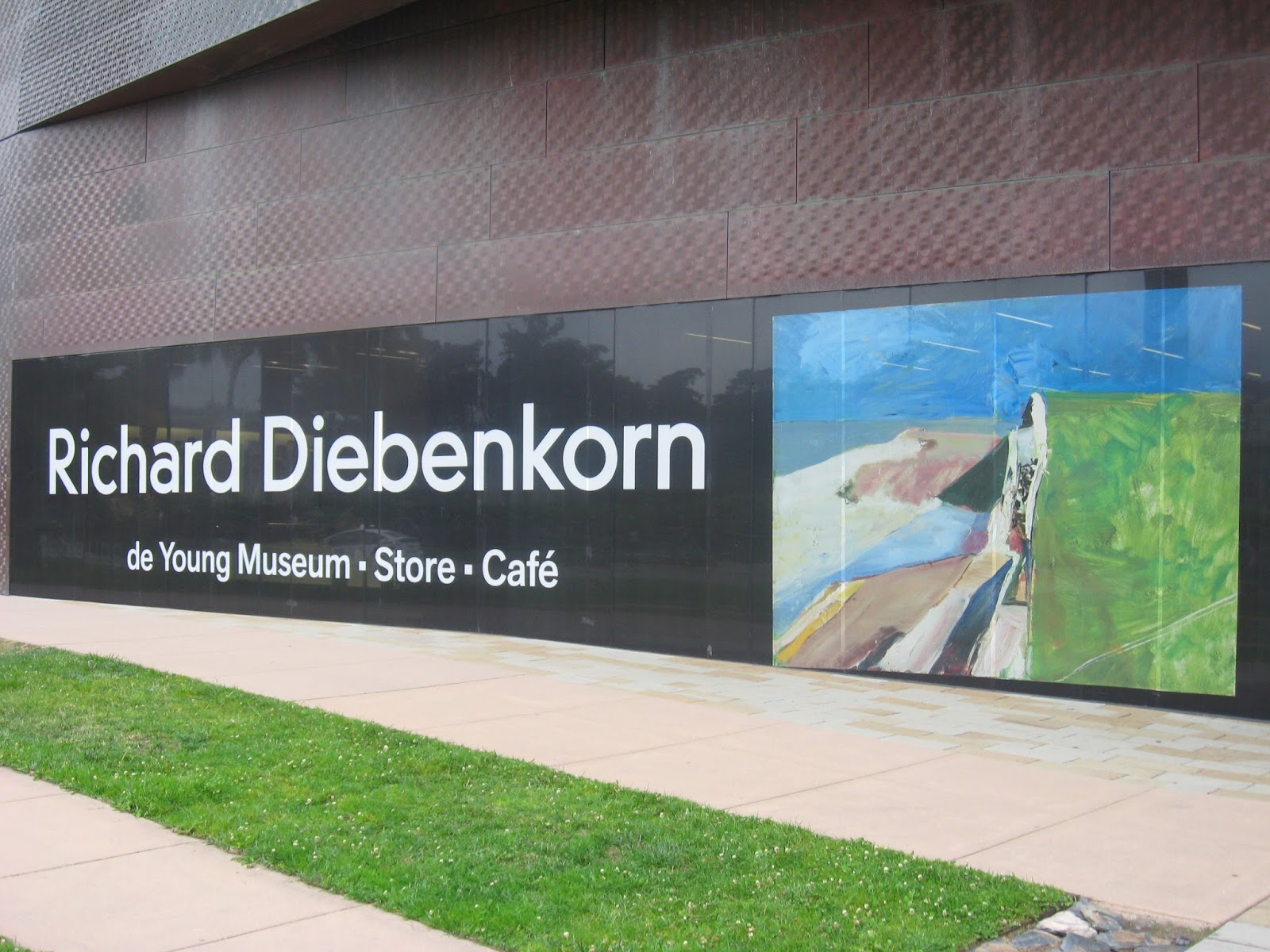
On art: Richard Diebenkorn, The Berkeley Years, 1953-1966


Richard Diebenkorn was profoundly influenced by the nature and culture of the San Francisco Bay Area. Color, light and atmosphere played a significant role in many of the 20th century American artist's works that are on view in Richard Diebenkorn: The Berkeley Years, 1953-1966, at the de Young Fine Arts Museum in San Francisco's Golden Gate Park through September 29.

The exhibition, which had its debut in June, is the first of its kind to focus on this pivotal period in the career of this postwar American artist.

During his lifetime, Diebenkorn (1922-1993) achieved acclaim as one of the most significant and influential artists of California and of postwar America. His early work is associated with Abstract expressionism and the Bay Area Figurative Movement of the 1950s and 1960s.

At the beginning of this exhibition of more than 130 paintings and drawings that were assembled from museums and private collections across the country, we get to go outside the lines to get a feel for what's going on in Diebenkorn's mind as he shares his thoughts in Notes to myself on beginning a painting:

  • Attempt what is not certain. Certainty may or may not come later. It may then be a valuable delusion.
  • The pretty, initial position, which falls short of completeness, is not to be valued -- except as a stimulus for further moves.
  • Do search. But in order to find other than what is searched for.
  • Use and respond to the initial fresh qualities, but consider them absolutely expendable.
  • Don't "discover" a subject -- of any kind.
  • Somehow don't be bored -- but if you must, use it in action. Use its destructive potential.
  • Mistakes can't be erased, but they move you from your present position.
  • Keep thinking about Pollyanna.
  • Tolerate chaos.
  • Be careful only in a perverse way.

Richard Diebenkorn /
Seated Figure with Hat, 1967,
oil on canvas.
Much of the art in Richard Diebenkorn: The Berkeley Years, 1953-1966 is devoted to a three-year period in which Diebenkorn "painted prolifically, his paintings, watercolors, and drawings synthesizing elements of nature with an abstract approach in what came to be known as his Berkeley series," according to the de Young's Fine Arts magazine, in previewing the show. Later in the exhibition, we see Diebenkorn's subsequent figurative phase, and it is easy to see and understand why he had a profound influence on American modernism.

As I walked through the exhibit rooms on a recent Friday evening, studying and absorbing Diebenkorn's artwork, my attention was drawn to several of the artist's quotes that were prominently displayed on the gallery walls. I took the time to read each of them carefully:

  • "Abstract means literally to draw from or separate. In this sense, every artist is abstract ... a realistic or non-objective approach makes no difference. The result is what counts."
  • "All paintings start out of a mood, out of a relationship with things or people, out of a complete visual impression."
  • "I began to feel that what I was really up to in painting, what I enjoyed almost exclusively, was altering -- changing what was before me -- by way of subtracting or juxtaposition or superimposition of different ideas."
  • "It was impossible to imagine doing a picture without it being a landscape; to try to make a painting space, a pure painting space, but always ending up with a figure against a ground."

After its San Francisco premiere, Richard Diebenkorn: The Berkeley Years, 1953-1966, will move to southern California and be on view at the Palm Springs Art Museum from October 26, 2013, to February 16, 2014.

To learn more about the Richard Diebenkorn exhibition at the de Young: http://diebenkorn.famsf.org/

Photograph of de Young Fine Arts Museum by Michael Dickens, 2013.
Photograph of Richard Diebenkorn's Seated Figure with Hat, 1967, courtesy of Wikipedia Commons.