Showing posts with label light. Show all posts

Wednesday, September 11, 2013

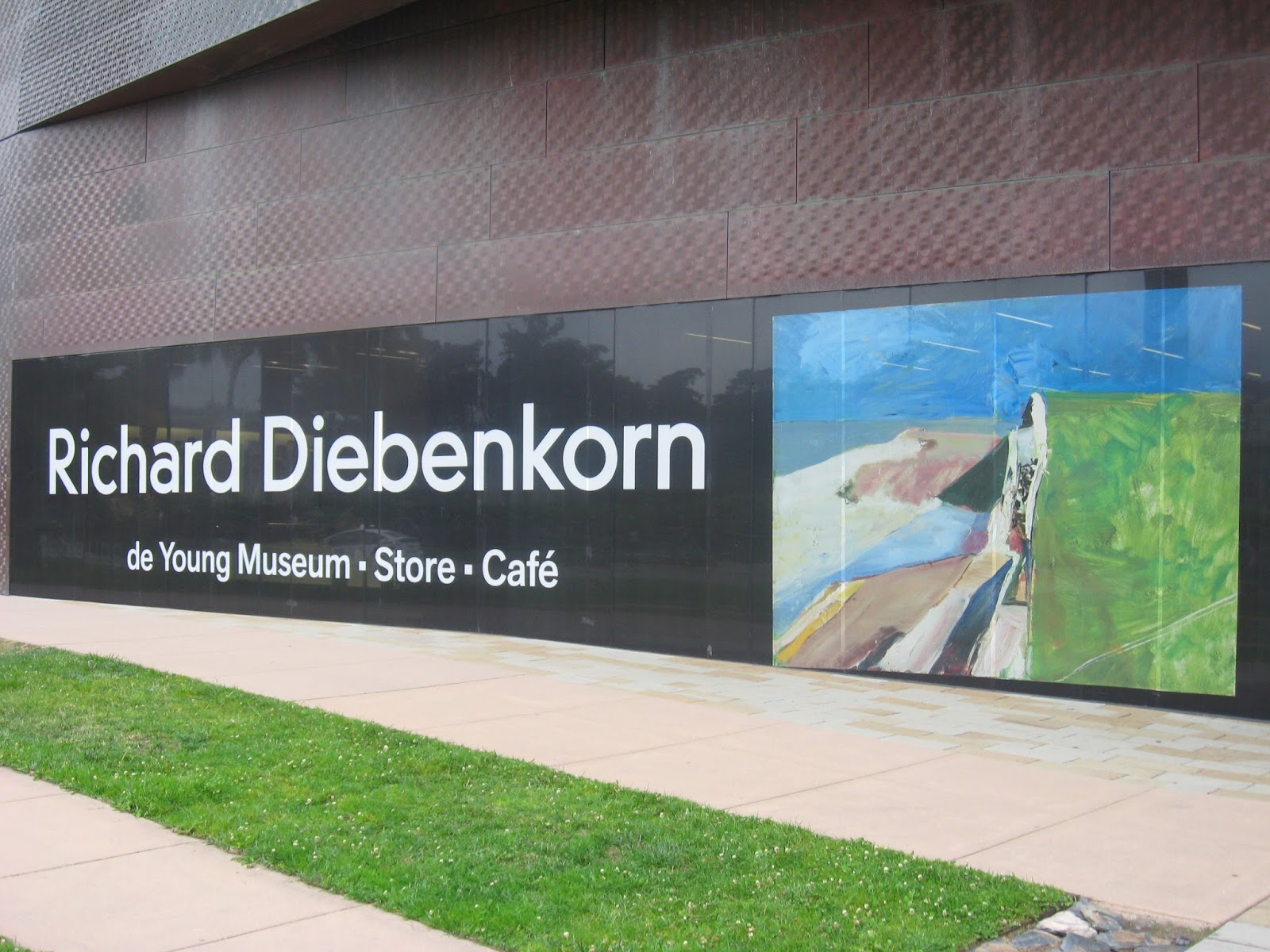
On art: Richard Diebenkorn, The Berkeley Years, 1953-1966


Richard Diebenkorn was profoundly influenced by the nature and culture of the San Francisco Bay Area. Color, light and atmosphere played a significant role in many of the 20th century American artist's works that are on view in Richard Diebenkorn: The Berkeley Years, 1953-1966, at the de Young Fine Arts Museum in San Francisco's Golden Gate Park through September 29.

The exhibition, which had its debut in June, is the first of its kind to focus on this pivotal period in the career of this postwar American artist.

During his lifetime, Diebenkorn (1922-1993) achieved acclaim as one of the most significant and influential artists of California and of postwar America. His early work is associated with Abstract expressionism and the Bay Area Figurative Movement of the 1950s and 1960s.

At the beginning of this exhibition of more than 130 paintings and drawings that were assembled from museums and private collections across the country, we get to go outside the lines to get a feel for what's going on in Diebenkorn's mind as he shares his thoughts in Notes to myself on beginning a painting:

  • Attempt what is not certain. Certainty may or may not come later. It may then be a valuable delusion.
  • The pretty, initial position, which falls short of completeness, is not to be valued -- except as a stimulus for further moves.
  • Do search. But in order to find other than what is searched for.
  • Use and respond to the initial fresh qualities, but consider them absolutely expendable.
  • Don't "discover" a subject -- of any kind.
  • Somehow don't be bored -- but if you must, use it in action. Use its destructive potential.
  • Mistakes can't be erased, but they move you from your present position.
  • Keep thinking about Pollyanna.
  • Tolerate chaos.
  • Be careful only in a perverse way.

Richard Diebenkorn /
Seated Figure with Hat, 1967,
oil on canvas.
Much of the art in Richard Diebenkorn: The Berkeley Years, 1953-1966 is devoted to a three-year period in which Diebenkorn "painted prolifically, his paintings, watercolors, and drawings synthesizing elements of nature with an abstract approach in what came to be known as his Berkeley series," according to the de Young's Fine Arts magazine, in previewing the show. Later in the exhibition, we see Diebenkorn's subsequent figurative phase, and it is easy to see and understand why he had a profound influence on American modernism.

As I walked through the exhibit rooms on a recent Friday evening, studying and absorbing Diebenkorn's artwork, my attention was drawn to several of the artist's quotes that were prominently displayed on the gallery walls. I took the time to read each of them carefully:

  • "Abstract means literally to draw from or separate. In this sense, every artist is abstract ... a realistic or non-objective approach makes no difference. The result is what counts."
  • "All paintings start out of a mood, out of a relationship with things or people, out of a complete visual impression."
  • "I began to feel that what I was really up to in painting, what I enjoyed almost exclusively, was altering -- changing what was before me -- by way of subtracting or juxtaposition or superimposition of different ideas."
  • "It was impossible to imagine doing a picture without it being a landscape; to try to make a painting space, a pure painting space, but always ending up with a figure against a ground."

After its San Francisco premiere, Richard Diebenkorn: The Berkeley Years, 1953-1966, will move to southern California and be on view at the Palm Springs Art Museum from October 26, 2013, to February 16, 2014.

To learn more about the Richard Diebenkorn exhibition at the de Young: http://diebenkorn.famsf.org/

Photograph of de Young Fine Arts Museum by Michael Dickens, 2013.
Photograph of Richard Diebenkorn's Seated Figure with Hat, 1967, courtesy of Wikipedia Commons.

Tuesday, May 21, 2013

A celebration of words: Sharing the stage to read and listen to stories and ideas


I read from Calvin Trillin's The Tummy Trilogy
during the fifth annual WriterCoach Connection's
Read-and-Write-a-thon at Longfellow Middle School.

Last Saturday morning, I participated in the fifth annual WriterCoach Connection Read-and-Write-a-thon at Longfellow Middle School Library in Berkeley.

I had never participated in a read-a-thon and, honestly, didn't really know what to expect. Would I be nervous? Would I be confident? Would my voice project adequately? Would the audience warm to my literary selection?

During the 75 minutes I spent at the WriterCoach Connection Read-and-Write-a-thon, which began my activity-filled Saturday (and, later, would include stops at two busy grocery stores, plus an evening birthday/bowling party on the other side of the Bay), I was both humbled and amazed. There was much generosity from the dozen-or-so supporters in the library at the time I read, who focused on my every spoken word for the 15 minutes in which I commanded their attentiveness.

For those who were inspired and dropped in at the Longfellow Middle School Library-cum-literary café between 8 a.m. and 6 p.m., they were greeted with a comfortable and inviting setting as well as a nice selection of good, healthy eats in which to enjoy an assortment of non-stop poetry (lots of Emily Dickinson), prose (Henry David Thoreau and David Halberstam), children's literature (Dr. Seuss) and fiction (Téa Obreht and Flann O'Brien, among many) ~ even a reading of Abraham Lincoln's famous speech "The Gettysburg Address." The Read-and-Write-a-Thon was spread over 10 consecutive hours as an ever-changing cast of writing coaches and students shared center stage (actually, it was a comfy sofa) to read and listen to stories and ideas that give life and light to our world.

When it was my turn to read at 9 a.m., I calmly walked up to the front of the spacious reading room, immediately made eye contact with the audience, and enthusiastically read about food and travel from The Tummy Trilogy by the American humorist Calvin Trillin, who through his books American Fried; Alice, Let's Eat; and Third Helpings, established himself as, in Craig Claiborne's phrase, "the Walt Whitman of American eats."

In the opening chapter from American Fried, "The Traveling Man's Burden," I read aloud Trillin's written words and tried to inject some of his wry humor with just the right amount of wit, sarcasm, and the occasional pause for dramatic effect:

"The best restaurants in the world are, of course, in Kansas City. (pause) Not all of them; (pause) only the top four or five."

The opening paragraph drew nice laughter from the audience. Immediately, I realized I had made a good literary choice, and the polite-but-hearty applause I received at the end of my reading made me feel good inside.  I flashed a big smile as I returned to the table my wife and I shared, and enjoyed some fresh strawberries and cheddar cheese. Afterwards, I learned that Trillin had been a past donor to the WCC Read-and-Write-a-thon.

Indeed, my first read-a-thon experience was a positive one.

That night, on the WCC website, there was high praise to go along with an impressive list of donors who contributed to the Read-and-Write-a-thon. "Everyone who attended agreed that this was the best Read-and-Write-a-thon ever! In addition to inspired 15-minute individual readings, highlights included a large group of student readings, a spirited game of team Literary Jeopardy, and a moving group reading of "The Laramie Project."

This year, I have been volunteering with the WriterCoach Connection (WCC) -- a program of the non-profit Community Alliance for Learning -- that helps students become more competent and confident writers. WCC does this by matching middle- and high-school kids with community volunteers -- like me -- for one-on-one coaching during their English classes.

The WCC now has more than 600 volunteer coaches, from all cultures and backgrounds -- parents, grandparents, working and retired people, and recent college graduates -- working in 10 San Francisco Bay Area public schools. I have been a volunteer at Longfellow Middle School in Berkeley, where this year we've already held more than 2,200 individual coaching sessions.

My goal as a writing coach is simple and straight-forward, yet heartfelt: To help strengthen a student's writing skills and help them develop their ideas. And, through the use of positive encouragement and showing care, I believe I am making a difference in these students.

Some of my students have been easy to connect with while others have been shy and reserve in their demeanor. They include boys and girls, Hispanics, Asians, Native Americans, blacks and whites -- a microcosm of Berkeley's population. Sometimes, I sense discouragement when I sit down with a student. However, I try to convey hope and enthusiasm and, I always ask: "What can I help you with today?"

Volunteering as a writer coach has been a uniquely rewarding experience for me. I've enjoyed seeing my students become more critical thinkers and confident writers, and there's the satisfaction of giving them a quiet and positive space in their busy school day to thrive in. Of course, too, there's witnessing the gratitude of dedicated teachers whom we serve. It's an experience I look forward to repeating next school year.

As the current school term winds down, I sense that my students are becoming more confident in their abilities not to mention more competent in their writing and thinking skills.

After all, inside every student there is a writer.

Tuesday, April 2, 2013

A sacred space is graced with light


Sacred space /Graced With Light

Imagine a series of light pathways that connect heaven and earth, manifest as ribbons.

Graced With Light is a stunning, music-inspired installation created by American visual artist Anne Patterson that incorporates a French Gothic-style cathedral's vaulted ceiling arches.

In engaging audiences through this remarkable creation that synthesizes art and music, light and sound, space and self, Graced With Light, which had its debut last month in San Francisco's Grace Cathedral, brings the beauty of art into a famed sacred space.

Grace Cathedral, whose ancestral parish, Grace Church, was founded in 1849 during the California Gold Rush, has always been a place to belong; a place to explore; a place to go deeper in one's faith. And, Graced With Light, part of a celebration of 100 Years of Music at Grace Cathedral, is designed to grow and change.

As I entered Grace Cathedral on an overcast Easter Sunday morning, I saw the Episcopal cathedral, located on Nob Hill, in a brand new light. What I witnessed was miles upon miles of colorful ribbon ~ 20 miles-worth of shimmering ribbon ~ hand-assembled by Patterson, this year's cathedral artist in residence, with help from the Grace Cathedral community.

Each viewing of Graced With Light will be different thanks to the way in which light reflects inside the cathedral from both the natural ceiling lights as well as from the many colorful stained glass windows.

The message Patterson has conveyed is a personal one ~ and one which left a lasting impression with me. Imagine ribbons carrying our prayers, our dreams and our wishes skyward. And, in return, see grace streaming down the ribbons to each of us.

Graced With Light will be on view at Grace Cathedral through this summer.

To learn more about Graced With Light: http://www.gracecathedral.org/air.

Tuesday, November 27, 2012

In our garden with Ralph Waldo Emerson


"Philosophically considered, the universe is composed of Nature and the Soul."

Ralph Waldo Emerson (1802-1883), American poet and essayist, and champion of individualism

* * *

Ralph Waldo Emerson wrote about  a variety of subjects, and he wrote very well. The 19th century American poet and essayist spent considerable time and effort focusing on and developing certain tenets about individuality and freedom, and about the relationship between the soul and surrounding world.

While Emerson's view about nature was more philosophical than naturalistic, I find much comfort in using his words to illustrate my photographs of our garden.

Below are a few of Emerson's word pictures that I've found joy in discovering and sharing. The themes of friendship, giving thanks and integrity are universal and go beyond borders.

Cheers, love and peace my dear readers.

* * *

"The glory of friendship is not in the outstretched hand, nor the kindly smile, nor the joy of companionship; it is in the spiritual inspiration that comes to one when he discovers that someone else believes in him and is willing to trust him."

* * *

For each new morning with its light,
For rest and shelter of the night,
For health and food, for love and friends,
For everything Thy goodness sends.

* * *

"Nothing is at last sacred but the integrity of your own mind."

Photograph of Pristine rose by Michael Dickens, copyright 2012. All rights reserved.

Tuesday, June 26, 2012

A sacred space for the 21st century is upon us: Its name is the Cathedral of Christ the Light.


Drawing upon the tradition of light as a
sacred phenomenon.

Imagine a 21st century sacred space built with modest materials ~ primarily wood, glass and concrete ~ that draws on the tradition of light as a sacred phenomenon, and during daytime hours is lit entirely by natural daylight. There is such a sacred space.

The Cathedral of Christ the Light is the cathedral of the Roman Catholic Diocese of Oakland, Calif. It is the seat of the Bishop of Oakland and it is also a pivotal point of worship for Catholics throughout the city of Oakland as well as Alameda County.

The cathedral's name is a departure from the Catholic tradition of naming cathedrals after Mary the Mother of God or a patron saint.

Cathedral of Christ the Light /
Reflections of a city and of its cathedral.
Built in 2008 and bordering the city's Lake Merritt, the Cathedral of Christ the Light replaced the Cathedral of Saint Francis de Sales, which was irreparably damaged in the Loma Prieta earthquake of 1989 that shook the Bay Area.

"It is a spiritual font that inspires and unites our richly diverse diocese in its mission to sanctify, educate and serve," says Reverend Raymond Sacca, rector of The Cathedral of Christ the Light, on its website http://www.ctlcathedral.org/. "Whenever I enter the cathedral, I find myself drawn beyond the worries and distractions of the day into the majestic, yet serene, presence of Christ whose compassion and peace lift up my spirit."

An amazing structure with a wooden /
glass skin that creates an interior
full of light.
It is inviting to experience Mass in this sacred, light-infused Modernist space. It is also a welcoming space for listening to a concert of uplifting music or sitting quietly for a few minutes in a pew simply to enjoy and admire the sanctuary.

The architectural firm Skidmore, Owings & Merrill LLP designed the sacred space that is The Cathedral of Christ the Light, calling it "an amazing structure with a wooden/glass skin that creates an interior full of light." Ground was broken on May 21, 2005 and was consecrated and dedicated on September 25, 2008. It was built on a site of 2.5 acres and the cathedral structure itself consumes 20,996 square meters. The exterior of the sanctuary is 118-feet high and has seating for 1,350 people.

The main Cathedral superstructure, which is located at the busy Oakland intersection of Grand Avenue and Harrison Street, across from Lake Merritt, is unlike any I have ever seen. I've driven by the cathedral hundreds of times and its beauty never ceases to amaze me. 

According to the architect, the superstructure consists of a "hybrid structural system of reinforced concrete, pre-fabricated glued laminated wood timber members, high-strength structural steel rods paired with glued laminated wood compression struts, and a steel friction-pendulum seismic base isolation system. The superstructure is supported atop an eighteen-foot-high mausoleum substructure of reinforced concrete extending to a reinforced concrete mat foundation."

21st century thinking / The lightest ecological
 footprint was always a core design objective. 

"As its name suggests, the Cathedral draws on the tradition of light as a sacred phenomenon," says the architectural website Archdaily.com ~ http://www.archdaily.com. "Through its poetic introduction, indirect daylight ennobles modest materials ~ primarily wood, glass, and concrete. With the exception of evening activities, the Cathedral is lit entirely by daylight to create an extraordinary level of luminosity."

What is impressive to the casual observer is learning that the lightest ecological footprint was always a core design objective. Also, it is encouraging to find out that through a highly innovative use of renewable materials, the building minimizes the use of energy and natural resources.

Indeed, the Cathedral of Christ the Light is a sacred space with a 21st century sensibility.

To read more about The Cathedral of Christ the Light, please see:

To view a colorful pictorial of The Cathedral of Christ the Light, please see:

To read an article from Architectural Record about the cathedral, please see:
http://archrecord.construction.com/projects/portfolio/archives/0901cathedral-1.asp

All photographs by Michael Dickens, copyright 2012. All rights reserved.