Showing posts with label De Young Fine Arts Museum. Show all posts

Tuesday, September 9, 2014

Modernism: Every picture has a story


A rare opportunity / Modernism comes to the de Young.

Imagine having a rare opportunity to to see one of the most important gifts of modern art ever made to our nation.

On a recent Friday night, my wife and I visited the de Young Fine Arts Museum in San Francisco's Golden Gate Park to see Modernism from the National Gallery of Art: The Robert & Jane Meyerhoff Collection. It is showing in the Herbst Exhibition Galleries through October 12.

Ellsworth Kelly / Orange Green (1966).
The de Young is the sole venue for this collection, which encompasses many of the finest works by Ellsworth Kelly, Roy Lichtenstein, Robert Rauschenberg, Jasper Johns and Frank Stella, among many -- one of the most representative collections of American painting from the postwar period. It also includes a rare display of Barnett Newman's 15-painting modern art masterpiece The Stations of the Cross: Lema Sabachthani. 

Modernism represents the first time that "a significant portion" of the Meyerhoff Collection has been shown outside of the National Gallery of Art in Washington, D.C. And, of course, it only adds to the prestige of impressive shows to come to the de Young and its sister museum, the Legion of Honor, in the past year. They include: Richard Diebenkorn: The Berkeley Years, 1953-1966; David Hockney: A Bigger Exhibition; The Art of Bulgari: La Dolce Vita and Beyond, 1950-1990; and Anders Zorn: Sweden's Master Painter. Added up, these special exhibitions have helped draw more than 1 million visitors to these San Francisco museums between July 2013 and January 2014.

Walking through the exhibition galleries at the de Young to see Modernism, I was surprised to see that not only was photography allowed -- often it isn't during special exhibitions -- it seemed to be encouraged. After all, every picture has a story -- and I was only all too glad to be able to photograph many of my favorites.

Roy Lichtenstein / Painting with Statue of Liberty (1983).

According to Fine Arts magazine, "In the late 1950s, the Baltimore-based real estate developer and philanthropist Robert Meyerhoff and his wife, the late Jane Meyerhoff, began collecting art by the then-emergent Abstract Expressionists, acquiring paintings and works on paper by Grace Hartigan, Hans Hofmann, and Clyfford Still. Works by Josef Albers, Joseph Cornell and Ad Reinhardt -- artists who rose to prominence in the wake of World War II -- were also among the couple's earliest acquisitions. The Meyerhoffs then focused on the generation of artists who followed  the Abstract Expressionists -- Johns, Kelly, Lichtenstein, Rauschenberg, and Stella -- all of whom also became close friends of the pair." By the time of Jane's death, in 2004, the Meyerhoff's collection included more than 300 works in a variety of media by more than 50 artists.

Among the works that are featured in the de Young installation are: Perilous Night (1982) by Jasper Johns; Orange Green (1966) by Ellsworth Kelly; Painting with Statue of Liberty (1983) by Roy Lichtenstein; Picasso's Skull (1989-1990) by Brice Marden; Archive (1963) by Robert Rauschenberg, and Flin Flon IV (1969) by Frank Stella.

Observing / The Stations of the Cross.
Meanwhile, one can't help but notice the centerpiece of Modernism from the National Gallery of Art: Newman's The Stations of the Cross: Lema Sabachthani (1958-1966), which was presented within a large, dedicated room, "experienced as the artist intended, as a single work in an intimate, contemplative space."

Writing about Newman's The Stations of the Cross, San Francisco Chronicle art critic Kenneth Baker noted: "Newman saw himself as seeking and finding an abstract pictorial code for ultimate human concerns: the polarities of light and darkness, of wholeness and transience, despair and longing for redemption, living and dying.

"Sighting back from our own grossly materialistic moment, across the watershed of minimalism, we may find it hard to take Newman's aspirations seriously, but the paintings still produce the sort of elevated feeling that people frequently say they seek in art."

Indeed, every picture has a story.

Let the conversation begin!

All photographs by Michael Dickens © 2014.

Wednesday, August 27, 2014

It's summer vacation time ... see you in a week!


In Shakespeare Garden / Enjoying a quiet evening's walk alone with nature
and the Bard in San Francisco's Golden Gate Park 

It's late summer, a time of the year when many of us here in the U.S. take a week's vacation to rest, relax, rejuvenate and enjoy a break from routine.

As we head into the Labor Day weekend, I've decided to take the week off from my blog and enjoy a walk in the park, both literally and figuratively.

See you in a week with some thoughts about Modernism from the National Gallery of Art, an exhibition whose sole venue is the de Young Fine Arts Museum in San Francisco's Golden Gate Park.

Editor's note: Vacation travel can do wonders to one's body, mind and spirit. I enjoyed it so much I decided to take an extra week off from my blog. It will return on Tuesday, Sept. 9. Cheers.

Tuesday, June 3, 2014

On the beauty of nature: the loveliness of quiet


Inside Golden Gate Park / The loveliness of quiet.


 "Adopt the pace of nature: her secret is patience."
 Ralph Waldo Emerson


At the entrance of
Shakespeare Garden.
One of my favorite swatches of nature hidden inside San Francisco's Golden Gate Park can be found around the corner from the entrance to Shakespeare Garden.

It's a short walk -- maybe, a couple hundred yards -- from the de Young Fine Arts Museum, where I visited on a recent Friday evening. What I saw during the evening's twilight made a wonderful impression on me.


A majestic eucalyptus
tree in Golden Gate Park
that's full of character.
There are majestic eucalyptus and redwood trees that are full of character, some beautiful patches of green grass, colorful wildflowers, and a nice walking path that includes cobble stones. It's all topped off by a comfortable, brown wooden bench to sit down upon and enjoy a contemplative moment of thought or, perhaps, read a book or write in a journal. Best of all, it's peaceful and quiet. You can actually hear yourself think. Sometimes, the best things in life are still free.

Never underestimate the loveliness of quiet.

All photographs by Michael Dickens © 2014.

Tuesday, December 17, 2013

David Hockney: A feeling of liberation in his art


David Hockney / Self portrait with red braces.
Watercolor on paper, 2003.

David Hockney: A Bigger Exhibition, assembled exclusively for the de Young Fine Arts Museum in San Francisco's Golden Gate Park, is both expansive in its scope and monumental in its scale. Think big and you get the picture.

It's the first comprehensive exhibition of David Hockney's 21st-century artwork -- featuring more than 300 works of this celebrated 76-year-old British artist's work shown utilizing 18,000 square feet of gallery space and spread over two floors -- and it includes not only watercolor on paper and oil on canvas, but also iPad drawings and digital movies.

My wife and I happened upon David Hockney: A Bigger Exhibition on a recent Friday evening about three weeks after its opening and we were both impressed by how Hockney's work, which surveys the artist's work from 2002 to present, incorporates both the use of traditional materials and also evolving technologies.

"This exhibition illustrates Hockney's concentration during this period on two genres, portraits and landscapes, in media ranging from the complex technologies used to make the movies to simple pencil and paper," wrote Richard Benefield in the museum's Fine Arts magazine. "Like an artist alchemist, Hockney in one minute uses a modern digital device to make a colorful iPad drawing; in the next he shows us that he is one of our greatest draftsmen by rendering an exactingly detailed charcoal drawing of a forest scene in East Yorkshire."

David Hockney / Yosemite I
iPad drawing printed on paper (6 sheets)
and mounted on Dibond (6 sheets),  2011.
One can't help notice some very larger-than-life paintings -- big picture en plein air landscapes -- assembled on many of the walls throughout the Herbst Exhibition Galleries that were assembled by Hockney's longtime friend and colleague Gregory Evans. Many of these landscapes are grand in their size and include multi-canvas oil paintings and large-scale digital movies that were shot using multiple cameras, some which utilized as many as 18 monitors for their display.

"Not only does he make vivid a startling range of green hues in landscape paintings, but his drawings -- even those made on an iPad -- continually probe for marks, textures and patterns to register nature's details," wrote San Francisco Chronicle art critic Kenneth Baker in his review of the Hockney exhibition.

David Hockney/ Woldgate Woods, 26, 27, & 30 July 2006.
Oil on canvas (6 panels).

There's a little something of everything for everyone and a lot of Hockney goes a long way. It's the largest exhibition ever mounted by the de Young -- much of it is shown chronologically -- and it includes still lifes, portraits and photographic collages. Throughout, Hockney makes use of a wonderful sense of color -- he stirs our emotions through his exuberance for beauty and nature -- and he's a master of modern digital technology.

"Hockney might seem an odd choice for the largest exhibition ever in San Francisco's Fine Arts Museums," wrote Baker. "But on at least two grounds it makes sense: The Bay Area has a deep history of interest in and production of figurative art, and Hockney's work has much to teach us about observation and depiction that links to the long history of art."

David Hockney / Self-portrait with Charlie, 2005. Oil on canvas.
• • •
A Bigger Exhibition / Paintings, works on paper and video.
At the de Young, San Francisco, Oct. 26, 2013-Jan. 20, 2014.

All photographs courtesy of Google images, 2013.

Wednesday, September 11, 2013

On art: Richard Diebenkorn, The Berkeley Years, 1953-1966


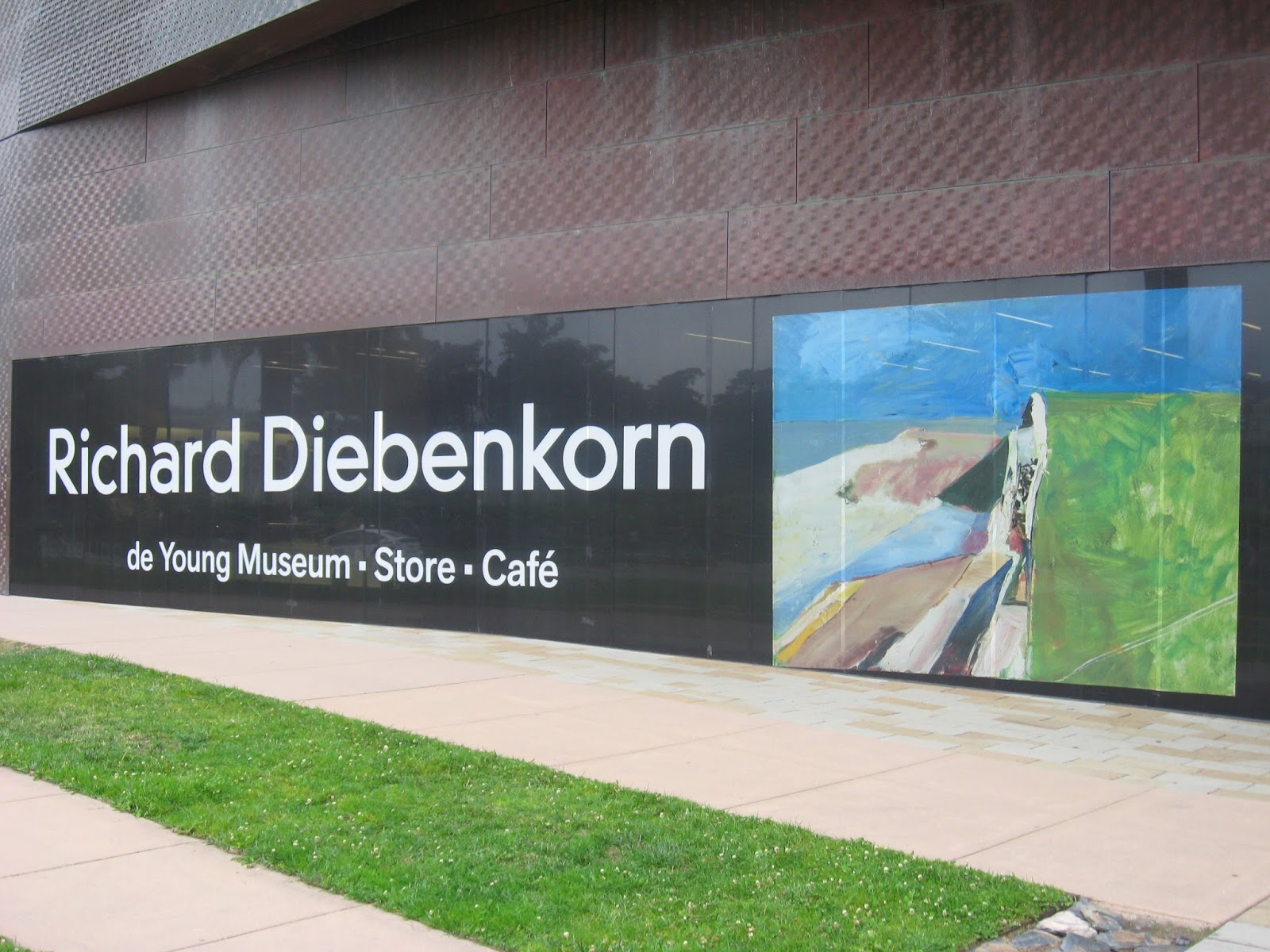
Richard Diebenkorn was profoundly influenced by the nature and culture of the San Francisco Bay Area. Color, light and atmosphere played a significant role in many of the 20th century American artist's works that are on view in Richard Diebenkorn: The Berkeley Years, 1953-1966, at the de Young Fine Arts Museum in San Francisco's Golden Gate Park through September 29.

The exhibition, which had its debut in June, is the first of its kind to focus on this pivotal period in the career of this postwar American artist.

During his lifetime, Diebenkorn (1922-1993) achieved acclaim as one of the most significant and influential artists of California and of postwar America. His early work is associated with Abstract expressionism and the Bay Area Figurative Movement of the 1950s and 1960s.

At the beginning of this exhibition of more than 130 paintings and drawings that were assembled from museums and private collections across the country, we get to go outside the lines to get a feel for what's going on in Diebenkorn's mind as he shares his thoughts in Notes to myself on beginning a painting:

  • Attempt what is not certain. Certainty may or may not come later. It may then be a valuable delusion.
  • The pretty, initial position, which falls short of completeness, is not to be valued -- except as a stimulus for further moves.
  • Do search. But in order to find other than what is searched for.
  • Use and respond to the initial fresh qualities, but consider them absolutely expendable.
  • Don't "discover" a subject -- of any kind.
  • Somehow don't be bored -- but if you must, use it in action. Use its destructive potential.
  • Mistakes can't be erased, but they move you from your present position.
  • Keep thinking about Pollyanna.
  • Tolerate chaos.
  • Be careful only in a perverse way.

Richard Diebenkorn /
Seated Figure with Hat, 1967,
oil on canvas.
Much of the art in Richard Diebenkorn: The Berkeley Years, 1953-1966 is devoted to a three-year period in which Diebenkorn "painted prolifically, his paintings, watercolors, and drawings synthesizing elements of nature with an abstract approach in what came to be known as his Berkeley series," according to the de Young's Fine Arts magazine, in previewing the show. Later in the exhibition, we see Diebenkorn's subsequent figurative phase, and it is easy to see and understand why he had a profound influence on American modernism.

As I walked through the exhibit rooms on a recent Friday evening, studying and absorbing Diebenkorn's artwork, my attention was drawn to several of the artist's quotes that were prominently displayed on the gallery walls. I took the time to read each of them carefully:

  • "Abstract means literally to draw from or separate. In this sense, every artist is abstract ... a realistic or non-objective approach makes no difference. The result is what counts."
  • "All paintings start out of a mood, out of a relationship with things or people, out of a complete visual impression."
  • "I began to feel that what I was really up to in painting, what I enjoyed almost exclusively, was altering -- changing what was before me -- by way of subtracting or juxtaposition or superimposition of different ideas."
  • "It was impossible to imagine doing a picture without it being a landscape; to try to make a painting space, a pure painting space, but always ending up with a figure against a ground."

After its San Francisco premiere, Richard Diebenkorn: The Berkeley Years, 1953-1966, will move to southern California and be on view at the Palm Springs Art Museum from October 26, 2013, to February 16, 2014.

To learn more about the Richard Diebenkorn exhibition at the de Young: http://diebenkorn.famsf.org/

Photograph of de Young Fine Arts Museum by Michael Dickens, 2013.
Photograph of Richard Diebenkorn's Seated Figure with Hat, 1967, courtesy of Wikipedia Commons.

Tuesday, June 25, 2013

Engaging in a dialogue that spans religions, cultures and history


At the de Young Museum /
Objects of Belief from the Vatican

Eketea, god figure /
Gambier Islands, wood (collected 1834-1836).

Objects of Belief from the Vatican: Art of Africa, Oceania, and the Americas, an exhibition of 39 rarely seen holdings of the Vatican Ethnological Missionary Museum that is on display at the de Young Fine Arts Museum in San Francisco through September 8, celebrates the multiple paths of spirituality represented by the objects on display and serves to invite viewers to engage in a dialogue that spans religions, cultures and history.

On a recent Friday evening, I had the opportunity to see Objects of Belief from the Vatican, drawn from a collection that numbers more than 80,000 objects. The softly-lit, upstairs gallery was both quiet and meditative as I viewed these beautiful works of art, which were selected for their artistic and cultural significance. I was impressed by the exhibition's design to offer each patron with a personal viewing experience, "allowing for reflection on the diversity of human expression manifest in objects of belief, and on the multiple paths to religious understanding."

According to the de Young, Objects of Belief from the Vatican draws its inspiration from the Vatican's recent efforts to highlight world cultures through important special exhibitions such as this one. It marks the first time that an exhibition consisting solely of works from the Vatican Ethnological Missionary Museum from continents and cultures beyond Europe has traveled to the United States.

Jesuit Father Nicola Mapelli, director of the Vatican Ethnological Missionary Museum, believes using these objects as a means of reconnecting with indigenous communities throughout the world is very important. "Through the objects we can show the living story of a people: their history, hopes, joys, and desires," said Mapelli, in a Fine Arts magazine article about the exhibition. "Through our exhibitions, we can show our visitors from around the world something about the wonderful culture and spirituality of indigenous people."

One thing which I enjoyed about the exhibition was its presentation allowed me to learn about the local and global significance of these "objects of belief" and their journeys, leading from one culture to another and from the past to the present, without an imposition of a single dominant cultural storyline.

Among the many important "manifestations of spirituality" in the exhibition are two masks and three shrine carvings that were obtained in 1691 by Fray Francisco Romero in Colombia's Sierra Nevada de Santa Marta and presented to Pope Innocent XII, which represent the beginning of the Vatican's ethnological collections.

Also, there are two rare and figurative sculptures depicting the gods Tu and Tupo that were gifted by Father Francois Caret, the first missionary in Mangareva, to Pope Gregory XVI in 1837. And, easily noticed is a 15th-century Mexican stone sculpture of the Aztec god Quetzalcoatl. This embodied image serves as a visual and physical reminder of a manifestation of belief in a dynamic ritual culture.

To learn more about Objects of Belief from the Vatican:

http://deyoung.famsf.org/pressroom/pressreleases/objects-belief-vatican-art-africa-oceania-and-americas

http://catholic-sf.org/ns.php?newsid=23&id=61097

Photographs by Michael Dickens, copyright 2013

Tuesday, March 5, 2013

Girl with a Pearl Earring: Who's that girl?


Girl with a Pearl Earring 

If life is best shared through story, as it's been said, then, art is the medium through which we illustrate these stories.

One such story that has been wonderfully illustrated is Vermeer's Girl with a Pearl Earring. This renowned and beloved masterpiece, labeled the Dutch Mona Lisais one of the most beautiful and artistically important paintings in the world.

Currently, the de Young Fine Arts Museum in San Francisco's Golden Gate Park is hosting Girl with a Pearl Earring: Dutch Paintings from the Mauritshuis. The show, which opened on January 26 to much fanfare, continues its residency in The City through June 2. It is drawing tremendous crowds and much attention, too.

Last Friday, I visited the exhibition, which is on loan from the Royal Picture Gallery Mauritshuis in The Hague, and came away impressed by the many outstanding paintings from the 17th-century Dutch Golden Age. Both portraits and still lifes, which give Dutch art a visually and intellectually appealing resonance, were well represented among the 35 paintings. Among them were: A Hunting Party near the Hofvijver in The Hague, Seen from the Plaats (ca. 1690) by Gerrit Berckheyde and The Goldfinch (1654) by Carel Fabritius. Other masterstroke artists represented included: Salomon van Ruysdael, Abraham van Beyeren and Rachel Ruysch.

And, of course, the special exhibition wouldn't be complete without giving due props to the most famous Dutch master of them all, Rembrandt. In fact, a separate exhibition gallery featuring 60 etchings by Rembrandt van Rijn, entitled Rembrandt's Century, is also on display and included in the admission price for Girl.

However, the centerpiece of the Dutch Golden Age exhibition remained the iconic Girl with a Pearl Earring. It was the one spectacular painting that garnered everyone's attention, the one everyone wanted to see. And I must say this: The showstopper, which had its very own gallery room, was quite the jewel.

Johannes Vermeer painted the timeless portrait of Girl with a Pearl Earring using oils on canvas, circa 1665. While it's been a popular painting for several centuries, its celebrity and superstar status was enhanced only recently, in both literature and on film. In 1999, Tracy Chevallier's best-selling, historical novel fictionalized the circumstances of the creation of the painting. In turn, the novel inspired a 2003 dramatic movie starring Colin Firth as Vermeer and Scarlett Johansson as the wide-eyed girl, Griet. Hired by Vermeer as an assistant, she sits for him as a painting model while wearing one of his wife's pearl earrings dangling from her left earlobe. The book and the film brought the radiant painting to life and helped introduce it to a wide-reaching audience.

On this particular morning, I took my time in absorbing the atmosphere of the spacious gallery room as I approached Girl with a Pearl Earring. I wanted to take full advantage of this rare opportunity to see the most famous of Vermeer's 36 paintings and, arguably, the second most famous painting in the world.

First, I stood to the right of the hauntingly beautiful, softly-lit masterpiece. Then, I stood in front of it. Finally, I shifted to the painting's left side. I wanted to see this lovely portrait set against a dark, neutral background from a variety of angles. In each instance, there were different aspects of the painting, which was restored in 1994, that I focused upon: the girl's beautiful wide eyes, her parted lips, her blue turban-like headscarf with its yellow veil, her yellowish-brown jacket with the shining white collar, the intimacy of her gaze towards me. And, of course, the focal point: the most famous pearl earring ever painted.

Soon, I left the exhibition and headed out into a lovely, sunlit San Francisco afternoon impressed by Girl with a Pearl Earring. Yet, after seeing this magical face full of much drama and conflict, I couldn't help but think that there were many questions about this masterpiece in search of answers. I pondered some of them while walking across the park on my way to eat lunch.

  • What is the girl thinking as she stares at us? 
  • Do her eyes and half-smile convey a sense of innocence or are they meant to be seductive? 
  • And, centrally, why is the girl wearing a pearl earring?

I'm sure others are asking the same questions as me.

Indeed, who's that girl?

Tuesday, January 29, 2013

Finding serendipity on a Saturday afternoon walk in San Francisco's Golden Gate Park


Look, there's a gull on top of the fountain ... /
A hap
py accident or a pleasant surprise? 

Life is full of surprises and we all like a pleasant surprise every once in a while, right?

There is such a word to describe a pleasant surprise. That word is serendipity, which means a "happy accident" or "pleasant surprise"; specifically, serendipity is the accident of finding something good or useful while not specifically searching for it.

The word "serendipity" was first coined by Horace Walpole, the fourth Earl of Orford, in a January 28, 1754 letter to British diplomat Horace Mann. In this letter, Walpole said he formed the word serendipity from the Persian fairy tale The Three Princes of Serendip in which the heroes "were always making discoveries, by accidents and sagacity, of things they were not in quest of."

I had a brush of serendipity recently. It occurred during a recent Saturday afternoon visit I made to the de Young Fine Arts Museum in San Francisco's expansive Golden Gate Park to see an exhibit on the life of the extraordinary ballet dancer Rudolf Nureyev, "A Life in Dance."

Just before entering the museum, I stopped for a moment at the central fountain that straddles the de Young, the California Academy of Sciences and the Music Concourse to take a photograph of the fountain as I have done many times before. Located in an open-air plaza with many heavily pollarded trees (London plane and Scotch elm), it's a lovely fountain surrounded by beautiful park scenery that looks handsome in both daylight and at nighttime, too.

While my photograph was intended to be of the central fountain, much to my surprise, there was a gull sitting on top of the fountain at the time I took my photograph. The gull became my focus as much as the fountain. Indeed, it was a pleasant surprise, a happy accident. That's serendipity and I'm grateful because the gull made my photograph more interesting and colorful.

May we all find a little bit of serendipity in our lives.

Wednesday, August 24, 2011

Picasso: He wanted to be a painter ...

Pablo Picasso / "Give me a museum and I'll fill it."

"Give me a museum and I'll fill it," said Pablo Picasso, arguably the most compelling figure of 20th century modern art.

The Spanish artist wanted to become a painter and, instead, he became Picasso.

"Picasso: Masterpieces from the Musee National Picasso, Paris" is an exhibition of "Picasso's Picassos." An extraordinary group of 150 paintings, sculptures, drawings and prints are currently on display in a special exhibition at the de Young Fine Arts Museum in San Francisco's Golden Gate Park through Oct. 9.

Portrait of Dora Maar
(Oil on canvas, 1937)
It's a good month for Picasso lovers as "The Steins Collect: Matisse, Picasso, and the Parisian Avant-Garde," an exhibition showcasing the collections of Gertrude Stein and her siblings, major figures in the early 20th century Bohemian Paris, is on display at the San Francisco Museum of Modern Art through Sept. 6. Among the 40 Picasso highlights are: Lady With a Fan and Boy Leading a Horse.

Earlier this month, I took the opportunity to visit the de Young to gaze at the genius of Picasso and see for myself why looking at a painting by Picasso is like a form of magic.

Among the many memorable moments for me were: The Spanish Civil War and The Weeping Woman, Portrait of Dora Maar, Still Life with Pitcher and Apples, The Matador, and my favorite, Chat saisissant un oiseau (Cat Catching a Bird).

A Picasso quote that appeared overhead in one of the gallery rooms read: "Painting is just another way of keeping a diary." Another spelled out: "Painting is stronger than me. It makes me do what it wants."

Picasso at the de Young / A fresh, revealing perspective 

Well, I am happy to say that I came away with a new, refreshing and revealing perspective of Picasso.

The man could paint.

"It took me four years to paint like Raphael but a lifetime to paint like a child," said Picasso.

And, little did I realize until that lively Friday evening, Picasso had a sense of humor, too.