Showing posts with label influence. Show all posts

Tuesday, September 24, 2019

“The Weight” – 50 years, still transcending time and space


Robbie Robertson / “The Weight”

Growing up as a teen in Ocean Springs, Miss., then continuing through my university days at Macalester College in Saint Paul, Minnesota, The Band always stood out as one of my favorite music groups. Starting with their outstanding live LP Rock of Ages, I started collecting their albums over the years and my appreciation for this Canadian-American roots rock group never wavered. They made critically-acclaimed soulful music enriched by a singular voice that was influenced by country, blues and Americana. Going on a musical journey with The Band also meant hearing gospel and mountain music – even Angelic hymns.

I always appreciated that there was stability – and versatility – in The Band’s lineup, which featured Robbie Robertson on guitar and vocals; Levon Helm on drums, vocals, mandolin and guitar; Rick Danko on bass guitar, vocals and fiddle; Garth Hudson on Lowrey organ and keyboards, accordion and saxophone; and Richard Manuel on piano and keyboards, drums and vocals. Though The Band had three vocalists sharing lead and harmonies, Manuel was seen as their primary vocalist. All but Helm, who was born among the dirt farms in Elaine, Arkansas, hailed from the provinces of Canada. It was during their time spent backing up Bob Dylan when he ditched folk and went electric that The Band gained not only prominence but also their monicker. They were originally formed as The Hawks, a backing band for the rockabilly singer Ronnie Hawkins, joining him one by one between 1958 and 1963.

Although they were always “the band” to the various frontmen and locals in Woodstock, New York, where they moved after touring with Dylan in the U.S. in 1965 and around the world in 1996, Helm once said the name “The Band” worked pretty well when they came into their own. Once they began performing as The Band in 1968, they recorded 10 studio albums and collaborated again with Dylan in 1974 on a live concert album. The original quintet ended their touring career back in 1976 with “The Last Waltz” concert at the Winterland Ballroom in San Francisco, which featured many iconic musical celebrities of that era, including: Dylan, Van Morrison, Eric Clapton, Neil Young, Muddy Waters, Dr. John, the Staples Singers and Joni Mitchell. The performance was filmed by Martin Scorsese and released as a 1978 documentary, The Last Waltz.

Since then, three of the original members of The Band have passed away – Manuel committed suicide in 1986, Danko died of heart failure in 1999 and Helm, who went on to a successful film career with roles in The Coal Miner’s Daughter and The Right Stuff, died of throat cancer at age 71 in 2012. Meanwhile, Robertson, now 76, found success with a solo career and as a Hollywood music producer. He has scored the music for 10 Martin Scorsese films. Hudson, now 82, went on to record a number of solo projects and is still a much in-demand studio musician. Last year, he was named a Member of the Order of Canada.

Although my music tastes have expanded over the years since my days as college radio disc jockey at Macalester’s WMCN-FM, I have maintained a fondness for The Band’s musical template of Americana, roots rock and country rock, which along with The Byrds and The Flying Burrito Brothers, helped pave the wave for the popularity of The Eagles.

The Band’s first album, Music From Big Pink, which was released in 1968, included three songs penned by Dylan: “This Wheel’s On Fire,” “Tears of Rage,” and “I Shall Be Released.” It also included “The Weight,” which was featured in the seminal counterculture film Easy Rider, making it one of the group’s most memorable and best-known songs. According to The Wall Street Journal, the songs on Music From Big Pink combined “vivid imagery with a touch of Impressionism; they sound both utterly original and like folk songs that have been passed down for generations.”

While it’s been a while since I listened to Music From Big Pink, lo and behold, a week ago I came across an interesting Rolling Stone article about Robbie Robertson playing “The Weight” with Ringo Starr and musicians across five continents, captured in an epic “Playing For Change” video, that was the result of two years of work spread across 10 countries. I was intrigued by the possibilities and gave the video a good watch and listen.

“The Weight,” written by Robertson and sung by Helm, has been described as “a masterpiece of Biblical allusions, enigmatic lines and iconic characters,” and its enduring popularity makes it an essential part of not only the American songbook but it’s also one of the great songs that shaped rock and roll, too.

“What key is it in, Robbie?” Starr, sitting behind his drum kit, asks Robertson, who’s in Los Angeles, during a telephone conversation at the beginning of the video. The former mop-top Beatles drummer nods. “F-demented!” What follows is a delightful and heartfelt cover of “The Weight,” beginning with Robertson’s soulful guitar lick that brings back memories of the original introduction. From there, the song takes off verse by verse as a series of all-star musicians spanning the globe – Lukas Nelson (son of Willie), Marcus King, Congolese soul singer Mermens Mosengo, Japanese guitar virtuoso Char, among many – add their own distinctive influence to enhance the palate of the song, each from different locations around the world.

According to Rolling Stone, the project for “The Weight” came from Playing For Change, a group that is dedicated to “breaking down the boundaries and overcome distances between people.” It includes 15 music schools across 11 countries, documentaries and viral videos bringing artists from different cultures together. Co-founder Mark Johnson, a Grammy Award-winning producer-engineer who has worked with Paul Simon among many, told Rolling Stone that it took a year and a half of production over five continents. “We made it brick by brick, starting with Robbie. That’s what makes this special. We could never have assembled this group in the studio. You need to go there, and then when you go there, you’re where they feel comfortable. You hear that in the music.”

After watching and listening to this version of “The Weight,” I’m gobsmacked. After 50 years, thanks to time and space, this enduring classic has only gotten better. Levon Helm would be proud.


Credits: Video courtesy of YouTube.com. Screenshot photo of Robbie Robertson courtesy of Playing For Change.

Tuesday, March 29, 2016

Oscar de la Renta: Celebrating a global fashion icon

Oscar de la Renta / The Dominican-born
American designer celebrated the best in us.
"Beauty, optimism, confidence." Three words that define how Dominican-born American designer Oscar de la Renta celebrated the best in us through his remarkable and colorful fashion. De la Renta (1932-2014) dressed women for modern life, and he was one of the most beloved and influential fashion icons whose career spanned both the 20th and 21st centuries. 

De la Renta's knowledge of literature, art, music and social history influenced his fashion design, and "his work was admired for its contemporary sensibility, romantic artistry, and traditional workmanship." 

His fashion has been worn by distinguished women and celebrities, including First Ladies Betty Ford, Nancy Reagan, Laura Bush and Hillary Clinton, actress Sarah Jessica Parker, and singer Rihanna.


Oscar de la Renta / He was deeply
influenced by the people, history and
customs of Spain.
Last week, I had the opportunity to see a world-premiere retrospective of de la Renta's designs with my wife that opened less than two weeks ago at the de Young Fine Arts Museum in San Francisco's Golden Gate Park. "This is the first major survey to celebrate the life and career of one of fashion's most influential designers, examining his craft and technique, the historical and cultural influences on his work, and the clients who wore his designs," according to Fine Arts magazine.

The colorful exhibition included more than 130 ensembles spanning de la Renta's remarkable career, beginning in Spain where he first gained his initial commissions to his formative years that were spent in some of the world's most famous and iconic European fashion houses, and finally to his role as a designer for many influential and celebrated personalities. 


Oscar de la Renta for Pierre Balmain
Evening ensemble; coat and pants,
Spring/summer, 2000.
"Today, people – clothes – are international. Frontiers are non-existent," de la Renta once said. He broke a barrier in becoming the first American designer to head a French couture house when he joined Pierre Balmain.

André Leon Talley, former American Vogue editor-at-large and the exhibition's curator, said of the iconic designer: "Oscar carried with him the warmth of paradise, surely drawn from the sheer happiness of his childhood, growing up in a tropical environment in a huge family, surrounded by love." 


Throughout the 1970s, Oscar de la Renta's
collections included his hallmark sophisticated
take on daywear.
Further, Talley said: "Throughout his life, there was always love and laughter and it infused everything he took to task, be it the designing a simple cashmere coat, a suit, or a gorgeous evening dress; preparing a lovely dinner party; or tending to his gardens. Oscar loved life, and the light from within him beamed out to his world."

It became clear to me as I walked through the exhibit rooms that de la Renta's designs were full of beauty and color, and filled with elegance. It is evident that he had a true desire to make all of his women look and feel beautiful.

The special exhibition celebrating the fashion of Oscar de la Renta continues through May 30 in the Herbst Exhibition Galleries at the de Young. 

If your travels bring you to the San Francisco Bay Area between now and the end of May, I highly recommend you treat yourself and see this enjoyable exhibition – and bring your camera along to take photographs as non-flash photography is allowed in this exhibition.

Learn more about the Oscar de la Renta exhibition:
http://deyoung.famsf.org/exhibitions/oscar-de-la-renta-retrospective

Photos: Oscar de la Renta courtesy of Fine Arts magazine and FAMSF. Exhibition photographs by Michael Dickens, © 2016.

Wednesday, September 11, 2013

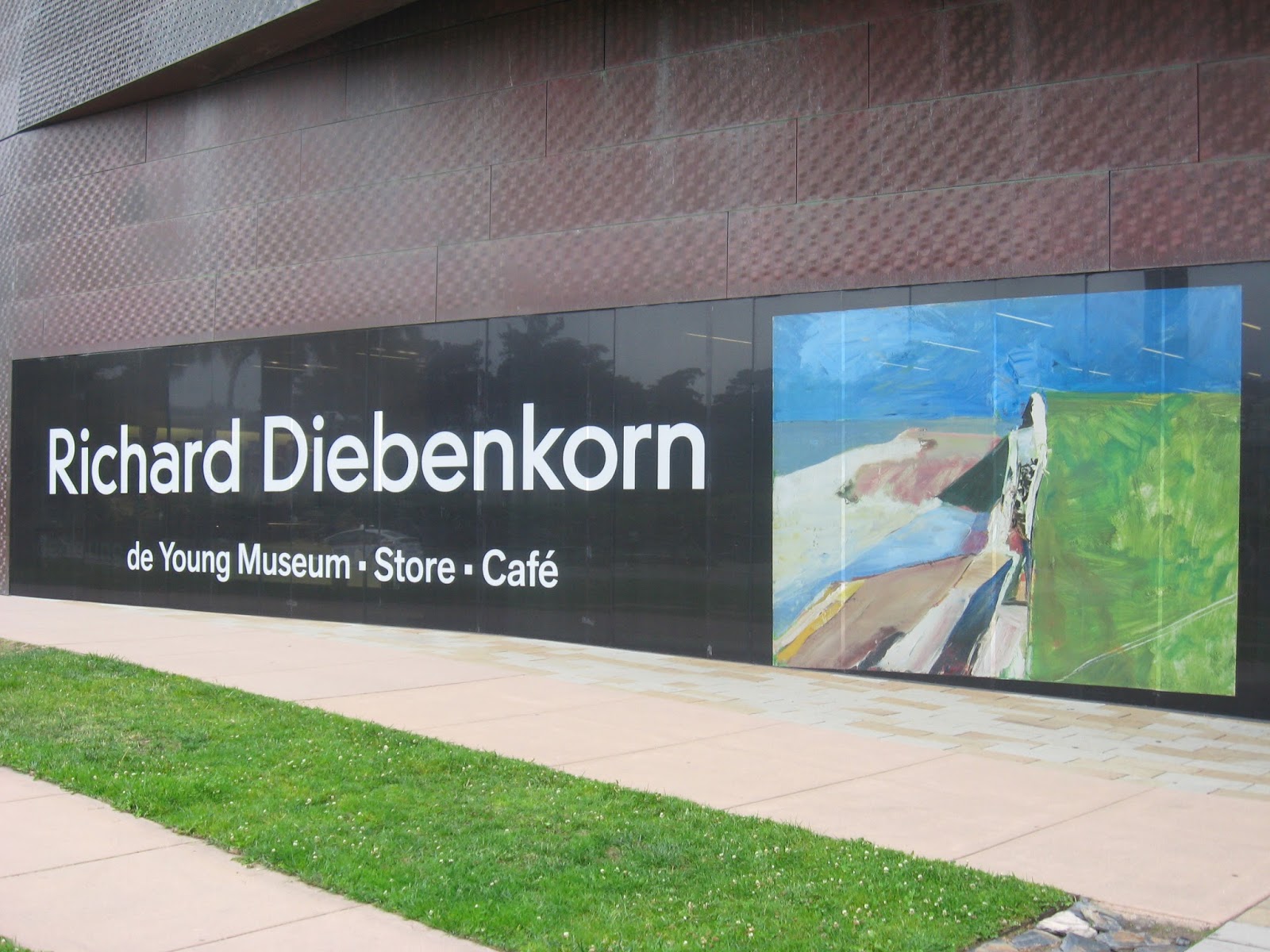
On art: Richard Diebenkorn, The Berkeley Years, 1953-1966


Richard Diebenkorn was profoundly influenced by the nature and culture of the San Francisco Bay Area. Color, light and atmosphere played a significant role in many of the 20th century American artist's works that are on view in Richard Diebenkorn: The Berkeley Years, 1953-1966, at the de Young Fine Arts Museum in San Francisco's Golden Gate Park through September 29.

The exhibition, which had its debut in June, is the first of its kind to focus on this pivotal period in the career of this postwar American artist.

During his lifetime, Diebenkorn (1922-1993) achieved acclaim as one of the most significant and influential artists of California and of postwar America. His early work is associated with Abstract expressionism and the Bay Area Figurative Movement of the 1950s and 1960s.

At the beginning of this exhibition of more than 130 paintings and drawings that were assembled from museums and private collections across the country, we get to go outside the lines to get a feel for what's going on in Diebenkorn's mind as he shares his thoughts in Notes to myself on beginning a painting:

  • Attempt what is not certain. Certainty may or may not come later. It may then be a valuable delusion.
  • The pretty, initial position, which falls short of completeness, is not to be valued -- except as a stimulus for further moves.
  • Do search. But in order to find other than what is searched for.
  • Use and respond to the initial fresh qualities, but consider them absolutely expendable.
  • Don't "discover" a subject -- of any kind.
  • Somehow don't be bored -- but if you must, use it in action. Use its destructive potential.
  • Mistakes can't be erased, but they move you from your present position.
  • Keep thinking about Pollyanna.
  • Tolerate chaos.
  • Be careful only in a perverse way.

Richard Diebenkorn /
Seated Figure with Hat, 1967,
oil on canvas.
Much of the art in Richard Diebenkorn: The Berkeley Years, 1953-1966 is devoted to a three-year period in which Diebenkorn "painted prolifically, his paintings, watercolors, and drawings synthesizing elements of nature with an abstract approach in what came to be known as his Berkeley series," according to the de Young's Fine Arts magazine, in previewing the show. Later in the exhibition, we see Diebenkorn's subsequent figurative phase, and it is easy to see and understand why he had a profound influence on American modernism.

As I walked through the exhibit rooms on a recent Friday evening, studying and absorbing Diebenkorn's artwork, my attention was drawn to several of the artist's quotes that were prominently displayed on the gallery walls. I took the time to read each of them carefully:

  • "Abstract means literally to draw from or separate. In this sense, every artist is abstract ... a realistic or non-objective approach makes no difference. The result is what counts."
  • "All paintings start out of a mood, out of a relationship with things or people, out of a complete visual impression."
  • "I began to feel that what I was really up to in painting, what I enjoyed almost exclusively, was altering -- changing what was before me -- by way of subtracting or juxtaposition or superimposition of different ideas."
  • "It was impossible to imagine doing a picture without it being a landscape; to try to make a painting space, a pure painting space, but always ending up with a figure against a ground."

After its San Francisco premiere, Richard Diebenkorn: The Berkeley Years, 1953-1966, will move to southern California and be on view at the Palm Springs Art Museum from October 26, 2013, to February 16, 2014.

To learn more about the Richard Diebenkorn exhibition at the de Young: http://diebenkorn.famsf.org/

Photograph of de Young Fine Arts Museum by Michael Dickens, 2013.
Photograph of Richard Diebenkorn's Seated Figure with Hat, 1967, courtesy of Wikipedia Commons.