Showing posts with label justice. Show all posts

Wednesday, December 11, 2019

Rosa Parks: In Her Own Words at the Library of Congress


Rosa Parks: In Her Own Words, the newest Library of Congress multimedia exhibition, opened on December 5, in the Library’s South Gallery of the Jefferson Building in Washington, D.C., to much fanfare and critical praise. By humanizing Rosa Parks, visitors are able to see her greatness in a new light.


“I want to be remembered as a person who stood up to injustice, and most of all, I want to be remembered as a person who wanted to be free and wanted others to be free.”

– Rosa Parks


If you are of a certain age, chances are good you remember the famous photograph of Rosa Parks seated on a Montgomery, Alabama, bus, taken Dec. 21, 1956.

A year earlier, on Dec. 1, 1955, Parks became nationally known for her refusal to give up her seat to a white man on a crowded bus in the same city.

Parks’ arrest was the catalyst that led to the Montgomery Bus Boycott, a pivotal event in the American Civil Rights movement which ultimately brought about the dismantling of Jim Crow segregation in the southern United States.

While Rosa Parks’ refusal to give up her seat on the bus, the Montgomery Bus Boycott and the subsequent fallout from it all happened before I was born, as a student of American history I’ve always been interested in learning more about her life of defiance and how she became a symbol of human dignity and freedom, not only in America but internationally, too.

During a recent visit to Rosa Parks: In Her Own Words at the Library of Congress, I learned that while Rosa Parks (1913-2005) became an icon of the Civil Rights Movement – “celebrated for this single courageous act of civil disobedience” – she has often been characterized by misconceptions. It’s an old and convenient story that is finally being debunked. “Contrary to popular belief, Parks was not a demure seamstress who chose not to stand because she was physically tired.” Instead, as I learned, “her calm demeanor hid a militant spirit forged over decades.”

Among many first-week visitors to the exhibit was E.R. Shipp, a Pulitzer Prize winner for commentary, who is journalist in residence at Morgan State University’s School of Global Journalism and Communication in Baltimore, Maryland. She wrote Parks’ obituary while she was a reporter for The New York Times and gained a keen insight about the civil rights icon – especially after interviewing Mrs. Parks in a New York City church in 1988, in the midst of a voter registration drive. She and I shared a brief conversation in person following a curator’s tour and later continued it via email as we discussed our shared experiences after seeing Rosa Parks: In Her Own Words.

“I was very impressed with the exhibit and think that, for most people, it will be a revelation,” Shipp told me. “Even now, many people only know that Mrs. Parks refused to give up her seat on a bus in Montgomery and that she became known as ‘the Mother of the Civil Rights Movement.’ Those who know that, don’t now much more than that.”

Shipp conveyed to me she was impressed by the quality of Mrs. Parks’ personal writings as much as with the behind-the-scenes insights that her writings offer us. She hopes to make use of the papers as a scholar and journalist in the future. “I did not really know her family lineage and did not realize that many of her forebears could easily have called themselves white. They were what the writer Jill Nelson has called ‘the voluntary Negro,’ she said.”

Shipp, who writes a column every other Wednesday for the Baltimore Sun, shared her insights about Parks with her readers today, noting: “Perhaps it is inevitable that each generation puts a stamp on the past. The power dynamics of who disseminates a history becomes key.”

Rosa Parks: In Her Own Words is presented in a multimedia format in four main areas – Early Life and Activism, The Bus Boycott, Detroit 1957 and Beyond, and A Life of Global Impact – and together, we learn of the complete story about the remarkable life and contributions of the mother of the Civil Rights Movement.


So, just who was Rosa Parks? For one, she was a seasoned activist – an organizer – who organized to free the Scottsboro Boys in the 1930s. Also, she helped operate the NAACP and Brotherhood of Sleeping Car Porters offices in Montgomery during the 1940s and 1950s. Despite her punishment from the bus incident, which included unemployment and dire poverty – not to mention being the subject of death threats – Parks strove for social justice and human rights. She served as an inspiration not only in the U.S. but also around the world, fighting for women’s rights and speaking out against the Vietnam War. She was a prisoner advocate and supported the growing Black Power movement of the 1960s. By the 1980s, she supported the presidential campaigns of Jesse Jackson and also participated in the anti-apartheid protests against South Africa. She was an advocate of nonviolence and peace. What a remarkable life Mrs. Parks lived!

After her death in 2005, Rosa Parks’ body lay in honor at the U.S. Capitol Rotunda, the first woman given that distinction. In 2006, a statue of Mrs. Parks was placed in the National Statuary Hall. Throughout the U.S., there are many schools, parks and streets which are named in her honor.

Thanks to the vast archives of the Library of Congress, which includes the Rosa Parks Collection (a gift to the Library of Congress from the Howard G. Buffett Foundation), visitors to Rosa Parks: In Her Own Words will see a variety of rarely seen materials that offer not only an intimate view of Rosa Parks, but also document her life and activism – “creating a rich opportunity for viewers to discover new dimensions to their understanding of this seminal figure.”

Credits: Cover photo by Michael Dickens. Original photo of Rosa Parks seated on bus from Library of Congress Prints and Photographs Division. Rosa Parks statue photo courtesy of AOC.gov. Video courtesy of YouTube, LOC.gov.

Tuesday, January 9, 2018

On Oprah Winfrey: Indeed, a new day is on the horizon


It isn't often that an awards speech is so moving that it brings both men and women in the audience to their feet. Yet, in accepting the Cecil B. DeMille Award for lifetime achievement during the 75th Golden Globes in Beverly Hills, Calif., on Sunday night, media entrepreneur Oprah Winfrey did just that. She delivered such a moving, fire and brimstone speech that for many – including yours truly – it was the highlight of the nationally televised awards ceremony. It's certainly what everyone has been talking and tweeting about on social media over the past day.

Throughout the three-hour ceremony broadcast on NBC and hosted by late-night talk show personality Seth Meyers, it was encouraging to see the actors, writers, directors and others who walked the red carpet and later took the stage sharing important conversations and articulating a set of values that's been missing from our government leaders for the past year. There was plenty of talk about diversity and decency – and, of course, the #MeToo movement. If the power of women was on full display Sunday night – and it certainly was – then Oprah showed that without a doubt she was the most powerful woman in the Beverly Hilton ballroom on Sunday night.

"America is upside down and inside out," opined New York Times columnist Frank Bruni, writing about the Golden Globes ceremony. "There's meaningless make-believe in the capital of politics. There's meaningful politics in the capital of make-believe."

Thus, the appeal of what Ms. Winfrey said Sunday night – and the eloquence and immediacy of her voice in how she delivered her message – raised our collective consciousness about sexual abuse and harassment. She showed a fresh determination for all of us to rally around – something that's been sorely lacking in our current president. Bruni called Ms. Winfrey's address, "a glorious speech about how a yesterday of discrimination becomes a tomorrow of hope."

Bruni wrote: "One of the best routes, she noted, are role models. She recalled what it meant to her, when she was younger, to see Sidney Poitier receive Hollywood's highest accolades. And she wandered aloud what it might mean for little girls Sunday night to see her getting the Cecil B. DeMille Award for outstanding contributions to the world of entertainment."

Veteran newsman Dan Rather, writing on his Facebook page Monday morning, said Ms. Winfrey's speech was "a bold and passionate call for hope, a rejection of the cynicism and darkness of the present."

Her words, Rather noted, "embodied the best traditions of American oratory. They rang with a moral clarity rooted in the march toward justice. They were not blind to the distance we have traveled as a nation and the distance yet to go. They were uplifting and inspiring, while recognizing that achieving progress will take work."

Among the many highlights of Ms. Winfrey's speech – and one which resonated with me – was when she spoke out about valuing freedom of the press.

"I want to thank the Hollywood Foreign Press Association because we all know the press is under siege these days. We also know it's the insatiable dedication to uncovering the absolute truth that keeps us from turning a blind eye to corruption and to injustice. To tyrants and victims, and secrets and lies, I want to say that I value the press more than ever before as we try to navigate these complicated times, which brings me to this: what I know for sure is that speaking your truth is the most powerful tool we all have. And I'm especially proud and inspired by all the women who have felt strong enough and empowered enough to speak up and share their personal stories. Each of us in this room are celebrated because of the stories that we tell, and this year we became the story.

"But it's not just a story affecting the entertainment industry. It's one that transcends any culture, geography, race, religion, politics, or workplace. So I want tonight to express gratitude to all the women who have endured years of abuse and assault because they, like my mother, had children to feed and bills to pay and dreams to pursue. They're the women whose names we'll never know. They are domestic workers and farm workers. They are working in factories and they work in restaurants and they're in academia, engineering, medicine, and science. They're part of the world of tech and politics and business. They're our athletes in the Olympics and they're our soldiers in the military."

Finally, Ms. Winfrey brought the Golden Globes audience to its feet when she said: "I want all of the girls watching here now to know, that a new day is on the horizon. And when that new day finally dawns, it will be because of a lot of magnificent women, many of whom are right here in this room tonight, and some pretty phenomenal men, fighting hard to make sure that they become the leaders who take us to the time when nobody ever has to say 'me too' again."

On Sunday night, many of us saw Ms. Winfrey as Madame President. Not only a spiritual leader but a brilliant woman, who unlike our current president, came from nothing and built a billion-dollar empire. She is well respected and loved. Her nine-minute speech gave us hope – and, certainly, she encouraged all of us to be inspired and to stand up and be heard, and also to be inspired for social justice. 

The Washington Post quoted actress Meryl Streep afterward saying that Ms. Winfrey "launched a rocket" with her speech. "I want her to run for president," Ms. Streep told The Post. "I don't think she had any intention (of declaring). But now she doesn't have a choice."

Certainly, it will be interesting to see if the seed planted by Ms. Winfrey's hopeful and inspiring speech grows into some bigger than anything we might imagine. Don't count out an Oprah for President possibility in 2020. 


Photo: Courtesy of Google Images. Video: Courtesy of YouTube.com. 

Tuesday, April 12, 2016

Mississippi memo: You don't love your neighbor by discriminating against them


Mississippi / From Hospitality State to Hostility State, thanks to H.B. 1523.

Dear Mississippi,

In case you missed it we've already had this conversation. You don't get to decide who sits at the lunch counter.

Love, America

The above letter that's making the rounds on Facebook sums up a lot of common-sense feelings in just a few words. In a matter of days, Mississippi went from being the "Hospitality State" to the "Hostility State," thanks to the recent passing of a hateful and discriminatory measure (House Bill 1523) by the State Legislature.

Memo to Republican Governor Phil Bryant: "You don't love your neighbors by discriminating against them." Shame on you.

Mississippi / "You're on my mind ... "
Indeed, I've been saddened by the appalling news that my former home state of Mississippi (where I graduated from high school in the Gulf Coast city of Ocean Springs) last week passed legislation and the governor signed into law "The Religious Liberty Accommodations Act," which directly targets the LGBT community throughout the state – from Tupelo to Biloxi, from the Delta to the Gulf Coast and everywhere in between.  The bill is so draconian that the state's largest daily newspaper, the Clarion-Ledger of Jackson called it "an act of oppression."

According to the Human Rights Campaign (HRC), the nation's largest lesbian, gay, bisexual, and transgender (LGBT) civil rights organization, H.B. 1523 "would allow individuals, religious organizations and private associations to use religion to discriminate against LGBT Mississippians in some of the most important aspects of their lives, including at work, at schools, and in their communities."

In an April 6 editorial, The Clarion-Ledger wrote: "Through the swish of  pen, (Governor Phil) Bryant signed away the rights of families, ignored the pleas of residents and businesses, and wrote another page in the state's history that future generations will be shocked – even embarrassed – to read. With a final stroke of that pen, Mississippi welcomed its latest Jim Crow law and displayed a sign for the world to see: Welcome to Mississippi. No gays allowed. Mississippi and its citizens deserve better than this unconscionable law."

In no time at all, Mississippi became the butt of jokes nationwide, as evidenced by a satirical Mississippi Anti-LGBT video released by the comedy website Funny or Die, which has already received 50,000 views on YouTube:


According to an article in the South Mississippi Sun-Herald newspaper over the weekend, Gulf Coast mayors seemed unanimous in their stance against H.B. 1523, saying it didn't reflect the residents of their respective South Mississippi cities. Each worries about the negative publicity and potential economic fallout that might hit the Coast. (On Monday, rock singer Bryan Adams pulled out of a concert scheduled for Thursday in Biloxi to protest the signing of H.B. 1523.)

Ocean Springs Mayor Connie Moran told the Sun-Herald she thought H.B. 1523 was unnecessary and bad legislation. "It is nothing more than codified discrimination," she said. "This just set us back to the 1960s. We're just moving from a sense of bigotry from race to sexual identity.

"Freedom of religious expression is every individual's right, but it has no place in government."

Memo to the Mississippi State Legislature and other supporters of H.B. 1523:  Folks, it's 2016 not 1966! Have you not learned from your past?

Fortunately, there's at least one voice of reason in Mississippi, despite all of the shambles happening at the state capitol. It belongs to independent bookseller Square Books, located on the town square in Oxford, the city which is home to the University of Mississippi. In business since 1979 – and widely known among readers as the hub of William Faulkner's "postage stamp of native soil," Yoknapatawpha – Square Books in its infancy hosted a variety of racially and culturally diverse authors including Toni Morrison, Allen Ginsberg and Alice Walker as well as Mississippians John Grisham, Richard Ford and Willie Morris.

Over the weekend on their Facebook page, the owners of Square Books posted a message that read: "In the wake of HB-1523, we at Square Books want to make sure you know that you are welcome here. Always. 'If you are anyone, from anywhere, we hope you will visit us, and we hope you may find something you would like to read.'"


Square Books gets it – that H.B. 1523 needs to be repealed. Now, let's hope that the state's governor and legislature get it, too. Sooner than later.

As Rev. Susan Russell, an Episcopal priest and activist from Pasadena, Calif., recently wrote on Huffington Post, "Let's get back to work making this a country where the pledge of 'liberty and justice for all' doesn't depend on your zip code. It's what we're all called to do."

Amen.


Tuesday, August 6, 2013

March: Transforming an American civil rights icon into a geek celebrity


John Lewis rose from the humble beginnings of growing up poor on an Alabama sharecropper's farm to become a national leader of the American Civil Rights Movement and, later, a conscience of the Congress. He has lived a life committed to justice and nonviolence.

Now, imagine this same American civil rights icon and admired politician transforming into a geek celebrity. When he's not being the dean of the Georgia congressional delegation, Lewis has shown he's just as comfortable being surrounded by librarians and the Comic-Con crowd as he is being around politicians on Capitol Hill.

March, a graphic novel
trilogy by John Lewis
Lewis has written a graphic novel trilogy, March, and the first book in this series of three will be published next week by Top Shelf Productions. It's a remarkable and vividly-told memoir of his lifelong struggle for civil and human rights.

Book One illustrates Lewis' life as an African-American boy in rural Alabama, his life-changing meeting with Martin Luther King, Jr., and the birth of the Nashville Student Movement, and their battle to tear down Jim Crow segregation through nonviolent lunch counter sit-ins. Lewis' leadership in the 1965 march from Selma to Montgomery, Ala. is relived in March, and we learn what happened and how it happened. (Eight days after the "Bloody Sunday" protest, former President Lyndon Johnson sent the Voting Rights Act to Congress.)

Lewis collaborated with writer and congressional aide Andrew Aydin and award-winning cartoon artist Nate Powell on March. Aydin adapted the strong narrative of Lewis' story to the graphic page and Powell richly illustrated it all in black and white. As a student, Lewis was inspired by the 1958 comic book Martin Luther King and the Montgomery Story. So, it should come as no surprise that Lewis would turn to the graphic novel format in which to provide another story about the American civil rights movement.

Now, everyone from CNN to Comedy Central is lined up to interview Lewis, the only sitting member of Congress to write a comic book, in the coming days. (He is booked to appear on Comedy Central's The Colbert Report on Aug. 13 to promote March.)

March has generated good reviews and drawn universal praise in advance of its Aug. 13 release.

"Congressman John Lewis has been a resounding moral voice in the quest for equality for more than 50 years, and I'm so pleased that he is sharing his memories of the Civil Rights Movement with America's young leaders," wrote President Bill Clinton on the book's back cover, in praise of March. "In March, he brings a whole new generation with him across the Edmund Pettus Bridge, from a past of clenched fists into a future of outstretched hands."

As a young activist, Lewis once stood along side Dr. Martin Luther King, Jr., during the "March on Washington" in the early 1960s and delivered a keynote speech at the march. As chairman of the Student Nonviolent Coordinating Committee (SNCC) during its most productive years, Lewis was one of the "Big Six" leaders in the American Civil Rights Movement and the young upstart played a key role in the struggle to end legalized racial discrimination and segregation. Lewis was the youngest speaker at the March on Washington for Jobs and Freedom rally 50 years ago (its golden anniversary is Aug. 28) and, sadly, is the only remaining speaker of the event alive today.

Now age 73, Lewis has served as a Democratic member of the U.S. House of Representatives since 1987, where he represents the 5th district of Georgia. In his distinguished career, Lewis has received the Presidential Medal of Freedom from Barrack Obama, the first African-American President.

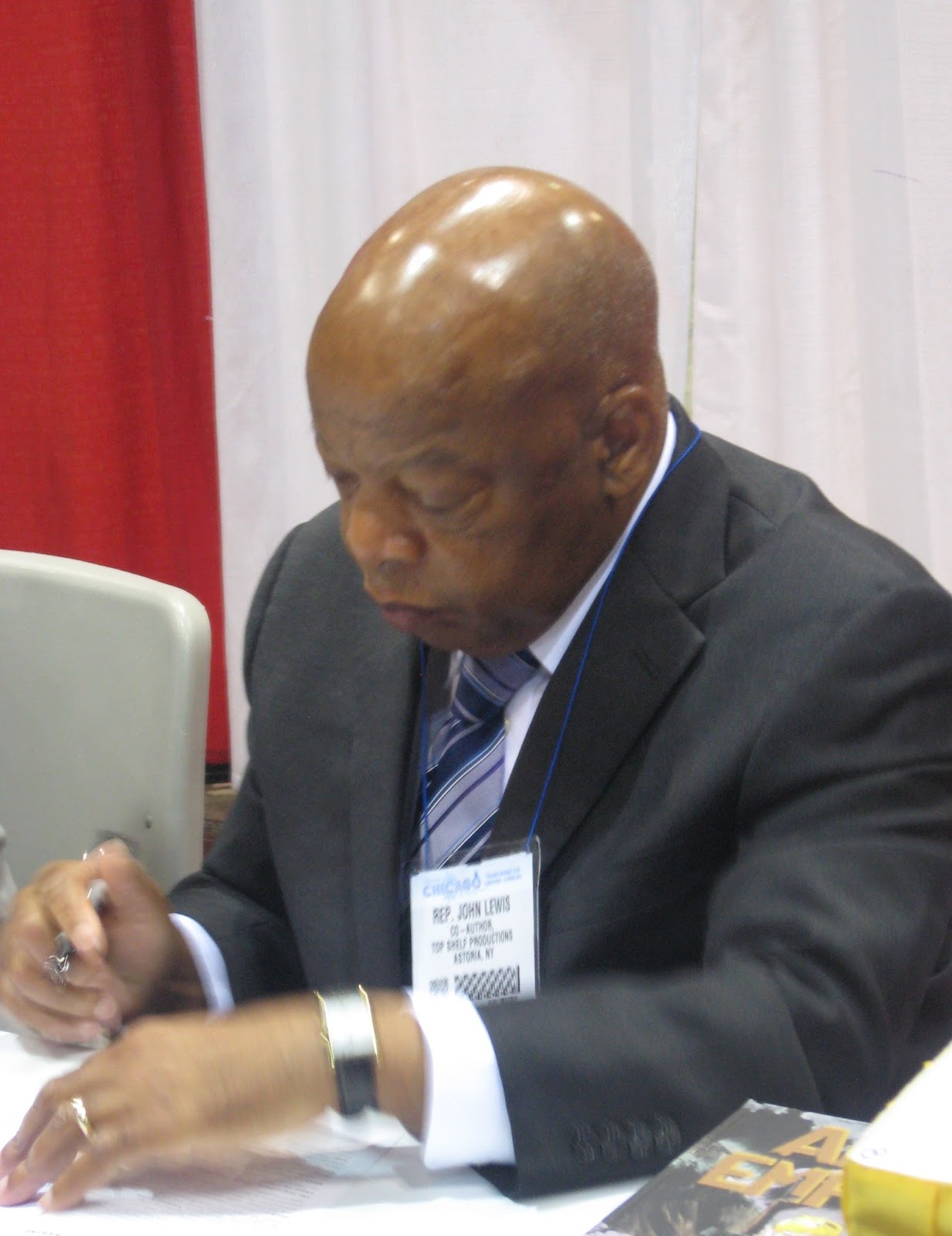
Rep. John Lewis signing March
at the American Library Association
summer conference in Chicago.
In June, at the American Library Association national conference in Chicago, I was fortunate enough to meet Lewis (I was third in line) and receive a signed "advance look" copy of March. (At the Comic-Con pop culture convention in San Diego last month, I learned, lines for Lewis' appearance were so overwhelming that fire marshals almost shut the event down.)

After signing my copy of March, Lewis extended his hand to shake mine. I thanked him for his lifelong dedication to civil rights and public service. I'm sure he hears this kind of praise all the time from his constituents and admirers. Nevertheless, he seemed appreciative of my words and thoughts -- and my interest in his book. Lewis looked me straight in the eye, smiled enthusiastically, and wished me well.

On this summer Sunday afternoon, it was too good an opportunity to not make the effort to be there for John Lewis and, personally, say "thank you" for his struggle of a lifetime to build a beloved community.

Photograph of Rep. John Lewis by Michael Dickens (copyright 2013). 
Image of March courtesy of Top Shelf Productions.

Tuesday, December 4, 2012

With peace and joy fully alive in our hearts


Christmas tree at the Palace Hotel, San Francisco.
(2008)

The season of Advent is upon us, and it marks the beginning of the Western Christian liturgical year. Advent is arguably the most easily recognizable season of the year. The signs of the Advent season are familiar: Christmas trees and decorations, both in homes and in public places, are in abundance in cities and townships from coast to coast in the U.S. and throughout much of the world.

It's hard to believe that Christmas Day is but three weeks from today as I write this post.

Advent commences on the fourth Sunday before Christmas. This year it began on December 2, and it's a season which is observed in many Western Christian churches across the world in preparation for the celebration of the Nativity of Jesus at Christmas. The term advent is an anglicized version of the Latin word adventus, which means "arrival" or "coming" -- anticipating the coming of Jesus.

This is a time of spiritual reflection and anticipation. As Advent begins, so, too, does the holiday season of music, found in both sacred hymns and carols and in secular songs.

An early feature of the celebration of the Christmas season, the rise in the importance and popularity of the carols can be attributed to the influence of Francis of Assisi. It should be noted that chants, litanies and hymns were written and sung in Latin and were used during the church liturgy, rather than popular songs. And, yet, today, whether sung in English, French, Latin or Italian -- or any other language for that matter -- these hymns ring out as beautiful sounds to our collective ears.

On the occasion of the arrival of this holiday season, my wife and I recently enjoyed a lovely evening with the San Francisco Symphony Orchestra as they welcomed Pink Martini in concert at Davies Symphony Hall in San Francisco. The "little orchestra" from Portland, Oregon, draws its inspiration from music from all over the world -- it crosses genres of classical, jazz and classic pop -- and its repertoire includes songs sung in English, Spanish, Italian, French, German, Japanese, Chinese, Turkish, Hebrew and Arabic.

During the band's two-hour, 20-song concert, Pink Martini performed the familiar "The Little Drummer Boy", "We Three Kings" and "Auld Lang Syne" in the spirit of the holiday season as well as a couple of their own original holiday songs, "Congratulations – A Happy New Year Song" and "A Snowglobe Christmas". 

However, one holiday song which made an emotional impact with me was "La Vergine Degli Angeli", written by the Italian Romantic composer Giuseppe Verdi. The song title, which translates to "The Virgin of the Angels", was written for the opera La forza del destino (The Force of Destiny), which had its debut in 1862. On this evening, "La Vergine Degli Angeli" was beautifully interpreted by Pink Martini vocalist China Forbes.

"La Vergine Degli Angeli" appears on Pink Martini's holiday music album 'Joy to the World' and I encourage each of you to listen for both its beautiful lyrics and passionate vocal quality.


La vergine degli angeli

La vergine degli angeli
Mi copra del suo manto
E me protegga vigile
Di dio l'angelo santo
La vergine degli angeli
E me protegga me protegga
L'angiol di dio
E me protegga
L'angiol di dio
Me protegga
E me protegga

The Virgin of the Angels

The Virgin of the Angels
Covers me with her mantle,
And protects me vigilantly
Sacred angel of God.
The Virgin of the Angels
And/She protects me, protects me,
The angel of god
And/She protects me
The angel of god protects me.
And protects me.

There are lessons we can learn during Advent. 

"During this season," says San Francisco's Grace Cathedral on its website, "we wait and hope for the arrival of a state of perfect peace and harmony. We still live in a world where violence and injustice exist and so, throughout Advent, we slow down, and endeavor to live in a way as though these problems have all been washed away. Advent is also an active sort of waiting, in that we strive to do justice and to love our neighbors with renewed vigor.  We try to seek out places where violence and iniquity exist, and step into them with peace and joy fully alive in our hearts." 

May this be a season of peace and joy for all of us -- and, may we all take part in promoting the spirit of sharing peace and joy.

To hear the entire Pink Martini 'Joy to the World' holiday music CD: http://youtu.be/RcIUz9jop5E

1. White Christmas
2. White Christmas (part II) featuring Saori Yuki
3. Shchedryk (Ukrainian Bell Carol)
4. Santa Baby
5. Elohai, N’tzor
6. Little Drummer Boy
7. Congratulations – A Happy New Year Song
8. Do You Hear What I Hear?
9. La Vergine Degli Angeli
10. We Three Kings
11. A Snowglobe Christmas
12. Ocho Kandelikas (Eight Little Candles)
13. Silent Night
14. Auld Lang Syne 

Christmas tree at the Palace Hotel, San Francisco, by Michael Dickens.
Copyright 2008. All rights reserved.