Showing posts with label pop. Show all posts

Tuesday, November 13, 2018

Thoughts on Elvis Costello: Look Now and Then

Elvis Costello / The master storyteller at the
DAR Constitution Hall, in Washington, D.C.

Elvis Costello knows how to charm the pants off an audience. He’s done it successfully for more than 40 years as one of his generation’s greatest songwriters and performers. He’s worked diligently at his craft to attain a special place in the music world. Whether with a simple wink, a friendly smile, or just the right choice of words and upbeat tone of voice, the bespectacled and iconic English musician, who was once described by a critic as a “pop encyclopedia,” has become a master of the craft of storytelling.

Now, healthy again after recovering from surgery for a small but very aggressive cancerous malignancy, Costello once again is delighting crowds with his good-natured manner and geniality of performing. He’s taking great care not only of himself, but also the stories he’s sharing with his audiences, through their lyrics and unusual combination of musical instruments.

On November 4, at the DAR Constitution Hall in Washington, D.C., in just the third night of his current 20 city “Look Now and Then ...” tour – and in what was my 12th Elvis Costello adventure – I saw a show like no other he’s given, and I’ve seen Elvis perform solo; with his various backing bands, including the Attractions, the Imposters, and the Sugarcanes; in a duet show with his longtime keyboardist Steve Nieve; accompanied by the late extraordinary New Orleans pianist Allen Toussaint backed with a brass horn section – even dressed to the nines in a black tuxedo performing with the San Francisco Symphony.

Musically, throughout the evening’s two-and-one-half-hour performance, accompanied by the always sharp and in-form Imposters (Nieve on a variety of keyboards, drummer Pete Thomas, and bassist Davey Faragher) and joined by vocalists Kitten Kuroi and Briana Lee, who added soulful backing harmonies to new songs such as “Unwanted Number” and the classic “Alison,” the 64-year-old Costello moved freely between introducing 10 new “uptown pop” songs from his recently-released album ‘Look Now’ such as “Burnt Sugar Is So Bitter,” which he co-wrote with Carole King; “Don’t Look Now” and “Under Lime.” There’s a little bit of swagger in Costello these days and as one critic recently remarked, the new material is “full of rich characters loaded with desire and heartache.” Costello also dug into his vast catalog of spinning-wheel classics to share “This Year’s Girl,” which has been remade into the theme song for the HBO series “The Deuce;” “Clubland,” “Green Shirt,” “Watching the Detectives,” (performed as a spacey solo under a green spotlight for full visual affect); “Pump It Up,” and “(What’s So Funny ‘Bout) Peace, Love and Understanding.”

Truly a music fan, Costello delights in championing the works of other musicians, from country star George Jones to rock guitarist and producer T Bone Burnett to influential Philadelphia hip-hop band The Roots – even former Beatles icon Paul McCartney – to name just a few whom he’s collaborated with over the years. Whether immersing himself in pop, rock and roll, country, Americana, soul or jazz, among the many genres that he’s mastered over many years, in concert Costello shares many of the lessons he learned and we’re rewarded with songs that are as literate as they are artful.

On ‘Look Now,’ Costello has revisited his partnership with Burt Bacharach, himself a master songwriter, on three impressionistic tunes, “Don’t Look Now,” “Photographs Can Lie,” and “He’s Given Me Things.” Bacharach’s piano lines, as interpreted and performed live by Nieve, are both poignant and beautiful – and reminded me of some of Bacharach’s brilliant late ‘60 pop collaborations with lyricist Hal David.

Throughout the show’s 27 songs, Costello showed he can be acerbic and witty, as well as lamenting and sad. There’s a fine balance between rock and balladry in a Costello performance. As his Washington, D.C. concert reminded us, his shows have become more than an exercise in nostalgia and pastiche. I have no doubt that this tour will be a triumph for Costello, providing him with an opportunity for enlivening his mastery of the songwriting form – and with a keen dramatist’s eye, too.

Because of Costello’s desire to showcase his new songs, his show is now very much of the present. Collectively, his body of work is that of adept storyteller who’s learned more than a few things from the past. On this night, Costello took his mostly baby-boomer audience on a musical journey through his expansive songbook that was not only intimate and entertaining, but also humbling and inspiring.

Elvis Costello’s DAR Constitution Hall, Washington, D.C., set list:

Main set: This Year’s Girl / Honey, Are You Straight or Are You Blind? / Clubland / Don’t Look Now / Burnt Sugar Is So Bitter / Green Shirt / Photographs Can Lie / Temptation / Brilliant Mistake / Why Won’t Heaven Help Me? / Under Lime / Watching the Dectectives / Deep Dark Truthful Mirror / He’s Given Me Things / Unwanted Number / High Fidelity / Alison / Everyday I Write the Book.

First encore: Stripping Paper / Suspect My Tears / (I Don’t Want to Go to) Chelsea / Mr. and Mrs. Hush / Pump It Up.

Second encore: A Face in the Crowd / Blood & Hot Sauce / American Gangster Time / (What’s So Funny ‘Bout) Peace, Love and Understanding.
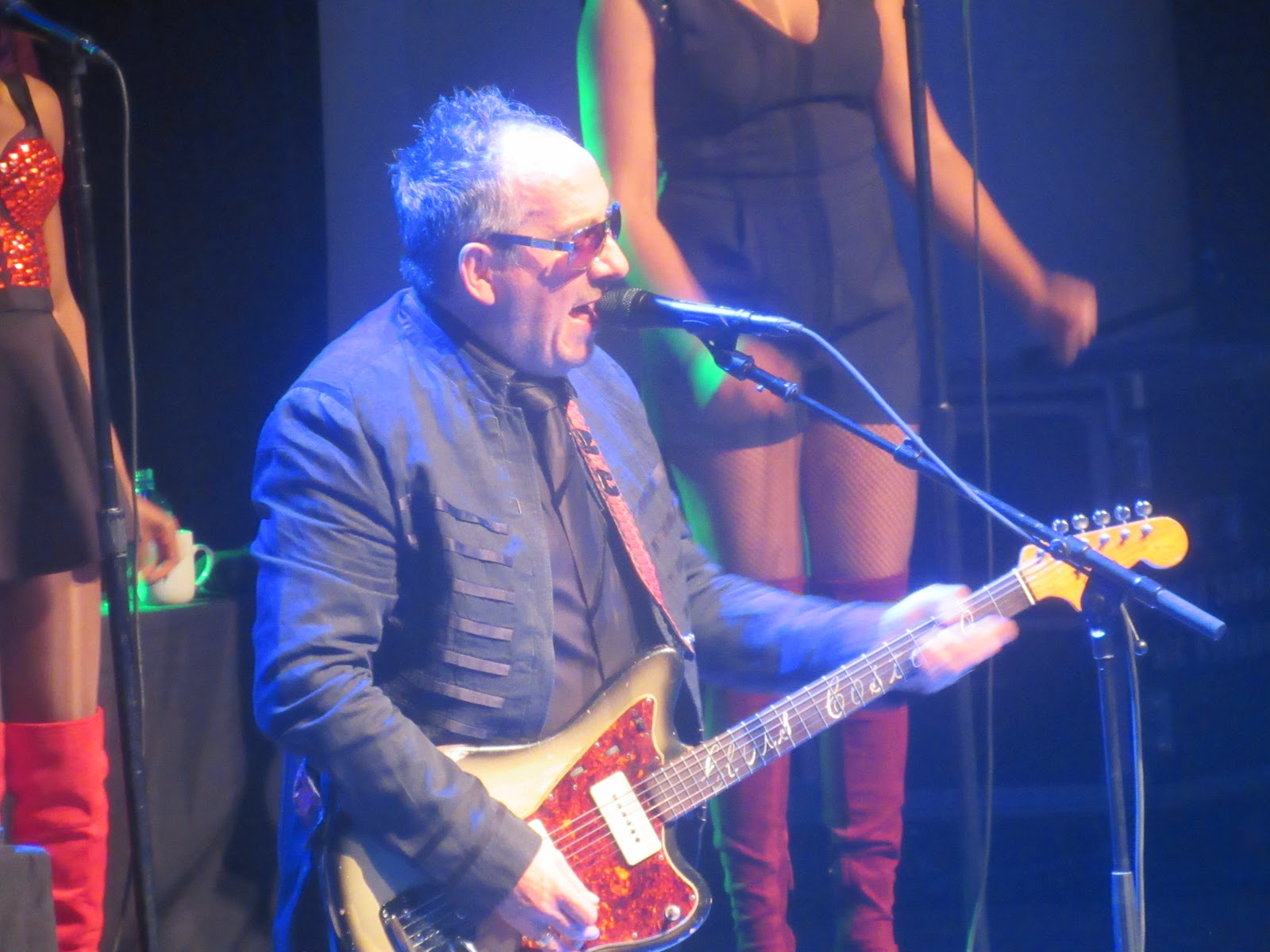


All photos: © Michael Dickens, 2018.

Tuesday, October 23, 2018

Ambition with talent: Costello is back with “Look Now”


In a recent Q & A with the London-based Financial Times, Elvis Costello was asked: Which matters more to success, ambition or talent? The 64-year-old English troubadour answered matter-of-factly, “Once upon a time, I would have said ambition without talent was worthless. Now I’m not so sure.”

Earlier this month, the ambitious – and extraordinarily talented – Costello released his first new album with his band The Imposters in 10 years, the cohesive Look Now, on Concord Records. One critic mused that “it’s not just craft but touch, not just energy but sensitivity. On Look Now, Costello and The Imposters have both.”

After Costello revealed earlier this year he had survived a bout with a “small but very aggressive” cancer, word of a new album was very welcome news. Produced by Costello and Sebastian Krys, the songs comprising Look Now represent some of Costello’s best career work. His sophisticated and transforming songbook runneth over with simplicity and immediacy. 

Elvis Costello
Whether immersing himself in pop, rock and roll, country, Americana, soul or jazz, among the many genres that he’s mastered over many years, Costello shares many lessons learned and we’re rewarded with songs that are as literate as they are artful. The gifted storyteller has returned in fine form.

Costello, who paired with Burt Bacharach on 1998’s Painted From Memory, has reunited with the master songwriter on three impressionistic tunes, “Don’t Look Now,” “Photographs Can Lie,” and “He’s Given Me Things.” Bacharach’s piano lines are both poignant and beautiful – and reminded me of some of his brilliant late ‘60s pop collaborations with lyricist Hal David. Costello also penned “Burnt Sugar Is So Bitter” with another songwriting giant, Carole King, that is soulful with its female choir. Throughout the album, Costello can still be acerbic and witty, lamenting and sad in his lyrics. There's a fine balance between rock and balladry in Look Now.

As one critic noted, "Look Now is much more than an exercise in nostalgia and pastiche. As the title implies, it’s very much of the present, and the work of a master storyteller who’s learned more than a few things from the past.”

In a recent Pitchfork review, its critic concluded, “As a collection of tunes, Look Now is a triumph for Costello, a showcase for how he can enliven a mastery of form with a dramatist’s eye. But as an album, Look Now is a success because of the Imposters. ... They are a sharp, supple outfit that can swing and sigh, sometimes within the same number, as when they effortlessly pivot between boss’s nova verses and a radiant chorus during 'Why Won’t Heaven Help Me?' This subtle sophistication and palpable flair make Look Now more than a mere set of songs – it’s a record worth getting lost within.”

Wednesday, April 4, 2012

Graceland at 25: Acclaimed and still influential

Graceland at 25/ Still rightly acclaimed and controversial, too

I read with interest recently the news of the 25th anniversary of Graceland, Paul Simon's groundbreaking album, that will be commemorated with musical and film celebrations this year.

On June 5, Graceland 25th anniversary editions will be released to commemorate the anniversary of the acclaimed and influential 1986 album that continues to inspire generations of music fans. Simon will headline the Hard Rock Calling festival in London July 13-15. A film, Under African Skies, which documents the story of the album and its attendant controversies, screens Wednesday in Toronto.

Peter Aspden, a culture columnist for the Financial Times of London, wrote two weeks ago about how Graceland was rightly acclaimed on its release in 1986. Yet, it was also dogged by political controversy, too.

Paul Simon
You see, in collaborating with a talented group of South African musicians that included the a cappella singing group Ladysmith Black Mambazo, Simon was accused of having broken the cultural boycott against the nation's apartheid regime. As Aspden commented, "it was a mess of an argument and it continues to be so today."

Much of Graceland was recorded in South Africa and it featured many South African groups and musicians. And, while Simon faced accusations that he had broken the cultural boycott that was imposed by the rest of the world against the apartheid regime in South Africa, which at the time was in its final years, it was a view that was not supported by the United Nations Anti-Apartheid Committee. This was because the album featured the talents of black South African musicians while offering no support to the white South African government led by State President P.W. Botha.

As Aspden opined: "No one was in any doubt as to Simon's intentions, which were entirely benign. The album brought a relatively obscure musical tradition to the ears of the world (it sold 14 million copies). The South African musicians on the album went into the project with eyes wide open. 'We used Paul as much as Paul used us,' said the guitarist Ray Phiri, one of Simon's collaborators. This was not an obvious case of cultural exploitation."

According to Aspden, Simon had his detractors. They included Jerry Dammers, who wrote the political anthem "Free Nelson Mandela." While Dammers believed it was wrong for Simon to go South Africa in the 1980s, he said it's in the past. "It's the time not to forgive and forget but to remember and forgive." And, added singer/songwriter Billy Bragg: "He was on the wrong side of the argument despite his good intentions. The cultural boycott was part of the economic boycott that brought South Africa to heel."

In traveling to South Africa when it was not politically correct to do so, Aspden said Simon "found an artistic community that was tired of being ostracized and hungry for the outside world." He created an album devoid of anger. "Not because he didn't find any there but because he believed, in that time and place, in art's power to transcend politics."

Graceland became not only Simon's most commercially successful album ~ it reached No. 3 in the national Billboard charts ~ it also drew praise and accolades for its mixture of African polyrhythms, pop, rock, Zydeco and Tex-Mex as well as the South African Zulu isicathamiya and mbaqanga singing styles. Rolling Stone called it "lovely, daring and accomplished." And, Simon said he considered the title track the best song he's ever written.

"Actually, the achievement of Graceland and what it overcame was not a political thing," Simon told the Toronto Globe and Mail. "It was an artistic bridge that was new at the time. And that was really the achievement. But the other is a juicier story."

To read Peter Aspden's March 23 column:  http://www.ft.com/intl/cms/s/2/bc70acc2-7362-11e1-9014-00144feab49a.html#axzz1qlP2VYu1