Tuesday, September 17, 2013

Rafael Nadal: Returning to form and structure


Rafael Nadal / Thirteen is an amazing number.

When Rafael Nadal won the 2013 U.S. Open singles championship last week with a convincing 6-2, 3-6, 6-4, 6-1 victory over his new arch rival, No. 1 Novak Djokovic, it marked the completion of a remarkable comeback that even the 27-year-old Spaniard would deem astonishing.

Nadal won in 3 hours and 20 minutes on a hard court surface that, while it remains his least favorite, he has been a perfect 22-0 on this summer.

What an enjoyable run it has been for Nadal. He has won two Grand Slams, eight other ATP titles and amassed a 61-3 record in 2013. Then, last weekend, he kept his commitment to represent Spain in the Davis Cup playoffs and contributed wins in both singles and doubles that clinched a berth for his country in the 2014 World Group.

Consider this: A year ago, Nadal watched the U.S. Open from his home on the Spanish island of Majorca, his knees battered and his ego bruised. His 2012 ended unceremoniously with an early, second-round exit from Wimbledon, and he didn't play again until February of this year. Following Nadal via social media, his fans worldwide feared the worst for their beloved hero and many turned away from tennis altogether.

After skipping the Australian Open, Nadal resurfaced after a seven-month sabbatical to play in a clay-court event in Chile. Although he didn't win in his first tournament back on tour, he began to reinvent himself.

The hands of a champion. 
Soon, Nadal began to win nearly every tournament in sight: Sao Paulo, Acapulco, Indian Wells, Barcelona, Madrid, Rome, Roland Garros, Montreal and Cincinnati leading up to the U.S. Open. His only setback on clay was losing to Djokovic in the final at Monte Carlo. It remains a mystery as to why he lost in the first round on grass at Wimbledon after a successful clay-court season. However, throughout much of the year, Nadal has looked more fit -- both mentally and physically -- and the mood, both in his camp and among his fans, improved tremendously with each title he won.

At the U.S. Open, the relentless Nadal, who by then had discarded his familiar knee wrap, was a favorite among fans and became a huge drawing card at Arthur Ashe Stadium. When he beat Djokovic in the final, he joyfully sobbed while rolling around on the surface of the world's largest tennis arena. Then, he basked in the glow of the lights shining down upon him as he hoisted the winner's trophy for a world-wide audience to enjoy. Before he flew home to Spain, Nadal made the rounds of the New York media, including an appearance on PBS's Charlie Rose, clutching the trophy.

"For a few things, this is probably the most emotional one in my career," said Nadal, after winning his second U.S. Open crown. He has faced Djokovic in three of the last four Open finals. "I felt that I did everything right to have my chance here. You play one match against one of the best players in the history in Novak and No. 1 in the world on probably his favorite surface. I knew I had to be almost perfect to win. It means a lot for me to have this trophy with me today."

Although Djokovic enjoys an 11-7 edge on hard courts, he's managed to win only three of his 11 encounters in Grand Slams against Nadal, who now leads what many consider the most prolific series in Open era history 22-15.

After losing to No. 2 Nadal on a cool evening in Arthur Ashe Stadium, Djokovic praised his opponent, saying: "He was too good. He definitely deserved to win this match and this trophy."

At work chasing after No. 1.
Nadal now owns 13 major titles, which places him third all-time behind Roger Federer (17) and Pete Sampras (14). Nadal has won eight French Opens, two Wimbledons, two U.S. Opens and one Australian Open. He has won at least one Grand Slam title in each of the past nine years, and he holds a winning record against his biggest rivals -- Djokovic, Federer and Andy Murray. So, his chances of catching -- and, maybe, surpassing -- Sampras next year are very good. And, if his knees remain healthy, why shouldn't he be in the conversation about catching and surpassing Federer?

"Thirteen is an amazing number," said Nadal, whose self-belief and competitive nature on the court are among his biggest attributes and contributes to his immense popularity among tennis fans. Adds Djokovic: "He's definitely one of the best tennis players to ever play the game."

Although Djokovic retained his No. 1 ranking despite losing the U.S. Open final, Nadal has a good chance of regaining the No. 1 ranking before the end of the year on the basis of accrued points over the past calendar year. Indeed, there's still a lofty goal for Nadal to achieve before the end of the year -- returning to a form and structure that lifted him to become the No. 1-ranked player twice, in 2009 and again in 2011, totaling 102 weeks at the top of the tennis world.

"Let me enjoy today," Rafa told reporters after winning the U.S. Open when asked about "greatest-ever" comparisons. "For me, is much more than what I ever thought. Means a lot this one for me. I will say the same like I do every time. I'm going to keep working hard, doing my things to have more chances in the future."

Photographs of Rafael Nadal courtesy of AFP/Getty Images.

Wednesday, September 11, 2013

On art: Richard Diebenkorn, The Berkeley Years, 1953-1966


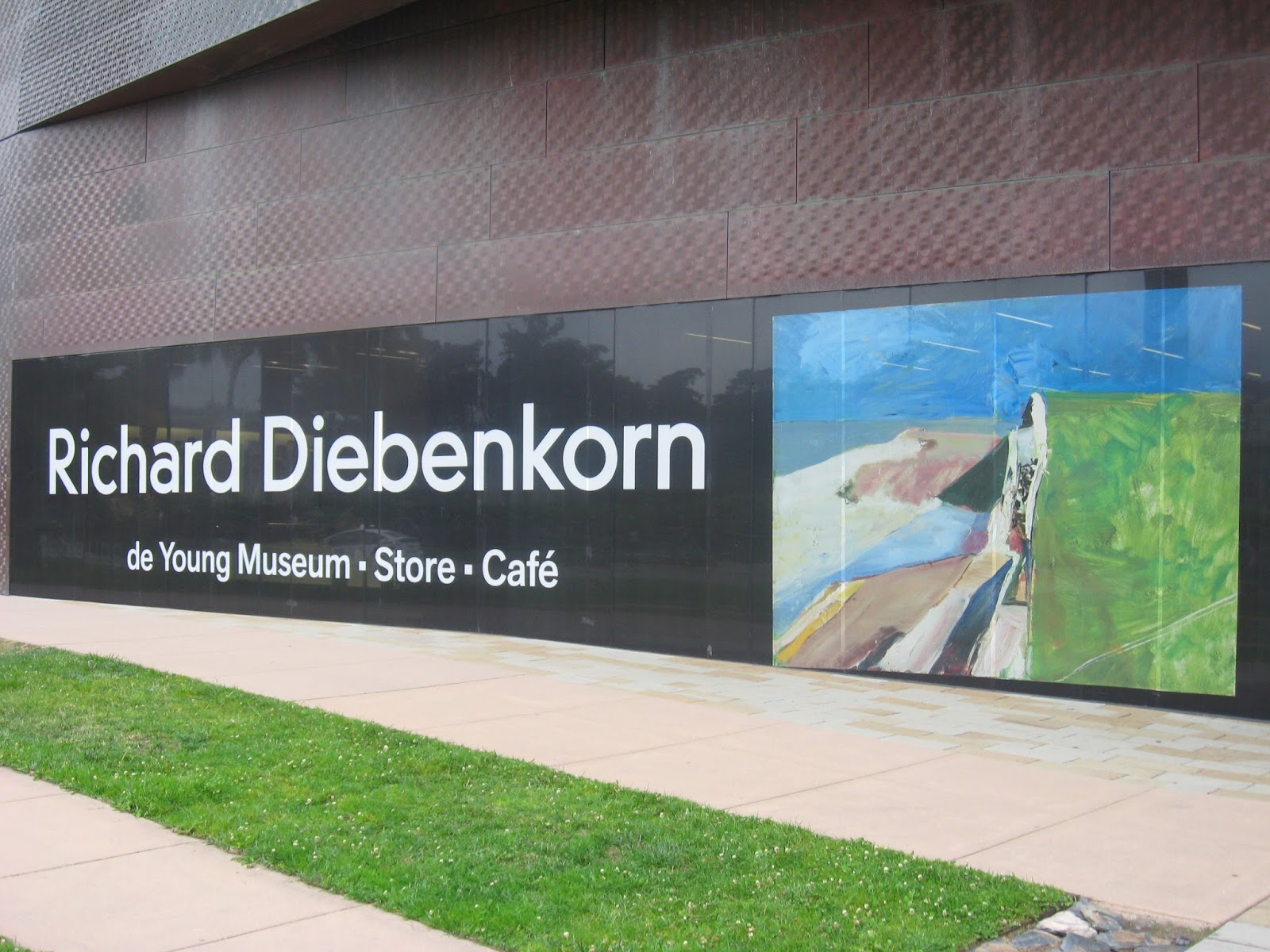
Richard Diebenkorn was profoundly influenced by the nature and culture of the San Francisco Bay Area. Color, light and atmosphere played a significant role in many of the 20th century American artist's works that are on view in Richard Diebenkorn: The Berkeley Years, 1953-1966, at the de Young Fine Arts Museum in San Francisco's Golden Gate Park through September 29.

The exhibition, which had its debut in June, is the first of its kind to focus on this pivotal period in the career of this postwar American artist.

During his lifetime, Diebenkorn (1922-1993) achieved acclaim as one of the most significant and influential artists of California and of postwar America. His early work is associated with Abstract expressionism and the Bay Area Figurative Movement of the 1950s and 1960s.

At the beginning of this exhibition of more than 130 paintings and drawings that were assembled from museums and private collections across the country, we get to go outside the lines to get a feel for what's going on in Diebenkorn's mind as he shares his thoughts in Notes to myself on beginning a painting:

  • Attempt what is not certain. Certainty may or may not come later. It may then be a valuable delusion.
  • The pretty, initial position, which falls short of completeness, is not to be valued -- except as a stimulus for further moves.
  • Do search. But in order to find other than what is searched for.
  • Use and respond to the initial fresh qualities, but consider them absolutely expendable.
  • Don't "discover" a subject -- of any kind.
  • Somehow don't be bored -- but if you must, use it in action. Use its destructive potential.
  • Mistakes can't be erased, but they move you from your present position.
  • Keep thinking about Pollyanna.
  • Tolerate chaos.
  • Be careful only in a perverse way.

Richard Diebenkorn /
Seated Figure with Hat, 1967,
oil on canvas.
Much of the art in Richard Diebenkorn: The Berkeley Years, 1953-1966 is devoted to a three-year period in which Diebenkorn "painted prolifically, his paintings, watercolors, and drawings synthesizing elements of nature with an abstract approach in what came to be known as his Berkeley series," according to the de Young's Fine Arts magazine, in previewing the show. Later in the exhibition, we see Diebenkorn's subsequent figurative phase, and it is easy to see and understand why he had a profound influence on American modernism.

As I walked through the exhibit rooms on a recent Friday evening, studying and absorbing Diebenkorn's artwork, my attention was drawn to several of the artist's quotes that were prominently displayed on the gallery walls. I took the time to read each of them carefully:

  • "Abstract means literally to draw from or separate. In this sense, every artist is abstract ... a realistic or non-objective approach makes no difference. The result is what counts."
  • "All paintings start out of a mood, out of a relationship with things or people, out of a complete visual impression."
  • "I began to feel that what I was really up to in painting, what I enjoyed almost exclusively, was altering -- changing what was before me -- by way of subtracting or juxtaposition or superimposition of different ideas."
  • "It was impossible to imagine doing a picture without it being a landscape; to try to make a painting space, a pure painting space, but always ending up with a figure against a ground."

After its San Francisco premiere, Richard Diebenkorn: The Berkeley Years, 1953-1966, will move to southern California and be on view at the Palm Springs Art Museum from October 26, 2013, to February 16, 2014.

To learn more about the Richard Diebenkorn exhibition at the de Young: http://diebenkorn.famsf.org/

Photograph of de Young Fine Arts Museum by Michael Dickens, 2013.
Photograph of Richard Diebenkorn's Seated Figure with Hat, 1967, courtesy of Wikipedia Commons.

Friday, September 6, 2013

Dateline Seattle: All the world's a fair in the Great Northleft


Left ...

Right ...

... and Center

Art in the Great Northleft. That's the description for this year's Bumbershoot, Seattle's annual showcase music and art festival, that wrapped up on Labor Day, just as it has every year since 1971. Bumbershoot is held on the grounds of the 74-acre Seattle Center, home of the iconic Seattle Space Needle.

Sunday at the Starbucks Stage /
Enjoying the Duke Robillard Band.
At this year's Bumbershoot, over the course of two days, my wife and I and friends enjoyed music by Death Cab For Cutie, Ra Ra Riot, Mates of State and the Duke Robillard Band and stand-up comedy by 30 Rock co-star Judah Friedlander, with whom we later enjoyed a serendipitous, five-minute conversation while walking about the Seattle Center grounds on Monday afternoon.

Also, we gathered for "Nerdprov", which crossed the streams of geek culture with comedic improvisation, as performed by the Seattle Experimental Theater; and we viewed a trio of Seattle International Film Festival Jury Award-winning one-reelers from Australia, Canada and Spain.

Bumbershoot at twilight.
I've visited Seattle nearly every year at this time for the last 20 years, and I never tire of going to Bumbershoot, drinking Seattle's best coffee, or taking photographs of the Space Needle, which was built for the 1962 Seattle World's Fair. As it happened, this year I could have left my umbrella at home for it stayed dry throughout the four days we visited the Emerald City.

Seattle's given us Starbucks in the seventies, grunge rock in the eighties and Amazon.com in the nineties. It's home to the Elliott Bay Book Company, one of the country's outstanding independent booksellers. There's a certain geeky, caffeinated quality to this northwest city that I enjoy, and it's only a two-hour flight up the Pacific coast from San Francisco.

"To some extent, Seattle remains a frontier metropolis, a place where people can experiment with their lives, and change and grow and make things happen," wrote Tom Robbins, the American author whose best-selling novels are "seriocomedies" that are often wildly poetic and told with strong social and philosophical undercurrents.

Indeed, all the world's a fair in the Great Northleft.

All photographs by Michael Dickens, copyright 2013.

Tuesday, August 27, 2013

Thoughts: Of Shakespeare, summer and sonnets


One of my favorite urban escapes is Shakespeare Garden, tucked away near the California Academy of Science and the de Young Fine Arts Museum in San Francisco's Golden Gate Park. It's quiet, serene, and meditative. It's filled with shady trees and an abundance of pretty flowers. There's even a sun dial.

The garden is absolutely beautiful. I love, love, love it.

At the entrance to Shakespeare Garden
in San Francisco's Golden Gate Park.

As the number of remaining summer weekends can be counted on one hand, it only seems fitting to take time out from our hurried lives and think fondly of Shakespeare, sonnets and summer days.

Shakespeare Garden sun dial /
Count only sunny hours.

Shall I compare thee to a summer's day?
Thou art more lovely and more temperate;
Rough winds do shake the darling buds of May,
And summer's lease hath all too short a date;

Sometime too hot the eye of heaven shines,
And too often is his gold complexion dimm'd;
And every fair from fair sometimes declines,
By chance or nature's changing course untrimm'd;

By thy eternal summer shall not fade,
Nor lose possession of that fair thou ow'st;
Nor shall Death brag thou wander'st in his shade,
When in eternal lines to time thou grow'st:

So long as men can breathe or eyes can see,
So long lives this and this gives life to thee.

~ William Shakespeare, Sonnet 18


Of Shakespeare, summer and sonnets.

The history of Shakespeare Garden in Golden Gate Park dates back to 1928 and was the brainchild of Alice Eastwood, who served as the long-running director of botany for the Academy of Sciences. The California Spring Blossom and Wildflower Association originally established the space as the Garden of Shakespeare's Flowers.

Flowers and plants have always played an important tool of imagery throughout Shakespeare's literary masterpieces. In this Shakespeare Garden, there are over 200 flowers and plants dotting the beautiful and colorful landscape, including: poppies, mandrakes, daisies, violets, lilies and roses.

The quiet and the beauty inside Shakespeare Garden /
Standing near the back wall looking towards the entrance.

All photographs of Shakespeare Garden by Michael Dickens, copyright 2013.

Tuesday, August 20, 2013

Curt Flood: An every day reminder of one of America's past baseball heroes


Beyond boundaries / Outside Curt Flood Field in Oakland, Calif.

As the Major League baseball pennant races heat up across the country, here in the Bay Area, the San Francisco Giants have gone from first to worst while the Oakland A's of Moneyball fame continue to fight for survival, remaining at or near the top of their division, while playing in what one local sports columnist labeled the Oakland Coliseum as "the greatest terrible place on Earth."

While San Francisco has played center stage to many of baseball's greatest stars -- Willie Mays, and Willie McCovey of the Giants come to mind -- as well as one of the game's biggest anti-heroes, Barry Bonds, across the Bay in Oakland, most of its greatest home-grown talent like Frank Robinson, Vada Pinson and Willie Stargell have earned their accolades elsewhere.

Then, there's Curt Flood, a Major League baseball player, who spent much of his career as a center fielder for the St. Louis Cardinals.

Curt Flood / Won seven consecutive Gold Gloves
for the St. Louis Cardinals between 1963-69.
Born in Texas but raised in Oakland, Flood played in the same outfield as Robinson and Pinson at West Oakland's McClymonds High School. Each became a major leaguer with the Cincinnati Reds in the mid-1950s. After two seasons, Flood was traded by the Reds to the Cardinals in December 1957. For the next twelve seasons, Flood became a defensive fixture for the Cardinals, winning seven consecutive Gold Gloves, making three All-Star teams, and winning two World Series titles. In 1969, he collected the first hit in a major league regular season game in Canada. During his career, Flood hit .293, knocked out 1,861 hits and drove in 631 runs.

However, despite his outstanding career on the field, it was outside the lines that Flood developed his principal legacy to the Summer Game. Flood became a pivotal figure in the labor history of baseball when he refused to accept a trade to the Philadelphia Phillies following the 1969 season, and he ultimately appealed his case to the U.S. Supreme Court.

Flood believed that the decades-old reserve clause that Major League Baseball employed was unfair because it "kept players beholden for life to the team with which they originally signed, even when they had satisfied the terms and conditions of those contracts."

Flood's rebellion against the baseball establishment came at a period of time when the U.S. was coming apart at the seams. We were at war in Southeast Asia, marching for civil rights through the South, and dealing with the tragedy of the assassinations of Dr. Martin Luther King Jr. and Sen. Robert F. Kennedy. As a country, we were losing great Americans who were dying for the rights of others.

Curt Flood refused a trade to the
Phillies after the 1969 season.
In his 1971 autobiography, The Way It Is, written with Richard Carter, Flood cited the Phillies' poor record and dilapidated Connie Mack Stadium, and for what he believed were "belligerent -- and, racist -- fans" as reasons for refusing to report to his new team. He forfeited a $100,000 contract for the season and, instead, chose to pursue his legal options with the blessing of the the players' union head Marvin Miller and the union's funding.

In a December 24, 1969 letter addressed to Baseball Commissioner Bowie Kuhn, Flood demanded the commissioner declare him a free agent. He wrote:

After twelve years in the major leagues, I do not feel I am a piece of property to be bought and sold irrespective of my wishes. I believe that any system which produces that result violates my basic rights as a citizen and is inconsistent with the laws of the United States and of the several States.

"It is my desire to play baseball in 1970, and I am capable of playing. I have received a contract offer from the Philadelphia club, but I believe I have the right to consider offers from other clubs before making any decision. I, therefore, request that you make known to all Major League clubs my feelings in this matter, and advise them of my availability for the 1970 season.

No doubt, Flood was influenced by the civil rights events of the 1960s taking place throughout the United States. In Miller's 1991 book A Whole Different Ball Game: The Sport and Business of Baseball, the union head recalled that in a meeting with the executive board of the players' union, Flood said: "I think the change in black consciousness in recent years has made me more sensitive to injustice in every area of my life."

Flood v. Kuhn (U.S. 258) was argued before the Supreme Court on March 20, 1972. Former Supreme Court Justice Arthur Goldberg, Flood's attorney, argued that the reserve clause depressed wages and limited players to one team for life. Meanwhile, the counsel representing Major League Baseball countered that the commissioner had acted "for the good of the game."

On June 19, 1972, the Supreme Court ruled 5-3 with one recusal in favor of Major League Baseball, invoking the principle of stare decisis ("to stand by things decided"). It cited as precedent  a 1922 ruling in Federal Baseball Club v. National League (259 U.S. 200).

While Flood's legal challenge was ultimately unsuccessful, it united major league baseball players in solidarity as they fought against baseball's reserve clause and sought free agency.

Curt Flood / "Left a legacy of fairness."
Flood sat out the 1970 season and returned briefly in the next year and played in 13 games for the Washington Senators, who acquired him from the Phillies and signed him to a $110,000 contract. He hit only .200 and his defensive skills showed deterioration. He retired after the 1971 season. Four years later, baseball's reserve clause was nullified by an arbitrator and it paved the way for free agency.

On January 20, 1997, Flood died of pneumonia from complications due to throat cancer. Later that same year, Flood's legacy was acknowledged in Congress through the Baseball Fans and Communities Protection Act of 1997. It was numbered HR21 (Flood's Cardinals uniform number) and was introduced in the House of Representatives on the first day of the 105th Congress. The legislation established federal antitrust law protection for major league baseball players to the same extent as provided for other professional athletes. The Curt Flood Act of 1998, which was similar to the House's legislation, was introduced in the Senate and enacted into law the following year.

Flood, who San Francisco Chronicle baseball writer Henry Schulman once wrote "left a legacy of fairness," has been described by many as "pioneer, hero, legend, and freedom fighter -- a sort of all-star in the world at large."

In the book Reconstructing Fame: Sport, Race, and Evolving Reputations, David J. Leonard writes about Flood: "The man who was daily denounced and virtually banished from America has since been compared to Dred Scott, Jackie Robinson and Rosa Parks as a great American." In the same book, Leonard quotes journalist George F. Will, who said of Flood's contribution to baseball: "Few have ever matched the grace and craftsmanship Curt Flood brought to it as a player. However, none have matched what he did for the game as a citizen. ... He once said, 'I am pleased that God made my skin black, but I wish He had made it thicker.' Friends of baseball, and of freedom, are pleased that he didn't."

A welcome sign to Curt Flood Field
in Oakland, Calif.
In paying tribute to Flood, the city of Oakland renamed a baseball and athletic field in his honor several years ago, Curt Flood Field, that is a little more than a mile from my home. I've driven by it numerous times. Most of the time, I've noticed, the baseball field lies empty and it looks a bit tired and worn. A local high school baseball team and other youth sports groups use the facility that is located at the well-travelled intersection of Coolidge Avenue and School Street in a mixed-race urban neighborhood.

Sometimes, I wonder, if you were to ask most of the kids who play on the field about who Curt Flood was or what he did for them and the Summer Game, would you get more than just a blank stare?

Photos of Curt Flood Field by Michael Dickens, copyright 2013.
Photos of Curt Flood courtesy of Wikipedia Commons.

Tuesday, August 13, 2013

A simple question with a complicated answer: Where do you want to live?


Copenhagen Concert Hall at night. /
The No. 1 best global city according to Monocle.

Our cities are designed for living, working, cultural entertainment and late nights. Even fresh starts. Some cities have it figured out, some don't.

From transportation to green space, retail possibilities and residential settlements, it's always interesting to find out what makes a good city a great place to live.

The July/August issue of Monocle
rates the 25 best global cities.
Each summer for the past seven years, Monocle, the London-based global magazine that's a must-read for its coverage of international affairs, business, culture and design, has presented a special quality of life rankings with a top of the world list of the 25 best global cities.

"Too many major cities, including some of our top 25, all but shut down on a Sunday -- we believe a city should be a seven-day operation," writes Monocle's Steve Bloomfield and Michael Booth, in the introduction to this year's top of the world list, which appears in the magazine's July/August 2013 issue (issue 65, volume 07). "We asked our team or correspondents and researchers to judge how easy it is to arrange a spontaneous dinner with friends on a Sunday night. Are the restaurants open? Can you buy groceries and wine?"

Other common factors which Monocle studied include: crime rates, weather, education, health care, transportation and "an airport with a host of international destinations." Of course, it helps if a city has good plazas and outdoor cafés as well as art galleries that stay open late and museums that are free, too.

It did not surprise me that few U.S. or North American cities made Monocle's Top 25 -- Honolulu at No. 17 was highest ranked while my beloved San Francisco ranked 24th. Nor, should it be surprising that six of the top 10 were European cities, including this year's No. 1 Copenhagen.

No. 14 Paris /
The Pyramid at the Louvre is always a buzz of activity.
Why did Copenhagen rank No. 1 and not Paris (ranked No. 14) or London (which did not even rank in the top 25)? Here's why: "World-conquering urban quality of life requires the trickiest of balancing acts -- between progress and preservation, stimulation and security, global and local. Perfection is unobtainable, of course, but Copenhagen is striking one of the best deals right now.

"The Danish capital has hit the top spot this year not just because of its daring art scene, its matrix of cycle super-highways and its pioneering approach to street culture but also its ability to define itself as a global city. Copenhagen's wonderful self-reinvention continues to impress."

As for what the magazine said about San Francisco, in a nutshell it wrote: "Northern California's spectacular city scores high on tolerance and urban verve but tech-dollars continue to drive up the cost of living." I'd have to agree. As much as I would enjoy living in the Inner Sunset, within walking distance of Golden Gate Park, the cost of buying or renting is somewhat prohibitive. Thus, living across the bay in Oakland, I believe, is a better value.

No. 19 Vancouver, B.C. /
This western Canadian city hosted the 2010 Winter Olympic Games.

Here's Monocle's world list of the 25 best global cities for 2013:

1. Copenhagen
2. Melbourne
3. Helsinki
4. Tokyo
5. Vienna
6. Zürich
7. Stockholm
8. Munich
9. Sydney
10. Auckland
11. Hong Kong
12. Fukuoka
13. Kyoto
14. Paris
15. Singapore
16. Hamburg
17. Honolulu
18. Madrid
19. Vancouver
20. Berlin
21. Barcelona
22. Amsterdam
23. Portland (Oregon, U.S.)
24. San Francisco
25. Düsseldorf

No. 22 Amsterdam /
The city's bicycle culture and canals are an appealing.
In looking over Monocle's top 25 best global cities list, I've been lucky enough to have visited eight of these cities in my lifetime -- Copenhagen, Helsinki, Paris, Honolulu, Vancouver, Amsterdam, Portland and, of course, San Francisco, which I get to see nearly every day. There are many more on Monocle's list I would love to visit some day in the future like Sydney and Berlin.

Does the perfect city exist? Not likely. Will it ever? Probably not. And, of course, what works for some of us, doesn't for all of us. Yet, it's nice know that there are a handful of good cities throughout the world whose quality of life makes me want to live there some day.

No. 24 San Francisco /
The de Young Fine Arts Museum in Golden Gate Park.
By the way, one reason the San Francisco Bay Area (which has been my home for nearly 18 years) is a great place to live is because it is easy to arrange a spontaneous dinner with friends on a Sunday night; great restaurants are open on Sunday nights; and you can buy groceries and wine on Sundays, day or night.

And, having a Major League baseball team -- the San Francisco Giants -- that's won two World Series titles in the past three years is a nice bonus and adds to the quality of life, too.

Where do you want to live?

Photo of Copenhagen Concert Hall courtesy of Wikipedia Commons.
Photo of Monocle courtesy of monocle.com.
All other photos by Michael Dickens, copyright 2010, 2012 and 2013.

Tuesday, August 6, 2013

March: Transforming an American civil rights icon into a geek celebrity


John Lewis rose from the humble beginnings of growing up poor on an Alabama sharecropper's farm to become a national leader of the American Civil Rights Movement and, later, a conscience of the Congress. He has lived a life committed to justice and nonviolence.

Now, imagine this same American civil rights icon and admired politician transforming into a geek celebrity. When he's not being the dean of the Georgia congressional delegation, Lewis has shown he's just as comfortable being surrounded by librarians and the Comic-Con crowd as he is being around politicians on Capitol Hill.

March, a graphic novel
trilogy by John Lewis
Lewis has written a graphic novel trilogy, March, and the first book in this series of three will be published next week by Top Shelf Productions. It's a remarkable and vividly-told memoir of his lifelong struggle for civil and human rights.

Book One illustrates Lewis' life as an African-American boy in rural Alabama, his life-changing meeting with Martin Luther King, Jr., and the birth of the Nashville Student Movement, and their battle to tear down Jim Crow segregation through nonviolent lunch counter sit-ins. Lewis' leadership in the 1965 march from Selma to Montgomery, Ala. is relived in March, and we learn what happened and how it happened. (Eight days after the "Bloody Sunday" protest, former President Lyndon Johnson sent the Voting Rights Act to Congress.)

Lewis collaborated with writer and congressional aide Andrew Aydin and award-winning cartoon artist Nate Powell on March. Aydin adapted the strong narrative of Lewis' story to the graphic page and Powell richly illustrated it all in black and white. As a student, Lewis was inspired by the 1958 comic book Martin Luther King and the Montgomery Story. So, it should come as no surprise that Lewis would turn to the graphic novel format in which to provide another story about the American civil rights movement.

Now, everyone from CNN to Comedy Central is lined up to interview Lewis, the only sitting member of Congress to write a comic book, in the coming days. (He is booked to appear on Comedy Central's The Colbert Report on Aug. 13 to promote March.)

March has generated good reviews and drawn universal praise in advance of its Aug. 13 release.

"Congressman John Lewis has been a resounding moral voice in the quest for equality for more than 50 years, and I'm so pleased that he is sharing his memories of the Civil Rights Movement with America's young leaders," wrote President Bill Clinton on the book's back cover, in praise of March. "In March, he brings a whole new generation with him across the Edmund Pettus Bridge, from a past of clenched fists into a future of outstretched hands."

As a young activist, Lewis once stood along side Dr. Martin Luther King, Jr., during the "March on Washington" in the early 1960s and delivered a keynote speech at the march. As chairman of the Student Nonviolent Coordinating Committee (SNCC) during its most productive years, Lewis was one of the "Big Six" leaders in the American Civil Rights Movement and the young upstart played a key role in the struggle to end legalized racial discrimination and segregation. Lewis was the youngest speaker at the March on Washington for Jobs and Freedom rally 50 years ago (its golden anniversary is Aug. 28) and, sadly, is the only remaining speaker of the event alive today.

Now age 73, Lewis has served as a Democratic member of the U.S. House of Representatives since 1987, where he represents the 5th district of Georgia. In his distinguished career, Lewis has received the Presidential Medal of Freedom from Barrack Obama, the first African-American President.

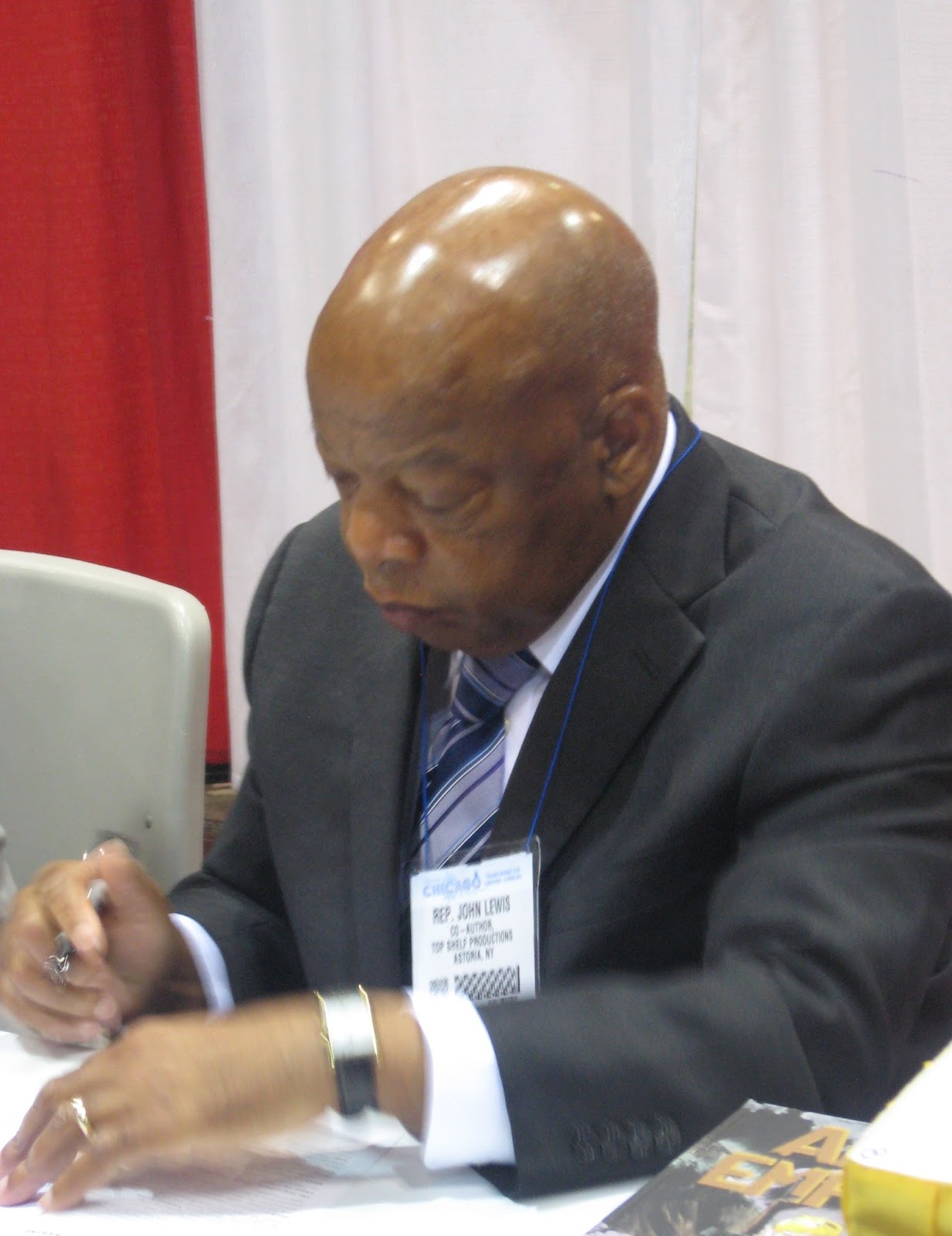
Rep. John Lewis signing March
at the American Library Association
summer conference in Chicago.
In June, at the American Library Association national conference in Chicago, I was fortunate enough to meet Lewis (I was third in line) and receive a signed "advance look" copy of March. (At the Comic-Con pop culture convention in San Diego last month, I learned, lines for Lewis' appearance were so overwhelming that fire marshals almost shut the event down.)

After signing my copy of March, Lewis extended his hand to shake mine. I thanked him for his lifelong dedication to civil rights and public service. I'm sure he hears this kind of praise all the time from his constituents and admirers. Nevertheless, he seemed appreciative of my words and thoughts -- and my interest in his book. Lewis looked me straight in the eye, smiled enthusiastically, and wished me well.

On this summer Sunday afternoon, it was too good an opportunity to not make the effort to be there for John Lewis and, personally, say "thank you" for his struggle of a lifetime to build a beloved community.

Photograph of Rep. John Lewis by Michael Dickens (copyright 2013). 
Image of March courtesy of Top Shelf Productions.

Tuesday, July 30, 2013

Renegade Craft Fair: Out of the studio and into the spotlight


Handmade petite paper flowers by Blooms in the Air artist Ji Kim
were on display at the Renegade Craft Fair in San Francisco.

The Renegade Craft Fair, which came to San Francisco's Fort Mason last weekend, brought out hundreds of artists and craft makers from their studios and into the spotlight to celebrate all things handmade in a variety of media.

Since its debut in 2003, the Renegade Craft Fair has showcased the best and brightest in Etsy indie craft and design, and it's become a major player in a booming DIY (Do It Yourself) craft movement in the U.S. and elsewhere.

Each year, the Renegade Craft Fair visits five U.S. cities (Austin, Brooklyn, Chicago, Los Angeles and San Francisco) plus London. Here, and in other cities, Renegade Craft Fair events are held in both summer and winter months. The San Francisco summer happening comes in late July while the winter event occurs in early December, just in time for the Christmas holidays. I've been a Renegade Craft Fair goer for the past three summers, and it's become one of my favorite San Francisco things to do.

From new and traditional to modern and innovative, there's always a diversity of art and style at the Renegade Craft Fair. It's interesting to see what's new and hip in the areas of art, clothing, jewelry, photography, quilts, toys and other knick-knacks -- and to be able to meet and mingle with the artists behind these creations.

On Sunday, thousands gathered inside the Festival Pavilion at Fort Mason to see over 250 modern makers of art. There were arts and crafts enthusiasts, bloggers, media scouts and taste makers -- even savvy shoppers stocking up early on unique, artist-created gifts for the end of the year holidays.

Among the hundreds of handmade goods I perused at this year's San Francisco Renegade Craft Fair were:

  • fresh butter crunch treats from p.o.p. candy;
  • neat things for the house from the recoverie
  • handmade greeting cards "sure to make 'em laugh" from Julie Ann Art
  • handcrafted leather goods and jewelry focusing on creating beautiful, functional and timeless accessories from btwn wind & water
  • handmade jams and pickles from lemon bird
  • completely conscious clothing created with sustainable materials from field day
  • beautiful, functional things for the curated home from Nell & Mary.  
Of the 2013 Renegade San Francisco craft makers, two garnered my attention for different reasons:

Mass transit made art by LinePosters.
First, LinePosters, a popular Brooklyn, N.Y.-based poster and apparel group co-founded by Cayla Ferari and John Brezicky, whose moniker "mass transit made art" drew me in because of my interest in mass transit and city maps.

LinePosters creates posters, letterpress cards and t-shirts of "highly stylized mass transit maps from iconic cities around the globe." Among them, transit maps of Chicago, New York, San Francisco, London and Paris caught my eye. (Earlier this month, I rode the Chicago "L" trains; I regularly ride BART to go back-and-forth between Oakland and San Francisco; and I love the London Underground and Paris Metro!)

As I bought four LinePosters letterpress cards (London, New York, Paris and San Francisco), I briefly chatted with one of the co-founders, Cayla Ferari, to learn more about what inspired her to turn mass transit maps into art. Then, I took the time to congratulate Cayla on what I thought was a truly original idea. In turn, she shared with me about how Oakland reminded her of Brooklyn, because both shared an up-and-coming art, food and culture scene despite often being over-shadowed by their bigger, neighboring cities of Manhattan and San Francisco.

Second, Blooms in the Air (aka BITA) is a petite and whimsical handmade paper flower shop created by a young and free-spirited southern Californian artist, Ji Kim. In visiting Ji's booth, it was evident that her flowers not only are pretty; they are always in season and in style, too.

On her website, Ji describes her art of paper flowers and what inspires her to create them. "The shop came to life when a desire to create something beautiful using my own two hands grew too big to ignore," says Ji. "BITA believes in the simple, honest joy that flowers give and hope that the inspired arrangements will leave you and your loved ones smiling."

In talking with Ji, I learned how she blends her creative talents with her attention to detail that enables her to create simple, well-crafted floral keepsakes. It explains why she describes herself as an archi-designer, an architect and designer who is a creative type, too. Although I did not buy any paper flowers on this day, I gained an appreciation for why Ji loves her art and enjoys talking to those interested in learning more about the beauty and joy of her art making.

Photo of Blooms in the Air by Michael Dickens, copyright 2013.
Photo of San Francisco mass transit made art courtesy of LinePosters.com.

Tuesday, July 23, 2013

On pop culture: A great design that's always making a fashion statement


The Converse Chuck Taylor All-Star sneaker

In recent years, the colorful, unisex appeal of Converse Chuck Taylor All-Star sneakers has become quite noticeable, especially among teens and young, college-aged adults.

After all, great design never goes out of style. Sometimes, it just gets a little edgy and interactive.

I learned this first hand last week while perusing a Converse Store during a walk along Santa Monica's Third Street Promenade, which houses the largest collection of Converse footwear (which includes Chuck Taylor All-Star and their companion sneaker Jack Purcell) and apparel in the world.

Converse Chuck Taylor All-Star sneakers have come a long way since their basic black and white styles were once the elite footwear of choice for generations of basketball-playing Americans. Their popularity predates Adidas and Nike. In the 1970s, the iconic American punk rock band The Ramones gave the Converse brand a worldwide counterculture status. Other notables who've worn the Chuck Taylor All-Star brand include Kurt Cobain of grunge rock Nirvana fame and British actor David Tennant, the Tenth Doctor, in the BBC television science fiction series Dr. Who.

Today, thanks to their casual appearance and variety of bright and vivid colors, the Converse Chuck Taylor All-Star sneakers are a "must-have" for a new generation of sneaker wearers. While they are now known more for their vintage fashion appeal than their athletic use, there is still a "wow" factor and a casual sense of coolness attached to them.

At Converse's Third Street Promenade flagship store, you can even design your own creative, one-of-a-kind pair of All-Star kicks in what is billed as Converse Customization. Through the use of iPad technology and over 150 customization graphics, including collaborations with local Santa Monica artists, customers can channel their inner Jackson Pollack or Andy Warhol in expressing their own personal and artistic style -- from abstract expressionist to modern pop art.

The Converse Chuck Taylor All-Star sneakers remain a great design, always making a fashion statement.

Photograph of Converse Chuck Taylor All-Star sneakers by Michael Dickens, copyright 2013.

Tuesday, July 16, 2013

Uplifting our mind: Finding inspiration in religious and sacred art


Johann Koerbecke / The Annunciation (1457)

The artistic imagery of religious or sacred art is intended to inspire us and uplift our mind. Whether Christian, Islamic, Catholic, Buddhist or Hellenistic in nature, there is a path of spiritual realization and beauty worth discovering throughout the world's cathedrals, mosques, chapels and art museums.

Earlier this month, I had the pleasure of visiting the Art Institute of Chicago while on holiday in America's "Second City", and I made a point to look for the museum's religious and sacred art. The Art Institute's permanent collection of religious and sacred art includes a variety of works created by German, Dutch, Spanish and Italian artists. There is also a wing devoted to Indian and Islamic art, which included some religious and sacred artifacts.

Some of the earliest surviving Christian art goes back to near the origins of Christianity. Meanwhile, an example of Islamic sacred art can be seen in the Great Mosque of Kairouan (also called the Mosque of Uqba), located in Tunisia. Built in 670 AD, the upper part of the prayer niche (known as the mihrab) is decorated with 9th century lusterware tiles and painted intertwined vegetal motifs. And, Buddhist art has its origins on the Indian subcontinent and followed the life of Siddhartha Gautama from 6th to 5th century BC.

Among the most common Christian themes found in religious or sacred art is that of the Virgin Mary holding the infant Jesus and also of Christ on the Cross, and the Art Institute's collection includes many examples of both themes.

Fortunately, the Art Institute allows non-flash photography in many of its permanent galleries. Thus, I have the pleasure of sharing with you a sample of some of the religious and sacred art spanning the 15th through 18th centuries, which I saw and photographed during my afternoon at the Art Institute of Chicago.


Colyn de Coter /
Virgin and Child Crowned by Angels
(1490/95)

Burgos Cathedral /
The Birth of Saint John the Baptist (c. 1525)

Giovanni Battista Tiepolo /
Virgin and Child with Saint Dominic
and Hyacinth (1730/35)

About the paintings:

* In Johann Koerbecke's "The Annunciation" (oil on panel, transferred to canvas), the German painter depicts one of eight scenes from the life of the Virgin decorating the inside of the wings of his masterpiece, the altarpiece on the high altar of the Cistercian abbey of Marienfeld, near Münster in northwest Germany.

* Colyn de Coter's style and subjects, as shown in his "Virgin and Child Crowned by Angels" (oil on panel), reflected the traditions of the great 15th-century Netherlandish painters. In his painting, a comfortable, bourgeois interior underscores Christ's humanity, all the while angels crown the Virgin as the Queen of Heaven.

* In "The Birth of Saint John the Baptist" (polychromed and gilded wood) from the Spanish Burgos Cathedral, the figure of the infant Baptist being passed between his mother, Saint Elizabeth, and a kneeling midwife are depicted in this relief. During this period, painted wood sculpture was popular in Spain, and it is assumed that this relief probably came from a carved altar dedicated to the life of the Baptist.

* "Virgin Child with Saints Dominic and Hyacinth" (oil on canvas) by Italian painter Giovanni Battista Tiepolo is an altarpiece that, according to the museum, was likely destined for a church in Venice. "Tiepolo transformed the traditional subject of the Virgin and Child with interceding saints into a light-filled vision. Supported on golden clouds, the Virgin and Child appear atop an altar table with a richly embroidered hanging."