Tuesday, October 29, 2013

A spiritual journey: Opening hearts and minds


All great music is a gift and thus an instrument of God.
~ Wynton Marsalis

Wynton Marsalis, the 52-year-old Grammy- and Pulitzer-winning trumpeter, who is the artistic director of Jazz at Lincoln Center, has created the beautiful and inspiring Abyssinian: A Gospel Celebration, a landmark collaboration of jazz, gospel, instrumentation and vocals, which unites secular and sacred music. While it is structured and progresses like a Roman Catholic or Anglican Mass, it's also rich in the African-American Baptist tradition, too.

"The theme of the Mass is that everyone has a place in the house of God," Marsalis said during a recent interview with the Boston Globe. "We're the most integrated nation ever, at least in the modern world that we know about. For our music to be, we have an identity but that identity is already universal. I try to find the core values that are so fundamental that they transcend ethnic identity. That doesn't mean I run from it. I embrace African-American culture and I love it and embrace it, but it is a part of a human identity. So, I'm always trying to make a larger human statement."

Damien Sneed, conductor
 of the Abyssinian Mass.
Recently, Marsalis took the Abyssinian Mass on a 16-city tour that included performances in Dallas, New Orleans, Kansas City, St. Louis, Augusta, Ga., and Washington, D.C, playing in both concert halls and churches. Last weekend, the 15-piece Jazz at Lincoln Center Orchestra along with the 70-voice Chorale Le Chateau, guided by the stylish and exuberant 34-year-old choral director Damien Sneed, who conducted the mass, returned to the "House of Swing" in New York City and presented Abyssinian: A Gospel Celebration before three sold-out audiences at the Rose Theater. It was broadcast online via a world-wide webcast.

In watching Saturday evening's demanding performance online in the comfort of my living room, I became riveted by Abyssinian's libretto, its celebratory joy and its profound message. The choir was full of spirit. The orchestra clearly was enjoying itself. And, the spirited sermonizing from the Reverend Dr. Calvin O. Butts, III, brought much charisma to the presentation. There was a whole lot of feeling in that show.

"The choir brings the fire and the choir brings the truth to the Abyssinian Mass," Sneed told NPR. "The choir brings the spirit, it's like the haaaaaa, the breadth of God."

Amen, amen, amen. O Father we go forth in Thy Holy Name.

Wynton Marsalis solos
during the Abyssinian Mass.
Indeed, the music in Abyssinian: A Gospel Celebration is not just gospel and it's more than just jazz, too. There's also an element of classic music that resembles Handel's Messiah. 

The work originally had its premiere in 2008 as a commission in honor of the 200th anniversary of Harlem's Abyssinian Baptist Church. It made its European debut in 2012 at London's Barbican Theatre.

In a recent interview with NPR's John Burnett that aired on Weekend Edition Saturday as part of its year-long series "Ecstatic Voices: Sacred Music in America," celebrating the diversity and richness of sacred music in the U.S., Marsalis explained how different kinds of music are related -- the universality of rhythm -- showing how a rolling 6/8 rhythm is found in both African and Anglican religious music. Tapping his fingers on a notebook and humming "a complicated pattern," Marsalis remarked how "in a slower tempo, it would be 'Greensleeves.'" He demonstrates by scat-singing the melody. "All the musics are related."

Some additional observations Burnett shared in his NPR story about Marsalis and the 17 movements that comprise the Abyssinian Mass:

"(It) digs deeply into what Marsalis would call 'the soil' of the black church: its shouts, its dirges, its spirituals, it hymns of praise. With this work, he celebrates the seminal influence the church has had on the music of black Americans, and the continuing pull it exerts on his own artistic and spiritual life.

"Marsalis used the joyful stylings of the African-American gospel tradition to deliver a musical message of universal humanity. He says he tried to put it all in there: God and Allah exultation and the blues, Saturday night and Sunday morning."

Glory to God in the Highest! Glory to God in the Highest!


After the tour's final show Sunday night in Boston's Symphony Hall, Marsalis took a moment to reflect on many positive things that stood out, which he chronicled on his Facebook page.

"When Chris Crenshaw started to sing the Benediction tonight, the choir began co-signing him, 'Come On Deacon, Preach brother! Make it plain.' He sang these words with a powerful clarity:

"Lord, from you all things. Though we are many in life and death, we are truly one. Just the calling of your Holy name releases us to perceive the oneness in all, of all. You have given us, through your word, the divine thought. And the divine thought IS the divine manifestation IS holy action."

For Marsalis, "that is the power of prayer in whatever religion, or none at all."

After the two-and-one-half hour online performance concluded Saturday evening, I realized I didn't want it to end. Listening to Abyssinian: A Gospel Celebration attentively, it brought out a lot of emotions and moods. It was very joyful and uplifting. It gave me pause to reflect upon what a blessing it was to be part of such a glorious experience and full-circle journey.

Amen.

You can watch the entire Abyssinian: A Gospel Celebration via: http://wyntonmarsalis.org/live/.
Photographs courtesy of artsneworleans.org, NPR.org, kplu.org

Tuesday, October 22, 2013

Autumn colors: Let's take a road trip


Road Trip # 1 scarf / Inspired by autumn colors.

Inspiration comes in all forms, shapes and colors. Sometimes, it comes from an appreciation of our natural world observed while taking a road trip by automobile.

"The leaves had not really started to change to other colors rather having mellowed to old greens as they prepared for true autumn," remembered Babs Ausherman, known throughout the online yarn and fiber community as "Miss Babs".

A year ago, Ausherman was in search of natural surroundings to nurture her creative side as a fiber artist. Her "road trip" by car led her through the scenic and colorful mountains of Tennessee.

"The roadside grasses had gone tan with burgundy/russet seed heads, the sky was clear and blue," Miss Babs observed.

What she chronicled in vivid detail became the inspiration for a lovely, autumn-colored scarf design she created last year. The notes she wrote for the pattern read like a travelogue.

A hard-working, insightful fiber artist, Ausherman is the owner of Miss Babs Hand-Dyed Yarns & Fibers, Inc., an online retailer of hand-dyed yarn and fiber and patterns based in Mountain City, Tenn., the county seat of Johnson County, located in the northeasternmost corner of the Volunteer State. She was raised in a family of creative types and entrepreneurs. Miss Babs believes a good day's work is good for the soul.

I've had the pleasure to renew acquaintances with Miss Babs each of the past several years when she comes to California for Stitches West, an annual yarn and fiber expo held each February in Santa Clara. I've come to appreciate her sharp wit, artistic and creative flair, and thoughtfulness.

As I gazed upon the completed "Road Trip #1" scarf while perusing the Miss Babs booth at Stitches West earlier this year, immediately, I fell in love not only with the beautiful palette of autumn colors, but also with the design and feel of the scarf.

The Road Trip #1 scarf / 
Each section represents
the colors of the land and sky --

and it's a wonderful project
to knit on a road trip.
There are five colors that comprise the "Road Trip #1" scarf: "The original scarf is knit in Moss, Russet, Candied Pecan, Wheaten, and Coos Bay. The scarf takes a full skein of one color, and partial skeins of the other four colors," writes Miss Babs in describing the scarf on Ravelry, an online social media site for knitters and fiber artists.

"The sections represent the colors of the land and sky, but they also seem to be reminiscent of the concrete roads that we sometimes travel on. They make a thumpity-thump rhythmic sound," she adds in describing the scarf's design. "In addition to being inspired by the colors of a road trip, this scarf is a wonderful project to knit on during a road trip, since it is all garter stitch!"

My wife, who has knitted several scarfs for me, respects my taste in knitted arts. So, the "Road Trip #1 scarf seemed a natural fit. Because of its unisex pattern, I hinted that I would love to have one of these "road trip" scarves for my very own. Without hesitation, we purchased a copy of the pattern and picked out the requisite skeins of Heartland Worsted hand-painted 3-ply Merino yarn, much to the delight of Miss Babs.

My very own
Road Trip #1 scarf.
Fast forward through the remainder of winter, spring and summer to a few weeks ago. Just in time for autumn, I now have my completed scarf that's filled with its own autumn colors. During the time my wife knitted this project, it was both interesting and enjoyable to see my very own "Road Trip #1" scarf take shape, color by color and section by section. The finished scarf looks just as beautiful as the pictures that illustrate the easy-to-follow pattern.

Looking ahead, the Stitches West 2014 show is only a few months away, and I'm looking forward to attending so I can show off my "Road Trip #1" scarf for Miss Babs. I'm confident she'll be pleased by how it turned out. Now, if only I can find the time to go on a road trip.

All photographs of the Road Trip #1 scarf by Michael Dickens, copyright 2013.

Tuesday, October 15, 2013

On Tunisian tennis: A season on the brink?


Malek Jaziri / The No. 1-rated Arab tennis player in the world.

At a glance, the order of play for last Friday's quarterfinal-round of the ATP Challenger event in Tashkent, Uzbekistan, which included three of the top four remaining seeds, seemed ordinary enough.

Except that it wasn't.

At 10 a.m. on Court No. 3, the order of play showed a scheduled match between two unseeded players, one an Arab, the other an Israeli. However, before play began in this lower-tier tennis tournament -- the minor leagues of professional men's tennis, if you will -- Malek Jaziri of Tunisia, ranked 169th in the world at the time but currently the top-rated Arab player, withdrew from his match against Amir Weintraub, an Israeli, who advanced on the walkover to the semifinals.

More often than not, a walkover is the result of one player being too injured to be able to play. Only, this time, Jaziri's inability to play was because of political interference and not because of a knee injury, diplomatic and convenient as it might seem -- regardless of what the tournament's website indicated as the official reason.

Instead, in a move that arguably shocked the tennis world and garnered the attention of both USA Today and Sports Illustrated here in the U.S. as well as various international media abroad, Tunisia's tennis federation ordered its best player off the court, forbidding him from playing. Simply because his opponent-to-be was an Israeli.

In an e-mail provided by Jaziri's brother and manager, Amir, to the Tunisian state news agency on Friday, the Tunisian tennis federation on Thursday stated: "Following a meeting this afternoon with the Ministry of Youth and Sports, I have the immense regret to inform you that you are ordered not to play against the Israeli player."

A sports ministry spokesman, Sadok Touati, confirmed for the Associated Press that the federation sent the e-mail on Thursday after it consulted the ministry.

"The ministry does not interfere in the affairs of the sports federations," said Touati. Meanwhile, the federation president was unavailable for comment.

Although Jaziri, 29, is ranked well below the top players in his sport  -- a little over a year ago he was 100 places higher (69th) before injuries and a string of losses against lower-ranked opponents derailed him -- by all indications he is afraid the Tunisian federation's decision could harm his career. Few besides Jaziri in Tunisia have achieved a world ranking that would garner much notice. And, Jaziri could have risen to 135th had he won the tournament in Tashkent. Instead, when the new rankings were released on Monday, his ranking changed from 169th to 165th following last week's tournament.

Malek Jaziri drapes himself in his country's flag after he won
his first round match in the 2012 French Open.

While Arab countries have over the past decades observed boycotts of varying degrees against Israeli athletes in a protest over Israel's treatment of Palestinians, it's a shame to see athletes today become pawns in a geo-political chess game. And, in a sport which prides itself on global competition and is played worldwide, it's a disturbing interference of politics by a country (Tunisia) which is still searching for a democratic balance after its Jasmine Revolution paved the way for other Arab Spring revolutions a little more than two years ago. Tunisia has been in the midst of a political crisis for many months as a result of deadlocked negotiations between the ruling Islamist party, Ennadha, and the opposition over new parliamentary and presidential elections.

"It's a pity for the athletes who get caught up in these situations that end up hurting their personal career," said Shlomo Glickstein, the director of Israel's tennis association. In a statement, he added that it was sad such incidents such as what happened on Friday still occur.

In an interview with L'Equipe, Selima Sfar, a former Tunisian professional tennis player and the only Arab woman to achieve a top-100 world ranking (she was once ranked 75th in 2001), said she was shocked and worried about the "regressive" behavior shown her country's tennis federation.

Selima Sfar
"I am angry and disappointed," Sfar told the French sports daily. "It is a very bad image for my country. We fought hard to become professionals and now we are not supported."

Sfar, who retired from the tour in 2011, believes that political interference is unbearable. "Our people fought also with blood to move towards democracy and openness, and instead we are moving backwards," she said. "To play against an Israeli does not mean you are being a bad Tunisian Arabic or a bad Muslim. I'm proud to be Tunisian, Arab and Muslim, but I am ashamed of my country when it behaves like that."

In this day and age, it seems to me that if an Indian (Rohan Bophanna) and a Pakistani (Aisam-Ul-Haq Qureshi) can separate their differences and unite as a formidable doubles team, putting the politics of their two warring nations aside and promoting peace on the court, then an Arab nation which is struggling to establish its identity in the world of tennis should allow its best player to face all comers -- even if the player on the other side of the net is Israeli.

Just imagine, Jaziri and Weintraub could have used their match to try to improve relations between their countries. Ironically, both belong to the same French tennis club, Sarcelles Tennis, north of Paris. If they can both get along and be friends on and off the court -- they have known each other for years through their sport -- why can't Tunisia work towards promoting tolerance and understanding with Israel and allow Jaziri and other Tunisian athletes to compete against Israelis?

According to various published reports, the president of the Sarcelles tennis club, Jonathan Chaouat, said he spoke to Jaziri last Thursday night and that the player was upset that he would be unable to play Weintraub.

"He explained to me that he could not play the match," said Chaouat. "When I asked him where the pressure not to play was coming from he replied 'my country.'

"What is certain is that it was not Malek who decided not to play this match. Malek was taken hostage."

Malek Jaziri
Although he was reluctant to discuss the matter, Weintraub told the Jerusalem Post that Malek "is a good friend" and that "he really wanted to play."

While Jaziri has not spoken publicly about last week's incident, earlier he described the challenges of being a professional tennis player in the Arab world in an interview published on the tournament's website.

"In Arabic countries there is not a tradition of tennis except in North African countries like Morocco, Tunisia and Algeria," said Jaziri. "There are, however, professional events in the Arab world like in Dubai and Qatar, but the Arab countries should come out and give more opportunities to players from the region. Giving wild cards is not enough; they need to support players in other ways, too.

"Tennis is a tough sport. We as professional tennis players have to fight it out every day," he said. "One week is good, one week is bad. And, we have to go through these ups and downs. In some countries, the situation is favorable for tennis players because of the support of their associations. But in some countries, like ours, it is really bad. Life for us is a battle every day."

Asked about finding support in his home country, Jaziri said: "I had a national sponsor, but now my country is going through a very bad period economically and politically; it is not easy for me. I have a tough job at hand to manage my tennis. I want to travel with a coach, but can't afford one. But, I'm hoping that the situation will change for the better."

In an interview with Agence France-Presse on Monday, Amir Jaziri blasted the decision of the Tunsian tennis federation as "shocking, because it brings politics into sport. We are totally against that. And Malek is the first victim, because tennis is his career, his bread-winner.

"To be clear, Malek pulled out for sporting reasons, because he was injured. He did his warm up, something was wrong and the doctor found that his knee was swollen," Amir Jaziri said.

"But at the political level, we received an order not to play. It was an e-mail from the Tunisian Tennis Federation, via the technical director."

Amir Jaziri said in the interview with AFP that he didn't know whether his brother would have played the match if it weren't for the knee injury. He said he failed to understand how the Tunisian Tennis Federation could give such an order considering that Jaziri has previously faced Weintraub and Tunisia played against Israel in the 2009 Federation Cup.

"Tennis doesn't normally get much media coverage in Tunisia," said Amir Jaziri. "What happened was only done as part of an electoral campaign, and everyone profits (electorally) from this."

The International Tennis Federation (ITF), which has jurisdiction over federations (while the ATP -- the Association of Tennis Professionals -- has jurisdiction over the players), is investigating the whole matter involving the Tunisian federation forcing Jaziri to withdraw against his wishes at Tashkent. While it is unclear what, if any, sanctions might be imposed against the Tunisian federation, I'm in agreement with the ITF's ideals.

"The ITF believes that sport fosters good collaboration between nations," said ITF spokesman Nick Imison. "And, as such, players should be able to compete freely on the international circuit. If a federation were responsible for a player taking part that would go against the ethos of the organization and against the ITF constitution.

"The most important thing going forward is for Tunisian players to be able to play freely against any opponents in the future. That is the aim of all the tennis governing bodies."

A postscript: On Wednesday, the ATP released a statement saying it had completed its investigation and relieved Malek Jaziri of any culpability.

"We have found no wrongdoing on the part of the player and all of the information we have gathered has been passed  on to the ITF," the statement said.

Meanwhile, the ITF's investigation of the alleged forced pullout remains ongoing, said ITF spokeswoman Barbara Travers.

"The ITF takes any matter regarding discrimination very seriously and this incident will be discussed by the ITF Board of Directors at its regularly scheduled meeting (Oct. 31-Nov. 1) in Cagliari, Italy," Travers wrote in an e-mail. "We have asked the Federation Tunisinne de Tennis to make any relevant submissions to the ITF ahead of that meeting."

While Travers said the ITF would have no further comment until after the board meets, the ITF could bring sanctions against the Tunisian tennis federation, such as bans from Davis Cup competition, if it finds that the federation violated regulations. The ITF is also affiliated with the International Olympic Committee.

Malek Jaziri photographs courtesy of footplus.tn, rolandgarros.com and atpworldtour.com.
Selima Sfar photograph courtesy of tunisienumerique.com.

Wednesday, October 9, 2013

Sounds of autumn: Hardly Strictly Bluegrass


Hardly Strictly Bluegrass / The sounds of autumn returned to
Golden Gate Park  -- and so did the crowds to hear these sounds.

The first weekend in October had been marked "HSB" on my Google calendar for quite some time -- and, while it had nothing to do with baseball or sport, it had everything to do with music and fun.

You see, the first weekend of October holds a special significance for my wife and me because it's Hardly Strictly Bluegrass weekend. What has become one of the premier music festivals in the country has become an annual highlight of our San Francisco cultural calendar.

Oh, by the way, did I mention Hardly Strictly is free, too?

First Aid Kit / Their lovely and soothing rendition of
Simon and Garfunkel's "America" Friday on the Rooster Stage
was one of the many highlights of this year's festival.

There's no place better to be in San Francisco on a gorgeously beautiful, autumn weekend than in Golden Gate Park at the Hardly Strictly Bluegrass Festival, the late Warren Hellman's gift to The City. Although the Bay Area billionaire investment banker and benefactor -- himself a spirited banjo player and a lover of bluegrass music -- died in 2011, he left an endowment to ensure its existence for many years to come. (There are no corporate sponsors.) At last year's festival, the first following Hellman's death, one of the meadows used for Hardly Strictly Bluegrass was renamed Hellman Hollow to honor his memory.

Boston-based group Della Mae
offered a fresh and contemporary
spin to bluegrass. 
Last weekend, the congenial Hardly Strictly Bluegrass Festival returned for a 13th edition with its usual eclectic lineup of talent, including: Emmylou Harris, Ralph Stanley, Boz Scaggs, Bonnie Raitt, Chris Isaak, Nick Lowe, Los Lobos, First Aid Kit, Richard Thompson and Steve Martin with Edie Brickell, to name just a few of the more than 80 acts, who performed during the festival's three days, spread out over six different stages across the western half of Golden Gate Park. Perennials like Steve Earle and Buddy Miller were there. And, there were a lot of Wainwright's, too -- Loudon III, Martha and Sloan, but, alas, no Rufus.

Nick Lowe / The silver-haired
and tender-hearted songwriter
was wonderful company on a
sunny afternoon.
For the hundreds of thousands who poured into the Park, filling the lawns, crowding into the hills and even dotting a few treetops (festival organizers estimated the weekend crowd to be 900,000, including over 400,000 on Sunday), there was a little something for everyone to celebrate: traditional bluegrass (Ralph Stanley and the Cinch Mountain Boys), contemporary bluegrass (Della Mae), country (Vince Gill with The Time Jumpers), rockabilly (Chris Isaak), soul (Bettye LaVette), folk (First Aid Kit), Americana (Della Mae), revivalist roots (the Felice Brothers), contemporary rock (Mark Lanegan) and roots rock (Steve Earle).

As I explained to a friend of mine Monday on Facebook, there was an embarrassment of great music riches at this year's festival. My brother in Louisiana texted me that he was "green with envy" and wished he could be at Hardly Strictly. There were so many quality choices each day filling the six stages between 11 a.m. and 7 p.m.; sadly, it was impossible to see all of them.

Friday's Rooster Stage line-up.
On Friday, my wife and I arrived mid-afternoon in time to see Washington, D.C. indie-rock duo The Evens followed by the Swedish folk duo First Aid Kit on the Rooster Stage.

The Söderberg sisters, Johanna and Klara, gave a lovely, soothing rendition of the Simon and Garfunkel hit "America" that caught everyone's attention and was a highlight for us.

Later, we sprinted across the meadow and landed at the Arrow Stage in time to enjoy the desert noir sound of Calexico, whose musical style has been influenced by mariachi, conjunto, cumbia and Tejano as well as a mixture of mid-20th century jazz and turn-of-the-21st century rock.

Desert noir / Calexico's music is influenced by a variety of Mexican
sounds combined with a mixture of period jazz and rock.

On our way out, we paused at the Banjo Stage and caught a couple of tunes by Bonnie Raitt, whose set mixed old favorites like "Something to Talk About" with new songs from her nineteenth album Slipstream. Unfortunately, her set conflicted with Calexico, and since we had seen Raitt before, we opted for Calexico, which had been high on our list of must-see bands at this year's festival.

Bettye LaVette bared her soul
to an appreciative audience
 on the Towers of Gold Stage.
On Saturday, we eagerly returned to the festival site and camped out all afternoon at the Towers of Gold Stage, the western-most stage on the festival grounds. Toting a picnic basket full of food and beverages, we spread out a large beach towel on the Lindley Meadow lawn and soaked up some welcome San Francisco sunshine while enjoying the assortment of sets offered by Bettye LaVette (soul), Nick Lowe (witty and elegant acoustic British pop and rock) and Los Lobos (American Chicano rock). In between, music from Dave Alvin (Americana) and Boz Scaggs (blue-eyed soul) was piped in from their adjoining Star Stage sets to fill the gaps.

What's Going On / Boz Scaggs (second from left) sat in
with Los Lobos on the Marvin Gaye classic "What's Going On"
Saturday afternoon on the Towers of Gold Stage.

A wonderful treat during Los Lobos' "disconnected" set was seeing Boz Scaggs sit in with the East L.A. band on the Marvin Gaye classic "What's Going On." By the time the sun began to fade on a lovely afternoon that passed much too quickly, it all added up to a memorable experience.

On Hardly Strictly's third and final day Sunday, we braved the masses who filled the Park to see and hear Steve Martin and Edie Brickell with the Steep Canyon Rangers. Their new album Love Has Come For You, featuring Martin's inventive five-string banjo playing with Brickell's detail-rich lyrics and distinctive voice, has garnered rave reviews and it was the must-see moment of the weekend.

Because we knew the Banjo Stage at Hellman Hollow would be the place everyone wanted to be between during the early-afternoon hours, we arrived more than an hour before the 1:25 p.m. start of Martin and Brickell's set, found a small postage-stamp sized bit of green grass to put down our beach towel and picnic basket, and were treated to a nice, traditional bluegrass set by Laurie Lewis and Friends that whetted our appetite for more.

Inventive, distinctive and entertaining, too /
Steve Martin and Edie Brickell with the Steep Canyon Rangers
 presented a hybrid of bluegrass and comedy that delighted
 one of the weekend's biggest gatherings at this year's festival.

After Martin and Brickell's amazing and entertaining one-hour set -- you knew Martin would add a bit of comedy banter in between songs -- we darted across the festival grounds and landed on the Star Stage in Lindley Meadow, where we kicked back and relaxed, listening appreciatively to Chris Isaak perform "Wicked Game" among his parade of rock and rockabilly hits before calling it an afternoon. As much as we would have liked to stay on for either the traditional, early-evening farewell set by Emmylou Harris or sample the gypsy rhythms of Gogol Bordello, we were both physically and musically spent. Attending Hardly Strictly for three days straight will do that, but it felt good.

This year's Hardly Strictly Bluegrass Festival was, indeed, a Lucky 13th -- it added up to another satisfying festival experience that I know we'll talk about for a long time to come -- and we look forward to returning next year to do it all over again.

To see a complete list of artists who performed at this year's Hardly Strictly Bluegrass Festival as well as to link to the webcast archive of selected performances:

http://www.hardlystrictlybluegrass.com/2013/

All photographs by Michael Dickens, copyright 2013.

Tuesday, October 1, 2013

On 'Eleven Rings: The Soul of Success'


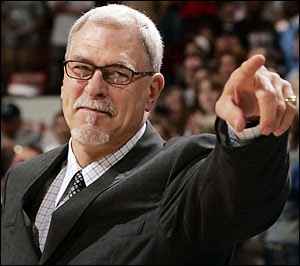
Phil Jackson / "The soul of success is surrendering to what is."

For the past two weeks, my bedtime reading has been Eleven Rings: The Soul of Success by Phil Jackson, written with Hugh Delehanty, that was published earlier this year. It is one of those books that's been a truly wonderful read. It's hard to set it down and I don't want it to end. The book is as much a primer for getting in the mood for the upcoming professional basketball season that starts later this month as it is a memoir with candid insights into the alchemy of leadership.

At more than 300 pages, there's plenty to absorb in Eleven Rings: The Soul of Success, and Jackson quotes from the Grateful Dead, William James, Thelonius Monk, Abraham Maslow and Lao-Tzu, among many. The book reflects Jackson's polymathy.

"In the space of a page, he toggles from psychotherapy to Native American customs to Christianity to Buddhism and back to 'two recent studies published in the Journal of Experimental Social Psychology'," the New York Times wrote in its review of Eleven Rings.

As those of you who follow American professional basketball know, Jackson enjoyed a storied career as head coach of the NBA's Chicago Bulls (1989-98) and the Los Angeles Lakers (1999-2004, 2005-11), and he won more championships -- eleven -- than any coach in the history of professional sports. Delehanty is a former editor for Sports Illustrated, who previously co-authored Jackson's best-selling memoir Sacred Hoops.

Jackson, who grew up the son of Pentecostal preachers in North Dakota, learned the secrets of mindfulness and team chemistry during his playing career with the New York Knicks in the 1970s. Later, as a coach for the Bulls, he managed arguably the greatest basketball player in the world, Michael Jordan, and as coach of the Lakers, Jackson is credited with turning Kobe Bryant into a mature leader of a championship team.

"When you play the game the right
way, it makes sense to the players
and winning is the likely outcome."
~ Phil Jackson
It was in his "quest to reinvent himself," that Jackson became an explorer, learning about humanistic psychology, Native American philosophy and Zen meditation. His approach to leadership was based upon "freedom, authenticity, and selfless teamwork that turned the hyper-competitive world of professional sports on its head." He is not afraid to quote from various religions' holy scriptures.

In teaching his players an abbreviated version of mindfulness meditation that's based on the Zen practice, Jackson writes: "I was interested in getting them to take a more mindful approach to the game and to their relationships with one another. At its heart, mindfulness is about being present in the moment as much as possible, not weighed down by thoughts of the past or the future."

On winning and losing, Jackson writes: "When you play the game the right way, it makes sense to the players and winning is the likely outcome."

"But there's another kind of faith that's even more important," he adds. "The faith that we're all connected on some level that surpasses understanding. That's why I have players sit together in silence. Sitting silently in a group without any distractions can make people resonate with one another in profound ways. As Friedrich Nietzsche said, 'Invisible threads are the strongest ties'."

At the beginning of each chapter, Jackson shares a quote that illustrates the theme of his message. For instance:

Life is a journey. Time is a river. The door is ajar.
~ Jim Butcher

The greatest carver does the least cutting.
~ Lao-Tzu

The privilege of a lifetime is being who you are.
~ Joseph Campbell

Think lightly of yourself and think deeply of the world.
~ Miyamoto Musashi

In the end, Jackson shares this thought:

"Buddhist sages say that there's only a 'tenth of an inch of difference' between heaven and earth. And I think the same can be said about basketball. Winning a championship is a delicate balancing act, and there's only so much you can accomplish by exerting your will. As a leader your job is to do everything in your power to create the perfect conditions for success by benching your ego and inspiring your team to play the game the right way. But at some point, you need to let go and turn yourself over to the basketball gods.

"The soul of success is surrendering to what is."

One thing that Eleven Rings shows us -- and you don't have to be a fan of basketball or sports to appreciate it -- is this: When it comes to the most important lessons in life, we still have much to learn.

Photos of Phil Jackson and of the cover of Eleven Rings: The Soul of Success courtesy of Google images.

Tuesday, September 24, 2013

A visual tour de force that says you're definitely in Berkeley


The Rotante Dal Foro Centrale / A visual tour de force

Look, how the floor of heaven
is thick inlaid with patines of bright gold;
There's not the smallest orb which thou behold'st
But in his motion like an angel sings ...
Such harmony is in immortal souls;
But, whilst this muddy vesture of decay
Doth grossly close it in, we cannot hear it.

~ William Shakespeare, from The Merchant of Venice

The Rotante Dal Foro Centrale is a shining orb measuring six and one-half feet in diameter. It sits on a swatch of circular bricks surrounded by a bed of bright green grass amid a tall grove of California redwood trees. It's a head turner and an eye opener that's located just off bustling Oxford Street, along a busy pathway near the western entrance of the 178-acre University of California campus in Berkeley, across the bay from San Francisco.

Walking by the Rotante Dal Foro Centrale, as I did on a recent sunny Saturday afternoon, it garnered my attention. And, it grabbed the attention of many others, too: UC students, tourists, football fans heading across campus to Memorial Stadium and locals just up from downtown Berkeley, who snapped photographs standing next to the bronze sphere, peered through it, touched it and stared curiously at it. I suppose small children could crawl through it, though I wouldn't recommend it. Yet, it's opening is big enough to leave gifts or secret notes inside.

The Rotante Dal Foro Centrale is the creation of the Italian sculptor Arnaldo Pomodoro (b. 1926), who has sculpted variations of the "Sphere Within Sphere" that are located around the world, including at the United Nations Headquarters in New York; the Hirshhorn Museum and Sculpture Garden in Washington, D.C.; Tehran Museum of Contemporary Art, Iran; and Tel Aviv University, Israel.

While some have suggested that the Rotante Dal Foro Centrale resembles a huge eyeball gazing at us, one can't help wonder if the sculpture's design is meant to symbolize the September 11 attacks on America because of its explosive appearance.

On a campus filled with political and counterculture history, classic architecture and freestanding art that includes both modern abstracts and artistic gods and goddesses -- plus an assortment of bears reflecting the school mascot Oski -- leave it to a burnished metal ball with a large jagged hole to be a visual and conversational tour de force.

It's a campus landmark that definitely says you're in Berkeley.

Photograph of Rotante Dal Foro Centrale by Michael Dickens, copyright 2013.

Tuesday, September 17, 2013

Rafael Nadal: Returning to form and structure


Rafael Nadal / Thirteen is an amazing number.

When Rafael Nadal won the 2013 U.S. Open singles championship last week with a convincing 6-2, 3-6, 6-4, 6-1 victory over his new arch rival, No. 1 Novak Djokovic, it marked the completion of a remarkable comeback that even the 27-year-old Spaniard would deem astonishing.

Nadal won in 3 hours and 20 minutes on a hard court surface that, while it remains his least favorite, he has been a perfect 22-0 on this summer.

What an enjoyable run it has been for Nadal. He has won two Grand Slams, eight other ATP titles and amassed a 61-3 record in 2013. Then, last weekend, he kept his commitment to represent Spain in the Davis Cup playoffs and contributed wins in both singles and doubles that clinched a berth for his country in the 2014 World Group.

Consider this: A year ago, Nadal watched the U.S. Open from his home on the Spanish island of Majorca, his knees battered and his ego bruised. His 2012 ended unceremoniously with an early, second-round exit from Wimbledon, and he didn't play again until February of this year. Following Nadal via social media, his fans worldwide feared the worst for their beloved hero and many turned away from tennis altogether.

After skipping the Australian Open, Nadal resurfaced after a seven-month sabbatical to play in a clay-court event in Chile. Although he didn't win in his first tournament back on tour, he began to reinvent himself.

The hands of a champion. 
Soon, Nadal began to win nearly every tournament in sight: Sao Paulo, Acapulco, Indian Wells, Barcelona, Madrid, Rome, Roland Garros, Montreal and Cincinnati leading up to the U.S. Open. His only setback on clay was losing to Djokovic in the final at Monte Carlo. It remains a mystery as to why he lost in the first round on grass at Wimbledon after a successful clay-court season. However, throughout much of the year, Nadal has looked more fit -- both mentally and physically -- and the mood, both in his camp and among his fans, improved tremendously with each title he won.

At the U.S. Open, the relentless Nadal, who by then had discarded his familiar knee wrap, was a favorite among fans and became a huge drawing card at Arthur Ashe Stadium. When he beat Djokovic in the final, he joyfully sobbed while rolling around on the surface of the world's largest tennis arena. Then, he basked in the glow of the lights shining down upon him as he hoisted the winner's trophy for a world-wide audience to enjoy. Before he flew home to Spain, Nadal made the rounds of the New York media, including an appearance on PBS's Charlie Rose, clutching the trophy.

"For a few things, this is probably the most emotional one in my career," said Nadal, after winning his second U.S. Open crown. He has faced Djokovic in three of the last four Open finals. "I felt that I did everything right to have my chance here. You play one match against one of the best players in the history in Novak and No. 1 in the world on probably his favorite surface. I knew I had to be almost perfect to win. It means a lot for me to have this trophy with me today."

Although Djokovic enjoys an 11-7 edge on hard courts, he's managed to win only three of his 11 encounters in Grand Slams against Nadal, who now leads what many consider the most prolific series in Open era history 22-15.

After losing to No. 2 Nadal on a cool evening in Arthur Ashe Stadium, Djokovic praised his opponent, saying: "He was too good. He definitely deserved to win this match and this trophy."

At work chasing after No. 1.
Nadal now owns 13 major titles, which places him third all-time behind Roger Federer (17) and Pete Sampras (14). Nadal has won eight French Opens, two Wimbledons, two U.S. Opens and one Australian Open. He has won at least one Grand Slam title in each of the past nine years, and he holds a winning record against his biggest rivals -- Djokovic, Federer and Andy Murray. So, his chances of catching -- and, maybe, surpassing -- Sampras next year are very good. And, if his knees remain healthy, why shouldn't he be in the conversation about catching and surpassing Federer?

"Thirteen is an amazing number," said Nadal, whose self-belief and competitive nature on the court are among his biggest attributes and contributes to his immense popularity among tennis fans. Adds Djokovic: "He's definitely one of the best tennis players to ever play the game."

Although Djokovic retained his No. 1 ranking despite losing the U.S. Open final, Nadal has a good chance of regaining the No. 1 ranking before the end of the year on the basis of accrued points over the past calendar year. Indeed, there's still a lofty goal for Nadal to achieve before the end of the year -- returning to a form and structure that lifted him to become the No. 1-ranked player twice, in 2009 and again in 2011, totaling 102 weeks at the top of the tennis world.

"Let me enjoy today," Rafa told reporters after winning the U.S. Open when asked about "greatest-ever" comparisons. "For me, is much more than what I ever thought. Means a lot this one for me. I will say the same like I do every time. I'm going to keep working hard, doing my things to have more chances in the future."

Photographs of Rafael Nadal courtesy of AFP/Getty Images.

Wednesday, September 11, 2013

On art: Richard Diebenkorn, The Berkeley Years, 1953-1966


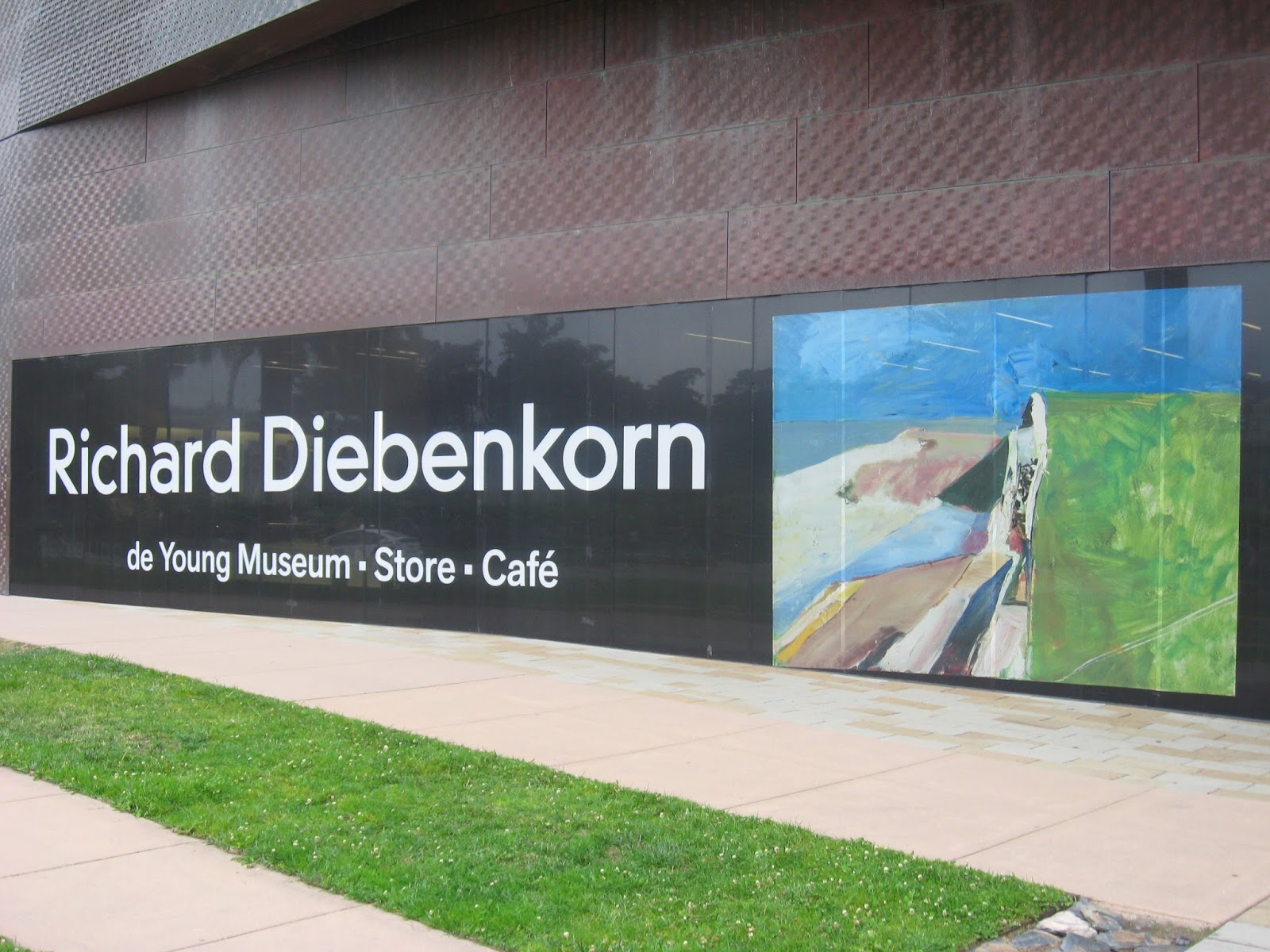
Richard Diebenkorn was profoundly influenced by the nature and culture of the San Francisco Bay Area. Color, light and atmosphere played a significant role in many of the 20th century American artist's works that are on view in Richard Diebenkorn: The Berkeley Years, 1953-1966, at the de Young Fine Arts Museum in San Francisco's Golden Gate Park through September 29.

The exhibition, which had its debut in June, is the first of its kind to focus on this pivotal period in the career of this postwar American artist.

During his lifetime, Diebenkorn (1922-1993) achieved acclaim as one of the most significant and influential artists of California and of postwar America. His early work is associated with Abstract expressionism and the Bay Area Figurative Movement of the 1950s and 1960s.

At the beginning of this exhibition of more than 130 paintings and drawings that were assembled from museums and private collections across the country, we get to go outside the lines to get a feel for what's going on in Diebenkorn's mind as he shares his thoughts in Notes to myself on beginning a painting:

  • Attempt what is not certain. Certainty may or may not come later. It may then be a valuable delusion.
  • The pretty, initial position, which falls short of completeness, is not to be valued -- except as a stimulus for further moves.
  • Do search. But in order to find other than what is searched for.
  • Use and respond to the initial fresh qualities, but consider them absolutely expendable.
  • Don't "discover" a subject -- of any kind.
  • Somehow don't be bored -- but if you must, use it in action. Use its destructive potential.
  • Mistakes can't be erased, but they move you from your present position.
  • Keep thinking about Pollyanna.
  • Tolerate chaos.
  • Be careful only in a perverse way.

Richard Diebenkorn /
Seated Figure with Hat, 1967,
oil on canvas.
Much of the art in Richard Diebenkorn: The Berkeley Years, 1953-1966 is devoted to a three-year period in which Diebenkorn "painted prolifically, his paintings, watercolors, and drawings synthesizing elements of nature with an abstract approach in what came to be known as his Berkeley series," according to the de Young's Fine Arts magazine, in previewing the show. Later in the exhibition, we see Diebenkorn's subsequent figurative phase, and it is easy to see and understand why he had a profound influence on American modernism.

As I walked through the exhibit rooms on a recent Friday evening, studying and absorbing Diebenkorn's artwork, my attention was drawn to several of the artist's quotes that were prominently displayed on the gallery walls. I took the time to read each of them carefully:

  • "Abstract means literally to draw from or separate. In this sense, every artist is abstract ... a realistic or non-objective approach makes no difference. The result is what counts."
  • "All paintings start out of a mood, out of a relationship with things or people, out of a complete visual impression."
  • "I began to feel that what I was really up to in painting, what I enjoyed almost exclusively, was altering -- changing what was before me -- by way of subtracting or juxtaposition or superimposition of different ideas."
  • "It was impossible to imagine doing a picture without it being a landscape; to try to make a painting space, a pure painting space, but always ending up with a figure against a ground."

After its San Francisco premiere, Richard Diebenkorn: The Berkeley Years, 1953-1966, will move to southern California and be on view at the Palm Springs Art Museum from October 26, 2013, to February 16, 2014.

To learn more about the Richard Diebenkorn exhibition at the de Young: http://diebenkorn.famsf.org/

Photograph of de Young Fine Arts Museum by Michael Dickens, 2013.
Photograph of Richard Diebenkorn's Seated Figure with Hat, 1967, courtesy of Wikipedia Commons.

Friday, September 6, 2013

Dateline Seattle: All the world's a fair in the Great Northleft


Left ...

Right ...

... and Center

Art in the Great Northleft. That's the description for this year's Bumbershoot, Seattle's annual showcase music and art festival, that wrapped up on Labor Day, just as it has every year since 1971. Bumbershoot is held on the grounds of the 74-acre Seattle Center, home of the iconic Seattle Space Needle.

Sunday at the Starbucks Stage /
Enjoying the Duke Robillard Band.
At this year's Bumbershoot, over the course of two days, my wife and I and friends enjoyed music by Death Cab For Cutie, Ra Ra Riot, Mates of State and the Duke Robillard Band and stand-up comedy by 30 Rock co-star Judah Friedlander, with whom we later enjoyed a serendipitous, five-minute conversation while walking about the Seattle Center grounds on Monday afternoon.

Also, we gathered for "Nerdprov", which crossed the streams of geek culture with comedic improvisation, as performed by the Seattle Experimental Theater; and we viewed a trio of Seattle International Film Festival Jury Award-winning one-reelers from Australia, Canada and Spain.

Bumbershoot at twilight.
I've visited Seattle nearly every year at this time for the last 20 years, and I never tire of going to Bumbershoot, drinking Seattle's best coffee, or taking photographs of the Space Needle, which was built for the 1962 Seattle World's Fair. As it happened, this year I could have left my umbrella at home for it stayed dry throughout the four days we visited the Emerald City.

Seattle's given us Starbucks in the seventies, grunge rock in the eighties and Amazon.com in the nineties. It's home to the Elliott Bay Book Company, one of the country's outstanding independent booksellers. There's a certain geeky, caffeinated quality to this northwest city that I enjoy, and it's only a two-hour flight up the Pacific coast from San Francisco.

"To some extent, Seattle remains a frontier metropolis, a place where people can experiment with their lives, and change and grow and make things happen," wrote Tom Robbins, the American author whose best-selling novels are "seriocomedies" that are often wildly poetic and told with strong social and philosophical undercurrents.

Indeed, all the world's a fair in the Great Northleft.

All photographs by Michael Dickens, copyright 2013.

Tuesday, August 27, 2013

Thoughts: Of Shakespeare, summer and sonnets


One of my favorite urban escapes is Shakespeare Garden, tucked away near the California Academy of Science and the de Young Fine Arts Museum in San Francisco's Golden Gate Park. It's quiet, serene, and meditative. It's filled with shady trees and an abundance of pretty flowers. There's even a sun dial.

The garden is absolutely beautiful. I love, love, love it.

At the entrance to Shakespeare Garden
in San Francisco's Golden Gate Park.

As the number of remaining summer weekends can be counted on one hand, it only seems fitting to take time out from our hurried lives and think fondly of Shakespeare, sonnets and summer days.

Shakespeare Garden sun dial /
Count only sunny hours.

Shall I compare thee to a summer's day?
Thou art more lovely and more temperate;
Rough winds do shake the darling buds of May,
And summer's lease hath all too short a date;

Sometime too hot the eye of heaven shines,
And too often is his gold complexion dimm'd;
And every fair from fair sometimes declines,
By chance or nature's changing course untrimm'd;

By thy eternal summer shall not fade,
Nor lose possession of that fair thou ow'st;
Nor shall Death brag thou wander'st in his shade,
When in eternal lines to time thou grow'st:

So long as men can breathe or eyes can see,
So long lives this and this gives life to thee.

~ William Shakespeare, Sonnet 18


Of Shakespeare, summer and sonnets.

The history of Shakespeare Garden in Golden Gate Park dates back to 1928 and was the brainchild of Alice Eastwood, who served as the long-running director of botany for the Academy of Sciences. The California Spring Blossom and Wildflower Association originally established the space as the Garden of Shakespeare's Flowers.

Flowers and plants have always played an important tool of imagery throughout Shakespeare's literary masterpieces. In this Shakespeare Garden, there are over 200 flowers and plants dotting the beautiful and colorful landscape, including: poppies, mandrakes, daisies, violets, lilies and roses.

The quiet and the beauty inside Shakespeare Garden /
Standing near the back wall looking towards the entrance.

All photographs of Shakespeare Garden by Michael Dickens, copyright 2013.