Saturday, November 24, 2018

Thoughts on art and travel: Revisiting an artistic interior

An artistic interior /
Interior of the Church of Saint Bavo
by Dutch artist Pieter Saenredam
As I ready to visit Europe next month for the first time in six years, I am reminded of the last time I crossed the Atlantic Ocean. It was during a spring holiday in 2012, and my travel included visits to Amsterdam and Brussels, with a quick day trip by train to Paris. As I recall, I spent part of a Sunday afternoon visiting the Rijksmuseum in Amsterdam. For me, spending time in art museums is always time well spent. And, if you're lucky like I was on that day, you just might learn something new, too.

In an exhibit featuring a retrospective of Dutch artists, I came across a 17th-century painting depicting the interior of the Saint Bavo Church in Haarlem, the Netherlands, by Pieter Jansz. Saenredam.

Saenredam (1597-1665), who was the son of a printmaker and draughtsman, painted this oil on panel of the light-filled interior of Saint Bavo Church in 1636. Saenredam painted no fewer than six "portraits" of Saint Bavo, considered by many as one of the finest Gothic buildings still in existence today. Each time, he focused on one of the organs. Here, he depicted the Resurrection of Christ on the open shutter of the organ. He mixed gold powder with his paint to represent the gold in the painting. In describing the ornamentation of this painting, the Rijksmuseum website wrote: 

"At the time Saenredam painted the Saint Bavo Church, leading music-lovers were campaigning for more organ music to be played in church services. Calvinist ministers object to organ music. Little music was played in church and psalms were sung unaccompanied. The ministers would rather have had no organs at all in church because they felt the beautifully decorated organs were evidence of ostentation and excess. Haarlem's music-lovers handed a petition to the town council, in which they asked to be allowed to use the organ, 'the ornament of the church', everyday. It is possible that Saenredam gave the organs a prominent position in his painting in support of this campaign."

(As an aside, the interior of the church, which was originally Roman Catholic, was stripped of all of its embellishments, including statues and paintings, by the Protestants following the iconoclasm of the Protestant Reformation.)

What I learned in researching the artist and the painting is this: Saenredam was the first Dutch painter to specialize in church interiors. His precise on-the-spot observations and detailed perspectives helped us to have a better understanding and appreciation for these architectural marvels. And, through the addition of including tiny figures, he helped to emphasize the height and immensity of the church. Finally, in some of his interior paintings, the artist used a central perspective: All the lines in the painting disappear in a single point.

The Getty Center in Los Angeles, California, which owns one of Saenredam's interior paintings of Saint Bavo, commented on his work in its website:

"The overall impression is one of strong verticality, soaring space, and penetrating light, a spiritual reference to the heavens above. The inclusion of small figures accentuate the viewer's experience of exalted interior space. Saenredam described architectural elements in great detail: vaulted ceilings, moldings, decorative capitals, clustered pillars, and clerestory windows."

Saenredam made his first drawing of the interior of the church of Saint Bavo in 1626. From then on, he devoted himself almost exclusively to painting church interiors, always using precise perspective. Of his fifty surviving paintings, almost half show the interiors of two churches, Saint Bavo and the Mariakerk in Utrecht.

What can we learn from Saenredam's sacred interior spaces? For one, they were designed for contemplation. Unlike others whose paintings evoked a certain type of pomp, pageantry, and theatre that was usually seen in Roman Catholic churches, Saenredam's surprisingly modern paintings evoked "the whitewashed austerity of the Dutch Reformed church," says the Getty Center.

In describing Saenredam's style and viewpoint, the Getty Center said: "There are no processions, no clusters of worshippers at shrines. He adopted a very low viewpoint and a palette restricted to the palest of tones, and allowed few people into his bare interiors. He concentrated on depicting light, color, and space. Many Dutch artists continued his tradition, but few equaled his inventive vision." 

Indeed, Saenredam's painting of the interior of the Church of Saint Bavo owes its poetry to his desire to paint a faithful rendering, one that is careful and accurate.

Note: An original version of this blog post was published on July 10, 2012.

Tuesday, November 20, 2018

On art and fashion: Contemporary Muslim Fashions

Thanks to social media, I have become Facebook friends with several Tunisian women, all whom are Muslim. Some of them cover their heads in colorful headscarves, known as hijabs; most do not. Each have become individuals of style within and beyond their communities in this North African country bordered by Algeria, Libya and the Mediterranean Sea, as I’ve learned firsthand through many thoughtful online conversations. While the nature of the Muslim dress code worldwide is a complex and diverse one, like it or not, Muslim fashion has become part of the mass-media’s attention drawn to contemporary Muslim life.
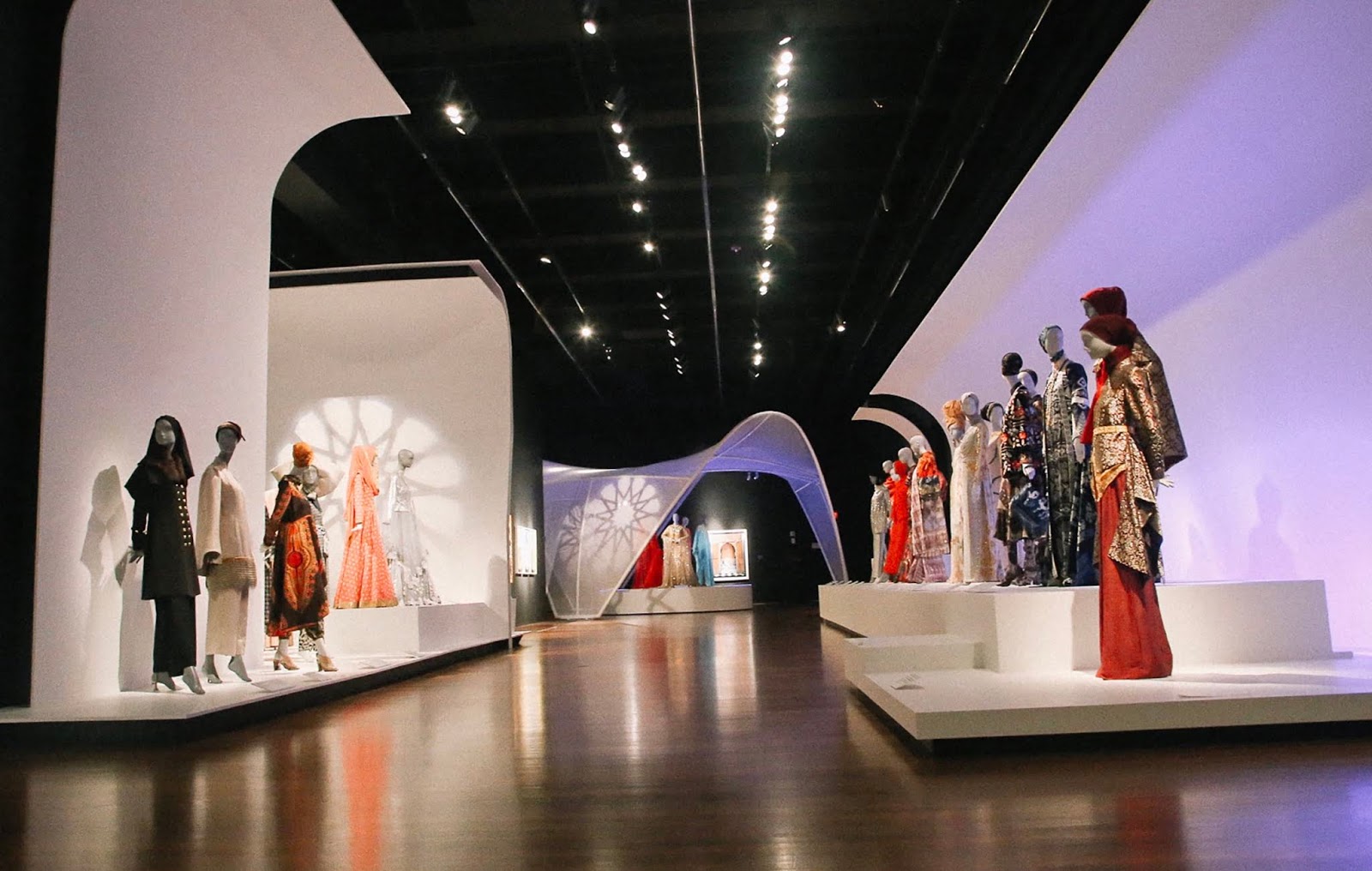
Currently, the deYoung Fine Arts Museum in San Francisco is examining Contemporary Muslim Fashions by “spotlighting places, garments, and styles from around the world,” in a show that began in late September and continues through January 6, 2019.

Contemporary Muslim Fashions is the first major museum exhibition to explore “the complex, diverse nature of Muslim dress codes worldwide” by bringing together different religious interpretations and cultures of Islam. The creativity and diversity – and politics – of modest dressing is celebrated.


I’ve learned that this exhibition considers “how Muslims define themselves – and are defined – by their dress and how these sartorial choices can reflect the multifaceted nature of their identities.”

Contemporary Muslim Fashions crosses through many different religious interpretations and cultures, featuring spectacular creations from a dynamic fashion scene by designers from both the Middle East and Southeast Asia – think Malaysia and Indonesia. From street wear to couture, the exhibition includes “high-end fashions, such as those by Malaysia-based Blancheur; street wear, such as modest designs from London-based Sarah Elenany; sportswear, such as the burkini; and commissioned garments from both emerging and established designers.”


The exhibition also includes the use of social media as a primary material – an agent of change. Muslim voices and personal narratives are framed by using runway footage of fashion shows and news clips as well as documentary and fashion photography.

As visitors to Contemporary Muslim Fashions will learn, while Islam is a multicultural faith, the dress of its followers is “shaped not only by religious principles but also by local customs and traditions and global fashion trends.” Thus, a woman from Tunisia is more likely to be contemporary in her fashion attire than a woman living in Saudi Arabia.


In her review of Contemporary Muslim Fashions for The Hollywood Reporter, critic Celine Semaan wrote, “Because of the current political climate from which it is rising, the show carries a message of hope and acceptance. The act itself of organizing this exhibition is nothing if not a peaceful demonstration of the American values written in the First Amendment: freedom of speech, freedom of expression, freedom of religion.”

Laird Borrelli-Persson of Vogue, in reviewing Contemporary Muslim Fashions, quotes curator Jill D’Alessandro, who believes, “Fashion can be an agent for positive change, for understanding, and breaking down barriers; they (fashion designers) want to exhibit in the United States and in Europe because they want their cultures to be understood.”

One thing’s for sure: There’s a diversity in Muslim fashion that is strikingly beautiful, both for its modern aesthetic and for its street-style appeal.

Photos: Cover – Mary Katrantzou skirt and shirt (silk and polyester), and Malone Souliers shoes.  Bottom – Flight jacket with U.S. Constitution written in Arabic on the back and First Amendment written in English inside, by Slow Factory (Courtesy of deYoung Museum and Google Images). Video: Courtesy of YouTube.com.

Tuesday, November 13, 2018

Thoughts on Elvis Costello: Look Now and Then

Elvis Costello / The master storyteller at the
DAR Constitution Hall, in Washington, D.C.

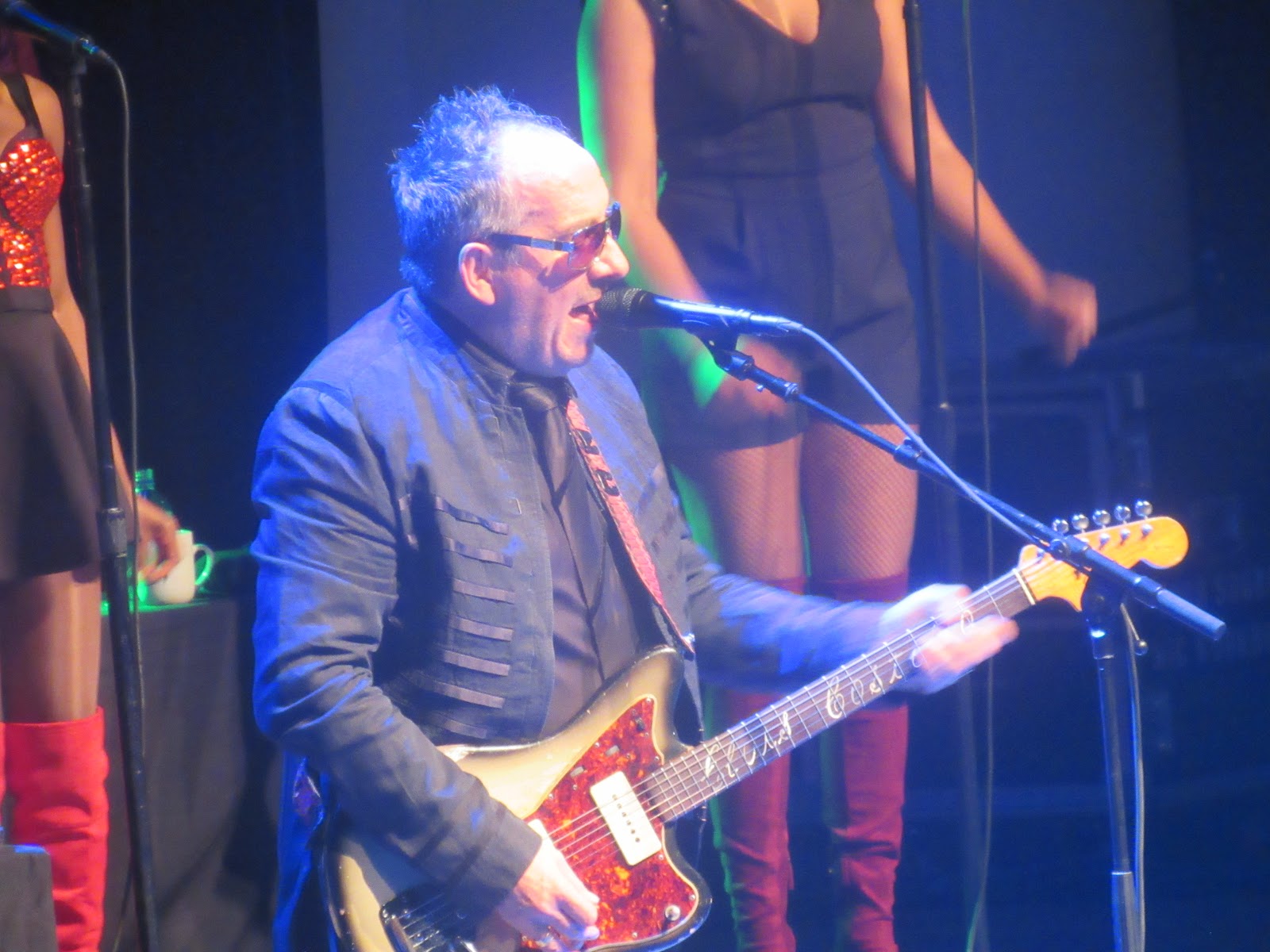
Elvis Costello knows how to charm the pants off an audience. He’s done it successfully for more than 40 years as one of his generation’s greatest songwriters and performers. He’s worked diligently at his craft to attain a special place in the music world. Whether with a simple wink, a friendly smile, or just the right choice of words and upbeat tone of voice, the bespectacled and iconic English musician, who was once described by a critic as a “pop encyclopedia,” has become a master of the craft of storytelling.

Now, healthy again after recovering from surgery for a small but very aggressive cancerous malignancy, Costello once again is delighting crowds with his good-natured manner and geniality of performing. He’s taking great care not only of himself, but also the stories he’s sharing with his audiences, through their lyrics and unusual combination of musical instruments.

On November 4, at the DAR Constitution Hall in Washington, D.C., in just the third night of his current 20 city “Look Now and Then ...” tour – and in what was my 12th Elvis Costello adventure – I saw a show like no other he’s given, and I’ve seen Elvis perform solo; with his various backing bands, including the Attractions, the Imposters, and the Sugarcanes; in a duet show with his longtime keyboardist Steve Nieve; accompanied by the late extraordinary New Orleans pianist Allen Toussaint backed with a brass horn section – even dressed to the nines in a black tuxedo performing with the San Francisco Symphony.

Musically, throughout the evening’s two-and-one-half-hour performance, accompanied by the always sharp and in-form Imposters (Nieve on a variety of keyboards, drummer Pete Thomas, and bassist Davey Faragher) and joined by vocalists Kitten Kuroi and Briana Lee, who added soulful backing harmonies to new songs such as “Unwanted Number” and the classic “Alison,” the 64-year-old Costello moved freely between introducing 10 new “uptown pop” songs from his recently-released album ‘Look Now’ such as “Burnt Sugar Is So Bitter,” which he co-wrote with Carole King; “Don’t Look Now” and “Under Lime.” There’s a little bit of swagger in Costello these days and as one critic recently remarked, the new material is “full of rich characters loaded with desire and heartache.” Costello also dug into his vast catalog of spinning-wheel classics to share “This Year’s Girl,” which has been remade into the theme song for the HBO series “The Deuce;” “Clubland,” “Green Shirt,” “Watching the Detectives,” (performed as a spacey solo under a green spotlight for full visual affect); “Pump It Up,” and “(What’s So Funny ‘Bout) Peace, Love and Understanding.”

Truly a music fan, Costello delights in championing the works of other musicians, from country star George Jones to rock guitarist and producer T Bone Burnett to influential Philadelphia hip-hop band The Roots – even former Beatles icon Paul McCartney – to name just a few whom he’s collaborated with over the years. Whether immersing himself in pop, rock and roll, country, Americana, soul or jazz, among the many genres that he’s mastered over many years, in concert Costello shares many of the lessons he learned and we’re rewarded with songs that are as literate as they are artful.

On ‘Look Now,’ Costello has revisited his partnership with Burt Bacharach, himself a master songwriter, on three impressionistic tunes, “Don’t Look Now,” “Photographs Can Lie,” and “He’s Given Me Things.” Bacharach’s piano lines, as interpreted and performed live by Nieve, are both poignant and beautiful – and reminded me of some of Bacharach’s brilliant late ‘60 pop collaborations with lyricist Hal David.

Throughout the show’s 27 songs, Costello showed he can be acerbic and witty, as well as lamenting and sad. There’s a fine balance between rock and balladry in a Costello performance. As his Washington, D.C. concert reminded us, his shows have become more than an exercise in nostalgia and pastiche. I have no doubt that this tour will be a triumph for Costello, providing him with an opportunity for enlivening his mastery of the songwriting form – and with a keen dramatist’s eye, too.

Because of Costello’s desire to showcase his new songs, his show is now very much of the present. Collectively, his body of work is that of adept storyteller who’s learned more than a few things from the past. On this night, Costello took his mostly baby-boomer audience on a musical journey through his expansive songbook that was not only intimate and entertaining, but also humbling and inspiring.

Elvis Costello’s DAR Constitution Hall, Washington, D.C., set list:

Main set: This Year’s Girl / Honey, Are You Straight or Are You Blind? / Clubland / Don’t Look Now / Burnt Sugar Is So Bitter / Green Shirt / Photographs Can Lie / Temptation / Brilliant Mistake / Why Won’t Heaven Help Me? / Under Lime / Watching the Dectectives / Deep Dark Truthful Mirror / He’s Given Me Things / Unwanted Number / High Fidelity / Alison / Everyday I Write the Book.

First encore: Stripping Paper / Suspect My Tears / (I Don’t Want to Go to) Chelsea / Mr. and Mrs. Hush / Pump It Up.

Second encore: A Face in the Crowd / Blood & Hot Sauce / American Gangster Time / (What’s So Funny ‘Bout) Peace, Love and Understanding.


All photos: © Michael Dickens, 2018.

Tuesday, November 6, 2018

Thoughts on books: Leadership in turbulent times

Today is Election Day in the United States and throughout America, the mid-term elections serve as a referendum on the direction of our country under President Donald J. Trump. Are we content with the everyday chaos coming out of the White House or do we hearken for something better?

We’re reminded that when the U.S. has been at odds with itself, a born leader has come along to remind us of the common causes we share – and just as important, of our shared humanity. Think back to when Barack Obama became the first black elected President of the United States 10 years ago this week. It seems like such a long time ago, that chilly Election Night victory speech in Chicago’s Grant Park, when one voice changed the world.

However, with the U.S. becoming more deeply divided by the hate, fear, deviciveness and lies that have characterized the first two years of the Trump presidency, it’s worth looking back to some of our country’s past presidents – Abraham Lincoln, Theodore Roosevelt, Franklin Roosevelt and Lyndon Johnson – all of them leaders, to see if they have something to teach us about the challengers we face as a nation today.

In Leadership in Turbulent Times, published by Simon & Schuster in September, Pulitzer Prize-winning author and historian Doris Kearns Goodwin draws upon the four presidents she has studied most closely – Lincoln, both Roosevelts and Johnson – to show how each recognized leadership qualities within themselves and were recognized as leaders by others.

Seven questions are explored in great detail in Leadership, which form the foundation of Goodwin’s book. They are: Are leaders born or made? Where does ambition come from? How does adversity affect the growth of leadership? Do the times make the leader or does the leader shape the times? How can a leader infuse a sense of purpose and meaning into people’s lives? What is the difference between power, title, and leadership? Is leadership possible without a purpose larger than personal ambition?

The blogger meets the author.
According to Goodwin, “No common pattern describes the trajectory of leadership. Although set apart in background, abilities, and temperament, these men shared a fierce ambition and a deep-seated resilience that enabled them to surmount uncommon hardships. At their best, all four were guided by a sense of moral purpose. At moments of great challenge, they were able to summon their talents to enlarge the opportunities and lives of others.”

In a recent interview with The History Channel, Goodwin said that leadership is elusive because one size does not fit all. “In my book, I have sought to make the concept of leadership less abstract and more practical through specific stories that can provide a guide and inspiration to show how – with ambition, self-reflection and perseverance – leadership skills can be developed and strengthened.

“Through my study of leadership these past five years, I found a family resemblance of traits and patterns of behavior – among them humility, empathy, resilience, courage; the ability to replenish energy, listen to diverse opinions, control negative impulses, connect with all manner of people, communicate through stories and keep one’s word. ... They remind us of what is needed today.”

On Abraham Lincoln, Goodwin characterized the 16th President by writing: “Confident and humble, persistent and patient, Abraham Lincoln had the ability to mediate among different factions of his party, and was able, through his gift for language, to translate the meaning of the struggle into words of matchless force, clarity and beauty.”

We should be grateful for Goodwin’s book – she offers heartening examples of leadership from the past in the hope that “we will not accept our current uncivil polarization as the norm.”

Goodwin hopes that Leadership will provide reassurance through the study and stories of “my guys,” who set forth a template of shared purpose, collaboration and compromise – “the best of our collective identity in times of trouble.”

Leadership in Turbulent Times is timely – very timely – and it’s timeless at the same time.

Tuesday, October 30, 2018

Thoughts on food: Fix me a plate, please


On “Fix Me a Plate,” world-renowned chef Alex Guarnaschelli’s weekly web series, the quintessential New Yorker shows us in delightful four-and-five-minute bites that she knows just where to go for a truly New York food experience.

Guarnaschelli, a Food Network star recognized for her work as a "Chopped" judge and an "Iron Chef," has selected old-school cafes and restaurants throughout New York’s five boroughs to highlight on “Fix Me a Plate.” These are places where one can still get fresh and authentic, quality-made dishes. Most of these are no-frills establishments – hangouts, if you will – that are filled with longtime traditions and plenty of charm.

In each episode, Guarnaschelli explores a different iconic New York eatery “that has built its success on a confidence and connection to doing things the way they’ve always been done.”

In the first six episodes of “Fix Me a Plate,” Guarnaschelli visits Lucali – think best pizza in Brooklyn – then, follows it with soulful chicken and waffles at Amy Ruth’s in Harlem. Need we say more? She also stops by Tanoreen in Bay Ridge, Brooklyn, for traditional Middle Eastern cuisine, and Nom Wah Tea Parlor, a Chinatown delight that serves a variety of treats from egg rolls to almond cookies. Finally, there’s Indian samosas at Dhaka in Queens, and Russ and Daughters on the Lower East Side for bagels piled high with cream cheese and lox.


Recently, “Fix Me a Plate” returned with a new season of shows that so far has served up Polish pierogi at Krolewskie Jadlo in Williamsburg, Brooklyn; tacos at Rockaway Beach Surf Club on Long Island, and doughnuts at the Donut Pub in Chelsea. Also, there’s been Thai at Brooklyn’s Pok Pok, the knock-out combo of Sicilian-style square pizza and Italian spumoni ice cream at Spumoni Garden in Bensonhurst, Brooklyn; and chopped liver at Sammy’ Roumanian in lower Manhattan. This week, “Fix Me a Plate” introduced viewers to the Original Crab Shanty in City Island by the Bronx for a family-style portion size of pasta with crabs and lobster.

Asked via Twitter if she has a favorite episode of “Fix Me a Plate,” Guarnaschelli tweeted, “Spumoni Garden obviously. Also love Sammy’s Roumanian and a couple of others that haven’t aired yet.”

New episodes of “Fix Me a Plate” debut weekly on the show’s Facebook page on Monday evenings.


Tuesday, October 23, 2018

Ambition with talent: Costello is back with “Look Now”


In a recent Q & A with the London-based Financial Times, Elvis Costello was asked: Which matters more to success, ambition or talent? The 64-year-old English troubadour answered matter-of-factly, “Once upon a time, I would have said ambition without talent was worthless. Now I’m not so sure.”

Earlier this month, the ambitious – and extraordinarily talented – Costello released his first new album with his band The Imposters in 10 years, the cohesive Look Now, on Concord Records. One critic mused that “it’s not just craft but touch, not just energy but sensitivity. On Look Now, Costello and The Imposters have both.”

After Costello revealed earlier this year he had survived a bout with a “small but very aggressive” cancer, word of a new album was very welcome news. Produced by Costello and Sebastian Krys, the songs comprising Look Now represent some of Costello’s best career work. His sophisticated and transforming songbook runneth over with simplicity and immediacy. 

Elvis Costello
Whether immersing himself in pop, rock and roll, country, Americana, soul or jazz, among the many genres that he’s mastered over many years, Costello shares many lessons learned and we’re rewarded with songs that are as literate as they are artful. The gifted storyteller has returned in fine form.

Costello, who paired with Burt Bacharach on 1998’s Painted From Memory, has reunited with the master songwriter on three impressionistic tunes, “Don’t Look Now,” “Photographs Can Lie,” and “He’s Given Me Things.” Bacharach’s piano lines are both poignant and beautiful – and reminded me of some of his brilliant late ‘60s pop collaborations with lyricist Hal David. Costello also penned “Burnt Sugar Is So Bitter” with another songwriting giant, Carole King, that is soulful with its female choir. Throughout the album, Costello can still be acerbic and witty, lamenting and sad in his lyrics. There's a fine balance between rock and balladry in Look Now.

As one critic noted, "Look Now is much more than an exercise in nostalgia and pastiche. As the title implies, it’s very much of the present, and the work of a master storyteller who’s learned more than a few things from the past.”

In a recent Pitchfork review, its critic concluded, “As a collection of tunes, Look Now is a triumph for Costello, a showcase for how he can enliven a mastery of form with a dramatist’s eye. But as an album, Look Now is a success because of the Imposters. ... They are a sharp, supple outfit that can swing and sigh, sometimes within the same number, as when they effortlessly pivot between boss’s nova verses and a radiant chorus during 'Why Won’t Heaven Help Me?' This subtle sophistication and palpable flair make Look Now more than a mere set of songs – it’s a record worth getting lost within.”

Saturday, October 20, 2018

Thoughts on tennis: Nadal, Djokovic must break silence

Are Rafael Nadal and Novak Djokovic
being used as sporting pawns?

The boldfaced headline in Thursday’s Times of London newspaper spoke loudly: “Novak Djokovic and Rafael Nadal warned over Saudi Arabia event.” In a story by tennis correspondent Stuart Fraser, he wrote that the two tennis superstars “have been warned that their participation in a lucrative exhibition in Saudi Arabia in December could be used used by the country’s controversial regime as ‘a form of sportswashing.’”

While Saudi Arabia has always been viewed as a prominent destination for conducting global big business, tennis – I have learned – is part of a growing Saudi sports propaganda program. Mind you, Saudi Arabia has little or no history when it comes to professional sports. Besides tennis, it has shown recent interest in bringing motor racing, boxing, football – even pro wrestling – to the Arab empire.

Now is the time for Nadal and Djokovic, currently ranked No.1 and No. 2 in the world, to use their global popularity to bring attention to the “truly appalling” human rights record of Saudi Arabia, warns Amnesty International. The world human rights organization made its plea in the aftermath of the disappearance and murder of Saudi journalist Jamal Khashoggi, who for the past year had been writing global op-ed pieces for the Washington Post while living in exile in the United States. Many of Khashoggi’s writings were critical of Crown Prince Mohammed bin Salman and the Saudi royal family.

A day after news about Khashoggi’s disappearance surfaced, a tennis exhibition match billed as the King Salman Tennis Championship in Jeddah, between Nadal and Djokovic, was announced. The financially attractive, end-of-the-year exhibition scheduled for December 22, would see each participant make at least $1 million. Under the present circumstances, it would seem to fly in the face of their humanitarian outlook.

Since the news about Khashoggi emerged, dozens of global business and media conglomerates have withdrawn from attending an upcoming international conference in Riyadh, billed as the Future Investment Initiative – among them: Bloomberg, CNBC, CNN, the Financial Times, the New York Times, the Los Angeles Times, Viacom and the World Bank president, Jim Yong Kim.

In a recent sports blog for The Guardian of London, sports writer Kevin Mitchell notes “the two players appear to have remained deaf to growing clamor over seeming endorsement of Saudi Arabia.” He calls both Nadal and Djokovic “men of conscience and integrity,” but warms they “continue to risk their good name by accepting an invitation to play in a meaningless exhibition in Saudi Arabia, a regime under critical scrutiny for the disappearance of the journalist Jamal Khashoggi.”

(Since the publication of Mitchell’s blog, early Saturday Saudi Arabia confirmed that Khashoggi was dead. He was killed inside the Saudi consulate in Istanbul, Turkey.)

Indeed, I agree with Mitchell. Perhaps, it’s as if both players are waiting for the international embarrassment to pass. Yet, I have to wonder if either is oblivious to the growing criticism that’s gathering around them. Or, simply, are they ignorant of the seriousnous of the greater issue?

“Neither is a good look for athletes who have always been aware of their wider responsibilities,” writes Mitchell. After all, both have foundations that help disadvantaged youth through tennis. Plus, Nadal was widely seen – thanks to social media – helping clear debris in his native Majorca after recent floods hit the Spanish island, and Djokovic has been active in campaigning for flood relief in his home country of Serbia. Bottom line: both Nadal and Djokovic are decent gentlemen.

In hindsight, one wonders whatever possessed Nadal and Djokovic to agree to play in the Saudi exhibition in the first place? Certainly, they don’t need the money. Although December exhibitions in various corners of the world are common and bring the sport to cities not already on the ATP World Tour schedule, the tennis season is already much too long. Pulling out now would make a statement about how the world should view Saudi Arabia’s behavior and pattern of state-sanctioned killing.

I would hate to see Nadal and Djokovic continue to be used as sporting pawns – displayed before a world-wide audience – flaunted by the Saudi government to distract us from their murderous regime. They need to break their silence now.

Tuesday, October 16, 2018

Thoughts on TV: NBA's LeBron James is unfiltered on HBO’s The Shop – In the barbershop you can’t lie.


Imagine watching an unfiltered conversation and debate featuring four-time NBA most valuable player LeBron James and other big names from sports and entertainment.

It’s all happening down at The Shop, which debuted as a periodic series this summer on HBO. James’s latest off-the-court vehicle gives viewers a “one-of-a-kind barbershop experience, which for many provides a sanctuary for free-flowing and spirited discussions.” It’s really good TV, folks. What’s not to like about seeing James and his friends sipping on some wine and dropping a few swear words while offering viewers a side of themselves that we rarely get to see?

The idea behind this open-forum series, a collaboration between James and Maverick Carter’s digital media company, Uninterrupted, is to visit barbershops around the country and gather groups of distinguished individuals – athletes who want to be entertainers and entertainers who envy athletes – who are free to speak honestly on sports, music, pop culture, race, current events, business and other “culturally relevant” topics. The half-hour program is unscripted and features a no holds barred attitude. Sure, there's the upfront adult language disclaimer at the start of each episode. Yet, it’s not as if we’ve never heard an occasional F-bomb dropped in the course of mature and frank conversation between mature adults.


Episode 2 of The Shop premiered last Friday night on HBO, and among those joining James were the hip-hop artist Drake, who opened up about the struggle to retire gracefully, the rules of hip-hop, and his on-going feud with Kanye West.

“I think maybe one of my biggest concerns in my career is just to figure out how to exit gracefully,” Drake admits during the broadcast. “I’ve watched people overstay their welcome, and I just don’t ever want to be that guy that’s addicted to the feeling of victory, addicted to the emotion of people digesting something that they love, and get to the point I’m just feeding them something and they’re just like, ‘Yeah.’”

Says James: “I’d rather fail being who I am than fail being somebody they want me to be.”

At The Shop / 
(L-R) Maverick Carter, LeBron James, Drake.

Both Drake and James shared thoughts about their evolving approaches to fatherhood and how each were influenced by their relationships with their parents. Joining in the conversation were pro basketball stars Ben Simmons of the Philadelphia 76ers, WNBA All-Star Elena Della Donne of the Washington Mystics, Indiana Pacers guard Victor Oladipo and NBA rookie Mo Bamba of the Orlando Magic, who spoke about their “rapidly evolving” careers.

The current episode follows up on last month’s candidly raw Episode 1, which established the show’s parameters, and featured former Daily Show host and Emmy and Peabody Award-winner Jon Stewart, rap icon Snoop Dogg, New York Giants wide receiver Odell Beckham Jr., Golden State Warriors star Draymond Green and WNBA most valuable player Candace Parker "deconstructing their success," as one critic wrote.

“Anyone who has been in a real barbershop, like the ones where I grew up, knows why this show can be so incredible,” said James, 33, a native of Akron, Ohio. “The Shop is exactly why we created Uninterrupted. I’m really excited HBO believed our idea and is helping us create something special.”


Photos: Courtesy of HBO Sports.
Videos: Courtesy of YouTube.com.


Tuesday, October 9, 2018

Thoughts on David Hockney’s “The Queen’s Window” – A country scene to honor a lover of the countryside


Last week, Westminster Abbey commemorated the 65th anniversary of Queen Elizabeth’s reign with a dedication ceremony of “The Queen’s Window,” created by British pop art icon David Hockney. Measuring 28 feet by 12 feet, “The Queen’s Window” represents what the New York Times described as “a hawthorn, a thorny floral shrub, blooming in a joyous profusion of reds, blues, greens and yellows.”


In a video interview posted by the Abbey, Hockney said of the newly revealed window, “It’s celebratory.” He revealed that he crafted the trees to look as though “Champagne had been poured over bushes.”

What is remarkable is that Hockney reworked the design for the Abbey window from an earlier painting using a iPad, which has become one of his favorite tools for creating art in recent years. At age 81, he’s been known to use new technology quite extensively – such as cameras, photo copiers and fax machines – throughout his remarkable and colorful career. It has liberated Hockney as an artist and set him apart from others who rely solely on the use of traditional materials.

“For many years, I pondered how we should celebrate The Queen’s reign in the Abbey,” the Very Rev. Dr. John Hall, dean of the church, said, during the dedication of “The Queen’s Window” on Oct. 2, inside London’s Westminster Abbey. “A statue seemed wrong, though there are many from earlier centuries. We already have a portrait of Her Majesty in the Diamond Jubilee Galleries. A stained glass window seemed the obvious thing, and a great window was available, a double lancet surmounted by a circular oculus containing sexfoil tracery, on the west side of the North Transept, the only window there without stained glass.”

Hockney, whom I learned had never before designed stained glass, came to see the window and the next day sent Hall a draft design. The dean responded to Hockney in kind: “As I wished not herald or representational, but a country scene to honor someone we know to be a lover of the countryside, a design evocative of his work in East Yorkshire.”

As the “most celebrated living artist,” in the words of Hall, Hockney seemed a natural fit for creating “The Queen’s Window.” After all, his fame coincided with the queen’s reign. The dean has called Hockney’s work, “absolutely vibrant.” He was quoted by the New York Times as saying: “It’s very legible, so in that sense it’s very accessible, and I think people will be very excited by it.”

Hockney collaborated on “The Queen’s Window” with stained glass experts at Barley Studio in northern England. He’s happy with the final outcome.

Said Hockney: “I think it’s looking marvelous!”


Photograph: Courtesy of Google Images. 
Videos: Courtesy of Westminster Abbey.


Tuesday, October 2, 2018

Thoughts on music: Cécile McLorin Salvant


When I recently listened to Cécile McLorin Salvant sing the hard-hitting “Okie Wise,” during an NPR “Tiny Desk Concert,” I was awed by the way in which she embraced the discomforting theme of this acapella American folk song with both calmness and ease. “Okie Wise,” which tells a tragic story of a murder victim, Naomi Wise and her husband and killer, John Lewis, addresses gender-based violence head on and McLorin Savant places it in a historical context, too.

Then pushed her in deep waters
Where he knew that she would drown
He jumped on his pony and away he did ride
The screams of little Okie went down by his side.

I’ve always been impressed by the powerful sound and range of the Miami-native McLorin Salvant’s voice and her choice of songs. She can at times sing spiritually, and other times jazzy, but always – always – it’s her voice that’s both superb and exquisite in its sound and in its presentation. Little did I realize that as a teen, McLorin Salvant, 29, the son of a Haitian father and French mother, once sported a Mohawk hairdo and was into bands like Alice In Chains and other “radical feminist punk stuff,” she recently was quoted as saying in an NPR interview. “Sometimes I still really like Bikini Hill, and I still have my little Pearl Jam grunge moments.”

I first became acquainted with McLorin Salvant a few years ago when she was a featured guest vocalist during a Jazz at Lincoln Center Orchestra holiday concert, and have always thought of her first and foremost as a jazz vocalist – think of her as a young Sarah Vaughan. I still remember how much expressiveness came across in her voice – not to mention that she exuded such a wonderful vocal foundation thanks to a classical music upbringing.

McLorin Salvant’s set list for her recent “Tiny Desk Concert,” which featured, “Fog,” “Look At Me,” “Monday” and “Okie Wise,” showed off the depth and breadth of her vocal range. Her just released fifth album, The Window, is a series of duets with pianist Sullivan Fortner that “explores and extends the tradition of the piano-vocal duo and its expressive possibilities.” Throughout, we see how “the two are free to improvise and rhapsodize, to play freely with time, harmony, melody and phrasing.”

On The Window, McLorin Salvant covers Leonard Bernstein’s “Somewhere” from West Side Story and “Were Thine That Special Face” by Cole Porter. Plus, she sings in French on two songs, her own composition “A Clef” and “J’ai L’Cafard.”

McLorin Salvant isn't interested in the idea of relevance – although being a Grammy Award-winning artist has given her credibility and drawn much attention toward her music. Instead, as she noted in a press release for The Window, she’s interested in the idea of presence. Nothing wrong at all with that kind of attitude.