Wednesday, August 22, 2018

On urban travel: Philadelphia Faces

The Signer / Commemorates the spirits and 
deeds of all who devoted their lives
 to the cause of American freedom. 

In October 1682, the Quaker William Penn founded the city of Philadelphia between the banks of the Delaware and Schuylkill rivers in the English Crown Province of Pennsylvania. Within a century, Penn’s “greene countrie town” in eastern Pennsylvania became one of the largest cities in the British Empire with 25,000 inhabitants. By 1790, the year in which the federal capital moved to Philadelphia, the city’s population exceeded 44,000.

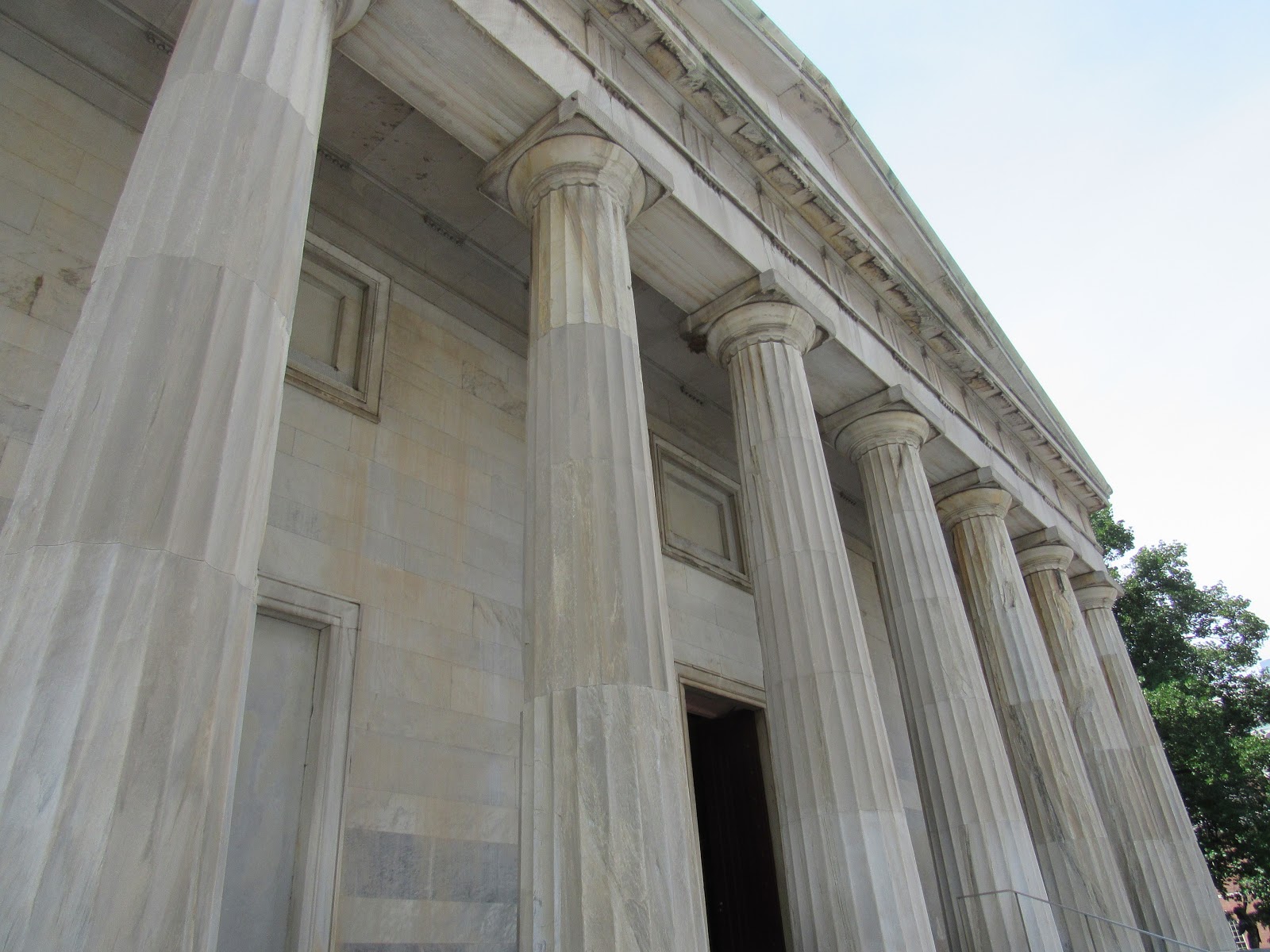
Second Bank of the U.S.
Among the positives of Philadelphia’s rapid 18th century growth, which included the creation of many broad avenues and large city blocks, one need only look at the addition of many languages and cultures to the city’s streets (north-south streets are numbered while east-west streets are named). I learned through a recent visit to the Portrait Gallery at the Second Bank of the U.S. in Philadelphia’s historic Old City district that Europeans throughout the Western world arrived here “to be able to worship freely, to lobby political leaders,” and “to pursue economic gain.” Also, “other cultures brought by free blacks from the Caribbean and enslaved Africans transported across the Atlantic added to Philadelphia’s cosmopolitan character and bustling economy.”

Meanwhile, Philadelphians also experienced many of the same challenges that a young American nation faced, too. As a city, Philadelphia was trying to transform from being a colonial outpost into an independent nation. “Personal experience with the political, economic, and cultural changes sweeping America after the Revolution made life for Philadelphians a mixture of tradition and innovation.”

Benjamin Franklin
Walk about the city – especially in Independence National Historic Park (which includes the Liberty Bell and Independence Hall) and in the Old City – and you’ll see that Philadelphia is Benjamin Franklin’s city. He was the city’s favorite son as well as an innovator and a difference maker.

Franklin’s likeness is found on banners and especially in paintings and sculptures. Beyond, the football stadium on the Ivy League campus of the University of Pennsylvania is named Franklin Field.

Franklin (1706-1790), I learned, was a “true son of the Enlightenment – a self-educated, runaway apprentice who translated his skill as a printer into a prosperous business.”

Although Franklin portrayed himself as a self-made man, in truth he benefited from the assists of many en route to achieving prosperity. In return, Franklin founded many organizations, including the Leather Apron Club and the Library Company of Philadelphia to benefit others. “His civic contributions improved safety, education, and health care in Philadelphia.”

Walking in Rittenhouse Square
During our brief stay in Philadelphia, we enjoyed a pre-dinner stroll through Rittenhouse Square, which at 7 o’clock on a Friday evening was lively with a mixture of millennials, families with dogs, and tourists snapping photographs of the many sculptures that dot the landscape. Of note, on the western side of the square is the Romanesque-style Church of the Holy Trinity, an Episcopal church designed by the Scottish architect John Notman. The first service was held there on March 27, 1859. Afterward, we enjoyed a sausage pizza and glass of wine at Pietro’s (1714 Walnut St.) that was followed by dessert at Capogiro Gelato Artisans (117 S. 20th St.).

On Saturday, we walked from the Hotel Palomar (117 S. 17th St.) to the lively Reading Terminal Market (corner of Market and N. 12th St.) for breakfast crepes at Profi’s Crêperie and a sinfully delicious maple bacon doughnut from Beiler’s Bakery followed by a walk around Independence Square. Later, we rode the Broad Street SEPTA train to Citizens Bank Ballpark to enjoy an afternoon Phillies-Mets baseball game. A quiet Saturday evening dinner at Le Pain Quotidien (1425 Walnut St.), a favorite of ours wherever we travel, was a nice way to relax after the ballgame. A steady, Sunday morning rain after breakfast kept us inside our hotel until it was time to return to the 30th Street Amtrak Station for our trip home.

Citizens Bank Ballpark
Today, the “city of Brotherly Love” (and sisterly affection) is an exceptional cultural and business center, easily accessible by Amtrak train (about two hours north of Washington, D.C., and 1.5 hours south from New York City’s Penn Station).

From Fairmount Park, home to major museums and sculpture gardens, the Philadelphia Zoo and 215 miles of biking and jogging paths, to South Philly, home to Philadelphia’s professional sports teams at Citizens Bank Ballpark (Phillies), Lincoln Financial Field (Eagles) and Well Fargo Center (76ers and Flyers), Philadelphia is a city where independent thinking – and free expression – is both revered and celebrated.

Photos: By Michael Dickens © 2018.

Tuesday, August 14, 2018

A few minutes with Ted Robinson: "Sometimes, winning is measured by giving everything you have at 3 a.m. ..."

Ted Robinson
Ted Robinson calls a variety of sports each year, including American professional and collegiate football and college basketball, on both cable and network TV and on radio. Every two years, he serves as an NBC Sports Olympics play-by-play broadcaster, commenting on a variety of sports such as short-track speed skating, springboard and platform diving, tennis and baseball. However, for many American sports fans on a national level, he’s most identified for his body of work as a tennis play-by-play commentator.

Since 2000, Robinson has anchored NBC’s tennis coverage. He’s called every French Open final alongside John McEnroe and Mary Carrillo since 2000, as well as the Wimbledon Championships from 2000-11. He was also the prime time host of the U.S. Open on USA Network for 22 years.

Robinson, 61, a New York native who resides near San Francisco, also anchors tennis broadcasts for Tennis Channel throughout the year, a position he’s held since 2007. It was in this capacity of hosting Tennis Channel’s night-time coverage of the recent ATP 500 Citi Open in Washington, D.C., televised to a mostly North American audience, that Robinson found himself perched inside the Stadium court broadcast booth at the Rock Creek Park Tennis Center in the early hours of August 3, commenting on Andy Murray’s third-round match against Darius Copil. He shared the call of the match with Hall of Famer Jim Courier.

Because of heavy rain, which delayed play on Stadium court by more than four hours, the Murray-Copil match didn’t begin until nearly midnight on Thursday, August 2. It was just Murray’s third competition since beginning his comeback from January hip surgery and his third Citi Open match in four days – and, as it happened, the Murray-Copil match didn’t end until 3:01 a.m. early Friday morning after three hard-fought sets by both players. Robinson remained focused throughout the broadcast and stayed on the air with Courier until after both players had exited the Stadium court to the applause of a hundred or so spectators who stayed to the very end, too.

Two days later, an hour before it was time for Robinson to call the Citi Open final between Alexander Zverev and Alex De Minaur, he sat down with me in the players’ dining hall for a 20-minute conversation. Robinson re-lived commenting on Murray’s emotional match and how he handled the complexity of the moment by remaining silent for a solid 90 seconds once Murray began sobbing tears into a towel while seated at his bench after he won, letting the pictures and sound tell the story. Robinson also shared with me how he got his start in tennis broadcasting and what his relationship with tennis great and broadcast sidekick John McEnroe has meant to him. He described why the epic Federer-Nadal Wimbledon 2008 final remains the best tennis match he’s ever called 10 years after it was played. Finally, Robinson spoke about how Tennis Channel is changing the landscape of tennis broadcasting in the U.S. as it attempts to reach larger audiences.

What do you remember most about Andy Murray’s match against Darius Copil that started at midnight on a Thursday night and lasted until 3:01 a.m. Friday morning?

“I’m used to late nights from all of my years at the U.S. Open, but this late? Never. I think the only time a match that we know of that had finished later than this one was at the (2008) Australian Open (between Lleyton Hewitt and Marcos Baghdatis) that lasted until (nearly) 5 a.m. It was quite a match.

“Honestly, it got to the point where I wasn’t really thinking about the hour as much as I was of the dynamic of Murray having not played much and coming back from his injury and his surgery – and how having to play yet another long match, coming from behind and, probably, mostly in the third set, it amazed me that he was putting the effort out. He could have easily, after losing a 5-0 lead, drop the first-set tie-break. I thought, OK, he could put out an effort in the second set, just cash it in, and move on to Toronto. The fact that he didn’t do that, just to me, is admirable.

“It is a lot of what we saw during the years of great late night matches at the Open. There’s something about that environment that’s unusual. To play that late at night brings out a special competitiveness in players. That’s what we saw, why Murray’s a champ. He didn’t pack it in at all, and of course, the emotion at the end was unprecedented. I’ve never seen that. I don’t think I’ve ever seen that in any sport, and it’s a point to really what the genesis of that reaction was. Everyone was asking. Everyone has theories. Andy is the only one who can know for sure.”

As a broadcaster, do you just sit back and let the pictures tell the story? You maintained quiet for 90 seconds after Murray sat down and began crying into his towel before you broke your silence.

“Yes, I think all of my years of training probably paid off, in being taught by people – most notably Dick Ebersol (former chairman of NBC Sports) – about how to handle those kind of moments. We don’t speculate; we’re not mind readers. We don’t speculate about injuries and health; we’re not doctors. ... I’ll talk about or report, if it’s radio, what I see – but not what I think. So, the scenario here, everyone could see what was happening to Murray. But why? We could not even imagine to guess. I know we punctuated it. I said to Jim Courier that ‘winning is more than just being measured by championships. It’s about putting your heart out there at 3 a.m. in the third round of a regular tour match.’ And Jim said, ‘winning is not just getting back on court.’ I think the blend of those two thoughts was the proper way to catch the moment. I’m sure, everyone has all kinds of theories about why he broke down. Maybe, some day I’m sure, Andy will talk to the BBC and address the moment.”

How did this rank with some of the other tennis broadcast moments you’ve done? After all, you called many Wimbledon and French Open finals, including Federer-Nadal in 2008, from which the book and documentary “Strokes of Genius” were written and produced?

“This was different because it wasn’t as much about tennis as it was about the human condition. It was a third-round match in a regular-season tour event. It wasn’t a championship match. Andy’s reaction compels us to put the moment in a much higher plateau. That’s what we’re all wondering about. So, the last question to it is: There were tears, and it was tears of ‘blank.’ Were they tears of joy? Were they tears of exhaustion? Were they tears of satisfaction? Were they tears of reality? Honestly, I don’t know. That’s why I won’t go there (to speculate). That’s really like playing the old ‘Match Game’ with Gene Rayburn. ‘Andy Murray broke down in his chair and he cried tears of blank.’ We just don’t know what the ‘blank’ is.”

I found it interesting that Murray said during one of his Citi Open press conferences that he’s more interested and concerned with his health now than his world ranking. Why do you think this is?

“I think anyone who has young kids would agree. He wants to be able to play with his kids. He wants to hit tennis balls with his kids, kick some soccer balls. I’m sure that’s what he’s thinking.

“It’s going to be a moment that will be re-lived and I hope Tennis Channel re-lives it for a long time. It’s a very powerful moment and it speaks to ... you needed to be there at 3 a.m. to experience it.”

Speaking of the Federer-Nadal 2008 Wimbledon final, is that the best or most compelling match you’ve ever called?

“Yes, it inspired ‘Strokes of Genius’ (both the book by Jon Wertheim and the Tennis Channel documentary film). It will never be replicated for rivalry, stakes, drama and setting. There were multiple rain delays, darkness, looming curfew ... all on the sport’s greatest stage.”

Robinson also noted some runners-up that he’s called: Venus Williams-Lindsay Davenport, Wimbledon final 2005; Andre Agassi-Pete Sampras, U.S. Open quarterfinals 2001, “four tie-break sets and (the) Ashe (Stadium crowd) gave them a standing ‘O’ before the fourth-set tie-break began; Jennifer Capriati-Justine-Justine Henin, U.S. Open semifinals 2003.

You’ve broadcast a variety of sports, including baseball, basketball, football, the Olympic Games. How did you get started broadcasting tennis?

“When Dick Enberg (longtime NBC tennis commentator) decided to move to CBS, NBC’s tennis producer reached out to gauge my interest. He had watched the U.S. Open frequently. And to further my cause, John McEnroe went to bat for me with Dick Ebersol. That’s a debt I can never repay!

“I started with NBC in 2000, worked Wimbledon through 2011, and just finished my 19th French Open for them.

“Tennis Channel started through a connection with Larry Meyers, their executive producer. I began on some Davis Cup ties and then some Legends/Seniors events. As I had left baseball, my availability for Tennis Channel increased. They have welcome me with more work each year. No surprise – they are essential for the sport!”

How does commenting on live matches on site, such as the Citi Open in Washington, D.C., compare with sitting in Tennis Channel’s Los Angeles studios doing “live” broadcasts remotely?

“The number of events that we go to and do live presentations is what we’re all doing this for. To come and spend a week here and be able to interact with the players, the coaches, the officials, the trainers ... that’s what’s important. At some point, we will reduce that. That will be the one trade off. The reality is that finances will dictate not just Tennis Channel but many channels that broadcast sports. Tennis Channel was actually at the front end of this.

“My 11-or-so years of working for Tennis Channel, we’ve been calling matches from our studios in Los Angeles quite a bit because it’s financially reasonable. It’s already bled into other sports on other networks – and it will continue. But this is the thing ... you can’t replace the personal touch and interaction, being here where the players see you, the players know you, they come sit at the desk with Justin (Gimelstob) all week – and Justin knows them. We do it here, we do it in Charleston (South Carolina), Houston, Indian Wells and, of course, the four majors.”

How so you interact with each of your tennis partners, such as John McEnroe and Mary Carrillo and Jim Courier? Do you prepare differently based upon who you are paired with?

“Everybody knows it’s no secret that John McEnroe has been the most important part of my tennis broadcasting career. I wouldn’t have had the chance to call Wimbledon or the French Open for NBC without his support. Gosh, I’ve called tennis 25 years with him – and John’s a friend. He’s a friend. He knows my family, I know his family. I’ve been to his home, he’s been to my home. That’s special. I have a different level of appreciation for him.

“John is simply one of the great analysts across any sport that I’ve worked in. Without question, he ranks up with the best. We’ve had a special relationship. I say this a lot, but I really mean it – and all of the names you’ve mentioned are all champions. Jim (Courier), Lindsay (Davenport), Chrissie (Evert), Martina (Navratilova), Tracy (Austin). I worked with Chrissie my first three years with NBC. Martina, Tracy and Lindsay here (with Tennis Channel) and Jim at USA Network and Tennis Channel. There’s no other sport where the greatest champions who played the sport ... almost all of them are commentators. That’s extraordinary! John has a special place because of the length of time we’ve been together and our friendship. That can’t be duplicated.”

Now that NBC no longer has the contract to broadcast Wimbledon, do you miss it?

“I went back to Wimbledon with Tennis Channel this year for the first time since the 2012 London Olympics, and I understood how much I missed it, how great it is. It’s very special. When you go back, you recognize it’s the one place that everyone has played the sport; the championship everyone dreams of winning no matter where they grew up or what surface they learned to play on. They want to win Wimbledon. The surface is now the outlier. There’s few tournaments played on grass, there’s fewer grass courts in America. I’ve never played on a grass court, have you?”

How did Tennis Channel approach its Wimbledon coverage differently from ESPN’s, aside from the fact that all of the matches it aired were on tape?

“A lot of the matches Tennis Channel was airing from Wimbledon were in the hours that people could watch them – and that was our strength. If you missed the live presentation on ESPN, you have a chance to watch it on Tennis Channel in more human hours. Tennis Channel just started doing this last year and I think it’s a very good service for the viewer, especially if you live in California, where live tennis is over by noon. Now, I get home at 4 o’clock in the afternoon and I didn’t see the Nadal match today ... put on Tennis Channel and there’s a pretty good shot we’re going to have it on.”

Will you go to the U.S. Open this year?

“No, I don’t go to the Open any longer because of my broadcast commitments with football. (Robinson is the radio play-by-play voice of the San Francisco 49ers.) Also, the way that television has changed there. Tennis Channel doesn’t call matches there any longer at the U.S. Open. I went back there a couple of years ago for Tennis Channel during the middle weekend, when ESPN would do its Bowling Green-Southern Mississippi football game (on Saturday night) instead of the Open. Those days are over.”

In addition to calling tennis, you also have broadcast baseball, basketball, football and Olympic sports such as springboard and platform diving and short-track speed skating. Do you have a favorite?

“That answer has changed a lot over the years. I used to think baseball, but I would say more now that I really appreciate the Olympics. The more I’ve done the Olympics, the more that I appreciate it. There’s something special about the Olympics. As corny as it sounds, having the world come together in relative peace every other year for two weeks is special. Wimbledon is special and I do love the atmosphere around college football. I enjoy going to stadiums. I enjoy the atmosphere of college football, the passion. College sports comes from the heart, whereas pro sports is more often from the head.”

Photo: By Michael Dickens © 2018.


Wednesday, August 8, 2018

On tennis: A few minutes with Sascha Zverev


In art and poetry, the German writer and poet Johann Wolfgang von Goethe once said, personality is everything. Perhaps, after watching Alexander Zverev last week, tennis should be added to that list, too.

The 21-year-old from Germany, born to Russian parents, with the rockstar appeal, sandy-blonde mop-top hair, and (as I learned from interviewing him) a wry sense of humor, is currently ranked No. 3 in the world, behind Rafael Nadal and Roger Federer, two of the best that the sport of tennis has ever produced. Once again, he’s picking up right where he left off last summer, as one of hottest hard-court players on the ATP World Tour with his sights focused on winning the U.S. Open later this month. The young and mature tennis wunderkind, affectionately known as Sascha, plays with great confidence and authority – not to mention possessing a powerful serve – and, always, with a keen instinct that’s well beyond his years. Although his play at times looks effortless, it’s always entertaining.

On Sunday, Zverev added his second career ATP 500 series championship to his C.V. (which also includes three Masters 1000 trophies) as he successfully defended his Citi Open crown with a straight-set victory over 19-year-old Australian upstart Alex de Minaur, 6-2, 6-4, in Washington, D.C. It was his 41st tour win of the season. Zverev dropped just one set in his five matches, and played with plenty of confidence and authority as he moved about the hard-court surface on the Stadium court at Rock Creek Park Tennis Center, where he was well liked by fans. In the final, Zverev took control of de Minaur from the outset, breaking his opponent in his first two service games. It prompted this comment from de Minaur afterward: “Today, he came out blazing and sort of was too good for me.”

The Citi Open title was the third tour-level title this year for the versatile Zverev to go with trophies he lifted earlier in Madrid and Munich on clay. He’s won nine ATP titles overall, but is still looking for his first Grand Slam triumph.

From observing him during the week against Malek Jaziri, his older brother Mischa, Kei Nishikori, Stefanos Tsitsipas and, finally, de Minaur, I couldn’t help but think that every time the tall (6-feet-6-inch, 1.98 m) and lean (189-pound, 86 kg) Zverev walked on the court, he painted word pictures with his tennis racquet while conquering all who came in his path. It’s worth noting that his ballet-like artistry on the tennis court was simply a thing of beauty that’s worth appreciating. Along with Tsitsipas and de Minaur, Zverev represents the future of men’s tennis.

As Zverev readies to defend his Masters 1000 Rogers Cup title in Toronto this week, beginning with a second-round matchup against the 116th-ranked Bradley Klahn of the United States, one thing that impressed me about him during his week-long stay in the nation’s capital city was how he handled himself during his daily press conferences. Sascha came across as both relaxed and charming – even showing a keen instinct like he does on the tennis court by being quick with his responses to reporter’s questions – and, he exuded a playful side of himself that not many get to witness. I sensed that Zverev enjoyed answering the media’s questions every day as he sat front and center on a raised platform before us, no matter how straight-forward, serious or light-hearted the questions might be. Each time, I came away feeling I learned something new about both sides of Zverev’s persona, as a highly successful tennis athlete and as someone whom many throughout the sporting world idolize.

Here’s a sampling of some of Zverev’s responses and witticisms:

• Asked about his pursuit of Nadal and Federer, the world’s No.1 and No. 2-ranked players: "I don’t think Roger’s too concerned about it. I think he’s somewhere in Switzerland right now enjoying, I don’t know, milk from his cow. From his own cow. ... I’ve said it a few times – Roger and Rafa are still the best out there right now. They are still winning Grand Slams. They are still winning the biggest titles. ... Saying that I’m at their level is something that wouldn’t be fair to them.”

• On handling the pressure of being the defending champion at the Citi Open and being ranked in the Top 5 in the world: “It’s means you come here, you know you have a few points to defend, and you still come out here to win. It’s feels great. It shows, I think, mental strength as well. I think it shows a little bit of maturity. ... It was a fantastic week for me.

“Last year was all just the beginning. This year I’m proving that I’m actually at this level, that I’m playing pretty consistent.”

• Asked after the semifinals, when it was pointed out by a reporter that at age 21 he was the “adult” on the court against the 19-year-old Tsitsipas, and the age of the other semifinalists were 19 and 20, he spit out: “I’m the only one who’s allowed to buy a drink here in the U.S., right?”

• When asked what it’s like being a role model, Zverev quipped: “Am I a role model for you? Well, you can grow a full beard and I can’t, so.”

• On playing his older brother Mischa, Sascha reflected: “I enjoyed the moment. We played great tennis. I think we both played close to our best. I just enjoyed it out there ... as much as I could. I hope everyone else did as well.

“I think knowing each other, that’s why the level was so high. You kind of knew an easy shot, he’s going to go there, I’m going to go there. ... We just had to enjoy the moment as much as we can and the level was pretty high. I played well, and I think Mischa played pretty well also. For us, it was more enjoyment.”


• On who might replace the Big Four of Federer, Nadal, Novak Djokovic and Andy Murray, an obvious but necessary question to ask the young World No. 3, Zverev didn’t hesitate when he said: “I think it’s natural that the higher you get in the rankings, the more people look at you, and the more people kind of want to play you and they want to play you at your best, and they want to beat you, no matter what.”

• On being surprised by the success he’s enjoyed at this early stage of his career, Zverev said: “I have put in a lot of work into becoming the player I am. I still am. Of course, I am happy every time I win, but I also know what it takes to be where I am.”

Photo: By Michael Dickens © 2018.

Wednesday, July 25, 2018

Baseball Americana: celebrating history, community

Baseball Americana at the Library of Congress

Baseball in 1879
Americans, I learned, during a recent visit to see the "Baseball Americana" exhibit at the Library of Congress in Washington, D.C., had been playing baseball for a long time before they agreed upon the rules of the game – or even settled on how to spell it. Baseball, it seemed, was known by some as "town ball" or, more generically, as "round ball." Yet, no matter what form, the sport which has given us Babe Ruth, Ted Williams, Hank Aaron and Mickey Mantle, among so many stars – and broken the color barrier with Jackie Robinson – has endured. But it hasn't stayed the same in anyone's lifetime. One need only look at the use of the designated hitter in the American League since the 1970s.

"Baseball Americana" is a colorful and important showcase of pieces of baseball history curated by the Library of Congress with the help of Major League Baseball, ESPN, and the National Baseball Hall of Fame and Museum, that cannot be found anywhere else – but it's not meant to be a comprehensive history of baseball. Instead, as viewers to the exhibit will see, "Baseball Americana" is a celebration of baseball as community as well as an exploration of the sport's "gritty roots" and its "changing traditions." It's also about the game of baseball as we know it today.

The  American essayist and culture critic Gerald Early once said, "I think there are only three things America will be known for 2,000 years from now ... the Constitution, jazz music, and baseball."

Magna Carta of Baseball
Visitors are given a chance to consider baseball, both in its past and present forms, as it relates to the players and teams and to the communities that it creates. We learn how each of these groups has contributed to the fabric of baseball – its customs and traditions – and how they thrive, evolve or eventually fade into memory.

Front and center, the Magna Carta of Baseball shows the handwritten "laws" of the game. They are the founding documents for the modern version of baseball, going back to 1856, before the Civil War. The evolution of baseball equipment – bats, balls and gloves – are explored. The role that Jackie Robinson and Branch Rickey played in integrating the Major Leagues is discussed in great detail. There are also plenty of vintage black and white photographs, colorful posters, scouting reports and scorecards – even bobble-heads. Also, there are interactive areas that allow visitors to touch and feel bats and balls and gloves, create their own baseball cards, and test their baseball knowledge and IQ.

Free agency and player rights are addressed. The Negro Legues and the role of women's baseball are featured, too. And, the comedy of baseball as seen on TV (Cheers) and in film (Bull Durham) is not to be missed.

Willie Mays ca. 1965
My favorite part of "Baseball Americana" was hearing the "voices of the game" – Mel Allen, Vin Scully, Russ Hodges, to name a few – create colorful word pictures of some of the great moments of our National Pastime, including the final out of Don Larsen's 1956 World Series perfect game, Hank Aaron's record-breaking 714th home run from 1974, and Bobby Thomson's 1951 "shot heard 'round the world." And, nothing beats watching the greats of the game, including Willie Mays, Bob Gibson and Barry Bonds – in black and white and in color – come alive on the video screens.

The late commissioner of baseball, Bart Giamatti, once said, "Baseball breaks your heart. It's designed to break your heart." How else do you explain what the long-time suffering Chicago Cubs fans endured before they finally won a World Series in 2016 after not winning one in the past 118 years?

Time and again, baseball brings us together to watch or play the game – and to discuss it, analyze it, debate it. Heck, it's even spawned an entire cable network devoted to our National Pastime. From visiting "Baseball Americana," which opened on June 29 and continues through next June, I came away with a renewed appreciation of the way the history of baseball illuminates the history of our nation and the role baseball plays in providing us with a shared sense of belonging.

Cover Photo: By Michael Dickens © 2018.
Note: A digital version of "Baseball Americana," can be seen at www.loc. 

Tuesday, July 17, 2018

There's no better place in the world to make a comeback

Wimbledon Centre Court /
The thrill of victory 

on the most famous rectangle in tennis.

One year ago, Novak Djokovic left Wimbledon injured and uncertain of his future. On Sunday, the Serbian left the All England Club as the 2018 Wimbledon gentlemen's singles champion for the fourth time. As a further reward, he even got to share a dance with this year's ladies' singles champion, Angelique Kerber, at Sunday night's Champions' Dinner.

While the past couple of years have seen some dark, barren times for the 13-time Grand Slam champion, his 6-2, 6-2, 7-6 (3) win over 32-year-old Kevin Anderson of South Africa in this year's Wimbledon final proved without a doubt that Djokovic is back – and, now, he's the newly ranked No. 10 player in the world.

Meanwhile, Anderson's memorable fortnight, which included a five-set victory over No. 1 seed Roger Federer in the quarterfinals that propelled him toward reaching his second Grand Slam final in less than a year, lifted him to No. 5 in the latest ATP rankings.

"Even though today is not the result I was looking for, I think in the next few days, just seeing my new career-high ranking is going to mean a lot to me," said Anderson during the trophy presentation following Sunday's final. "Looking back at some of the matches, especially my quarterfinal and semifinal match, it will really set, in what I've accomplished. I can be happy with that and use it for continued motivation."

At No. 21, Djokovic became the lowest-ranked male to win Wimbledon since Goran Ivanisevic won in 2001 while ranked No. 125.

Novak Djokovic celebrates his Wimbledon 
victory by waving to his family.
While the 12th-seeded Djokovic's victory, which came a day after his epic five-set semifinal win over World No. 1 Rafael Nadal, lifted him back into the Top 10, it's worth asking: just how good was Djokovic during this Wimbledon fortnight? Does this put him in the right frame of mind with the United States Open just a few weeks away? Can Djokovic win any more majors?

Tackling these pressing  questions one at a time, Djokovic remains the best returner in men's tennis, bar none, and it made a big difference against the 6-foot-8 Anderson, who was hobbled by mental and physical fatigue brought on from his six plus-hour marathon semifinal on Friday against John Isner, in which the fifth set alone was stretched to 50 games (26-24 in favor of Anderson) and lasted nearly three hours alone. Understandably, the personable giant, who is one of the nicest and most polite professionals on tour, had little left for the final. Indeed, by winning Wimbledon, it gives Djokovic a big psychological boost heading into the North America hard court season leading up to the United States Open, which begins the final week of August. And yes, if Federer can still win Grand Slams at age 36, there's  no reason that Djokovic can't win a few more, too – he's just 31.

The past couple of years have seen a decline in Djokovic's desire – not to mention turmoil among his coaching team – coupled with a serious injury to his right elbow that required surgery following this year's Australian Open. On Sunday, it was great to see the champion, nicknamed "Nole," back on Centre Court playing in a Grand Slam final, reunited with his longtime coach Marian Vajda who sat perched in the players' box just above Centre Court. Djokovic played solid-if-not-patient tennis throughout much of the two hour and 19 minute match. He won 76 percent (52 of 68) of his first-serve points, hit 20 winners against 13 unforced errors and broke his opponent four times in four tries. Although Anderson finished with 10 service aces and hit 26 winners, he committed 32 unforced errors and was zero-for-seven in break-point conversions. Djokovic outpointed Anderson 100-74.

On match point, with Djokovic serving at 6-3 in the third set tie-break, he forced Anderson into netting a forehand return. The final was over. After meeting Anderson at the net to shake hands and exchange pleasantries, Djokovic lifted his arms in triumph – much to the delight of the cheering crowd. Soon after, the new champion knelt down to nibble a few blades of grass in celebration – giving a literal interpretation to tasting victory.

Three-year-old Stefan Djokovic, secure in the
arms of his mother, Novak Djokovic's wife
Jelena, during the trophy ceremony.
Shortly after the ancient silver gilt cup that is awarded to the winner was solidly in Novak's hands, the BBC's cameras quickly cut to Djokovic's box where the charming sight of his three-year-old son, Stefan, secure in the arms of his mother, Djokovic's wife Jelena, applauded his papa's accomplishment.

"It feels amazing – the first time in my life I have someone screaming 'Daddy! Daddy!'," said Djokovic, beaming a smile during his on-court interview with the BBC's Sue Barker.

"I'm very emotional with him being there, and my wife and while team. I cherish this moment."

Polite and gracious, Djokovic continued: "I would like to congratulate Kevin. I was quite lucky to get through. I'm very grateful to everyone who has been supporting me. The last couple of years haven't been easy, facing for the first time a severe injury. I had many moments of doubt and didn't know if I could come back. But there's no better place in the world to make a comeback. I always dreamed of holding this trophy as a boy. This is a sacred place for tennis. It's very special."

Indeed, as Djokovic showed everyone on Sunday, there's no better place in the world than Centre Court at Wimbledon – the most famous rectangle in tennis – to make a comeback.

Photos: Courtesy of Google Images.

Wednesday, July 4, 2018

UNIQLO For the Win – New Apparel, Same Federer


Roger Federer/UNIQLO Global Brand Ambassador

When the eight-time Wimbledon champion and No. 1 seed Roger Federer walked out on Centre Court to christen the start of this year's Wimbledon Championship and begin his title defense on Monday afternoon, he wore a new brand, Tokyo-based UNIQLO - not Nike, his long-time apparel partner. The decades-long Federer-Nike era was over. It was a stunning sight to the start of this year's fortnight.

The 36-year-old Federer's nearly all-white attire – collarless shirt with a two-button front and a red pinstripe accent, shorts, bandana-style headband, socks and warm-up jacket – had the minimal and slim-cut red and white UNIQLO logo. His white shoes, which are custom made, were still Nike and bore the familiar swoosh logo. Federer's new UNIQLO kit bore the design of the Japanese brand's artistic director Christophe Lemaire.

Within minutes after the 20-time Grand Slam winner took Centre Court for his first-round match against 57th-ranked Dusan Lajovic of Serbia, UNIQLO UK tweeted:

"UNIQLO is honoured to welcome Roger Federer as our new Global Brand Ambassador!"

In a statement released by UNIQLO, Tadashi Yanai, UNIQLO's founder and chairman, said, "Mr. Federer is one of the greatest champions in history – my respect for him goes beyond sport.

"Our partnership will be about innovation on and off the court. We share a goal of making positive change in the world, and I hope together we can bring the highest quality of life to the greatest number of people. UNIQLO will help Mr. Federer continue taking tennis to new places while exploring innovations in a number of areas including technology and design with him."

Federer said, "I am deeply committed to tennis and to winning championships. But like UNIQLO, I also have great love for life, culture and humanity. We share a strong passion to have a positive impact on the world around us and look forward to combining our creative endeavors."

Soon after the announcement, Sports Illustrated executive editor and senior writer Jon Wertheim tweeted:

Roger Federer debuts his new Uniqlo kit
at Wimbledon on Monday.
"Uniqlo for the win. #Wimbledon"

Wertheim added, "As we see a global athlete wearing Uniqlo, a reminder: Tokyo will host the 2020 Olympics. $30 million per year, sources tell us. Do they get into performance footwear now?"

According to Darren Rovell of ESPN.com, the deal "is worth more than $300 million guaranteed over 10 years and has an unprecedented clause that says that Federer will still collect the money even if he doesn't play." He can also sell patches on his shirt, which he couldn't do with Nike.

When you take a look at Federer's $300 million UNIQLO deal, consider this: his career on-court earnings over the past two decades are a mere $116.6 million.

Federer's deal with Nike expired on March 1. He continued to wear Nike without a deal during recent grass-court tournaments in Stuttgart and Halle, Germany, last month. He appeared for his Wimbledon pre-tournament press conference on Sunday wearing an open-collar dress shirt and sports jacket. By all appearances, Federer looked like he was dressed up for a dinner out the Wimbledon village with his family and team instead of coming in from the practice courts.

Christopher Clarey, tennis columnist for The New York Times, said in a tweet that "Federer's Nike deal is done but have been told by industry sources that the RF logo will revert to Federer at some stage in the next few years. Am told they do not own the rights to it in perpetuity so it may well rise again."

As it happened, Federer beat Lajovic in the opening round, 6-1, 6-3, 6-4, in a tidy 1 hour and 19 minutes, then returned on Wednesday afternoon to Centre Court and beat 94th-ranked Lukas Lacko of Slovakia in straight sets, 6-4, 6-4, 6-1. He is undefeated wearing UNIQLO and has now won 26 consecutive sets at Wimbledon. Although it might take a few matches to get used to seeing Federer in UNIQLO instead of Nike, I think the change is a good one for the Swiss maestro. He's playing inspired, efficient tennis and – still – is the player to beat at Wimbledon this year.

"We're going to have to get adjusted to not seeing the Nike swoosh," said Hall of Famer Jim Courier, who analyzed Federer's opening-day match for Tennis Channel. "It's like Superman without the 'S'. We'll see if it has any impact on him. I doubt it."

While Federer's fashion choices will be debated by the media and his legion of worldwide fans, one thing's certain: the new UNIQLO grand brand ambassador still looks fabulous in white. His new adornments highlight his graceful movement and masterful strokes – and, as Federer has shown so far, he still knows how to play superb tennis.

Photos: Courtesy of Uniqlo Twitter feed and Google images.

Friday, June 22, 2018

World Cup: Tennis stars in touch with the beautiful game


The 21st World Cup of football – the international variety not the American kind – is one of the biggest quadrennial sporting events in the entire world. It began last week in Russia and it's set to distract sports fans across Planet Earth through Sunday, July 15, which happens to be the same day as the gentlemen's singles final at Wimbledon.

Speaking of tennis, it's not a surprise that many of the world's best tennis professionals are showing an avid interest  – an emotional involvement, if you will – in the World Cup tournament. After all, it's probably the pipe dream of many players that if they weren't carving out a nice career on tennis courts while globe trekking around the world, they would be sporting their skills playing the "beautiful game" on grassy pitches and in front of thousands of die-hard football fans.

When it comes to the World Cup, I've learned, it's okay for players to become emotionally involved and to have a sense of fighting spirit – not only for their team, but for everyone in the entire country.

Last Sunday, after he won the MercedesCup tournament in Stuttgart, Germany, for his 98th career title, Roger Federer tweeted a photo of himself driving home to Basel, Switzerland via the German autobahn. His tweet read: "Made it back home on time to watch Switzerland vs. Brazil. Great effort team Switzerland, good luck Brazil for the rest of the way."

Roger Federer/Driving on the German autobahn.

Elena Vesnina of Russia, ranked No. 1 in the world in doubles with her partner Ekaterina Makarova, was in attendance for the World Cup opener between host Russia and Saudi Arabia in Moscow's Luzhniki Stadium on June 14. She produced live content for the WTA's Instagram feed.

Speaking of which, an Instagram video posted by the WTA has drawn a lot of position attention. The WTA tweeted: "The #FIFAWorldCup is here! #WTA stars will be watching ... Will you?"

The one-minute video shows a variety of WTA stars, including Vesnina, Simona Halep of Romania, Caroline Garcia of France, Karolina Pliskova and Petra Kvitova of the Czech Republic, Daria Kasatkina of Russia, Caroline Wozniacki of Denmark, Anastasija Sevastova and Jelena Ostapenko of Latvia, Johanna Konta of Great Britain, Madison Keys of the United States, and Julia Goerges of Germany. Each is shown trying their skills at dribbling and passing a football. Clearly, their talent has no limits, does it?

Meanwhile, Germany's Andrea Petkovic tweeted a list of things that she likes about the World Cup: "1. No more awkward silences in elevators with strangers. 2. Always something to watch on TV. 3. Iceland and their chiseled chins. 4. Hair fashion."

Last weekend, Kristina Mladenovic of France tweeted, "ALLEZ LES BLEUS" in support of her country's entry in the World Cup. France beat Australia in its opener.

Among the men, Rafael Nadal, long a fan of Real Madrid in the Spanish League, is leading the cheers for Spain – of course – and Novak Djokovic has a vested interest in Serbia. Also, Tunisia's Malek Jaziri, a long-time football fan, is cheering for his home country's team from afar while competing in Halle, Germany this week at the Gerry Weber Open.

According to David Law of BBC5 Live and co-host of "The Tennis Podcast," of all of the Fever-Tree Championships player lounge World Cup player goal celebrations so far, those of Novak Djokovic and his team "are the most ecstatic by far. Basically, he did a lap of the entire room."

Djokovic has built up a good relationship with several of the Serbia World Cup team and often picks their brains about different ways to improve his training regime. In a press conference on Sunday before the start of the Fever-Tree Championships at Queen's Club in London, Djokovic, who is an avid fan of the Serbian national team that won its opener over Costa Rica, insists he would happily miss a first appearance for Serbia in the World Cup final if it means he is back in the Wimbledon men's title match.

Fortunately, it appears the World Cup final match has a later kick off time than the start for the Wimbledon men's singles final, but only by a couple of hours. Otherwise ...

"Really? I didn't know that. Wow," said Djokovic. "Ive been fortunate to win Wimbledon three times and play well there. If that happens I would obviously be very happy to miss the World Cup final."

Cover photo: Courtesy of TennisTV Twitter feed.
Roger Federer photo: Courtesy of Roger Federer Twitter feed.

Tuesday, June 12, 2018

Admiring brilliance: Nadal wins his 11th French Open title


Rafael Nadal clutches 
the Coupe des Mousquetaires
after winning his 11th French Open title.

"We admire brilliance but will we get competition?" NBC's outstanding tennis commentator Ted Robinson asked as he readied to call Rafael Nadal's first match of the 2018 French Open against Simone Bolelli of Italy at Stade Roland Garros two weeks ago. Fast forward to the end of the Paris fortnight Sunday and the answer is yes.

Nadal captured his 11th French Open crown by defeating 24-year-old Austrian star Dominic Thiem, the only man to defeat him on clay during the past two years, 6-4, 6-3, 6-2, on Court Philippe Chatrier. In what seemed at times to resemble a blowout but was actually decided by just a few service breaks, Thiem did not play bad. Nadal just played better.

"I'm very happy right now," said Nadal during an on-court interview with French TV after his victory while awaiting the start of the trophy presentation. Nadal addressed the crowd in both French and English.

The victory solidified the King of Clay's No. 1 world ranking and it was Nadal's first major title victory with Carlos Moya as his primary coach after long being coached by his uncle Toni Nadal.

The last time that Nadal and Thiem met, last month in the ATP Masters 1000 Mutua Madrid Open, Thiem ended Nadal's 21-match and 50-set winning streaks on clay. Thus, everyone attending Sunday's French Open men's singles final in person as well as those watching on TV around the world all asked the same question: Can Thiem do it again and beat Nadal in the final at Roland Garros? As it happened, the answer was no.

Nadal, 32, who was trying to become the first player – man or woman – to win 11 titles at three different tournaments, including his 11th Couple des Mousquetaires at Roland Garros, was solid in winning 82 percent of his first-serve points. Also, he controlled the net, where he won 16 of 18 opportunities, and broke Thiem five times in 17 chances. Nadal hit 26 winners to offset his 24 unforced errors.

Thiem countered with seven service aces but also committed five double faults. Although he won 67 percent of his first-serve points, he had trouble winning points on his second serve and converted just 34 percent of his chances. Thiem broke Nadal just once in three tries. He hit 34 winners but committed 42 unforced errors. Nadal outpointed Thiem 105-79.

Throughout their two hour and 42 minute match, Nadal was cool under pressure. Playing under humid conditions, the final featured many long, grueling rallies between both Nadal and Thiem. The first seven games lasted 45 minutes – alone – and set a tone for the remainder of the afternoon.

Nadal got off to a fast start by winning the first six points of the match and broke for a quick 2-0 lead. The Spaniard hit many memorable topspin forehand winners, a tribute to his drive and determination. When Thiem was broken at love in the 10th game, it gave Nadal the first set 6-4.

Early on, BBC5 Live's David Law, co-host of The Tennis Podcast, tweeted about Thiem, "Has the basic artillery to live with Nadal. Whether that's sustainable, another matter. Might rattle Rafa, though."

Thiem knew he had to be perfect to beat Nadal for the first time in a best-of-5 set match – and after the first set, he faced the unenviable task of having to win three of the remaining four sets. Plus, in the back of his mind, he must have been aware of this stat: Nadal is 95-0 when he wins the first set in a best-of-5 set match on clay. Make that 96-0 now.

The second set began similar to the first as Nadal jumped out to a 3-0 lead. He exhibited an ability to absorb everything Thiem hit at him and not get down anytime he lost a point. Nadal would lose 79 points during the match, still knowing he would come out ahead at the end. Ahead 4-2, it prompted NBC's outspoken analyst and Hall of Famer John McEnroe to comment about Thiem for his television audience watching back in the U.S., "He's got to find a gear he's never used in order to beat Nadal. ... I just don't think he has it in him." Although Thiem fought valiantly at times, he couldn't regain the break that he surrendered to Nadal early in the set and the Spaniard won the second set 6-3.

Nadal wasted little time in breaking Thiem early to go ahead 2-1 at the start of the third set. It seemed no matter how well Thiem played, Nadal was ridiculously just a little better. The effort Nadal displayed throughout the match – as well as the entire tournament – was unbelievable. Not even a cramped left hand, which Nadal sustained after holding for 3-1, could detour him. After all, he's still a pretty lethal player with just nine functioning fingers.

As Nadal served for the match, ahead 5-2, Thiem fought off four match points before the inevitable happened. On his fifth championship point, Nadal won the game and the set 6-2 – and clinched the match for his 17th Grand Slam championship title, which moved him to within three of Roger Federer's career-leading 20 majors.


Nadal lifted his arms high in the air and raised his head toward the heavens in celebration. La Undécima was all his to savor. Then, he and Thiem arrived at the net together from opposite directions and shared a long embrace before walking off the terre battue.

Give props to Thiem for fighting hard and playing well – even in defeat. He was trying to become the first Austrian since Thomas Muster in 1995 to win the French Open. During an on-court interview, Thiem told McEnroe, "I fought for every ball, but Rafa was just too good. I have to accept it. To play here is one of the toughest challenges in all sports.

"Even when Rafa isn't 100 percent," said Thiem referring to Nadal's hand cramp late in the match, "he's still pretty amazing."

After receiving the Coupe des Mousquetaires trophy from 1968 French Open champion Ken Rosewall, Nadal lifted it three times high above his head, then accepted the thunderous applause in a very prolonged ovation from the French crowd. It brought teams to Nadal's eyes followed a few moments later by a big smile. He clutched the trophy in both arms close to his chest as the Spanish national anthem, "Marcha Real" was played.

After the trophy presentation, Nadal was asked on court by McEnroe to describe the feeling of winning his 11th French Open title. "It's impossible to describe the feeling. This is the tournament I love to win.

"I've received all this love and appreciation from the crowd and I thank everyone. The emotions are always high when you win something you think is impossible."

By winning, Nadal matched Margaret Court's record of claiming 11 singles titles at the same Grand Slam. It also improved his Roland Garros win-loss record to an astonishing 86-2, and he's now won 111 best-of-5 sets clay-court matches and lost only two during his remarkable career.

Nadal also became one of just four players to claim three or more major championships after turning 30, joining Federer, Rosewall and Rod Laver.

En route to his 11th Roland Garros title, Nadal dropped just one set the entire fortnight, against Diego Schwartzman in the first set of their quarterfinal match that started on Wednesday. Nadal finished by winning nine consecutive sets, which included three in his quarterfinal win over Schwartzman, three in his semifinal win over Juan Martín del Potro, and three against Thiem in the final. Nadal improved his win-loss record to 30-2 this season, and has won his last 12 matches – all on clay.

Afterward, Nadal told the media gathered for his final press conference that he believes there is room for him to improve. He said, "You can always improve something, and I think that everyone can improve. There is no limit. You never know where is the limit. If you don't have the will to improve, you don't understand the sport, because the sport is always about improving. That's the meaning of sport. It's playing with the dream of doing something better than what you're doing before. ... When you're not working with passion of doing something better, I think that sports will lose its sense."

Now, it's on to the grass-court season for Nadal with his No. 1 ranking secured for now and the start of the Wimbledon fortnight just three weeks away.

Cover photo: Courtesy of Associated Press.
Highlight video: Courtesy of YouTube.com.

Tuesday, May 22, 2018

The 2018 French Open: Creating beautiful poster art through capturing the simple bounce of a tennis ball


Roland Garros and modern art have enjoyed a long, steady and tasteful relationship. It's a very French thing. In a sport where a player's instinct and spontaneous movement creates beautiful art out of work during every rally – especially on a terre battue canvas – the annual French Open poster is seen as a colorful and fascinating part of the Roland Garros experience. 

Each year since 1980, the grounds at Roland Garros in the 16th arrondissement of Paris have displayed bright and imaginative posters that truly embody the spirit and excitement of the French Open. After all, if tennis is seen as art – and why not? – then, its athletes are truly artists who have traded paint brushes for tennis rackets.

In an earlier era, Les Quatre Mousquetaires (Jacques Brugnon, Jean Borotra, Henri Cochet and René Lacoste) were prestigious French tennis players who dominated the sport in the second half of the 1920s and early '30s and were known for their dashing grace and athleticism. They became national icons in France – their success in winning the 1927 Davis Cup against the United States helped lead to the building of the Roland Garros venue at Porte d'Auteuil – and the French Open men's championship trophy was named the Coupe des Mousquetaires in honor of the quartet. 

Today, one need only think of World No. 1 Rafael Nadal, the undisputed king of clay, whose Picasso-like artistry as he glides across Court Philippe Chatrier – brushing his racquet against a tennis ball – is truly a bold and dynamic thing to admire. He's won 10 French Open singles titles, most of any athlete – male or female – which has endeared him to the French and tennis fans worldwide.

The quintessential Björn Borg's hair
as captured by Eduardo Arroyo in 1981.

Among the artists who have created French Open poster art since its inception are: Eduardo Arroyo, whose 1981 Pop Art image of Björn Borg's hair captured a quintessential quality of 1980s tennis; Joan Miró, one the most prominent influences on the development of both Surrealism and 20th-century art, who created the 1991 poster; documentary filmmaker and painter Jean-Michel Meurice, whose 1996 poster was inspired by the red clay and white lines of the Roland Garros courts; jazz drummer and composer Daniel Humair, who conveyed a musical rhythm to capture the pulse of the French Open in his 2004 poster; and Du Zhenjun, who in 2015 became the first Chinese artist selected to design a French Open poster. His training in traditional Chinese painting and calligraphy is reflected in his work.

Jazz drummer and composer Daniel Humair
conveyed a musical rhythm to capture
the pulse of the French Open in 2004.

For this year's French Open, Paris-born Fabienne Verdier was commissioned to create the poster for the 2018 tournament, which begins Sunday. Born in 1962, Verdier is the fourth woman selected to design the official Roland Garros poster, following in the footsteps of Jane Hammond (2003), Kate Shepherd (2007) and Nalini Malani (2010). She's also the first French artist, too. 

"For me, Roland Garros evokes those first warm days that herald the arrival of summer in Paris, when the intense light of May and June makes the ochre day sparkle," said Verdier, in an interview recently posted on French Open website rolandgarros.com. "As the sun races across the sky, the courts turn from amber to tobacco, from saffron to sepia, from ochre to red, from sienna to brown. During every rally, the balls collect this multicolored dust and, like comets, leave enchanting lines of energy in their wake."


In creating the 2018 French Open poster, Verdier chose to focus on the simple bounce of a tennis ball. In a split-second moment, she perfectly captures "that moment of truth in which the ball, after hitting the clay, sets off on one of many possible trajectories. The ball's movement gives off incredible energy."

Verdier describes her abstract impression this way: "I tried to portray the lightning speed of the player's movements. The energy that they transmit to the ball in a movement full of spontaneity, vitality, power, precision and slide. And I imagined one of those unexpected bounces that take the opponent by surprise and force them, in the following rally, to surpass themselves once again in order to get one step closer to victory in Paris."

To view the entire collection of French Open art posters: www.rolandgarros.com
Fabienne Verdier video courtesy of YouTube.com
French Open poster art courtesy of www.rolandgarros.com

Tuesday, May 15, 2018

Encore: Who lives, who dies, who gets to tell your story?

Creative genius / Lin-Manuel Miranda
It's been said that works of art have long informed how people understand the past, and Lin-Manuel Miranda's Hamilton, which I saw for the second time in the past year last weekend in New York City, is no exception.

As the creative genius of the Broadway smash-hit Hamilton, Miranda changed the way that people considered one of the Founding Fathers and the era he lived in. In doing so, it put Miranda in lofty territory, alongside how Shakespeare transformed Richard III, and how the author Leon Uris romanticized the founding of Israel in his novel Exodus.

In revisiting an essay I wrote about Miranda in March 2016, here's some things worth noting:

In creating Hamilton, Miranda relied on the core elements of hip-hop and R & B-inspired music as well as jazz, pop and Tin Pan Alley – plus a racially-diverse cast – to make history as relatable as possible. Soon after its 2015 debut, Hamilton became a certifiable Broadway box office hit – it remains one of the toughest, most-sought after tickets on Broadway – and the musical became centered around a story arc that relates Hamilton's life story, from his orphaned upbringing in the West Indies to his death in a duel at the hands of Aaron Burr.

"This is a story about America then, told by America now," Miranda, a native New Yorker of Puerto Rican heritage, once told The Atlantic, "and we want to eliminate any distance between a contemporary audience and this story."

In a September 29, 2015 essay for The Atlantic, Edward Delman wrote, "Hamilton, then, has the potential to strongly influence the way Americans think about the early republic. For one thing ... it understands Thomas Jefferson to be a deeply flawed individual. It presents an American history in which women and people of color share the spotlight with the founding fathers. The primarily black and Hispanic cast reminds audiences that American history is not just the history of white people, and frequent allusions to slavery serve as constant reminders that just as the revolutionaries were fighting for their freedom, slaves were held in bondage.

"Perhaps, the most significant lesson the show might teach audiences, and one that has particular relevance today, is the outsized role immigrants have played in the nation's history. Alexander Hamilton was an immigrant – a fact that Miranda repeatedly emphasizes throughout the show – and the musical also prominently features the Marquis de Lafayette, a French nobleman who played a crucial role during the revolutionary war."

It's pretty amazing to think back to the fascinating process which Miranda translated the history of the unlikely rise and untimely fall of the first U.S. Treasury Secretary, Alexander Hamilton, onto the stage. He drew upon the Ron Chernow biography of Hamilton for focus and inspiration. Then, flash back to May 12, 2009, when Miranda first performed "The Hamilton Mixtape" before an audience that included President Barack Obama and First Lady Michelle Obama at the White House Evening of Poetry, Music and the Spoken Word, accompanied by pianist Alex Lacamoire.


In looking back at a February 2015 feature about Hamilton, Rebecca Meade of The New Yorker wrote: "It does not seem accidental that Hamilton was created during the tenure of the first African-American President. The musical presents the birth of the nation in an unfamiliar but necessary light: not solely as the world of élite white men but as the foundational story of all Americans. Thomas Jefferson, James Madison, and George Washington are all played by African-Americans. Miranda also gives prominent roles to women, including Hamilton's wife Eliza Schuyler, and sister-in-law Angelica Schuyler. When they are joined by a third sister, their zigzagging harmonies sound rather like those of Destiny's Child.

"Miranda portrays the Founding Fathers not as exalted statesmen but as orphaned sons, reckless revolutionaries, and sometimes petty rivals, living at a moment of extreme volatility, opportunity, and risk. The achievements and the dangers of America's current moment – under the Presidency of a fatherless son of an immigrant, born in the country's island margins – are never far from view."

The Grammy Award-winning original cast recording, produced by The Roots' Questlove and Black Thought – has been a welcome companion of mine on my car stereo for several years – and I never really tire of its songs.


"I don't know how many really good ideas you get in a lifetime," Miranda once told The Hollywood Reporter, "but the idea of telling Hamilton as a hip-hop story was definitely one because you get to do everything: love and death and a war and duels and revenge and affairs and sex scandals."

One thing remains certain: Thanks to Miranda's genius, the Tony Award-winning Hamilton continues to have a positive influence in altering our perception of American history, and the role in which artists are helping shape historical narrative. And, Miranda knows that he can't stop being who he is just because more people are looking at him.

Photo credits: Lin-Manuel Miranda's Twitter feed and Google Images. Video/audio credit: YouTube.com.