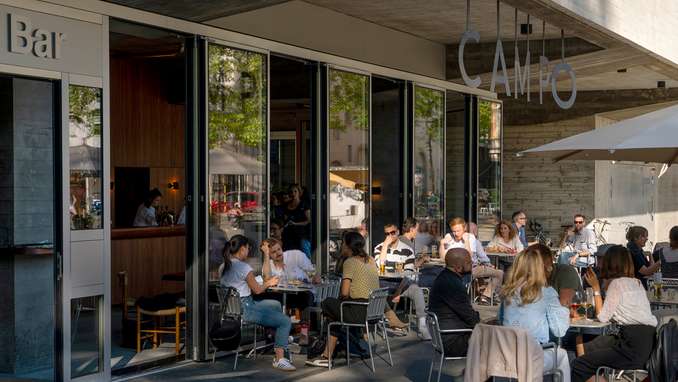
Musings about my life filled with music, sport and urban travel – and, sometimes, art, fashion, food, and gardening. By Michael Dickens
Tuesday, October 22, 2019
On baseball: An unlikely World Series journey
What an unbelievable and unlikely baseball journey it’s been for my adopted (hometown) team, the Washington Nationals. A week ago, at 11:08 p.m. Eastern Time, the Nationals completed a four-game sweep of the St. Louis Cardinals to win the 2019 National League Championship Series. After beating the Milwaukee Brewers in a winner-take-all Wild Card game, then prevailing over the Los Angeles Dodgers in the National League Division Series, the Nationals captured the team’s first pennant in its brief history since the franchise grew out of the defunct Montreal Expos after moving to Washington, D.C. in 2005. It’s been a time to remember.
Not since the days of President Franklin Delano Roosevelt in 1933 has there been a World Series played in the nation’s capital city. It involved the original Washington Senators, who played their games at the long-since-torn down Griffith Stadium in the Shaw neighborhood, near Howard University. Those Senators left town three decades later and are now the Minnesota Twins. Then, a second Washington Senators franchise arrived in 1961 and promptly left town in 1972 to become the Texas Rangers.
In 1904, the Senators were playing so poorly that well-known baseball writer and humorist Charles Dryden famously wrote: “Washington – first in war, first in peace, last in the American League.”
Finally, Washington’s baseball fortunes all changed a week ago on October 15.
⚾️ Prize least expected.
⚾️ Pop the corks. Raise the pennant.
⚾️ Improbable team.
Now, the Nationals will face the mighty Houston Astros in the 2019 World Series starting tonight. Pretty good for a Nationals team that was 19-31 on May 23 and seemed hopeless. The team wasn’t hitting in the clutch, it wasn’t pitching effectively, it wasn’t fielding particularly well. The team’s manager, Dave Martinez, was on the verge of being fired.
Then, the team started winning – and people started paying attention.
“Since baseball time is measured only in outs,” the esteemed longtime New Yorker baseball writer Roger Angell wrote in The Summer Game, “all you have to do is succeed utterly; keep hitting, keep the rally alive, and you have defeated time. You remain forever young.”
While I’ve long been a fan of the San Francisco Giants from living 21-plus years in the San Francisco Bay Area before moving to suburban Maryland two years ago, I’ve (finally) begun taking an interest in the Nationals, too. After all, Nationals Park is only 6.5 miles from our home just across the District line – and I’ve been a baseball fan all my life.
As longtime Washington Post national baseball columnist Thomas Boswell, who’s been around the nation’s capital city writing about baseball through good times and bad – mostly bad – wrote upon the Nationals’ pennant-clinching victory over the Cardinals: “What the Washington Nationals have done this season is like going into your backyard with a spade to plant petunias and, instead, striking oil.
“Their appointment with the World Series, just 14 days after facing elimination in the wild-card game, is like spilling water on Grandma’s painting of an old farm house and finding out she had painted over a still-pristine Picasso.”
Last week’s Game 4 pennant-clinching victory over the Cardinals – another “Curly W in the books” as the team’s radio play-by-play broadcaster Charlie Slowes bellowed in a celebratory tone across the air waves – was part comedy, part horror show. But in the end, the Nationals won 7-4. Indeed, as NLCS MVP Howie Kendrick of the Nationals said, “Some of the best things come from the unexpected moments.” Indeed, they do. How else do you explain the “Baby Shark” phenomenon that’s unified the Nationals and rallied their fan base? I witnessed good fortunes for the Giants in 2010, 2012, and 2014. Maybe, good fortunes will come to the Nationals, too.
So, I say: “Congratulations to the Nationals and good luck!
#STAYINTHEFIGHT
A World Series postscript:
The Washington Nationals won their first World Series title on Wednesday, October 30. They beat the Houston Astros 6-2 in the decisive Game 7 of the best-of-7 series and won the series four games to three. It brought the city of Washington its first World Series title in 95 years.
⚾️ Can you believe it?
⚾️ World Series Curly W!
⚾️ A great victory.
#FIGHTFINISHED
Photo: Courtesy of Google Images.
Tuesday, October 15, 2019
Getting lost at the Smithsonian with Aasif Mandvi
Aasif Mandvi is a comedian and actor – and, as I’ve recently learned much to my delight, a pop culture fanatic at heart. In his new podcast series, “Lost at the Smithsonian with Aasif Mandvi,” the former “Daily Show” correspondent who now co-stars in the CBS drama “Evil,” gets up close and personal with some of the most iconic artifacts at the National Museum of American History in Washington, D.C.
Whether exploring vintage clothing (Fonzie’s leather jacket from “Happy Days”), ratty furniture (Archie Bunker’s chair from “All in the Family”) or mismatched shoes (Dorothy’s ruby slippers in “The Wizard of Oz”), there are endless ways to get lost at the Smithsonian. Mandvi and his guests at the Smithsonian share how these and other items – 10 iconic pop culture objects out of 156 million in the Smithsonian collection – each became defining symbols of 20th century American pop culture.
In the opening episode of the series, we learn why Henry Winkler’s portrayal of “The Fonz” became the breakout character in the mid-70s sit-com “Happy Days” and how his leather jacket became a symbol of coolness in an era of Watergate, when Americans yearned for simpler, happy days. Mandvi interviews Winkler to learn how he was able to turn “The Fonz” into an American icon.
“He was everybody who I wanted to be and who I wasn’t, because I was not in control of my life or my psyche,” said Winkler in describing his portrayal of “The Fonz.”
In the second episode, Mandvi explores the acoustic guitar belonging to José Feliciano, who at age 22 was the first artist to perform a “personalized” rendition of the National Anthem. Today, taking liberties with the National Anthem is commonplace before baseball games and many other American sporting events. However, as Feliciano deviated from the norm when he performed “The Star Spangled Banner” before a 1968 World Series game in Detroit, it nearly destroyed his career. But was it an act of protest or patriotism? You might be surprised by the musician’s answer.
“My version was not outlandish,” recalled Feliciano, now 72, during his conversation with Mandvi. “It was a combination of soul, gospel and because I’m Latin, I gave it a little bit of a Latin feel.”
What began as a chat about Feliciano’s legendary guitar ended up morphing into a thoughtful conversation about race, about patriotism, and what it means to be an American. The blind, Grammy Award-winning Puerto Rican artist also performs a private concert when he’s reunited with his guitar at the Smithsonian.
The third episode, which debuted last week, focuses on the ruby slippers Judy Garland wore in the 1939 film classic “The Wizard of Oz.” As Mandvi recently tweeted, “Click your heels 3 times and say ‘There’s no place like @amhistorymuseum,’ & you’ll be transported to an exhibit that’s been viewed 100,000,000+ times. ... Well, not really. But you’ll get pretty close.”
Curator Ryan Lintelman said of Dorothy’s famous ruby slippers: “So we estimate that since 1979 we we got them, a hundred million people have seen them probably. You know, it’s pretty incredible. And other than like maybe the Mona Lisa, I don’t know that any other museum can really claim that one thing has been seen by so many people,” he said.
Thus far, three episodes of “Lost at the Smithsonian” have aired and new podcast episodes drop each week via Stitcher. Those in the know have hinted that among the future items Mandvi explores include Muhammad Ali’s boxing robe and Mr. Spock’s ears from the original “Star Trek” TV series.
I don’t know about you, but I can’t wait to get lost at the Smithsonian.
Listen to “Lost at the Smithsonian” via Stitcher:
https://www.stitcher.com/podcast/stitcher/lost-at-the-smithsonian
A postscript: “Lost at the Smithsonian” concluded its run on November 24. Following is a list of themes for each episode:
1. Fonzie’s Jacket
2. Jose Feliciano’s Guitar
3. Dorothy’s Ruby Slippers
4. Phyllis Diller’s Gag File
5. Muhammad Ali’s Robe
6. Carrie Bradshaw’s Laptop
7. Archie Bunker’s Chair
8. Pele’s #10 Jersey
9. Bee Gees’ Silver Suits
10. The Original Muppets
Tuesday, October 8, 2019
On art and photography: By the light of the silvery moon
In addition to regularly attending the NGA’s monthly “Evenings on the Edge,” in which the east gallery stays open late the first Thursday of selected months, from time to time the NGA also sponsors insightful lectures in conjunction with its ongoing exhibitions.
Last week, my wife and I attended one of these lectures, “Photographing the Moon,” which featured curators from the Smithsonian National Air and Space Museum discussing the history of photographing the moon and how photography played both a significant role in preparing for the Apollo 11 moon landing on July 20, 1969 and in shaping the cultural consciousness of the event.
We learned how “the mission, launched within the framework of Cold War rivalry with the Soviet Union, was not merely one of scientific discovery and technical prowess. It was necessary, as President John F. Kennedy explained in a famous 1962 speech, ‘to win the battle ... between freedom and tyranny’ and held nothing less than ‘the key to our future on Earth.’”
![]() |
| Buzz Aldrin’s Footprint, July 20, 1969 |
Then, Matthew Shindell, curator of planetary science, in “Geology from Orbit: Robots, Cameras and Photogeology,” described the development and impact that photogeology, which provided for early photography of the earth and moon from airplanes, had in establishing a pathway for mapping and selecting landing sites for manned missions to the moon.
The hour-long lecture tied in nicely with the “By the Light of the Silvery Moon” exhibition at the National Gallery of Art, which we viewed afterward. (The exhibition opened on July 14 and continues through January 5, 2020 in Gallery 22 of the NGA’s West Building.)
Collectively, the photographs displayed in “By the Light of the Silvery Moon,” ranging from the 19th century to the “space-age” 1960s, “merged art and science and transformed the way that we envision and comprehend the cosmos.”
Credits: Cover photo: By Michael Dickens. Other photos: Courtesy of “By the Light of the Silvery Moon” exhibition. Video: Courtesy of YouTube and National Gallery of Art.
Tuesday, October 1, 2019
Rhiannon Giddens: A global voice that resonates with curiosity and purpose in these troubled times
![]() |
| Rhiannon Giddens / there is no Other |
When Rhiannon Giddens released her latest album, the intense and sparsely-arranged there is no Other – recorded with Italian multi-instrumentalist Francesco Turrisi – earlier this year, it “at once was a condemnation of ‘othering’ as well as a celebration of the spreading of ideas and connectivity and of a shared experience.”
Together, Giddens and Turrisi traced an overlooked movement of sounds originating from Africa and the Arabic world and found common ground in how those sounds influenced European and American music. The original songs which Giddens penned for there is no Other as well as interpretations of others such as Ola Belle Reed’s “I’m Gonna Write Me a Letter,” Oscar Brown Jr.’s “Brown Baby” and the Italian traditional “Pizzica di San Vito,” collectively illustrate both her adoration of Appalachian bluegrass, gospel, opera and traditional Italian music and the commonality it brings to the human experience. Her interpretation of the gospel standard “Wayfaring Stranger” ranks up there with those of Emmylou Harris and Johnny Cash.
It was in this spirit that I saw Giddens and Turrisi perform selections from there is no Other last week in the 450-seat Terrace Theater at the Kennedy Center for the Performing Arts in Washington, D.C. It was the first time I had seen Giddens in concert. I hope it’s not the last.
Giddens, 42, is a celebrated Grammy Award-winning artist and MacArthur “Genius” Grant recipient, who loves to dig through the past to reveal bold and candid truths about our present. The messages in her songs have drawn upon slave narratives as well as African American experiences, including the 1960s Civil Rights movement, and are often told from the point of view of black women’s suffering and resilience. In concert, Giddens painstakingly takes the time to weave her excellent storytelling skills to put each song into an historical context.
Giddens recently was featured in the Ken Burns Country Music documentary film series. In an interview with the Greensboro (N.C.) News & Record, she said, “I have played country, I have sung country. I’ve listened to country or what we say is country. I’ve played a lot of music that has been funneled into what became country. I play music that country has been borrowed from.
“But it’s just a strand of what I do. You can’t box the music that I do. People ask me all the time, ‘What do you play?’ Well, I play American music. That includes what we would call country.”
![]() |
| Rhiannon Giddens and Francesco Turrisi |
Over the course of their two-hour show that was full of interplay between these two gifted musicians, Giddens and Turrisi criss-crossed cultures – African, Arabic, European and American – that reflected a wide global sensibility and brought together old and familiar – and new – stories. It was as if a music appreciation master class broke out extemporaneously. There’s a sense of curiosity and purpose in Giddens’ music that is both thoughtful and reflective – and, on this night last week, it was refreshing to hear it resonate clearly during these troubled times we live in.
Credits: Cover photo – courtesy of Google Images. Story photo – courtesy of rhiannongiddens.com. Video – courtesy of NPR Music.
Labels:
candid,
country,
folk,
Francesco Turrisi,
gospel,
intensity,
interpret,
minstrel banjo,
Rhiannon Giddens,
sparse,
storytelling,
traditional
Tuesday, September 24, 2019
“The Weight” – 50 years, still transcending time and space
![]() |
| Robbie Robertson / “The Weight” |
Growing up as a teen in Ocean Springs, Miss., then continuing through my university days at Macalester College in Saint Paul, Minnesota, The Band always stood out as one of my favorite music groups. Starting with their outstanding live LP Rock of Ages, I started collecting their albums over the years and my appreciation for this Canadian-American roots rock group never wavered. They made critically-acclaimed soulful music enriched by a singular voice that was influenced by country, blues and Americana. Going on a musical journey with The Band also meant hearing gospel and mountain music – even Angelic hymns.
I always appreciated that there was stability – and versatility – in The Band’s lineup, which featured Robbie Robertson on guitar and vocals; Levon Helm on drums, vocals, mandolin and guitar; Rick Danko on bass guitar, vocals and fiddle; Garth Hudson on Lowrey organ and keyboards, accordion and saxophone; and Richard Manuel on piano and keyboards, drums and vocals. Though The Band had three vocalists sharing lead and harmonies, Manuel was seen as their primary vocalist. All but Helm, who was born among the dirt farms in Elaine, Arkansas, hailed from the provinces of Canada. It was during their time spent backing up Bob Dylan when he ditched folk and went electric that The Band gained not only prominence but also their monicker. They were originally formed as The Hawks, a backing band for the rockabilly singer Ronnie Hawkins, joining him one by one between 1958 and 1963.
Although they were always “the band” to the various frontmen and locals in Woodstock, New York, where they moved after touring with Dylan in the U.S. in 1965 and around the world in 1996, Helm once said the name “The Band” worked pretty well when they came into their own. Once they began performing as The Band in 1968, they recorded 10 studio albums and collaborated again with Dylan in 1974 on a live concert album. The original quintet ended their touring career back in 1976 with “The Last Waltz” concert at the Winterland Ballroom in San Francisco, which featured many iconic musical celebrities of that era, including: Dylan, Van Morrison, Eric Clapton, Neil Young, Muddy Waters, Dr. John, the Staples Singers and Joni Mitchell. The performance was filmed by Martin Scorsese and released as a 1978 documentary, The Last Waltz.
Since then, three of the original members of The Band have passed away – Manuel committed suicide in 1986, Danko died of heart failure in 1999 and Helm, who went on to a successful film career with roles in The Coal Miner’s Daughter and The Right Stuff, died of throat cancer at age 71 in 2012. Meanwhile, Robertson, now 76, found success with a solo career and as a Hollywood music producer. He has scored the music for 10 Martin Scorsese films. Hudson, now 82, went on to record a number of solo projects and is still a much in-demand studio musician. Last year, he was named a Member of the Order of Canada.
Although my music tastes have expanded over the years since my days as college radio disc jockey at Macalester’s WMCN-FM, I have maintained a fondness for The Band’s musical template of Americana, roots rock and country rock, which along with The Byrds and The Flying Burrito Brothers, helped pave the wave for the popularity of The Eagles.
The Band’s first album, Music From Big Pink, which was released in 1968, included three songs penned by Dylan: “This Wheel’s On Fire,” “Tears of Rage,” and “I Shall Be Released.” It also included “The Weight,” which was featured in the seminal counterculture film Easy Rider, making it one of the group’s most memorable and best-known songs. According to The Wall Street Journal, the songs on Music From Big Pink combined “vivid imagery with a touch of Impressionism; they sound both utterly original and like folk songs that have been passed down for generations.”
While it’s been a while since I listened to Music From Big Pink, lo and behold, a week ago I came across an interesting Rolling Stone article about Robbie Robertson playing “The Weight” with Ringo Starr and musicians across five continents, captured in an epic “Playing For Change” video, that was the result of two years of work spread across 10 countries. I was intrigued by the possibilities and gave the video a good watch and listen.
“The Weight,” written by Robertson and sung by Helm, has been described as “a masterpiece of Biblical allusions, enigmatic lines and iconic characters,” and its enduring popularity makes it an essential part of not only the American songbook but it’s also one of the great songs that shaped rock and roll, too.
“What key is it in, Robbie?” Starr, sitting behind his drum kit, asks Robertson, who’s in Los Angeles, during a telephone conversation at the beginning of the video. The former mop-top Beatles drummer nods. “F-demented!” What follows is a delightful and heartfelt cover of “The Weight,” beginning with Robertson’s soulful guitar lick that brings back memories of the original introduction. From there, the song takes off verse by verse as a series of all-star musicians spanning the globe – Lukas Nelson (son of Willie), Marcus King, Congolese soul singer Mermens Mosengo, Japanese guitar virtuoso Char, among many – add their own distinctive influence to enhance the palate of the song, each from different locations around the world.
According to Rolling Stone, the project for “The Weight” came from Playing For Change, a group that is dedicated to “breaking down the boundaries and overcome distances between people.” It includes 15 music schools across 11 countries, documentaries and viral videos bringing artists from different cultures together. Co-founder Mark Johnson, a Grammy Award-winning producer-engineer who has worked with Paul Simon among many, told Rolling Stone that it took a year and a half of production over five continents. “We made it brick by brick, starting with Robbie. That’s what makes this special. We could never have assembled this group in the studio. You need to go there, and then when you go there, you’re where they feel comfortable. You hear that in the music.”
After watching and listening to this version of “The Weight,” I’m gobsmacked. After 50 years, thanks to time and space, this enduring classic has only gotten better. Levon Helm would be proud.
Credits: Video courtesy of YouTube.com. Screenshot photo of Robbie Robertson courtesy of Playing For Change.
Sunday, September 15, 2019
Storytelling: Figuring out adulthood in “The Female Gaze”
![]() |
| Shefali Vasudevan |
“A lot of the film and television I saw growing up was very male-centric,” says Vasudevan. “When I went to film school and realized how heavily male the industry was, I knew I really wanted to create something of my own to combat it.
“The term ‘The Female Gaze’ is a twist on the term ‘Male Gaze,’ where everything in art, entertainment and news has been told strictly from the male perspective up until recent years. We wanted to flip that and make the narrative about women and how they view the world.”
Vasudevan approached Godwin, her Emerson classmate with whom she shared an improv class, with her idea of telling their stories in a unique way and she was instantly on board. “I had worked with Shefali before, and have always respected and trusted her vision,” says Godwin. “I was also excited about being involved with a web series that honestly portrayed a variety of stories about men and women that I could relate to.”
Asked if it’s easy to relate to the situations her character, Jen, has found herself in, Godwin said that while her character “is not directly based on myself, she is in a lot of situations that I’ve also found myself in.
“For example, figuring out where she stands in a relationship versus being single and navigating jobs. I feel like I’ve been able to relate to every part of Jen, even if I haven’t been in her exact scenario. I still feel the same emotions and make the same discoveries that she does.
“For me, it was pretty easy to get inside Jen’s head, as a lot of what she experiences is similar to what I’ve gone through as I navigate my 20s. It’s a release for me to be able to bring my current awareness from personal situations and go back into that situation as Jen who’s experiencing it for the first time.
“Shefali has a really great honest writing style, but she also loves when actors make the role their own. During the rehearsals she encouraged us to improvise, which we sometimes added lines from, and tweak the dialogue to sound a little more like how our character would say it. It’s such a great experience to work with Shefali, because she puts so much into her work and then opens it up for collaboration to make the best product possible. That’s the ultimate dream!”
![]() |
| Camra Godwin |
“For example, figuring out where she stands in a relationship versus being single and navigating jobs. I feel like I’ve been able to relate to every part of Jen, even if I haven’t been in her exact scenario. I still feel the same emotions and make the same discoveries that she does.
“For me, it was pretty easy to get inside Jen’s head, as a lot of what she experiences is similar to what I’ve gone through as I navigate my 20s. It’s a release for me to be able to bring my current awareness from personal situations and go back into that situation as Jen who’s experiencing it for the first time.
“Shefali has a really great honest writing style, but she also loves when actors make the role their own. During the rehearsals she encouraged us to improvise, which we sometimes added lines from, and tweak the dialogue to sound a little more like how our character would say it. It’s such a great experience to work with Shefali, because she puts so much into her work and then opens it up for collaboration to make the best product possible. That’s the ultimate dream!”
When Vasudevan started creating “The Female Gaze,” she was writing from her own perspective and personal experiences as a 24-year-old (she just turned 25 this month) and with an 18-to-30-year-old audience in mind. She said, “I think a lot of the themes are universal.
“The characters deal with love and find themselves, and I don’t think anyone ever stops learning about themselves!”
Godwin, 25, agrees, saying “I think a lot of people 18-30 would relate directly to what each character is going through, but the emotions that our characters feel transcend age groups.
“Everyone has an idea of what heartbreak, excitement, love and confusion (to name a few) feels like!”
In developing “The Female Gaze,” Vasudevan, who earned a BFA in Film Production from Emerson College in Boston, originally hoped to learn more about filmmaking. She also became a central character in her own web series. The first series run of seven episodes included titles such as “First Time,” “F**kboy,” “Damsel,” and “Best Friends.”
In the fourth episode, “Damsel,” Vasudevan’s character, Priya, shares an intimate on-the-mouth kiss with her friend, Silvia (played by Avery Richardson). When asked if there was any sense of awkwardness, or if it was about Priya’s empowerment, acting upon her desires – perhaps figuring out her sexuality – she expressed, “I was writing this scene based on the experience of some of my friends and myself. What a lot of people today don’t really understand is that sexuality can be a little more complicated to navigate and not all black and white. It can also be something that is repressed in a lot of us because for so long in our lives we were told we had to think a certain way. Older generations tend to think that you can only like men or you can only like women. But I think for some people the attraction is based on person to person and relationship to relationship.”
Vasudevan suggested that Priya’s character “has entertained the thought of being with a girl, but until this moment in her life she has never met a girl in real life that she was attracted to. So, in the previous episode, she was with a man she felt attracted to,” but then “she feels so strongly toward Silvia that she has to act on it! I think by the end of the series, Priya realizes she has to explore this about herself before she can be in an open and honest relationship with either a man or a woman.”
While the final product of each six-to-seven minute episode comes off as a very smooth viewing experience, there’s plenty that goes into the creation and production. “We shot everything episode to episode,” said Vasudevan. The music heard in each episode comes from a variety of Emerson alumni (GUPPY, Pool Boys, Love Under the Sun) and Vasudevan said each were kind and gracious about contributing their music to the series.
“Learning how to self-produce my own work outside of college was difficult,” Vasudevan admits, “but I started to form a community and creat a good work flow this project.”
In the fourth episode, “Damsel,” Vasudevan’s character, Priya, shares an intimate on-the-mouth kiss with her friend, Silvia (played by Avery Richardson). When asked if there was any sense of awkwardness, or if it was about Priya’s empowerment, acting upon her desires – perhaps figuring out her sexuality – she expressed, “I was writing this scene based on the experience of some of my friends and myself. What a lot of people today don’t really understand is that sexuality can be a little more complicated to navigate and not all black and white. It can also be something that is repressed in a lot of us because for so long in our lives we were told we had to think a certain way. Older generations tend to think that you can only like men or you can only like women. But I think for some people the attraction is based on person to person and relationship to relationship.”
Vasudevan suggested that Priya’s character “has entertained the thought of being with a girl, but until this moment in her life she has never met a girl in real life that she was attracted to. So, in the previous episode, she was with a man she felt attracted to,” but then “she feels so strongly toward Silvia that she has to act on it! I think by the end of the series, Priya realizes she has to explore this about herself before she can be in an open and honest relationship with either a man or a woman.”
While the final product of each six-to-seven minute episode comes off as a very smooth viewing experience, there’s plenty that goes into the creation and production. “We shot everything episode to episode,” said Vasudevan. The music heard in each episode comes from a variety of Emerson alumni (GUPPY, Pool Boys, Love Under the Sun) and Vasudevan said each were kind and gracious about contributing their music to the series.
“Learning how to self-produce my own work outside of college was difficult,” Vasudevan admits, “but I started to form a community and creat a good work flow this project.”
![]() |
| Road trippin’ with “The Female Gaze.” |
Indeed, Vasudevan changed the dynamic, and in doing so, she confesses that having a majority female crew also brings a different energy to the set. “There is a lot less ego involved – and a lot of creativity,” she said. “I have been on some really great male-run sets, but in general, on female-run sets everyone is just there to work and do a good job.”
When she was asked if there have been an production obstacles, Vasudevan said, “PLENTY! But I love it. My background from school is directing and writing, but more recently I decided to learn more about producing and acting.
“Producing has been such a fun way to use my problem solving skills. For the cafe episode (shot in a Le Pain Quotidien in Studio City), I actually talked to a few different cafes and Le Pain Quotidien was just the most responsive, affordable and flexible to work with! Lunch was also included in our space rental fee, which was incredible. I’m still dreaming about their chocolate hazelnut spread.
“The biggest obstacle was definitely the final episode of the first season and coordinating everyone on that set. I had a lot of help from my good friend and co-director on that episode, Caroline Ullman. The main issues came with coordinating actors and making sure we got through all of the scenes we needed to film in such a short amount of time. But the team of filmmakers we worked with were so incredible and patient with us! We ended up eating everything we needed and then some.”
When she was asked if there have been an production obstacles, Vasudevan said, “PLENTY! But I love it. My background from school is directing and writing, but more recently I decided to learn more about producing and acting.
“Producing has been such a fun way to use my problem solving skills. For the cafe episode (shot in a Le Pain Quotidien in Studio City), I actually talked to a few different cafes and Le Pain Quotidien was just the most responsive, affordable and flexible to work with! Lunch was also included in our space rental fee, which was incredible. I’m still dreaming about their chocolate hazelnut spread.
“The biggest obstacle was definitely the final episode of the first season and coordinating everyone on that set. I had a lot of help from my good friend and co-director on that episode, Caroline Ullman. The main issues came with coordinating actors and making sure we got through all of the scenes we needed to film in such a short amount of time. But the team of filmmakers we worked with were so incredible and patient with us! We ended up eating everything we needed and then some.”
Asked what the reaction from friends and family has been, Vasudevan said her family has been extremely supportive of the entire process. “I told my mom about what the story was going to be about a long time ago,” she recalled, “and when I started making the project I felt so insecure about it.
“There was one day when I was on the phone with her talking about how nervous I was, and she told me, ‘This is so incredible what you’re doing. You’re creating a body of work for yourself, of what you’re like right now, of what your friends are like, of what you’re experiencing, and you’re always going to remember it because you have this series.’ And that made me really happy and more confident about the project because yeah, maybe not a lot of people will see it, but it is such a truly vulnerable expression of my life right now and I’m excited to have that.”
Godwin added, “When we first put it out, there’s always a sense of anxiousness because you want people to be able to connect with it like you did, and all that anxiousness has melted away for me now!”
“There was one day when I was on the phone with her talking about how nervous I was, and she told me, ‘This is so incredible what you’re doing. You’re creating a body of work for yourself, of what you’re like right now, of what your friends are like, of what you’re experiencing, and you’re always going to remember it because you have this series.’ And that made me really happy and more confident about the project because yeah, maybe not a lot of people will see it, but it is such a truly vulnerable expression of my life right now and I’m excited to have that.”
Godwin added, “When we first put it out, there’s always a sense of anxiousness because you want people to be able to connect with it like you did, and all that anxiousness has melted away for me now!”
With “The Female Gaze,” Vasudevan is emphasizing storytelling from a woman’s perspective. “I want people to see that women are messy and complicated and annoying and beautiful and weird, and that’s okay!
“I also hope that the stories resonate with people. Getting responses from people telling me that they related to the characters was incredible and more than what I thought I would get out of this experience initially.”
Find “The Female Gaze” on social media:
On Facebook @ https://www.facebook.com/thefemalegazeseries/
On Twitter @TFGSeries
On Instagram @thefemalegazeseries
Credits: “The Female Gaze” videos, courtesy of YouTube. Individual photos of Shefali Vasudevan and Camra Godwin by Lauren Cabanas. Cover photo and Road Trip episode photos by Zachary Shea Mills. Behind the Scenes of the final episode “This Is Not A Party” photo by Ariel Skovera.
Find “The Female Gaze” on social media:
On Facebook @ https://www.facebook.com/thefemalegazeseries/
On Twitter @TFGSeries
On Instagram @thefemalegazeseries
Credits: “The Female Gaze” videos, courtesy of YouTube. Individual photos of Shefali Vasudevan and Camra Godwin by Lauren Cabanas. Cover photo and Road Trip episode photos by Zachary Shea Mills. Behind the Scenes of the final episode “This Is Not A Party” photo by Ariel Skovera.
Tuesday, August 20, 2019
Remembering the eloquence of Jack Whitaker
![]() |
| Jack Whitaker / 1924-2019 |
I spent some quiet time Monday morning reflecting upon the life of legendary sports broadcaster Jack Whitaker, known for his eloquent commentaries, who passed away Sunday at age 95. What a wonderful life Whitaker lived crafting broadcast essays about sports, inspired by writers he admired like Alastair Cooke and Heywood Hale Broun. You have to be of a certain age to remember these masters of the writing craft – and I am of that certain age.
Born and raised in Philadelphia, where he got his broadcasting start after graduating from St. Joseph’s College, Whitaker was a decorated veteran of World War II, fighting in the Normandy Campaign and was wounded by an artillery strike. He went on to a career as a sportscaster with both CBS and ABC.
Whitaker was regarded as “The Talking Head” of sports – long before David Byrne ran with the moniker and named his American rock band The Talking Heads. He broadcast football, golf and horse racing, among many sports. “I know that I’m regarded as The Talking Head,” he once told Sports Illustrated during a 1977 interview. “I’d like to be exactly that and say something that people will remember or get excited about. I’d like to bring sports into the thinking process.”
![]() |
| Jack Whitaker |
On the eve of the Kentucky Derby horse race one year, Whitaker waxed poetically about the mood and feeling of one of America’s most iconic sporting events: “America never looks better than on a spring afternoon at the horse farms around Lexington.
“The bluegrass fields and limestone-permeated water has given strength to 81 Derby winners. Just up the road is Churchill Downs in the city of Louisville. In Louisville, America thrives. It was here that Americans discovered how to blend golden corn, barley, malt and rye into bourbon whiskey. It was here that baseball’s National League was founded and where they still make the famous Louisville sluggers. And it was in Louisville that the Kentucky Derby thrived and grew into something beyond a horse race.”
In perusing Whitaker’s obituary in Monday’s print edition of The New York Times, I learned that he “reserved his greatest passion for golf,“ and loved to weave historical imagery into his accounts.
For instance, in commenting about the British Open at Troon, Scotland, for ABC’s World News Tonight in 1982, he spoke:
“Through all the years, the British Open has changed very little. The biggest addition has been the tented city, looking like Henry V’s camp at the Battle of Agincourt. Here you can buy among other things lawn mowers, cashmere sweaters and Champagne, which is replacing tea as Britain’s national beverage. But basically the British Open is the same as it was in 1860 when they first played it down the road at Prestwick. Playing in the British Open is like reading American history at Independence Hall or studying opera at La Scala. It’s golf at its most simple, its most pure, its most magnificent.“
Rest in peace, Jack Whitaker. You shared a marvelous passion for sports with us for many years. I’ll remember what you said once about the sport of golf that you loved so much: “Golf accommodates itself anywhere. It travels better than Beaujolais. Golf is the most moveable feast of all.”
Labels:
British Open,
broadcasting,
eloquence,
football,
golf,
horse racing,
Jack Whitaker,
language,
Olympics,
personality,
sports
Thursday, August 8, 2019
What makes a good city great?
![]() |
| Dining out in Zürich |
No matter where in the world, our cities are designed for living, working, cultural entertainment and late nights. Some times, they are even designed for fresh starts.
While some cities have it figured out, some don’t. From transportation and green spaces to retail possibilities and residential settlements, what makes a good city a great place to live?
In his editor’s letter in the July/August issue, Monocle’s editor-in-chief Tyler Brûlé wrote: “When we look at a city we’re constantly asking if the infrastructure is in place to allow residents and visitors to be as productive as possible while also having a pleasant experience navigating the place.”
While I’ve written about Monocle’s Quality of Life rankings before, it’s always an interesting subject to study and dissect. In looking over this year’s list of the Top 25 cities in the world, it makes me pine for world travel.
Here’s Monocle’s Top 25 places in the world to live:
1. Zürich
2. Tokyo
3. Munich
4. Copenhagen
5. Vienna
6. Helsinki
7. Hamburg
8. Madrid
9. Berlin
10. Lisbon
11. Melbourne
12. Stockholm
13. Sydney
14. Amsterdam
15. Vancouver
16. Hong Kong
17. Kyoto
18. Barcelona
19. Paris
20. Düsseldorf
21. Auckland
22. Fukuoka
23. Brisbane
24. Oslo
25. Singapore
In describing Zurich, the magazine writes: “Zürich is a city that gives you the feeling that all is right with the world. It starts at the airport, where you’ll encounter few queues at customs and a punctual train that delivers you from arrivals to the city Centre in minutes. You’ll step out onto nearly swept streets lined with well-appointed shops – and in the distance catch a glimpse of the snow-capped Alps beyond the turquoise blue of Lake Zürich.
In commenting about this year’s No. 1 city, Zürich, Brûlé wrote, “Zurich has become something of a global master at making travel a joy. Add global connectivity to the mix via its airport and railway stations, high-quality housing and an ever-improving restaurant-and-retail scene and you'll know why we often refer to it as Berlin for people over 40 (or who know better.).
“While Zürich still has many areas that could be improved (more-daring architecture, more relaxed retail trading hours, more mature trees planted by developers and more incentives to make balconies greener) it’s got most things right. And it’s for this reason that it’s vaulted a few positions this year to take the top spot – yet again. Indeed, this is the second time that Zürich has clinched the highest position on the winners’ podium.”
Photos: Courtesy of Monocle.com.
Labels:
city,
culture,
design,
entertainment,
green space,
living,
Monocle,
place,
possibility world cities,
qualify of life,
transportation,
Zürich
Tuesday, July 23, 2019
Freshly brewed: Comedians in Cars Getting Coffee
![]() |
| Eddie Murphy and Jerry Seinfeld share a good laugh in a 2004 Porsche Carrera GT |
Freshly brewed episodes of Comedians in Cars Getting Coffee, comedian Jerry Seinfeld’s talk show that combines good laughs, great coffee and colorful vintage cars into a series of quirky but likable “caffeine-fueled adventures” with the sharpest minds in comedy, rolled out last week on Netflix.
The latest batch of 12 episodes of Comedians ... features 11 comedians, 11 different cars, endless pots of coffee – especially prominently-featured Lavaazza Italian espresso – and lots of laughs. Among the featured guests this season are: Ricky Gervais (in back-to-back episodes), Eddie Murphy, Seth Rogen, Matthew Broderick, SNL’s Melissa Villaseñor and Martin Short. As for the cars, let’s see, they include: a 2004 Porsche Carrera GT, a 1976 Dodge Monaco, a 1969 Maserati Mistral and a 2018 Lamborghini Huracán Performante.
Each episode is touching in its own way, and thanks to Seinfeld – still curious at age 65 – the art of conversation remains alive and well. Seinfeld is one of the best when it comes to the art of observational humor, whether talking about personal relationships or the nuances of uncomfortable social obligations. It’s what we loved about the New York native in Seinfeld, which spanned 180 episodes over nine seasons from 1989-98 on NBC. The series remains a fixture in reruns across the country.
Now, having successfully transitioned from broadcast TV to an internet series, Seinfeld has taken an offbeat approach that shows another side of the comedy world. It’s something the comedian feels talk shows and interviews can’t or don’t let you see. The web-based comedy series he created, directs and stars in debuted in 2012 and is shot using DSLR and interior-mounted Go-Pro cameras.
“It’s a show about trust,” said former Daily Show host Jon Stewart.
Nominated for an Emmy Award for Outstanding Informational Series or Special, in Comedians ... Seinfeld connects with those whom he admires the most and the show shines in its ability to go inside the minds of some of the word’s funniest people. A who’s who of contemporary A-list comedians, including Chris Rock, Sarah Silverman and Amy Schumer as well as iconic ones Mel Brooks, Carl Reiner, Don Rickles and Jerry Lewis, have been coffee companions of Seinfeld’s. So have present and past late night TV hosts Trevor Noah, Stephen Colbert, Jimmy Fallon, David Letterman and Jay Leno. Seinfeld co-stars Julia Louis-Dreyfus, Jason Alexander and Michael Richards have also made appearances.
Each 12-to-20-minute episode of Comedians ... follows a premise of Seinfeld introducing a vintage car such as a 1983 Mercedes Benz station wagon or a 1991 Nissan Figaro, then picking up his guest comedian in that vintage car, driving around and sharing conversation, and, finally, stopping for coffee and more conversation. Seinfeld films most episodes in New York and Los Angeles, but has also ventured to New Jersey and Massassuchetts – even Portland, Ore.
In this season’s episode with Broderick, for instance, the two drive around the actor’s childhood Manhattan neighborhood, reminisce about their mutual love for Mel Brooks and share laughs about Brook’s original film version of The Producers. (Broderick co-starred as Leo Bloom in the Broadway musical adaptation as well as a 2005 remake of the film.) They also live out a baseball fantasy of being New York Mets ball players at Citi Field. The camera captures them walking into the clubhouse to don their Mets jerseys, then follows them out on the diamond hitting and fielding. Finally, we see the two sitting in box seats eating hot dogs while discussing Broderick’s 1986 film Ferris Bueller’s Day Off, which prominently includes the central character driving around Chicago in a sporty fire engine-red Ferrari and spending an afternoon in the bleacher seats at Chicago’s Wrigley Field cheering for the Cubs.
Meanwhile, when Seinfeld meets up with Short in L.A., not only do we get to re-live some of the best of Jiminy Glick, Short’s fictional Comedy Central talk show host character, but the former SNL and SCTV star also shares how appearing in a Canadian production of Godspell helped launch his comedy career and those of Gilda Radner, Eugene Levy and Paul Shaffer.
Whether meaningful or meandering, silly or deep, the unscripted conversations between Seinfeld and his Comedians in Cars Getting Coffee companions are hardly a show about nothing.
Cover photo: Courtesy of Comedians in Cars Getting Coffee website. Video: Courtesy of YouTube.
Tuesday, July 16, 2019
On Wimbledon: Gentlemen’s final was like none before it
The No. 1 seed Djokovic, 32, captured his fifth Wimbledon crown and his 16th Grand Slam title overall, outlasting the 37-year-old Federer 7-6 (5), 1-6, 7-6 (4), 4-6, 13-12 (3). The fifth set, alone, which was decided by a 12-games-all seven-point tie break, lasted two hours.
For much of the match, it was Federer who seemed to be the better player on Centre Court. But in the end, although he was on top of most of the statistical categories – which one Twitter pundit likened to winning the policy debates and popular vote in a U.S. presidential election, but ultimately losing to the Electoral College count – statistics didn’t count for a thing.
The latest Djokovic-Federer clash had something for everyone. It was tense, it was brilliant, it was bold, it was baffling, it had star power. It had royalty, movie stars, dot.com titans and Hall of Famers watching from the Royal Box. At times, Federer’s wife, Mirka, could be seen – picked up by the BBC cameras – with her head buried in her hands, too nervous and unable to look up at the action down on the court. Other times, Djokovic’s mother, Dijana, was shown clutching a religious pendant with both hands, perhaps, seeking divine intervention. Interspersed, there was plenty of superior, high-quality play displayed by both superstars. Each took time looking for weaknesses in each other’s game. There was much creative shotmaking throughout by both Federer and Djokovic to appreciate. Long, back-and-forth rallies were plentiful and not uncommon.
At times, both played like they were the best player in the world. Djokovic is the current No. 1 and Federer is a longtime former No. 1, who is currently ranked third. In losing, Federer came close to winning. In the fifth set, he had two championship points on his racquet, serving for the match at 8-7, 40-15, and was unable to convert either of them into his ninth Wimbledon singles championship, which would have tied him with Hall of Famer Martina Navratilova. He won 36 games during the match to 32 for Djokovic. He hit 94 winners compared to 54 for Djokovic. He hit more aces, 25-10, converted seven of 13 break point chances and, more often than not, controlled many of the points until he didn’t.
A match for the ages…— Wimbledon (@Wimbledon) July 14, 2019
The moment @DjokerNole retained his crown to become #Wimbledon champion for a fifth time after a historic men’s singles final#JoinTheStory pic.twitter.com/zDQlEBviMD
When he was asked during his post-match interview session what went wrong at the critical point of the championship match, Federer said simply, “One shot I guess. Don’t know which one to pick. Your choice.”
However, in the tightest moments of the match – the three tie-break deciders that came in the first, third and fifth sets – Djokovic reigned supreme. He proved more mentally fit and physically tougher. Meanwhile, Federer made some questionable decisions in each of the tie breaks, and each time, they came back to haunt him.
“I thought most of the match I was on the back foot,” Djokovic said during his news conference about beating Federer for the third time in a Wimbledon final. “I was defending. He was dictating the play. I just tried to fight and find a way when it mattered the most, which is what happened.”
In the end, on Djokovic’s championship point, Federer shanked a return high into the air – and it cost him dearly. The native of Belgrade, Serbia won the match and his fifth Wimbledon crown, not because he was necessarily the best player on Centre Court Sunday. Instead, Djokovic played the best when he needed to the most.
![]() |
| Roger Federer / Post-match news conference |
Federer was asked how his latest Grand Slam setback at Wimbledon compared to his epic 2008 loss to Rafael Nadal. “This one is more straightforward maybe in some ways because we didn’t have the rain delays, we didn’t have the night coming in and all that stuff,” he recalled. “But sure, epic ending, so close, so many moments. I mean, sure there’s similarities. But you’ve got to go dig, see what they are. I’m the loser both times, so that’s the only similarity I see.”
And what did Djokovic think of winning his 16th career major after being on the brink of defeat? “It was kind of a flashback,” he said, remembering that he saved two match points against Federer in the semifinals at the U.S. Open in both 2010 and 2011. “But look, in those kind of moments, I just try to never lose self-belief, just stay calm, just focus on trying to get the ball back, return, which wasn’t serving me very well today.”
Djokovic called his latest classic encounter with Federer, which was his fifth straight win over the Swiss star and fifth straight in Grand Slam play, “the most mentally demanding match” of his career. While he said that his nearly-six hour 2012 Australian Open final against Nadal was “the most physically demanding match” he’s ever played, against Federer Sunday, “mentally this was a different level because of everything.
“You need to be constantly playing well throughout five hours if you want to win a match like this. I guess there is an endurance part. But I think there is always this self-belief. You have to keep reminding yourself that you’re there for a reason and that you are better than the other guy.”
Photos: Courtesy of Wimbledon.com. Video: Courtesy of Wimbledon Twitter.
Labels:
belief,
classic,
excellence,
excitement,
Grand Slam,
losing,
Novak Djokovic,
Rafael Nadal,
Roger Federer,
tension,
Wimbledon,
winning
Subscribe to:
Posts (Atom)