Tuesday, December 1, 2020

A slice of modern day life ... like an “Open Book”

Open Book host Scott Simon
with The Cactus League
author Emily Nemens

Modern day life as we know it slowed down back in mid-March. Sometimes, it's not always easy to remember what day of the week it is – there is a blur to them all after sheltering in place for eight months because of the coronavirus pandemic. Yet, I have found there are many wonderful and simple things in which to be thankful. For me, “Open Book” is something that is both simple and worth appreciating.

Each evening, I look forward to connecting via Twitter with NPR Weekend Edition Saturday host Scott Simon, who has invited us into his Washington, D.C. residence for a half-hour salon he calls “Open Book.” Each “Open Book” show commences at 6:15 p.m. EST (3:15 p.m. San Francisco, 11:15 p.m. London, 12:15 a.m. Paris), and Simon, a Chicago native and unabashed Cubs fan, craves our company and the questions we submit for his guests.

In any given week, Simon's visitors might include: Columbia University historian, author and Financial Times contributor Simon Schama, ESPN Outside the Lines host Jeremy Schaap, Paris Review editor and author of the novel The Cactus League Emily Nemens and Veep co-star/comedian Matt Walsh. Among his many guests have been: Moneyball author Michael Lewis, Baltimore Symphony Orchestra conductor Marin Alsop, American writer Terry Tempest Williams, sports writer and author Howard Bryant, and music writer and pop culture historian Greil Marcus.

On Open Book, Scott Simon
shares his love of reading and literature.
For me, “Open Book” is like an extension listening to Weekend Edition Saturday because there is the calming presence of Simon's voice and the idea that if you tune in, you’ll come away having acquired new knowledge and feel good about our world. On “Open Book,” Simon shares an anecdote or two about daily family life during the pandemic followed by reading a poem or a short story from the likes of Dorothy Parker, Terrance McNally, Shel Silverstein, E.B. White – maybe a haiku penned by his dog Daisy – then, there's a visit by a special guest. Finally, it’s followed by question and answer time that enables viewers to participate in the discussion. Recently, Simon has also been reading from his work-in-progress baseball novel, tentatively titled Wins, Losses and Saves, and asking viewers for their feedback.

Not only is Simon a master interviewer, he’s also a great listener. It all adds up to a scholarly conversation in the new normal. At the end of each show, Simon remembers to pay tribute to our everyday heroes: first responders, healthcare workers, postal carriers, food service workers and others who are doing their part to help keep “the trains” of everyday life running on schedule.

Scott Simon, host of “Open Book.”
Scott Simon, host of Open Book.
Don’t worry if you’re busy at the appointed time to catch “Open Book” live. It immediately is available for replay on demand and previous episodes remain on Simon's Twitter account @nprscottsimon and are archived on his website, scottsimonbooks.com. So, it's actually possible to binge-watch “Open Book” while enjoying a coffee or tea, any time of the day or night.

While it's difficult to predict how long we will be shuttered by the coronavirus outbreak before it's safe to resume our normal daily comings and goings, I do hope Simon will consider continuing “Open Book.” If not nightly, then perhaps he can host “Open Book” at least once or twice a week. Thanks to Periscope and Twitter – and with able assistance from his wife Caroline and his oldest daughter Elise feeding him questions and helping with production – Simon has shown the simplicity of reaching so many of us with relative ease and he does so with much warmth.

Hopefully, if there’s a positive to come from the pandemic, it's that people will appreciate the gentler things of life, like “Open Book.” I know I have.

Thursday, November 26, 2020

Happy Thanksgiving, 2020


It’s Thanksgiving Day in America.

As is my Thanksgiving tradition, sharing a Thanksgiving thought and poem with gratitude to the American poet and essayist Ralph Waldo Emerson:

For each new morning with its light,
For rest and shelter of the night,
For health and food, for love and friends,
For everything Thy goodness sends.

Giving thanks and remembering the kindness each of my dear friends, both old and new, with whom I’ve crossed paths with, both near and far, has shown me.

Cheers, love and peace.


Photo: © Michael Dickens.

Tuesday, April 7, 2020

What day is it today?

Looking out my front door on Saturday morning.

What a difference a month makes. Indeed, as someone recently wrote, “Time looks different than it did a month ago.” No more commutes, allowing an extra hour of sleep on weekday mornings, no more Saturday morning grocery shopping – Thursday mornings at my local Trader Joe’s seem less crowded and hectic – and no baseball or any live sports of any kind to distract the rhythm of hurried lives. Instead, watching sports means watching classic replays of NCAA Final Fours or World Series.

By the way, what day is it today? I woke up this morning swearing it was Wednesday. It wasn’t, it was just Tuesday in Mount Rainier, Md.

Now, social distancing is likely to recognized as the buzz phrase of the year – and it’s only the beginning of April. Suddenly, my Google calendar is full of cancelled entries – from my Friday docents tours at the Library of Congress to hosting our Seattle friends last week to our own weekend mid-month theater trip we looked forward to in New York City. Lots of plans and hopes dashed – cancelled – because of the global coronavirus pandemic that’s spreading across the country like nothing I’ve ever experienced. No sense in buying concert, theater or baseball tickets or planning any travel until we know when our lives return to normal and it’s safe to do things that until last month we took for granted. By the way, what will the new normal be like anyway?

The past month has been filled with strange and scary times. Our narcissistic president has shown his incompetence, greed and his lack of empathy. He and his inept administration are in way over their heads. Decorum is not one of this president’s strong suits. Speaking of suits, would it pain this president to button his suit coat when he’s in front of the cameras, which lately seems to be every day since he can’t hold one of his “campaign rallies”?

Now, no matter how busy – or panicked – we might become, day by day, worrying about our health, our finances, our future, we look for diversions. Anything to avoid thinking about the coronavirus crisis and how POTUS wants to get us all killed. Fortunately, there are ways to break the monotony and find daily solace in our discretionary time while we stay at home “flattening the curve” in quarantine. For me, these simple pleasures include:

• Watching live or on demand Steve Nieve’s daily improvisation. Steve who? Steve Nieve. For those in the music know, The British-born Nieve, 62, is a longtime keyboard maestro who for more than 40 years has anchored Elvis Costello’s Attractions and Imposters bands. He’s an accomplished classical and jazz pianist, and each evening, he turns the naturally-lit living room of his and wife Muriel’s simple-but-colorful French home into a music salon for about half-an-hour on his Facebook page, Steve Nieve Page. Nieve plays, Muriel operates the smartphone camera (and sometimes shows images of their colorful backyard while she hums and sings along in her delightful French accent). They are joined by young singer Ajuq. Chances are good you’ll hear Nieve break out into some Costello faves like “Alison,” “Shipbuilding,” “The Long Honeymoon,” and “Useless Beauty.” These sessions will definitely make you smile.

• Watching live or on demand NPR Weekend Edition Saturday host Scott Simon’s nightly “Open Book” family get-together that he broadcasts via his Twitter page @nprscottsimon. Each evening, from his home in Washington, D.C., Simon talks about and reads from books and also FaceTimes with special guests. The art of conversation about literature and music lives on.

• Also on Twitter, former longtime ESPN SportsCenter anchor Keith Olbermann joins us from his New York City residence, sitting alone in his comfortable reading chair – sometimes joined by one of his dogs – and reads to us in his wonderful and distinctive voice. His nightly “Thurbercast” is both delightful and enjoyable. Like the others, you can catch the “Thurbercast” live or on demand on Olbermann’s Twitter page @KeithOlbermann.

• Finally, NPR Music has an abundance of Tiny Desk Concerts which you can link to through their website. Thanks to the pandemic, it’s be re-branded for now as Tiny Desk (Home) Concerts. One of the newest ones features Death Cab For Cutie’s frontman Ben Gibbard singing a newly-penned tune, “Life in Quarantine,” as well as “Me & Magdalena,” a tune Ben wrote for The Monkees’ Good Times album, and finally  “She’s Got a Problem,” an homage to songwriter and musician Adam Schlesinger of the band Fountains of Wayne, who passed away on April 1 from complications due to COVID-19.

There’s no right or wrong way to spent your hours and days and nights and weekends and weeks. Many different cultural organizations from coast-to-coast such as the Kennedy Center, Jazz at Lincoln Center and San Francisco’s de Young Museum of Fine Arts are offering music and conversations and virtual exhibition tours.

And, of course, what better time than now to binge-watch something you’ve been wanting to binge-watch? There’s lots to find perusing through streaming channels like Netflix and Acorn TV. I’m currently enjoying Ugly Delicious, New York chef David Chang’s original series for Netflix, in which he combines travel, cooking and history – three things I’m very fond of. Each episode highlights a single dish or concept, and he explores how it is made in different regions and how it evolves. Pretty cool, eh?

In the meantime, “Let people know you love them and wash your hands everybody. We’ll see you on the other side,” says Gibbard at the conclusion of his NPR Music Tiny Desk (Home) Concert.

 It kind of says it all, doesn’t it?

Tuesday, March 17, 2020

The way it is: Find your joy whatever it may be


On the grounds of the Library of Congress,
Washington, D.C.

What a difference two weeks makes.

Two weeks ago, my wife and I attended a book signing event at Politics & Prose Bookstore in Washington, D.C., featuring Washington Post sports columnist John Feinstein talking about college basketball – telling some wonderful and funny stories – and signing copies of his new book The Back Roads to March, and also scored tickets to two outstanding concerts. One feted Garth Brooks, who was awarded the 2020 Gershwin Prize for Popular Song by the Library of Congress at DAR Constitution Hall and the other featured Bruce Hornsby and yMusic at the Strathmore Music Center in Bethesda, Md., a beautifully constructed, small hall with breathtaking architecture and sight lines and awesome acoustic qualities.

How could I know then that soon after, the coronavirus would shake up our lives and shut down the country? No longer would it be arts and sports as usual. Within a matter of hours and days, professional and college sports were sidelined in the nation’s interest to combat the spreading of the coronavirus. Soon, the arts and entertainment world followed. This is a time of year when we’re used to having basketball, ice hockey, baseball, soccer, tennis, golf, and March Madness with the NCAA basketball tournament all going on at the same time and fighting for our attention and interest. There’s also plenty of great Broadway theater this time of year in New York City and we recently had bought tickets for a Broadway musical and an off-Broadway play at the Brooklyn Academy of Music scheduled over Easter weekend. Now, nothing. Broadway is dark for the foreseeable future and our trip effectively scrubbed. We hope to trek to New York City when times are safer and our health isn’t in danger.

Bruce Hornsby and yMusic
Many of us are asking this simple question: How can we get by when arts and sports – so much of our civic life and pastime – are shut down? After all, each in its own way fosters human connection and a sense of community. Just about all of us are suffering, whether it be mentally, physically or emotionally.

There’s plenty of anxiety for everyone to handle and no one knows just when we can expect a sense of normalcy, again. Will it come in June, July? Maybe. Will it come by September or October? I hope so. Nobody really knows for sure.

As we practice social distancing as a means of overcoming the coronavirus pandemic, through working at home and going out only when necessary to buy groceries, visit pharmacies or pickup a take-away meal – self quarantining – it becomes more important to have family and friends to stay in contact with, through picking up the telephone, through FaceTime and Skype, through texting and email. Thank goodness for modern technology while we are all sequestered and following the rules.

Take breaks to find your joy whatever it may be. Each day, turn off the news for a little while and turn on to your favorite kind of music. Mine includes everything from Elvis Costello to Pink Martini to Wynton Marsalis to Emmylou Harris. I’ve got plenty of great CDs to enjoy – and Spotify to fill in the gaps. Washington, D.C., has an outstanding classical music station, WETA-FM, which my car radio is always tuned to, and it’s accessible via the NPR app as well as online via the station’s website. There’s no better time than now to appreciate listening to music.

For those who can, going for a good solitary walk or a run through the park is seen as essential for our health and wellbeing. For half an hour yesterday afternoon, my wife and I went for a walk through our neighborhood and explored some streets we weren’t familiar with. Our journey was maybe a mile in duration but it felt so good. Perhaps, planting a garden or watering early-season flowers is a possibility as spring begins soon. Anything that allows us to escape the mundane, anything to get away from cable news or Twitter overload is a plus in my book.

A glimpse of my Roger Angell books
Speaking of books, it’s a great time to make time to read. I’ve got plenty of books on my bookshelves ready for me to turn their pages. With baseball usually in the spring air this time of year, I’m always eager to read one of Roger Angell’s excellent books on baseball like The Summer Game.

Remember, we are all in this together and however we can, each of us must help one another – whether through simple politeness while we queue for our groceries at the local market or by stepping up to the plate and showing responsibility in matters of importance. Don’t do anything daring or stupid. Indeed, the coronavirus makes no sense and how dare it take over our lives – but it has, and we hope our federal government finally shows some of the same leadership that many in the private sector have been showing for over a week.

One of these days, things will start to come back around. We just don’t know when – and that’s a pretty scary thought. In the meantime, do take care of yourself and those whom are nearest and dearest to you, too.

Tuesday, March 10, 2020

Indian Wells: An unprecedented shakeup to tennis


Indian Wells Tennis Garden 

It’s been less than 48 hours since the BNP Paribas Open in Indian Wells, Calif., one of the most prestigious events on the professional tennis calendar, was canceled. There has been plenty of anxiety over the spreading coronavirus in the United States and worldwide, which has cost tennis the first of what could be many more tournaments.

Make no mistake, the cancellation of Indian Wells, an ATP Masters 1000 and WTA Premier Mandatory tournament – dubbed the “fifth Grand Slam” – with $17 million in prize money that’s owned by billionaire American business magnate Larry Ellison, was big news in the sports world on Monday. It was all over social media and discussed on television and radio and in newspapers across the United States. In fact, the BNP Paribas Open sent notification Sunday night that the tournament would not be held as scheduled by using social media channel Twitter, linking its tweet to a statement on its website.


On Monday afternoon, ATP Chairman Andrea Gaudenzi issued a statement on the 2020 BNP Paribas Open not being held:


Understandably, many fans tennis fans are disappointed by the cancellation of Indian Wells – some are calling it an overreaction instead of a decision made with the right intentions – and some players expressed frustration with how the decision was communicated to them. Even the media are chiming in, too. ESPN tennis commentator Chris Fowler tweeted: “Major events being called off day by day. Feels unprecedented in our lifetimes. What’s next?”

A day after the Indian Wells cancellation was announced, the number of confirmed cases of coronavirus (COVID-19) in the Coachella Valley where the tournament is held had increased from one to six. With the Miami Open scheduled to begin in two weeks followed by tournaments in Charleston and Houston soon after – not to mention the upcoming European spring clay season in Monte Carlo, Madrid and Rome – every event could be in danger of cancellation or be played in empty stadiums without spectators allowed to attend. Also, up in the air is the matter of ranking points for players and distribution of prize money.


Kristi Ahn of the United States, ranked 96th in the world, had received a wild card entry to play in the women’s singles draw at Indian Wells. A member of the WTA’s player council, Ahn told The New York Times on Monday, “I think they (the Indian Wells tournament officials) did everything they could, but all of a sudden the situation changed overnight, which is unfortunate. We can’t be mad at them for what, I think, is ultimately the right decision.”

On Monday, following the cancellation of the BNP Paribas Open, tournament organizers in Indian Wells made a rapid effort to accommodate players who had already arrived in the scenic palm desert site by guaranteeing players in the main draw singles and doubles events and in the qualifying singles draw complimentary  lodging as well as access to practice courts – even medical and laundry service – through March 16. As New York Times tennis correspondent Christopher Clarey tweeted: “Will feel like the run-up to a tournament, only this time there’s no tournament.”


Ted Robinson, a longtime Tennis Channel broadcaster, who was scheduled to provide play-by-play commentary on many of the main stadium matches from Indian Wells (for a mostly U.S. audience), called the developments an “unprecedented shakeup to tennis.” In an email interview Monday evening with Tennis TourTalk (for whom I am a contributing editor), he said that “ranking points, unexpected hole in the schedules of players, lost opportunities for those defending points and looking to come back, taking advantage of a wild card like Jack Sock ... the answers to these unknowns will be fascinating.”

The Miami Open, which is the next tour-level stop for both the ATP and WTA tours, is moving ahead as scheduled. On Monday, tournament organizers issued a statement:


Meanwhile, Robinson said the cancellation of Indian Wells places unintended consequences on other tournaments. “Does this place ‘pressure’ on Miami, Charleston and Houston, all scheduled to host tennis events in the next month? Not to speak of Rome, as many already have pointed out, where Italy has just cancelled all sporting events for the month of March. 

“Many minds have likely addressed the possibility of finding a ‘window’ within 2020 to stage IW, but like many, I can’t see a feasible time, especially in an Olympic year.”

Stay tuned.

Credits: A version of this blog post first appeared in Tennis-TourTalk.com. Photo: Wikimedia Commons.

Tuesday, March 3, 2020

A Tuesday Night Memo at 10: Getting to know me ...

My blog, “A Tuesday Night Memo,” recent turned 10. Yes, I’ve been writing a blog for a decade!

People who know me well know that I’ve been interested in writing, reporting and storytelling for much of my life. So, it’s only natural that I turned to blog writing because it gave me an opportunity to hone my writing skills and provided a forum for writing about things that truly interested me that I wanted to share with others.

Here’s a little touch of history about my blog:

I started writing “A Tuesday Night Memo” on January 26, 2010, as a means for sharing musings about my life filled with music, sport and urban travel, and to foster community with my friends, family and Facebook acquaintances. More recently, I added a Twitter profile, which has allowed me to reach a wider audience across the country and the world. Finally, I jumped onto the Instagram bandwagon earlier this year in order to share and comment on some of my favorite photographs and subjects.

Folks who read my blog know that I’m passionate about music, sport and urban travel Additionally, I have used “A Tuesday Night Memo” as a vehicle for writing from time to time about art, food, fashion, gardening and religion – and in the age of Trump about politics. Before we moved to the east coast nearly three years ago, sharing news about our former Oakland, Calif., flower gardens at home always seemed to generate great interest and enthusiasm. Maybe, it was the pretty shapes and colors of our flowers that others found appealing, especially since we could maintain a garden all year long. Here in Maryland, thanks to having four distinct seasons of the year, our gardening and gardens are limited to certain times of the year.

The feedback I’ve received from the 482 “blogged” entries for “A Tuesday Night Memo,” which collectively have received more than 179,000 page views, not only is very much appreciated but also very useful. Among the many subjects I have written about, some of my favorites have been: my appreciation of tennis champion Roger Federer; how the city of Seattle fosters community through international cinema; a history of the world as seen through 100 objects; classical music conductor Gustavo Dudamel; Golden State Warriors head coach Steve Kerr; my music love affairs with Elvis Costello and Pink Martini; validating our travel experiences through the photographs we take; and Jerry Seinfeld’s internet comedy Comedians in Cars Getting Coffee.

Among my recent posts, I have written about: An appreciation of women’s tennis grand slam champion Ashleigh Barty; a look at what makes makes a good city great; figuring out adulthood through the web series “The Female Gaze”; a profile of Rhiannon Giddens and a look at her global voice that resonates with curiosity and purpose in these troubled times; and “Getting Lost at the Smithsonian,” a podcast crafted by comedian Aasif Mandvi.

In the meantime, I thoroughly enjoy sharing my writing week in and week out, and I look forward to contributing more of my words and thoughts in what is shaping up to be another exciting year awaiting all of us. With a shoutout to Monocle, the London-based global briefing magazine that covers international affairs, business, culture and design, here’s a Q & A so you can learn a little more about me:

Where do we find you this week?
On Sunday, I was at The Cinema Club in northwest Washington, D.C., discussing the best new American and foreign independent films. This week, we saw Saint Frances, written by Kelly O’Sullivan, which is filled with plenty of empathy, humor and grace. It’s definitely worth seeing. On Monday evening, I was at Politics & Prose listening to a lively discussion about college basketball with John Feinstein, whose new book, The Back Roads to March is a must read for NCAA March Madness.

What’s the ideal start to your Sunday?
I’m an early riser, so I like to pull out one of my three French presses and make a pot of coffee to enjoy while perusing the Sunday “fat papers” – The Washington Post and The New York Times. Also, it’s a chance to update my status on Facebook and check Instagram.

Soundtrack of choice?
Lately, I’ve been enjoying the music of George Gershwin, from Gershwin Plays Gershwin: The Piano Rolls and other light classical fare based on my choice via Spotify. I always have dreamed of being a pianist giving recitals in small concert halls or playing in sporty jazz clubs. Gershwin’s music always puts me in or leaves me in a good mood.

What’s for breakfast?
I love a good bowl of granola cereal with maple yogurt and, perhaps, a slice of toast with peanut butter. On weekends, when I’ve got more time, I enjoy springing for a cinnamon raisin bagel with cream cheese. Coupled with a small glass of orange juice and coffee, my breakfast puts me in a good mood for the remainder of the day.

News or not?
Always in the morning. I tune in to listen to “Morning Edition” on NPR and peruse the online editions of  The Washington Post and The New York Times. I often use my Twitter feed as a means of tapping in to NPR and other media like The San Francisco Chronicle (from living in the San Francisco Bay Area for 20+ years) and The Guardian. I also try to keep up with a variety of long-form articles from The New Yorker and my favorite magazine is Monocle, the London-based monthly that focuses on world affairs, art and architecture, and cultural arts.

Some exercise?
I enjoy riding an exercise bicycle every chance I get – which isn’t often enough – but I’ve always been an avid walker and the flatness of the National Mall in Washington, D.C., makes walking very inviting. 

Cultural musts?
Living five miles from Capitol Hill in Washington, D.C., as well as being a docent at the Library of Congress, I’ve learned there’s so much culture to tap into – if you’ve got the time and interest. The National Gallery of Art has become a favorite destination and, of course, I never tire of exploring the Jefferson Building at the Library of Congress.

A glass of something you’d recommend?
I enjoy a glass of wine with dinner. During the winter months, I drink mostly reds and quite often it’s Pinot Noir. During summertime, when the weather is warm and I’m often grilling on our patio deck, I enjoy drinking a Pinot Grigio from Oregon or a California Sauvignon Blanc.

Ideal dinner venue?
I’m fond of many of the Chef José Andrés concepts in Washington, D.C., including Jaleo and China Chilcano. Closer to home, about five minutes by car, is Franklins – our go-to place for ourselves and when we’re hosting out-of-town friends. I love their shrimp and grits and Carolina pulled pork.

Favorite look?
This time of the year, I enjoy wearing Lands End traditional fit blue jeans, a Navy blue or black turtleneck shirt with a Uniqlo down vest, knitted socks crafted by my wife, and either a pair of Navy blue Cole Haan or charcoal black Adidas sneakers. I like to coordinate my colors!

Stay tuned!

Tuesday, February 11, 2020

On books: In NPR host Scott Simon’s ‘Sunnyside Plaza,’ he reminds us why kindness starts from within

Scott Simon is one of America’s most admired writers and broadcasters. Every week, I make an appointment to listen to NPR’s Weekend Edition Saturday, which he hosts. I follow him on Twitter, along with a million others. So, when Simon writes, speaks or uses social media to convey what’s on his mind, I’m eager to be in the mix, and I have an appreciation for his respectful thoughts on topics that range from humor to serious matters.

Simon has already written eight books – from novels to memoirs – on a variety of subjects near and dear to him including baseball. 

He’s an unabashed Chicago Cubs fan and loyalist and his enthusiasm for our National Pastime easily rubs off on others. 

Last month, Simon’s recently-penned ninth book – a story he’s wanted to tell for years – was published by Little, Brown and Company. Sunnyside Plaza, a mystery aimed at young readers, is a “story of empowerment as a young woman decides to help solve a mystery of multiple suspicious deaths in her group home.” 

A deft storyteller who can make you both laugh and cry, Simon wrote the mystery of Sunnyside Plaza from his own past. After all, when he was in his teens, Simon took a job in an assisted living facility in Chicago, where he worked with people who had developmental disabilities. He drew upon those experiences there in writing his new book.

“It was more formative in my life, I think, than most any war I’ve covered, any political campaign I’ve covered, any reportorial experience I’ve had,” Simon said in a recent NPR interview. He explained how “it really opened my eyes into seeing the world differently.”

NPR Weekend Edition Saturday host Scott Simon
Recently, my path crossed with Simon’s on his book tour, where he spoke about Sunnyside Plaza before an attentive audience at the American Library Association mid-winter conference in Philadelphia. 

In describing the kinds of individuals he came across in the group home, Simon explained that there were “people who have joy and amazing ingenuity just to get through the day, people with great spirit who see past the superficial differences we often see. Once I saw past it, it opened my eyes. It taught something to me.”

On this particular day in Philadelphia and in interviews, Simon speaks about how his personal experiences of working in the group home shaped his thinking and writing about it. In his familiar, midwestern polite tone of voice, he says that he purposefully avoids using specific terms to describe the people living at Sunnyside Plaza because he doesn’t want to get tangled up in an issue of language. Instead, as he suggests, “I want readers to see them as people, not put a label on them at any point in the book.” 

Since its publication, Sunnyside Plaza has drawn much critical praise, both in print reviews and from peers. For instance, The Wall Street Journal wrote: “A wise, humane book from NPR’s Scott Simon tells a mystery from the point of view of a 19-year-old resident of a group home for people with intellectual disabilities. Mr. Simon’s respect and affection on every page of this gentle mystery narrated by Sally Miyake, a 19-year-old resident of a group home.” Meanwhile, Jerry Spinnelli, the Newbery winning author of Maniac Magee and The Warden’s Daughter, says: “Sunnyside Plaza is a light in the shadows that illuminates the humanity in us all. It’s a book as special as its characters. A treasure.”

A question that Simon is often asked on his book tour centers on why he’s decided to leap from his role as a highly-respected journalist into writing novels. On his personal website, scottsimonbooks.com, he notes: “I wanted to challenge myself. And I thought I might have something to offer. I’ve been blessed with a rich reporting career that’s often veered between the imperative, like covering wars, and the inane, like learning how to tango (within the same week, I reported the war in Kosovo, and went swimming in Beverly Hills with Esther Williams). One refreshed my perspective for the other. So, I hope I can use my experiences to put details, feeling, and a certain humor into my fiction. And I hope I can apply some old reporting muscles to try to imagine new lives.”

Photo credits: Sunnyside Plaza dust cover courtesy of Amazon.com. Scott Simon photo courtesy of americanlibrariesmagazine.org. 

Tuesday, February 4, 2020

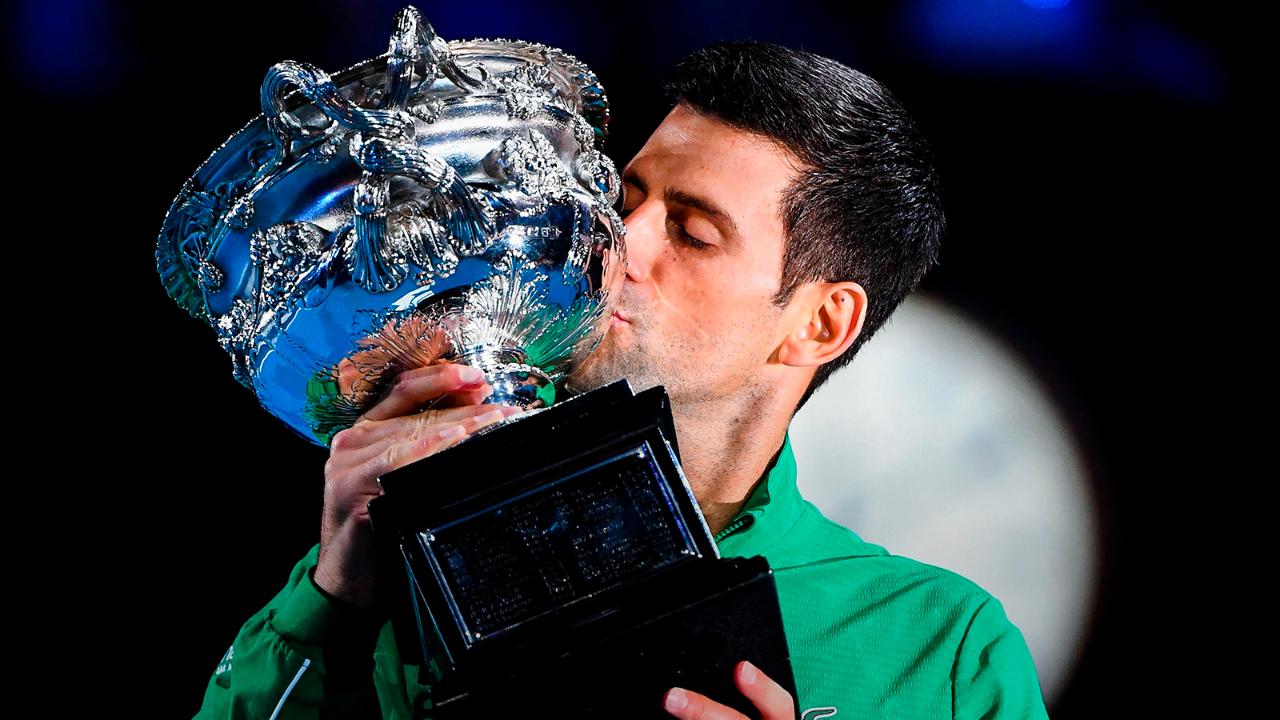
On tennis: Novak Djokovic turns a perfect night Down Under into winning his seventeenth major title


On a perfect night for tennis in Melbourne, with clear skies and an open roof in Rod Laver Arena, Novak Djokovic won his seventeenth Grand Slam singles title with a five-set victory over Dominic Thiem in the Australian Open men’s singles final Sunday. Once again, Djokovic proved himself unconquerable. He remains hungry and driven.

Djokovic’s 6-4, 4-6, 2-6, 6-3, 6-4 triumph that lasted four hours rewarded him with his eighth Norman Brookes Challenge Cup trophy and returned the Serbian to No. 1 in the world rankings.

“I’ve had (the) privilege to win this big tournament for eight times,” said Djokovic, 32, during his post-match press conference that didn’t start until the early hours of Monday morning. “To start off the season with a Grand Slam win significantly boosts your confidence and your expectations are quite high for the rest of the season. But whatever happens, this season is already successful.”

Djokovic arrived in Melbourne a fortnight ago after he won all of his singles matches and contributed significantly to Serbia’s triumph in the inaugural ATP Cup team title in Sydney. In the year’s first Grand Slam, which took place amid difficult circumstances from the blazing bush fires that blanketed much of southeastern Australia, the second-seeded Djokovic began a run of good form by dropping just one set before the final. En route, he beat No. 14 seed Diego Schwartzman in the fourth round, No. 32 seed Milos Raonic in the quarterfinals and No. 3 seed Roger Federer in a much-anticipated semifinal – all in straight sets – before the 26-year old Thiem, whom New York Times tennis columnist Christopher Clarey characterized as one “with thunder in his ground strokes and highlights in his dark hair,” pushed him to five sets in the title match. 

Although Thiem had won four of five previous matches against Djokovic – and built a two-sets-to-one lead Sunday thanks to stringing together six straight games at one point – he hadn’t beaten him on an outdoor hard court. This time, although No. 4 seed Thiem had some chances – especially when Djokovic began to struggle with both his consistency as well as his level of energy – the Austrian just couldn’t reach the finish line in time.

Thiem was broken in the third game of the decisive set and never quite recovered. His last chance to pull even came as Djokovic served at 4-3, 15-30. Then, the Serbian won the next three points to hold serve and the end drew nearer.

On this memorable night and in this particular final, Djokovic was at times defiant. To wit, twice he was cited for time violations. But always, Djokovic was tenacious – especially in long rallies – as he gutted out his victory over Thiem by serving nine aces and hitting 46 winners. 

With his latest major title, Djokovic moved to within three of Federer, the all-time leader with 20 Grand Slam titles, and he’s now two behind Rafael Nadal’s 19. Once again, the old guard fended off the new blood. However, one thing’s certain: Thiem proved he’s more than just a clay-court specialist. He can play heroically on hard courts. After all, Thiem beat No. 29 seed Taylor Fritz, No. 10 seed Gaël Monfils, top seed Nadal and No. 7 seed Alexander Zverev in his four matches leading up to Sunday’s final against Djokovic. Thiem also spent six hours more than Djokovic on court throughout the tournament.

“Huge congrats to Novak, an unreal achievement,” said Thiem, gracious in his remarks during the trophy ceremony. “You have helped to raise the level, and I’m proud and happy I can compete in this time and period of tennis.”

When it was Djokovic’s turn to address the crowd, he remarked: “This is definitely my favorite court, my favorite stadium in the world, and I’m blessed to hold this trophy once again.”

Then, looking toward Thiem as he spoke in a complimentary tone of voice, Djokovic said: “I would like to congratulate Dominic on an amazing tournament. It wasn’t meant to be tonight. But you were very close to winning. 

“You definitely have a lot more time in your career and I’m sure you’ll get more than one Grand Slam trophy in your career.”

Thiem, who was attempting to become the first new major winner since Marin Cilic won the 2014 US Open, fell short in a Grand Slam final for the third time in his young professional career. His Australian Open set back followed two previous defeats against Nadal in the finals of the 2018 and 2019 French Open.

“I think there’s not much to change,” Thiem said during his final Melbourne press conference. “In the last two sets, I definitely gave everything I had. Novak is part of three guys who are by far the best players who ever played tennis. If you play a Grand Slam final against him, it’s always going to be a match where small details are deciding.

“ ... It’s unique in sports history that the three best players by far are playing in the same ere a,” Thiem acknowledged. “That’s what makes it very, very difficult for players to break through.”

Indeed, Djokovic, along with Federer, 38, and Nadal, 33 – The Big Three of men’s tennis – have combined to win the past 13 majors. One has to go back to Stan Wawrinka’s 2016 US Open victory to find a Grand Slam winner other than Djokovic, Federer and Nadal. Wawrinka and Andy Murray, with three Grand Slams apiece, are the next best active players behind the Big Three. For sure, Djokovic isn’t quite ready to rest on his laurels. Not now, anyway. 

“Grand Slams are one of the main reasons why I am still competing and still playing full season, trying to obviously get the historic No. 1. That’s the other big goal,” Djokovic said. “I put myself in this position that is really good at the moment. I’m super happy with the way I started the season. It kind of sets the tone for the rest of the year.”

Original commentary written for Tennis-TourTalk.com.
Photo: Courtesy of Australian Open website.

Tuesday, January 14, 2020

Djokovic repped his team and country – and won the ATP Cup for Serbia with one of his best friends by his side


When Novak Djokovic won his ninth consecutive match on hard courts against Rafael Nadal in a pivotal singles rubber between Serbia and Spain at the ATP Cup final Sunday night, he continued the mastery he’s enjoyed over the World No. 1 by winning 19 consecutive sets going back to the 2013 US Open final.

Djokovic’s 6-2, 7-6 (4) win over Nadal inside a packed and loud Ken Rosewall Arena leveled the inaugural ATP Cup final at 1-1 and overturned the momentum Spain had established when Roberto Bautista Agut gave his country a 1-0 lead following his 7-5, 6-1 win over Dusan Lajovic in the opening rubber. Djokovic extended his ATP Cup singles unbeaten streak to six and improved his career head-to-head record against Nadal to 29-26.

It also meant the first ATP Cup, which began with 24 teams playing in three Australian cities amid the country’s blazing bushfires and ended with the final two in Sydney at the end of the 10-day tournament, would come down to a winner-take-all live doubles rubber that would decide which country would lift the title trophy. What a way to start the 2020 tennis season!

Looking back, Djokovic dominated Nadal from the beginning of their one hour and 55 minute match. He put the Spaniard on the defensive, both with his returns and during some prolonged and grueling rallies. After Djokovic broke Nadal in the opening game and later in the seventh game of the first set, he hit four consecutive aces to close out the first set. Djokovic maintained his level of intensity in the second set – he would finish with 12 aces and win 84 percent (41 of 49) of his first-serve points – and forced Nadal into a defensive posture that took him out of his comfort zone. As Djokovic later recalled, “I started the match perfectly with everything working for me.

“I was trying to take away as much time as possible from him. I was serving very well, definitely the best serving match I had in the tournament. Just extremely satisfied with the way I performed.”

Djokovic outpointed Nadal 75-59 and saved five of five break points. 

Nadal was matter of fact in his assessment: “Happy the way that I was able to compete. I had my chances. I was very close. Not happy with the loss, of course, but the feeling in that second set is positive.”

Now, with plenty of flag-waving fans repping both countries and with the arena’s namesake, Australian Hall of Famer Ken Rosewall in attendance, it was game on for the champion’s trophy.

While Spain opted not to play Nadal in doubles because he had run out of energy, Djokovic still had something left in the tank to offer Serbia. He was in the Serbian doubles lineup, where he teamed with his longtime friend and teammate Viktor Troicki. Together, they proved clutch against Pablo Carreño Busta and Feliciano Lopez of Spain and won the decider, 6-3, 6-4.

“We won against a really, really good doubles team,” Djokovic said during Serbia’s team press conference. “It was a surprise that Nadal was not on the court, but nevertheless, we had to do the job and the job was done very well.”

Throughout, Team Serbia received tremendous and loud fan support, especially in Sydney, where there is a large Serbia population – and Djokovic fed off of the energy that their vocal cheers of “No-le” and “Ser-bia” created. As New York Times tennis correspondent Ben Rothenberg tweeted, “Every Serbia match felt like a home game, both in Brisbane and Sydney.”

“I’ve never experienced an atmosphere like this on a tennis court. ... You carried us to victory and we owe you a big, big thanks,” Djokovic said during the trophy ceremony in thanking the Serbian fans. “We are part of an individual sport where we play by ourselves. But even when we were playing singles, it never felt like it was only you out there. You always have a team in your corner giving you strength and focus. This was the highlight of the competition, along with the support of fans and the flags.”

As soon as Djokovic served out the final game of the match and the tournament, his Serbian teammates and their captain, Nenad Zimonjic, sprinted from the team zone on to the court and surrounded him and Troicki. Together, they broke into a celebratory group hug that was both genuine and giddy – and thoroughly enjoyable to see.

“I’ll remember this experience for the rest of my life as definitely one of the nicest moments in my career,” said Djokovic following his team’s jubilant celebration. That says something coming from the 16-time Grand Slam champion who will begin his title defense of the Australian Open next week in Melbourne. Djokovic has lifted the Norman Brookes Challenge Cup seven times. 

“Ive been very fortunate and blessed to have an amazing career the last 15 years, but playing for the team, playing for the country with some of my best friends for a long time, you can’t match that. That’s just too special.”

A version of this story first appeared on Tennis-TourTalk.com. 
Screenshot photo courtesy of ATP world video stream.

Wednesday, January 1, 2020

At the year’s end, one last 2019 travel adventure


Once upon a time, the beloved and respected American actor Alan Alda suggested that you have to leave the city of your comfort and go into the wilderness of your intuition. “What you’ll discover,” he said “will be wonderful. What you’ll discover is yourself.”

As we begin the New Year, 2020, no matter where we may be or reside in the world, it’s worth a moment of our time to consider the meaning of Alda’s words.

Last Sunday, my wife and I returned from a brief but eventful five-day holiday visit to New York City, our fourth trip there during 2019. Each time we go – and it’s only a 3 1/2-hour trip via the Amtrak Northeast Regional – we try to see a different part of what is arguably one of the greatest cities in the world. Our post-Christmas, pre-New Year’s visit rewarded us with a wonderful opportunity to discover new things – and, this time, from a Lower East Side perspective. It was worth it.

Our visit began with theater – we saw the much anticipated “David Byrne’s American Utopia” at the intimate Hudson Theatre (once home to NBC’s “Tonight Show” back in the early 1950s Steve Allen era), featuring a tour de force performance by the Talking Heads superstar that was part TED talk, part rock concert, and very much a bare-footed dance spectacle. There were crowd-favorite hits newly arranged by Byrne like “Once in a Lifetime” and “Burning Down the House,” that complemented songs covering the 67-year-old’s post-Heads solo career. All together, they wove a narrative in which Byrne tried to help his audience find a sense of happiness in these troubled times we all live in.


Our visit included shopping, from loading up on mouth-watering Lindt chocolates to finding new fashion at Uniqlo’s expansive Fifth Avenue headquarters near the Museum of Modern Art just above Rockefeller Plaza, where there was plenty of activity centering around its colorful, larger-than-life Christmas tree and popular skating rink.

We enjoyed a satisfying, educational day visiting two of the city’s finest museums – the newly re-opened MOMA, where we braved the crowds hovering around Van Gogh’s “The Starry Night” and Monet’s “Water Lillies,” and a hidden gem in the Tenement Museum, located at the corner of Orchard and Delaney streets in the Lower East Side, about a five-minute walk from the Hotel Indigo, where we lodged during our stay.


All along our journey in New York City, which the cast of Hamilton describes it as “the greatest city in the world,” there was plenty of wonderful food awaiting us, from the delicious dim sum at Nom Wah Tea Parlor in Chinatown on Christmas Evening (very much worth the 75-minute wait just to get a table); to a pre fixe epicurean delight at Butter in Midtown; to late night posh doughnuts at the Donut Pub in Chelsea; and, finally, deli delights at Russ & Daughters Appetizers (bagels with cream cheese) and Katz’s (cheese blintzes).


New York City is a place in which I could never see myself getting bored. There’s always plenty of interesting things to explore and admire – and to be curious about – any time of the day or night.

As I learned once again, it’s easy to get caught up in the city’s history. I was reminded of this when I learned about late 19th/early 20th-century shop life at 97 Orchard Street while visiting the Tenement Museum. I was reminded of this through the art I saw at MOMA; as well as in the Puerto Rican-infused jazz music I heard at Jazz at Lincoln Center. Also, in the theater I enjoyed on Broadway with “David Byrne’s American Utopia,” and from the tremendous choice of food – where, if you think about it, there’s every imaginable ethnic cuisine to be discovered and eaten.


There’s plenty to explore in New York City. I know I’ll be back, again, soon.

In the meantime, I look forward to 2020 and the New Year that awaits. Hopefully, it will be a year full of new discoveries and new travel adventures. It is truly my hope that yours will be filled with new discoveries and new travel adventures, too.

Safe travels and Happy New Year!

Photographs: Michael Dickens, © 2020.